

After Rigoberto Urán delivered a surprise win in Québec, the racing moves on the Montréal. A slightly hillier course could favor the attackers even more, which will make predicting an already unpredictable race quite a challenge!
The Route
The Grand Prix Cycliste de Montréal takes on 17 laps of a 12.1km circuit for a total distance of 205.7 kilometers. The race starts along the Avenue du Parc, makes a loop along the slopes of Mount Royal, and then finishes back where it started.
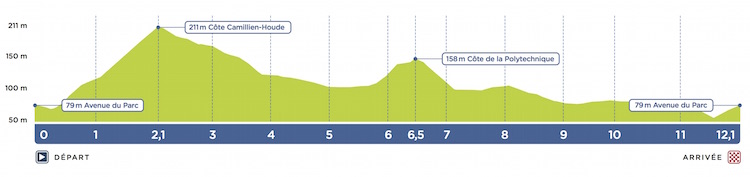
There are three uphill sections in each lap. After a short downhill from the starting line, the first and most difficult climb comes almost immediately: the Côte Camillien-Houde, 1.8 kilometers at an 8% average gradient. From the top, there is a fast descent, a brief flat section, and the next uphill test, the short but difficult Côte de la Polytechnique, 780 meters at a 6% average. There is a particularly steep 200m section of about 11% along the way. After another descent, things even out for a bit until the final 1100 meters: the riders will make a right turn heading south and shoot downhill on the Avenue du Parc, and then they will make a 180 degree turn to head right back up the Avenue in the other direction towards the finish. That final run-in is a 560m, 4% climb.
The Contenders
While the startlists are the same and many of the top contenders are the same, the Montréal circuit is, on the whole, harder than that of the GP Québec. “The two are different,” Rui Costa told VeloHuman from Québec. “Montreal is a race that I think is harder, and more open.”
The Côte Camillien-Houde, crested 17 times, will put the heavier riders into serious difficulty and will likely see a smaller group coming into the final few laps than the peloton in Montréal. An attack on the 8% gradients has a decent chance of holding out over the final few up and down kilometers. The finish in Montreal, however, is a fair bit easier, which means that a select group of escapees could find themselves battling it out in a sprint. Orica-GreenEdge kept the race on lockdown last year, allowing a sizable bunch to finish together, but that was rather unusual for this race, and I’d expect a more select group to battle for the win this time around. Whatever the scenario, explosiveness and excellent climbing legs are important.
It was not a real shocker to see an Etix-QuickStep rider take the win in Québec, given all the firepower they have, though Rigoberto Urán seemed like maybe the fourth best option on his team! In any case, EQS will have another excellent opportunity to nab the win in Montréal. Julian Alaphilippe looked strong in an escape attempt that was ultimately reeled in in Québec, and Michal Kwiatkowski looked particularly impressive chasing down Greg Van Avermaet. Despite Urán’s victory, I still see Alaphilippe and Kwiatkowski as the top EQS riders for Montréal, as Urán won’t be taking anyone by surprise this time; in fact, I’d be just as surprised if he won Montréal now that he’s no longer under the radar. Still, watch out for the Colombian: he’s got all the right skills for these races, and although he’s basically taken a two-year hiatus from contending in the Classics, there was a time when he was a top rider for the Ardennes and in Lombardy—and apparently still has those skills hiding under the hood.
Rui Costa has won in Montréal in the past and was runner-up in 2014. Without Simon Gerrans around, I like his chances this year. He looks to be in good form. The biggest question is team leadership. Costa made it into the select group that appeared to have their shot at fighting for the Québec win before hesitation allowed the larger pack to catch back up, but then Lampre-Merida backed Diego Ulissi in the final sprint. The Italian could be a strong contender in Montréal as well. Both riders are great climbers with explosive side, and my first instinct is to see Costa as the man for Montréal given his past performances, but Lampre might not see it that way, which makes it harder to view Costa as an out-and-out favorite.
For most of the day in Québec, BMC looked to be the strongest team in the race, contributing to the chase of the early break and then involving themselves in one attack after another. It didn’t work out in the end, but it showed the team’s strength and that bodes well for Greg Van Avermaet and Philippe Gilbert in Montréal. The selective profile will weed out some of the purer sprinters, but the less difficult finish will provide an excellent opportunity for both riders, who can rely on their impressive uphill speed, with a shot in a reduced sprint. I’m not sure either one is at full strength just yet with Worlds as such a major goal, but they’ll be close to their best. I like Van Avermaet a bit more than Gilbert, as he’s been coming to the GP Montréal for so many years running now, but both are contenders.
Tony Gallopin, 3rd last year, showed good form with an 8th place in Québec. The way I see it, Montréal suits him better. He’s a excellent tactician who knows how to make an attack, and he has the fast finish to win out of a small group. He appears to be in terrific form as well. He was in the small group that made it up the Côte de la Montagne at the head of the race in Québec, and still managed to come in 8th in the final sprint after that group was swept up (Van Avermaet, also in that small group initially, could only manage 10th despite being near the front in the finale). In a wide-open race, I like Gallopin’s chances to turn last year’s third-place result into a win. If he doesn’t, Tim Wellens, Jurgen Roelandts, and Tiesj Benoot are other options for a loaded Lotto-Soudal.
Michael Matthews was the runner-up in Québec and he’ll have a shot in Montréal, but I see the parcours as being just a bit too difficult to view him near the top of the favorites (oddsmakers disagree with me on this one). In any case, if Matthews is not able to handle the climbs, it shouldn’t be too much of a problem for OGE, who have Adam Yates (on blazing form at the moment), Simon Yates, and Michael Albasini too.
Tom-Jelte Slagter is in the best form he’s been in all season. He was 4th in Québec, and although he’s had better results there in the past, I think Montréal suits him well too. He can handle tough climbs without too much trouble. Slagter isn’t going to Worlds, having suddenly found his form after the Dutch team selection, and I therefore expect he’ll be giving it everything he has to pull something off in Montréal. Ramunas Navardauskas and Ryder Hesjedal are other options for Cannondale-Garmin.
Lars Petter Nordhaug won here in 2012 and count be counted out. Trek’s Bauke Mollema and Fabio Felline make for a great 1-2 punch. The same is true for Giant-Alpecin’s Simon Geschke and Warren Barguil. Europcar has Tommy Voeckler, while FDJ can rely on Arthur Vichot. AG2R is the French squad with the widest array of options: Romain Bardet, Alexis Vuillermoz, and Jan Bakelants are all potential contenders. I was very impressed with LottoNL-Jumbo in Québec, and see Robert Gesink and Wilco Kelderman liking this parcours even more—Sep Vanmarcke is another option for the men in yellow.
Alexander Kristoff was surprisingly in the mix in Québec but it’s hard to see him holding on over the more challenging GP Montréal parcours. Hesitation at the head of the race late on in Québec helped his chances but I doubt he’ll get that kind of gift again, though obviously he’ll be a favorite if he’s there for a sprint.
VeloHuman Top 10 Race Favorites
Winner: Tony Gallopin
Podium: Rui Costa, Tom-Jelte Slagter
Other Top Contenders: Greg Van Avermaet, Michal Kwiatkowski, Philippe Gilbert, Julian Alaphilippe, Michael Matthews, Diego Ulissi, Bauke Mollema
VeloHuman will be at the race so be sure to follow @VeloHuman on Twitter for more analysis!