Author: VeloHuman

  • Vuelta a España 2013 Post-race Impressions: Ring in the Old, Ring in the New

    Podium

    Even More Unpredictable Than Predicted

    Now that the peloton has finally ended its journey in Madrid, we can look back on a few of the storylines. The biggest storyline of the Vuelta is obviously the succcess of Christopher Horner, who improved on his previous best Grand Tour performance (a lone top 10, 9th in the Tour de France in 2010) by winning the race ahead of past winners Vincenzo Nibali and Joaquim Rodriguez. He won a stage early on and it seemed like a great feel-good story, the balding veteran outclassing the favorites for a day; then he proceeded to look stronger and stronger each day, ultimately dropping Nibali and the rest nearly whenever he set his mind to it. This was always going to be a race for a strong climber (the only individual time trial had a categorized climb right in the middle of it), and Horner was unquestioably the best climber in Spain these past three weeks. Obviously there are a lot of theories on how he managed to take everyone by surprise and dominate the ascents, but clearly fresh legs played a part, as Horner had little mileage prior to the start of the Vuelta, unlike the rest of the big favorites, who had all taken on the Giro or the Tour already. Similarly, Contador hadn’t raced a Grand Tour before his Vuelta win last year, and Juan Jose Cobo’s 2011 Vuelta was his first Grand Tour of the year as well. Future hopefuls should take note.

    It’s important to note that as old as he is, it’s not like Horner came out of nowhere. His career has had an interesting arc: much of his prime was spent racing (and really dominating) the American circuit. When he did finally start to concentrate on the higher level Euro competition, he was already well into his 30s: but he had a lot of success, and didn’t really see any decline as he aged either. As recently as 2010 (the year he top 10ed in the Tour), he won Pais Vasco. He was 2nd there and 4th in Catalunya in 2011 (a year in which he also won the Tour of California), was 2nd in Tirreno-Adriatico and 9th in Pais Vasco in 2012, and was 6th at Tirreno-Adriatico this year. None of those results come close to winning the Vuelta, but they show that he’s quietly built quite a resume very late in his career: a Grand Tour win will be the perfect marquee accomplishment for the 41 year old. The question now is: where will he be next year? As explosive and resilient as he was in the Tour of Spain, he doesn’t have a team for next year. It’s only a matter of time before someone makes him an appealing offer commit his smiles and his small frame to their cause.

    After losing the race he was so heavily favored to win just a week ago, Vincenzo Nibali probably isn’t smiling, but taking 1st place in a grueling Giro and then 2nd place in the Vuelta with all those Italian miles already in your legs is an unbelievable accoomplishment that deserves recognition even if it was disappointing for Nibali. A single Grand Tour podium in a year is a feat worthy enough of praise. Winning one and runnering up a second? Vincenzo Nibali will be one of a very select group of riders who will be seen as legitimate challengers to Froome in the 2014 Tour de France. Alejandro Valverde and Joaquim Rodriguez can both come away proud; Valverde nabbed the final spot on the podium after his disappointing Tour de France, and he also won the points jersey despite not actually winning any stages. Purito wanted more, but 4th and a beautiful stage victory on Alto del Naranco will look great in his Palmares.

    Nicolas Roche entered the race with a stated goal of coming in in the top 5. 5th overall and a stage win felt like a long time coming for the rider who has displayed a lot of talent in the past few years, but never come away with much to show for it. And not to take anything away from winning a stage later on during a Grand Tour, but Roche’s victory came early in the race, against his GC rivals: no gimmes there. AG2R won’t mind Carlos Betancur’s complete anonymity so much given Domenico Pozzovivo’s 6th place overall performance. He quietly notched a pair of Grand Tour top 10s this year without all that much team support.

    Thibaut Pinot rolled in 7th overall, dispelling a great deal of doubt after his forgettable Tour de France. He’s definitely gotten back on track: he didn’t seem to struggle on the descents, and he hung with the likes of Nibali and Horner for a good part of many of the hardest climbs. Remember, he’s only 23, and he’s now got a pair of Grand Tour top 10s to his name. With a focused offseason, Thibaut Pinot will hope to build on this late success next year. Another young GC rider who really stood out was Leopold Konig. Nabbing a GT Top 10 at the head of a Pro Continental team against stacked squads like Astana and Movistar is quite the feat. Like Roche, his stage victory was early on in the race, meaning that he had to outclass the best in the bunch to pick it up. And Daniel Moreno (10th) nabs his 3rd Vuelta top 10 in as many year, and perhaps even more impressively, on the heels of a major one-day victory in La Fleche Wallonne, he picked up two early stage wins, and held three different jerseys for a time; he’s following in his team leader’s footsteps, making a name for himself as a killer uphill finisher with the ability to find his way into a Grand Tour leaderboard as well.

    Samuel Sanchez will be disappointed with 8th, but most observers didn’t view him as much more than an outside contender coming in. He never seemed to find his form, and it’s starting to look as if his best years are behind him. At least he comes away with more than fellow old guys Michele Scarponi and Ivan Basso–Basso didn’t really look all that bad in this race, but he vacated his 7th overall spot when he abandoned on a nasty Stage 14.

    The biggest disappointment of the Vuelta has to be Team Sky. Sergio Henao came into the race as one of the favorites, and Rigoberto Uran was touted as a great second option if things went awry; awry they went, as neither rider was able to keep the pace when the road went up. To his credit, Uran came so close to a victory from a breakaway on Stage 16, but was denied by Warren Bargul at the line. Vasil Kiryienka’s stage win (actually the third career Grand Tour stage victory for the Belarusian, which is the same number that his teammate Bradley Wiggins has) was some consolation, but for all Henao’s potential, he failed to deliver in a big way.

    Youth Is Served Winning Stages, and So Is the Rainbow Jersey

    Michael Matthews and Warren Barguil have arrived. Matthews, the 22 year old Aussie sprinter, had been having enough success in smaller races this year that I definitely saw big things for him in the Vuelta, and he did not disappoint, winning first on the 5th stage and again on the final day of festivities in Madrid. For the past few years, Orica-GreenEdge has looked to one of his teammates on the sprint stages, especially the ones with hard roads to the finish line, but it looks like the time of Michael Matthews is upon us. Meanwhile, Maximiliano Richeze racked up four top 3 stage performances but failed to come away with a victory, which must be a heartbreak: he really looked like one of the fastest riders in the peloton, and was inches away from winning on multiple occasions. In a similar boat were Tyler Farrar and Gianni Meersman, who both made a habit of lurking around the top 5 on the sprint stages (four times), without ever notching a victory. Meersman gets a pass, as he has already had a great year up to this point, but Farrar ends his year looking desperately for his old winning ways. Clearly he’s still fast, but his only victories in the past two years have come in Continental Tours; the American doesn’t have a contract for next year, and obviously a big win would have helped make his case.

    23 year old Warren Barguil took a brilliant win from the breakaway in Stage 13. Then, Barguil did it again on Stage 16 ahead of the immensely talented Rigoberto Uran in a drag race to the line. Taking a victory like that ahead of the explosive Giro and Olympic Road Race runner-up marks Barguil as a name to watch for the future. For his Argos-Shimano squad, it was “No Kittel or Degenkolb, no problem” in Spain this year. FDJ’s Alexandre Geniez and Kenny Elissonde both won mountain stages as breakaway survivors. And in stage after stage, 25 year old Nicolas Edet of Cofidis was constantly leading the breakers over the KOMs: he earned himself the title of King of the Mountains in the process. Seeing a pattern? All in all, France’s 25 and under crowd of Barguil, Geniez, Elissonde, Edet, and Pinot took between them four stage victories, the polka dot jersey, and 7th overall in GC; quite a haul for les Francois after they came up short of expectations in the Tour de France.

    Another impressive young breaker was Daniele Ratto, who won a grueling 14th stage that saw mass abandons all by himself on a mountaintop finish.

    Zdenek Stybar isn’t exactly young (27), but he’s young to road racing, and the former CX world champ added to his amazing year jumping ahead late with Philippe Gilbert and beating him a photo finish to steal the 7th stage from the sprinters at Mairena de Aljafare.

    Fortunately, Gilbert’s long, demoralizing drought of victories in the rainbow jersey ended in the following week when he outsprinted Edvald Boasson Hagen and Maximiliano Richeze to win stage 12. He’s come very close time and time again this year, but a win has eluded him. Outsprinting some of the fastest men in this race to get it meant that he ended his wait in grand style.

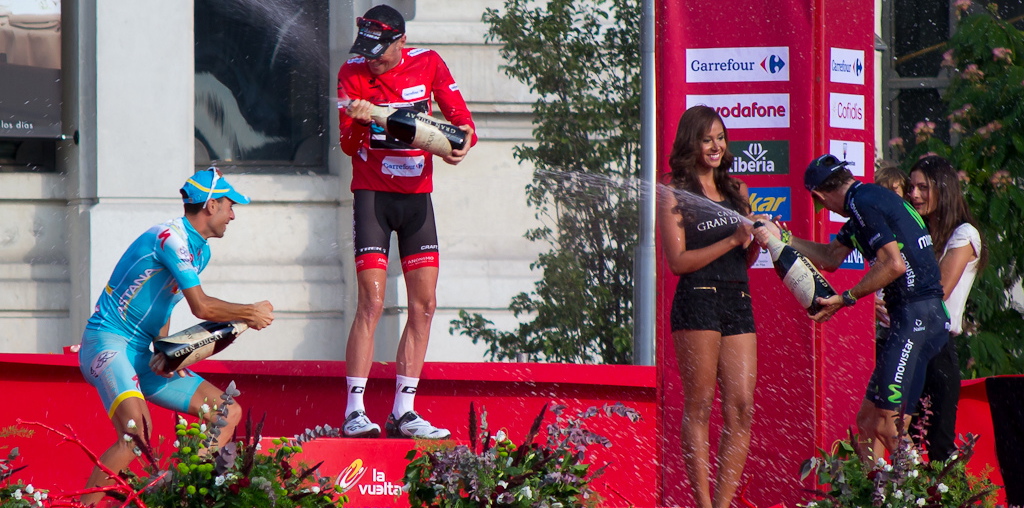
    Three weeks of racing have finally come to a close, and in the end, the Vuelta was full of surprises for riders both young and old. We were treated to visions of riders who could be around for years to come (riders like Matthews, Stybar, Barguil, Konig, and Pinot), and of riders who finally took long awaited victories (Horner and Gilbert). Up next? The race that so many of these big names were preparing for when they decided to make the trip to Spain: the 2013 UCI World Championships.

    -Dane Cash

    Photo by Esteban Lamas
  • Grand Prix Cycliste de Montreal 2013 Preview

    MontrealPhoto

    WorldTouring in North America, Chapter 2

    The WorldTour’s three most recent one-day winners: John Degenkolb, Filippo Pozzato, and now, Robert Gesink. One or two years ago, this set of winners might have seemed totally predictable, but in 2013? It’s as if all of these guys who have been flying under the radar decided to reenter the scene in grand style at the same time. Belkin has had a great week, with Bauke Mollema stealing a stage from the power sprinters at the Vuelta, and Robert Gesink outsprinting Peter Sagan himself in Quebec. As closely as the two are tied together, and as often as they share common riders in their leaderboards, GP Quebec is an important foreshadower for GP Montreal.

    That race came down to a very reduced sprint with some marquee names, guys we expected to be right there, like Peter Sagan, Greg Van Avermaet, and Rui Costa. Things pretty much went as expected, right up to the point where Robert Gesink (with Arthut Vichot not far behind) passed all those pre-race favorites for the victory. Obviously Gesink is a major talent (he won Montreal in 2010 and was 2nd at Quebec in 2012), but 1. his Palmares have been so lacking lately, and 2. his career resume hasn’t really shown any evidence of a high caliber sprinting ability: with a kilometer to go and Tom Jelte Slagter also with the lead group, I wouldn’t have even picked Gesink to be the highest placed rider from his own team, let alone in the whole race. But while Sagan and Van Avermaet seemed just too exhausted to keep up on the ascent to the line, Gesink powered ahead and took a commanding win. With a career that primarily features results in climber’s races, Gesink seemed like a better pick (albeit an outside one) to get involved in Montreal; if this is the kind of form he’s got right now, and if he’s suddenly realized that he has a heck of a sprint within him, he goes from a worthy-of-a-mention-as-a-past-winner pick to one of the favorites for the second of the Canadian WorldTour dates.

    GP Montreal Profile

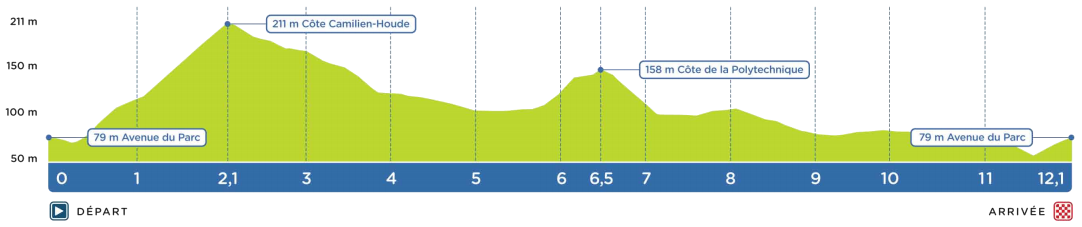
    Like its sister race, the Grand Prix Cycliste Montreal has a profile that provides great opportunities for successful attacks on the final lap. Unlike its sister race, Montreal’s big climbs come earlier in the circuit (Côte Camilien-Houde, 1.8 km at 8%, and Côte de la Polytechnque, 0.78 km at 6&), and they’re followed by several kms of gentle descent, and the finish in Montreal, while uphill, is only a few hundreds meters at a few percent grade, rather than a long upward drag: in other words, the race favors attackers who can go from much further out, and it also is friendlier than Quebec was to any sprinters who beat the odds and manage to stay up front. Last year, Lars Petter Nordhaug (then of Team Sky, now of Belkin) made a move from several kilometers out. Rui Costa in 2011 and Robert Gesink in the inaugural edition in 2011 also made moves from several kilometers out.

    Gesink’s sprint is what surprised everyone on Friday; we’ve always known he could climb and put in a sustained effort. It’s those skills that won him this race in 2010, and now that we know he’s got quite a kick, he’s got a great shot again here. But Sagan will be out to improve on his placing from Quebec, as will Greg Van Avermaet, Rui Costa, and up-and-comer Arthur Vichot, all of whom finished with the lead group not very far behind Gesink in Quebec. Costa won this thing two years ago and he’s my favorite rider to launch a successful long attack, but he’s also got the kick to outsprint a reduced group. FDJ’s Vichot has had a fine year, runner-up yesterday and French national champion not long ago; he was also in the mix in the finale at Quebec last year and like Costa, he’s got a varied skillset and could either make an early jump or hang with a small group. I like his chances. Sagan and Van Avermaet might find it harder to come across with the lead bunch or to launch a big attack early, as the higher altitude hills in Montreal are likely to break up the race on the final laps, but if they do, the finish suits them more than it did in Quebec. I’ll throw out some familiar names of real fastmen who will also appreciate the finish if they can just make it there at the head of the race: John Degenkolb, Filippo Pozzato, Giacomo Nizzolo, Matti Breschel, Matt Goss, and Luka Mezgec are the biggest ones for me. The way Degenkolb has been going, I think it’s a real possibility he is in the final group chasing down the final break, and Breschel was, of course, in the top 10 in Quebec on Friday.

    Should the truer sprinters all be dropped, I’d imagine the danger men in the pack pursuing the last breakers will include: Tom-Jelte Slagter of Belkin, Fabian Wegmann of Garmin-Sharp, Jan Bakelants and Tony Gallopin of Radioshack, Michal Kwiatkowski of Omega Pharma-Quick Step, Jurgen Roelandts of Lotto Belisol, Bjorn Leukemans of Vacansoleil, Francesco Gavazzi, Simone Ponzi, and Borut Bozic of Astana, and Francisco Ventoso of Movistar.

    But since this is a race with a pretty serious incline in the circuit that will tire out everyone in the field and will surely launch some bids for glory, perhaps the most important question will be: who launches the marquee attack as the race nears its finish? If it’s not one of the riders mentioned above, last year’s winner Lars Petter Nordhaug seems like a great place to start. Recent results have been lacking, though, so the top alternative choices include Pierrick Fedrigo (2nd behind Costa in 2011), Ryder Hesjedal (3rd in 2010), Niki Terpstra (who was off the front until the end on Friday, finishing 6th), Alexander Kolobnev, Simon Geschke, Enrico Gasparotto, Sylvain Chavanel, Simon Spilak, and Christophe Riblon and Cadel Evans, who led the chasers over the line behind Sagan at GP Quebec. OGE’s stable of Michael Albasini, Pieter Weening, Sebastian Langeveld, and Cameron Meyer and Euskaltel’s squad of climbers, like the Izagirre brothers, are also great bets to animate the race from a distance. Evans and Hesjedal seem the most motivated of the Grand Tour stars here, but any one of Froome, Contador, Porte, Schleck, Talansky and van Garderen might decide to go for a long one as well.

    However it goes down, long distance attack or late catch and pass by a bunch, I think the Grand Prix Cycliste de Montreal is going to end with many of the same names from Friday towards the front, riders who combine a strong kick with an aggressive style and a whole lot of endurance.

    VeloHuman Predictions

    Winner

    Peter Sagan

    Podium

    Rui Costa, Robert Gesink

    Top 10

    Greg Van Avermaet, Tom Jelte-Slagter, John Degenkolb, Arthur Vichot, Matti Breschel, Jurgen Roelandts, Niki Terpstra

    -Dane Cash

    Photo by O. Taillon.

  • Vuelta a España 2013 Day 21: Where We Stand After Nineteen Stages, and Looking Ahead to Stages 20-21

    UpAngliru

    Day 21: Angliru Awaits

    When the Vuelta organizers decided to put the Alto de L’Angliru on the penultimate stage, they were obviously hoping (against the odds) that the Tour of Spain would come down to an epic showdown on one of the sport’s most famous climbs. When Nibali’s Astana squad took a commanding early lead, it appeared that this race was all but wrapped up, but Christopher Horner has seemed to gain seconds on the favorite basically every time the road has gone up at the finish. Somehow, the 41 year old American closed the early gap, then lost time in the individual time trial, and now has closed the gap again. He and Nibali finished together with the group on Stage 17, which Bauke Mollema won with a brilliant long range sprint that caught some big fastmen by surprise. Horner crossed the line well ahead of the Italian on Stage 18, behind breakaway survivor Vasil Kiriyenka (who put in a massive solo effort that Sky will be proud of). Earlier today, Horner reclaimed the red jersey by just seconds when a small gap formed at the stage finish (behind the day’s winner, Joaquim Rodriguez, whose team was motivated enough to pull back a breakaway that everyone thoguht would succeed). In the past few days, he’s just been a better climber, plain and simple, and throughout this race he’s had the explosive flair to gain time at the line (an ability that has nabbed him two stage wins so far). Nibali, on the other hand, has appeared to lose a step in the past few days. In fact, even Rodriguez and Valverde have gained a little on the Giro winner: his once seemingly unassailable lead has totally crumbled. It all comes down to tomorrow, when the peloton takes on perhaps its most daunting challenge.

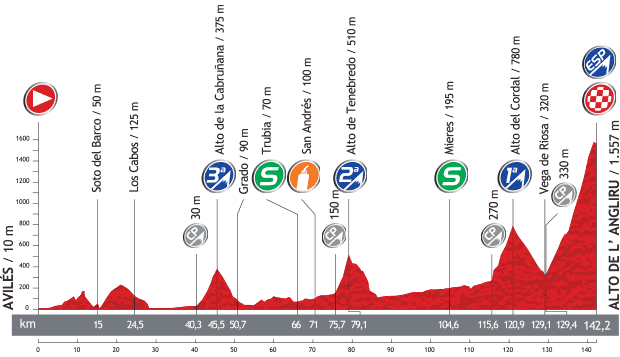
    Stage 20: Aviles > Alto de L’Angliru | 142.2km | High Mountains (Summit Finish)

    VS20

    The stage is short but brutal: 142.2 kilometers, but with a succession of climbs that get progressively harder and harder. A Category 3 is followed by a Cat. 2 right around the halfway point. Then the riders will take on the very steep Alto del Cordal, a Category 1 climb, whose summit is only 8.2 kilometers from the foot of the final ascent of the Vuelta, Alto de L’Angliru. It’s one of the most famous mountains in the sport, and one of the most demanding: 12.2 kilometers at an incredible 10.2%, grading out at a maximum of 23.5% not far from the top. Apart from a tiny blip where the road dips slighly down for a hundred meters or so a few kilometers up (a section that is followed by a stretch at 21%), there is really no respite anywhere on this monster until you get to the top. The roads are windy and narrow. And the riders will be taking this beast on after a hard, high-speed day up and over some serious climbs. It’s not for the faint of heart. The long, unrelenting drag does not make it easy to attack. It’s the sort of test that requires a massive tank: this is a mountain about which former pro Patrice Halgand said that “on the Angliru the guys go too pitifully for the climb to have any sporting interest. Even the winner goes up in slow motion. There’s no attacking. From front to rear, everyone just gets up as best he can.”

    Nibali’s recent fading makes predicting this stage quite difficult. On the one hand, the stage favors Nibali’s skillset more than many of the shorter, more explosive finishes that we’ve seen so far, but on the other hand, the past few days don’t instill any confidence in Vincenzo Nibali’s ability to pull this one out. Bookmakers seem to be favoring all three of Horner, Rodriguez, and Valverde over him for the stage win. If I had to make a prediction (and I do, since this is a preview!) I do think it will come down to a field of the GC contenders and a select group of star climbers who stay with them rather than an early breakaway, but I also think that Nibali’s chances are being underrated. Sustained uphill effort is Nibali’s bread and butter. It’s what won him the Giro. He also has his elite squad of lieutenants on a day where the pace will be high, while Horner has lost two of his strongest teammates, Fabian Cancellara and Haimar Zubeldia. In other words, I won’t write Nibali off so easily. But I think Horner will be right there: he’s been unflappable so far and he’s passed every test he’s faced, even if this test is in a class of its own. I expect Rodriguez to make moves and I expect Valverde to try to counter, though Purito has looked really strong. I don’t see any of the rest of the top 10 finishing ahead of them. I do think that Igor Anton, Diego Ulissi, Rigoberto Uran, or Michele Scarponi could be allowed to go ahead for the stage win: Anton’s come very close here before, and Scarponi and Ulissi have looked good lately. Uran seems to be picking his battles, and Horner has shown the value of fresh legs in this race, wearing red in his first Grand Tour of the year while the rest of the GC favorites struggle to maintain their form across multiple three-week challenges. Mikel Nieve, Jose Herrada, Chris Anker Sorensen and Rafal Majka, and, of course, Warren Barguil could also try to strike ahead for glory with a legitimate shot at the victory, either from an early breakaway (probably less likely to win) or from the pack at the start of the climb.

    This is the stage that will decide the Vuelta, so it’s a must-see. I never thought I’d be considering Chris Horner the favorite to win on L’Angliru and to therefore win the whole race, but here we are. Hopefully the rest of the contenders can keep it interesting.

    VeloHuman Stage Favorites

    1. Chris Horner | 2. Vincenzo Nibali | 3. Joaquim Rodriguez | 4. Alejandro Valverde

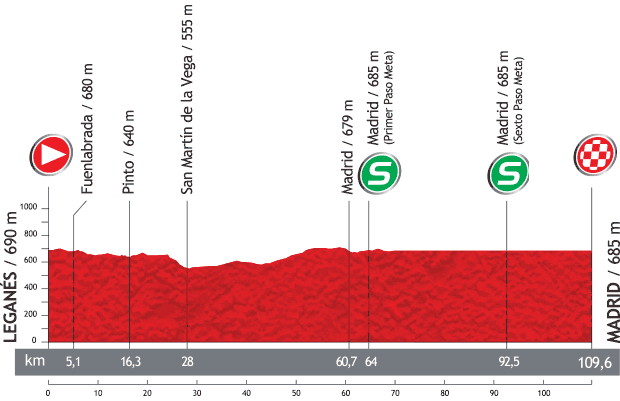
    Stage 21: Leganes > Madrid | 109.6km | Flat

    VS21

    After they climb one of the hardest mountains out there, the riders get to end their Vuelta with a less-than-110-kilometer parade to the finish in Madrid. It is, as they say, as flat as a pancake. Hard to see this ending any other way than with a bunch sprint.It may seem a bit less climactic than the previous day’s GC showdown, but there are some very quick men who have waited three weeks for this perfectly flat day guaranteed to go to a sprinter. Denied by late attackers on multiple days that seemed guaranteed to be sprint-fests, a few of the fastest ones still have yet to win a stage this race: Edvald Boasson Hagen, Maximiliano Richeze, and Tyler Farrar. They finished in that order behind a surprising Bauke Mollema on stage 17. Boasson Hagen has been hell-bent on winning a stage recently, jumping into break after break. Richeze has consistently looked like one of the fastest guys out there. And, of course, Tyler Farrar has actually won the final stage of the Vuelta before. Meanwhile, Michael Matthews, who looked so hot at the start of the race, and who won the 5th stage, and Gianni Meersman, who came in as perhaps the sprinter most favored to win at least one stage seemhave faded a bit, but Matthews showed awesome top end speed just two weeks ago, and Meersman has been close a bunch of times (and has taken big wins against some big names this year). Maybe Michael Morkov’s earlier win was a flash in the pan, but his track racing style will appreciate the lack of selective climbs on the final stage. Guys like Adrien Petit, Robert Wagner, Anthony Roux, Luca Paolini, Paul Voss, Grega Bole and Juan Antonio Flecha, Leigh Howard if OGE actually decides to support him instead of Matthews, and either member of the Argos duo of Reinardt Janse van Rensburg and Nikias Arndt are the outsider picks, but I think it will be hard for an outsider pick to take it in the finale. Eddy Bos and Richeze are probably my favorites, and since I have to give the nod to someone, I’ll give it to the experienced, proven winner from Norway, though I think it’s a really close call here.

    VeloHuman Stage Favorites

    1. Edvald Boasson Hagen | 2. Maximiliano Richeze | 3. Tyler Farrar | 4. Michael Matthews

    -Dane Cash

    Photo by Mikel Ortega.

  • Grand Prix Cycliste de Quebec 2013 Preview

    GP Quebec

    WorldTouring in North America, Chapter 1

    The WorldTour follows up GP Ouest France with two more Grand Prix circuit-style races this weekend, also run on hilly courses that seem to lead to battles between late attacekrs and hard-charging pursuit groups. This weekend’s competitions are unique among WorldTour races, however, in that they take place in North America. Canada, to be exact.

    Friday’s race comprises 16 laps of 12.6km (totalling 201.6km) around scenic Old Quebec. It has a number of rolling ups and downs and it finishes on an incline; obviously, there are no Alpine summits in the middle of Quebec City, but the ascents are more than enough to encourage constant aggressive moves off the front, and even if attacks are reeled in, the incline at the line favors the lighter, more versatile hard-chargers. Last year, Simon Gerrans and Greg Van Avermaet jumped ahead in the final lap, and hung on despite a spirited bridging attempt by Peter Sagan and an impressive (and sizeable) group of pursuers behind them, a group that was led across the line by Rui Costa. Going further back, we see similar outcomes. The hard pace of the 2011 edition whittled the lead group down to a group of about ten on the final lap, and Philippe Gilbert added another victory to his great list that year by launching a successful attack with Robert Gesink in the final kilometers, and then beating the Dutchman to the line. The inaugural edition in 2010 saw Tommy Voeckler make a successful bid for glory. Given the versatile talents in attendance, I think this year’s Grand Prix Cycliste de Quebec will again come down to a late attack battling a small group of chasers, though a sizable bunch sprint for the line isn’t out of the question, and while I think it’s a bit less likely, neither is a long-range breakaway victory.

    GP Quebec Profile

    None of this race’s past winners will make the start tomorrow, meaning that 2013 will see a new winner in Quebec. One favorite for that title stands above the rest: Cannondale’s Peter Sagan. After a successful classics campaign in which he nabbed a win at Gent-Wevelgem and a boatload of other high placings, he stormed the Tour de France green jersey competition. But he hasn’t been resting on his laurels: he’s been a prominent feature in some big American stage races, winning stages and the points competition at the USA Pro Cycling Challenge. He has clearly kept his form sharp, and with so many opportunities to tune up at the AmericaTour level in preparation for the big doubleheader in Canada this weekend, it’s hard to see past him. As he showed in Gent-Wevelgem, he’s more than capable of winning via a late attack. He came close to bridging the gap last year, and this year he’s got that much more experience, and probably better form. He’s a smart rider and a excellent handler, which will come in handy in the constant quest to come out of the corners at high speed. He’s shown time and again this year that all but the most difficult of climbs are not a problem for him, making it very likely that he’ll be somewhere near the front towards the end of this race. Whether he attacks off the front or outsprints the field, Sagan has the tools to win this thing.

    He’ll have a big target on his back, and his challengers will be many. One rider who has been just behind Sagan at a number of races this year is Greg Van Avermaet, who has looked sharp through his many appearances this summer. He attacked on the final climb of the GP Ouest France, but the break refused to organize themselves: GVA himself seemed to be the most concerned with dragging other riders to the finish and, therefore, wouldn’t work with a group. As such, he didn’t start with enough of a gap when he launched his own solo from the reduced bunch, and was caught in the final few hundred meters. He’ll hope to have a bit more success in Quebec, where he narrowly lost out to Simon Gerrans last year. Like Sagan, his skillset makes him a danger in both a late attack and a reduced sprint; he’s not as quick as the Slovakian wunderkind, but he might be a bit more likely to make a move, which showed last year.

    Also in that last-ditch move on the final climb of Ouest France was Michal Kwiatkowski, who was a familiar face on most of the intermediate stages where Sagan featured so prominently in the Tour de France. Had the final break managed to work together two weeks ago, he would have been a strong contender for the win. He’s a better climber than Sagan, but still has a great sprint. His teammate Sylvain Chavanel has earned himself a ton of camera time time this year with his characteristic aggressive riding, and his time trial victory at the Eneco Tour shows that the 34 year old is still soloing well this year. He’ll probably need to strike earlier than guys like Sagan or Van Avermaet, but if he can time an attack, he’s always a good bet to feature on a profile like this.

    Rui Costa has had a lot of success in Canada (he was just behind Van Avermaet last year), and he has the perfect combination of skills to win in a variety of ways. He showed off that combination of skills by winning two stages from a breakaway in the Tour de France; he can solo, he can climb better than most other riders in this race, and he has a surprising sprint. He’ll definitely be lurking around the top of the leaderboard. His teammate Francisco Ventoso is another rider with a shot, coming off a top 10 in Ouest France.

    Lotto Belisol’s Jurgen Roelandts, Belkin’s Lars Petter Nordhaug (who won last year’s Grand Prix Cycliste de Montreal) and Tom Jelte Slagter (fifth here last year), Cannondale’s Moreno Moser, Astana’s trio of Francesco Gavazzi, Borut Bozic, and Simon Ponzi, and Radioshack’s trio of Tony Gallopin (winner of the Clasica de San Sebastian), Jan Bakelants (Tour de France stage winner) and Maxime Monfort are all also great candidates for a win from a late attack or a very reduced field sprint.

    If a larger bunch reaches the finish line, it will be hard to beat Sagan in a sprint, but John Degenkolb of Argos-Shimano and Giacomo Nizzolo of Radioshack (they have a lot of options here!) are on the shortlist of riders who have a decent shot at it. Degenkolb went into the Vattenfall Cyclassics as something of an unknown in terms of form, and all he did was win the whole thing. He showed continued form at the GP Ouest France, where he, too, managed to get into the late attack of Van Avermaet and Kwiatkowski (and was probably the prime reason that the breakaway attempt refused to cooperate), quite a feat for a sprinter. He then proceeded to place tenth in the sprint after putting out a lot of effort in the failed attempt to break free. He won’t mind the uphill finish in Quebec. Neither will Giacomo Nizzolo, who looks great right now, and who came so close to a win at Ouest France, but was denied at the line by a charging Filippo Pozzato. Speaking of Pozzato, I almost didn’t mention him in my Ouest France preview, given a lack of recent results, and I’m still not really sure how to judge his chances here: was his Ouest France win a flash in the pan, or is his form back to where it once was? Matti Breschel of Saxo-Tinkoff was a top 10 finisher at the Vattenfall Cyclassics and is a capable climber. Look out for Luka Mezgec, who was just behind Sagan in a bunch of stages in Alberta and the USAPCC and who could be a second option for Argos if Degenkolb struggles. And, of course, Matt Goss will be in attendance, though he was 27th at Vattenfall’s sprintfest and a DNF in the GP Ouest France.

    A number of big name Grand Tour winners are making the start, probably looking to go for a long one, launching off one of the many hills they’ll ascend in their trips around Quebec: Ryder Hesjedal, Chris Froome, Alberto Contador, Cadel Evans, and even Andy Schleck are all here. Sky also has Richie Porte, Garmin also has Andrew Talansky, Tom Danielson, and Fabian Wegman (Top 10 in every edition of this race so far), and BMC’s Tejay van Garderen gives that team yet another option. Of these big three-week stars, Hesjedal and Evans are probably most likely to feature; Hesjedal doesn’t really have any one-day statement wins in his career yet, but he’s had a flair for high placings and he has a strong kick: plus, this is a home race for him, which is rare. Evans has shown decent form since arriving in Canada (he won a stage at the Tour of Alberta) and he has always had a good sprint if he makes it to the line with a small lead group. Other riders who will look for a long distance opportunity, or hope that the fast men are all dropped, include Katusha’s Alexandr Kolobnev and Simon Spilak, AG2R’s Christophe Riblon and Jean-Christophe Peraud, Pierrick Fedrigo, OPQS’s Niki Terpstra, Astana’s Enrico Gasparatto, everyone on Euskaltel, and Orica GreenEdge’s typical stable of breakaway capable talent: Michael Albasini, Sebastian Langeveld, Pieter Weening, and Cameron Meyer. Also, watch out for Europcar’s David Veilleux, riding in his home country and having just announced an imminent retirement.

    However it plays out, I think the Grand Prix Cycliste de Quebec is going to be another very exciting race, guaranteeing plenty of attacks and counterattacks to give you a double dose of high speed racing after a morning that will likely offer the same from Spain!

    VeloHuman Predictions

    Winner

    Peter Sagan

    Podium

    Greg Van Avermaet, Rui Costa

    Top 10

    Michal Kwiatkowski, John Degenkolb, Giacomo Nizzolo, Ryder Hesjedal, Sylvain Chavanel, Jurgen Roelandts, Filippo Pozzato

    -Dane Cash

    Photo by Arnaud Anciaux.

  • Vuelta a España 2013 Day 18: Where We Stand After Sixteen Stages, and Looking Ahead to Stages 17-19

    Anton

    Day 18: GC Shaping Up

    The trip to the Pyrenees whittled an already thin list of true contenders down even further. With just three uphill finishes remaining, only three riders are within two and a half minutes of Vincenzo Nibali: Christopher Horner, Alejandro Valverde, and Joaquim Rodriguez. Breakaway riders took impressive victories on Stages 14 (Daniele Ratto), 15 (Alexandre Geniez), and 16 (Warren Barguil again). Attrition dropped Nicolas Roche from his spot near the top (he now sits 3:43 back on Nibali after a trying Stage 14) and it dropped Ivan Basso and many others out of the race entirely on a rainy, cold Stage 15 that saw mass abandons. On Stage 16, as the GC contenders rolled in behind Barguil and Rigoberto Uran (who lost out to Barguil in a photo finish), Nibali looked vulnerable for the first time, losing a little over twenty seconds to his rivals. After the rest day, the road from Calahorra to Burgos provides only on a pair of Cat. 3 climbs, giving Nibali a bit more time to get back any strength he might be missing before the arduous trip from Burgos to the Peña Cabarga, and then the lumpy stage that prefaces the road to l’Angliru.

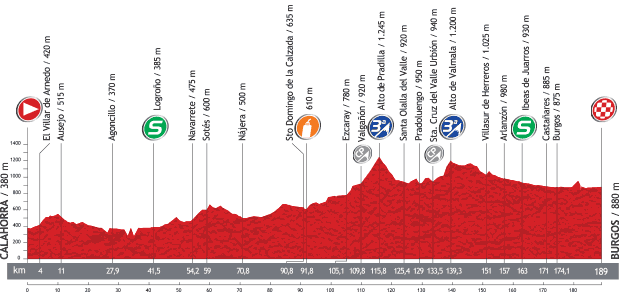
    Stage 17: Calahorra > Burgos | 189km | Medium Mountains

    VS17

    While there are only two categorized climbs, there is a good deal of upward travel in the first 140 kilometers of the stage. The last few days have been for aggressive attackers, and surely Stage 17 will see riders striking out for the long one; but it’s been a long time since the sprinters had a chance to be on camera, and those who have made it this far will fight hard to bring back anyone up the road. The last several kilometers are techinical and include a short but steep spur that will invite further aggression. Michael Matthews and Maximiliano Richeze have looked the strongest to the line so far in this race, if it comes to a bunch sprint. Edvald Boasson Hagen, Gianni Meersman, and Fabian Cancellara are strong options as well, given their combined sprinting and soloing abilities. Boasson Hagen’s Team Sky came so close to a victory in Stage 16, and Eddy Bos himself was barely pipped to the line by Philippe Gilbert earlier in the Vuelta; he’ll be highly motivated and he’s very capable in this sort of finish. Juan Antonio Flecha has been a common sight at the Vuelta’s sprint finishes, though he hasn’t come that close to actually winning anything. This finish suits him as well as any.

    VeloHuman Stage Favorites

    1. Edvald Boasson Hagen | 2. Michael Matthews | 3. Maximiliano Richeze | 4. Fabian Cancellara

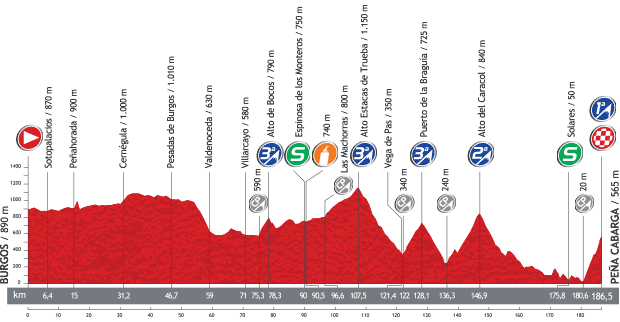
    Stage 18: Burgos > Peña Cabarga | 186km | High Mountains (Summit Finish)

    VS18

    The road out of Burgos is much more demanding than the road in. It goes up and over a trio of Category 3s and a hard Cat. 2, and then finishes atop the Peña Cabarga. The summit has seen fireworks before (future Tour de France winner Chris Froome bested Juan Jose Cobo here in 2011). It’s an extremely difficult, 6 km push at an average of 9.2%, and a 20% section in the final kilometer will surely see gaps form late if they haven’t already. With so many lumps early, this stage could be another for a breakaway, as the GC strongmen haven’t seemed too concerned with the prospect of hunting down early breakers. If that happens, watch out for Rigoberto Uran, who was so close to a victory in Stage 16. Amets Txurruka will probably have another go at it, as might Chris Anker Sorensen. Diego Ulissi has been a bit quiet lately, but after some rest, he might have the strength to challenge for the stage victory. Igor Anton, currently in 15th, will probably be allowed up the road if he attacks on the final climb, and he’s managed to keep pace with the GC heavyweights over the last few days, showing great form.

    Whether their battles will come behind a successful breakaway is hard to say, but the fight among the red jersey contenders will be fierce. Having smelled blood on Stage 16, Nibali’s rivals will look for a chance to test him again here. The steepness would seem to favor Joaquim Rodriguez. Alejandro Valverde looked good attempting to chase him down on the last day in the Pyrenees. Thibaut Pinot has been very impressive of late, and his fresher legs appear to be paying off. Samuel Sanchez has been coming on strong. Chris Horner looks unbelievable going uphill, and he’s had the help of a very strong Robert Kiserlovski. Nicolas Roche cracked on stage 14, but on Stages 15 and 16 he was looking sharp again. The relatively short length of the climb will not favor Nibali’s climbing style, so he’d better be rested and ready to fight.

    VeloHuman Stage Favorites

    1. Joaquim Rodriguez | 2. Igor Anton | 3. Rigoberto Uran | 4. Christopher Horner

    Stage 19: San Vicente de la Barquera > Alto del Naranco | 181km | Medium Mountains

    VS19

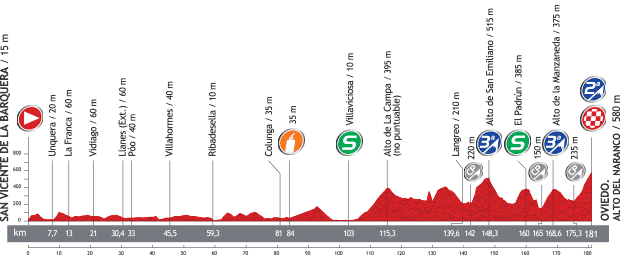
    A relatively flat first half gives way to a very lumpy second half: this stage will favor an aggressive, punchy rider with a lot of pop still in his legs after so many miles already traveled through Spain. The day finishes with a roughly 6 km, 4.2% average grade Cat. 2, Alto del Naranco: not tough enough to open up big time gaps in GC, but more than tough enough to put a hard hitting climber in line for the victory. Warren Barguil has to be in the conversation again. Rinaldo Nocentini has come close in a few stages (2nd to Barguil in Stage 13), and the explosive French rider will look to stand out among a field that has been reduced by the tough hills and tough weather by this late point. Bauke Mollema was right behind him on that stage and will be hoping to salvage something from this Grand Tour, and he is a hard finisher uphill. Uran and Ulissi will again be aiming to put their explosiveness to good use. Uran’s teammate Sergio Henao and Lampre’s Michele Scarponi (who has been very active in breakaways recently) could see an opportunity here, and Amets Txurruka will definitely look to be involved in any breakaway proceedings. Should the peloton reach the final climb together, the Katusha duo of Daniel Moreno and Joaquim Rodriguez will try to best Alejandro Valverde for the day’s victory, and Samuel Sanchez will be gunning for the line as well. Chris Horner has basically attacked on every summit finish, and he could do so again here. Ivan Santaromita, Mikel Landa, and Pieter Serry are other outsiders for the stage win, whether from the breakaway or the peloton.

    VeloHuman Stage Favorites

    1. Rigoberto Uran | 2. Diego Ulissi | 3. Bauke Mollema | 4. Warren Barguil

  • Vuelta a España 2013 Day 14: Where We Stand After Thirteen Stages, and Looking Ahead to Stages 14-16

    Envalira

    Day 14: Into the Pyrenees

    The last three days have been full of surprises. Fabian Cancellara and Tony Martin taking the top two spots in Stage 11’s ITT, perhaps not that surprising… But Domenico Pozzovivo taking the third spot ahead of Vincenzo Nibali? And Nicolas Roche not far behind? Clearly they are on the form of their lives. On Stage 12, World Champion Philippe Gilbert finally took his first win of the year, timing a sprint perfectly and zipping past Edvald Boasson Hagen in the closing meters of a slightly uphill finish. An impressive group managed to break away on Stage 13, and an on again off again pursuit eventually gave up the chase, allowing Warren Barguil to solo away from his breakaway companions in the last kilometer for the victory. Two relatively easy days of racing complete, the peloton now takes on three very hard stages that are sure to have GC implications.

    Stage 14: Bagà > Andorra | 155.7km | High Mountains (Summit Finish)

    VS14

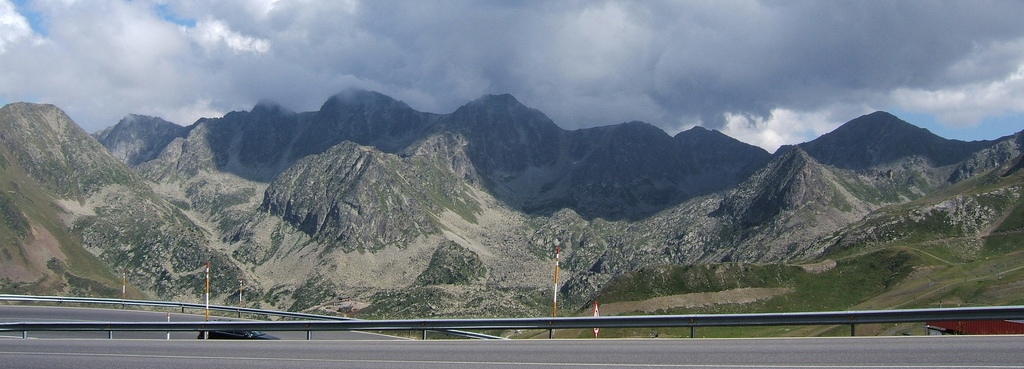
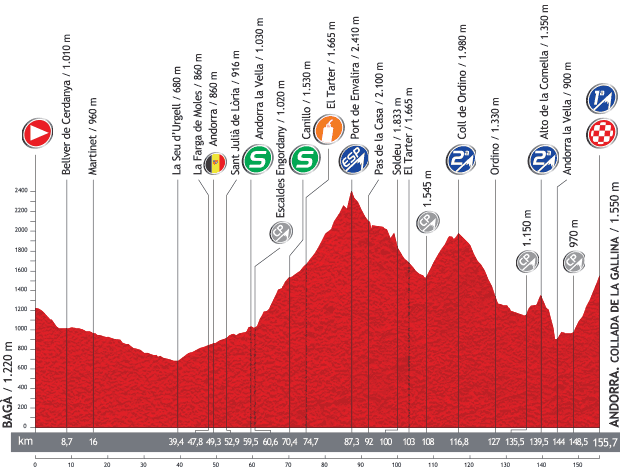
    The first categorized climb of the day happens to be the highest point in the Vuelta, Port de Envalira. The special category ascent is a 26.7 km slog at an average of 5.2% with sections of 15%; it’s a long, hard climb to the top, but the summit is nearly 70 kilometers from the finish, and after the legs of even the best climbers are exhausted, the climbing will continue. Steep descents and a pair of Cat. 2s lie between the special category climb and the finish, a Cat. 1 summit, 7.2 km at 8% that doesn’t really let up at the line either. There are some real talents who are out of GC contention these days, meaning a breakaway win is more than possible; if that happens, Roman Kreuziger, Diego Ulissi, and any number of Euskaltel riders (Anton, Nieve) might try to get into the fray. But it will be a grueling day of racing and no small feat to stay away from the peloton riding up and over four very hard climbs. With so much up and down, falling off the pace could lead to serious losses, meaning that the GC men will be at their limit trying to hang on. There have been some tough days so far in the Vuelta, but nothing with this much potential to blow up the race.

    Whether they are contesting for the stage or fighting amongst themselves behind a breakaway, I see Vincenzo Nibali staying in control of the lead and Ivan Basso and Joaquim Rodriguez possibly gaining a bit on the others in the top 10. Rodriguez knows he needs to get up the road before his opportunities run out, and Stage 14 could be one of his best remaining, while Basso is built for long, grueling days like this, especially since he doesn’t have the mileage many of his rivals have this year. If Thibaut Pinot can handle the high speed descending (and the weather may be nasty as well), he’s looked very good climbing in this Vuelta. Chris Horner has been climbing unbelievably so far, but Stage 14 could really test his resolve. I’ve been doubting him so far and he’s continuously surprised me, but I’m doubting him again here anyway. Alejandro Valverde had a bit of trouble hanging on on Stage 10 and his team is down a man after a crash; he’ll have some tough days ahead if he wants to stay close to Nibali. Nicolas Roche and Domenico Pozzovivo have been outperforming expectations so far; it’s time to see if they’re really up to snuff. Dani Moreno and Samuel Sanchez both struggled in Stage 10; Moreno might be able to hang onto his top 10 position, but I don’t see him picking up another stage win here. Samuel Sanchez has been getting stronger as the Vuelta goes on, and with riders with less impressive GC resumes (Eros Capecchi, Tanel Kangert) in front of him, he might lose time to Nibali this stage, but gain time on the riders around him in the GC battle.

    VeloHuman Stage Favorites

    1. Joaquim Rodriguez | 2. Vincenzo Nibali | 3. Ivan Basso | 4. Alejandro Valverde

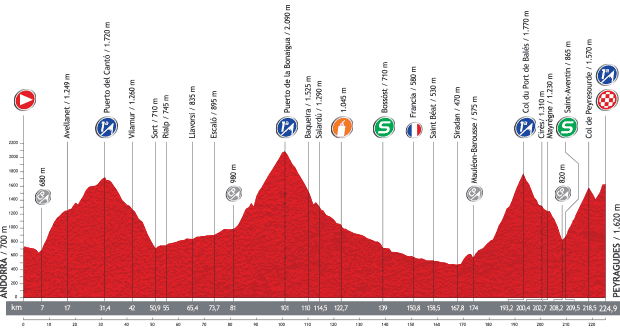
    Stage 15: Andorra > Peyragudes | 224.9km | High Mountains (Summit Finish)

    VS15

    A pair of Cat. 1 climbs before the halfway mark is even reached could be a great launching pad for anyone with breakaway aspirations. Two more categorized summits in the final 25 kilometers will require serious climbing legs. The same riders mentioned above, as well as some of the same names that attacked early in stage 13 (names like Michele Scarponi, Benat Intxausti, and Bauke Mollema) could jump at the opportunity for a stage win. Of the GC contenders, Alejandro Valverde and Dani Moreno will love the flat run-in after the final climb. With so many ascents, there will be opportunities for attacks to go out of a lead group, but it may not be steep enough to keep a small group from galloping to the line for the stage win; the real question is whether they will be breakers or GC men. Knowing how favorable the finish will be to the likes of Valverde and Katusha’s big names, Saxo-Tinkoff and the other teams in contention would love to see a breakaway take the bonus seconds away from their GC rivals.

    VeloHuman Stage Favorites

    1. Alejandro Valverde | 2. Daniel Moreno | 3. Joaquim Rodriguez | 4. Roman Kreuziger

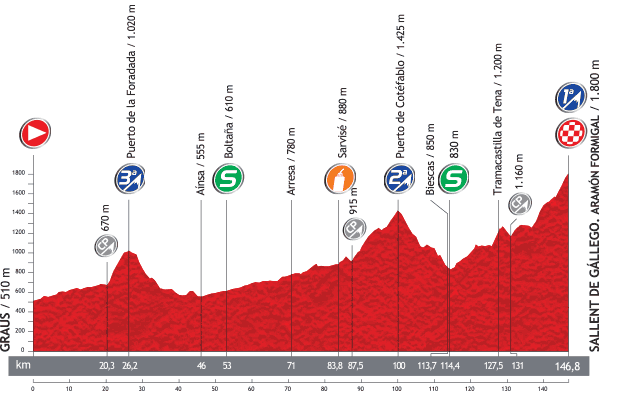
    Stage 16: Graus > Formigal | 146.8km | High Mountains (Summit Finish)

    VS16

    Monday’s stage is an interesting one. It’s one of the shortest stages in the race, but it’s essentially one long uphill grind with a few ups and downs on the way: the starting line’s altitude is 500 meters, but the day ends at 1800, with a Cat. 3 and Cat. 2 along the way to the Cat. 1 summit finish. The pace will be very high, and legs will tire. The last climb is 15.8 kilometers at a relatively gentle average gradient of 4%; it’s probably not steep enough to see any successful attacks from the GC men, especially not if the pace is as high as I think it will be. A breakaway could take it, of course, but should the big names constitute the group furthest up the road, the teams of the heaviest hitters will keep them at the front and in contention for a stage win. If a group finishes together, the leader of perhaps the strongest team, Vincenzo Nibali, will probably be content to roll in behind the  leaders of the other marquee teams: Alejandro Valverde, Nicolas Roche, and Joaquim Rodriguez.

    VeloHuman Stage Favorites

    1. Alejandro Valverde | 2. Nicolas Roche | 3. Joaquim Rodriguez | 4. Vincenzo Nibali

    -Dane Cash

    Photo by Andy Hay.