Episode 16: Tour de Suisse 2015 Pre-race Show The Recon Ride takes a closer look at the WorldTour calendar’s last pre-Tour de France event, the Tour de Suisse.
[powerpress]
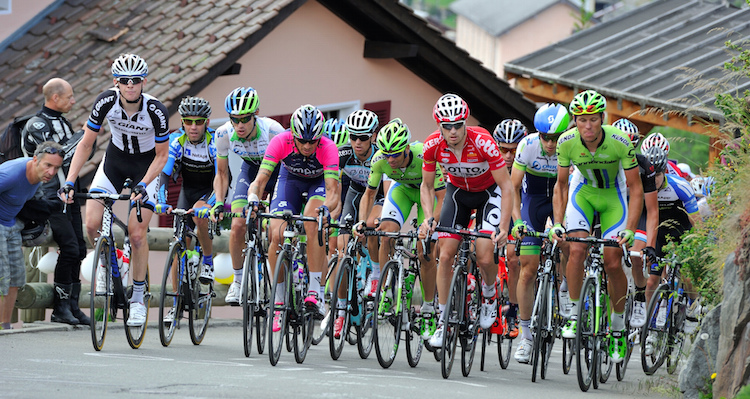
Many of cycling’s biggest names are headed to Switzerland to take on the Tour de Suisse. Dane Cash of VeloHuman and Cosmo Catalano of Cyclocosm delve into the storylines of the nine-day stage race in the latest episode of the Recon Ride.
The Dauphiné marks the arrival of “Tour de France season,” drawing an always impressive startlist of top Tour talent hoping for a final tuneup before La Grande Boucle. The big names and mountainous parcours should make this year’s edition of the race a worthwhile attraction.
The Route
The 2015 Dauphiné route offers a healthy dose of difficult climbs. The only stage without a categorized climb is the TTT, and even that has some challenges.
The race kicks off with a bumpy stage 1 likely to favor a punchier rider, with eight categorized climbs, small though they may be, on the day. Stage 2 does have a Cat. 1 challenge on the menu, but a long flat finale could favor the sprinters. The Stage 3 TTT will likely have serious GC implications. 24.5 kilometers is long enough to open the sort of gaps that will have an impact in a one-week race, especially given a long, slightly uphill stretch in the second half of the stage.
Stage 4 will be a day for the sprinters or more versatile fast-finishers before the GC riders come to the fore again on Stage 5, which closes out with a one-two punch of categorized climbs. Stage 6 is another day that may have a GC impact, closing out with a Category 3 climb.
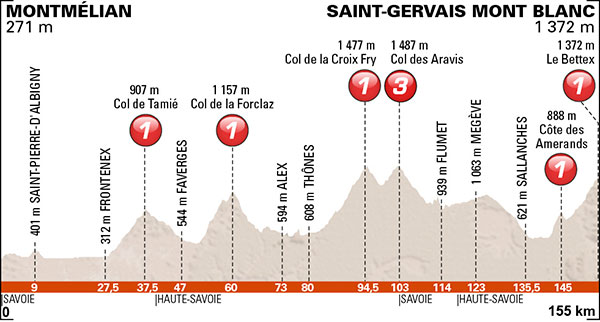
Stage 7 will probably be the most decisive stage of the 2015 Critérium du Dauphiné. After 30 flat kilometers, it’s up and down the rest of the way, with a total of five Cat. 1s along the route, including the summit finish.
Stage 7: Montmélian › Saint-Gervais Mont Blanc (155km) – A succession of difficult climbs will likely make Stage 7 the Dauphiné’s most hotly contested GC battleground.
None of the climbs are all that brutal by themselves but altogether they will provide plenty of launching pads for the uphill specialists. Stage 8 closes out the race with another Category 1 summit finish at Modane Valfréujs.
The General Classification Contenders
Two of cycling’s so-called “Big Four” will garner the most attention coming into the race: Chris Froome and Vincenzo Nibali. Froome has won the race before, the year he won the Tour de France, and he may be hoping to replicate his performance from 2013, where he came into the Tour riding high on the back of strong performances in the one-weekers. He’s had a decent, though not great, year so far, and this is an opportunity to get on track with a big success for his Tour bid this year. At his best, Froome is almost unstoppable, and he should be motivated to be close to his best here. The team trial suits Sky well. Nicolas Roche and Wout Poels are among Froome’s many strong teammates in attendance who will be valuable supporters or even potential alternatives should the need arise.
Vincenzo Nibali’s path to Tour de France victory was a bit different from Froome’s—the Italian all-rounder did not look nearly as strong in the run-up to the 2014 Tour, but peaked at the right time in July. If he’s looking to replicate that approach, he might not be quite at 100% here. If he’s gunning for victory though, he should love the climber-friendly profile, and Astana’s TTT squad looks strong too. This is a great parcours for Nibali, without any individual time trial to potentially set him back against his more chrono-adept rivals—motivation may be the key factor in determining how well he performs.
Last year’s winner Andrew Talansky was one of the most surprising winners of a WorldTour race all year, grabbing the Critérium du Dauphiné yellow jersey with a brilliant breakaway move on the final stage. The lack of a time trial in this year’s edition does not suit Talansky, the USA’s new national time trial champion, but with all of these climbs, the opportunities are there for plenty of action should he be hoping to get aggressive again this year. Teammate Daniel Martin is another option—individual time trials often tank his chances in stage races, and the absence of one here will make this an attractive event for him.
Alejandro Valverde will love the Dauphiné parcours. He’s been cycling’s most successful rider so far this season, landing on podiums almost at will, and he should be motivated to prove himself ready for the Tour with Nairo Quintana elsewhere. Movistar brings a strong team that includes Beñat Intxausti, who was great in the Giro.
Tejay van Garderen has looked great at times this season, and mediocre at other times. With the Tour on the horizon, though, he should be in strong form in this race, and with the strength of BMC’s world champion TTT squad, he should be set up for success. Van Garderen has focused on improving as a pure climber recently and that will come in handy here.
Despite a disappointing Ardennes campaign, Joaquim Rodríguez has shown flashes of brilliance in 2015. If he rides here like he did in País Vasco, he’ll be difficult to beat, especially with these sorts of climbs—the uphill challenges in the Dauphiné are many, but none of them are of the brutal, interminable sort that could put Rodríguez into trouble against the likes of Froome. Katusha Teammate Giampaolo Caruso should be a great second. Lampre’s Rui Costa is riding in the Dauphiné instead of the Tour de Suisse this year, eschewing a chance to win a fourth Suisse title in a row. He is hoping to make his mark on the Tour de France this season, which means that the form should be there. The profile, with its constant ups and downs but without any Ventoux-esque climbs, should suit him very well too.
Wilco Kelderman rode well here last year and should be primed for success with the Tour around the corner. Julian Alaphilippe will be eager to show that his success on the climbs in California was no fluke. Trek’s Bauke Mollema rode very well in Tirreno-Adriatico, and should be in the mix with the favorites in this race if he can show that sort of form here. AG2R’s two-pronged attack of Romain Bardet and Jean-Christophe Peraud won’t be easy to counter, assuming the French squad can hang tough in the TTT. Mathias Frank, Pierre Rolland, and Daniel Navarro, and Simon Yates are others with an outside chance at success in the General Classification.
The Stagehunters
The list of sprinters in this mountains race is rather thin, but not without talents. Nacer Bouhanni, Sacha Modolo, and Luka Mezgec look like the fastest finishers here, with Tyler Farrar, Edvald Boasson Hagen, Samuel Dumoulin, Kris Boeckmans, and Kevin Reza are others who could be in the mix in the bunch kicks.
Versatile quick men like Simon Gerrans, Ramunas Navardauskas, and Tony Gallopin will hope to challenge the more explosive GC types on the intermediate days, like Stage 1. And of course, watch out for any strong climbers who fall out of contention early with poor TTT performances to get involved in the breakaway conversation later on in the race.
VeloHuman Top 10 Overall Favorites
GC Winner: Chris Froome Podium: Alejandro Valverde, Vincenzo Nibali Other Top Contenders: Tejay van Garderen, Joaquim Rodríguez, Andrew Talansky, Rui Costa, Romain Bardet, Bauke Mollema, Wilco Kelderman
Be sure to follow @VeloHuman on Twitter for more analysis and commentary during the race!
Episode 15: Critérium du Dauphiné 2015 Pre-race Show The Recon Ride dives into the many storylines of the Critérium du Dauphiné.
[powerpress]
Dane Cash of VeloHuman and Cosmo Catalano of Cyclocosm take a closer look at the 2015 Critérium du Dauphiné, which boasts a strong startlist of contenders hoping to hone their Tour de France form in one last race before the sport’s biggest event.
With Fabio Aru’s Stage 20 victory closing out the climber-oriented days of the 2015 Giro d’Italia, just one stage remains in the race.
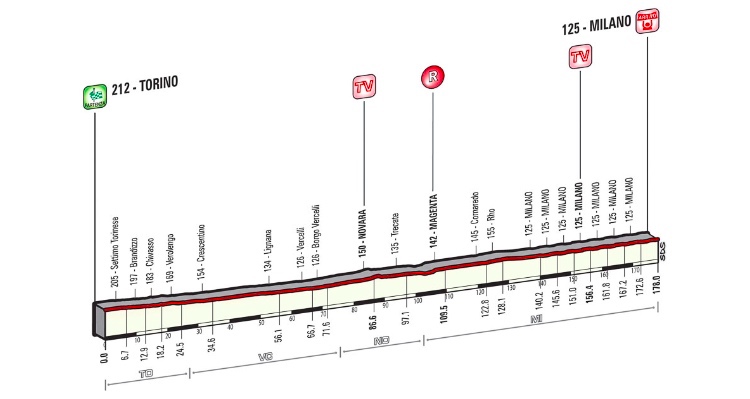
Stage 21 is pan-flat from the start in Turin to the finish in Milan. It’s a profile the sprinters will love. The racing closes out with seven laps of a 5.4km circuit, and things get a bit technical in the second half of each lap, with multiple corners and a roundabout. That means that the final trip around the circuit will likely be hectic. The last kilometer, however, is a straightaway to the finish line, one that will likely see the big-name sprinters still in this race getting up to some very high speeds.
High-speed finishes are great for Sacha Modolo, whose two stage victories so far in this Giro make him the de facto favorite again here. His leadout support has been outstanding so far in the race, and he’s able to finish it off with a powerful finishing kick. All of the other quick men will have their eyes on the men in fuschia in Milan.
Giacomo Nizzolo is now up seven career 2nd-place finishes in Giro d’Italia sprints, but this may represent the best opportunity he’s ever had to finally take a victory. A technical run-in to the line suits his bike-handling skills, and the long straight finish suits his blazing top speed. The perfect flatness of the profile should help hide one of the weaknesses of his never-ending campaign to finally win a Giro stage: a leadout train that has always disappeared late in the race. Without any climbs to wear them out, Trek will have no excuses for leaving Nizzolo alone in this Stage 21 finale.
Elia Viviani started the Giro hot with a stage win, but he’s cooled since then. Still, for pure speed when at his best, Viviani is right up there with the other top names in this race, and can’t be counted out here.
Luka Mezgec won the final stage of last year’s Giro d’Italia, and he’ll benefit from the an always skilled Giant-Alpecin leadout in the tricky final few kilometers of this stage. He should be up there fighting for the overall win. LottoNL-Jumbo’s Moreno Hofland could be up there as well.
Davide Appollonio, Heinrich Haussler, and Kevin Reza are other riders to watch in the probable sprint finish of Stage 21.
Be sure to follow @VeloHuman on Twitter for live analysis of Stage 21, and check back soon for plenty more pre-race coverage of the Critérium du Dauphiné, the Tour de Suisse, and, of course, the Tour de France.
After Fabio Aru stormed back into 2nd place overall with his Stage 19 victory, only one GC-oriented stage remains in the 2015 Giro d’Italia. Stage 20 is all about the Colle delle Finestre, one of the hardest climbs the professional peloton will ride all year.
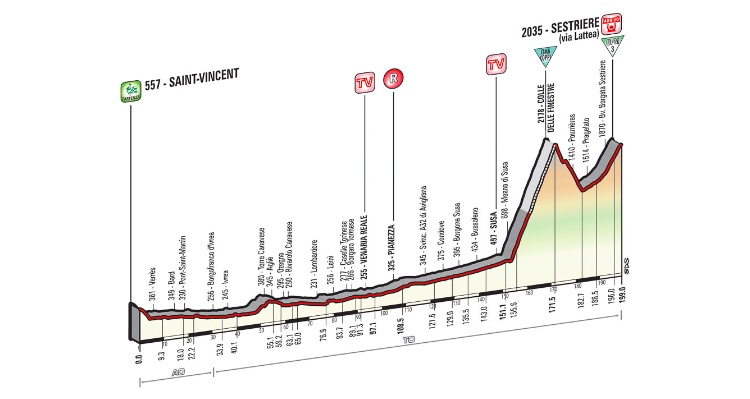
Stage 20 opens with 150km of flat, which will put some exhaustion into the legs before the brutal ascent to the Cima Coppi, the highest point in the Giro d’Italia. The Colle delle Finestre is 18.5km long with a 9.2% average gradient, and after a very steep short opening stretch, it’s pretty steady all the way up. About halfway to the top, however, the pavement runs out—the final 7.8 kilometers are undertaken on a dirt road. Interestingly enough, after the riders finally make their way to the top, they’ll have more racing to do. The summit is followed by a short but steep descent and then another climb, the 9.2km, 5.4% Cat. 3 ascent to the finish line in Sestriere.
The breakaway may get a lot of space early on in the day, but as this is the last opportunity for any GC riders to get anything done, the pace could kick up at a moment’s notice as the final climb looms—and it’s not over after that. A strong break will have a chance, but enough favorites could be looking to pick up stage wins in the Giro in this last opportunity that the pack will have a good chance of catching the riders up the road.
Alberto Contador has one final chance to win a stage in the race he’s dominated. Just as was the case on Stage 19, the only question on Stage 20 is whether or not he wants to put in the effort. If he does, he should be able to take the victory here—on the incredibly difficult Colle delle Finestre, he should be able to distance his rivals if he is so inclined.
If Contador doesn’t go on the attack, there will be a strong favorites to take up the task. Fabio Aru now has his stage win and he’s back in 2nd place. He seems to have refound some form after a few days of weakness but he might not want to risk his 2nd place with an attack on these unforgiving challenges. Mikel Landa, out of contract for next year and back to 3rd, may have more incentive to go on the move, and if Contador is back to focusing on Aru, that could spring Landa for another stage victory.
Ryder Hesjedal has been very strong these past few stages, but for all his efforts, he’s still outside the Top 5 on GC and lacking a stage win. Expect the same type of aggressive Hesjedal we’ve seen over the last week. He has one last opportunity to make something happen here, and it’s a good one, given the way he’s been going lately.
Steven Kruijswijk has lost the KOM jersey and is in a similar boat to the one Hesjedal is in, outside the Top 5 and without a stage victory, despite some great riding in this Giro. He’ll be a rider to watch as well. Another rider to watch: Yuri Trofimov had a bad day (relatively speaking) on Stage 19 but don’t count out the former mountain biker on the dirt road climb here on Stage 20.
For potential long-range winners, look to the names that have now become familiar in that conversation, names like Beñat Intxausti, Giovanni Visconti, Franco Pellizotti, Carlos Betancur, Esteban Chaves, Darwin Atapuma, Edoardo Zardini, Francesco Bongiorno, and Stefano Pirazzi.
VeloHuman Stage 20 Favorites
1. Alberto Contador | 2. Mikel Landa | 3. Ryder Hesjedal
Be sure to follow @VeloHuman on Twitter for more race analysis, and check back after the conclusion of Stage 20 for the preview of the final stage. Also, don’t miss the most recent episode of the Recon Ride podcast!
Philippe Gilbert took a hard-fought victory at the end of a challenging Stage 18 but things don’t get any easier in the Giro’s 19th stage, among the hardest days in the whole Giro due to its length and climb-filled finale.
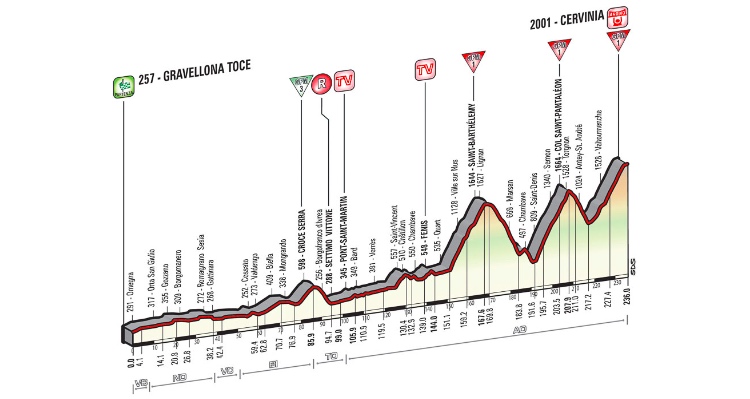
The first 150 of its 236 total kilometers are mostly flat except for a single short Cat. 3, but then things change dramatically. After 150km, the peloton will hit the first of three Cat. 1 climbs that come in rapid succession to conclude the stage. First up is the Saint-Barthélemy climb, 16.5km at 6.7%. Then the riders will take on a fast descent into the foot of the Col Saint-Pantaléon, also 16.5km but steeper, with a 7.2% average gradient. After that it’s a short downhill to the foot of the Cervinia climb to the summit finish, 19.2km at a 5% gradient. The toughest sections are midway through the climb, with things flattening out near the very top.
Stage 19 would be a long day even without the uphill challenges, but with so many kilometers of climbing, it will be positively brutal. Such a climber-friendly profile will likely spark action among the GC types who have just this stage and the day after it remaining to make something happen in this race. And while Alberto Contador may have the pink jersey virtually locked up, he may still be looking for a stage victory. Those things being the case, the GC teams in the bunch may put pressure on the breakaway and ultimately fight it out amongst themselves, though a strong break will appreciate the serrated-edge look of the parcours.
Contador is far and away the best all-rounder in the race, and he showed on Stage 18 that he isn’t content to sit around waiting to be crowned champion in Milan. He wants to dominate this race, and he’ll have an opportunity here. On these climbs, which might wear down weaker pretenders, Contador should have ample opportunity to put the hammer down if he really wants to.
Mikel Landa has been the only climber who has come close to matching Contador’s strength in this race, and he will have a chance at a third Giro stage win here if Contador is unwilling to expend the energy required to keep him in check. Astana teammate Fabio Aru hasn’t looked as strong these past few days as he did at the start of the race, so Landa is probably Astana’s best hope here, though there is always the possibility Aru may now be the one allowed to slip away in pursuit of the Stage 19 victory while Contador has his eye on Landa.
Should the other GC types near the top of the leaderboard be given any breathing room on the late climbs, Yuri Trofimov has looked very strong recently. He has a lot of ground to make up on Aru but the podium is not completely out of the question, which will be excellent motivation for Trofimov. Leopold König should appreciate these sorts of climbs if he’s feeling strong, as should Steven Kruijswijk, who could be looking to continue his aggressive approach now that he’s wearing the blue KOM jersey.
Ryder Hesjedal is now firmly inside the GC Top 10 but he’s far enough outside of the pink jersey picture that he’s been given opportunities to get up the road. Assuming he still as the energy after a strong effort on Stage 18, he will almost certainly attempt something long-range from whatever group he is in, and he may have a shot at the early breakaway.
For other potential long-range winners, look for other names that have become familiar in the breakaway conversation so far: Movistar’s Giovanni Visconti and Beñat Intxausti (who will be on the lookout for KOM points), AG2R’s Carlos Betancur, Katusha’s Ilnur Zakarin, Sky’s Mikel Nieve, Bardiani’s Stefano Pirazzi, BMC’s Darwin Atapuma, and Androni Giocattoli’s Franco Pellizotti.
VeloHuman Stage 19 Favorites
1. Alberto Contador | 2. Mikel Landa | 3. Yuri Trofimov
Be sure to follow @VeloHuman on Twitter for more race analysis, and check back after the conclusion of Stage 19 for the preview of the next stage. Also, don’t miss the most recent episode of the Recon Ride podcast!