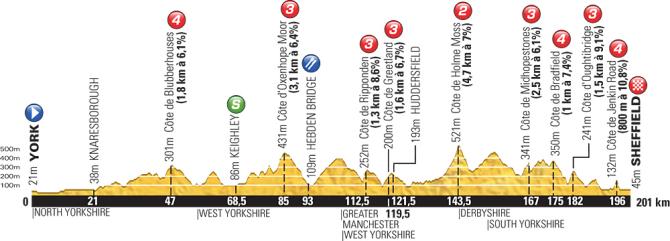
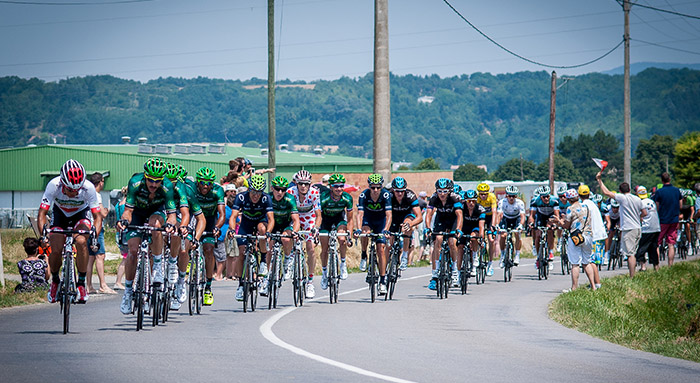
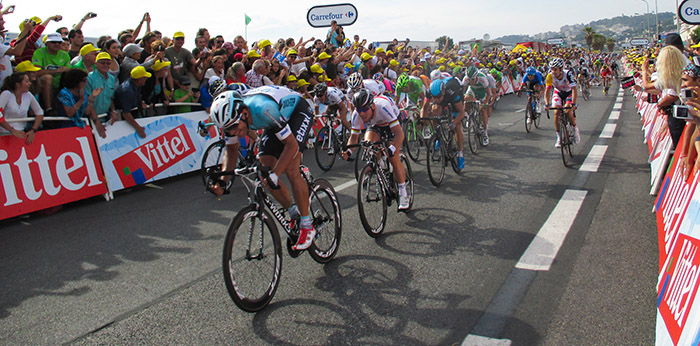
After a chaotic finale that saw Mark Cavendish and Simon Gerrans hit the deck very hard and Marcel Kittel ride on to win the day, the opening stage of the 2014 Tour de France is officially in the books. The excitement should continue on Stage 2, and hopefully for more positive reasons. As wild as the finish to the first stage was, for most of the day the riding was pretty tame, as a flat profile led to a mostly controlled journey, but things will be quite different on the second stage. Undulating is too gentle a word for the profile. With seven categorized climbs in the final 90 kilometers, all of them at 6% or greater, and a few uncategorized ascents climb to boot, Stage 2 has the look of an Ardennes Classic. The last four categorized ascents come in quick succession, closing out with the Jenkin Road climb with just 5 kilometers remaining. It is only 800 meters long but at a wicked 10.8% average grade. The barrage of late uphill tests are sure to inspire attacks. And while it obviously isn’t as long as Liege-Bastogne-Liege, it is the second longest stage in the first two weeks of the race at 201 kilometers; anyone still searching for Grand Tour form could get worn down and found out early. The high mountains may still be a ways off, but Stage 2’s journey from York to Sheffield should offer plenty of fireworks.
Given the profile, it seems likely that the stage will come down to either a late attack, or a sprint among the day’s survivors. As early as it is in the Tour de France, the former will be hard-earned, as the GC squads will be determined to deny any opportunists a chance to get ahead. However things play out, the explosive, well-rounded types with the versatility to win either in a late move or from a reduced sprint will be the favorites for victory.
Cannondale’s Peter Sagan will be the top favorite for Stage 2. Unlike most of his sprinting rivals, he should be able to handle the constant up-and-down, and he has the ability to win the day with an aggressive strike or from a sprint. This stage looks made for his versatile array of talents, and he proved in the Tour de Suisse and again in the first stage that he’s on excellent all-around form right now.
Orica-GreenEdge’s Simon Gerrans is another top contender, for many of the same reasons, with the biggest question mark being his health following his crash. The 2014 Liege-Bastogne-Liege winner relishes a profile like this, with plenty of opportunities to attack, or at least to whittle down the pack. An excellent puncheur, he will be one of the most dangerous men in the peloton if he does decide to make a late move, but don’t underestimate his sprint either: he actually defeated Sagan in a reduced sprint in the 2013 Tour de France. Unfortunately, his hard fall near the Harrogate finish line will cloud his chances for Stage 2; it’s hard to know how well he will feel after such a bad crash. Teammate Michael Albasini could be another option, especially as a card to play on the late climbs.
Movistar’s Alejandro Valverde, one of the most successful Ardennes riders of his generation, is an obvious choice here; for him, motivation could be the determining factor. While he, too, could contend for Stage 2 in a variety of ways, he may be more concerned with staying safe for GC. If he does decide to get into the mix, he will be a strong candidate for victory.
Behind Gerrans and Valverde at Liege-Bastogne-Liege was Michal Kwiatkowski of Omega Pharma-Quick Step. He has all the tools for success, but his form is questionable right now. If he’s feeling good, he will be a contender. GC riders other than Valverde and Kwiatkowski who could find themselves among the favorites if the pack really starts to thin out include Bauke Mollema and Rui Costa.
The difficult profile, and the likelihood of an animated race, will probably be too much for “pure” sprinters Marcel Kittel and Andre Greipel. (Mark Cavendish may be out of the race with a shoulder injury after his crash; even if he makes the start it seems unlikely that he’ll be capable of contending). Obviously if one of the big sprinters is there at the finish, he will be a favorite, but it will be a big ask. Kittel’s teammate John Degenkolb, however, leads a select group of non-Sagan sprinters who at least have a chance of surviving the difficult day. Also in this group are Movistar’s JJ Rojas, Tinkoff-Saxo’s Daniele Bennati, and FDJ’s Arnaud Demare and, to a lesser extent, Katusha’s Alexander Kristoff and Lampre-Merida’s Sacha Modolo. I wouldn’t really call him a sprinter, but fast-finishing Ramunas Navardauskas (3rd on the opening stage) could excel in a reduced sprint as well.
Quite a few riders stand out as potential protagonists for late attacks. Garmin-Sharp’s Tom-Jelte Slagter, FDJ’s Arthur Vichot, Lotto Belisol’s Tony Gallopin, Europcar’s Tommy Voeckler, and, if he is feeling up to it, Katusha’s Joaquim Rodriguez will like the short, steep challenges that Stage 2 has to offer. Fabian Cancellara, Sylvain Chavanel, Greg Van Avermaet, Jan Bakelants, and Geraint Thomas are all strong soloists with the climbing legs to put in a long distance strike.
VeloHuman Stage Favorites
1. Peter Sagan | 2. Simon Gerrans | 3. Michal Kwiatkowski
The long wait for the Grand Départ of the 2014 Tour de France is over, and that means it’s time for the Stage 1 Preview as well! In case you missed the overall race preview, you can find it here. As a note: I’ll be previewing every stage of the race, all the way to the Champs-Élysées, so you can check back every day for stage profiles and picks. You can also follow @VeloHuman on Twitter for more live analysis during the race.
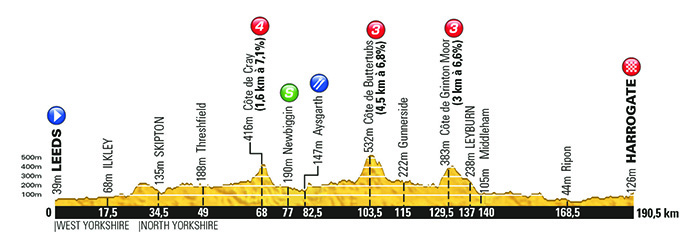
The opening stage of the 101st Tour is a mostly flat trip through Yorkshire. The peloton will take on a Category 4 climb and then a pair of Cat. 3s in the middle of the stage, but the bumps in the road aren’t likely to trouble anyone. 50 kilometers of generally flat roads lead into the finish, practically guaranteeing that this will be a stage for the sprinters. There is a roundabout with around 2 kilometers to go, but after that it’s a pretty straight shot to the line, meaning that the fast men will be truly flying in the final few moments. Though the high speed run-in to the finish will make it hard to tell that the riders are on a slope, the road does kick uphill a bit over the last kilometer.
The Tour de France quite often starts with a time trial, essentially denying the sprinters any opportunity to wear the yellow jersey during the race, but when things kick off with a mass-start road stage instead, the competition for a day in the sport’s most recognizable piece of clothing is fierce. The opening few days of a Grand Tour are already frenzied enough, and with riders going all out for the maillot jaune while they still have a shot, it could get hectic out there.
Given the profile, it seems likely that this stage and the coveted prize on offer will come down to a shootout between the sport’s three fastest sprinters: Giant-Shimano’s Marcel Kittel, Omega Pharma-Quick Step’s Mark Cavendish, and Lotto Belisol’s Andre Greipel.
I see Kittel and Cavendish as neck and neck on this one, with Greipel close behind. Kittel’s performance in last year’s Tour de France established him as sprinting’s new top man, and he’s followed up with some nice victories this year. He was head and shoulders above the competition in the Giro d’Italia before abandoning with illness. Of particular interest in his limited time in that race was his Stage 3 victory, in which he closed a ridiculous gap in the final hundred meters to overcome a serious positioning deficit and take the win. It showed just how strong he is this year even when things don’t really go as planned for his team; that strength is all the more fearsome when Giant-Shimano’s awesome leadout squad hits their mark, and they usually do. Koen de Kort, Tom Veelers, Roy Curvers, and the extremely-fast John Degenkolb make for a stellar train, and they all work very well together. In what is likely to be a very high speed finale, Kittel will be hard to beat on Stage 1.
Mark Cavendish will be going full gas to win this stage and the yellow jersey on British roads, and he is Kittel’s chief opponent. On paper, his leadout should be quite strong, but they haven’t really put it all together yet this year. Still, Cav has taken several nice wins this season to show that he’s on form, and unlike last year, there will be no question of post-Giro fatigue. I’m not sure his top-end speed matches Kittel’s but the slight uphill gradient may be more favorable to the Manx Missile, who is considerably lighter than his chief rival. Motivation will also be sky-high. These two should be neck and neck.
I think Andre Greipel’s chances are being a bit underrated by the bookies. Like Kittel, he benefits from a leadout that usually delivers him to the finish-line with machine-like precision. He will also be coming into this race with the confidence of having just won the German National Road Race Championship and a host of other victories all year. And despite his massive legs, Greipel has shown that he can succeed even on slight uphill gradients in the final few hundred meters. He should be a real contender for Stage 1.
After Stages 1 and 3, we should have a better idea of which of the big three is fastest right now, but until then, it’s hard to name a favorite of them with much certainty. There will also be a few other names in the mix, and given the increased likelihood for crashes on a hectic opening stage sprint, outsiders could find themselves battling for the win at a moment’s notice. Cannondale’s Peter Sagan generally seems locked in for the Top 5 on these sorts of stages but rarely actually contests the victory when Kittel, Cavendish, and Greipel are involved; however, the somewhat uphill finish will suit him nicely and it could give him an edge. The same is true for FDJ’s Arnaud Demare, who is on fire right now. It’s possible that Giant-Shimano’s John Degenkolb finds himself sprinting for the victory (if something happens to Kittel, or if, for whatever reason, his team decides to back him instead), and in that scenario, Degenkolb will be very dangerous here as well. Lampre-Merida’s Sacha Modolo took his first WorldTour win in the Tour de Suisse last month and this finish suits him perfectly. Katusha’s Alexander Kristoff, Trek’s Danny van Poppel, Europcar’s Bryan Coquard, IAM Cycling’s Heinrich Haussler, and Movistar’s JJ Rojas will be fringe contenders. Michael Matthews, unfortunately, suffered a training crash this week and his Tour start is now in doubt. Even if he does make the start, it seems unlikely that he’ll be able to be in the mix while still recovering; however, Orica-GreenEdge teammate Simon Gerrans could try his luck with this finish.
VeloHuman Stage Favorites
1. Marcel Kittel | 2. Mark Cavendish | 3. Andre Greipel
After months of buildup and weeks of tune-up races, the main event is upon us. We’ve gone a few days without any WorldTour racing (though hopefully you have had a chance to enjoy the VeloHuman Up-and-comer Q&A Series in the meantime), but the 2014 Tour de France finally kicks off in Leeds on Saturday, July 5th. As usual, in addition to the overall preview, VeloHuman will be previewing every stage of the race. You can find all of those stage previews here. Also, you can follow @VeloHuman on Twitter for more analysis and commentary during the Tour.
The Route
The route of this year’s Tour de France is an intriguing one: in keeping with recent editions, the 101st Tour de France waits a full week to throw any serious mountains at the peloton, but there are some real challenges on the menu before the road reaches high altitudes. The first stage of the race is a mostly flat affair through Yorkshire that is likely to end in a sprint. The second stage may not have high mountains, but with nine categorized climbs on the docket, including an 800 meter, 10.8% bump just 5 kilometers before the finish line, it should be a thrillfest, and the GC contenders will need to be alert. Stage 3, the Tour’s last day in England, is another likely day for the sprinters, and the also mostly flat Stage 4 will probably end in the same way. Stage 5, however, will be one of the most intriguing of this year’s Tour de France.
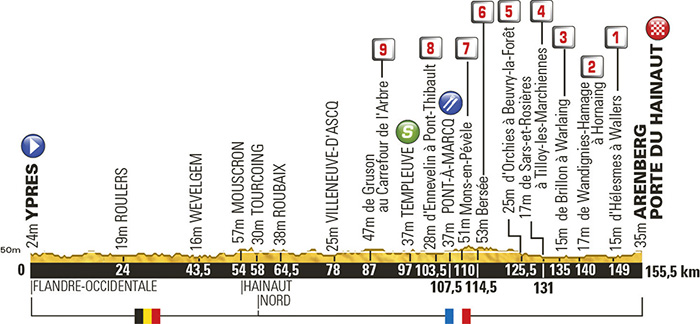
Nine cobbled sections will pose a tough challenge to the lightweight GC contenders on Stage 5.
To add excitement to the 101st edition of the race, the organizers added a cobbled stage that will travel over some of the same challenging terrain that features in spring’s Paris-Roubaix. The Tour stage isn’t as long as the Monument Classic, but the route travels over sections of the Carrefour and Mons-en-Pévèle and plenty of other difficult sectors, and the bumpy roads could bounce the lightweight GC types all over the road. It will be a white-knuckle ride all the way to the finish, and attacks will be coming hot and heavy from classics specialists given the rare chance to shine on their favored terrain in the Tour de France.
Stage 6 is flat enough to be a likely sprinters’ target. Stage 7 is mostly flat as well, but a few late bumps could put the heavier sprinters under pressure. The peloton finally hits a real uphill finish on Stage 8, though time gaps should be small, as the closing climb up the Gerardmer is less than 2 kilometers long. Stage 9 includes some tough climbs, including a Cat. 1 ascent; it could be a day for the breakaway or for the versatile fast-finisher types, with a mostly flat final 20 kilometers, but GC attacks aren’t out of the question. However, the overall contenders may opt to save energy for Stage 10, which will throw tough ascents at the peloton all day long.
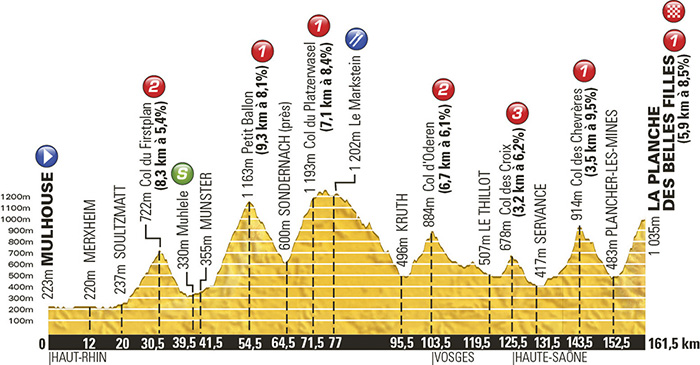
Stage 10 will be a roller coaster ride of tough climbs and difficult descents, offering plenty of opportunities for attacks to go free.
At 161.5 kilometers, Stage 10 is not particularly long, but four Cat. 1 climbs and a few smaller ascents stand between the riders and the finish line. For most of the day, the riders will be facing tough climbing or tricky descending, and that is likely to encourage aggressive riding, especially with a rest day to follow. After the day off, Stage 11 is a bumpy one but it probably won’t have GC implications. The same is true for Stage 12.
The Tour heads to the Alps for its first real high mountain test on Stage 13. An HC-rated finish awaits. Stage 14 will not offer respite, starting with a very long Cat. 1, followed by the 19 kilometer, 6% average grade Hors Categorie climb up the Col d’Izoard, and then ending with a Cat. 1 climb to Risoul. The peloton will be glad for the flat day on Stage 15, as well as the rest day that follows.
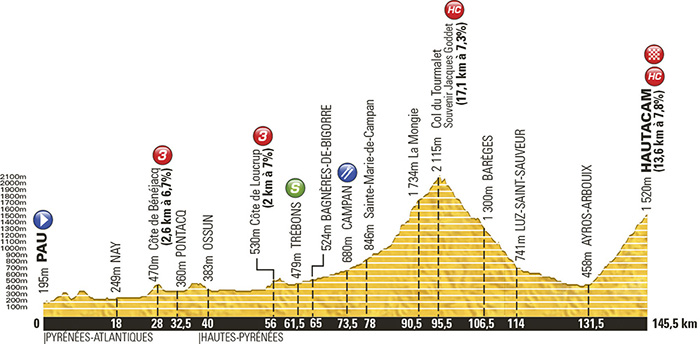
On Stage 18, the final mountain stage of the 2014 Tour de France, the riders must overcome both the Col du Tourmalet and a Hautacam summit finish.
Stage 16 is the first of three days in the Pyrenees, and will challenge the riders with a late HC-rated climb followed by a little over 20 kilometers downhill to the finish line. Stage 17 is tougher, with three Cat. 1 climbs on the way to an Hors Categorie summit finish. Stage 18 will be the last chance for the climbers to pick up time, and what a chance it will be: the pack will climb the fearsome Col du Tourmalet, zoom down the other side, and then ascend to Hautacam and the finish line.
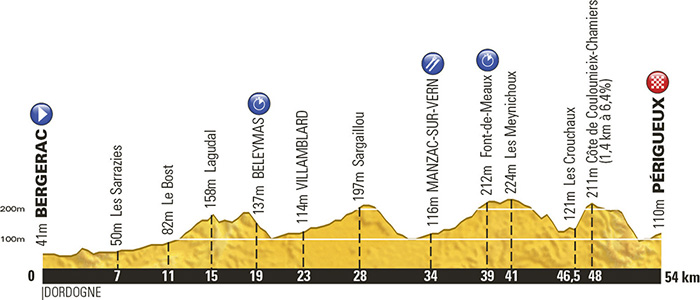
Stage 20’s race against the clock is a very long one at 54 kilometers. Gaps between the GC riders will be significant.
A mostly flat Stage 19 will allow the GC contenders to recharge before taking on the decisive time trial on Stage 20. It’s a long one at 54 kilometers, and it could seriously shake up the General Classification. The parcours is hilly, which will offer some consolation to the climbers, but riders with big engines will have the advantage over this distance. The GC will be decided as the last rider crosses the line on Stage 20, with the classic Champs-Élysées sprint on tap for the twenty-first and final stage of the race.
All told, this year’s route may seem a bit more climber-friendly than those of recent years, but a cobbled stage and a long time trial at the end of three tough weeks of racing will make a well-rounded skillset a requirement for victory. And although the high mountains don’t come until the middle stages of the Tour de France, some early challenges will keep everyone on their toes from the beginning of the race. It should be a thrilling ride all the way from Leeds to Paris.
The General Classification Contenders
The Tour de France is a long race, and the mountains and cobbles along the journey could shake things up at a moment’s notice, but in terms of the yellow jersey fight, there are two competitors who stand out as the clear favorites. Team Sky’s Chris Froome and Tinkoff-Saxo’s Alberto Contador are a cut above their opponents, climbing and time trialing in a league of their own and with powerful teams backing their bids for yellow. Between them however, things are very tight.
Froome was dominant in last year’s Tour de France, and his convincing victory came after a dominant spring that saw him establish his supremacy across several races. Meanwhile, would-be top rival Alberto Contador never seemed to find his top level in the run-up to the 2013 Tour, and he was unable to get to that level during the race either. At least so far, 2014 has been a different story entirely. Alberto Contador has been the best GC rider in the sport, winning races like Tirreno-Adriatico (where he put his uphill wizardry on full display) and the Vuelta al Pais Vasco (where he flashed stellar chrono form) and carrying that good shape through June’s Criterium du Dauphine. He is a proven winner of the Tour de France who seems to have refound the ability he lacked in 2013. Meanwhile, Chris Froome has struggled to overcome hurdle after hurdle, as injury and illness have waylaid his plans throughout the year. That isn’t to say that he hasn’t flashed his brilliance here and there; he took victory in the Tour de Romandie and looked very sharp in the Dauphine prior to a crash. Still, compared to last year’s bulletproof campaign, this year has been a difficult one for the defending champion, which makes his grip on the title of pre-race favorite a more tenuous one.
If forced to pick a favorite, I’d still name Chris Froome (though I believe that his edge is razor-thin). The ability he has shown over the past year when at peak form is just impossible to ignore, and he has displayed enough strength when healthy in 2014 to at least maintain his position as pre-race favorite. He was clearly the better rider last year, and while his inability to dominate the early season this year raises questions, his many ailments have certainly played their part in slowing him down, and he appears healthy now. Richie Porte and Mikel Nieve are top-notch teammates for the climbs who could find themselves lurking at the fringes of the Top 10 in their own right, and Geraint Thomas and Vasil Kiryienka are powerful pace-setters on the hilly and flat days. Contador’s bid for victory, meanwhile, took a serious hit this past week when it was announced that star teammate Roman Kreuziger would not be riding in the Tour due to an ongoing investigaton into biological passport irregularities. Contador will no longer be able to enjoy the luxury of having last year’s 5th place overall finisher at his side. Replacement Rafal Majka is obviously also very talented but he will likely be fatigued after a hard Giro. Mick Rogers and Nicolas Roche, though excellent support riders, are also coming off the same tough Giro. In short, despite Contador’s stellar season, he will still have something to prove against the defending champion; regardless, I’ll reiterate that this should be a close fight and it’s extremely tough to call between these two stars right now.
Behind them is a pair of second-tier favorites who are themselves on a level above the rest of the GC hopefuls: Astana’s Vincenzo Nibali and Movistar’s Alejandro Valverde look to be the top contenders after Froome and Contador, and though victory will be a tall order for either of them, they should at least be seen as heavy favorites to fight it out for the final spot on the podium. Nibali had a brilliant 2013 campaign, winning the Giro d’Italia convincingly and taking runner-up honors in the Vuelta a España, but he has been unable to find as much success in stage races this year. Still, he proved in 2013 that at peak form he is one of the top climbers in the world, and a great descender and a master tactician to boot. He’ll have two weeks to ride himself into Grand Tour form, and it’s not as if 5th in the Tour de Romandie and 7th in the Dauphine are bad results, per se. And remember, Joaquim Rodriguez looked way off the pace in the 2013 Dauphine, finishing 16th, and went on to a Tour de France podium. I don’t think it’s out of the question that Nibali gets back to the top level before the race hits the mountains. Victory in the Italian road race championship was a good sign. This event is the focus of his season, and I expect him to be in his best shape of the year when the Tour gets into the mountains, and if he can reach his 2013 form, he could find himself battling Froome and Contador at the very top. He’ll also have one of the race’s finest teams backing him, with constant lieutenant and Top 10 finisher (and legitimate threat for a repeat Top 10) Jakob Fuglsang, veteran Michele Scarponi, and versatile Tanel Kangert at his side.
Alejandro Valverde, unlike Vincenzo Nibali, has been landing top results left and right all year. This is probably his last year as Movistar’s featured rider for the Tour, so motivation is high. Perhaps the one question mark in his stellar 2014 resume is the lack of recent results in top-level stage races. He eschewed the Dauphine and the Suisse in the run-up to the Tour, opting for the Route du Sud instead. He was strong there, but it’s hard to judge his form based on that race, given the lower level of competition. He was strong in Pais Vasco, but that was in April. It will be interesting to see how he goes in the Tour de France after well over two months away from WorldTour competition. With Ion Izagirre and the excellent Beñat Intxausti for support, he will have plenty of help, and his Spanish national championship-winning time trial form should come in handy as well. Given the sort of peak ability he has shown over the last few years, his strong team, and his knack for success in 2014, I expect him to be one of the last men standing as Froome and Contador ratchet up the pace on the steep climbs.
Garmin’s Andrew Talansky was already worthy of inclusion in the Top 10 conversation after landing 10th in last year’s Tour, but he solidified his presence in the discussion of outside contenders with his stellar Criterium du Dauphine. Though it may be tempting to write off his victory in that race to tactics alone, he would not have been in position to win the GC with his long-distance attack had he not put in strong performances throughout the race; he was sitting in 3rd place on GC before his daring move. Talansky has steadily improved as a climber over the past few years, and Garmin sends a great support squad to back his bid for the overall, with strong climber Janier Acevedo to help set the pace uphill and a number of other excellent teammates who thrive on the hilly days. Compatriot Tejay van Garderen will also be hunting a strong overall result, and he, too, is armed with ever-improving climbing skills. After a disappointing 2013 in which he seemed to take a step backward, he kicked off 2014 with renewed vigor. He was stellar in Catalunya, winning a mountain stage ahead of Contador, Purito, Froome, and others, and finishing 3rd overall on GC. However, a crash in the Tour de Romandie left him with a small hip fracture, which forced him to abandon that race and clearly slowed him in the Dauphine. Still, he certainly looked to be rounding into form as the Dauphine progressed and he has a dedicated BMC team backing him for a good GC result.
Belkin’s Bauke Mollema got off to a slow start in 2014, but he was climbing very well in the Tour de Suisse, and appears to be finding form just in time for his season’s biggest target. Given Belkin’s sponsorship woes, motivation is high, and Mollema should have it in him to fight for a strong GC result. Teammate Laurens Ten Dam is a valuable second.
Lotto Belisol’s Jurgen van den Broeck spent all of 2013 and much of this season hunting the form that put him into 4th place in the Tour de France in 2010 and 2012, and until June’s Criterium de Dauphine, he did not have much to show for his efforts. But his 3rd place in the Dauphine, earned with some top-notch climbing performances, put him right back into the Top 10 discussion, given the ability he has shown in the past. He won’t have much team support, but the parcours is in his favor, with only a single time trial stage. Like so many other outside contenders, he may find the podium a very difficult goal, but a Top 10 is within his reach.
A Top 10 may be well within the reach of World Champion Rui Costa as well, though it’s hard to know what to expect out of the talented Portuguese all-rounder given that this is his first time as a GC team leader in the Tour de France. Signs point to stellar form right now after his brilliant Tour de Suisse victory (and a host of other strong results this season that may have been overlooked in all the attention given to his lack of actual victories in the rainbow jersey). Of particular interest was his terrific time trial performance in the Suisse, where he was third to specialists Tony Martin and Tom Dumoulin in that race’s 24.7 km time trial seventh stage. Whether he has the consistency required to land a top GC result in a three-week race is unclear, but he certainly has all the tools to make him a good candidate. 2013 Vuelta winner Chris Horner makes for a stellar second, though his form is an unknown right now.
FDJ’s Thibaut Pinot has not been having an excellent season results-wise, but he has not been bad either, with Top 10s in Pais Vasco, Romandie, and the Bayern Rundfahrt. He was a bit under the weather in the Tour de Suisse and never really mounted much of a challenge in that race, but he did put in a strong time trial on a parcours that did not seem to suit him. It was actually one of a number of strong chrono performances from the climbing star this year, and if he has indeed found an extra gear against the clock (and if he can get back to his peak form by the time the Tour hits the mountains), he’ll be a dangerous outsider.
AG2R’s Romain Bardet has continued to deliver impressive results in his young career, with several Top 10s in big races already in 2014. He’ll appreciate the hilly parcours. Teammate Jean-Christophe Peraud has had a very strong season so far and will be looking forward to the race after crashing out of last year’s edition while looking well-positioned for a strong result. 2013 Alpe d’Huez stage winner Christophe Riblon makes for yet another strong all-rounder for AG2R. Fellow French stars Thomas Voeckler and Pierre Rolland of Europcar at least deserve a mention, but they may be chasing stage wins, with Voeckler generally unimpressive this year and Rolland coming off the Giro d’Italia (he was terrific in that race, but hunting for a strong result in the Tour de France GC after the Giro is probably too much to ask). Speaking of Giro participation and stage hunting, Katusha’s Joaquim Rodriguez is on the startlist, but he has said that he is purely here for stage wins and as preparation for the Vuelta, as he is still recovering from his Giro crash. Earlier in the season there was talk of teammate Simon Spilak having support as a GC rider but Katusha seems to be more focused on stage wins now; Spilak won a stage in the Dauphine but he was a non-factor in the GC. He’s very talented but he has yet to make much of a run at Grand Tour GC success; Yuri Trofimov may be Katusha’s designated GC rider instead. Michal Kwiatkowski of Omega Pharma-Quick Step was one of the spring’s biggest stars, but he took a break from racing following the Tour de Romandie and since then he has not apperaed to be at the same level that he was at in March and April. However, the Polish rising star is a tough competitor and this is a big target of his season, so it would not be a surprise to see him back to top form by the time the GC race heats up. He’ll hope to improve on his 11th place in last year’s race. IAM Cycling’s Mathias Frank has delivered quite a few excellent performances in his first year with his new team and he is sporting an improved time trial this season. He’ll look for continued success here. Leopold Konig leads the GC charge for fellow wildcard invite NetApp-Endura. He was excellent in the 2013 Vuelta a España, landing in the Top 10 and winning a stage, but injury has hampered his 2014 campaign. He appeared to be rounding into form at the Dauphine, however, and his team has selected a Tour squad dedicated to his GC hopes (leaving VH Up-and-comer Q&A Series interviewee Sam Bennett off the startlist). A Top 10 is within Konig’s reach. Also on the fringes of GC contention are Cofidis’s Daniel Navarro and Rein Taaramae and Trek’s Haimar Zubeldia and Frank Schleck (Andy appears to be riding in support of them).
The Stagehunters
As usual, the caliber of stagehunters in the Tour de France is very high, especially among the sprinters. With at least seven days very likely to end in bunch sprints, the sport’s elite sprinting trio of Mark Cavendish, Marcel Kittel, and Andre Greipel are in attendance. All of them have had success this year, but they have not faced each other on many occasions, meaning that the battle for sprint supremacy is very much up in the air.
With his four victories in 2013, Marcel Kittel established himself as the fastest sprinter in that year’s Tour, and his dominance in the first two stages of this year’s Giro d’Italia (before he pulled out of the race with illness) suggest that he has not slacked off in 2014. His top-speed is otherworldly and he also has a nearly unbeatable leadout train. I think he is the best of the three right now.
OPQS’s Mark Cavendish has won some nice victories this year all over the map, and was head and shoulders above his competition in the recent Tour de Suisse on Stage 4, the one chance he had to sprint for victory (a crash derailed his bid for glory on Stage 5). His leadout, despite the additions of Mark Renshaw and Alessandro Petacchi, has not been as strong as he would have hoped, but there is plenty of talent there and they could put it together for the Tour. What’s more, last year’s “disappointment” (two stage wins is a disappointment when you are Mark Cavendish) came after he had raced a difficult Giro d’Italia, and this year, he skipped that Grand Tour in favor of shorter races. Perhaps with fewer race miles, he’ll be better prepared to take on his rivals.
Andre Greipel has had quite a year, racking up victory after victory since January’s Tour Down Under. Having just won another German Nationals title, as well as stages in each of the last four races he has undertaken, Greipel is obviously on great form. Lotto’s leadout team is a good one. Still, Greipel is probably the third of the trio right now. As much success as he has had this year, he has mostly been facing lower-level competition recently and I’m not sure how well his dominance against that competition will carry into the biggest race of the year. However, he is still a member of that elite trio, well above the rest of the sprinting pack, and picking up a few victories is a reasonable goal for the German.
Even with the dominance of this select trio of sprinters, however, the battle for the green jersey is still likely to come down to Peter Sagan, who can hunt for victories in the Tour’s many hilly stages and reliably expect Top 10s in the flat ones. As he consistently racks up very high placings, the triumvirate of top sprinters will be fighting amongst themselves for victories on the very flat stages, and not even contesting some of the hillier days that Peter Sagan is targeting. The convincing winner of the Tour de Suisse points competition, Sagan is firing on all cylinders right now and it’s hard to see past him in any stage likely to end in a reduced bunch sprint. Cannondale teammate Elia Viviani appears to be here in a support capacity.
Michael Matthews figures to offer some competition to Sagan on the tougher days; he showed stunning climbing legs in the Giro d’Italia and, having abandoned that race before it got too mountainous, he should have enough energy in the tank to challenge Sagan on the hilly stages. Marcel Kittel’s teammate John Degenkolb isn’t as good a climber as Matthews or Sagan but he could be there on some of the tougher days, too. FDJ’s Arnaud Demare is ready to prove that he, not Nacer Bouhanni, is the best sprinter on his team, and he’ll have an eye on the sprints that follow more difficult stages as well. Katusha’s Alexander Kristoff is especially adept at sprints that follow grueling days in the saddle: the cobbled fifth stage could be a good opportunity to shine against some of these other names. This Tour de France will also be a rare opportunity for him to sprint with the support of a dedicated team, meaning that he may also surprise even on the less demanding stages.
Lampre’s Sacha Modolo has been knocking at the door of his first WorldTour victory for a while and he finally got it in the Tour de Suisse; he’s on excellent form right now and is a nice outside candidate in the sprints. Europcar’s Bryan Coquard has been extremely successful hunting victories in lower level French races this year; with a little luck he could be in the mix. Movistar’s JJ Rojas, Trek’s Danny van Poppel, Tinkoff-Saxo’s Michael Morkov and Daniele Bennati, and Cofidis’s Adrien Petit and versatile Julien Simon are other outside contenders for the sprints who will hope to play spoiler to the heavier favorites.
Punchy types who will look to get into the mix on the hillier stages include 2013 stage winner and 2014 Liege-Bastogne-Liege winner Simon Gerrans of Orica-GreenEdge and his on-form teammate Michael Albasini, Garmin’s Tom-Jelte Slagter, FDJ’s Arthur Vichot, Lotto Belsol’s Tony Gallopin, OPQS’s Jan Bakelants, and Europcar’s Cyril Gautier. As mentioned before, Joaquim Rodriguez considers himself purely a stagehunter in this race, making him a very likely aggressor in the later mountain stages of the Tour. We won’t know which big-time climbers abandon failed GC bids to hunt stage wins until the leaderboard starts to take shape in the middle of the race, but Purito is sure to be among the most prominent of the riders looking for mountaintop victories from the breakaway in the Tour’s final week.
Garmin’s Ramunas Navardauskas, IAM’s Sylvain Chavanel, BMC’s Greg Van Avermaet, Astana’s Lieuwe Westra, Sky’s Geraint Thomas, OPQS’s Niki Terpstra, Belkin’s Lars Boom and Sep Vanmarcke, and, of course, Trek’s Jens Voigt and Fabian Cancellara are just a few of the names that stand out as likely long distance protagonists; for many of them, the cobbles of Stage 5 are a major target. Cancellara is also likely to be one of the main contenders in the Tour’s lone time trial, where he will face off against the GC heavyweights and other chrono specialists like World Champ Tony Martin and Giant-Shimano up-and-comer Tom Dumoulin.
VeloHuman Favorites
General Classification
Winner: Chris Froome Podium: Alberto Contador, Vincenzo Nibali Other Top Contenders: Alejandro Valverde, Tejay van Garderen, Andrew Talansky, Bauke Mollema, Jurgen van den Broeck, Rui Costa, Thibaut Pinot
Points Classification
Winner: Peter Sagan
I will be previewing every stage of the 2014 Tour de France here at VeloHuman.com, so make sure to bookmark the page! VH will bring you stage profiles, favorites, and outsiders for every day of racing. You can check out the Stage 1 Preview here. There will be plenty more commentary and analysis on Twitter @VeloHuman. If you’re the type who can’t get enough cycling talk, you’ll be glad you followed! Hope to see you soon.
-Dane Cash
Photos by Damien, jvanattenhoven, Alain Stoll, and Harald.
For the fourth entry in the Up-and-comer Q&A Series, VeloHuman talked to Belkin’s Nick van der Lijke. Nick is only 22 years old, and was just 21 when Belkin offered him a spot on their team after a very successful 2013 campaign that saw him win the Beverbeek Classic and Kreiz Breizh Elites. He started his 2014 campaign at the Vuelta a Andalucía and then raced in a number of one-day events, including the Dwars door Vlaanderen and Scheldeprijs, before a busy May and June with starts in the Tour of Turkey, the Tour of California, the Critérium du Dauphiné (his first WorldTour event), and the World Ports Classic. A day after competing in the Dutch National Championship Road Race, he talked to VH about his season, what he has learned so far, and his goals for the future.
VH: Nick, I have to start by asking about the Dutch Championship race on Sunday. You attacked very early in the race. I’m wondering: were you just trying to get home as fast as possible to watch the World Cup game against Mexico?
NvdL: Of course! (Nick laughs). No, no, I thought it was the best chance for me, because we had some big riders waiting until the end, and there were some riders going for the break, and I was one of them, so I tried to get into the break and I succeeded. I think it was a good opportunity, but I hoped that Garmin would also join the breakaway and they didn’t—so it was a little bit too hard to stay until the end.
VH: You did stay out front for quite a while, though, and it seems that that is a target of yours this season, getting into those breakaways. That was something that Belkin had talked about for the Tour of California earlier this month as well. Now that you’re at the top level, riding against these top teams, how hard it is to get into the breakaways?
NvdL: It’s much different from last year. . . . It’s harder, everyone can ride the bike very well. It’s much harder than last year. Last year, you just had to be strong at the right moment and then you’re in the breakaway, but this year it’s different. I was really happy that yesterday I succeeded getting into the breakaway. I think it’s nice for the upcoming races.
VH: Do you enjoy the challenge of getting into the breakaway and then spending a hard day out front?
NvdL: Yeah. And also you’re getting stronger, being in the breakaway. Sometimes you just have to get stronger and stronger. . . . When you are stronger you can wait till the end, but right now I have to take the chances and be in the breakaway, and maybe with a little bit of luck, stay in the front.
VH: You had a great 2013 with the Rabobank Development team. You won your first race of the year, the Beverbeek Classic, and notched a collection of other victories and strong results, including Top 10s at the Under 23 versions of Flanders and Paris-Tours. What was your first thought when you realized that you would be making that jump up from a Continental Team to the WorldTour with Belkin?
NvdL: Well, for a long time it was a little bit hard: I had the results, but in June I hadn’t heard anything from any team, so I was a little bit scared. It was at the time that Euskaltel stopped, and some other teams stopped, so it became harder and harder. So I was really happy when Belkin called, and also, it was after Kreiz Breizh, which I’d won, so I was really happy. But starting was really hard, I did not have the perfect winter. In January, I had to go easy for two weeks with training, so it was a little bit hard at the start of the season. But now after California I’m getting better and better, I think. From now it’s just getting better and better, hopefully without any more problems with the body.
VH: When you first arrived at Belkin, did the team give you a sense of what your role would be in your first year?
NvdL: Yeah, just learning and getting stronger. But also, they said they would give me the opportunity to find the specialty for me, because uphill I’m good, and on the flat I’m good, and in the sprint I’m good, and . . . though it’s a little bit hard for me at the moment, I think I have found a little bit of a specialty which I can get better at in the winter, so that could be easier for the next few years.
VH: You’ve also been doing a fair bit of a leadout work, and that seems to be going well. Theo Bos, Barry Markus, and Moreno Hofland have all gotten some strong results with you involved in the leadout train. Are you getting comfortable with that role as well?
NvdL: Yeah, it’s a much different role . . . but in the first part of the season I think it was better for me because the races were less hard and because I was not in really good shape. So I think it was better for me to get stronger and get used to the level.
VH: You rode on the Rabobank Development Team with a number of your current teammates, including Hofland and Markus and Wilco Kelderman. What’s it like being together again at this level? Did you all expect to be here together at some point?
NvdL: We talked about it when we were Juniors and U23. It’s a little bit funny that we’re riding with each other now. It’s nice, and I know them very well and they know me, so you know what you’ve got with each other.
VH: The Critérium du Dauphiné in June was your first WorldTour race. Can you talk about how that compared to races you’d done in the past?
NvdL: The first stage I had some stomach issues. It was much harder than I expected but the first days were really hard. I thought, “Uh . . . what’s this?” But I think the last four days were getting better and better, and the last two days were really good. I could give the best of myself for Wilco.
VH: What does your racing calendar look like going forward?
NvdL: I don’t know yet. I think maybe after next week, I’ll have a race program for the next two months. But for now, till July 20th, I have nothing on the program, so first I have a little bit of vacation, and then just easy training and then back to hard training.
VH: Are you going anywhere for vacation?
NvdL: Yeah, I’m going with my girlfriend to Germany.
VH: Great!
NvdL: Yeah, it’s really nice. I look forward to it.
VH: Do you have any specific goals for the rest of this season?
NvdL: I think there will be some one-day races. I hope, and I always thought, that Canada, Quebec and Montreal, that circuit . . . maybe . . . I’ll be good at it. . . . I really like that circuit.
VH: One of the biggest stories of the past few weeks has been the news of Belkin’s departure from the sponsorship role coming sooner than expected. How are you handling the sponsorship uncertainty?
NvdL: Yeah, I didn’t expect it. So I thought, “Oh Belkin stopped? I thought they were also in for next year . . .” But then I read the article . . . and I thought “Ugh, another problem.” After last year it was really hard to find a sponsor, and now it’s getting much harder I think, but the team says it’s looking good and that, probably, we will find a sponsor. Otherwise I have to look for other teams. I have different feelings about it. It’s nice to have a two-year contract but you want to be in a team and you want to keep together. You want to ride the next year with them and to get nice results and good team performances.
VH: One last question. You have a very broad skillset, as you mentioned earlier, good on the hills, good on the flats. You said that the team wanted to give you a chance to find your specialty; now that you’re progressing through the season, have you started to figure out what sorts of races you’re targeting in the future in your career?
NvdL: Yeah, I think not the Grand Tour races but the six- and seven-day races, like California. Those races are, I think, perfect for me. Hopefully I’m getting stronger uphill also, so maybe in the next few years I could do something also in the GC, that would be really nice of course, but going for stage wins is the first target for me.
Nick is hoping that the improved form he saw in June continues to translate into better and better results for the rest of the season. While his teammates take on the Tour de France, he will look to perfect that form with some extended training time over the next few weeks. Belkin’s sponsorship status will be of particular importance to the trajectory of his career, as he is one of the few riders on his team signed on for multiple years. However, with the sort of ability that caught Belkin’s eye in the first place and a clear desire to use every race as an opportunity to get stronger, he is well-positioned for success, whatever happens.
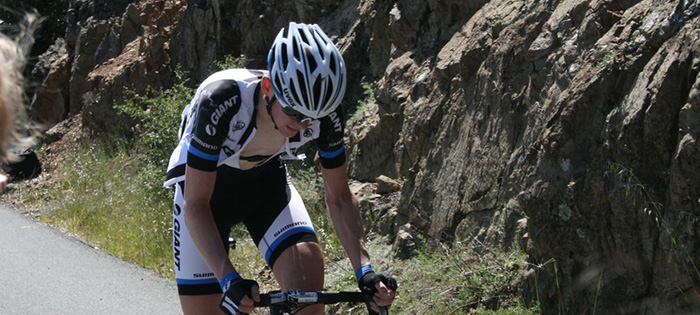
Chad Haga climbing Mount Diablo at the 2014 Amgen Tour of California | Photo: Naoto Sato
The WorldTour may be taking a break before the July’s Tour de France, but the VeloHuman Up-and-comer Q&A Series is here to hold you over until the racing picks back up again. In this third installment, VH talks to Giant-Shimano’s Chad Haga, on a brief summer break from competition. Chad joined the Dutch squad after a breakout 2013 in which he took 10th in the Tour of California, 2nd in the Volta ao Alentejo, and a stage at the Tour of Elk Grove. The 25-year-old American is something of a rarity in the peloton: he holds a bachelor’s degree (in mechanical engineering), having graduating from Texas A&M before kicking off his pro career. We talked about adapting to racing on the WorldTour and Giant-Shimano’s world-beating sprint train, among many other things.
VH: Where are you spending summer break?
CH: I’m staying in Lucca, Italy [Chad’s home base in Europe].
VH: How are you settling in? You live with [Garmin-Sharp’s] Ben King, is that right?
CH: Yep. Settling into Lucca specifically has gone pretty easily. It’s a laid back little town and the apartment is really well located inside the wall. Neither of us has a car and we get along just fine. The Italian lifestyle is great and the roads are terrific. That’s part of why I’m spending my break here. I haven’t spent a lot of time to experiencing the city or exploring, so I’m looking forward to doing that over the next few weeks.
VH: How do you plan on spending your time off from racing?
CH: Specifically, I’m not sure yet. I would like to make a trip over to Siena to see their famous horse races in July, Il Palio. I visited Siena last fall and learned about these races and thought that it would be really awesome to go, and now I’ve got the opportunity to do that. But besides that I don’t have any really detailed plans for how I’ll spend my break. So far I’ve just been doing a lot of relaxing and reading and playing the piano.
VH: You were 10th overall in the 2013 Tour of California so obviously you’ve done big races in the past, and you’ve done well in them. But in March you started in your first WorldTour event, the Volta a Catalunya. You said in your blog that it was much harder than the prior year’s Tour of California. Can you describe what it is that makes racing at the WorldTour level so much more difficult?
CH: At the WorldTour level, generally every race is longer. I added up all the race kilometers that I had last year compared to this year and divided by the number of race days and on average, every race is 30 kilometers longer, so you’re talking about close to an hour longer every single race, and on top of that it’s a higher level of racing. At the WorldTour races, there’s no Continental teams. Every single WorldTour team is there. It’s just a very high level of racing, it’s very demanding and that takes adjustment.
VH: At Catalunya you were part of a squad that launched Luka Mezgec to three wins, and then in the Dauphiné you and the rest of Giant-Shimano drilled it on the front in the closing kilometers of the third stage to set up Nikias Arndt for victory. Have you been working a lot on the leadout in your training with the team?
CH: That’s been a big area of development for me, learning how to do it and the skills and the technique and the mental training required to pull off something like that for a rider like me, who’s not so comfortable with it in the first place.
VH: Obviously Giant-Shimano is doing something right with the leadouts because you’ve become this sprint powerhouse of the WorldTour. You’re winning stages in Catalunya and the Dauphiné with Mezgec and Arndt, and of course you have huge names like Marcel Kittel and John Degenkolb. Are you able to identify anything that Giant-Shimano is doing differently that is setting up all these guys for so many wins?
CH: It seems to me that we do a very good job, when things go right and when things go wrong, either way, we always break down the stage in detail and analyze everything we did: what we did right and what we need to change. We just do a very good job of analyzing everything so that we can be even better in the future, and it seems to carry over from race to race and so we continue to get better at it.
Photo: Giant-Shimano
VH: What is the skillset that you feel you’ve improved the most since joining the team?
CH: I guess it would have to be positioning. I still have a lot of work to do with that but I feel that I’ve gotten much better at staying with my teammates when it’s important, and the fight for position in leadouts and into the base of climbs.
VH: You’re into music; do you listen to anything in particular when you’re on the trainer?
CH: If I’m warming up for a time trial, it’s very specific music. For the past two years, the only thing I really listen to when I’m warming up for a time trial is a band called Periphery.
VH: That’s a rock band right?
CH: Yeah. They’re like . . . tech metal.
VH: Was there a reason that that became your routine before the time trial?
CH: I just love their music in the first place, it always gets me pumped up. I think the first time trial I listened to them, I won. It hasn’t always worked out that way since then but it’s my go-to warm up music.
VH: You’re living in Italy and you’re riding for a Dutch team; are you picking up any languages? What’s the predominant language spoken on the team?
CH: Well everybody speaks English, which is very good, I can communicate and bond with my teammates. But aside from that, there’s half a dozen other languages spoken on the team around the dinner table, so it’s a lot of different dialects and languages bouncing around.
VH: Speaking of communicating and bonding, are there any veteran riders on the team that you’ve been able to form a relationship with and learn from so far?
CH: Roy Curvers and [John] Degenkolb. I’ve done a lot of races with them and we get along well, and both of them have a lot of experience and can do a lot of teaching. I really enjoy racing with them and learning from them.
VH: Where do you see yourself fitting in as a rider over the next few years? Obviously you have the all-rounder skillset, and you’re excellent in the time trial. What sort of races do you see yourself targeting?
CH: I . . . (Chad laughs) have not thought that far ahead. I hope to be able to really compete for the GC in weeklong stage races, at the Tour of California level, 2.HC, and hopefully at the WorldTour level. In the meantime I really enjoy the opportunity to go on the attack and get into breakaways.
VH: After your summer break is over, what is next on the program for 2014?
CH: Race-wise, I don’t know yet, that’s still up in the air being decided. I go to a three-week altitude training camp in France during mid-July so that’s the most immediate thing on my calendar.
VH: Do you have any particular goals for the rest of 2014?
CH: I would really love to win something before the year ends, but I don’t have a target race in mind. I take every race as it comes and look for opportunities. I would love to get selected to race the Vuelta. I know that’s a possibility, so I have high hopes for that, and I’d love to return to the World Championships and race the team time trial.
VH: Has Giant-Shimano given you an indication of what their expectations or goals are for you in your first year?
CH: They don’t expect me to get a result in a specific race; there is no real target race in that sense. They just want me to work as hard as I can and learn as much as I can, and use this as a building year in the hope of having a breakout year next year. It helps a lot. There is pressure, of course, to do my job and work as hard as I can, but to not really have any weight on my shoulders makes for a really smooth transition to this level.
VH: You have a mechanical engineering degree, so obviously you’re comfortable with math. Do you tend to pay a lot of attention to your power data while you’re riding, or do you try to ride according to how you feel and leave the analysis for after the race?
CH: I have to cover up my data during the race because I will obsess over it to the detriment of my racing. I definitely analyze it very in-depth after the race, and then our team also has our own data guru for further analysis, but I save that for after the race, because otherwise I would never look up from my power meter!
VH: I’m sure it was a big decision at first, but do you feel you’ve made the right call foregoing an engineering career for now?
CH: Yeah, at least for now, I’m really glad I did. I’ve got the degree to fall back on, so I’m glad that I finished it, but I think this was the perfect opportunity to really go for it, so I have no regrets.
VH: Was there a particular race, maybe during your very successful 2013, at which you felt “Hey, I have a future in this”?
CH: I think that when I first realized that I might be on the cusp of a breakout year was in Portugal last year, at the start of the season. One of our first races, we did the Volta ao Alentejo. I never won anything which was really frustrating, but I was on the podium for multiple stages and on the GC, and was having a great ride. It was after that race where I was first contacted by a Pro Tour team, and I realized that this could actually happen.
VH: What has been the biggest surprise in your first year?
CH: Hm. Just that the racing is so much harder! I knew it was going to be harder, everybody told me it would be harder but you still don’t realize it until you get into the races and then you realize, “Hey wait a minute, this is freakin’ hard!”
While some of his teammates are hunting stages in July’s Tour, Chad will be doing plenty of riding of his own, also in France. After that, there are a number of possibilities for his next race. Chad showed in this year’s Tour of California the toughness required to spend a long day out front in a very high level race, a good sign that the victory he is hunting may not be far off.
The Dauphine was supposed to be a showdown between Tour favoritesChris Froome, Alberto Contador, Vincenzo Nibali, but other riders decided to crash the party, offering a chance for a number of stars beyond those big names to show off impressive form. At first, it did not look like any outsiders would have a chance. Chris Froome was impeccable in Stages 1 and 2, delivering a convincing victory in the opening time trial, and nabbing another stage win on the following day. Contador was not far behind in the ITT and just moments behind Froome on the second stage. Things seemed set for a showdown between the two, especially with Nibali showing signs of weakness: Astana’s GC man could not match the constant accelerations of his two rivals on the slopes of Stage 2. The coming days had plenty of surprises in store, however. Froome’s hard crash on Stage 6 raised a cloud of uncertainty over his race, but it was only the beginning of the surprises; Andrew Talanksy shocked the cycling world when his early attack on the final stage survived the immense efforts of a group of strong chasers, giving the American the overall victory ahead of Contador. Jurgen van den Broeck was another winner out of the move, sliding into 3rd overall. Meanwhile, Chris Froome couldn’t handle the pace of the chase and fell out of the Top 10 altogether, forced to be content with his two stage victories and the points jersey.
Unfortunately, Froome’s crash makes it difficult to draw any clear conclusions about his form coming into the Tour de France. He looked unstoppable on the first two stages, but it’s hard to say whether his vulnerability in the final two days was a result of his inability to match rival Contador, or pain from his injuries. With the way he rode the first mountain test, I have to imagine that his crash had a significant impact on him in the closing stages. Regardless, what could have been a major confidence booster for Froome in what has been an otherwise rough year was instead yet another disappointment. He goes into the Tour with question marks surrounding his campaign, no longer the sterling, heavy favorite he was in 2013.
Meanwhile, Alberto Contador made a strong statement: he put in a stellar opening time trial and matched Froome in the first climbing stage, even before Froome’s crash. He was by far the strongest climber of the GC riders in the penultimate day of racing. Though he was unable to reel in Talansky’s move on Stage 8, the strength he showed in his attempt was another impressive show of the excellent shape he is in. Even more encouragingly, he was able to deliver such a strong Dauphine despite lacking support from the big names that will support his Tour bid; top lieutenants like Roman Kreuziger and Nicolas Roche did not join him for this race. With the help of Tinkoff-Saxo’s first string, Contador will be an extremely difficult opponent in the Tour de France.
Vincenzo Nibali‘s 7th place in the final GC was not a bad performance, per se, but at no point in the race did he look the part of a Tour de France top contender. Time is running out for Nibali to find form in 2014 before his main objective.
Andrew Talanksy made the most emphatic statement of the Dauphine, and it wasn’t only due to his masterful attack in the final stage. He never would have been in contention for the overall had he not delivered strong performances throughout the race: 4th in the opening ITT, 5th in the mountainous 2nd stage, and the GC rider closest to Contador on Stage 7, Talansky was firing on all cylinders all week long, and he looks primed for another strong Tour de France (he was 10th last year). Jurgen van den Broeck can take many of the same positives away from the race: his podium position was the result of a consistent racing from the very first day of the Dauphine. He has been lacking that consistently recently. After a disappointing 2013, van den Broeck made a resounding statement to his team that he deserves another shot at the Tour GC this year.
Wilco Keldmeran followed up his 7th in the Giro with an excellent 4th at the Dauphine: carrying that level of form this far into June confirms that the 23-year-old is truly the real deal. Romain Bardet‘s 5th should offer a fair bit of consolation for his team; AG2R will be without Carlos Betancur come July’s main event. Adam Yates landed an impressive 6th; his Tour of Turkey victory and his 5th in the Tour of California were nice results, but a Top 10 in this race, one of the biggest one-week events of the year, is an undeniable confirmation of his talent.
Tejay van Garderen looked like a strong contender for the overall, but after faltering early he revealed that he had sustained a hip fracture in the Tour de Romandie; with that in mind, his 13th overall is not as disappointing. He did seem to get stronger as the race went on. Speaking of injuries and Top 15s, Leopold Konig notched an 11th place, which should give NetApp some hope that his recovery from a knee injury is coming along.
Among the stagehunters, Giant-Shimano’s Nikias Arndt took an impressive sprint win on a technical finishing circuit in the 3rd stage. It seems the Giant sprint train can do no wrong, no matter who is doing the sprinting (more on that train in the next Up-and-comer Q&A, so be sure to check back Monday). Simon Spilak was seen by many, including VH, as a potential outside contender for the overall victory, but whether due to heat or team leadership decisions, he instead spent the race hunting stage wins, and he secured one with a brave breakaway move on a hilly Stage 5. Teammate Yuri Trofimov, OPQS’s Jan Bakelants, Astana’s Lieuwe Westra, and Sky’s Mikel Nieve were other deserving breakaway victors.
Takeaways from the Tour de Suisse
For the second week in a row, the last stage of a major WorldTour race ended with brilliant fireworks to shake up the overall GC; again, an early attack stuck to the very end, overhauling the final leaderboard. Much like the Dauphine, the Tour de Suisse offered lots of insight into the form of some likely Tour de France protagonists, and it did it with plenty of excitement, to boot.
With his first opportunity as a Grand Tour leader approaching, Rui Costa delivered his third GC victory in the Tour de Suisse in grand style, on the back of some solid time trialing (his 3rd place in the Stage 7 chrono bettered even Fabian Cancellara) and stellar climbing, and with the help of the sharp racing mind for which he is well-known. His escapees held off a mad chase in the race’s final stage and he out-attacked all of them in the closing kilometers to take his first stage win and first overall victory in the rainbow jersey. It’s hard to know how Costa will fare in his inaugural run as his team’s featured GC rider in the Tour de France, but his performance in Switzerland makes a powerful statement about his form and his skillset, which is looking more well-rounded with every race.
Tony Martin of OPQS saw his chances at an impressive GC win slip through in fingers in the mountainous final stage, but he should still be very pleased with his trip to Switzerland. His ability to land a Top 10 in a very hilly race was impressive, and he won both time trials convincingly. That ITT success may not come as a big surprise, but Martin was not the bookies’ favorite in the first chrono due to its short length. With this form, he should be the favorite for the long time trial in the penultimate stage of the Tour de France, and he’ll also have earned trust from his team as a GC rider in chrono-heavy weeklong races to come.
Mathias Frank was a strong 2nd overall and, like Costa, his nice result was buoyed by a very impressive (and much improved) time trial skillset. That discipline is not traditionally seen as one of his strengths. This more complete game will serve him nicely in the upcoming Tour. Bauke Mollema, 3rd overall, did not time trial as well as expected in the Suisse, but he did climb at a very high level, an encouraging sign ahead of the Tour, especially after a slow start to his year.
Giant’s Tom Dumoulin is an established chrono talent who has flashed climbing chops as well, and he made a nice statement in this race; he used his skill against the clock to get ahead early and held on in the mountains for 5th. At just 23, he’s one of quite a number of exciting young up-and-comers for the Dutch team… again, check back Monday for more on Giant-Shimano’s young talent! Davide Formolo of Cannnondale was decidedly the revelation of the race. The 21-year-old was 4th at the Tour of Turkey, but few could have expected him to finish this major event ahead of Roman Kreuziger. He put in a pair of decent time trials and consistently climbed with the top GC riders, good for 7th overall.
Speaking of Roman Kreuziger, his Suisse was an up-and-down affair, and in the end, he settled for 8th overall. He did not time trial particularly well, and though climbed to a 2nd place finish on Stage 8, he missed the move on Stage 9 and therefore lost a chunk of time to his other rivals. It’s a disappointment for last year’s podium finisher, but it’s nothing to scoff at, and he certainly looks strong enough to play the role of elite domestique again for Alberto Contador.
Thibaut Pinot‘s 15th overall was a disappointment, but he battled sickness in the race and was unable to give it 100%. He still managed to find himself in the Top 10 on the Stage 7 time trial, which is a strong result in that discipline for him. I don’t think he’ll be too discouraged by his race.
For many observers, Bradley Wiggins will be seen as the biggest disappointment of the Suisse. He did not crack the Top 10 in the opening ITT, lost time in the following stages, crashed, and then abandoned. Sky reported that he had a chest infection coming into the Suisse, and his crash left him with a knee injury. Whatever the reason, Wiggins was unable to have much of an impact on the event. While Wiggins has already said that he won’t be on Sky’s Tour de France squad, the team has yet to make any official statements; unfortunately his forgettable trip to Switzerland probably won’t help whatever chance he still has. Teammate Sergio Henao was another victim of misfortune, this one more grave: he was hit by a car doing recon for the Stage 7 ITT, and he is out for the foreseeable future with a broken knee.
Wilco Kelderman may have been able to land a top GC result right after the Giro d’Italia, but Cadel Evans was not up for it; he finished 11th overall in the Tour de Suisse and never seemed to be a strong challenger. Fellow former Tour winner Andy Schleck was not a GC factor but he at least finished the race. Unfortunately his brother Frank crashed hard in Stage 3 and was forced to abandon.
Peter Sagan easily took his third Tour de Suisse Points jersey. He only came away with one stage victory, but he was consistently stellar over the whole first week, finishing in the Top 6 for six days in a row, and then notching the 15th best ITT in Stage 7. He looks very sharp. Mark Cavendish of OPQS took a convincing victory in Stage 4 to put the pure sprinters on notice that he’s feeling strong as the Tour approaches. Unfortunately, he was unable to contest the following stage: he was one of several riders to hit the deck in a crash in the last few hundred meters. Sacha Modolo survived the carnage to take a victory that day, and I doubt anyone will say that it was purely a lucky break as his rivals crashed behind him: he looked extremely fast in the final moments of the stage, and he’s been close to a victory like this for a while.
Johan Esteban Chaves deserves a paragraph of his own. Orica-GreenEdge obviously has a collection of brilliant sprinters, puncheurs, and breakaway artists, but they have been looking for a top-flight climber to score victories when the road goes up. Suddenly, they are flush with climbing young talent. Adam Yates has the makings of a star, as he proved in the Dauphine, and 24-year-old Johan Esteban Chaves Rubio, who, like Yates, also flashed brilliance in the Tour of California, made another loud statement this week with a victory on the Verbier climb. To boot, he did it with a late uphill surge from the pack of GC heavyweights, besting uphill stars like Roman Kreuzgier and Bauke Mollema. The future looks bright for OGE and their young climbers.
La Grande Boucle Awaits
The Tour de France is now less than two weeks away. In the interim, national championship races will put new riders into national jerseys, and the Tour’s biggest protagonists will get in their final days of preparation before the main event. VeloHuman has plenty in store: check back soon for another entry in the Up-and-comer Q&A Series, and get ready for Tour de France previews!