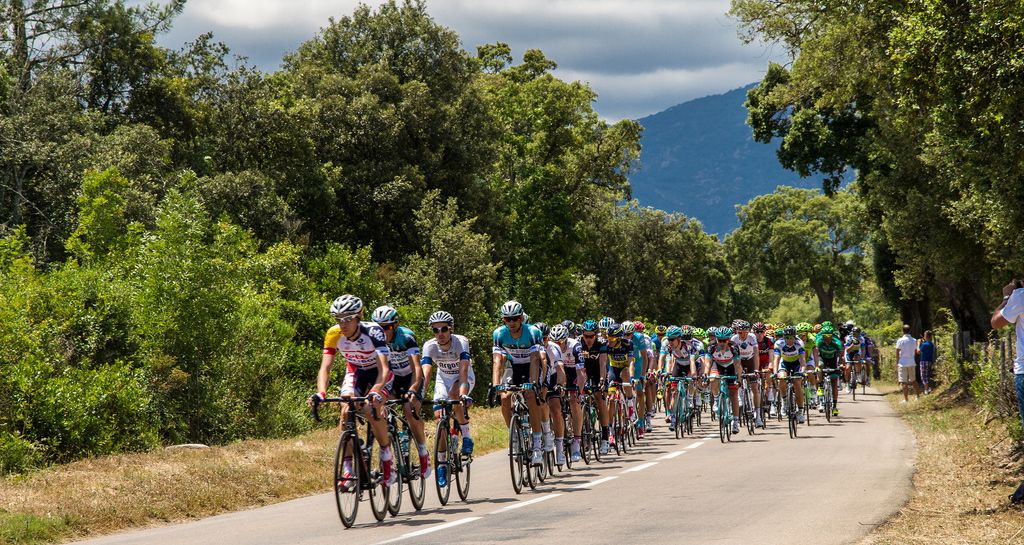
Day 3: A Wild Corsican Start
Eschewing a prologue this year, the Amaury Sport Organization decided to kick of the Tour de France with a flat stage and two hilly stages, ensuring action from the get go. We knew stage 1 would be hairy, ridden at times on narrow, windy roads even if it was flat, but we never could have predicted the crash-ridden affair that was. The Orica-GreenEdge team bus arrived at the finish late and (according to them team) was waved through the finish line toward the parking area… despite the fact that the gantry (a structure built set up several meters above the finish line that serves multiple purposes for signage and timing) had already been put in place. Predictably, the bus got stuck under the apparatus when the riders were less than an hour out, and what was initially a humorous affair turned crazy when the race staff could not manage to get the bus out. Over race radio, they informed the riders of an incident, and officially moved the finish line 3km closer… Minutes later, as the riders were closing in on the new makeshift finish line, staff succeeded in moving the bus, and back over race radio came the organizers, letting the riders know that the finish was now the original finshing line. Moments later (probably largely as a result of the confusion and rapid change in tempo), a few riders touched wheels and a massive crash took down a number of big names, including Peter Sagan, Tony Martin, and Alberto Contador. Stage favorite Mark Cavendish stayed upright but was stuck behind the carnage. A severely reduced bunch escaped the mess and among them was, Marcel Kittel, who managed to gallop to the stage win, his first in the Tour de France. Typically, if a crash occurs in the last three kilometers of a race, riders are given the time of the group they were with pre-crash; therefore, while the crash did not occur within there kilometers of the original finish, what with all the confusion about the finishing line caused through no fault of the riders, it was all but expected procedure when race organizers gave all riders the same time for overall classification on the day. While Tony Martin had to take a trip to the hospital, and others suffered bruises and cuts, nobody was too seriously injured.
Marcel Kittel wore yellow for Stage 2, and all 198 original riders managed to made the start, scabs and sore elbows be damned. Unfortunately for Kittel, the hills proved to much for the young rider, and he was dropped from the bunch, along with Cavendish and Greipel, well before the finish line. What looked like Sagan’s day to lose became much more exciting when a group of six riders struck out for glory from the pack after the day’s final descent with only a few kilometers to go, Sylvain Chavanel among them. Sagan and the rest of the peloton gave vigorous chase and rounded up all but Radioshack’s Jan Bakelants, who managed to huff and puff his way to a one second victory over the hard charging sprinters. With it came the yellow jersey and a 1 second lead over the others. Sagan took second on the day.
Stage 3 was even hillier, and once again, the flatland sprinters found themselves distanced on the climbs, leaving familiar names like Peter Sagan, Edvald Boasson Hagen and Simon Gerrans to duke it out for the win. Gerrans enjoyed a perfect leadout round the final corners and down the straightaway, and despite Sagan’s best efforts to ride Orica-GreenEdge’s wheels (a number of Cannondale riders couldn’t hang on over the climbs) before launching toward the finish, he ran out of road and Gerrans claimed Orica’s first ever Tour de France win. Sagan nabbed another second and with it, the green jersey, while Bakelants remains in yellow with his single second lead over everyone else. Despite not yet bagging a stage win, Sagan sits in a strong position in the points competition with two near-wins to Cavendish/Greipel’s combined zero top 20s. All three have managed to keep it close in intermediate sprints.
Now, I’ll look ahead to the next stretch of racing. We’ve moved to the mainland, and kick it off with a team time trial followed by three days before the Pyrenees.
Stage 4: Nice > Nice | 25km | TTT
Stage 4’s team time trial is too flat and too short to see large time gap’s form, so I don’t think it will have too lasting an impact on the overall general classification; however, with 70+ riders sitting a one second back on Jan Bakelants and a number of non-selective stages to come, the highest placed rider on the winning team tomorrow will likely wear the yellow jersey for several days. Stage 1’s craziness shakes up the team time trial. Had some big names, including world’s-greatest-time-trialist, Tony Martin, not taken a hard fall in that mess, I’d consider this a showdown between Omega Pharma-Quick Step and Sky, both of whom bring very strong teams to the Tour. Without Martin (OPQS) or Geraint Thomas (Sky) at full strength, it’s going to be harder to predict; but I’d still take OPQS and Sky over the others. Omega Pharma’s 23-year old Michał Kwiatkowski stands to win yellow if his team can deliver a victory, and if they do, he might even be able to hold it for several days, being a capable climber. Chris Froome, Richie Porte, and Edvald Boasson Hagen will lead a powerful Sky team against them with the possibility of EBH taking yellow if they win. I don’t think I have any surprise names for this one teamwise, as the team time trial is a discipline that favors the strong teams. Other contenders include BMC, Garmin-Sharp, Belkin, Orica-GreenEdge, and Movistar — people seem to underrate Rui Costa and Nairo Quintana as time trialists.
Stage Favorites:
1. Omega Pharma-Quick Step | 2. Sky
Stage 5: Cagnes-sur-Mer > Marseille | 228.5 | Flat
With an early Category 3 climb and then three Cat 4s, it’s no gimme that Cavendish, Greipel, and Kittel will make it to Marseille with the bunch. But the Missile and Gorilla know they have to make up a lot of ground for the green after missing out completely on the sprints at three straight finishes. If they don’t make it, obviously we can expect Sagan, EBH, Goss/Impey/Gerrans, and possibly John Degenkolb (though he failed to make it with the pack in both the second and third stages). However, I think most of the bunch gallopers are going to make it, and this could be Cavendish’s first stage win of the Tour. Hopefully, all three of Cav (probably), Greipel (probably), and Kittel (maybe) make it, so we can get a better idea of how each is doing form-wise in comparison to one another.
Stage Favorites:
1. Mark Cavendish | 2. Andre Greipel
Stage 6: Aix-en-Provence > Montpellier | 176.5km | Flat
A single Cat 4 climb stands out on an otherwise pancake-esque route. Barring a crash, it should be a day for the heavy hitter sprinters. GC contenders will try to stay clear of any messes. Peter Sagan will have a good opportunity to see whether his team, built almost completely around providing him with a strong leadout on the flats, can get him in contention here, especially after lackluster team showings on stage 2 and 3.
Stage Favorites:
1. Mark Cavendish | 2. Andre Greipel | 3. Marcel Kittel
Stage 7: Montpellier > Albi | 205.5km | Medium Mountains
The day’s four climbs in order: Cat 3, Cat 2, Cat 3, Cat 4. Unfortunately for the breakaway artists, there are roughly thirty downhill kilometers leading into the finish line, meaning that while a breakaway might survive for a while, it seems likely that the Sagan types in the peloton will charge hard on the descending roads to sweep them up after the flatland sprinters are dropped. On the other hand, with the Pyrenees looming, the GC types might want to hold off, which works in favor of the break. It’s a perfect day for Orica-GreenEdge, a team with a number of riders who are capable of winning in a breakaway AND winning in a reduced sprint, making either scenario favorable for the Australian squad. If I had to make a pick, I’d bet the group comes back together on the descent, pitting Sagan against whomever Orica-GreenEdge is riding behind and other versatile riders with fast finishes, like Francesco Gavazzi (Astana), or Edvald Boasson Hagen or Michał Kwiatkowski if they don’t mind going all out the day before they take to the high mountains. Given the likelihood of strong performances in Stage 4’s TTT from a number of teams who have good sprinter-with-climbing-ability types, one of the riders gunning for this stage win could be sporting the yellow jersey in the blur of the bunch sprint… if they manage to catch the breakaway.
Stage Favorites:
1. Peter Sagan | 2. Francesco Gavazzi
-Dane Cash
Photo by Jean François Bonachera.
Leave a Reply