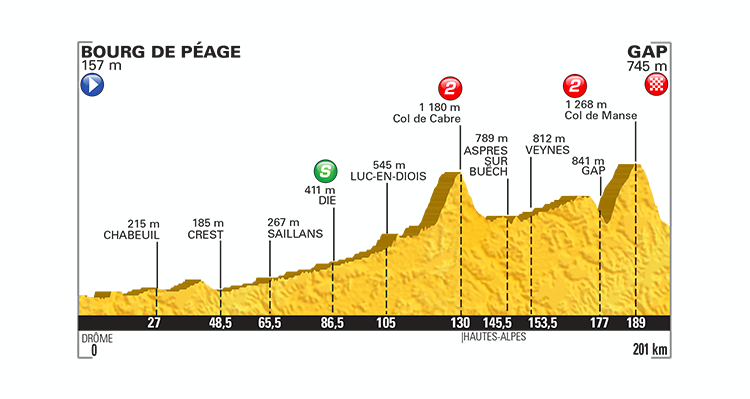
Stage 16: Bourg-de-Péage › Gap – 201km
In the final day of racing before the second rest day at the Tour, the peloton will take on a deceptively challenging 201km Stage 16 from Bourg-de-Péage to Gap. It’s the very definition of a transition stage, with the route taking the riders right into the foothills of the Alps in preparation for several tough days in the high mountains.
As such, the road takes a gentle upward bent for the first 120 kilometers that, despite lacking any categorization, will certainly put a bit of fatigue into the legs. Then comes the Cat. 2 Col de Cabre, 9.1km at 4.6%—it’s not an extremely difficult climb, but coming after a sustained gradient, it will hurt a lot more than the metrics might suggest.
A quick descent leads down to another uncategorized upward drag, before a speedy downhill into the second and final climb of the day, the Col de Manse. A Category 2 ascent at 8.9 kilometers at 5.6%, it’s another uphill test that will do more damage than the gradient would suggest.
From the top, it’s a steep, technical descent almost all the way to the finish line. Things only flatten out inside the final 4 kilometers.
The Tour has a great appreciation for Gap and for this particular route to the line—the race has finished there several times, especially in recent years. Every race is different, but if past trips to Gap are any indication of how this stage might play out, the breakaway will have a great chance, and the GC riders should be on their toes.
This is an excellent profile for a long-range move. The sprinters won’t really have a shot at the stage, and the Alps loom large, which will likely inspire the GC types to take it easy for most of the stage, at least until the final climb of the day. That will give the early breakaway an advantage, and even if an early move gets reeled in, others will likely be primed to jump clear as soon as the catch is made. Whatever the scenario, it will take a large engine, strong climbing legs, and excellent descending skills to win Stage 16. It’s long, there are a lot of vertical meters, and the descent into Gap is quite difficult—difficult enough to ruin Joseba Beloki’s career via a nasty crash, and difficult enough to force Lance Armstrong to show off his cyclocross skills when run off the road, when the Tour visited the same downhill in 2003.
Given the high likelihood of breakaway success (I rate odds of a long-range win at better than even) on Stage 16, there is really no single top favorite—there are only riders who will be more likely to succeed on the day.
Predicting which riders will make it into the main break has been an especially difficult proposition recently, with the teams of the GC outsiders putting in a lot of work to protect minor placings on the leaderboard. Plenty of riders at the fringes of and just beyond the Top 10 will be hoping to get up the road for stage honors here but that could be difficult given the competition.
Jan Bakelants has the wide array of talents, and the knack for getting into long-range moves, to thrive on Stage 16. He flashed excellent form on Stage 13, outclimbing nearly everyone on the steep uphill finale. If he’s in the lead group near the end of the day, the late climb and then the descent into gap will be an excellent opportunity for Bakelants to go in pursuit of a stage win. Alexis Vuillermoz and Romain Bardet give AG2R two more great options.
Michal Kwiatkowski is among the best descenders in the Tour de France peloton. On form, he combines uphill ability and finishing speed better than almost anyone in the race as well. At his best, Kwiatkowski would be a hot favorite for this stage, but he’s clearly not at 100% in this race. Still, Kwiatkowski has been active in the breakaway game and if he can hold on over the final climb, he’ll be deadly in the downhill run to the line.
Tinkoff-Saxo’s stated main ambition coming into the Tour de France was Alberto Contador’s GC campaign, but the team’s stagehunting aspirations have grown stronger and stronger as the race has gone on. This is an excellent profile for Tinkoff-Saxo’s stagehunters. Peter Sagan won’t have an easy time getting into the breakaway, but it’s certainly a possibility, and if he’s in the lead group at the end of the day, he’s got to be the top favorite. But even if Sagan misses out on a successful breakaway move, the team has other great options from afar. Michael Rogers is an excellent descender and won a similar stage from the break in last year’s Tour de France. Rafal Majka is in good form as well, and he’s a good bet to try to jump clear on the late climb.
Joaquim Rodríguez already has a pair of 2015 Tour wins, one from the breakaway. Rodríguez isn’t quite at his best form, but he’s still a stronger climber than most other potential breakaway candidates for the stage victory. The biggest question mark for Purito will be whether he tries to get into the move here, or whether he saves energy for the Alps.
Europcar also has options. Tommy Voeckler will appreciate the profile, and Cyril Gautier looks to be on very good form in this Tour (and has been active so far trying to get up the road). Pierre Rolland could try to get clear on the Col de Manse as well.
Vincenzo Nibali’s Grand Tour-winning climbing ability and elite descending skills will make him a top contender—if he’s at the front of the race at the end of Stage 16. Nibali’s current Top 10 GC position, though, may have his fringe GC rivals riding defensively to try to keep him from getting up the road, either in the early breakaway, or even late on in the day on the last climb. He’s got a great chance at Tour de France redemption via a stage win with this profile, but it won’t be a cakewalk getting clear of the peloton.
Sylvain Chavanel, Greg Van Avermaet, Dan Martin, Ryder Hesjedal, Jarlinson Pantano, Jakob Fuglsang, Wilco Kelderman, Simon Geschke, Rigoberto Urán, and Simon Yates are other candidates on the very long list of potential contenders from afar on Stage 16.
Regardless of whether the break is reeled in, the GC teams will likely drive a hard pace on the final climb—the Col de Manse has opened up gaps on the GC leaderboard in the past, and the day before a rest day in this year’s race, some of the more enterprising climbers in the pack could be on the lookout for opportunities to put their rivals into danger. That will make for a tough day in the peloton, likely to drop most of the traditional quick men from contention if the break does get caught.
Alejandro Valverde will be a favorite from the pack on Stage 16, given his strong descending abilities and terrific finishing kick. Tony Gallopin, whose climbing legs are more impressive right now than they’ve ever been, will have a great shot if this comes down to the pack as well, given his downhill skills and his impressive top-end speed. Chris Froome and Nairo Quintana can’t be counted out either. The latter has tried to test the former at every opportunity he’s gotten so far.
Michael Matthews, Matteo Trentin, Robert Gesink, Bauke Mollema, and John Degenkolb are others who will have a shot with the potential for a reduced sprint from the peloton.
VeloHuman Stage 16 Favorites
1. Jan Bakelants | 2. Joaquim Rodríguez | 3. Alejandro Valverde
With a rest day on tap following Stage 16, the next stage preview will be up on Tuesday—in the meantime, check out the latest episode of the Recon Ride podcast, which previews the final five stages!
-Dane Cash