

Stage 20: Modane Valfréjus › Alpe d’Huez – 110.5km
Stage 20 is the Tour’s final mountain stage, and the only stage in the race to feature two HC-rated climbs. Those two uphill tests are the only categorized climbs on the day, but they’re plenty challenging by themselves.
It’s a very short stage at just 110.5 kilometers, so expect a high pace all day. After a downhill run of 25km from the start the road angles upward in the form of the now-familiar Col de la Croix de Fer, though this time they approach the summit a different way.
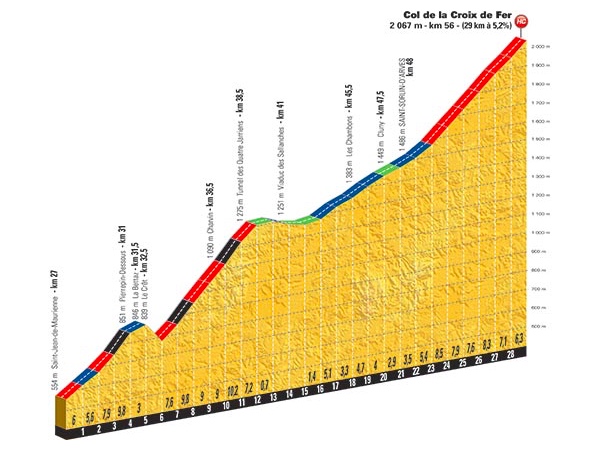
The trip upward will span 29km at 5.2%, with a few steeper sections early on and then near the top.
After the riders crest the climb, they’ll head downhill for about 30 kilometers into a short stretch of flat road, which leads into the foot of the final mountain climb of the 2015 Tour de France: Alpe d’Huez.
The legendary Alpine test is 13.8km in length with an 8.1% average gradient. It is at its steepest at the beginning of the climb and then with around 3 kilometers to go. Things even out a bit near the top for a final kilometer at just over 5%.
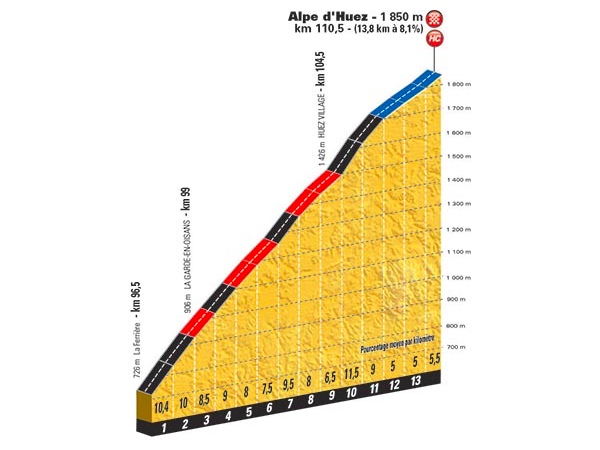
The profile isn’t a terrible one for the early breakaway, and if a strong group gets up the road they will have a chance, but most of the big favorites from afar have spent a lot of time in the breakaways in the past two stages, and that could leave them low on fuel. The GC men, especially if they wind it up early to put pressure on each other, have a good chance of fighting it out for the final mountain stage in the Tour.
Nairo Quintana put some time into Chris Froome on Stage 19 and will look to do so again on Stage 20. For Froome, the goal is simply to not lose 2 and a half minutes on the stage. Froome didn’t look totally cooked on Stage 19 and was probably playing things conservatively, limiting the damage reasonably well—but the young Colombian is nevertheless closer to yellow than he was before. That could have Froome planning to take Stage 20 as safely as possible.
If he decides to attack Quintana, Froome’s an obvious danger for stage win, but with the Tour de France on the line, that seems like a risky proposition. What’s more, Quintana, benefiting a great deal from having Alejandro Valverde as a foil, might just be stronger now anyway. If this does come down to the GC favorites, it’s hard to see anyone challenging Quintana for Stage 20.
Alberto Contador will likely give it a shot. He’s way too far down on Froome to be a threat, but the podium is not completely out of reach, and a stage win would be something of a consolation prize for Contador, whose Tour has fallen very short of his expectations. He’s not strong enough to beat Froome and Quintana head-to-head but there’s a chance he’s given enough of space that that won’t matter too much.
Stage 19 winner Vincenzo Nibali could obviously have aspirations of breaking clear of the GC group once again, and he’s certainly looked stronger in the past few days than he did at the start of the race. But he’s not likely to get nearly as much breathing room as before now that he’s in contention for the podium, and he’s bound to pay somewhat for his efforts on Stage 19.
Robert Gesink sits nearly 9 minutes behind Froome on GC, and he has nearly 4 minutes of cushion to the next rider on the leaderboard. If he feels strong on the final climb, don’t be surprised if he tries to leave the GC men behind to go in pursuit of a stage win. Even if his bid fails spectacularly, he’s got plenty of time to lose to drop even one spot inside the Top 10.
Romain Bardet has enjoyed two great stages in a row, with a win on Stage 18 and a top 5 placing (and plenty of KOM points racked up) on Stage 19. He’s certainly strong right now, and he’s far enough behind on GC that he’ll be given some space if he wants to go for a long one. It’s hard to predict how he’ll play the stage—in his quest for the KOM title, the points on the Croix de Fer won’t actually be all that important if Froome ends up placing highly on the final climb. Bardet can’t afford to wear himself down too much and not be in contention for a decent placing at the finish. As such, his strategic decisions should be more focused simply on whether he thinks he has a better chance at a high stage placing (and the accompanying KOM points) from the pack, or in the break. Sticking with the peloton until the final ascent and then launching a move could be the best tactic. In any case, after two days of exhausting himself, Bardet is likely to be bringing a bit of fatigue into Stage 20, so it will be a big challenge for him to take a victory, especially with stronger GC favorites and fresher potential breakaway candidates having their eyes on the same prize.
Joaquim Rodríguez is in a similar boat, but he has not looked the best in the past two stages. The veteran racer could still recover, however, and unlike Bardet he conserved energy after the breakaway was reeled in on Stage 19, so don’t be surprised if he gives a long-range attack another go on Stage 20.
Pierre Rolland has plenty of form in this Tour de France but two days in a row of exhausting solo efforts won’t have left him with much energy to try for another on Stage 20. Then again, everyone will likely be tired and Rolland isn’t a threat to the overall, so he may find success if he saves energy by riding in the pack until the final climb, and then goes for a long one on the early slopes.
Thibaut Pinot stayed with the GC men for the entirety of Stage 20, which, first, suggests that he is feeling strong right now, and second, will likely leave him a bit fresher than Bardet, Rodríguez, and a number of other likely breakaway contenders. That could serve him well for a long-range move, though he hasn’t quite had the strength to turn in a victory so far.
Jakob Fuglsang was one of the few big-name potential breakaway favorites to completely save his energy on Stage 19, dropping out of the GC group early, and he’s looked strong enough in this Tour that he may have a chance with a long one on Stage 20. The question for Fuglsang will be whether he gives it a shot at all. Now that Nibali is fighting for the podium, Astana may call for all hands on deck in support of the Italian GC contender, which could leave Fuglsang playing domestique. If he goes on the attack, he’s a dangerous rider.
Rigoberto Urán, Rafal Majka, Ryder Hesjedal, Andrew Talansky, Cyril Gautier, Adam Yates, Serge Pauwels, Samuel Sánchez, Warren Barguil, Mathias Frank, and Rafael Valls are other names to watch for a long-range strike on Stage 20.
VeloHuman Stage 20 Favorites
1. Nairo Quintana | 2. Chris Froome | 3. Alberto Contador
Don’t forget: you can find plenty more Tour de France analysis in the most recent Recon Ride podcast episode. Be sure to follow @VeloHuman on Twitter for more commentary during the race, and check back for the preview of the final stage of the 2015 Tour after the conclusion of Stage 20.