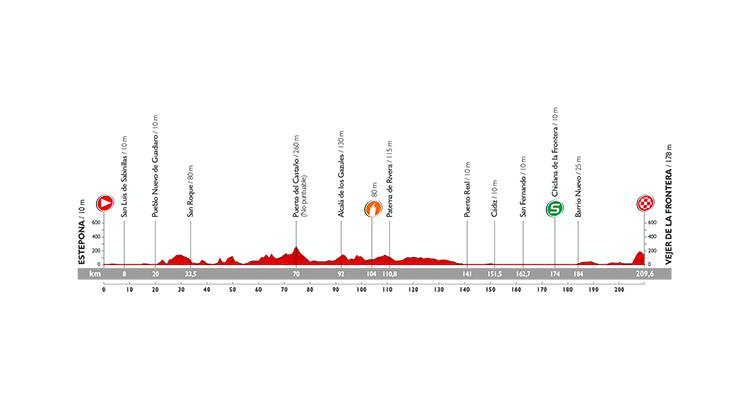
Stage 4: Estepona › Vejer de la Frontera – 209.6km
A cursory glance at the Stage 4 profile might lead you to expect a big bunch sprint at the end of the day. But take a closer look at the last 5km and it should be clear that the heavyweight sprinters won’t be in a happy place in this finale.
There isn’t a single categorized climb on the road from Estepona to Vejer de la Frontera, but things get very difficult just before the line after 200 mostly flat kilometers. With just over 4km to go, the road kicks up at a gradient of just over 10% for a little over a kilometer. After that initially vicious uphill stretch the grade eases a bit, but the climbing continues until there are about 2km to go, when the road flattens out, before angling downhill until there are just 500 meters left. Then the road kicks sharply upward again, getting into the double digits before easing to a gradient of a little over 4% at the finish.
A straightforward sprint with all the traditional speedsters in contention seems unlikely. First, the initial steep section could provide a launching pad for an aggressive puncheur to make an attack in the closing kilometers of the race. And if things are all together coming under the flamme rouge, the uphill drag to the line will favor a different sort of rider. Strong climbing legs will be as critical as explosiveness on Stage 4.
Peter Sagan has both in spades. He showed on Stage 3 that he’s not just taking the Vuelta a España as a long training ride, and having proven that he’s not afraid to go after the stages that suit him, he’s suddenly a dangerous contender in the stagehunting game. All that said, it’s still going to be hard to predict just when he’s going to put it all on the line to hunt down results in this race. The tough Stage 4 finish suits him very well, as it is likely to prove too difficult for anyone else with the same sort of speed, but there is always the possibility that Sagan just isn’t interested in expending the necessary effort to go for the win. If he does, he’ll be hard to beat. If he doesn’t, this is a wide open stage.
The finish looks great for Dan Martin, who showed strength on Stage 2 despite missing the day’s winning move. Martin has a Monument-winning ability to launch a late attack, but he’s also handier in a fast finish than most riders with his ability to climb should things stay together for a reduced sprint in the final few hundred meters. Martin is fresher than many of the star climbers in this race, and motivated to pick up a big result after a slow season.
Alejandro Valverde has the skillset to thrive at this finish and should be among the favorites, but form is a bit of a question mark. He was somewhat disappointing on a Stage 2 that seemed to suit him perfectly, just as he was a disappointment on the Mur de Huy and Mur de Bretagne in the Tour de France. If he’s worked through a bit of early-race sluggishness though, he’ll be up there fighting for the win.
The Katusha duo of Joaquim Rodríguez and Daniel Moreno should be anxious for a second chance after a missed opportunity on Stage 2. Rodríguez in particular looks strong and up for a challenge just like this where he can try a late attack, or rely on his decent uphill sprint.
John Degenkolb has shown flashes of the ability to take on something this steep, but he’s much better served when the tough climbs come earlier on in a stage—he’s capable of grinding it out over a long day of up and down and sticking it out for a flat sprint, but when the finish itself is this challenging, Degenkolb might struggle. Teammate Tom Dumoulin should be the best option for Giant-Alpecin. The double digits aren’t his forte but he’s got a nice turn of speed and a terrific ability to go solo when the opportunity presents itself.
Esteban Chaves took the peloton by surprise to take the Stage 2 win and the red jersey after a somewhat quiet season, but he won’t be able to stay out of the spotlight on Stage 4. All eyes will be on the race leader on the final climb. He’s still a threat but this isn’t a perfect finish for him compared to some of the other favorites, and he doesn’t have the element of surprise. Simon Gerrans would probably be OGE’s best option here, though his form is an unknown, as he’s coming back from an injury. If he’s healthy, he could contend for the win.
Carlos Barbero has had a lot of success this season on this sort of profile, though generally his results have come against far less imposing rivals. Still, don’t count him out against the Vuelta field—Caja Rural is on home turf and highly motivated to come away with a stage win in Spain’s biggest race.
Jelle Vanendert, Bart De Clercq, JJ Rojas, Nicolas Roche, Sergio Henao, Jasper Stuyven, Fabio Aru, and Domenico Pozzovivo are others to watch for Stage 4. Lastly, don’t completely count out Nacer Bouhanni. It will be a very tall order for the Frenchman to survive the steep stuff, but he looked mostly recovered from his Stage 2 crash in the sprint finish to Stage 3, and he has at times shown an ability to handle tough finales like this one.
VeloHuman Stage 4 Favorites
1. Peter Sagan | 2. Dan Martin | 3. Alejandro Valverde
Be sure to follow @VeloHuman on Twitter for more analysis and commentary during the race, and check back for the preview of the next stage after the conclusion of Stage 4. The VeloHuman overall Vuelta a España race preview is available here.