Tag: 2013

  • 2014 Rider Ranking Analysis: A Data-driven Approach

    2014 Rider Ranking Analysis: A Data-driven Approach

    Last week, VeloHuman published an article focused on the breakout stars of the 2014 season, continuing a tradition begun in 2013. Just as was the case last year, much of that analysis came out of a data-driven approach: VH charted rider performance differentials from last season to this one by looking at the points riders accumulated in that timeframe according to both Cycling Quotient and WorldTour Rankings and comparing the difference from one year to the next. Such an analysis makes it easy to see the most dramatic shifts in performance across the professional peloton. Providing a bit of data visualization and also the raw data itself proved a popular decision last year, allowing readers to draw their own conclusions about the ups and downs of the season, so VH decided to provide those tools again this year! Without further ado, the 50 biggest CQ points swings (for riders who were active this season—Mauro Santambrogio, suspended for the year, was left out of the graphic) between 2013 and 2014:


    Click here to view the full-size, single image version.

    Just a few of the highlights that jump out from the graphic: injuries obviously played a huge role in 2014. Back problems, heart problems, broken wrists, broken collarbones, and broken ribs accounted for much of the red in the Top 50. For some riders, however, the dropoff in performance could not readily be attributed to a fracture or other ailment. Peter Sagan stood on two Monument podiums and won a Tour de France stage in 2013; he didn’t make a single Monument Top 3 and he went winless in the Tour this year. He still finished 2014 ranked 9th overall in CQ Points, but instead of progressing, as may have been expected of the still young star, Sagan seemed to stagnate. Alberto Contador, on the other hand, overcame injury to soar this season. He may have missed out on Tour results but he dominated the one-weekers of the early season, taking victory in Tirreno-Adriatico and Pais Vasco and 2nd in Catalunya and the Dauphine, and then came back with a vengeance in the Vuelta.

    The red bar to the left of Vincenzo Nibali’s name may come as a surprise, but it shouldn’t; these are season-long rankings that take into account performances across the racing calendar. Nibali probably wouldn’t give up his season for the world, and a victory in the Tour de France makes it easy to ignore the entire rest of the year, but the Italian stage racing star plainly underwhelmed in the contests leading into the 2014 Tour, and did not put in many race days after Paris.

    Heralded rising stars like Michal Kwiatkowski, Tom Van Asbroeck, Fabio Aru, and Tom Dumoulin soared up the various popular rider ranking systems this season and that is reflected here, but a few of the breakout performances you may have missed are shown as well: Pete Kennaugh made statements in several Continental Tour races, and with the powerful support of Team Sky he should continue to develop. Jerome Baugnies of Wanty – Groupe Gobert has been a consistent performer in lower level races across the past few months. Niccolo Bonifazio, who just turned 21 last month, has taken big results at home in Italy and abroad; he just won three stages and the Points Classification, as well as taking 2nd overall, in the Tour of Hainan, a fine way to close out his first full season as a pro.

    The data visualization above offers some highlights from this season’s year-over-year rider ranking data but there is plenty more information to be gleaned from the raw numbers. If you are handy with data manipulation, you can draw conclusions of your own: click here to download the 2013–2014 data for the Top 500 riders of the season (on the CQ Ranking scale). Inside, you’ll find identifying biographical data (name, team, country, and birthdate) and CQ Ranking and WorldTour data from 2013 and 2014 along with the differentials across both seasons, so that you can filter and sort to your heart’s content as you make your own analysis. Keep in mind that Cycling Quotient’s ranking system and the WorldTour ranking system are different and favor different things—the CQ Ranking values Continental level results, for instance, while the WorldTour rankings do not. In fact, non-WorldTour riders do not score WT points at all even if they get results in WT races, which is why WorldTour ranking data doesn’t exist for plenty of names on the list. Both systems have their advantages, and ultimately, the sport’s biggest names score highly on both scales anyway.

    Feel free to share your thoughts here in the comments or on Twitter @VeloHuman!

    -Dane Cash

  • 2012-2013 Rider Ranking Data

    Yesterday, I offered some perspective on riders I thought made strides this season (just scroll down a bit if you haven’t read my thoughts yet). Much of that analysis was driven by my own observations, but I did a fair bit of data work to add a level of comprehensiveness that I would not have otherwise achieved. I work a lot with data analysis at my day job, and I couldn’t help myself when I started thinking about tools I might use to analyze rider performance! I figured I might as well share that data with anyone who is interested.

    I took Cycling Quotient’s top 200 riders and gathered various ranking data on them, namely: rider name, birthdate, nationality, 2013 team, 2012 CQ rank and points, 2013 CQ rank and points, 2012 UCI rank and points, and 2013 UCI rank and points. I calculated the changes in rank and points for both systems, and also the absolute values of points changes for both systems, and ended up with a table that was sortable based on many different factors. For those of you who are also bored and starving for cycling info this offseason, I hope my work will offer some solace!

    Here is the file, for download at your convenience:

    2012-2013 CQ and WorldTour Ranking Data

    If you know your way around Excel, you can sort and filter this info to your heart’s content. Want to examine the top-ranked British riders under the age of 28? Open in Excel, go to the data tab and apply filters, filter date of birth and nationality as you like, sort on CQ rank (or WorldTour rank if that’s what you’re looking for) and voila! I found sorting on absolute value of points deltas to be quite enlightening in terms of visualizing which riders saw the most emphatic changes from 2012 to 2013. Here are the top 25 biggest swings in CQ points out of that list of 200 in a handy bar chart from Datawrapper:

    25 Biggest Swings in CQ Points out of Top 200

    You can visualize all kinds of info if you know what you’re doing. And no matter how you feel about the UCI WorldTour system, the WT points swings you’ll see in the file actually do a pretty darn good job of tracking rider performance at the highest level from one year to the next; one of Cycling Quotient’s most valuable features is that it assigns a meticulously plotted points value to every pro (and national/world championship) race on the calendar. Thusly, young up-and-comers who have a lot of success on lower circuits make their way onto the CQ radar well before they make their way onto the world stage. At the same time, this means that it can be a bit harder to use CQ ranking to visualize which riders made big statements with top-level victories, which is essentially the point of the WorldTour ranking system. However, don’t forget the Pro Continental riders do not score WT points, meaning that those who rode for Europcar in 2013 will be absent from the WT rankings, etc.

    Some interesting top-level tidbits: how amazing was Chris Froome’s 2013? Even after a very successful 2012, Froome raised the bar to an unprecedented degree with his 2013. Meanwhile, nobody came close to Froome’s compatriot Bradley Wiggins in terms of sheer dropoff in results. Joaquim Rodriguez is an interesting case: even with another Monument victory, 2nd place at the World Champs, a podium finish in the Tour, and a host of other successes leading to his second straight WT number 1, he saw a pretty steep points decline on both the CQ and WT scale. The data also remind us that despite a Tour filled with interview focused on his apparent demise, Mark Cavendish still had one heck of a season; don’t forget his 5 Giro victories on route to that race’s points classification victory. And for a final note, remember that this list includes those riders in Cycling Quotient’s top 200 for the year: that means that one of the biggest performance drop-offs of the season isn’t reflected anywhere, because Ryder Hesjedal is not one of CQ’s top 200 this year!

    I hope my data compiling allows you to crystalize your own opinions about rider performance trends. And don’t get too down if you’re an Edvald Boasson Hagen or Simon Gerrans fan: remember how big an impact injury can have on a rider’s performance in any given year. And with that, I’ll leave you to your analysis! Enjoy.

    -Dane Cash

    Rider data from cqranking.com and uciprotour.com, data visualization from datawrapper.de.

  • Post-year Impressions: Charting the Arrivals and Step-ups of 2013

    HesjedalCostaBetancur

    2013 is in the books! Beñat Intxausti won the GC of the final WT race of the year, the Tour of Beijing, by taking a victory on the decisive fourth stage. Joaquim Rodriguez finishes the year as repeat WorldTour champion on the back of his GrandTour successes, a Monument victory, and a truckload of high placings in other big races.

    As this site is in the business of prospective analysis, my look back at 2013 will mostly be a look forward. I hope to shed some light on what we learned about the top riders in the sport this year, and which riders to watch in the future. If you’re reading VeloHuman, you don’t need me to tell you that Chris Froome is a rider to keep an eye on next year, or that Vincenzo Nibali is shaping up to be his main rival, or that Fabian Cancellara is still a talented racer. Instead, it’d be more productive for me to focus on the riders who made vast improvements in 2013, who we might say “arrived” this year, and who have set themselves up to do big things next year, so I’ll do just that, and name some names that I think made big strides this season and look to continue to do soon in the near future.

    A rather obvious duo headlines my list of the most emphatic arrivals this year. While everyone was busy wondering which Spaniard would present the best case against Chris Froome in the Tour de France, a 23-year old Colombian leg-muscled his way onto the scene, building off of early season success in the Tour of the Basque Country with a fierce display of climbing prowess on some of the Tour’s most difficult stages: Ventoux, Alpe d’Huez, Mont Semnoz. Though the early lead Froome had built up was insurmountable, Quintana’s later stage performances, matching the Sky captain’s every move uphill on his way to 2nd overall, a stage win, the polka-dot KoM jersey and the young rider’s white, he saved Movistar’s Tour after their team leader Alejandro Valverde hit some raw luck with a mechanical that dropped him out of contention. No one will overlook him next year, especially with such a climbing-oriented 2014 edition of the Tour de France on the docket. Alternatively, he could set his sights on the Giro. Quintana’s time trialing might need a bit of work, but he showed this year that he can outclimb most of the sport’s biggest names, and you have to think he can only get better, still a few years shy of his prime.

    Countryman Carlos Betancur blazed onto the scene with similar brightness. Top 10s at La Fleche Wallonne, Liege-Bastogne-Liege, and the Tour of the Basque Country were followed by a highly successful Giro d’Italia, in which the young Colombian took 5th overall and the young rider classification. Like Quintana, he is sorely lacking in the time trialing department—his remarkable Giro was made all the more remarkable by his appearance in the top 10 after losing almost five minutes to the eventual winner of the race in the first ITT. Like Quintana, he’ll gun for future Grand Tour success in chrono-light parcours while he improves in that discipline, and while he may be a shade shy of Quintana’s level on the longer Tour style climbs, he’s more explosive than the Movistar wunderkind, and will surely be a fixture in the climber’s classics to come.

    Zdenek Stybar is my other most emphatic arrival of the year. His situation is unique, in that cycling fans have heard Stybar’s name for years, but in a different discipline. Making the switch from cyclocross appears to have worked out for the Czech rider: even after a collision with a fan robbed him of a potential podium position in Paris-Roubaix, he still finished 6th in that race, and followed it up with a dominant Eneco Tour and a beautiful stage win in the Vuelta where he outsprinted none other than former World Champ Philippe Gilbert. His versatility was dazzling, and he will go into the 2014 classics season as a hot favorite across all kinds of terrain—and isn’t that the perfect expectation for a former cyclocross world champion?

    Many other riders who were already well within the sights of cycling fans took leaps onto the highest level. Outside of Quintana, the most emphatic arrivals among riders who finished the year in the WorldTour top 10 were made by Dan Martin and Rui Costa. Dan Martin was already a name on the minds of observers at the start of the season, with a Grand Tour stage win in 2011 and the overall victory at the Tour de Pologne in 2010, but he took a Monument Classic, a Tour de France stage win, and the overall at the Volta a Catalunya this year, successes that vaulted him to 6th place in the final WorldTour rankings of 2013 (putting him ahead of Spartacus himself). And Rui Costa came into the year as a well-known talent as a winner of a Canadian GP, the Tour de Suisse, and a stage in the Tour de France, but his two Tour de France wins and World Championship (to go with another dominant Tour de Suisse) put him at cycling’s center stage. He goes to Lampre in 2014 as the team leader, a Tour de France GC hopeful. Another star of the Tour, Bauke Mollema was already a well-known name for many fans of the sport, having finished 4th overall and 1st in the points classification in the 2011 Vuelta, but he came into his own this year with strong performances all over the calendar, in the Ardennes Classics, the Tour de Suisse, Tour de France, Vuelta (where he won a stage to redeem a disappointing GC effort), and Clasica de San Sebastian. His emergence comes at just the right time, with teammate Robert Gesink having another disappointing year in terms of Grand Tour GC contention; however, Gesink showed strong late season form in shorter races, winning the Grand Prix Cycliste de Quebec and placing highly in other events, suggesting a possible change of focus to shorter races going forward. And the timing was ripe for Marcel Kittel to make an explosive entrance: after injury in 2012 robbed him of an opportunity to make his mark on that year’s tour, his 2013 outing, which earned him a quartet of stage wins, suddenly sees him in the best-of-the-best conversation with Mark Cavendish and Andre Greipel.

    In case you missed it, his teammate Luka Mezgec was one of a number of young up-and-coming sprinters who showed promise this year. Mezgec spent the whole year nipping at the heels of other sprinters, racking up countless top 5s without a win until he finally picked up his first of the year and his first WT level win ever on the very last day of the WorldTour calendar in Beijing. Nacer Bouhanni took a pair of wins in that race to go with the points jersey, as well as a number of other wins this year, a boon for FDJ. His squadmate Arnaud Demare took stages in the Eneco Tour and the Tour de Suisse, an armful of honors in the Four Days of Dunkirk he won, and high placings in a number of one-day races. Yet another French, Europcar’s Bryan Coquard, a former track cycling star, transitioned quite nicely onto the road, collecting honors left and right on the Continental circuit. The 21 year old will be a major force on the fast finishes in 2014 now that Europcar looks to be joining the top division of teams. Michael Matthews came into the Vuelta flying high after Continental Tour success and proceeded to establish himself as the best sprinter in that race, with a special talent for nabbing victories after tough days in the saddle. His skills nabbed him a pair of stage wins, including the victory on the final day’s sprinter battle royale.

    Speaking of quick hardmen, Alexander Kristoff gets a paragraph of his own: he built on a strong 2012 (in which he took an Olympic Bronze Medal) with top 10s in three Monument Classics and his first WorldTour level win in the Tour de Suisse (besting Peter Sagan on a tough day that ended in a sprint). He has established himself as a serious contender for hardman sprinter’s races going forward.

    The Vuelta gave us an opportunity to see a number of coming out parties for GC contenders. Leopold Konig landed in the top 10 and picked up a stage win at the head of a Pro Continental team, quite a feat for the 25 year old. He’ll stay with NetApp for another year and will hope his performance garners further invitations to big events, where he’s sure to continue his success. Meanwhile, Saxo-Tinkoff’s Nicolas Roche achieved some long awaited success with a top 5 finish and a stage win. His constant presence at the front of the pack on mountaintop finishes in Spain suggests that he may finally have taken the step up to the next level, a good sign for 2014.
    Ulissi

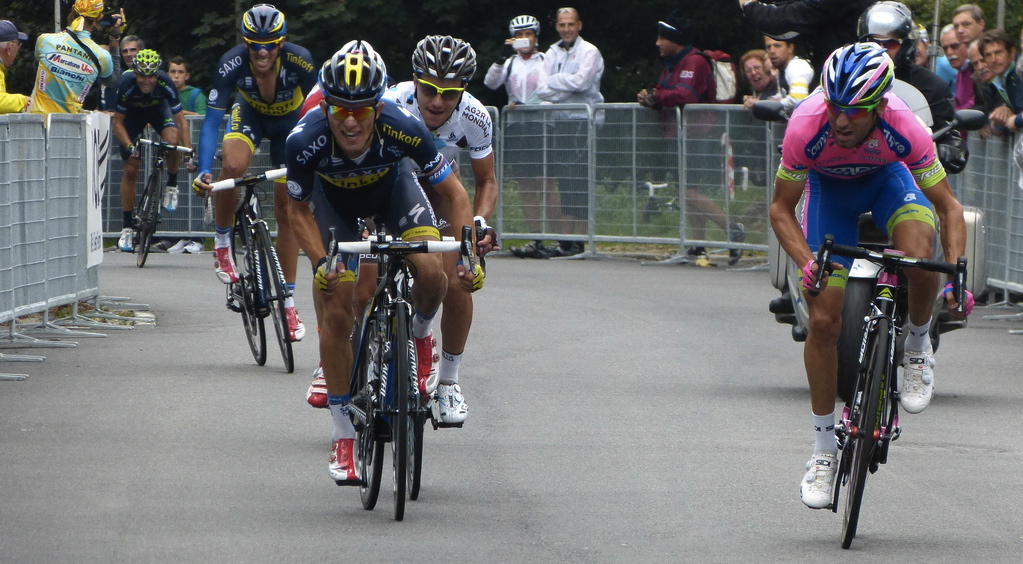
    Poland showed off a pair of riders with top level ability this year. Nico Roche’s teammate Rafal Majka didn’t win any races, but he was 7th overall in the Giro d’Italia and 2nd to Betancur for the young rider classification in that race, and he followed up with a 4th overall in his home tour to go along with his 1st place in the points classification of that race. The honors kept piling up as the year went on, when he narrowly missed out on a victory in Milano-Torino against another rising star (pictured above) and then stood on the podium in the final Monument of the year in Lombardy. By the same token (eerily), Michal Kwiatkowski may still have yet to win a pro race, but he burst onto the scene this year with a boatload of strong performances. 4th in both Tirreno-Adriatico and Amstel Gold, 5th in La Fleche Wallonne, and a heartbreaking 11th in the Tour de France after fellow up-and-comer Andrew Talansky grabbed the final top 10 spot on the last day of climbing, Majka looks to be a likely candidate for continued climbing success, and Kwiatkowski showed an incredible array of skills and looks poised to stake a claim to best all-rounder in the very near future.

    A significant number of teams saw young climbing talents rising up the ladder this year. Many are Italian. 2011 Giro stage winner Diego Ulissi took a big step forward with successes on both ends of the season, nabbing a top 10 at Paris-Nice early and then a stage win in the Tour de Pologne and a string of semi-classic victories in Italy. So far, most of his quantifiable successes have been on smaller stages, but he performed at a high level in some big races this year (he was lurking in a number of stages in the Vuelta even if he didn’t come away with a win), inspiring a lot of confidence going forward. He’ll be part of an explosive one-two combination with Rui Costa at Lampre in 2014. Astana teammates Fabio Aru and Simone Ponzi look like prime candidates for success next year. Another Italian, Moreno Moser, had several standout performances this year for Cannondale; he disappeared at times when he was expected to bring his success to a bigger stage, but he showed in Strade Bianche and other races in 2013 that he certainly has the ability to turn promise into achievement in 2014.

    Spaniard Jon Izagirre won’t be sweating the dissolution of his former team Euskaltel too much now that he has a new squad in Movistar, and it’s easy to see why they signed him. He nabbed the runner-up honors in the Tour de Pologne with a surprising time trial performance on the last day, and notched top 10s in the Tour Down Under and the one day Grand Prix Cycliste de Montreal as well.
    Vichot

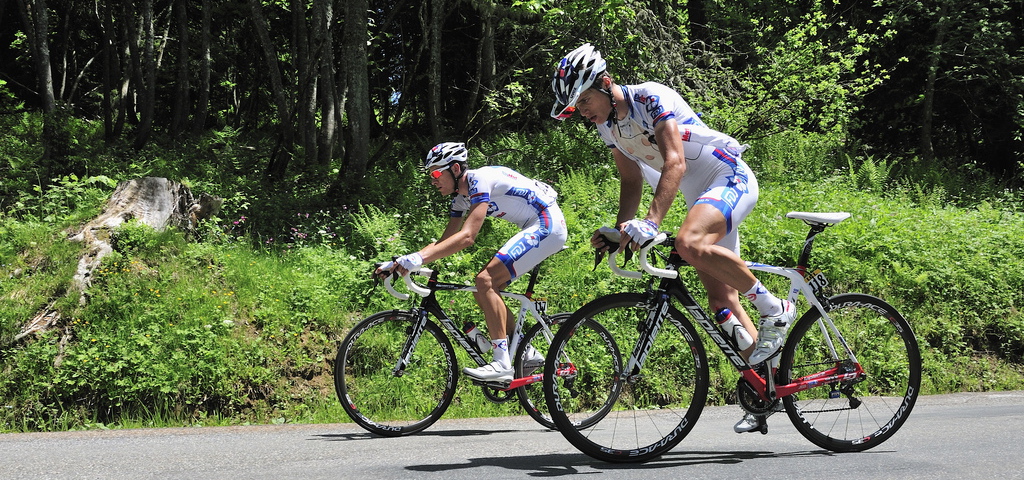
    24 year old Arthur Vichot looks to be one of yet another up-and-comer for FDJ with strong climbing legs and a fast finish, abilities that netted him the French national championship, the runner-up honors in Quebec, and the victory in the Tour du Haut Var-matin. AG2R’s Romain Bardet, winner of the Tour de l’Ain and a high finisher in the Tour of Beijing, appears to have a bright future, and he joins teammate Carlos Betancur as part of a crop of young uphill chargers on that team.

    Wilco Kelderman, a natural time trial talent, came into his own as a climber with a number of high-level successes in 2013. He picked up top 10s in Romandie, the Eneco Tour, and the Tour Down Under, and dominated the Tour of Denmark, where he won a stage, the points classification, and the overall. He’s another exciting up-and-comer for Belkin.

    Argos-Shimano teammates Warren Barguil and Tom Dumoulin got themselves onto the map this year, the former nabbing a pair of breakaway victories in the Vuelta, and the latter claiming runner up honors with an impressive Eneco Tour performance. Alongside Marcel Kittel, Luka Mezgec, and John Degenkolb, the duo makes a potent quartet of Argos riders 25 and under.

    Riccardo Zoidl nabbed the GC win at the Tour of Austria, and climbed at a high level in a number of other events. Darwin Atapuma moves up from Team Colombia to BMC after nabbing his first WorldTour win this year in Poland—that team desperately needs new blood, and Atapuma will be happy to oblige.

    To match all these young climbers coming into their own, a few time trialists are on the rise: Adriano Malori looks to be a threat in that department, putting in a top 10 at the World Championship ITT and taking second place behind Tony Martin on a few time trial stages in WorldTour races to go along with his ITT victory and the overall in Bayern-Rundfahrt. Rohan Dennis out-time-trialed Chris Froome in the Criterium du Dauphine on his way to a top 10 there and then showed his versatility when he won a stage and the overall in the Tour of Alberta. The 23 year old has established himself as a promising member of Garmin’s youth movement.

    This list is by no means exhaustive, and obviously much depends on how you define breakout success, but hopefully I’ve rattled off the names of many of tomorrow’s biggest names. And thanks to the Tour Down Under and its January start date, we won’t have too long to wait for the opening of the 2014 calendar–in just 11 weeks, the pro peloton heads to Nuriootpa, Australia to kick off the new season!

    -Dane Cash

    Photos by Flowizm, brassynn, and Georges Ménager.

  • Tour of Beijing 2013 Preview

    Miaofeng

    The Road Ahead

    The last WorldTour race of the year! Despite all the controversy around this race, and all the derision that is heaped on it by observers due to the poor organization and abysmal air quality that riders must suffer through in the name of cycling’s globalization (and in the service of a fat paycheck for the UCI), it’s still a major event with major contenders seeking last minute WT points. For all the hate it gets, it’s still a race that sees some of the sport’s biggest names fighting for victory, and the 2013 edition is no different. Current and former World Champions of Road Race and Time Trial, a Monument winner, and the Vuelta’s best sprinter are all making the journey to China.

    The 2013 Tour of Beijing will consist of five stages, none of them time trials. The first is a flat day sure to end in a sprint. The second throws in a few hills, but with a long flat run in to the finish, it’s another likely day for the sprinters. Stage 3 involves a hefty dose of climbing miles sure to put some fatigue in the legs before a summit finish on Stage 4 atop Miaofeng Mountain (site of the lovely sunset scene depicted above) sure to decide the Tour of Beijing. The final stage is a flat circuit race, another day for the sprinters.

    All-rounder Roundup

    Tony Martin is the two time winner of the Tour of Beijing, and as usual he heads a strong cast of supporters, but this year’s trip to China is different from the previous two: not only is there no time trial, but there is also a steep summit finish, which has not been the case in Tours of Beijing past. Stage 4 almost guarantees the winner will be a climber; the only way Tony Martin wins this race is with a long distance breakaway. Obviously he’s the rider to make this happen if it does, but that kind of gap when he has such a target on his back will be a tall order.

    There are plenty of star climbers to take up the challenge. The best combination of form and talent at this point seems to be Garmin-Sharp’s Dan Martin, 4th in this race and King of the Mountains last year. In 2013, that mountain prowess means so much more. Martin was one of the top five riders in Lombardy last week, and a time trial-less one-week stage race with only one or at most two days to make an all out attack is just his style. Back in March, he won the Volta a Catalunya with a powerful uphill move on the most mountainous stage of the race, he’ll look to do the same here.

    World Champion Rui Costa leads a strong Movistar squad. He’s an elite climber and, like Dan Martin, has elite explosiveness well-suited for stage races decided on one or two key days. Obviously, the world champion is on form right now, as he always seems to be at the end of the year. The two-time Tour de Suisse winner was 9th here last year. Capable climbers Benat Intxausti and Giovanni Visconti provide ample alternatives for the Spanish team.

    A third rider matching form to ability is Belkin’s Robert Gesink, who has some good results these past few weeks, winning in Quebec and coming in 10th in Lombardy. Not long ago he was touted as a Grand Tour contender, with climbing talent that landed him in the top 5 of a Tour de France. Like Martin, he’s shown a great kick in one-day races this year, and also like Martin, he’ll appreciate the lack of a time trial stage. Wilco Kelderman is a great backup option.

    Richie Porte heads Team Sky’s challenge. The Paris-Nice winner showed climbing ability in the Tour de France on par with the best riders in the world. The only question now is form: he hasn’t made many waves since rolling into Paris with Chris Froome. Young American Joe Dombrowski and Spaniard David Lopez are other very strong climbers on the squad.

    Another big name from earlier this season whose form is a question is Giro Young Rider Classification winner Carlos Betancur. The climbing specialist was purely a domestique for Domenico Pozzovivo in the Vuelta, but he looked to be improving in the ensuing one-day races in Italy. Obviously, if Betancur recovers that form, he’ll be hard to beat. If not, AG2R La Mondiale sends a lot of firepower: Tour de l’Ain winner Romain Bardet, Tour de France stage winner and Tour de Pologne stage winner/GC podium finisher Christophe Riblon, and Jean-Christophe Peraud mean business. AG2R could be one of the most active teams on stages 3 and 4; they’re sure to launch repeated volleys in the classics-style climbs in the former and the long uphill grind of the latter, hoping one sticks.

    Cannondale’s Ivan Basso has looked strong since his return, but he doesn’t have much in terms of results to show for his decent form; he abandoned the Vuelta and came in just outside the top 10 at Il Lombardia. He’ll hope to outlast his rivals on the long climb to the summit on Stage 4. Fellow aging star Michael Rogers will rue the lack of a time trial, but he’s been quite good this year in one week races in which he’s actually had a chance to ride for his own ambitions, finishing 6th in the Dauphine and 2nd in the Tour of California.

    Orica-GreenEdge’s Cameron Meyer, Astana’s Janez Brajkovic, BMC’s Mathias Frank, and Vacansoleil’s Thomas De Gendt are other names to keep in mind. Zdenek Stybar is another option for Omega Pharma – Quick Step; he could go for a long strike on the hilly stage 3 in an attempt to mitigate his losses in the probably-too-mountainous-for-him stage 4.

    This late in the year, with form fading after a long season and several riders hunting WT points at the close of 2013, the fight for the Tour of Beijing GC could see any number of enterprising contenders as the last man standing.

    Stagehunters

    Sagan, Cavendish, Kittel and Greipel might be sitting this one out, but there is a lot of young talent in China to take advantage of the three likely sprinter’s days. Michael Matthews, double stage winner in the Vuelta, headlines the list. OGE made it public that Matthews was their man for the harder sprint days in that race, with Leigh Howard as the man for the pan flat days, but when Matthews took a strong win early, his team gave him their full support on every bunch gallop opportunity, and he rewarded their faith with a victory in the final stage in Madrid. He’ll face fierce competition from FDJ’s Nacer Bouhanni, who won a Paris-Nice stage in March and found himself in the mix in a number of Giro stages, Cannondale’s Elia Viviani (winner of two stages in past Tour of Beijing), and of course, BMC’s Thor Hushovd, who started the year off slowly, but has picked things up in the post-Tour months. Luka Mezgec of Argos-Shimano was constantly nipping at the heels of Peter Sagan in their trip to North America recently, and he’ll have the support of a well marshalled lead out; Tom Veelers is a good alternate option. Alessandro Petacchi will be the man in the sprints for OPQS. Even at 39 he’s still looked imposing, runner-up in a Tour of Britain stage and always near the front in the Eneco Tour’s flat days. Constant high finisher but rare winner Robert Ferrari leads Lampre’s charge, and without the likes of Cavendish, perhaps he can nib a win here. I have already named Steele von Hoff an under the radar challenger this year so I suppose that precludes him from being considered under the radar again here, but if he wasn’t on your radar yet, he should be. Vacansoleil’s Barry Markus was a hot sleeper pick for the sprints in the Vuelta and he achieved nothing there; maybe he’ll get back on track here before he dons the Belkin green next year. Vacansoleil also has Kenny Van Hummel. On sprinting duty for a very strong AG2R team is Yauheni Hutarovich.Katusha has a trio of young sprinters in Alexey Tsatevich, Marco Haller (who won a stage here last year) and, going way under the rader, Anton Vorobyev.

    Regardless of whether he has a shot at GC, Zdenek Stybar is a great pick to nab a stage win on one of the five days. The Czech hardman, unfazed by the mud of the cyclocross circuit, the dust and cobbles of Paris-Roubaix, or the lumps of the Ardennes, is as good a bet as any to handle the Beijing smog and come out on top at a stage finish line with his versatile skillset. Stage 3 looks like a great place to strike, but he’s shown in a matter of weeks that he’s capable of winning on all kinds of profiles. His teammate Nikolas Maes is another sneaky stagehunter. The Astana trio of Francesco Gavazzi, Borut Bozic, and Simone Ponzi, Saxo-Tinkoff’s Matti Breschel, Cannondale’s Daniele Ratto and Damiano Caruso, Radioshack’s Jan Bakelants, and AG2R’s Rinaldo Nocentini are all versatile fast finishers. Gavazzi and Nocentini were 2nd and 6th, respectively, in last year’s GC. I think that’s unrealistic to repeat with this year’s parcours, but stage victories could be on their minds. The Tour of Beijing will be the farewell race of longtime star of combativity, Juan Antonio Flecha, and you can guarantee he’ll be going 100% in every breakaway possible in his last pro event. Stephen Cummings, 4th here in the past, is another strong breakaway candidate. And of course, Tony Martin will certainly be trying to get away on his own, even if he doesn’t think he has a shot at GC.

    With so many stages sure to end in a bunch finish with the climbers taking it easy in the back of the peloton, it will be the stagehunters at the fore for the majority of the Tour of Beijing.

    VeloHuman Predictions

    Winner

    Daniel Martin

    Podium

    Rui Costa, Robert Gesink

    Top 10

    Carlos Betancur, Michael Rogers, Richie Porte, Ivan Basso, Mathias Frank, Christophe Riblon, Thomas De Gendt

    -Dane Cash

    Photo by Tim Wang.

  • Il Lombardia 2013 Post-race Impressions: Purito Again

    como

    The Narrative

    As exciting as Purito’s second Monument win in rainy Northern Italy was, it wasn’t particularly surprising. Tommy Voeckler tried to make things interesting with one of his characteristic long distance attacks, and at one point he had a fairly decent gap, but his solo move was doomed to fail when the contenders actually decided to chase him down as they closed in on Lecco, and all his grimaces were for naught. From then it was a battle between the favorites who had survived hard climbs and tough conditions, and despite the fact that everyone knew it was coming, Joaquim Rodriguez was able to distance all of them with his own decisive late attack.

    Inches away from victory in the World Championship after a nearly successful late uphill strike, Rodriguez was clearly on elite form, and primed for a major win, even if it didn’t come on the World Championship stage. He won Il Lombardia last October, and this year, the external conditions and his physical condition echoed 2012: he shot off the front of an elite group of survivors at the same time as he did last year on the Villa Vergano, and again soloed to the victory in the rain, escaping a spirited pursuit from Alejandro Valverde, Dan Martin, and Rafal Majka.

    Takeaways

    At 34, it seems like Rodriguez is riding at the highest level in his career, more explosive on the climbs than ever. As Chris Froome is officially out of the Tour of Beijing, the victory in Lombardy gives Joaquim Rodriguez his third WorldTour Numero Uno, and just as he did in 2012, it was a late move on an Italian ascent that nabbed him his biggest win of the year and the overall title. The rider who spent so many years coming up just short in one-day events made it look easy, and expected, on his way to another highly coveted achievement, the top of the rankings.

    The other strong performers weren’t all that surprising either, though I’ll make a few brief notes to at least provide a few takeaways other than “Purito is really good, but we knew that already.” For one, Alejandro Valverde has been a hot rider all season, and, like Purito, has stood on the podium in a boatload of huge races: Liege-Bastogne-Liege, the Vuelta a España, the World Championship Road Race, and now Il Lombardia. He took the points classification at the Vuelta for his constant presence near the top of the leaderboard on stage after stage. And yet, Valverde will finish the year without a single WorldTour victory. His showings these past two weekends have typified what was all too common for the Green Bullet this year: he hung at the head of the peloton and made it onto the back of every move except the final, successful, race-winning one, and outsprinted everyone else in his pack of pursuers for 2nd or 3rd. Obviously he still has a ton of talent, but he’s come up just short so many times this year, and it makes me wonder whether he might not have benefitted from taking a few more risks trying to get into late moves or making his own.

    Rafal Majka will be a name to watch in 2013. Top 10 at the Giro and on the podium in Lombardy, Majka was one of a group of four riders, the other three of whom have all won Monument classics, who were clearly the best climbers in the race. He turned 24 in September, which means he’ll be 24 almost all of next season, too, and it seems likely that by this time in 2014, he’ll have officially won his first pro race. Saxo Bank has to be excited to have such a talented young rider coming into his own just as their team leader is starting to draw questions. Right behind him, Dan Martin has had a year both immensely satisfying (victories in Liege-Bastogne-Liege, the Volta a Cataluyna, and a stage in the Tour de France) and extremely frustrating (illness derailed his top 10 bid in the Tour de France and he crashed out of the Vuelta a España and the World Championship Road Race). Sunday was a bit of both for the Irish star: with only a few hundred meters to go, the Garmin rider was a sprint against Majka away from a podium spot in his second Monument of the year when a mechanical/crash ruined his shot. He settled for 4th. It was hard to predict his form coming into Lombardy because of his bad fortune in so many races leading up to this one, but he showed that he’s hot right now and goes into the Tour of Beijing as a leading candidate for victory, assuming he doesn’t have another crash or mechanical issue when it matters.

    I’m most interested in mentioning the rider who finished 5th: Enrico Gasparotto. If you’re keeping score at home, you may have missed the fact that Gasparotto has now been in the top 10 in Il Lombardia, GP Montreal, Liege-Bastogne-Liege, and Amstel Gold after winning Amstel Gold in 2012, and yet, he is constantly overlooked by prognosticators (like me) for teammate Vincenzo Nibali. Gasparotto obviously can sprint and attack on the slopes, and maybe next time he takes on a one-day climber’s race, he should get a little bit more respect; even if Nibali hadn’t crashed, the Shark doesn’t have much of a sprint and hasn’t shown the kind of explosive bursts of the Purito/Valverde/Moreno/Martin variety. Gasparotto, on the other hand, won a huge race (Amstel Gold) last year and has almost kept pace with these other huge names on numerous occasions since. To Nibali: he crashed out on wet Italian roads, something he managed to deftly avoid during his dominant Giro d’Italia (he did crash in the rain during the Grand Tour, but he was able to get back on the bike and keep going). He crashed and clearly burned up energy the past weekend at the Champs race as well. Obviously, he’ll be frustrated with these occurrences, but I’m not sure how great a shot he has in these sorts of races anyway. Hopefully we’ll have a few chances next year to see him at 100% and not on the deck in crunch time.

    The rest of your top 10 finished together: the sprint for 6th was rather easily won by the ever present Dani Moreno (what a year for Rodriguez’s friend and lieutenant, and behind him were young Pieter Serry (watch out for him next year as a third or fourth option for OPQS in the climber’s classics after top 10s here and in San Sebastian this year), aging Franco Pellizotti, Italian champ Ivan Santaromia, and late-form-finder Robert Gesink. Ivan Basso, Thibaut Pinot, Domenico Pozzovivo, and Nairo Quintana were among the riders also finishing in Moreno’s group who didn’t make it in the sprint for the rest of the top 10 positions.

    Peter Sagan couldn’t hang with the group over the early climbs and was out of the wet very early. Gilbert and Van Avermaet were both able to stay with the main contenders all the way to the final decisive climb, and they finished respectively in the top 20. Meanwhile, I wasn’t thrilled that Movistar wasted now world champion Rui Costa as a domestique once again, but perhaps he was tired after a week of photo opportunities and didn’t have the legs to contend for the victory. Diego Ulissi and Rigoberto Uran both fell off the pace when the going got tough, disappointingly, and Ulissi’s teammate Michele Scarponi abandoned due to illness.

    All things considered, this year’s Il Lombardia managed to stay very exciting despite its similarity to both last week’s World Championship race and last year’s edition of Il Lombardia. Purito made the viewing experience worth it, and became a two-time Monument winner in the process.

    -Dane Cash

    Photo by Nico Franano.

  • Il Lombardia 2013 Preview

    LombardyBridge

    High Stakes Hill-climbing in Italy, Round Two

    For all those big name riders who missed out on last week’s climber’s classic in Italy, this Sunday provides a perfect opportunity for redemption: another climber’s classic in Italy, 2013’s final Monument: Il Lombardia. It’s the last one-day WorldTour race of the year, the final Monument, and it’s well-timed, a race for the uphill specialists coming after a rare Championship race geared towards the same crowd, meaning that the contenders will be at the top of their game for a race that has, in the past, often featured riders in fading form.

    Last weekend’s grueling Worlds proved to be a competition for the GC types in the end, but up until the last lap around Florence, it wasn’t so clear whether they’d be able to drop Spartacus and his type; Il Lombardia, though, has steeper, more selective slopes that will require even more climbing prowess, putting the spotlight squarely on the lighter men in the peloton.

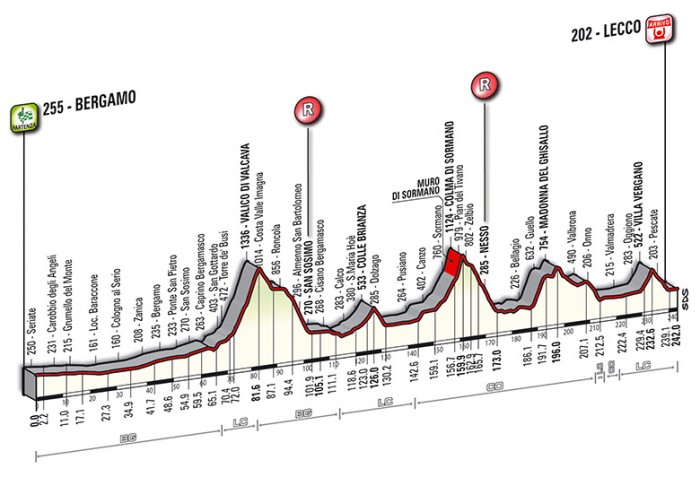
    The Valico di Valcava kicks things off before the halfway mark, 11 kilometers at an 8% gradient, a climb worthy of a high mountain stage in a Grand Tour. After another bump in the road, the Colle Brianza, the peloton takes on the very challenging wall of Sormano, touching gradients in the mid 20% range, with it’s summit a little more than 80 kilometers before the finish. It’s followed by a steep downhill and some flat land to give those dropped a chance to catch up, but regardless it will take a lot out of the legs of the heavier riders. The winding road up to the Madonna del Ghisallo is an irregular ascent that fluctuates between 10% sections and short periods of respite. Next up is a challenging descent, and then another 20 kilometers of flattish roads before the Villa Vergano climb, which, since being added to the parcours in 2011, has been the battleground on which this Monument has been decided. After so many intense lumps along the way to the finish in Lecco, the final test of 3.4 km at 8%, with a steeper run towards the top, is sure to launch the winner, or the small winning group, to victory.

    Lombardia

    Purito won in Lombardy last year, finally taking a well-earned first Monument title, and he’s the leading favorite again this year. He was agonizingly close to the rainbow jersey last Sunday when his attempt to solo away on the final slopes was shot down by a hard-charging Rui Costa. But if he’s maintained that top-level form into this Sunday, Rodriguez will have another excellent opportunity here, with a final launching pad perfectly designed for his punchy style that could create more of a gap than in Florence and less of a chance for chasers to catch back up. While said climb is almost 10 kilometers from the finish and followed by a downhill and then a flat (though technical) run-in towards the line, but the difficulty level of the slopes will inspire furious attacks that Purito can hope will prevent another sprint finish; not that he’s bad in a drag to the line, but certainly he’d prefer to avoid another last second disappointment to someone with a better kick. His teammate Daniel Moreno will be an excellent alternative option, especially if more than one rider is at the front of the race in the last kilometer. Moreno’s explosive style has netted him some big wins so far this year; he’s shown that not only can he hang on when things get hectic in a climber’s finish, but that he can be the one forcing the selection.

    Last weekend’s climactic finish makes previewing this weekend’s race easier: every other member of the star-studded cast that made it into Rodriguez’s final move last Sunday should be counted as a favorite again this weekend, including, of course, the two riders who are teammates again in a race of trade teams: Alejandro Valverde and Rui Costa. Despite all of his incredible talent, Costa might have been riding this race in support of Valverde had he not taken the rainbow jersey in Florence; Movistar has undervalued Costa in the past. However, now that he is the World Champion, Costa will probably be given freedom to make his own moves, and who can doubt his ability and his expertise after last week. Still, Valverde is Valverde, and if nobody is able to break free, he’ll be the one to beat in a sprint finish. Movistar has even more cards to play than these two: Nairo Quintana may not have much of a one-day resume, but if there is any one top tier classic for the young rider to make his mark, it’s Lombardy. Giovanni Visconti and Benat Intxausti have both won similarly challenging races in Italy this year (during the Giro).

    Home favorite Vincenzo Nibali managed to finish in 4th place last weekend despite having to dig deep to get back into the peloton after a late crash; who knows what might have been had he had that extra energy to use in the finish. The Giro winner will love the chance to show his strength in another challenging parcours, and he’s sure to make a move to break with the bunch when the road goes up late, as he doesn’t have much of a sprint to contend with the likes of Valverde, Moreno, or Costa. This lack of top-tier drag-racing talent has kept Nibali from having much success in single day races so far, but he’s on the form of his life, one of the top 5 riders in the sport this year, and it’s almost guaranteed that he’ll attempt to use his elite soloing ability to take the win. He may have a tough challenge climbing to the top of the podium, but of all the contenders, I see Nibali as by far the most likely to finish in the top 10.

    UranScarpSky’s Rigoberto Uran took a nasty fall on a wet descent in the waning minutes of the championship, taking himself out of the running for the final push. It’s a shame, because the explosive rider might have made a splash. He was on the podium in Lombardy last year (in fact, he was on the podium all the way back in 2008 as well), and he has the tools to improve on those performances here in 2013. Surprisingly, Uran has yet to take that big marquee classic victory (last year’s Gran Piemonte was a great first step at the 1.HC level, but a Monument win would be on a whole new plane). With the Sergio Henao for company (and as a good alternative, as Henao has had some fine results in one-day races), Uran will be a fierce challenger for the victory Sunday.

    Michele Scarponi lasted for a few moments in the decisive move during the World Championship race, and he’s been close to victory on numerous occasions in the past few weeks, coming up short again and again in the Vuelta. He’s another good home option riding for an Italian squad, but I think the real favorite on Lampre-Merida is young Diego Ulissi, who just took the midweek Milano-Torino. He has a great sprint (as he showed in the opening stage of this year’s Tour de Pologne, where he came out on top in a reduced bunch finish in a group fifteen strong after a late climb) and clearly the form to mix it up on the ascents. He’s not a great descender, and he’ll hope against hope for good weather, but if the conditions aren’t too nasty, Diego Ulissi could pose a serious challenge against the collection of better known, more established riders in the race.

    Dan Martin was one of a number of big names last week to suffer an unfortunate crash in the rain, but the fall did not seem to have any lasting effects. 2nd in the 2011 edition of this event, where he outkicked a group that included Purito and Ivan Basso for the title of runner-up, Martin has had quite a string of misfortune after his amazing early season success. If he can manage to stay on the bike the whole race, he’s primed for success here, with a parcours perfectly suited to his skillset. He denied Rodriguez a second Monument when he passed him en route to the win at Liege-Bastogne-Liege this spring, and he’d love the chance to collect a second one himself here at Il Lombardia in similar late-breaking fashion.

    Saxo-Tinkoff’s Alberto Contador was one of the many DNFs last weekend as well, but he was fifth in Milano-Torino, suggesting he has found some late season form after disappointing time and again in 2013. He’ll have allies trying to outrun the better sprinters on the final climbs, and he also has a strong team behind him. Rafal Majka was runner-up at Milano-Torino. He’s actually never won a pro race, but he’s come close a number of times and he’s got a great finish to match his climbing legs. Nicolas Roche finally came good after years of being touted with a great showing in the Vuelta, and he’s another option for the team.

    AG2R’s Domenico Pozzovivo nabbed fourth in Milano-Torino. He’s had a very strong 2013 and he’s kept a high level of climbing form all year. Carlos Betancur looked better last weekend than he did during his disappointing Vuelta, and should he find the form that went missing sometime this summer, he could surprise for his team this Sunday.

    With Bauke Mollema out, Robert Gesink leads Belkin into the year’s last Monument. He showed an impressive sprint in Canada and he’s obviously a great climber. He heads up a strong team: Lars Petter Nordhaug had a good World Championship race, Laurens Ten Dam is another great climber, and Tom-Jelte Slagter is a versatile rider with a fast finish.

    Philippe Gilbert has won this race twice, as recently as 2009 and 2010, but that seems like another lifetime for the Belgian star. He’s still got a great kick but he isn’t climbing as well as he used to. It’s not entirely out of the question that Gilbert finds those legs on Sunday, and if he manages to keep up with the attacks from the climbing heavyweights, obviously he’s a big favorite to outrun them at the line. BMC teammate Greg Van Avermaet is similarly positioned, a great all-rounder for whom Lombardy’s climbs might be just a bit too much. Strong climbers Ivan Santaromita, Mathias Frank, and Tejay van Garderen may be better options for BMC than the former champ Gilbert.

    Perhaps more likely is that Peter Sagan keeps up with Nibali et al. He just missed out in Florence, leading his group across the line for 6th place behind the climbing stars, and while Lombardy has more challenging climbs, it’s also shorter than the World Championship race. The young Slovakian has sometimes struggled in the most grueling of endurance races, and maybe with fewer kilometers to tackle, he’ll be more up for the ascents. His handling ability will be useful on the windy roads and he’ll surely be the man to beat in a sprint if he can hang on, though I don’t think the odds are in his favor. Teammate and two-time Giro d’Italia winner Ivan Basso finished 4th in Lombardy in 2011 and will be a better bet to stick with his fellow GC types. He showed good form in the Vuelta before abandoning on a day of nasty weather in the mountains, and he has a surprising finishing kick.

    Omega Pharma – Quick Step has a stable of all-rounder talent who will also be pushed to the limit, but who are capable of surprising. Michal Kwiatkowski has a very fast finish and when he’s on form, he can climb at a very high level, and Sylvain Chavanel, in his last WorldTour classic with OPQS, is a great bet to try for a long distance strike.

    A few other outsiders: Tommy Voeckler, Franco Pellizotti, Damiano Cunego, Chris Anker Sorensen, Alexandr Kolobnev, Rinaldo Nocentini, Warren Barguil, Thibaut Pinot, the Radioshack duo of Jan Bakelants and Andy Schleck, and Orica-GreenEdge’s trio of Michael Albasini, Pieter Weening, and Simon Clarke, who was impressive in the World Championship road race. For anyone with ambitions of winning, it will be hard to overcome the odds in one of the biggest events on the calendar against the top talents in the world all on form from their championship runs, but the late season classics have been full of surprises and excitement this year.

    VeloHuman Predictions

    Winner

    Joaquim Rodriguez

    Podium

    Rigoberto Uran, Vincenzo Nibali

    Top 10

    Alejandro Valverde, Rui Costa, Daniel Moreno, Daniel Martin, Diego Ulissi, Robert Gesink, Michele Scarponi

    -Dane Cash

    Photos by Jered Gruber and Laurent Brun.