Tag: 2014

  • Giant-Shimano’s Lawson Craddock “Learned a Ton” from a Season of Ups and Downs, Targeting More Stage Race Success in 2015

    Giant-Shimano’s Lawson Craddock “Learned a Ton” from a Season of Ups and Downs, Targeting More Stage Race Success in 2015

    Craddock ToC

    After a long season riding at the WorldTour level for the first time in his career, American up-and-coming stage racing star Lawson Craddock is finally enjoying an extended period of time at home in Texas. The all-rounder made a strong debut in the top division this year with Giant-Shimano, highlighted by a 3rd overall (and a second straight Young Riders Classification win) in the Tour of California in May. Craddock also rode in his first WorldTour-level race in June at the Tour de Suisse and then took on his first Grand Tour at the Vuelta in August. Having spent a few weeks at home after the conclusion of his race calendar, he will soon head to Australia to make his first career start in January’s Tour Down Under. VeloHuman caught up with Craddock by phone to hear his thoughts on 2014 and what lies ahead.

    Craddock’s goal for this season, his inaugural WorldTour year, was first and foremost to learn, and now looking back on his first twelve months at the top division, he seems satisfied with his WorldTour education so far: “I learned a ton this season. And it’s more than just what you learn on the bike. You learn a lot about yourself off the bike, about what you can handle and what you can’t handle,” he said. “Overall, it’s been a good year, I’ve had some ups and had some downs, and it was a great learning experience. It sucks being away from family and my girlfriend for so long but it was a great experience. I really enjoyed the year with Giant-Shimano.”

    One “up” among those ups and downs stands out well above the rest: Craddock’s excellent performance in the Tour of California. For Craddock, a spot on the podium and a successful defense of the Best Young Rider title were the welcome return on a serious investment of training. “I came into [the Tour of California] and I’d worked really hard. I went up to Ruidoso with Jasper Stuyven, a former teammate of mine, and really worked hard for three weeks straight and it showed. I was really happy with that and I think it gives me a lot to build on for the future,” he said.

    His success largely came on the back of a strong climbing performance on Mount Diablo in the race’s third stage. Known for his time trialing prowess early in his career, Craddock made it a major focus to improve as a climber, and has worked hard to transform himself into a more complete rider, capable of getting into the mix when the road goes up: in 2013, he took 7th in the USA Pro Challenge and 8th in the Tour of California, and in 2014 he made the step onto the podium in California. A strong, vocal support group has helped him to continually improve. “I’m just riding a lot more. You look back on my junior days and time trialing is my specialty but you look at where the most success comes from on the road and that’s the stage races. I kind of took a step back, I toned down a bit of the intensity and added a whole lot more hours and tried to drop a few pounds,” Craddock explained. “If you’re good at time trialing, chances are you’re good at climbing as well. You know, it took me a while to figure out how to do it the best way, but I had a really good support group behind me: Axel Merckx calling me a fatty pretty much every weekend, guys like Jim Miller really helping me take that next step in my career and change me from a time trialist into more of an all-round GC rider.”

    With the increased versatility, Craddock is hoping to reach a point where he can contend in the big stage races and ultimately the Grand Tours, though he is patient when it comes to expectations about his own development. “I take it step by step at a time; first you’ve got to finish a Grand Tour. I started the Vuelta this year and it didn’t go quite as well as I wanted it to. But you know, you’ve got to take certain steps in your career to progress. We’ll see. Maybe focus on the races like California, the Tour de Suisse and whatnot, and get successful at those before turning attention to something like a Grand Tour,” he said.

    Craddock’s run at the Vuelta, his first career Grand Tour start, ended earlier than he’d hoped, when he pulled out of the race during the 14th stage after a tiring two weeks spent largely on the front, putting in work for team leaders Warren Barguil and John Degenkolb. Craddock knew it was going to be a huge challenge entering the grueling Grand Tour, but that did not make it much easier. “Normally you ride the front for two or three days and then that’s about it. But when you’re doing a Grand Tour you’re on the front for thirteen days into a race and it’s just a whole new ballgame out there. But it was a great experience. And it definitely, although it did not end the year on a bright note, it gave me a lot of motivation to come back next year and improve myself, do what I know I’m capable of doing,” he said.

    Registering a DNF on Stage 14 after battling fatigue for so many long hours of constant work in the peloton was indeed one of the most difficult moments in his career, though the memory seems like it will only help drive him to continue to develop as a rider. “The sport is as tough, or I’d say even tougher mentally than it is physically. You put so much into a goal, and coming into this year my biggest goal was always to be at the Vuelta and finish the damn thing but you know, when you train as hard as you can and really stay focused and then see that things aren’t going as planned, and you’re getting dropped an hour and a half into a stage and you’re just not sure what’s going on, it’s definitely a tough pill to swallow. Especially climbing into the car was a really difficult thing for me to do, since that’s just not my mindset, I’m not a quitter,” Craddock said. “Hands down it was one of the hardest things I had to go through this year. But like I said, it just gives me all that much more motivation to come back next year.”

    With WorldTour and Grand Tour starts and a podium in a major pro stage race now under his belt, Craddock feels confident for 2015 and has noticed a difference in his form. “You do some WorldTour races like the Suisse and two weeks of the Vuelta and it definitely does change your body. What used to be an annoying pace to ride at, the high endurance, it’s now a comfortable pace for you to ride at. And I think, when you’re starting out with that as your base, you can definitely tell that there’s huge difference, you definitely see that you’ve taken a big step up,” he noted.

    Being surrounded by fellow young American talents should be a boon for Craddock as he continues to build that base: Giant-Shimano (Giant-Alpecin in 2015) signed Caleb Fairly and Carter Jones this offseason, bringing the team’s total of American riders aged 27 or younger to four. When asked what has drawn so many young American riders to the squad, Craddock first emphasized a very important detail about a few of his teammates: “First of all, I think Texan talent more than just American talent, because me, Chad [Haga], and Caleb are all Texans. So I think that’s something to be excited about, all three Texans on the WorldTour on the same team!” He then explained that his squad’s focus on and track record with rider development is very appealing. “I think you look at the team, you look at guys like Warren [Barguil] and Tom [Dumoulin], they came in as really strong Under-23 riders and the team has helped progress them into really strong GC riders and so you see that and I think that’s why it has such a high appeal towards the younger guys. You look at the team and you see the success that they’ve had with progressing riders. They’re not just putting riders off the deep-end and giving them too much to handle, they’re doing what they think is best and they’re thinking three, five, ten years down the road for us,” he said.

    Craddock has been in Texas enjoying time with family and friends and the easy access to Chinese and Mexican food while also putting in work with training partners Chad Haga, Carter Jones, Caleb Fairly, Nate Brown, and Gavin Mannion (Craddock noted that they call themselves the “Camp of Champs”), but the 22-year-old will head to Australia soon. Giant-Alpecin is bringing several of its biggest talents, but they know it will be a challenge battling the Australian riders at home. Craddock’s focus will be on putting in the work to position Marcel Kittel for the sprints and team GC leaders Tom Dumoulin and Simon Geschke for the overall. “You know, it’s Down Under, it’s going to be tough to beat the Australians, they’re always ripping on their home turf and especially in January, so it’s definitely going to be hard to beat them, but I think we’re coming with a really strong squad and obviously we’ve got Kittel for the sprints and we’ve got Tom and Geschke for the GC. We’re going to do everything that we can to put them in the best possible situation to get a result. I think it will be a lot of fun. The way things have been going I think we’ll have a lot of success . . . It’s definitely giving me a lot of motivation to train hard this last month and go out on those rainy days. But I’m excited to go. I’ve never been to Australia before. As long as I can go and do everything to help those guys out then I’ll walk away a happy man,” Craddock said.

    After the Tour Down Under, Craddock has his sights set on a few major targets for 2015, with an overall goal of gaining experience in the stage races, with some specific one-weekers in mind already. “I’d love to give the Vuelta another crack, but I think before that I’ll go straight back to Europe after Australia. I won’t do as many of those Belgian spring races as I did this year, kind of focus more on the weeklong stage races. Catalunya and Pais Vasco are in the schedule and obviously California is a really big goal for me. And I think because of this year and how things have been going already, it’s shaping up to be a good 2015,” he said.

    In terms of expectations and objectives, Craddock makes it clear that he still has a lot to learn, but he’s motivated and aiming high in the races that he thinks suit him best. Asked if what he’s learned and the numbers he’s seeing in his offseason training give him confidence that he can contend in more stage races in 2015, Craddock said, “I hope so. Maybe not so much in the bigger races but in the smaller races where I’ll have a chance to succeed. But I’m still really young and I’m still trying to learn as much as I can, racing the big weeklong races like Catalunya and Pais Vasco. I didn’t do those this year so I am not really sure what to expect. . . . We’ll just see and I’ll just take it as it comes.”

    -Dane Cash

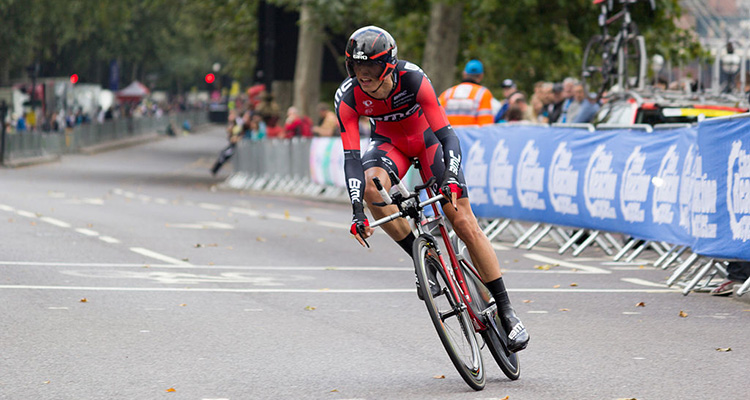
    Photo by Naoto Sato.
  • VeloHuman Up-and-comer Q&A Series: BMC’s Dylan Teuns

    VeloHuman Up-and-comer Q&A Series: BMC’s Dylan Teuns

    Dylan Teuns ToB

    22-year-old Dylan Teuns joined the BMC Development Team at the start of the 2014 season and enjoyed a successful first few months of the year, taking 2nd in the U23 Liège-Bastogne-Liège, 2nd overall and a stage in the Tour de Bretagne, and 2nd in the Omloop Het Nieuwsblad Espoirs. His strong early showings led to a stagiare spot with the WorldTour squad starting in August and a pro contract with them for 2015.

    With some security for the near future in place, Teuns rattled off a string of nice results this summer, taking a stage victory in the Giro della Valle d’Aosta in his last race with the Development squad before his stagiare period and then nabbing the Young Rider Jersey in the Tour of Utah, a stage in the Tour de l’Avenir, and 10th overall in the Tour of Britain, among other fine performances.

    The Belgian neo-pro took a break from training at the BMC camp in Spain to chat with VeloHuman for the latest entry of the VH Up-and-comer Q&A Series.

    VH: You raced practically non-stop from March all the way to October, winning a few times and signing a WorldTour-level contract along the way. What’s the first thing you did to unwind after the long season?

    DT: First, I took two weeks off for recovery at home, and then one more week on holiday.

    VH: What’s it like coming back to training camp after some time off? Does it take you extra time to get power back into the legs, or are you ready to go right away?

    DT: After the three weeks of rest, I wanted to start immediately building up to the training camp. But first, I had some problems with my sinus. I had some sinusistis, and I needed to rest one more week because I was sick. So, four weeks, I could start slowly, though not on the level I wanted to be because I needed to be careful in Belgium—from the end of October to the beginning of November the weather was not so good, and it was really cold and rainy sometimes. I needed to start slowly some days on the rollers. After two weeks I started to feel better. Then it was still two more weeks to the training camp and I had two good weeks. And now I feel really okay . . . my condition is not bad. When you go in the high heart rates it’s not like in the season, but that’s normal. In the lows it’s all very good.

    VH: And you feel like now you’re back to being at full health?

    DT: Yeah I’m normal. I feel good. Here you can train so well in good weather. Today it’s such a nice day. It feels like summer. And that’s great for training. Now we go on a holiday for two weeks in Belgium. I hope the weather is not too bad! When it’s cold I have no problem with it but I don’t know if it will rain too much. But we can train in Belgium as well, not so well on the climbs but we can still do some hours on the bike and that’s good. And then we can come back in January and we can go training on some hard climbs, stuff like that, which is perfect.

    VH: Does training camp with BMC feel different than training camps you’ve done in the past?

    DT: It’s quite the same, because last year I trained on a good level to do a good season because I was really motivated for my last year at U23 and I wanted to become a pro rider. And now I’m with the BMC team but still the training is quite the same. The things I did before with my Belgian training, it’s really the same things and I like it the way we do it now. But you can do more hours here in the wheels. And you train in a big group. . . . At home you go alone or with two guys, but here we’re training with the team in a big group. . . . It’s perfect.

    VH: At home you can train with friends; now you can train with Philippe Gilbert, which seems pretty nice!

    DT: It’s great! He’s a friendly guy. I saw him already last year a couple of times but now we are on the same team. Just today was the first time we were in the same group. We train in three groups. Every day it’s changing, the groups. I also trained with Greg [Van Avermaet] and he’s also a great guy. You see everyone, when we need to do workouts . . . everyone does his own thing and it’s not a race to see who is the best. We do our own thing and that’s good to develop for the next season.

    VH: You joined the BMC Development squad for the start of 2014. You’d had plenty of nice results in the past but you took a big step forward in 2014. You’ve credited a lot of that success to [team director] Rik Verbrugghe. What did you learn this season that helped you land so many U23 podiums and a major victory in the Tour de l’Avenir?

    DT: He doesn’t give his riders pressure, and that’s one thing from the beginning that was really good. He tells you things that you need to do, but he doesn’t put pressure on you or say you need to win this race or that race. He has a lot of experience because he spent a lot of years before on the Pro Tour team, and on other Pro Tour teams. He gives a lot of feedback. Like the stage in the Giro della Valle d’Aosta—he won stages in the big Giro and Tour de France which where the same sort of style.

    VH: It was your third and final Tour de l’Avenir. What did it feel like taking a stage win at the top of a Category 1 climb?

    DT: It was a great victory. Like you said, I went there three years in a row. The two years before . . . the first year I was working but then in the middle of the week I got sick and it was going not so good. And then the next year I had a kind of a free role. I was not the real leader but I could kind of do my own thing on the climbs. We did the first mountain stage and I was completely nowhere, and I was really disappointed. For two years in a row I was really disappointed. And I know it was a big race, when you can do something there, it’s so big, every WorldTour team will see that. My two other victories, a stage in the Tour de Bretagne and the Giro della Valle d’Aosta . . . I already had those two, but I still wanted to go to the Tour de l’Avenir with big ambitions and that was my goal, to win a stage. When I was at the line I was so happy and you can see it in the pictures. It was so great. I can’t explain it but it was such a great feeling.

    VH: What was it like moving from the Development Team up to the WorldTour squad?

    DT: After my first half of the season I was really happy I could sign. I knew from the beginning of June that I was going to be a stagiare, and that in July I could sign my ProTour contract. And then you don’t have as much stress anymore. And then I went to Utah and I worked for the team . . . we needed to control the race, that was a good thing for me because I always needed to work the last couple of kilometers for Cadel [Evans] or Ben [Hermans], who was, after Powder Mountain, 2nd in the GC, but I could still do my own results. Not really good ones, but when you see them on the last two days, I was close in the GC for the young riders. And then we talked about it, the evening before the last stage, we had a meeting, and they gave me the opportunity to do my own thing the whole stage; I didn’t need to do anything. The second-to-last stage I’d worked really hard for Ben, and Cadel was in the break, and all was good. And I took one and a half minutes back on GC and then I was about 1:20 back at the end of the second-to-last stage. And then we spoke about it with the team around the table with the director and they gave me a free role to take the jersey.

    VH: Basically, you were playing a support role for a few days and then suddenly found yourself in contention for the young rider’s jersey?

    DT: Yep. And then the Tour of Britain was a great race for me. We didn’t have a real leader there. Some guys were there preparing themselves for the Worlds. I was also there to prepare for the Worlds Under-23, but I knew when I finished l’Avenir I was not tired. I went for a week to my home, I could relax a bit and train easy the whole week and then I went to Britain . . . and there you can see what I can do.

    VH: Were you, or are you, nervous at all about the promotion to the WorldTour level?

    DT: I’m not nervous for next year. Well, maybe a little bit. I want to learn the first two years, I don’t want the big results, I think that’s not for now. I need to learn now from big riders like Gilbert and other guys who can teach me something. I need to learn also how the races are, how they race when the finale starts, things like that. And we’ll see in two or three years how I can do, maybe I can do a podium or something. But not for now.

    VH: Now that you’ve been with the squad for a bit, have you been able to pick up any advice from any of the veterans like Gilbert or Van Avermaet?

    DT: I didn’t race with Gilbert in the end of the season, but I did some races with Greg and he taught me well, some small things, things that are really important to know. When you do U23 races on a big level, like l’Avenir, you knew before that you need to be in front but in pro races, it’s always important to be in the front.

    VH: Have you been surprised by the level of racing with the WorldTour team? Is it harder or maybe even easier than you expected?

    DT: Last year I think the level was quite the same in the biggest Under-23 races, there’s not a lot of difference, but the WorldTour races, I think the level there is higher. We will see. I hope it’s not so high and that I’ll finish those races in the next season. Hopefully I can help Gilbert or someone else to a big victory so that then my season is also good.

    VH: Do you have an idea of your program for 2015 yet?

    DT: I start in Oman. That’s a good race for me I think. A good marker. And I hope to do the Ardennes Classics. I’m really excited about them. That’s the parcours where I raced most of the time last year and did some good results. That’s the kind of race I like.

    In following up his strong performances at the major U23 events with a collection of good results in big races like the Tour of Britain, Teuns has seen mostly consistent progression during his young career. Now that he has taken the step up to the sport’s top division, he will have the opportunity to learn from experienced stars like Philippe Gilbert and Greg Van Avermaet, which could see Teuns ready to compete in the Ardennes and other marquee events in the not-too-distant future.

    -Dane Cash

    Photo by Katie Chan.

  • IAM Cycling In, Europcar Out, Astana Warned: A Closer Look at the WorldTour Licensing Decisions

    IAM Cycling In, Europcar Out, Astana Warned: A Closer Look at the WorldTour Licensing Decisions

    AstanaTeam

    The Annual WorldTour license distribution process is, for most teams in the top division, a formality of paperwork. Winter 2014’s licensing period, however, has proven to be a newsworthy affair: one team was promoted from the Pro Continental level to the WorldTour, one team lost its WorldTour license, and one team was awarded its license with several strings attached, including a requirement to undergo a third-party investigation. The promotion, the demotion, and the probation each merit a closer look.

    IAM Cycling Joins Cycling’s Top Division

    Starting with the feel-good news, Swiss outfit IAM Cycling was officially awarded their WorldTour license in the first week of December. The announcement wasn’t a surprise by the time it came (various outlets had reported that the promotion was likely), but it was nonetheless a confirmation of much planning and hard work paying off. IAM Cycling came into existence in 2013 and made a few key signings prior to the 2014 season that made clear their commitment to competing with the elite teams in the sport. The team’s marquee additions, Mathias Frank and Sylvain Chavanel, both turned in fine seasons, elevating IAM Cycling to the top of the pile among Pro Continental squads (no team ranking system is perfect, but they did earn the highest Cycling Quotient Ranking of any PCT team).

    With Cannondale’s exit creating a WorldTour opening for the 2015 season, IAM saw their opportunity to advance and took advantage of it. The team may not have the abundance of race-winners of Movistar or Tinkoff-Saxo, but the collection of established talents and up-and-comers (including newly signed Clément Chevrier and Sondre Holst Enger) should prove sufficient for IAM to stay relevant even on a tougher schedule, a sentiment shared by team GC leader Mathias Frank. Frank is a bona fide contender in the stage races, especially the one-weekers, Sylvain Chavanel is a deadly one-day racer, time trialist, and stagehunter, and Matteo Pelucchi and Heinrich Haussler are capable of delivering results on flatter profiles. In other words, the squad may not have the depth of talent to support a Grand Tour winner, but strong riders in key roles give them the firepower to take a few wins at the WorldTour level.

    Europcar Denied WorldTour License

    As IAM joins cycling’s top division, Europcar will leave it behind. It’s one and done for the French team, who earned a promotion for the 2014 season only to find themselves facing a budget shortfall for 2015, a shortfall that ultimately led the License Commission to deny the team’s WorldTour application. From a business standpoint, things are dire for the squad right now (Europcar will be pulling out as a sponsor after 2015), but, all things considered, a demotion to the Pro Continental ranks may be for the best. Europcar was the WorldTour’s weakest link in 2014; to return to Cycling Quotient for further guidance, the French outfit was dead last among WorldTour teams in CQ Rankings this season, and not far ahead of PCT squads IAM Cycling and Cofidis, despite receiving automatic invites to all WorldTour events. Pierre Rolland was an admirable 4th in the Giro d’Italia, but beyond that the WorldTour spoils were thin for Europcar. As a French team composed almost exclusively of French riders, Europcar is likely to get invited to the major French races regardless of whether they are at the WorldTour level, and for a French team composed almost exclusively of French riders, that’s what matters. Given the squad’s struggle to deliver results when stretched thin across the WorldTour calendar this year, dropping to the second division might not be the worst thing in the world for Europcar.

    Astana Rides On

    The biggest news item of WorldTour licensing system was not a promotion or demotion, but, oddly enough, a renewal. Having racked up two doping positives in their WorldTour squad and a total of five across their whole organization in 2014, along with other reported misdeeds (alleged collaboration with doping doctor/cycling persona non grata Michele Ferrari) to boot, Astana’s 2015 WorldTour spot was not guaranteed. However, after a review period, the UCI announced Wednesday that Astana would, in fact, receive their license. For many fans, awarding the Kazakh outfit with a ticket to ride at the top division was tantamount to old-fashioned complacency with a broken system, but from a legal perspective, the UCI was in a difficult spot. The last time the UCI’s License Commission (an entity that operates independently) attempted to take action against a team that had racked up too many positives (Katusha), the team appealed to the Court of Arbitration for Sport and ultimately won the case, setting a precedent for future attempts to use the licensing process in a punitive fashion. Though repeated doping offenses within their organization and allegations of collusion with Michele Ferrari make it difficult to ignore the signs of potential systematic problems, in point of fact, the Astana WorldTour squad only notched two positive tests this season. A denied license probably would not have held up under CAS scrutiny with the current body of evidence, at least the body of evidence that exists publicly.

    Instead of setting up a costly and potentially embarrassing CAS battle, the License Commission gave Astana their WorldTour license but attached a few important probational strings to the decision; among them, a stipulation that Astana be subject to an independent audit with the understanding that should further evidence of rule-breaking come to light, the WorldTour license could be withdrawn. In short, this might not be the end of the story for Astana’s WorldTour ride in 2015, especially with evidence from the Padova investigation on Michele Ferrari still to be released. For now, the team’s big stars Vincenzo Nibali and Fabio Aru will have their guaranteed invites to the Giro and Tour lined up, but that could change in an instant if the UCI uncovers further signs of operational “deficiencies” at Astana. The decision did not play very well on the Twitterverse, but it will give the governing body time to gather more information and potentially make a better case for taking Astana’s license in the future.

    -Dane Cash

    Photo by Don Barrett.

  • Mathias Frank Almost Back to Full Strength, Preparing for Another Run at a Tour de France Top 10 and the (Potential) “Big Challenge” of a WorldTour Promotion

    Mathias Frank Almost Back to Full Strength, Preparing for Another Run at a Tour de France Top 10 and the (Potential) “Big Challenge” of a WorldTour Promotion

    Mathias Frank

    After a busy season that left him with a much-improved résumé but also a broken femur and second career Tour de France DNF, Mathias Frank is enjoying some time off. Earlier this year, his first with IAM Cycling, Frank landed in the GC Top 10 of five straight stage races, claiming runner-up honors in the Critérium International, Bayern Rundfahrt, and Tour de Suisse, and also racking up a few stage wins as well during the excellent run of performances from March to late June. The 27-year-old seemed primed for a successful return to the Tour de France, a race he’d abandoned in his 2010 debut due to a broken thumb and torn thigh muscle sustained in a crash in the prologue. However, Frank’s 2014 Tour campaign went awry on Stage 7, when he was one of a hapless bunch of riders who hit the deck hard inside the final kilometer. The crash left him with a broken left femur, an appointment with a surgeon, and another DNF in the world’s biggest race. Frank spent two months away from competition recovering before returning for a few one-day races to close out his 2014 racing program while getting a bit of strength back in his legs. Now one month removed from the season, he is (finally) nearly back to full health.

    “From the femur, I don’t feel anything anymore. I don’t have any pain or anything. There was a little imbalance at the last test I did, so I’m still working with the physio on it, but I’m sure I will be at 100% pretty soon again,” he told VeloHuman in a phone interview this week.

    As he takes those last few steps towards full recovery, Frank is able to look back on his season in a positive light. As frustrating as his Tour de France journey was, he still managed to put together an excellent first half of the year, which Frank acknowledges was “definitely” the best spring in his career. “Normally it always took me a bit longer to get into good shape. This year I was really happy to open the account early in the Critérium [International] and from then on, I did some pretty good racing the whole spring. So it was the best first part of the season for me,” he said.

    Frank joined IAM Cycling this season after several years in the red and black of BMC. Coming off a fine 2013, the Swiss rider was a promising addition to the Swiss team that was making several big improvements at the time, also bringing in star all-rounder Sylvain Chavanel. One might expect the season’s high hopes to have come with high pressure, but Frank says that he did not feel pressured to perform, at least not by anyone other than himself. “It’s something you always put on yourself, the pressure. I don’t feel any pressure from the team, it’s more my expectations that I have. . . . I think the expectations that I have are more than what the team has! The team really doesn’t put any pressure on me,” he said.

    Frank’s own motivation and the low-pressure team atmosphere contributed to a major step forward in results. Frank attributed his early season success to a “combination of different things,” among them, a new role in a new team: “The environment, the role that I have, that I can go for myself. I think I already felt in BMC the last couple of years, 2012 and 2011, I could see that I was always a competitor. I couldn’t really turn that into results but from the numbers from training I knew that I was quite close to being where I was this year. So it wasn’t really a surprise—I think that there were a lot of things coming into place.”

    The multiple podium performances in the spring raised Frank’s expectations even higher for the Tour, but when his run at the main goal of his season came to a sudden end in a heap of riders and mangled bikes near the finish line in Nancy, it was a psychological blow. Still, Frank seems to have already put the frustrating Tour behind him. “For sure, I was super disappointed,” he said. “I had a big chance going for the Tour in the really good shape that I had after the Tour of Switzerland, but at the end . . . that’s how it is. Crashes, they happen. You can’t do anything but get up and try it again next year. What also helped me this year was that I became a father in June, during the Tour de Suisse, so when I was home, there was something else, there was some distraction, with my daughter. I didn’t really think too much about it. I think I just took it as destiny, as a ‘try it next year’ again.”

    After crash-marred races that resulted in DNFs in both of his two career Tour appearances, Frank is hoping (in fact, he seems confident) that the third time will be the charm. “After two bad experiences, the third time it’s really going to work out. I really believe in this and that’s how I see it. That’s two bad crashes in my whole career, and they were at the Tour de France. So for sure, I’d say it’s sad, but it could happen anywhere. I’ll just have to try it again and at one point it will work,” he explained.

    Frank and his squad are currently awaiting word from the UCI License Commission regarding their application to join the WorldTour in 2015, but various sources have reported that the team will likely make the cut. Thanks to strong seasons by Frank and Sylvain Chavanel, IAM Cycling was among the best of the Pro Continental squads in the peloton in terms of results this season, but joining the WorldTour ranks is no small step up. A commitment to a full calendar of top-level races, including all three Grand Tours and all five grueling Monuments, is quite an effort for any squad, and many teams have struggled in their first year at the highest level. Frank acknowledges that if IAM Cycling is, in fact, given a WorldTour bid for the 2015 season, it will not be easy. At the moment, he is realistic about what the promotion might mean, but also hopeful that rider development will pay off. “I think it will be a big challenge for sure. It’s a tough schedule now with all these race days, with three Grand Tours. But I think it was good last year to do two Grand Tours, for the team. We still have a lot of young guys and I think for them, they’re developing and next year if we go WorldTour, the team should be ready for it,” he said. “It’s a big challenge, and maybe it takes another one or two years for some guys to adapt but in general I think we have a good squad with all the new guys that are coming at the end here, and we should be ready, if we move up to the WorldTour, to perform well there.”

    IAM Cycling added a few more “young guys” this transfer season, with up-and-comers Clément Chevrier and Sondre Holst Enger among a list of new arrivals that also includes climber Jarlinson Pantano and time trialing talent Stef Clement. On the other hand, the team lost experienced riders Thomas Löfkvist, Johann Tschopp, and Gustav Larsson. Frank knows that the veteran presence will not be easy to replace, but he likes what he sees in the team’s signings. “We lost some experienced guys . . . some pretty good pros. But I’m positive that the young guys will step up, the guys that we’re going to get. We’ll have to see, but I think in general we’ll be at least as good as this year,” he said.

    Mathias Frank’s own plans for 2015 are not yet set in stone, but he has his sights on the one-week stage races (like the Tours de Romandie and Suisse in which he’s had recent success) and especially the Tour de France, with a third run at cycling’s main event as his central target this upcoming season. “Next year, it will be all about the Tour. I really want to go to France in good shape again and try to get a Top 10, so I think we’re going to build the program around the Tour and start from there, but it’s not really decided yet so I can’t really give details. I think it will be less racing than this year for sure, but focusing on the Tour de France,” Frank said. “The Tour is going to be the biggest goal. . . . At the end it’s the Tour de France that really counts.”

    Frank has plenty of reasons to be optimistic about his major goal for next season, given the way he performed at several WorldTour and 2.HC races in 2014. On the other hand, he wouldn’t have to look very hard to find reasons to be cautious about targeting a race that has given him a broken femur and broken thumb in his two career appearances—but Frank seems to have put those unpleasant experiences behind him. That’s good news for IAM Cycling. With a WorldTour promotion (and its requirement to ride all three Grand Tours) a very real possibility, the Swiss team will be counting on their Swiss GC leader to deliver in 2015.

    -Dane Cash

    Photo by Georges Ménager.

  • Transfer Season 2014: The Peloton’s Most Improved Teams

    Transfer Season 2014: The Peloton’s Most Improved Teams

    With November in full swing, most of the high-profile moves of the 2014 transfer season have been completed. As always, some teams took advantage of the open market to make considerable upgrades to their rosters, while others did not take steps to improve, or worse, saw talented riders leave and failed to replace them. Only time will tell which of the many newsworthy signings will be success stories and which will go down as major missteps. Still, several squads stand out as having positioned themselves nicely for future success with their additions this fall. Some teams have improved by adding big-name stars, and others have solidified their rosters by signing multiple solid contributors that should fit into new roles nicely.

    One of the peloton’s highest-profile teams landed the highest-profile addition of the offseason. Tinkoff-Saxo signed Peter Sagan after several months of rumors, immediately making a squad already full of GC-style talent suddenly a danger in the classics and sprints. Given the opportunity to pick up one of the sport’s most electrifying young stars, Oleg Tinkoff was resolute in his pursuit of Sagan. The decision made by the Slovakian to ride for Tinkoff-Saxo does comes with a question mark or two: he never had enough support at Cannondale, and while the Bjarne Riis outfit he joins for 2015 is obviously packed with talent for mountain stages in Grand Tours, its supporting cast for the classics and sprints does not stand out quite as much in the peloton. It remains to be seen how effective they can be in closing down the late attacks that so often derail Sagan’s hopes. Meanwhile, in terms of overall transfer season wins and losses, Tinkoff-Saxo did lose Nicolas Roche, but new signing Robert Kiserlovski, who notched a Grand Tour Top 10 this year at the Giro, should fill his absence nicely.

    Tinkoff-Saxo’s loss of Nicolas Roche was Team Sky’s gain. A frustrating 2014 inspired the British squad to pull out all the stops this transfer season, and that meant adding proven Grand Tour Top 10 riders Nicolas Roche and Leopold Konig, both of whom should provide the team with deluxe domestique power in the Tour de France as well as options for overall contention in the Giro and Vuelta. Wouter Poels is another strong signing—the Dutch all-rounder took a big step forward this season and will provide Sky with both a capable challenger in the hilly classics and one-week races and a proven domestique (his support was an integral part of Rigoberto Uran’s podium performance in the 2014 Giro) for the Grand Tours. The influx of GC talent should more than make up for the loss of Dario Cataldo, who is headed to Astana for 2015. Sky also picked up a major talent for the sprints in Elia Viviani. The 25-year-old Italian was erratic this season but he has flashed remarkable top speed on occasion (he bested Mark Cavendish in two stages of the Tour of Turkey) and there is still time for him to develop. Team Sky’s more GC-oriented signings got a bit more press this transfer season, but Viviani is the new addition most likely to rack up the victories in 2015. The signing of Viviani, along with the rise of Ian Stannard and Geraint Thomas as Classics protagonists and Ben Swift as a fast finisher for the intermediate stages, will soften the impact that the exit of Edvald Boasson Hagen will have on the team’s stage-hunting and one-day racing ambitions, an impact Sky did not seem too concerned with anyway; they were in no rush to re-sign the Norwegian after a pair of lackluster seasons.

    A change of scenery could be just what Edvald Boasson Hagen needs, and he’ll get it at MTN-Qhubeka. The South African outfit added a stable of fast-finishing talents looking for a fresh start: in addition to EBH (who still has plenty of room to grow), they also signed Matt Goss, Tyler Farrar, and Theo Bos, among others. Goss, despite his lack of recent results, only just turned 28, and a change of pace could get him back on track in the sprints. Farrar may never beat Mark Cavendish in a one-on-one sprint battle again, but he is still capable of contesting flat profiles at the WorldTour level and he still has plenty of ability in the classics (he was 2nd in Dwars door Vlaanderen and Scheldeprijs this season, and 8th at the E3 Harelbeke). Theo Bos had a very successful 2014, winning races on three different continents, and should continue to deliver for his new team. MTN-Qhubeka may only be a Pro Continental Squad, but their transfer season talent haul was among the biggest in the whole pro scene.

    Fellow Pro Conti outfit Cofidis made a big splash of their own, but rather than loading up on multiple speedsters, they focused almost all of their attention on a single powerhouse sprinter. Nacer Bouhanni’s decision to drop to a second division squad after winning five Grand Tour stages and the Giro points jersey this season is unconventional to say the least, but apparently FDJ only had room for one star sprinter (Arnaud Demare), leaving Bouhanni looking for a new ride. He still wanted to be with a French outfit, and Cofidis will likely get invited to the races he’s targeting, so it does make some sense for the young sprinting mega-talent. For Cofidis, it’s a coup; after several seasons in the middle of the Pro Continental pack, they now have a star capable of consistently challenging for victories in some of cycling’s biggest events.

    Trek Factory Racing was another team that boosted their stock significantly with the addition of one rider: Bauke Mollema. Mollema didn’t have quite the 2014 that many expected, but he’s a consistent Grand Tour Top 10 rider (with Top 5 potential) who is also adept at shorter stage races and one-day classics. Andy Schleck’s retirement was big news but Trek had been without an elite GC talent for some time, and Mollema provides that ability, more than making up for the loss of Robert Kiserlovski.

    Team BMC gets the final mention among transfer season winners. Their signings were not as flashy as Team Sky’s or Tinkoff-Saxo’s, and they are jettisoning quite a few riders to boot, but in additions like Damiano Caruso, Jempy Drucker, and Alessandro De Marchi, BMC was able to pick up several bright talents just hitting their prime. Caruso (a surprise Top 10 in the Vuelta) provides the team’s GC ambitions with a much needed injection of youthful talent, Drucker adds firepower to the Classics lineup, and De Marchi brings his elite stagehunting talents and a potential for stage race KoM jerseys to the table. These all come in addition to rising star all-rounder Rohan Dennis, who arrived as a midseason transfer. BMC may not have grabbed many big headlines this fall, but they filled several needs and that will help them improve across the board in 2015.

    A year from now, it will undoubtedly be easier to evaluate the 2014 transfer season, but at the very least, the teams that have made the investments in riders like Leopold Konig and Alessandro De Marchi have put themselves in strong positions to succeed next year. The new transfers will have their chances to prove themselves soon; riders are returning to training after end-of-season vacations, and the start of the 2015 road season proper will arrive before long.

    -Dane Cash

    Photo by Sum_of_Marc.

  • 2014 Rider Ranking Analysis: A Data-driven Approach

    2014 Rider Ranking Analysis: A Data-driven Approach

    Last week, VeloHuman published an article focused on the breakout stars of the 2014 season, continuing a tradition begun in 2013. Just as was the case last year, much of that analysis came out of a data-driven approach: VH charted rider performance differentials from last season to this one by looking at the points riders accumulated in that timeframe according to both Cycling Quotient and WorldTour Rankings and comparing the difference from one year to the next. Such an analysis makes it easy to see the most dramatic shifts in performance across the professional peloton. Providing a bit of data visualization and also the raw data itself proved a popular decision last year, allowing readers to draw their own conclusions about the ups and downs of the season, so VH decided to provide those tools again this year! Without further ado, the 50 biggest CQ points swings (for riders who were active this season—Mauro Santambrogio, suspended for the year, was left out of the graphic) between 2013 and 2014:


    Click here to view the full-size, single image version.

    Just a few of the highlights that jump out from the graphic: injuries obviously played a huge role in 2014. Back problems, heart problems, broken wrists, broken collarbones, and broken ribs accounted for much of the red in the Top 50. For some riders, however, the dropoff in performance could not readily be attributed to a fracture or other ailment. Peter Sagan stood on two Monument podiums and won a Tour de France stage in 2013; he didn’t make a single Monument Top 3 and he went winless in the Tour this year. He still finished 2014 ranked 9th overall in CQ Points, but instead of progressing, as may have been expected of the still young star, Sagan seemed to stagnate. Alberto Contador, on the other hand, overcame injury to soar this season. He may have missed out on Tour results but he dominated the one-weekers of the early season, taking victory in Tirreno-Adriatico and Pais Vasco and 2nd in Catalunya and the Dauphine, and then came back with a vengeance in the Vuelta.

    The red bar to the left of Vincenzo Nibali’s name may come as a surprise, but it shouldn’t; these are season-long rankings that take into account performances across the racing calendar. Nibali probably wouldn’t give up his season for the world, and a victory in the Tour de France makes it easy to ignore the entire rest of the year, but the Italian stage racing star plainly underwhelmed in the contests leading into the 2014 Tour, and did not put in many race days after Paris.

    Heralded rising stars like Michal Kwiatkowski, Tom Van Asbroeck, Fabio Aru, and Tom Dumoulin soared up the various popular rider ranking systems this season and that is reflected here, but a few of the breakout performances you may have missed are shown as well: Pete Kennaugh made statements in several Continental Tour races, and with the powerful support of Team Sky he should continue to develop. Jerome Baugnies of Wanty – Groupe Gobert has been a consistent performer in lower level races across the past few months. Niccolo Bonifazio, who just turned 21 last month, has taken big results at home in Italy and abroad; he just won three stages and the Points Classification, as well as taking 2nd overall, in the Tour of Hainan, a fine way to close out his first full season as a pro.

    The data visualization above offers some highlights from this season’s year-over-year rider ranking data but there is plenty more information to be gleaned from the raw numbers. If you are handy with data manipulation, you can draw conclusions of your own: click here to download the 2013–2014 data for the Top 500 riders of the season (on the CQ Ranking scale). Inside, you’ll find identifying biographical data (name, team, country, and birthdate) and CQ Ranking and WorldTour data from 2013 and 2014 along with the differentials across both seasons, so that you can filter and sort to your heart’s content as you make your own analysis. Keep in mind that Cycling Quotient’s ranking system and the WorldTour ranking system are different and favor different things—the CQ Ranking values Continental level results, for instance, while the WorldTour rankings do not. In fact, non-WorldTour riders do not score WT points at all even if they get results in WT races, which is why WorldTour ranking data doesn’t exist for plenty of names on the list. Both systems have their advantages, and ultimately, the sport’s biggest names score highly on both scales anyway.

    Feel free to share your thoughts here in the comments or on Twitter @VeloHuman!

    -Dane Cash