Tag: 2014

  • Vuelta a España 2014: Stage 14 Preview

    Vuelta a España 2014: Stage 14 Preview

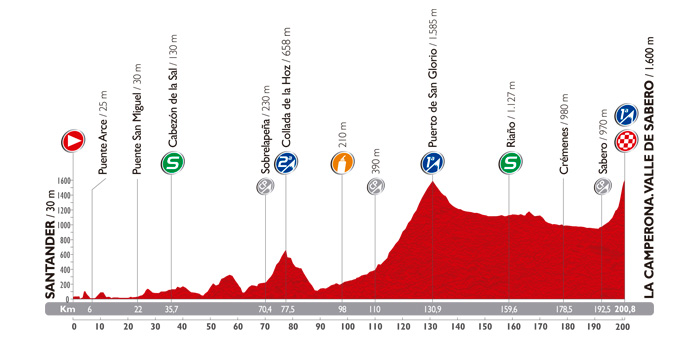
    Stage 14 Profile

    Santander › La Camperona. Valle de Sabero – 200.8 km

    Stage 13, won by Dani Navarro, saw a skirmish among the GC riders in its final few kilometers, but the impending fourteenth stage of the Vuelta will likely be an intense battle among the top overall contenders of this race. The uphill challenges on Stage 14 are daunting. Things get started with 70 kilometers of mostly gentle roads before the Cat. 2 Collada de la Hoz kicks off the day’s categorized climbing. After cresting that ascent and then riding a tricky downhill, the peloton will take on approximately twenty kilometers of false flat at a slight incline before reaching the bottom of the Puerto de San Glorio, 20.9 kilometers long at a 5.8% average grade. There are sure to be some tired legs in the pack once they reach the top after over forty kilometers going uphill, but there will still be challenges yet to come on the day. Following a fast descent comes a long stretch of mostly flat roads before the final test. After 192.5 kilometers in the saddle, the peloton will reach the foot of La Camperona, a vicious 8.3 kilometer climb whose average gradient of 7.5% doesn’t really tell the whole story. Things start out relatively easy, but with around 2 kilometers to go, the road kicks up sharply, and it stays in the 15% range, touching well over 20% at points, until the final hundred meters or so, where things ease off to be only a little under 9% in the run to the line.

    A profile like this will be absolutely brutal for all but the most lightweight climbing specialists. The GC contenders will be locked in on the final ascent, knowing that a bad day could lead to serious losses on such a steep climb (especially after some hard uphill riding earlier in the day). Stage 14 is likely to end in a major showdown for the red jersey hunters. Whether or not they are riding for stage honors will depend on how they play the run-in to La Camperona; if the pace is kept high over the flat section that precedes the final climb, with riders jostling for position as the slopes approach, the morning break will be doomed. However, there are some tough mountain days to come in the days ahead, which could lead to enough hesitation in the pack that if a truly top-notch climber is up the road, he might have a chance.

    The top favorite to shine on this profile is Katusha’s Joaquim Rodriguez, the peloton’s premier uphill charger. He has put in attacks here and there in this race, but nothing has really stuck so far. This time, the parcours is perfect, and he needs to land a blow soon or he’ll have run out of opportunities to claw back time from those ahead of him on the leaderboard. He has the also explosive Daniel Moreno as an elite second.

    Race leader Alberto Contador has been up to every challenge thrown his way in this race so far, and he should continue to shine here. His biggest weakness is his lack of team support, but he may be strong enough for that not to matter. He’s not the type to rest on his laurels (or his current race lead), and if he sees an opportunity to pick up more time on his rivals, he will.

    Movistar’s Alejandro Valverde is very dangerous on the extreme gradients, and he’s within striking distance of the overall lead. A strong ride seems likely on Stage 14, but he needs to get more aggressive in this race if he wants to move up to that coveted first spot in the General Classification.

    Astana’s Fabio Aru took the eleventh stage of the race with a perfectly timed attack as the finish line approached, and he is still far enough back on GC that the riders at the very top of the leaderboard might give him some leeway if he tries to go on the move again. He has the skillset to achieve more success here. Garmin-Sharp’s Daniel Martin is in a similar boat, and he’s shown with repeated attempts to get away on the steep stuff that he’s highly motivated to get results on these climbs.

    Robert Gesink, who looked strong in an ultimately unsuccessful attempt to get clear of the GC bunch on Stage 11, Samuel Sanchez, Stage 13 winner Daniel Navarro, and Warren Barguil are other riders in the GC conversation who could enjoy a bit of freedom and potentially success if they attempt to get clear on the last climb. Chris Froome, who has at times looked very strong, and at times looked to be lacking something in this race, will be put to the test on this gradient; at his best he’d be a top candidate for success, but there won’t be anywhere to hide if he’s not feeling in peak condition when the road shoots skyward on Stage 14. Teammate Mikel Nieve could look to get something of his own if Sky decides to set him loose.

    If the pack does put in the effort to keep the breakaway on a tight leash early in the day, it will be very hard for anyone up the road to stay clear all the way to the top of the final climb, but should the GC contenders spend the stage looking at each other instead of worrying about the break, it’s possible that a strong uphill talent could hold out for victory here. Trek’s Julian Arredondo, Garmin-Sharp’s Ryder Hesjedal, Astana’s Mikel Landa, OGE’s Esteban Chaves and Adam Yates, Lampre’s Przemyslaw Niemiec, Cannondale’s Alessandro De Marchi, and Belkin’s Laurens Ten Dam are on the list of strong-climbing riders who might be able to succeed from the morning breakaway; alternatively, some of the aforementioned group could look to put in a dig a bit closer to the finish line, still benefitting from being far enough out of GC contention that they might be given some breathing room.

    VeloHuman Stage Favorites

    1. Joaquim Rodriguez | 2. Fabio Aru | 3. Alberto Contador

    Be sure follow @VeloHuman on Twitter for live commentary of this and every stage of the 2014 Vuelta a España! The next preview will be up after the conclusion of Stage 14, so stay tuned.

    -Dane Cash
  • VeloHuman Up-and-comer Q&A Series: AG2R La Mondiale’s Hugo Houle

    VeloHuman Up-and-comer Q&A Series: AG2R La Mondiale’s Hugo Houle

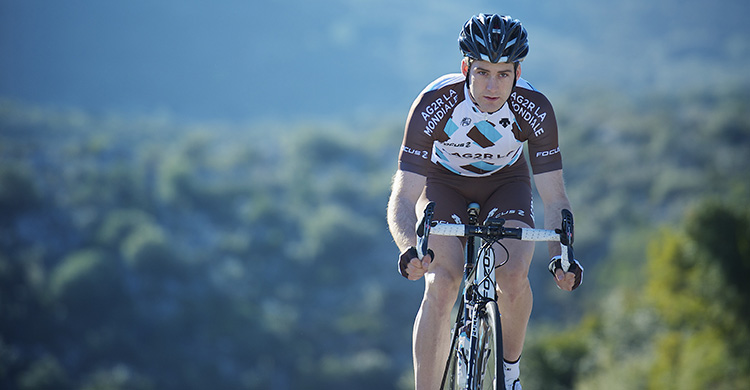
    Hugo Houle - Photo: Kramon

    In a new entry in the Up-and-comer Q&A Series, VeloHuman talked with 23-year-old Hugo Houle, a native of Sainte-Perpétue, Quebec. With the Tour of Alberta underway and the Grand Prix Cycliste de Québec and Grand Prix Cycliste de Montréal around the corner, now is the perfect time to catch up with one of Canada’s fastest-rising young stars.

    In his second year with French team AG2R La Mondiale, Hugo Houle is an all-round talent who made a name for himself at a young age, winning Canada’s Under-23 road race and time trial championships and finishing 4th overall in the U23 World Championship road race. His big results garnered the attention of WorldTour team AG2R La Mondiale, where he signed at the end of 2012 and has been riding since, with a largely classics-oriented race calendar. He recently spoke to VeloHuman about his year so far and his expectations for the rest of the season.

    VH: Hugo, you joined AG2R La Mondiale last year after spending a few years with Pro Continental Squad Spidertech. What was it like at first making that jump from Pro Continental Team up to the WorldTour? How did that transition go compared to your expectations?

    HH: In the end, it was the folding of Spidertech that gave me shot to join AG2R La Mondiale, because at first I had two more years with Spidertech. They folded at the end of 2012, so I found a place at AG2R La Mondiale, and I’m going to ride for them until 2015; I still have one more year on my contract with them. It’s a big step, because when you join a WorldTour Team, the races are longer and they make you ride more races. Sometimes you do two or three stage races in one month, so it takes time to build up to the volume of races. Also, the culture of a French team was new so I had to make some adjustments with that. So those are the big differences. With the volume of racing and the races being longer, you need to train longer, so I had to step up my training.

    VH: You rode plenty of races in your first season, with particular focus on the classics. What would you say were the biggest things that you learned in your first year?

    HH: I learned a lot! The first thing: to get to know a course, like, say, in Belgium . . . it’s hard, so it takes a couple of years to get to know the cobbled sectors and how to approach them and place yourself. So that’s the main thing. Even if you are strong, if you’re not well-placed, you don’t finish in the front, so last year I was more trying to understand the cobbled sectors. Now I’m good and I know them, so it’s easier to be well-placed, with good timing, and know when I have to move up. So that’s one thing. And also learning how to race with the team, the teamwork, and all that stuff. To know a teammate, what they like and what they want me to do, because I’m still pretty young so I have to do a lot of work and understand the races and do the best I can to help them save energy to be there at the end.

    VH: You look to be getting more comfortable in your second season, both in longer races and on the cobbles: last year you started Milano-Sanremo and Paris-Roubaix, but this year you started and finished them. Do you feel that you have continued to develop this year?

    HH: Yeah, for sure. Like I said, in those big races I now have more endurance so I can hold on for longer. So it’s easier to finish a race because I’ve become used to that distance and I know how to be well-placed. . . . So for sure it’s easier in the second year. . . . It’s not easy but I’ve learned a lot and I progress every year so that’s a good thing and the team is happy with the work I do.

    VH: Does AG2R La Mondiale have a specific role that they’re hoping you’ll grow into, maybe for the classics, or as a time trialist, etc.? You have a pretty versatile skillset.

    HH: For now they want me to do the work more than do my own stuff, but I have a good time trial and when I have an opportunity to do good on that, I always go all out. But they always put me in the big races, so to get the wins it’s hard because I’m still young. I do most of the classics, that’s where they want me to do well and support other riders, but they’re not talking about a leadership role, it’s more a support role for now. But I’m more of a punchy rider, so when it’s hills, circuit races like Quebec and Montreal, that’s where I could be good.

    VH: Are there any particular aspects of your skillset that you’ve worked to improve this season?

    HH: Yeah, they want me to lose some weight and be better in the hills. But it also depends on the time of year, because I’m doing classics the beginning of the year, and there we need more power for flat sections . . . and then for the second half of the year you need to be climbing, because I do more stage races, like Wallonie, Pologne, and now Limousin. It’s more hills, so I work more on those and am careful for weight because it makes a huge difference, the ratio of power to weight. . . . And before nationals I was doing more time trials. So I just try to see which races I’m going to do and try to train to be ready for that kind of effort. Let’s say if I do Montreal/Quebec, I try to do three to five minute hills to get ready for that kind of effort when I arrive at the race, so that I’m ready to do that. So all year, it changes.

    VH: Speaking of nationals: you’ve won both the Canadian U23 time trial and road race championships in the past, and you put in good performances this year at the top level with a 2nd place in the ITT and 7th in the road race. Is representing Canada on the international stage important to you?

    HH: Yeah, for sure. It’s important to try to build up the sport more in Canada. The sport is doing well, a lot of people are cycling and getting more interested in it. In Quebec they show more races now, all the classics and the three Grand Tours. Before it was only the Tour de France, so that’s a good development. For me, to be an ambassador for that is important, and to work with national teams and do well at nationals, that’s important for me. Racing in Europe, you bring a lot of experience that you can share with other riders. . . . I was pretty lucky to have Spidertech to make me race in Europe, and I was able to have a good result at the World Championship. That’s what helped me make the jump to a WorldTour team. The hardest thing is to get to a team. After, if you do well, your job and everything else, they keep you on board and you make friends with people. But the hardest part is to make a team in Europe and that’s why it’s hard for Canadians. So if I can help with that, it’s always good, and it’s nice to have more Canadians in the pro field. It’s important to do well and represent the country and get other riders to come to our level and come race with us.

    VH: Do you think a Canadian champs jersey, either for the time trial or the road race, might be a possibility in your future?

    HH: Yeah, that would be a goal. Right now it’s hard in the time trial with Svein Tuft, he’s pretty good at it! But I’m still young and have a couple of years ahead of me, so one day it could happen if I work hard and it’s something I would love to do. To wear the jersey in Europe for a whole year is something special and it gives you good visibility so it’s really important. I hope to do the double, like I did in U23, in the coming years. It would be great, but it’s always hard; Nationals, it’s always a special race because everyone knows the WorldTour guys are stronger and they all look at us to make the race and chase, so it’s always strange, but for time trial, I’ll keep training hard on that and one day maybe I’ll be as strong as Svein Tuft.

    VH: Well he is 37, so you have to think that at some point, maybe . . .

    HH: Yeah. I’m still 23 so I’ve still got a couple of years ahead of me!

    VH: What are your goals for the rest of the season?

    HH: I’d like to put in a result at the Tour of Alberta. It’s a good opportunity for me to race for the national team and I’m going to be a team leader and can do what I want to do, so I hope I can make a result there, and then a great performance in Montréal and Québec would be great for the people there and in front of my family, so I hope for a good result.

    VH: Last question, looking into the future a bit. Is there one particular race that maybe you grew up watching or maybe that you’ve ridden now and enjoyed that stands out as one you’re hoping to target for success in your career?

    HH: I think a lot of the races that I wanted to do, one-day races, I’ve done almost all of them, but now I will try to go for a Grand Tour for next year. Maybe the Giro or the Vuelta, though the Tour de France will be hard. The goal would be to ride the Tour de France before I stop cycling. I was not thinking about it when I started cycling, because it was just for fun, but now in the past few years I’ve seen that become more realistic. So to finish the Tour de France would be a big accomplishment, and racing the Olympics would be good also, so that’s the next step for me and that’s where I want to go.

    Still a few weeks shy of 24, Hugo’s role as a developing rider gaining experience particularly in the one-day races puts him in an interesting position on a team hoping to expand its results beyond the steep mountains, where they have had so much success this year. At the moment, Hugo is focused on landing results in Canada’s collection of major late-summer events, where profiles heavy on the short climbs suit his skillset nicely.

    -Dane Cash

    Photo by Kramon.

  • Vuelta a España 2014: Stage 13 Preview

    Vuelta a España 2014: Stage 13 Preview

    Stage 13 Profile

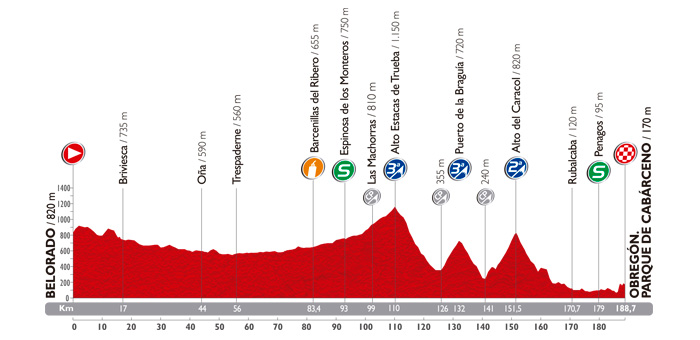
    Stage 13: Belorado › Obregón. Parque de Cabárceno – 152.2 km

    Following a very flat Stage 12 that, unsurprisingly, ended in a sprint (won by John Degenkolb), the Vuelta’s thirteenth stage will be a more unpredictable affair. The Stage 13 parcours is a tale of two halves. The opening 95 kilometers of racing take place on mostly flat, mostly straight roads. After the first intermediate sprint near the midpoint of the stage, however, the road begins to twist and turn through a stretch of tough hills. First on tap is a Cat. 3, with a fast descent to follow, and then another Cat. 3 and another fast descent, and then a tough Category 2 and yet another downhill. Even after the descent from the Cat. 2, it is still an undulating journey to the line, with a few uncategorized challenges yet to come. The finish is a lumpy affair: at 2.5 km to go, the road kicks up dramatically for a short but steep (a few sections push 10%) climb, which will be an attractive potential launching pad for the punchier riders. Then comes a series of short ups and downs before things flatten out for the final hundred meters of straightaway.

    The Stage 13 profile is one of the most breakaway-friendly in this race. Given the tough finish, the teams of the pure sprinters won’t be all that motivated to keep the early move in check, and even if the pack does try to maintain control of the day, the up-and-down, winding roads on the second half of the stage won’t make it easy. The opportunists, especially those with some punch or at least decent climbing legs and a nice finishing kick for the final straightaway, will be licking their lips at this opportunity to pick up a Grand Tour stage win.

    No single rider qualifies as the favorite in a stage like this, but there is a very long list of riders who could shine. BMC’s Philippe Gilbert is certainly one of them: the late rise is a perfect launching pad for the uphill charger, and he could look to get into the breakaway to contest the victory after a long day up the road. If Gilbert is in the lead group as the day nears its conclusion, whether that lead group is the main bunch or a small breakaway contingent, he’ll be hard to beat in the final few kilometers. His teammate Cadel Evans can’t be counted out either: with the climbing legs to handle the undulating profile and a nice finishing kick, and sitting more than 30 minutes behind on GC, Evans could try something from afar on Stage 13.

    Cannondale’s Peter Sagan is another strong finisher who isn’t afraid to get into the long-range moves. After starting the Vuelta in domestique mode while riding himself back into form, he’s now showing much more interest in battling for stage wins. He won’t be allowed into the day’s break without a fight, but if he is in the move he’ll be a top favorite; if he isn’t, and if things do come back together, he’ll be a top favorite in that scenario as well. His teammate Alessandro De Marchi is an elite breakaway specialist, and though he doesn’t have the same punchy style as Sagan, he is a tough rider who handles this sort of climbing particularly well. He has already taken one stage in this race. Oscar Gatto is yet another Cannondale rider with a chance to go for a long one here.

    Ryder Hesjedal is on the hunt for stage wins after falling out of GC contention in this Vuelta, and he does have a bit more explosiveness than many realize. He will be a top contender if he’s in the early break. Teammate Nathan Haas is very strong on a profile like this, and he knows how to play the breakaway game; he’s another good option for Garmin-Sharp.

    Luis Leon Sanchez has not been much of a factor in the higher-profile races this season, but Stage 13 does have a parcours that will suit him very nicely. A strong soloist who can climb and sprint quite well, he will be dangerous if he can get into the day’s breakaway. Caja Rural teammate Amets Txurruka is always dangerous on a lumpy profile as well.

    Trek has an impressive collection of riders who could be in the mix from afar in a hilly stage like this with Julian Arredondo, Bob Jungels, Fabio Felline, and Fabian Cancellara all potential protagonists here. Katusha’s Alexandr Kolobnev and Giampaolo Caruso, Lampre-Merida’s Damiano Cunego, OGE’s Adam Yates, Lotto Belisol’s Adam Hansen, Astana’s Alexey Lutsenko, and OPQS’s Pieter Serry and Tony Martin are others who will be well-suited to breakaway success on Stage 13.

    If the peloton does reel in the day’s breakaway before the finish line, a select few sprinters with good climbing legs and the more explosive GC riders will join the list of potential protagonists. In that scenario, Michael Matthews of Orica-GreenEdge will be the top favorite, having put his impressive climbing form on display in his Stage 3 victory. Belkin’s Paul Martens might have a chance of holding on for a potential sprint. John Degenkolb of Giant-Shimano won’t have an easy time surviving the late climbs, but it’s not out of the question that he makes it to the last hundred meters of flat to contest a sprint. Garmin-Sharp’s Daniel Martin, Katusha’s Daniel Moreno and Joaquim Rodriguez, BMC’s Samuel Sanchez, Movistar’s Alejandro Valverde, Belkin’s Robert Gesink (who possesses an underrated finishing kick), Astana’s Fabio Aru, and race leader Alberto Contador of Tinkoff-Saxo will also be contenders if Stage 13 is contested by the main pack.

    VeloHuman Stage Favorites

    1. Philippe Gilbert | 2. Michael Matthews | 3. Peter Sagan

    Be sure follow @VeloHuman on Twitter for live commentary of this and every stage of the 2014 Vuelta a España! The next preview will be up after the conclusion of Stage 13, so stay tuned.

    -Dane Cash

  • Vuelta a España 2014: Stage 12 Preview

    Vuelta a España 2014: Stage 12 Preview

    Stage 12 Profile

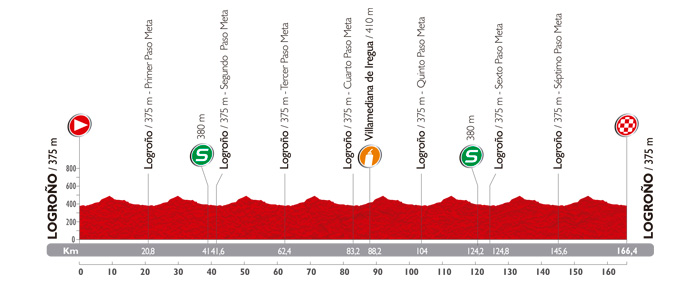
    Stage 12: Logroño › Logroño – 166.4 km

    The Vuelta’s eleventh stage followed up an eventful time trial with even more drama: Fabio Aru took the stage win in a hard-fought battle among the GC contenders, but the biggest story of the day was the abandonment of Nairo Quintana following another crash. Stage 12, which consists of eight laps of a 20.8 kilometer circuit in and around the town of Logroño, should allow the red jersey hunters to settle down a bit.

    Each lap includes the climb of a small, uncategorized hill and then a descent onto a flat stretch where the finish line awaits. Things get a bit technical in the final 5 kilometers of the circuit, with several roundabouts and sweeping turns in store as the road heads toward the center of town, but the final kilometer of each go-round is a flat, straight run to the line. The weather forecast for Stage 12 includes some chance of rain, which could make things a bit hectic on the urban circuit.

    A profile like this will make it almost impossible for an early break to go the distance. After several days of GC battles, the sprinters’ teams won’t want to miss this chance for a bunch gallop, and they’ll likely keep a sharp eye on the gap to ensure that their quick men get the finish they want. The sprinters will still have to be on their toes as the day draws near its close, however; it won’t be an easy task to steal one from the fast finishers, but on an urban circuit like this, it’s almost certain that a few enterprising riders will attempt late attacks from the bunch.

    With a high likelihood of a bunch sprint for stage honors, Stage 12 should offer another showdown between Giant-Shimano’s John Degenkolb and FDJ’s Nacer Bouhanni. Bouhanni will love the circuit, and the fact that there aren’t any categorized climbs on the menu. Potential bad weather would favor him as well. On this stage likely to go to the pure sprinters, he probably has a slight edge over Degenkolb, but don’t count the German out: their last head-to-head matchup came one day after Degenkolb had crashed, and he’s had some time to recover since then. His powerful leadout boosts his chances. It should be a close battle.

    OGE’s Michael Matthews showed his impressive top speed on Stage 8, crossing the line in 2nd behind Bouhanni. He’s highly motivated to show anyone watching that he has what it takes to be in the mix even against the sprinting heavyweights on a flat day.

    Lampre’s Roberto Ferrari was 3rd in Stage 2 of this race, and he’ll have another good opportunity to land a good result on the flat Stage 12. Astana’s Andrea Guardini has not yet featured in the group sprints of this Vuelta, but he should be able to get involved here. He has the speed to challenge even Bouhanni and Degenkolb in a bunch kick if he can make it to the final few kilometers in a good position. Cannondale’s Peter Sagan finally showed an interest in contesting a stage victory on Stage 8, where he took 3rd. If he decides to put in the effort here on Stage 12, he’ll be among the favorites in a sprint, especially with some corners to navigate in the run-up to the final straightaway and the potential for bad weather. Matteo Pelucchi, Tom Boonen, Jens Debusschere, Yauheni Hutarovich, Gerald Ciolek, Francesco Lasca, Robert Wagner and Jasper Stuyven are on the long list of outside contenders for the probable sprint finish.

    Though it will be very hard to stave off a hungry pack of sprinters, a few of the stronger solo artists in this race will probably try to attack on the last lap and use the twists and turns of the final few kilometers to hold an advantage over the chasers. Watch out for the likes of Tony Martin, Philippe Gilbert, Adam Hansen, and Fabian Cancellara as the peloton re-enters Logroño for the last time on the final lap.

    VeloHuman Stage Favorites

    1. Nacer Bouhanni | 2. John Degenkolb | 3. Peter Sagan

    Be sure follow @VeloHuman on Twitter for live commentary of this and every stage of the 2014 Vuelta a España! The next preview will be up after the conclusion of Stage 12, so stay tuned.

    -Dane Cash

  • Vuelta a España 2014: Stage 11 Preview

    Vuelta a España 2014: Stage 11 Preview

    Stage 11 Profile

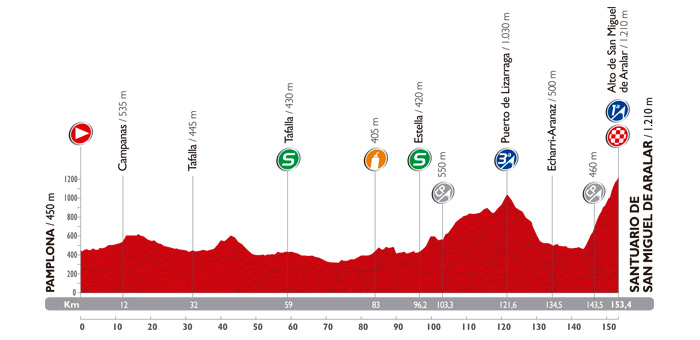
    Stage 11: Pamplona › Santuario de San Miguel de Aralar – 153.4 km

    Even after a tough time trial (won by Tony Martin) that saw Alberto Contador take the red jersey and Nairo Quintana and Chris Froome lose a lot of time, dramatically shaking up the General Classification of this race, the peloton won’t have a chance to rest on Stage 11. Another summit finish is on tap. The first two thirds of the stage are relatively tame, without any categorized climbs, but things get a bit more difficult with around 50 kilometers to go, when the road rises at the Puerto de Lizarraga, a Cat. 3 of 18.3 long kilometers with an average grade of 2.6%. It’s an uneven climb with a steep stretch at the top, so it is harder than the low gradient indicates. From the top it’s a tricky descent of about 9 kilometers, and then a stretch of flat before the final climb, a 9.9 kilometer Category 1 with an average gradient of 7.5%. It’s a fairly steady climb, except for a short 14% section at around 2.5 km from the top. The summit finish marks 153.4 kilometers in the saddle, making Stage 10 the second shortest non-TT day in the race: this is likely going to be a fast-paced affair.

    The breakaway will have its chance of taking this stage, but if the GC contenders decide to keep the early aggressors on a tight leash, it will be hard for anyone up the road to stay away with a late flat section (likely to see an injection of pace as the GC men jostle for position) and then a tough final climb. Katusha is among the teams who will hope that the battle for stage honors will come down to the GC contenders. Joaquim Rodriguez put in a respectable time trial on Stage 10 to stay within striking distance of the GC title, and he has already shown that he’s on the offensive in this race. The steep section near the finish should be a perfect place for him to strike out for a gap and for bonus seconds. Daniel Moreno makes for a dangerous ally. Katusha’s elite uphill talents will be very hard to keep under control in the last few kilometers of the race.

    Alberto Contador no longer has to gain ground on anyone, as the race leader, but without a strong team helping him, sitting tight and waiting for the attacks may not be the best idea. He’s obviously on excellent form, far more so than he was willing to admit publicly at the start of the race, and he’s not the type to rest on his laurels with a great opportunity for more success right in front of him.

    Nairo Quintana may have gone down hard on Stage 10 but Movistar isn’t out of this race yet. If the young Colombian wants to get back into this Vuelta a España, he’ll need to attack early and often. Alternatively, if he shifts his attention to helping Alejandro Valverde, attacking early and often (and forcing the other GC riders to chase) would still be a good strategy. Quintana’s form is an unknown after his fall, but if he’s feeling strong enough to attack, he probably will. That would give Valverde the opportunity to latch onto any wheels that go chasing after, and should this come down a sprint (things are a bit easier at the very top), Valverde would of course be the heavy favorite among the top GC contenders. Even if Quintana isn’t at his best, Valverde will still likely be in the mix on Stage 11 on his own. He has looked sharp in this Vuelta and he’s running out of opportunities to add another Grand Tour to his palmares.

    Chris Froome, on the other hand, showed in the Stage 10 ITT that he’s just not at his best in this race, giving up nearly a minute to Alberto Contador on a parcours that looked to suit him quite well. He’s still one of the top climbers in the Vuelta, though, with Mikel Nieve as a valuable second, so it would be unwise to overlook Team Sky on this final climb.

    Rigoberto Uran put in a great chrono and is now sitting in 3rd overall. He struggled to hold the pace on the first climbing stage of the Vuelta, but since then he’s looked stronger every day. He’s got a nice sprint and if he can hold onto the lead group to the line he’ll have a shot. Fabio Aru has been flying a bit under the radar in this Vuelta but he has looked to be in excellent shape thus far. More than two minutes behind on GC, he might be allowed some room if he puts in an attack, and this final climb suits him very well. Daniel Martin is another rider who could get aggressive. He tried an attack on Stage 9 but was reeled in; he’ll be on the lookout for another opportunity here. Esteban Chaves, who had a very rough day in the ITT, will at least now be less of a marked man should he try to put in a dig on his favored terrain. If he can pick himself up after his disappointing chrono, he could be in the mix (he might even try to his luck in the break). Winner Anacona, unlike compatriot Chaves, had a very impressive ride against the clock on Stage 10 after a very impressive breakaway victory on Stage 9, and those performances have put him into the GC conversation. That will make it harder to successfully attack the pack on the climb, but with the form he’s shown, he still has a shot at a good result on Stage 11 even from the pack and with the top GC contenders watching him more closely.

    Should the GC riders allow an early move to stay up the road all day, the long list of potential protagonists for stage honors from afar would include OGE’s Adam Yates, FDJ’s Thibaut Pinot and Kenny Elissonde, Garmin’s Ryder Hesjedal and Andrew Talansky, Lampre’s Jose Serpa and Przemyslaw Niemiec, Trek’s Julian Arredondo, BMC’s Cadel Evans, Astana’s Mikel Landa, Cannondale’s Alessandro De Marchi, Caja Rural’s David Arroyo and Amets Txurruka, Belkin’s Laurens Ten Dam, Europcar’s Romain Sicard, and Sky’s Dario Cataldo, among others.

    VeloHuman Stage Favorites

    1. Joaquim Rodriguez | 2. Alberto Contador | 3. Alejandro Valverde

    Be sure follow @VeloHuman on Twitter for live commentary of this and every stage of the 2014 Vuelta a España! The next preview will be up after the conclusion of Stage 11, so stay tuned.

    -Dane Cash

  • Vuelta a España 2014: Stage 10 Preview

    Vuelta a España 2014: Stage 10 Preview

    Stage 10 Profile

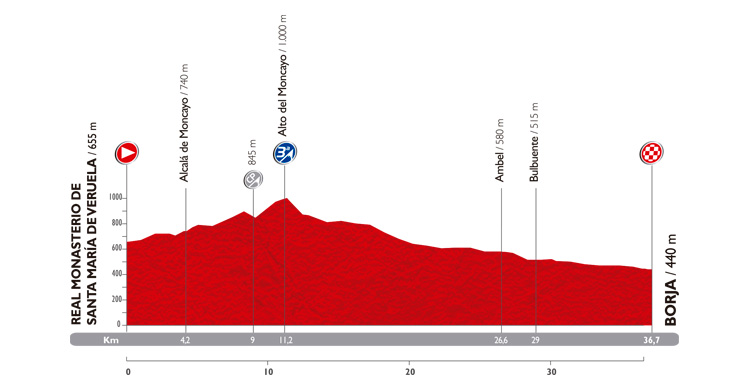
    Stage 10 (ITT): Real Monasterio de Santa María de Veruela › Borja – 36.7 km

    Winner Anacona led the peloton into the Vuelta’s first rest day with a win from the breakaway on Stage 9. Now it’s on to the critical Stage 10, a 36.7 km individual time trial. The parcours should open up some significant time gaps among the top GC contenders. The course starts out with a gentle uphill that leads into a short but steep Cat. 3 climb crested 11.2 kilometers into the stage. Then it’s all downhill to the finish. It’s not a straight-out run to the line, with some twists and turns along the way, but it’s not extremely technical. This is likely to be a very high speed chrono.

    Tony Martin is the big favorite for stage honors. This is route that will favor chrono specialists, and he is the world’s premier time trialist. He’s also a great descender. It’s hard to see anyone outmatching his engine over 36.7 kilometers.

    Behind Martin are several time trialing specialists and GC riders with top-notch chrono ability who should make the battle for Top 3 on the stage a tight one. Fabian Cancellara is obviously a prolific time trialist, and he’ll be one of the few riders with a shot of beating Martin in the World Champs later this month, but form is a bit in question at the moment. He has fallen off the pace even on a few of the flatter stages in this race, and though he’s likely give this time trial far more effort than he has on any stage so far, it may not be enough to match up with the likes of Martin. Cancellara is a strong descender and this is a nice parcours for him, but victory on Stage 10 would be a lot to ask.

    This ITT is central to the GC hopes of Chris Froome, and he is one of the few red jersey hunters who excels even on a flatter chrono profile. His time trial performances in this year’s Tour de Romandie and the Criterium du Dauphine were stellar, and if he can recapture that strength here, with motivation running high, he’s likely to be among the top finishers on the day.

    Alberto Contador is another GC rider with serious time trialing talent, and he’s a great descender to boot. If his time trialing engine is in as good shape as his climbing legs, he should be able to deliver a top-notch performance on Stage 10. Rigoberto Uran has developed into an elite talent against the clock as well, and he looks to be rounding into form in this race after a disappointing first mountain stage.

    Movistar’s Adriano Malori had a hot start to the year, winning a Tirreno-Adriatico time trial ahead of Martin and Cancellara. He hasn’t had as much success in the latter half of the season, but after post-crash injuries robbed him of a chance to take a Grand Tour ITT win in the Giro d’Italia, he’ll be motivated to go for this. Trek’s Kristof Vandewalle beat Malori by 3 seconds to take his first WorldTour win the Tour de Pologne chrono last month, and he’ll be another outsider for stage honors. BMC’s Rohan Dennis put in an underwhelming ride in the Eneco Tour’s time trial stage, but he’ll be eager to show his new team what he’s made of here. Bob Jungels (who is targeting this stage especially), Jesse Sergent, Tobias Ludvigsson, Vasil Kiryienka, Stef Clement, Jonathan Castroviejo, and GC riders Wilco Kelderman and Nairo Quintana (who has improved against the clock this year) are others who could be in the mix on Stage 10.

    VeloHuman Stage Favorites

    1. Tony Martin | 2. Chris Froome | 3. Fabian Cancellara

    Be sure follow @VeloHuman on Twitter for live commentary of this and every stage of the 2014 Vuelta a España! The next preview will be up after the conclusion of Stage 10, so stay tuned.

    -Dane Cash