With a roadside presence at the race, VeloHuman will be previewing individual stages of the 2015 Volta a Catalunya in addition to the overall race preview published earlier. Calella again hosts the opening stage of the race this year. The parcours resembles that of last year’s edition in many ways.
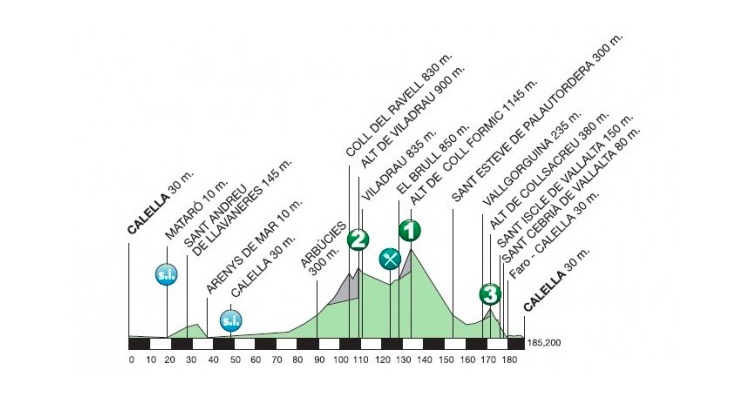
The stage opens with mostly flat roads for the first 80 kilometers, but the road turns upward near the midpoint of the day’s racing. The peloton will first take on the long Category 2 Alt de Viladrau (11.3 km, 3.3% average gradient) and then the Cat. 1 Alt del Coll Formic (7.8 km, 5.2% average gradient), before a long descent back towards the coast. The Cat. 3 Alt de Collsacreu (7.4 km, 3% average gradient) is the final climbing challenge of the stage, crested 18 kilometers before the line. The final few kilometers are mostly flat and not particularly technical.
Last year’s opening stage involved many of the same roads and similar climbs, and included the same ascent of the Collsacreu followed by a descent into Calella. That stage ended with a sprint finish. A repeat seems likely in 2015, though a reduction in the cast of characters likely to play a role in a bunch kick would also fall within the realm of expectation. These climbs probably won’t spring successful attackers, especially not on the first day of the Volta; though the Col Formic is a Cat. 1 challenge, categorizations are a bit deceiving in this race. Still, some of the heavier sprinters could fall out of contention on the slopes.
The diminutive Bryan Coquard has shown an ability to handle some climbing in the past, and he’s come close to a few wins already this year. Coming close to victory when racing at the WorldTour level is a common theme for Coquard, but with this startlist, he has a great chance of finally picking up a WorldTour win.
Caleb Ewan can handle some climbing and he looks to be on fine form after picking up two wins in the Tour de Langkawi. He’ll also have a good chance of picking up his first WorldTour win here.
Luka Mezgec won three stages last year (including the Calella opener of that edition) and seems like a good bet for more success in 2015 after already picking up a victory in the Tour du Haut Var-matin. The climbs will challenge him but if he can make it to the finish, he’ll be well-positioned to win. Matteo Pelucchi is in a similar boat: he’s had a lot of success so far this season and has a powerful finishing kick. If the climbs don’t take too much out of him he’s likely to contend for the win.
JJ Rojas is quite versatile for a fast finisher, and he has already taken a (rare) win this year. If some of the stronger sprinters are shed on the climbs, he’ll be one to watch. Julian Alaphilippe, Jasper Stuyven, Roberto Ferrari, Kévin Reza, and Julien Simon are other outside contenders with a chance. If a few of the GC names get aggressive on the climbs and manage to break up the race, look to Alejandro Valverde and Rigoberto Urán in a reduced sprint.
VeloHuman Stage Favorites
1. Bryan Coquard | 2. Luka Mezgec | 3. Caleb Ewan
Be sure to follow @VeloHuman on Twitter, and check back after the conclusion of Stage 1 for the preview of Stage 2.
While the Classics specialists are recovering from Milano-Sanremo and then heading to Belgium for E3 and Gent-Wevelgem, plenty of other big names, including several of the top stage racers in the sport, will make the journey to Spain to take on the Volta a Catalunya. With no time trials and tough climbs throughout the race, it’s a great event for those who enjoy riding uphill. This year’s edition boasts a startlist filled with stars certain to make things interesting. VH is on-site and will provide plenty of race coverage, including individual stage previews.
The Route
The Volta a Catalunya is a seven-day race that travels through Spain’s Catalonia region, starting in the beach town of Calella and then traveling along the coast and through the Pyrenees before finally coming to a conclusion in Barcelona, the capital of the autonomous community. There are climbs on every stage of the race, and they are categorized 3-2-1-Esp., though the climbs classified as “Cat. 1” here might be classified differently in other stage races. For example, the first Cat. 1 of the race is the Alt del Coll Formic, 7.8 kilometers at a 5.2% average gradient, which is probably not difficult enough for it to be classified as a Category 1 climb in, for instance, the Tour de France.
The first stage does have some tough climbs in the middle of the day and a small bump near the finish, but last year’s Calella stage ended in a bunch sprint and it seems likely that that scenario will repeat itself this year. Stage 2 is one that could go to the more versatile quick men who can stay at the head of the race on a late Cat. 3 climb.
The GC battle will heat up on Stage 3, which starts and finishes in Girona, with two Cat. 3s, a Cat. 2, and two visits to the same Cat. 1 climb along the way. After the peloton makes its second visit to said climb, the Alt dels Ángels (6 km at a 5.5% average grade), there will only be 13 kilometers remaining in the stage; in other words, attacks made on the climb may survive to the line.
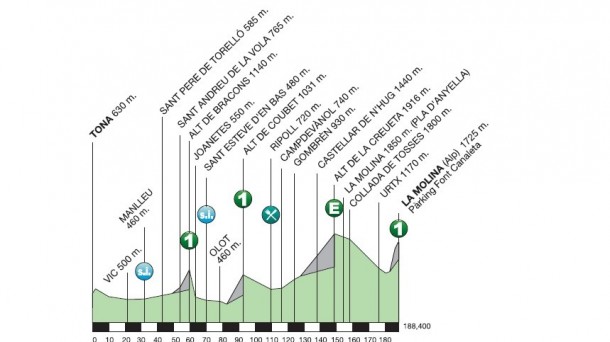
Stage 4: Tona › La Molina (188 km) – There won’t be many opportunities for tired legs to rest on the climb-filled fourth stage of the Volta a Catalunya.
Stage 4 will certainly see GC action. The riders will take on a series of climbs on the way to a summit finish at La Molina ski resort, with the seemingly interminable special-category Alt de Creueta (21 km at 4.5%) along the way.
None of the climbs on the stage are individually all that imposing compared to some of the mountains these riders will face in the Giro or the Tour, but taking on so many uphill challenges in rapid succession will certainly wear on the peloton.
Stage 5 will throw a late climb at the riders but the 2014 edition saw a sprit in the same location. Stage 6 is almost certainly for the sprinters. Stage 7, with its eight climbs of Barcelona’s Montjuïc, will almost inevitably see attacks, but whether they will have a GC impact is not so certain.
Several of these stages could end in bunch sprints, despite the climbs and their categorizations in the roadbook. Still, the multitude of vertical challenges guarantees plenty of attacks by the climbers, and the opportunity to put in those uphill digs has drawn a terrific startlist to this year’s race.
The General Classification Contenders
Last year’s winner Joaquim Rodríguez was a late scratch after coming down with an illness, but Tour de France winners Chris Froome and Alberto Contador are among the many elite GC names who will set out from Calella. Froome missed Tirreno-Adriatico with a chest infection, but he was not off the bike for long. Assuming he has maintained the strong form he showed in the Ruta del Sol, Froome will be hard to beat in this race, especially given the incredible team support Sky is bringing. Richie Porte will be another of the top favorites, with Leopold König, Nicolas Roche, and Wout Poels all enjoying contender status as well. Some may point to the lack of time trials in this race as a reason to doubt the chances of Froome (and Sky alternative Porte, for that matter), but at his best, Froome can match the world’s top climbers on the slopes. The overlong climbs on Stage 4 suit Froome and his team perfectly.
Alberto Contador is certainly among those top climbers. His 5th in Tirreno was a bit underwhelming given his status entering the race as the top favorite, but he has another opportunity here in a race in which he has shined in the past. He was 2nd last year behind Purito. Contador is a fiery competitor and he won’t back down from this chance to take on Froome. It won’t be easy against such opposition, but expect a powerful counterpunch from a rider who knows how to race here after Froome defeated him in their first meeting of the year at the Ruta del Sol. Though Contador’s team doesn’t have quite the firepower of Sky, Rafal Majka, Michael Rogers, and Robert Kiserlovksi should be a strong supporting cast as well, especially if Majka can get back to the Top 5-level form he showed in the Tour of Oman after a lackluster Tirreno.
2013 winner Daniel Martin typically performs very well in this race; in addition to his one victory he has also been runner-up twice. For the most part, these climbs suit him very well, and the Irish uphill specialist now lives in the area, meaning that he’ll get a chance to ride on home roads this week. Though he did not have a great Tirreno-Adriatico, Martin has tended to develop his form gradually at the start of the season. He should be among the top contenders here, with a nice finishing kick to help him nab bonus seconds. Andrew Talansky and Ryder Hesjedal make for excellent support riders or potential alternatives for Cannondale-Garmin.
Alejandro Valverde won the Volta back in 2009. He has looked good in almost every race he’s taken on so far this year, and just as it suits fellow hilly classics star Dan Martin, the parcours in this race suits Valverde too. His Spanish squad will look for a top result here, and with the Ardennes rapidly approaching, Valverde will probably be in top shape. His sprinting ability makes him a strong player in the bonus seconds game. He should contend for the podium, though he’ll need to be more aggressive than has been his style lately if he wants to fight for the win. Rubén Fernández is a strong ally.
Rigoberto Urán is in great shape right now and should be capable of fighting for the win. BMC’s Tejay van Garderen took his first WorldTour victory here in a mountaintop stage last year and finished 3rd overall. If he can bounce back from a less-than-successful Paris-Nice, he could notch more success this year. Spain’s Samu Sánchez makes for a nice alternative for BMC. Romain Bardet was just behind van Garderen in the aforementioned mountain stage in last year’s edition. He too struggled in Paris-Nice, but this ITT-less race suits his pure climber’s skillset. Domenico Pozzovivo and Carlos Betancur are other options for AG2R. Belkin’s Wilco Kelderman was another who underwhelmed in Paris-Nice, but he can find his form he should do well here. With practically every team in the race bringing a GC name to Catalonia, the list of outside contenders beyond the many GC riders already mentioned is very long. Some of those that have to be in the conversation are: Astana’s Fabio Aru (whose climbing legs were decent in Paris-Nice despite his poor overall result), Katusha’s Giampaolo Caruso, Lampre-Merida’s Rafal Valls, Giant-Alpecin’s Warren Barguil, Colombia’s Rodolfo Torres, IAM Cycling’s Jarlinson Pantano, Lotto Soudal’s Jurgen Van Den Broeck, Europcar’s Pierre Rolland, Cofidis’s Daniel Navarro, and OGE’s Esteban Chaves.
The Stagehunters
Despite the many hills along the road to Barcelona, the Volta does often involve several sprint stages. This year’s route should see a few. Giant-Alpecin’s Luka Mezgec won thrice here in 2014 and is again among the fastest names on the startlist. Bryan Coquard has had trouble turning Top 10s into results at the WorldTour level but he’ll have opportunities here. IAM Cycling’s Matteo Pelucchi started the year in fine form and should be able to contend for more results in this race. OGE’s Caleb Ewan, EQS’s Julian Alaphilippe, Trek’s Jasper Stuyven, Lampre’s Roberto Ferrari, and Movistar’s JJ Rojas are on the list of other quick men in Catalunya.
Meanwhile watch out for the likes of Amets Txurruka (Caja Rural), Cyril Gautier (Europcar), and Thomas De Gendt (Lotto Soudal) to try to find breakaway success among the many rollings hills in the race.
VeloHuman Top 10 GC Favorites
Winner: Chris Froome Podium: Alberto Contador, Alejandro Valverde Other Top Contenders: Dan Martin, Romain Bardet, Rigoberto Urán, Richie Porte, Tejay van Garderen, Samuel Sánchez, Fabio Aru
VeloHuman is on-site at the race and will have plenty more insight from Catalunya (keep an eye out for daily stage previews), so stay tuned here and on Twitter @VeloHuman! Also be sure to check out the Recon Ride for more pre-race commentary.
Milano-Sanremo, the first one-day race on the 2015 WorldTour and also the first “Monument Classic” of the season, has almost arrived! The grueling event, which will take riders from Italy’s Lombardy region to its Ligurian coast this Sunday, combines an overlong race distance with a few topographic features along the way, and often a sizeable dose of unpleasant weather. Even in a sport that prizes toughness, Milano-Sanremo demands grit and endurance on another level, which is why a big reason why its list of winners includes some of cycling most legendary hard men (one of the many topics discussed in the Recon Ride pre-race show, which you should also check out).
The Route
Though Milano-Sanremo has undergone a number of route changes in the past few years, the 293-kilometer route of the 2015 edition is similar to that of the 2014 edition (lacking a few of the climbs often planned for this race), with some alterations in the final kilometers. The peloton will set out from Milan and enjoy mostly flat roads for over a hundred kilometers. The pavement angles upward for the long, low-gradient climb of the Passo del Turchino a bit before the midway point, and that ascent is followed by a fast descent towards the coast.
293 kilometers in total, the Milano-Sanremo parcours becomes more and more difficult near the finish line.
From there, it’s still over a hundred kilometers along the Mediterranean in the direction of San Remo. Things stay flat for a while, but around kilometer 240, the peloton will start to hit a few small bumps, leading into a pair of more difficult late climbs likely to break up the peloton before the finish. First comes the Cipressa, 5.6 kilometers at a 4.1% average gradient. The riders will reach the top with a little over 20 km to go, take on a fast descent, and then speed over flat roads until they hit the foot of the Poggio climb. 3.7 kilometers at 3.7%, the Poggio does have a few steep sections (one stretch of 8%), and its otherwise unimposing gradient is of course made much more intimidating by the fact that the riders won’t reach the climb until they’ve already ridden 280 kilometers. The top of the Poggio is 5.5 kilometers from the finish, and followed by a fast descent that doesn’t even out until there are only 2.3 kilometers to go. From there, it’s a flat run towards the finishing straight on the Via Roma, a classic conclusion to Milano-Sanremo that has returned after many years of being left out of the route. With the reintroduction of the Via Roma, the finish line in this year’s race is almost a kilometer closer to the bottom of the Poggio than it was last year.
As of the day before the race, the weather forecast calls for some rain, though at the moment it seems the peloton may escape the torrential downpours common in the area this time of year.
The Contenders
Given the parcours, the likeliest outcome for Milano-Sanremo 2015 would appear to be a sprint showdown among the more versatile quick men of the peloton. The late climbs will give the opportunists a chance to try to get up the road and stay clear for the victory, and a few riders stand out as particularly likely protagonists in that scenario, but it won’t be easy to hold of the charging pack on these relatively low gradients. On the other hand, there are a few pure sprinters who might be favorites in any other high-speed finale but who might struggle here after such a long day.
Katusha’s Alexander Kristoff is the defending champion, the victor of the 2014 edition in a bunch sprint that saw him well ahead of several very speedy finishers. Kristoff’s ability to survive the grueling distance without losing too much of his kick was crucial to his win over the other sprinters last year, and it remains a strong reason to expect big things from him again this year. Kristoff also has the experienced Luca Paolini to help him navigate the day’s difficulties. He has been in excellent form all season, winning sprints in several stage races, and that only makes him appear a stronger candidate here. The one question mark for Kristoff is whether he’ll be close enough to the front of the race as the Via Roma approaches. The reduced distance between the bottom of the Poggio descent and the finish line will give Kristoff less time to regain ground if he loses position on the last climb. Kristoff is not a bad climber, for a sprinter, but there are other quick men who can go uphill more comfortably, and they look to be Kristoff’s biggest challengers should this come down to a sprint.
Tinkoff-Saxo’s Peter Sagan has been close to success in this race before, but he has come up short at the line. Gerald Ciolek (surprisingly) denied him of a victory in a reduced sprint in 2013, and although he came to the line with the main pack in 2014, he was a nonfactor in the sprint. The altered finish may benefit Sagan, whose climbing legs set him apart from the other quick men. More so than most, he is capable of launching a late attack on the Poggio, or at least holding the wheel of someone who does. If some of top sprinters in the peloton have faded by the time the finish nears, Sagan will be in a prime position to pick up his first Monument win.
Another sprinter with capable climbing legs making the start is Giant-Alpecin’s John Degenkolb. His 2014 MSR campaign was ruined by a late puncture, but soon after, he took 2nd in Paris-Roubaix, proving that distance is not a problem for him. He has continually improved in the top speed department over the last few years, and even against the biggest-name sprinters in the world he can hold his own; when a long day and a late climb enter the equation, Degenkolb becomes even more dangerous. He hasn’t quite had the results he would have hoped for coming into the race, racking up a number of 2nd-places to go with one win early in the season in Dubai, but if he is timing his peak right around now, Degenkolb will be a great candidate for victory.
Movistar’s Juan José Lobato sports an excellent combination of climbing legs and sprinting prowess, and he has used that skillset to pick up several wins already this season (denying Degenkolb on multiple occasions). He will hope to build on his 4th-place here last year, and with the form he has shown so far in 2015, that seems like a real possibility. Should Movistar feel that Lobato’s bid is in doubt near the end of the day, the team could try to send Alejandro Valverde up the road on one of the two late climbs.
Michael Matthews of Orica-GreenEdge has a similarly fine-tuned skillset combining climbing legs and a vicious finishing kick. His Paris-Nice victory suggests that the form is there as well. For Matthews, the main question mark is whether he can handle the distance. He doesn’t really have any results to speak of in overlong races. He could certainly change that at this year’s Milano-Sanremo, but it will be a foray into new territory.
Mark Cavendish headlines a collection of elite pure sprinters in attendance who will hope that their explosiveness is not too diminished by the time the peloton reaches the finish in San Remo. Cavendish has of course won this race in the past (in 2009) but it was a much younger Mark Cavendish taking the victory then. On last year’s parcours, similar to this year’s, Cavendish was with the main pack at the end of the day, but was unable to come away with more than a Top 5 after the long journey from Milan. With the Via Roma finish coming closer to the bottom of the Poggio, Cavendish will have to work even harder to maintain a strong position and his energy in the finale, making his candidacy as a top favorite questionable despite his legitimate claim to the title of fastest field sprinter on the startlist. Etixx-Quickstep does have alternatives on the roster in Michal Kwiatkowski and Zdenek Stybar, both on blazing form and capable of putting in a strong attack on a late climb in a one-day race.
Like Mark Cavendish, André Greipel is another powerful pure sprinter hoping to survive the long day with his strong kick intact. Coming off a sprint stage win at Paris-Nice, Greipel clearly has the sprinting form to contend in a bunch gallop, and in fact, he has made it a stated goal of this season to finally pick up a big one-day victory after years of near misses. If his pursuit of such a target has led him to improve his power and endurance, he will be a real contender here. Lotto-Soudal may look to Tony Gallopin as a second card to play near the finale.
The very long list of other quick men with a chance in a potential sprint, all of them with varying levels of versatility, includes Cofidis’s Nacer Bouhanni, the MTN-Qhubeka duo of Gerald Ciolek and Edvald Boasson Hagen, FDJ’s Arnaud Démare, Sky’s Ben Swift (3rd last year, though entering the race with uncertain form this year), Cannondale-Garmin’s Ramunas Navardauskas, IAM Cycling’s Heinrich Haussler, Lampre-Merida’s duo of Niccolo Bonifazio and Davide Cimolai, Astana’s Andrea Guardini, and Bora-Argon 18’s Sam Bennett.
Fabian Cancellara headlines the list of riders who could be looking to jump clear of the peloton in the final few kilometers. This parcours, without some of the uphill challenges of past editions, will make it very difficult for anyone to get away from the pack, but if anyone can do it, Fabian Cancellara is a prime pick. His time trial victory in Tirreno-Adriatico suggests that he is in formidable soloing shape at the moment, and he has done a great deal to work on his sprint this year should he come to the line with a small group. Cancellara was a surprising 2nd in last year’s bunch sprint, suggesting that he’s even a danger if he can’t shed the pack on the Poggio or the Cipressa. Having landed podium results each of the last four years, another strong placing seems practically guaranteed this year. Giacomo Nizzolo, fresh off a GP Nobili victory, offers Trek another option.
BMC’s duo of Philippe Gilbert and an on-form Greg Van Avermaet, Astana’s Vincenzo Nibali, Sky’s Geraint Thomas and Ian Stannard, IAM Cycling’s Sylvain Chavanel, and Lampre-Merida’s Pippo Pozzato and Rui Costa are other riders to keep an eye on when the attacks start to fly around the Cipressa and the Poggio.
VeloHuman Top 10 Favorites
Winner: Alexander Kristoff Podium: John Degenkolb, Peter Sagan Other Top Contenders: Fabian Cancellara, JJ Lobato, Michal Kwiatkowski, Greg Van Avermaet, Mark Cavendish, André Greipel, Michael Matthews
Be sure to follow @VeloHuman on Twitter for live commentary and analysis of the race, and don’t forget to listen to the Recon Ride pre-race show for plenty more on the year’s first Monument. Check back soon for previews and roadside coverage of the upcoming Volta a Catalunya!
Episode 5: Volta a Catalunya 2015 Pre-race Show The Volta a Catalunya kicks off right after Milano-Sanremo, which means the Recon Ride is back with another pre-race show.
[powerpress]
VeloHuman and Cyclocosm have teamed up again to present another episode of the Recon Ride, covering the Volta a Catalunya. With big GC names on almost every team making the trek to Spain, and climbs throughout the seven-day journey through Catalonia, the race should provide a healthy dose of uphill action. The Recon Ride takes a closer look.
Episode 4: Milano-Sanremo 2015 Pre-race Show The Recon Ride takes on the first Monument Classic of 2015.
[powerpress]
The first WorldTour one-day event on the calendar and the first “Monument” of the season, Sunday’s 293-kilometer ride from Milan to San Remo gives the Recon Ride podcast plenty to discuss. Will Alexander Kristoff defend his title? Can Peter Sagan finally get that marquee victory? Will an Italian rider show up to contend in a major Italian Classic? VeloHuman and Cyclocosm team up to cover all the major storylines.
The 50th running of Tirreno-Adriatico offers the cycling world a double dose of WorldTour racing for a few days in March as it overlaps with Paris-Nice in France. The Italian stage race boasts a startlist that includes three of the top four Tour de France favorites (Chris Froome was on the startlist but has withdrawn with a chest infection), elite sprinters, and a bevy of Classics stars tuning up for the one-day races around the corner. Recent history would suggest that this race is an important test for those stars hoping to stand at cycling’s center stage. After winning here last season, Alberto Contador went on to nab quite a collection of results over the course of the rest of his year. In fact, the last six editions in a row have been won by riders who either already had or would go on to add Grand Tour victories to their palmares. No other one-week stage race can boast such a consistent correlation between its winners and the winners of the sport’s biggest events.
The Route
With chrono mileage, sprint stages, bumpier days, and a brutal summit finish all along the route, Tirreno-Adriatico has all the makings of a mini-Grand Tour. Stage 1 is a flat, 5.7-kilometer individual time trial that replaced a TTT at the last moment. Something this short isn’t likely to shake up the GC all that much but it can’t be overlooked either. Meanwhile, some of the more powerful sprinters on the startlist will appreciate the chance to get a rare chrono victory. They will have another chance to shine on the short and flat Stage 2, which will almost certainly end in a bunch gallop.
Things get a bit more interesting on Stage 3, where the peloton will overcome cobbles and some short climbs in the second half of the day likely to favor the punchier riders. Stage 4 poses several challenges, with climbs of the Poggio San Romualdo and Monte San Vicino followed by back-back ascents of the short but steep Crispiero climb, almost certain to launch late attacks.
Stage 5 of Tirreno-Adriatico will put the peloton to the test with a summit finish on the Terminillo climb. 16.1 kilometers at 7.3%, it’s a long slog to the top that will put serious pain into the legs of anyone coming into this race out of shape.
Stage 5: Esanatoglia › Terminillo (197 km) – The long Terminillo climb on the fifth stage of Tirreno Adriatico will be a difficult test of uphill power.
Bauke Mollema told the Recon Ride that this was going to be a climb for the “strong guys” where long-term wattage would be key, and it’s easy to see why.
Stage 6 brings the riders back down towards sea level and should end in a bunch sprint. The seventh and final stage is a flat, 10 kilometer ITT, one final chance for GC action on the last day of the race. From start to finish, it is a balanced route that will require a complete skillset to win. Bonus seconds of 10-6-4 at finishes (and 3-2-1 at intermediate sprints) will benefit those with some punch.
General Classification Contenders
For weeks this was set up to be a clash of cycling’s “Big Four,” the four top favorites for the Tour de France, but Chris Froome withdrew from the startlist with a chest infection, leaving only three of those Grand Tour stars to battle it out with the rest of the contenders. It should still be quite a show.
Defending champion Alberto Contador will enter the race as the top favorite, with his combination of strong time trialing and elite climbing legs, and having shown great form in the Ruta del Sol, where only Froome could beat him. He dominated this race last year and it given his abilities it’s easy to see him head and shoulders above the competition again. Roman Kreuziger, who seems to be in excellent shape right now, will make for a strong support rider or a deadly alternative.
The alteration of Stage 1 from a TTT to an ITT helps Contador even more: his biggest rival looks to be last year’s runner-up Nairo Quintana, who rides for a Movistar team that would have likely put in an excellent performance in the group chrono; now, Quintana must go against the clock by himself, twice. That said, Quintana will have his opportunities to strike for glory on the challenging slopes that await in Tirreno-Adriatico, and he did show some form in January at the Tour de San Luis, where he was 3rd and even put in a decent ride in a mostly flat ITT. Quintana gets better every year (he just turned 25 in February), and he will relish the opportunity to climb one step higher on the podium than he did in the 2014 edition of the race.
Vincenzo Nibali has won here twice, and in top shape he would merit more consideration as the top overall favorite, but has not shown a great deal of form so far this season. He may be following a pattern similar to the one he followed last year, slowly building to his Tour de France peak; it certainly worked out for him in 2014. Furthermore, the route isn’t ideal for him, with its double helping of ITT days. Still, Nibali has gone from showing little form to riding at an elite level very quickly in the past. If that is what he has in mind for Tirreno-Adriatico, watch for him to try to take an early advantage on Stage 3, where short steep climbs will provide launching pads and late descents could help Nibali, a brilliant descender, escape from the peloton if he makes the attempt. A powerful team that includes Dario Cataldo, Michele Scarponi, and Lieuwe Westra will give Astana options.
The form of Joaquim Rodríguez, who typically merits inclusion among the top favorites in a stage race, is a major unknown after quiet starts in Dubai and Oman. The course doesn’t suit him particularly well either, though Purito can never be counted out. Daniel Moreno is here for Katusha as well. Unlike Rodríguez, Moreno has put in decent rides in San Luis and Oman already this season.
New Colombian ITT champ Rigoberto Urán flashed some form in Strade Bianche, where he was 7th, and this is an excellent parcours for him. Tirreno-Adriatico has difficult climbs, but nothing of the incredibly steep variety that might put him into difficulty against the likes of Contador. For Urán, the time trials and potential for bonus seconds (his finishing kick is impressive) on a few stages will be a golden opportunity to challenge the defending champion, as well as the only two riders who have finished the Giro ahead of him the past two season, Nibali and Quintana.
Bauke Mollema will lead the charge for Trek Factory Racing, and he says that he’s feeling good after an offseason with his new team, which a string of good results in early season races seems to confirm. Julián Arredondo gives Trek another dangerous option on the climbs.
Despite the absence of Chris Froome, Sky will still have a strong presence in Tirreno-Adriatico. Leopold König sports a strong time trial and can climb with the best on a good day and Mikel Nieve was 4th in the Ruta del Sol in February. Both riders should be motivated to take advantage of the opportunity to ride for their own results.
AG2R’s Domenico Pozzovivo would probably prefer more mountains, but he can’t be ignored here. He was 6th last year, and is coming off a nice ride in the Tour Down Under. Teammate Carlos Betancur is a bit of a wildcard, brilliant at his best but not having shown any form since this time last year. Cannondale-Garmin will have the weapons to make for an interesting race with Ryder Hesjedal, Davide Formolo, and Daniel Martin. FDJ’s Thibaut Pinot would prefer less chrono mileage but he has improved in that discipline over the past few seasons and will hope to make up any time he loses in the ITTs on the climbs in the middle of the race. New teammate Steve Morabito is VeloHuman’s Under-the-radar rider for Tirreno-Adriatico. After several years at BMC working as a reliable support rider, Morabito joined FDJ over the offseason. He’s a great climber and decent in the time trials, but he did not get many opportunities to ride for himself at BMC. It should be clear pretty early on in this race whether he is being given a chance to get his own results; if he is, he should surprise some people. Jurgen Van Den Broeck, Pierre Rolland, and Louis Meintjes are other outsiders with a shot.
Stagehunters
Much like Froome among the GC contenders, a sick Marcel Kittel withdrew from the race and the sprinters conversation, leaving Mark Cavendish looking like the top rider for the sprints. He will still have competition, however, especially as he and leadout man Mark Renshaw are both overcoming illness. Sky’s new acquisition Elia Viviani has beaten Cavendish more than once in the past and will hope to do so here. IAM’s Matteo Pelucchi is in great shape right now and should be in the mix. Bora-Argon 18’s Sam Bennett won a hotly contested sprint stage in Qatar and will be dangerous in the fast finishes. Peter Sagan will likely be involved in the bunch sprints as well, and will be especially dangerous on Stage 3, which finishes in Arezzo, where he won last year. Lampre’s Sacha Modolo, Giant’s Luka Mezgec, and Tyler Farrar and Matt Goss of MTN-Qhubeka are other fast men to watch out for.
With two chrono stages, the time trial talents merit a mention as well: Adriano Malori, Fabian Cancellara, Ian Stannard, and Niki Terpstra should all appreciate the pair of opportunities to pick up WorldTour stage wins against the clock at the open and close of the race.
VeloHuman Top 10 GC Favorites
Winner: Alberto Contador Podium: Nairo Quintana, Rigoberto Urán Other Top Contenders: Vincenzo Nibali, Bauke Mollema, Domenico Pozzovivo, Roman Kreuziger, Thibaut Pinot, Joaquim Rodríguez, Leopold König
For daily stage predictions and more Tirreno-Adriatico commentary, be sure to follow @VeloHuman on Twitter. And of course, don’t miss the Recon Ride for Tirreno-Adriatico 2015, which covers all the big storylines of the race and even includes a bit of insider insight from GC contender Bauke Mollema.