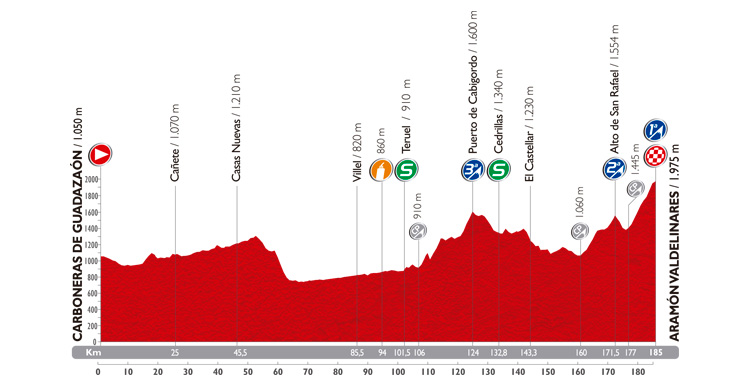
Stage 9: Carboneras de Guadazaón › Aramón Valdelinares – 185 km
After Nacer Bouhanni’s bunch sprint victory in Stage 8, the Vuelta heads North and the road gets mountainous. Stage 9 opens with a short downhill and then a long stretch on a slight incline. Roughly 50 kilometers into the day the incline abates for a fast downhill, and then the peloton will take on another long false flat before they reach the foot of the first categorized ascent. The Puerto de Cabigordo is quite a long Cat. 3, 18 kilometers in total, at an average gradient of 3.8%. From the top it’s 36 kilometers of mostly downhill roads to the two-part stage finale: the 11.5 kilometer, 4.2% average grade Alto de San Rafael, and the 8 kilometer, 6.6% average grade Aramón Valdelinares climb that follows almost immediately after. There are only 5.5 kilometers of descent between the two, so it will feel much more like one harsh climb with a quick respite in the middle than two separate tests. Near the very top of the final climb, at the end of a steeper stretch, things do flatten out a bit, opening the stage up for a possible sprint between survivors if a group reaches the line.
A breakaway will have a decent shot at this stage, with plenty of ups and downs after the midway point of the route to make controlling the race hard. However, it’s the day before a rest day, the GC is very tight, and there are bonus seconds on the line, meaning that there is a strong chance that a lot of riders in the pack will want to go full gas. For a long-range attacker to maintain any advantage over the final climb, a wealth of climbing talent will be necessary.
Stage 6 offered the first indications of who is on form and who isn’t in this race, and most of the riders who delivered on that final climb should be in the mix again here. Chris Froome will be a top favorite if this contest comes down to a battle among the GC contenders. He has been sharp in this Vuelta a España, and moreso than the very steep 4.6 km test that decided Stage 6, the final uphill drag that awaits on Stage 9 is much more Froome’s style. With Mikel Nieve as a top-notch lieutenant, Froome will look to take an advantage over his rivals here.
Movistar’s Alejandro Valverde put in a brilliant performance on Stage 6, but this will be a different sort of challenge. Climbs that require an explosive kick suit him perfectly, but over a longer, more drawn-out uphill ride, his post-Tour form will face a new test. He did do a lot of pulling at the front on the lower slopes of the final climb on Stage 6, suggesting that the engine is running well. If he is with the lead group at the finish, his sprint will make him hard to beat. Teammate Nairo Quintana will find this profile suits his skillset quite well, but he did fade a bit on Stage 6 and it’s a bit of a question mark whether the form is where it needs to be just yet. If he has gotten that little bit stronger over the past few days, this will be a nice opportunity for him to get ahead on GC.
Alberto Contador looked quite recovered from his leg injury on Stage 6, and this is an excellent profile for him if he is indeed returning to full strength. This is a longer test, which will offer a better opportunity to gauge his fitness. If it’s all there, he should be right in the mix for stage victory.
Joaquim Rodriguez has looked strong in this race but his performance on a sixth stage that seemed to suit him perfectly left a bit to be desired. He’ll have another shot at landing a good result here, with Daniel Moreno as a strong second.
Astana’s Fabio Aru and OGE’s Johan Esteban Chaves were 6th and 7th, respectively, on Stage 6, and this final uphill test will be a good opportunity for both uphill specialists to get involved in the battle for stage glory.
Daniel Martin definitely underwhelmed on Stage 6, but with that one exception he has looked strong recently, and this will be another chance to get it right. His sprint has been particularly on point, and if he can manage to stick with the lead group until the final kilometer he’ll have a shot in the flatter finish. Rigoberto Uran also struggled on the Cumbres Verdes climb, but typically, this long climb would suit him, and he’s not a bad post-climb sprinter either.
Cofidis’s Dani Navarro outperformed expectations on the Alto Cumbres Verdes and will be an outsider for victory here on Stage 9 if the GC men are indeed fighting for the day’s victory. Belkin has a powerful trio in Laurens Ten Dam, Robert Gesink, and Wilco Kelderman. Gesink and Kelderman in particular have strong finishing kicks if they can manage to stick with the leaders here. Having such strong team support will help. Sergio Pardilla, Warren Barguil, Samuel Sanchez, and Damiano Caruso are others who could be in the mix on Stage 9 if the General Classification riders make up the lead group on the road when the day nears its conclusion.
Thibaut Pinot and Julian Arredondo are both in the Vuelta a España targeting mountain stage victories, both are well-suited to this profile, and both would be allowed off the front if they decided to go for a long one here, but as of yet form is still a question mark for both as well. Ryder Hesjedal looked strong on Stage 7 before his crash, and could be a candidate for stage honors if he can get into the breakaway again here on Stage 9. Hesjedal’s teammate Andrew Talansky, Alessandro De Marchi, Damiano Caruso, George Bennett, Kenny Elissonde, Cadel Evans, Przemyslaw Niemiec, Winner Anacona, Louis Meintjes, Adam Yates, David Arroyo, and Amets Txurruka are others who could have a shot in a long-range strike.
VeloHuman Stage Favorites
1. Chris Froome | 2. Alejandro Valverde | 3. Alberto Contador
Now that the 2014 Tour de France is officially in the books, there’s time to draw a few conclusions about what we’ve seen. Three weeks of racing offer enough storylines and takeaways for weeks of analysis, but I’ve distilled my impressions down to a select few major observations.
A Worthy Winner
Vincenzo Nibali did not want this race to be remembered as the Tour de France without Chris Froome and Alberto Contador, and the results he delivered in pursuit of a truly dominant performance were quite impressive. With four stage wins and several other Top 5s, a strong challenge for the polka dot jersey, and a gap of nearly eight minutes to his closest challenger, Nibali was in another universe compared to the competition in the race. It would have been nice to have seen him battling Froome and Contador, and as things stand right now, Froome is still the oddsmakers’ favorite for the 2015 Tour, but Nibali did all the right things to ensure his place in the history books as a worthy maillot jaune.
We always knew that Nibali was a strong climber (one does not win the Vuelta and Giro without elite climbing ability) but he was up for it on every type of uphill challenge on the menu in this Tour, and avoided even one bad day. What’s more, he has developed into a top-notch time trialist, landing 4th in the Stage 20 chrono. And perhaps most importantly for this race, he displayed the sort of bike handling skills and racing savvy necessary to survive three weeks of riding on often rain-soaked and occasionally cobbled roads. There is a lot to be said for his ability to emerge unscathed from a Tour that dashed the hopes of so many other riders.
A Lengthy Injury Report
Speaking of those other riders: as much as Nibali did everything in his power to make this race his own, any rational analysis of this Tour has to include mention of the health issues that plagued so many riders and generated so many headlines. Alberto Contador was on fire this year and now he may not race again in 2014, and Chris Froome looked to be rounding back into shape before his multiple fractures took him out of the Tour. It would have undoubtedly been a very different Tour de France had they been in the mix in the mountains. They weren’t the only riders who suffered race-ending health problems. Mark Cavendish left the Tour on its very first day. Rui Costa was running well in the beginning of the race, but pneumonia hampered him as the Tour went on and ultimately he abandoned his campaign for a Top 10 overall. Andrew Talansky crashed and crashed again early on in the race and was just too banged up to continue riding at the level necessary to hang with the peloton. Andy Schleck suffered a serious knee injury which has put his next several months in doubt.
Others made it to the Champs-Élysées but were noticeably lessened by ailments along the way. Among the big names in this camp were John Degenkolb, whose first several days were hampered by injury, Arnaud Demare, who battled sickness, and Richie Porte, whose tumble out of the GC Top 10 may have been partially due to a chest infection. In short, a number of big names struggled with health issues in this Tour de France. Those riders who did survive and thrive in the race are worth noting, but it’s important to view all of their successes in perspective.
New Generation of Sprinters Here to Stay
With four victories, Marcel Kittel was clearly the best “pure sprinter” in the race. We’ll never know how Mark Cavendish might have fared against the younger Kittel through three weeks of racing, but Kittel continues to assert himself as a dominant force in the top tier of fast men. This is his second straight year of four wins, but remember, he’s only 26! Alexander Kristoff, with a pair of stage wins, is planting his flag as a sprinting force as well, especially in the bunch gallops that follow long and/or rainy days. Peter Sagan is known as the rider to beat on the hilly days that end in reduced sprints, but Kristoff has carved out a niche of his own: he’s not as strong a climber as Sagan, but even flatter stages, if lengthy enough (and especially when wet) can wear out the other fast men, and it is in those scenarios that Alexander Kristoff shines brightest. Andre Greipel and Marcel Kittel were both in the mix on Stage 15, but Kristoff won anyway, much as he won the sprint finale of this year’s Milano-Sanremo despite the presence of Mark Cavendish.
Peter Sagan may not have won a stage in this year’s Tour, but the nine Top 5 stage finishes that put him into the green jersey are undeniably impressive. It seems likely that with a stronger team, he’ll be able to focus more on winning and less on chasing down late moves; the question of “Where will Sagan land?” will be the biggest story of transfer season.
Several other young non-winners were, nonetheless, strong performers on a number of stages as well. 22-year-old Bryan Coquard was always in the mix in the sprints, and 22-year-old Arnaud Demare and 25-year-old John Degenkolb delivered some nice results despite nagging ailments.
A French Resurgence
The 2014 Tour de France was a wonderful return to prominence for French cycling. Jean-Christophe Peraud, who has landed several impressive results in stage races in his career, put in a next-level performance to reach 2nd overall in cycling’s biggest event. He got stronger as the Tour went on, and benefitted from a top-notch team that also included 6th place finisher Romain Bardet, just 23 years old. A climbing specialist with serious talent and a high ceiling, Bardet now has a Top 10 in the Tour and in Liege-Bastogne-Liege on his 2014 resume (to go with several other nice results), and he should continue to develop as an uphill force.
Thibaut Pinot finally took that step up that many expected after his 10th overall and stage victory in the 2012 Tour; a podium position in the Tour de France (ahead of Grand Tour winner Alejandro Valverde) will do wonders for his confidence. He seems to have gotten over his fear of descending, which was a major drawback to his game, but he developed into a much more well-rounded rider in other ways too, now seemingly capable of putting in a strong time trial and several straight good days in the mountains. He should only get stronger over the next few years.
The GC riders weren’t the whole story for the French revival either. Consummate breakaway specialist Blel Kadri took a very long stage win in Gerardmer, and versatile Tony Gallopin spent time in the yellow jersey and later escaped Peter Sagan and a chasing pack to win Stage 11. He took an impressive victory in San Sebastian last year and continues to prove his wide array of talents that include climbing, soloing, and sprinting.
Deserving Team Leaders
BMC’s Tejay van Garderen recovered from a prior injury to race in this Tour, and then recovered from an early crash and a single bad day in the Pyrenees to land 5th on GC when all was said and done. 2013 was a rough year for the young American, who, despite winning both the Tour of California and the USA Pro Challenge, looked to have taken a step back as a Grand Tour rider in that year’s edition of La Grand Boucle. With Cadel Evans showing signs of slowing down, however, BMC backed van Garderen completely in this year’s Tour, and by consistently hanging with with the GC Top 10 types and then delivering a very strong time trial performance in the penultimate stage, van Garderen proved that he is back on track as a GC contender. He’s still just 25.
Not far behind van Garderen on the GC leaderboard was Leopold Konig. Konig took a stage and 9th overall in the 2013 Vuelta, but 2014 hadn’t been going smoothly for the young Czech climber, who was slated for his first run at being a team leader in the Tour de France. A knee injury hampered his early season campaign and left him unable to prepare as well as he would have liked for this race. He overcame those obstacles and looked strong in the second and third week of the Tour, climbing to 9th on GC before the time trial on Stage 20. He proceeded to deliver the chrono of his life and jumped two more placings to finish 7th overall. It shouldn’t come as a complete surprise, as he has been delivering impressive time trial results somewhat under the radar over the last two years, but few expected him to land 5th in the ITT. If he can continue to show that sort of abiltiy against the clock, he will be a rider to watch in Grand Tours for years to come.
Looking Ahead
The last day of the Tour de France is not the last day of the cycling season! The Clasica de San Sebastian, a one-day race with a hilly profile designed to thrill, is less than a week away, with the Tour de Pologne and Eneco Tour soon after. Stay tuned for more previews, analysis, and rider interviews!
Stage 10: Mulhouse › La Planche des Belles Filles – 161.5 km
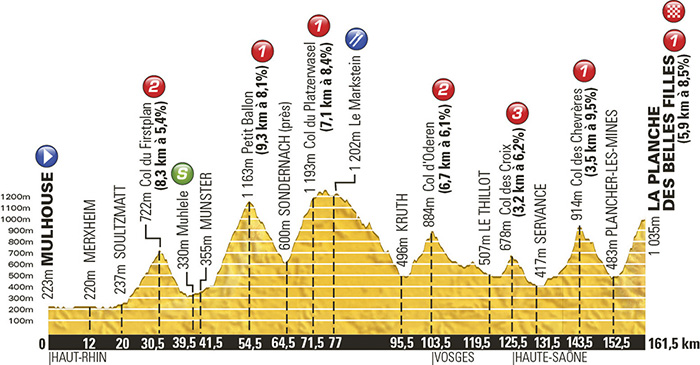
The peloton enjoyed a comparatively easy day in the ninth stage of the Tour de France, leaving the real fighting to the breakaway up the road, from which Tony Martin took a decisive victory with a long attack. That brief ceasefire in GC hostilities shouldn’t come as a surprise: the Stage 10 profile looks like a roller coaster viewed from the side. The day’s seven categorized climbs include four Cat. 1s. The final two will really hurt: the Col des Chevrères grades out at a vicious 9.5%, which will put the riders who prefer to grind out a steady tempo into a world of hurt, while the summit finish at La Planche des Belles Filles comes at the end of a 5.9 kilometer journey up a slope averaging 8.5%, with a section of 20% leading into the line. At 161.5 kilometers, it’s a short stage overall, but with so many uphill tests, the finish won’t come fast enough for the peloton.
The continuous onslaught of uphill challenges and fast descents makes this yet another good chance for a breakaway. The GC favorites will be much more concerned with each other than anyone out of contention who gets up the road, and the sprinters won’t have a chance here. Even if there is a concerted effort to pull back the break, the peloton could struggle to reel in those up front given the constant ups and downs and winding roads. However, unless the breakaway contains some serious climbing talent, it may start to falter as the day wears on, especially as the GC contenders start to ramp up the pace for the run-in to the final two brutal climbs. What’s more, the yellow jersey hunters took Stage 9 pretty easily, and a rest day awaits on Tuesday, meaning that the real powerhouses of this race will be fresh and ready to put it all on the line on Stage 10. That will further complicate things for those riders up the road. I see about a 50/50 chance for the break here. One thing’s for certain: for anyone to win this stage, a healthy dose of uphill ability will be required.
One major feature of the stage that you won’t see in the profile is the date itself: the peloton takes on Stage 10 on July 14th, Bastille Day. It’s been quite a while since a French rider won a stage of the Tour on the country’s national holiday, but it hasn’t been for lack of trying. For a French pro cyclist, there are few things more desirable than a Bastille Day victory, and that means that the French riders will be extra-aggressive trying to get out front on this climb-happy profile.
As with any stage that gives a breakaway a good chance of success, it’s hard to name anyone a favorite, but at least this day of harsh climbs allows us to narrow down the list a bit to the GC contenders and those opportunists with real climbing talent. Among said opportunists, it will be interesting to see which of the uphill chargers from the Stage 9 breakaway have enough left in the tank to give it another go on Stage 10; so many of the strong climbers who are out of GC contention and who might stand out as likely agressors will indeed be coming off a long day out front. Katusha’s Joaquim Rodriguez finally showed some form in the road to Mulhouse, picking up a handful of KOM points behind Tony Martin. If he continues to feel well, he could give it another go. Teammate Simon Spilak was with him in the Stage 9 break, and he is another rider who could be hoping to recover energy quickly to try for another long distance attempt.
Giant’s Tom Dumoulin, Belkin’s Steven Kruijswijk, Europcar’s Cyril Gautier, Bretagne-Séché’s Brice Feillu, Cofidis’s Daniel Navarro and Nicolas Edet (who will also be on the lookout for more mountain points), and Cannondale’s Alessandro De Marchi are other strong-climbing opportunists whose participation in the early move of Stage 10 may depend on how quickly they recover from the efforts of the day prior.
AG2R’s Christophe Riblon has not been very visible so far in this Tour de France, but it wouldn’t surprise me if the winner of last year’s Alpe d’Huez stage was saving his energy for another attempt to win on a momentous day. Stages like this are his specialty. NetApp-Endura’s Leopold Konig has not had the Tour he was hoping for, but this will be an opportunity for him to get something out of the race; he’s an excellent climber. Garmin-Sharp’s Janier Acevedo, Katusha’s Yuri Trofimov (far enough on the fringes of the General Classification that he’ll likely be given some freedom), Movistar’s Giovanni Visconti, FDJ’s Arnold Jeannesson, IAM Cycling’s Sebastien Reichenbach, AG2R’s Blel Kadri, Europcar’s Tommy Voeckler, Cofidis’s Rein Taaramae, and Trek’s Haimar Zubeldia and Frank Schleck are other good long-distance candidates who will come into Stage 10 without having spent the previous day out front. It will interesting to see if any of the teams hunting the yellow jersey send any top lieutenants up the road; Tinkoff-Saxo’s Nicolas Roche, Rafal Majka, and Michael Rogers, Sky’s Mikel Nieve, Lampre’s Chris Horner, and Movistar’s Benat Intxausti and Ion Izagirre would be big favorites if they made it into an early move.
Whoever ends up in the breakaway, they’ll have their work cut out for them staying away from the pack of GC contenders. The Tour de France has spent two days in the hilly Vosges region already, but this one is by far the most likely to shakeup the General Classification. Stage 10 is the best opportunity so far in the race for the elite climbers to get ahead, and that could make for a very fast day among the yellow jersey contenders; even if they aren’t actually focused on reeling in the riders up the road, it could very well happen anyway.
As might be rather obvious on a day with four Cat. 1 climbs and an uphill finish, Tinkoff-Saxo’s Alberto Contador is the favorite among the GC contenders. He is the best climber in the race, and he has an excellent team around him to put him into the best possible position to get ahead when the road goes up. If he gets away on the Col des Chevrères, with a meandering descent and another steep climb to follow, his rivals may not see him again until they get to the finish line, and for that reason he will be the day’s top favorite. It is important to note that by naming him as such, I am not saying that he is favored against the field, but given the fact that the GC contenders could very well reel in the day’s breakaway, and since it would be impossible to name any one rider as the favorite to take victory from the early move anyway, Contador is, in my mind, more likely than any other single rider to win Stage 10.
He will, however, have plenty of competition among the yellow jersey hunters. Astana’s Vincenzo Nibali looked up to the challenge in the steep finish of Stage 8, though this will be a much tougher day. Furthermore, his team has spent quite a long time at the front of the pack so far in the Tour de France, and it wouldn’t be surprising to see them showing signs of fatigue here. Still, Nibali appears to be very strong right now, and his position on GC will allow him to follow moves rather than having to worry too much about making them himself.
Sky’s Richie Porte put in a nice performance of his own on the uphill finish in Gérardmer, coming in only four seconds behind Nibali. These are very steep climbs he’ll be undertaking on Stage 10, but he does have a strong supporting cast, and they have not had to do too much work in this race so far. Movistar’s Alejandro Valverde tends to like the steep stuff, but he was not at the same level as the likes of Contador and Nibali on Stage 8, and he’ll need to find that form fast if he wants to keep fighting for the yellow jersey with so many uphill tests on Stage 10.
FDJ’s Thibaut Pinot was very impressive in Gérardmer, next to cross the line after Porte. For him, the big challenge of Stage 10 may be the barrage of difficult descents. He looks to have improved both his bike handling and his general confidence, but this will put him to the test. If he can manage to stay out of trouble while going downhill, he’ll be very well positioned to strike out for glory on Bastille Day when the road goes up. AG2R’s Jean-Christophe Peraud and Romain Bardet could also be planning to attack on Stage 10. Both have looked strong, with Peraud’s form coming as a bit of a surprise after he seemed to be struggling in the Dauphine. Europcar’s Pierre Rolland will almost certainly try something on one of the later climbs, but having picked up a chunk of time on GC on the way to Mulhouse (he is now 8th overall), he won’t be given nearly the same level of freedom to get ahead anymore.
Lampre-Merida’s Rui Costa, Belkin’s Bauke Mollema, and Lotto Belisol’s Jurgen Van Den Broeck are all sitting one after another in the General Classification and could try to pick up time on Stage 10 while the riders at the very top of the GC leaderboard are worrying about each other. BMC’s Tejay van Garderen has looked sharp on the climbs so far and I like his chances to continue to be in the mix as this race goes on. This will be a tough day for his compatriot Andrew Talansky, who has been on the deck more often than he would have liked in these past few days, but he is known for his tenacity and this is a day that will require a healthy dose of fighting spirit.
Be sure follow @VeloHuman on Twitter for live commentary on this and every stage of the 2014 Tour de France! With a rest day on tap after Stage 10, the next preview will be up on Tuesday, so stay tuned. In case you missed it, the overall Tour de France preview can be found here.
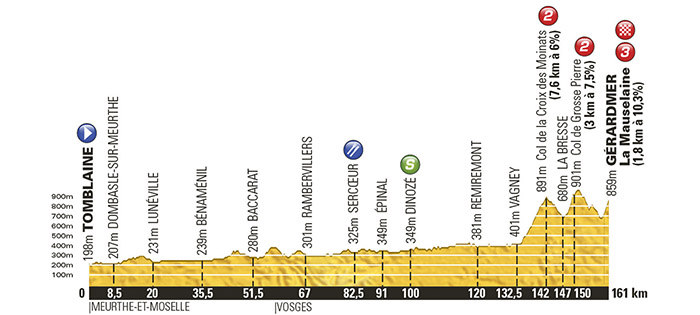
Stage 8: Tomblaine › Gérardmer La Mauselaine – 161 km
In the Tour’s seventh stage, Matteo Trentin earned his second career Tour de France win on a mostly flat day with a late sting in the tail. Stage 8 is another day of mostly flat roads leading into a late challenge, but this time the sting is a whole lot nastier. After 133 kilometers with only a few minor rollers, the Stage 8 profile suddenly turns savage. First comes the tough Cat. 2 climb of the Col de la Croix des Moinats, 7.6 km at an average gradient of 6%. After a speedy descent comes another Cat. 2 of 3 km at a steeper 7.5%. One more fast downhill leads into the final 1.8 kilometers, where the road kicks up in a vicious 10.3% average gradient 3rd Category climb to the Gérardmer finish. It’s not a long day, but the three late climbs are sure to weed out those who are not at the top of their game.
The early break will likely get a big advantage in the first two hours of racing, and with no chance for the pure sprinters at this finish and mountains on the horizon, the peloton’s chase may be a bit less spirited than we’ve seen on other stages. There is a chance of breakaway success here. Still, this will be the first real opportunity for the climbing specialists to do damage in the General Classification fight, which will probably lead to a real injection of pace from the pack in the last forty kilometers or so, at which point the break may struggle to hold their advantage on the flat run-in to the climbs. As such, this could be the first stage in the Tour that ends in a showdown among the GC candidates (with a few other punchy types likely in the mix as well). Any one of the day’s three uphill challenges could see action, with fireworks guaranteed on the steep final ascent.
With this finale, Movistar’s Alejandro Valverde has to be a rider to watch. The winner of the 2014 edition of La Fleche Wallonne is one of most explosive uphill finishers in the peloton, and he has been on top form all year, flashing his brilliance with victory after victory since February. With a chance to pick up time on his rivals, he’s certain to light up these late climbs.
Close behind Valverde at every turn in the Ardennes Classics was Michal Kwiatkowski of Omega Pharma-Quick Step. Stage 7 looked like a great opportunity for the versatile Kwiatkowski, but it turned out that he and his team were working for the also versatile Matteo Trentin. Kwiatkowski will have his opportunity on Stage 8. The short climbs are his forte, and he won’t have a problem with the descents that lead into the last climb of the day.
As one might expect on a stage involving a succession of late ascents closed out by a 10.3% climb, Alberto Contador will be a major player as well. The Tinkoff-Saxo leader knows he needs to pick up time on GC at every opportunity. An excellent descender, he may even try to strike out on the first or second categorized climb and attempt to grab an advantage from further out (and this could happen whether the peloton has reeled in the break or not). Contador has been unrivaled on the climbs so far this year, and this steep finish will allow him to turn the screws on his opponents for the yellow jersey of the Tour de France.
Katusha’s Joaquim Rodriguez would perhaps be the top favorite on this finish if his form weren’t in question. It is not clear how far along he is in his post-Giro recovery. Still, it’s hard to draw up a final two kilometers more perfect for Purito than these, and now that he’s further behind on GC than Andre Girepel, he’ll have the added benefit of being able to go on the attack without worrying the GC men. Garmin-Sharp’s Tom-Jelte Slagter and OGE’s Simon Gerrans and Michael Albasini are other very strong puncheurs who could enjoy that sort of freedom as well; head-to-head against the likes of Valverde this could be too steep for them, but as non-threats for the yellow jersey, they may be allowed off the front if they want to go for it. Europcar’s Pierre Rolland is further down on GC than he would have hoped, but that will at least grant him more flexibility to strike on Stage 8. It’s not one that necessarily favors him over the other GC types, but if he gets ahead of the pack in a move of non-GC riders, his chances will be good.
Astana’s Vincenzo Nibali, Lampre-Merida’s Rui Costa and Chris Horner and Belkin’s Bauke Mollema should handle the final slopes well. AG2R’s Romain Bardet has shown some punch at times this year. This will be a good test to see just how strong Sky’s new leader Richie Porte is on the climbs right now. Garmin-Sharp’s Andrew Talansky and Lotto Belisol’s Jurgen Van Den Broeck don’t immediately come to mind on a final climb like this, but both have looked to be on excellent form in the past few weeks.
Katusha’s Simon Spilak, Cofidis’s Daniel Navarro, AG2R’s Christophe Riblon, and Garmin-Sharp’s Janier Acevedo are all excellent climbers who are out of the GC picture entirely, so it wouldn’t be a surprise to see them among those trying something from afar. Tommy Voeckler and Cyril Gautier of Europcar are almost certain to be on the lookout for long-range success on Stage 8. Jan Bakelants of OPQS may be as well. It will be interesting to see if Tinkoff-Saxo puts any of Contador’s elite trio of lieutenants (Rafal Majka, Nicolas Roche, and Michael Rogers) up the road. Lastly, Cannondale’s Peter Sagan at least deserves a mention: I highly doubt that he will be in the mix on something as steep as this last climb, but he was among the Top 15 riders in 2013’s La Fleche Wallonne; he may at least give it a shot!
After months of buildup and weeks of tune-up races, the main event is upon us. We’ve gone a few days without any WorldTour racing (though hopefully you have had a chance to enjoy the VeloHuman Up-and-comer Q&A Series in the meantime), but the 2014 Tour de France finally kicks off in Leeds on Saturday, July 5th. As usual, in addition to the overall preview, VeloHuman will be previewing every stage of the race. You can find all of those stage previews here. Also, you can follow @VeloHuman on Twitter for more analysis and commentary during the Tour.
The Route
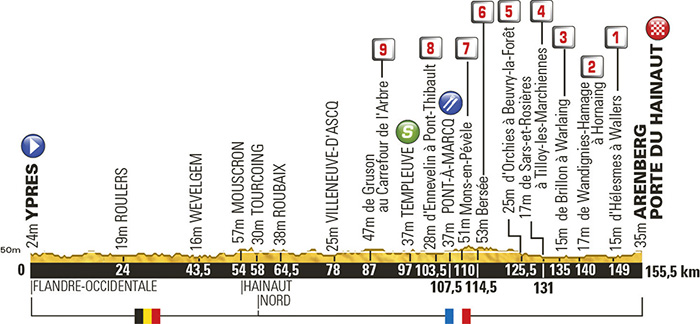
The route of this year’s Tour de France is an intriguing one: in keeping with recent editions, the 101st Tour de France waits a full week to throw any serious mountains at the peloton, but there are some real challenges on the menu before the road reaches high altitudes. The first stage of the race is a mostly flat affair through Yorkshire that is likely to end in a sprint. The second stage may not have high mountains, but with nine categorized climbs on the docket, including an 800 meter, 10.8% bump just 5 kilometers before the finish line, it should be a thrillfest, and the GC contenders will need to be alert. Stage 3, the Tour’s last day in England, is another likely day for the sprinters, and the also mostly flat Stage 4 will probably end in the same way. Stage 5, however, will be one of the most intriguing of this year’s Tour de France.
Nine cobbled sections will pose a tough challenge to the lightweight GC contenders on Stage 5.
To add excitement to the 101st edition of the race, the organizers added a cobbled stage that will travel over some of the same challenging terrain that features in spring’s Paris-Roubaix. The Tour stage isn’t as long as the Monument Classic, but the route travels over sections of the Carrefour and Mons-en-Pévèle and plenty of other difficult sectors, and the bumpy roads could bounce the lightweight GC types all over the road. It will be a white-knuckle ride all the way to the finish, and attacks will be coming hot and heavy from classics specialists given the rare chance to shine on their favored terrain in the Tour de France.
Stage 6 is flat enough to be a likely sprinters’ target. Stage 7 is mostly flat as well, but a few late bumps could put the heavier sprinters under pressure. The peloton finally hits a real uphill finish on Stage 8, though time gaps should be small, as the closing climb up the Gerardmer is less than 2 kilometers long. Stage 9 includes some tough climbs, including a Cat. 1 ascent; it could be a day for the breakaway or for the versatile fast-finisher types, with a mostly flat final 20 kilometers, but GC attacks aren’t out of the question. However, the overall contenders may opt to save energy for Stage 10, which will throw tough ascents at the peloton all day long.
Stage 10 will be a roller coaster ride of tough climbs and difficult descents, offering plenty of opportunities for attacks to go free.
At 161.5 kilometers, Stage 10 is not particularly long, but four Cat. 1 climbs and a few smaller ascents stand between the riders and the finish line. For most of the day, the riders will be facing tough climbing or tricky descending, and that is likely to encourage aggressive riding, especially with a rest day to follow. After the day off, Stage 11 is a bumpy one but it probably won’t have GC implications. The same is true for Stage 12.
The Tour heads to the Alps for its first real high mountain test on Stage 13. An HC-rated finish awaits. Stage 14 will not offer respite, starting with a very long Cat. 1, followed by the 19 kilometer, 6% average grade Hors Categorie climb up the Col d’Izoard, and then ending with a Cat. 1 climb to Risoul. The peloton will be glad for the flat day on Stage 15, as well as the rest day that follows.
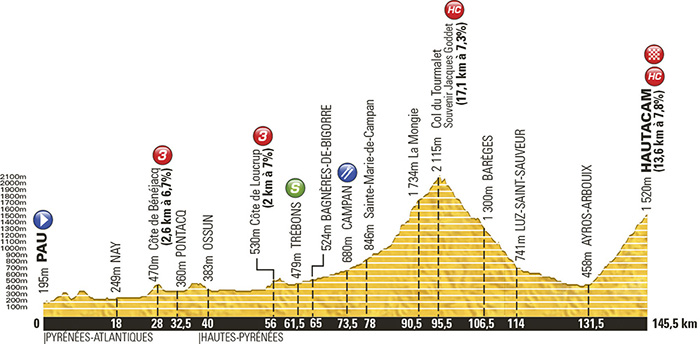
On Stage 18, the final mountain stage of the 2014 Tour de France, the riders must overcome both the Col du Tourmalet and a Hautacam summit finish.
Stage 16 is the first of three days in the Pyrenees, and will challenge the riders with a late HC-rated climb followed by a little over 20 kilometers downhill to the finish line. Stage 17 is tougher, with three Cat. 1 climbs on the way to an Hors Categorie summit finish. Stage 18 will be the last chance for the climbers to pick up time, and what a chance it will be: the pack will climb the fearsome Col du Tourmalet, zoom down the other side, and then ascend to Hautacam and the finish line.
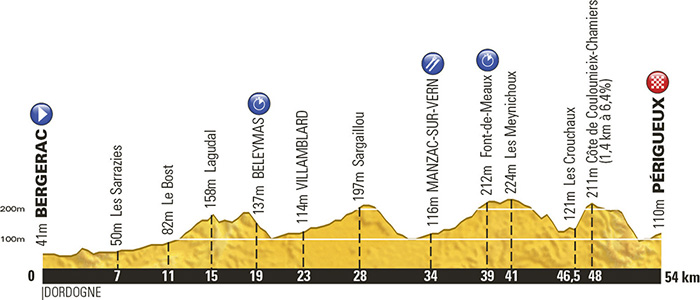
Stage 20’s race against the clock is a very long one at 54 kilometers. Gaps between the GC riders will be significant.
A mostly flat Stage 19 will allow the GC contenders to recharge before taking on the decisive time trial on Stage 20. It’s a long one at 54 kilometers, and it could seriously shake up the General Classification. The parcours is hilly, which will offer some consolation to the climbers, but riders with big engines will have the advantage over this distance. The GC will be decided as the last rider crosses the line on Stage 20, with the classic Champs-Élysées sprint on tap for the twenty-first and final stage of the race.
All told, this year’s route may seem a bit more climber-friendly than those of recent years, but a cobbled stage and a long time trial at the end of three tough weeks of racing will make a well-rounded skillset a requirement for victory. And although the high mountains don’t come until the middle stages of the Tour de France, some early challenges will keep everyone on their toes from the beginning of the race. It should be a thrilling ride all the way from Leeds to Paris.
The General Classification Contenders
The Tour de France is a long race, and the mountains and cobbles along the journey could shake things up at a moment’s notice, but in terms of the yellow jersey fight, there are two competitors who stand out as the clear favorites. Team Sky’s Chris Froome and Tinkoff-Saxo’s Alberto Contador are a cut above their opponents, climbing and time trialing in a league of their own and with powerful teams backing their bids for yellow. Between them however, things are very tight.
Froome was dominant in last year’s Tour de France, and his convincing victory came after a dominant spring that saw him establish his supremacy across several races. Meanwhile, would-be top rival Alberto Contador never seemed to find his top level in the run-up to the 2013 Tour, and he was unable to get to that level during the race either. At least so far, 2014 has been a different story entirely. Alberto Contador has been the best GC rider in the sport, winning races like Tirreno-Adriatico (where he put his uphill wizardry on full display) and the Vuelta al Pais Vasco (where he flashed stellar chrono form) and carrying that good shape through June’s Criterium du Dauphine. He is a proven winner of the Tour de France who seems to have refound the ability he lacked in 2013. Meanwhile, Chris Froome has struggled to overcome hurdle after hurdle, as injury and illness have waylaid his plans throughout the year. That isn’t to say that he hasn’t flashed his brilliance here and there; he took victory in the Tour de Romandie and looked very sharp in the Dauphine prior to a crash. Still, compared to last year’s bulletproof campaign, this year has been a difficult one for the defending champion, which makes his grip on the title of pre-race favorite a more tenuous one.
If forced to pick a favorite, I’d still name Chris Froome (though I believe that his edge is razor-thin). The ability he has shown over the past year when at peak form is just impossible to ignore, and he has displayed enough strength when healthy in 2014 to at least maintain his position as pre-race favorite. He was clearly the better rider last year, and while his inability to dominate the early season this year raises questions, his many ailments have certainly played their part in slowing him down, and he appears healthy now. Richie Porte and Mikel Nieve are top-notch teammates for the climbs who could find themselves lurking at the fringes of the Top 10 in their own right, and Geraint Thomas and Vasil Kiryienka are powerful pace-setters on the hilly and flat days. Contador’s bid for victory, meanwhile, took a serious hit this past week when it was announced that star teammate Roman Kreuziger would not be riding in the Tour due to an ongoing investigaton into biological passport irregularities. Contador will no longer be able to enjoy the luxury of having last year’s 5th place overall finisher at his side. Replacement Rafal Majka is obviously also very talented but he will likely be fatigued after a hard Giro. Mick Rogers and Nicolas Roche, though excellent support riders, are also coming off the same tough Giro. In short, despite Contador’s stellar season, he will still have something to prove against the defending champion; regardless, I’ll reiterate that this should be a close fight and it’s extremely tough to call between these two stars right now.
Behind them is a pair of second-tier favorites who are themselves on a level above the rest of the GC hopefuls: Astana’s Vincenzo Nibali and Movistar’s Alejandro Valverde look to be the top contenders after Froome and Contador, and though victory will be a tall order for either of them, they should at least be seen as heavy favorites to fight it out for the final spot on the podium. Nibali had a brilliant 2013 campaign, winning the Giro d’Italia convincingly and taking runner-up honors in the Vuelta a España, but he has been unable to find as much success in stage races this year. Still, he proved in 2013 that at peak form he is one of the top climbers in the world, and a great descender and a master tactician to boot. He’ll have two weeks to ride himself into Grand Tour form, and it’s not as if 5th in the Tour de Romandie and 7th in the Dauphine are bad results, per se. And remember, Joaquim Rodriguez looked way off the pace in the 2013 Dauphine, finishing 16th, and went on to a Tour de France podium. I don’t think it’s out of the question that Nibali gets back to the top level before the race hits the mountains. Victory in the Italian road race championship was a good sign. This event is the focus of his season, and I expect him to be in his best shape of the year when the Tour gets into the mountains, and if he can reach his 2013 form, he could find himself battling Froome and Contador at the very top. He’ll also have one of the race’s finest teams backing him, with constant lieutenant and Top 10 finisher (and legitimate threat for a repeat Top 10) Jakob Fuglsang, veteran Michele Scarponi, and versatile Tanel Kangert at his side.
Alejandro Valverde, unlike Vincenzo Nibali, has been landing top results left and right all year. This is probably his last year as Movistar’s featured rider for the Tour, so motivation is high. Perhaps the one question mark in his stellar 2014 resume is the lack of recent results in top-level stage races. He eschewed the Dauphine and the Suisse in the run-up to the Tour, opting for the Route du Sud instead. He was strong there, but it’s hard to judge his form based on that race, given the lower level of competition. He was strong in Pais Vasco, but that was in April. It will be interesting to see how he goes in the Tour de France after well over two months away from WorldTour competition. With Ion Izagirre and the excellent Beñat Intxausti for support, he will have plenty of help, and his Spanish national championship-winning time trial form should come in handy as well. Given the sort of peak ability he has shown over the last few years, his strong team, and his knack for success in 2014, I expect him to be one of the last men standing as Froome and Contador ratchet up the pace on the steep climbs.
Garmin’s Andrew Talansky was already worthy of inclusion in the Top 10 conversation after landing 10th in last year’s Tour, but he solidified his presence in the discussion of outside contenders with his stellar Criterium du Dauphine. Though it may be tempting to write off his victory in that race to tactics alone, he would not have been in position to win the GC with his long-distance attack had he not put in strong performances throughout the race; he was sitting in 3rd place on GC before his daring move. Talansky has steadily improved as a climber over the past few years, and Garmin sends a great support squad to back his bid for the overall, with strong climber Janier Acevedo to help set the pace uphill and a number of other excellent teammates who thrive on the hilly days. Compatriot Tejay van Garderen will also be hunting a strong overall result, and he, too, is armed with ever-improving climbing skills. After a disappointing 2013 in which he seemed to take a step backward, he kicked off 2014 with renewed vigor. He was stellar in Catalunya, winning a mountain stage ahead of Contador, Purito, Froome, and others, and finishing 3rd overall on GC. However, a crash in the Tour de Romandie left him with a small hip fracture, which forced him to abandon that race and clearly slowed him in the Dauphine. Still, he certainly looked to be rounding into form as the Dauphine progressed and he has a dedicated BMC team backing him for a good GC result.
Belkin’s Bauke Mollema got off to a slow start in 2014, but he was climbing very well in the Tour de Suisse, and appears to be finding form just in time for his season’s biggest target. Given Belkin’s sponsorship woes, motivation is high, and Mollema should have it in him to fight for a strong GC result. Teammate Laurens Ten Dam is a valuable second.
Lotto Belisol’s Jurgen van den Broeck spent all of 2013 and much of this season hunting the form that put him into 4th place in the Tour de France in 2010 and 2012, and until June’s Criterium de Dauphine, he did not have much to show for his efforts. But his 3rd place in the Dauphine, earned with some top-notch climbing performances, put him right back into the Top 10 discussion, given the ability he has shown in the past. He won’t have much team support, but the parcours is in his favor, with only a single time trial stage. Like so many other outside contenders, he may find the podium a very difficult goal, but a Top 10 is within his reach.
A Top 10 may be well within the reach of World Champion Rui Costa as well, though it’s hard to know what to expect out of the talented Portuguese all-rounder given that this is his first time as a GC team leader in the Tour de France. Signs point to stellar form right now after his brilliant Tour de Suisse victory (and a host of other strong results this season that may have been overlooked in all the attention given to his lack of actual victories in the rainbow jersey). Of particular interest was his terrific time trial performance in the Suisse, where he was third to specialists Tony Martin and Tom Dumoulin in that race’s 24.7 km time trial seventh stage. Whether he has the consistency required to land a top GC result in a three-week race is unclear, but he certainly has all the tools to make him a good candidate. 2013 Vuelta winner Chris Horner makes for a stellar second, though his form is an unknown right now.
FDJ’s Thibaut Pinot has not been having an excellent season results-wise, but he has not been bad either, with Top 10s in Pais Vasco, Romandie, and the Bayern Rundfahrt. He was a bit under the weather in the Tour de Suisse and never really mounted much of a challenge in that race, but he did put in a strong time trial on a parcours that did not seem to suit him. It was actually one of a number of strong chrono performances from the climbing star this year, and if he has indeed found an extra gear against the clock (and if he can get back to his peak form by the time the Tour hits the mountains), he’ll be a dangerous outsider.
AG2R’s Romain Bardet has continued to deliver impressive results in his young career, with several Top 10s in big races already in 2014. He’ll appreciate the hilly parcours. Teammate Jean-Christophe Peraud has had a very strong season so far and will be looking forward to the race after crashing out of last year’s edition while looking well-positioned for a strong result. 2013 Alpe d’Huez stage winner Christophe Riblon makes for yet another strong all-rounder for AG2R. Fellow French stars Thomas Voeckler and Pierre Rolland of Europcar at least deserve a mention, but they may be chasing stage wins, with Voeckler generally unimpressive this year and Rolland coming off the Giro d’Italia (he was terrific in that race, but hunting for a strong result in the Tour de France GC after the Giro is probably too much to ask). Speaking of Giro participation and stage hunting, Katusha’s Joaquim Rodriguez is on the startlist, but he has said that he is purely here for stage wins and as preparation for the Vuelta, as he is still recovering from his Giro crash. Earlier in the season there was talk of teammate Simon Spilak having support as a GC rider but Katusha seems to be more focused on stage wins now; Spilak won a stage in the Dauphine but he was a non-factor in the GC. He’s very talented but he has yet to make much of a run at Grand Tour GC success; Yuri Trofimov may be Katusha’s designated GC rider instead. Michal Kwiatkowski of Omega Pharma-Quick Step was one of the spring’s biggest stars, but he took a break from racing following the Tour de Romandie and since then he has not apperaed to be at the same level that he was at in March and April. However, the Polish rising star is a tough competitor and this is a big target of his season, so it would not be a surprise to see him back to top form by the time the GC race heats up. He’ll hope to improve on his 11th place in last year’s race. IAM Cycling’s Mathias Frank has delivered quite a few excellent performances in his first year with his new team and he is sporting an improved time trial this season. He’ll look for continued success here. Leopold Konig leads the GC charge for fellow wildcard invite NetApp-Endura. He was excellent in the 2013 Vuelta a España, landing in the Top 10 and winning a stage, but injury has hampered his 2014 campaign. He appeared to be rounding into form at the Dauphine, however, and his team has selected a Tour squad dedicated to his GC hopes (leaving VH Up-and-comer Q&A Series interviewee Sam Bennett off the startlist). A Top 10 is within Konig’s reach. Also on the fringes of GC contention are Cofidis’s Daniel Navarro and Rein Taaramae and Trek’s Haimar Zubeldia and Frank Schleck (Andy appears to be riding in support of them).
The Stagehunters
As usual, the caliber of stagehunters in the Tour de France is very high, especially among the sprinters. With at least seven days very likely to end in bunch sprints, the sport’s elite sprinting trio of Mark Cavendish, Marcel Kittel, and Andre Greipel are in attendance. All of them have had success this year, but they have not faced each other on many occasions, meaning that the battle for sprint supremacy is very much up in the air.
With his four victories in 2013, Marcel Kittel established himself as the fastest sprinter in that year’s Tour, and his dominance in the first two stages of this year’s Giro d’Italia (before he pulled out of the race with illness) suggest that he has not slacked off in 2014. His top-speed is otherworldly and he also has a nearly unbeatable leadout train. I think he is the best of the three right now.
OPQS’s Mark Cavendish has won some nice victories this year all over the map, and was head and shoulders above his competition in the recent Tour de Suisse on Stage 4, the one chance he had to sprint for victory (a crash derailed his bid for glory on Stage 5). His leadout, despite the additions of Mark Renshaw and Alessandro Petacchi, has not been as strong as he would have hoped, but there is plenty of talent there and they could put it together for the Tour. What’s more, last year’s “disappointment” (two stage wins is a disappointment when you are Mark Cavendish) came after he had raced a difficult Giro d’Italia, and this year, he skipped that Grand Tour in favor of shorter races. Perhaps with fewer race miles, he’ll be better prepared to take on his rivals.
Andre Greipel has had quite a year, racking up victory after victory since January’s Tour Down Under. Having just won another German Nationals title, as well as stages in each of the last four races he has undertaken, Greipel is obviously on great form. Lotto’s leadout team is a good one. Still, Greipel is probably the third of the trio right now. As much success as he has had this year, he has mostly been facing lower-level competition recently and I’m not sure how well his dominance against that competition will carry into the biggest race of the year. However, he is still a member of that elite trio, well above the rest of the sprinting pack, and picking up a few victories is a reasonable goal for the German.
Even with the dominance of this select trio of sprinters, however, the battle for the green jersey is still likely to come down to Peter Sagan, who can hunt for victories in the Tour’s many hilly stages and reliably expect Top 10s in the flat ones. As he consistently racks up very high placings, the triumvirate of top sprinters will be fighting amongst themselves for victories on the very flat stages, and not even contesting some of the hillier days that Peter Sagan is targeting. The convincing winner of the Tour de Suisse points competition, Sagan is firing on all cylinders right now and it’s hard to see past him in any stage likely to end in a reduced bunch sprint. Cannondale teammate Elia Viviani appears to be here in a support capacity.
Michael Matthews figures to offer some competition to Sagan on the tougher days; he showed stunning climbing legs in the Giro d’Italia and, having abandoned that race before it got too mountainous, he should have enough energy in the tank to challenge Sagan on the hilly stages. Marcel Kittel’s teammate John Degenkolb isn’t as good a climber as Matthews or Sagan but he could be there on some of the tougher days, too. FDJ’s Arnaud Demare is ready to prove that he, not Nacer Bouhanni, is the best sprinter on his team, and he’ll have an eye on the sprints that follow more difficult stages as well. Katusha’s Alexander Kristoff is especially adept at sprints that follow grueling days in the saddle: the cobbled fifth stage could be a good opportunity to shine against some of these other names. This Tour de France will also be a rare opportunity for him to sprint with the support of a dedicated team, meaning that he may also surprise even on the less demanding stages.
Lampre’s Sacha Modolo has been knocking at the door of his first WorldTour victory for a while and he finally got it in the Tour de Suisse; he’s on excellent form right now and is a nice outside candidate in the sprints. Europcar’s Bryan Coquard has been extremely successful hunting victories in lower level French races this year; with a little luck he could be in the mix. Movistar’s JJ Rojas, Trek’s Danny van Poppel, Tinkoff-Saxo’s Michael Morkov and Daniele Bennati, and Cofidis’s Adrien Petit and versatile Julien Simon are other outside contenders for the sprints who will hope to play spoiler to the heavier favorites.
Punchy types who will look to get into the mix on the hillier stages include 2013 stage winner and 2014 Liege-Bastogne-Liege winner Simon Gerrans of Orica-GreenEdge and his on-form teammate Michael Albasini, Garmin’s Tom-Jelte Slagter, FDJ’s Arthur Vichot, Lotto Belsol’s Tony Gallopin, OPQS’s Jan Bakelants, and Europcar’s Cyril Gautier. As mentioned before, Joaquim Rodriguez considers himself purely a stagehunter in this race, making him a very likely aggressor in the later mountain stages of the Tour. We won’t know which big-time climbers abandon failed GC bids to hunt stage wins until the leaderboard starts to take shape in the middle of the race, but Purito is sure to be among the most prominent of the riders looking for mountaintop victories from the breakaway in the Tour’s final week.
Garmin’s Ramunas Navardauskas, IAM’s Sylvain Chavanel, BMC’s Greg Van Avermaet, Astana’s Lieuwe Westra, Sky’s Geraint Thomas, OPQS’s Niki Terpstra, Belkin’s Lars Boom and Sep Vanmarcke, and, of course, Trek’s Jens Voigt and Fabian Cancellara are just a few of the names that stand out as likely long distance protagonists; for many of them, the cobbles of Stage 5 are a major target. Cancellara is also likely to be one of the main contenders in the Tour’s lone time trial, where he will face off against the GC heavyweights and other chrono specialists like World Champ Tony Martin and Giant-Shimano up-and-comer Tom Dumoulin.
VeloHuman Favorites
General Classification
Winner: Chris Froome Podium: Alberto Contador, Vincenzo Nibali Other Top Contenders: Alejandro Valverde, Tejay van Garderen, Andrew Talansky, Bauke Mollema, Jurgen van den Broeck, Rui Costa, Thibaut Pinot
Points Classification
Winner: Peter Sagan
I will be previewing every stage of the 2014 Tour de France here at VeloHuman.com, so make sure to bookmark the page! VH will bring you stage profiles, favorites, and outsiders for every day of racing. You can check out the Stage 1 Preview here. There will be plenty more commentary and analysis on Twitter @VeloHuman. If you’re the type who can’t get enough cycling talk, you’ll be glad you followed! Hope to see you soon.
-Dane Cash
Photos by Damien, jvanattenhoven, Alain Stoll, and Harald.
The Dauphine was supposed to be a showdown between Tour favoritesChris Froome, Alberto Contador, Vincenzo Nibali, but other riders decided to crash the party, offering a chance for a number of stars beyond those big names to show off impressive form. At first, it did not look like any outsiders would have a chance. Chris Froome was impeccable in Stages 1 and 2, delivering a convincing victory in the opening time trial, and nabbing another stage win on the following day. Contador was not far behind in the ITT and just moments behind Froome on the second stage. Things seemed set for a showdown between the two, especially with Nibali showing signs of weakness: Astana’s GC man could not match the constant accelerations of his two rivals on the slopes of Stage 2. The coming days had plenty of surprises in store, however. Froome’s hard crash on Stage 6 raised a cloud of uncertainty over his race, but it was only the beginning of the surprises; Andrew Talanksy shocked the cycling world when his early attack on the final stage survived the immense efforts of a group of strong chasers, giving the American the overall victory ahead of Contador. Jurgen van den Broeck was another winner out of the move, sliding into 3rd overall. Meanwhile, Chris Froome couldn’t handle the pace of the chase and fell out of the Top 10 altogether, forced to be content with his two stage victories and the points jersey.
Unfortunately, Froome’s crash makes it difficult to draw any clear conclusions about his form coming into the Tour de France. He looked unstoppable on the first two stages, but it’s hard to say whether his vulnerability in the final two days was a result of his inability to match rival Contador, or pain from his injuries. With the way he rode the first mountain test, I have to imagine that his crash had a significant impact on him in the closing stages. Regardless, what could have been a major confidence booster for Froome in what has been an otherwise rough year was instead yet another disappointment. He goes into the Tour with question marks surrounding his campaign, no longer the sterling, heavy favorite he was in 2013.
Meanwhile, Alberto Contador made a strong statement: he put in a stellar opening time trial and matched Froome in the first climbing stage, even before Froome’s crash. He was by far the strongest climber of the GC riders in the penultimate day of racing. Though he was unable to reel in Talansky’s move on Stage 8, the strength he showed in his attempt was another impressive show of the excellent shape he is in. Even more encouragingly, he was able to deliver such a strong Dauphine despite lacking support from the big names that will support his Tour bid; top lieutenants like Roman Kreuziger and Nicolas Roche did not join him for this race. With the help of Tinkoff-Saxo’s first string, Contador will be an extremely difficult opponent in the Tour de France.
Vincenzo Nibali‘s 7th place in the final GC was not a bad performance, per se, but at no point in the race did he look the part of a Tour de France top contender. Time is running out for Nibali to find form in 2014 before his main objective.
Andrew Talanksy made the most emphatic statement of the Dauphine, and it wasn’t only due to his masterful attack in the final stage. He never would have been in contention for the overall had he not delivered strong performances throughout the race: 4th in the opening ITT, 5th in the mountainous 2nd stage, and the GC rider closest to Contador on Stage 7, Talansky was firing on all cylinders all week long, and he looks primed for another strong Tour de France (he was 10th last year). Jurgen van den Broeck can take many of the same positives away from the race: his podium position was the result of a consistent racing from the very first day of the Dauphine. He has been lacking that consistently recently. After a disappointing 2013, van den Broeck made a resounding statement to his team that he deserves another shot at the Tour GC this year.
Wilco Keldmeran followed up his 7th in the Giro with an excellent 4th at the Dauphine: carrying that level of form this far into June confirms that the 23-year-old is truly the real deal. Romain Bardet‘s 5th should offer a fair bit of consolation for his team; AG2R will be without Carlos Betancur come July’s main event. Adam Yates landed an impressive 6th; his Tour of Turkey victory and his 5th in the Tour of California were nice results, but a Top 10 in this race, one of the biggest one-week events of the year, is an undeniable confirmation of his talent.
Tejay van Garderen looked like a strong contender for the overall, but after faltering early he revealed that he had sustained a hip fracture in the Tour de Romandie; with that in mind, his 13th overall is not as disappointing. He did seem to get stronger as the race went on. Speaking of injuries and Top 15s, Leopold Konig notched an 11th place, which should give NetApp some hope that his recovery from a knee injury is coming along.
Among the stagehunters, Giant-Shimano’s Nikias Arndt took an impressive sprint win on a technical finishing circuit in the 3rd stage. It seems the Giant sprint train can do no wrong, no matter who is doing the sprinting (more on that train in the next Up-and-comer Q&A, so be sure to check back Monday). Simon Spilak was seen by many, including VH, as a potential outside contender for the overall victory, but whether due to heat or team leadership decisions, he instead spent the race hunting stage wins, and he secured one with a brave breakaway move on a hilly Stage 5. Teammate Yuri Trofimov, OPQS’s Jan Bakelants, Astana’s Lieuwe Westra, and Sky’s Mikel Nieve were other deserving breakaway victors.
Takeaways from the Tour de Suisse
For the second week in a row, the last stage of a major WorldTour race ended with brilliant fireworks to shake up the overall GC; again, an early attack stuck to the very end, overhauling the final leaderboard. Much like the Dauphine, the Tour de Suisse offered lots of insight into the form of some likely Tour de France protagonists, and it did it with plenty of excitement, to boot.
With his first opportunity as a Grand Tour leader approaching, Rui Costa delivered his third GC victory in the Tour de Suisse in grand style, on the back of some solid time trialing (his 3rd place in the Stage 7 chrono bettered even Fabian Cancellara) and stellar climbing, and with the help of the sharp racing mind for which he is well-known. His escapees held off a mad chase in the race’s final stage and he out-attacked all of them in the closing kilometers to take his first stage win and first overall victory in the rainbow jersey. It’s hard to know how Costa will fare in his inaugural run as his team’s featured GC rider in the Tour de France, but his performance in Switzerland makes a powerful statement about his form and his skillset, which is looking more well-rounded with every race.
Tony Martin of OPQS saw his chances at an impressive GC win slip through in fingers in the mountainous final stage, but he should still be very pleased with his trip to Switzerland. His ability to land a Top 10 in a very hilly race was impressive, and he won both time trials convincingly. That ITT success may not come as a big surprise, but Martin was not the bookies’ favorite in the first chrono due to its short length. With this form, he should be the favorite for the long time trial in the penultimate stage of the Tour de France, and he’ll also have earned trust from his team as a GC rider in chrono-heavy weeklong races to come.
Mathias Frank was a strong 2nd overall and, like Costa, his nice result was buoyed by a very impressive (and much improved) time trial skillset. That discipline is not traditionally seen as one of his strengths. This more complete game will serve him nicely in the upcoming Tour. Bauke Mollema, 3rd overall, did not time trial as well as expected in the Suisse, but he did climb at a very high level, an encouraging sign ahead of the Tour, especially after a slow start to his year.
Giant’s Tom Dumoulin is an established chrono talent who has flashed climbing chops as well, and he made a nice statement in this race; he used his skill against the clock to get ahead early and held on in the mountains for 5th. At just 23, he’s one of quite a number of exciting young up-and-comers for the Dutch team… again, check back Monday for more on Giant-Shimano’s young talent! Davide Formolo of Cannnondale was decidedly the revelation of the race. The 21-year-old was 4th at the Tour of Turkey, but few could have expected him to finish this major event ahead of Roman Kreuziger. He put in a pair of decent time trials and consistently climbed with the top GC riders, good for 7th overall.
Speaking of Roman Kreuziger, his Suisse was an up-and-down affair, and in the end, he settled for 8th overall. He did not time trial particularly well, and though climbed to a 2nd place finish on Stage 8, he missed the move on Stage 9 and therefore lost a chunk of time to his other rivals. It’s a disappointment for last year’s podium finisher, but it’s nothing to scoff at, and he certainly looks strong enough to play the role of elite domestique again for Alberto Contador.
Thibaut Pinot‘s 15th overall was a disappointment, but he battled sickness in the race and was unable to give it 100%. He still managed to find himself in the Top 10 on the Stage 7 time trial, which is a strong result in that discipline for him. I don’t think he’ll be too discouraged by his race.
For many observers, Bradley Wiggins will be seen as the biggest disappointment of the Suisse. He did not crack the Top 10 in the opening ITT, lost time in the following stages, crashed, and then abandoned. Sky reported that he had a chest infection coming into the Suisse, and his crash left him with a knee injury. Whatever the reason, Wiggins was unable to have much of an impact on the event. While Wiggins has already said that he won’t be on Sky’s Tour de France squad, the team has yet to make any official statements; unfortunately his forgettable trip to Switzerland probably won’t help whatever chance he still has. Teammate Sergio Henao was another victim of misfortune, this one more grave: he was hit by a car doing recon for the Stage 7 ITT, and he is out for the foreseeable future with a broken knee.
Wilco Kelderman may have been able to land a top GC result right after the Giro d’Italia, but Cadel Evans was not up for it; he finished 11th overall in the Tour de Suisse and never seemed to be a strong challenger. Fellow former Tour winner Andy Schleck was not a GC factor but he at least finished the race. Unfortunately his brother Frank crashed hard in Stage 3 and was forced to abandon.
Peter Sagan easily took his third Tour de Suisse Points jersey. He only came away with one stage victory, but he was consistently stellar over the whole first week, finishing in the Top 6 for six days in a row, and then notching the 15th best ITT in Stage 7. He looks very sharp. Mark Cavendish of OPQS took a convincing victory in Stage 4 to put the pure sprinters on notice that he’s feeling strong as the Tour approaches. Unfortunately, he was unable to contest the following stage: he was one of several riders to hit the deck in a crash in the last few hundred meters. Sacha Modolo survived the carnage to take a victory that day, and I doubt anyone will say that it was purely a lucky break as his rivals crashed behind him: he looked extremely fast in the final moments of the stage, and he’s been close to a victory like this for a while.
Johan Esteban Chaves deserves a paragraph of his own. Orica-GreenEdge obviously has a collection of brilliant sprinters, puncheurs, and breakaway artists, but they have been looking for a top-flight climber to score victories when the road goes up. Suddenly, they are flush with climbing young talent. Adam Yates has the makings of a star, as he proved in the Dauphine, and 24-year-old Johan Esteban Chaves Rubio, who, like Yates, also flashed brilliance in the Tour of California, made another loud statement this week with a victory on the Verbier climb. To boot, he did it with a late uphill surge from the pack of GC heavyweights, besting uphill stars like Roman Kreuzgier and Bauke Mollema. The future looks bright for OGE and their young climbers.
La Grande Boucle Awaits
The Tour de France is now less than two weeks away. In the interim, national championship races will put new riders into national jerseys, and the Tour’s biggest protagonists will get in their final days of preparation before the main event. VeloHuman has plenty in store: check back soon for another entry in the Up-and-comer Q&A Series, and get ready for Tour de France previews!