Stage 8: Puebla de Don Fadrique › Murcia – 182.5km
The Vuelta’s eighth stage involves far more downhill kilometers than uphill kilometers, but a twice-ascended climb in the latter half of the day will still likely have an impact.
The first 110 kilometers of Stage 8 are almost all downhill as the Vuelta a España descends toward Murcia and the coast. Then comes a flatter stretch of about 30km before the peloton hits the Alto de la Cresta del Gallo, a tough Cat. 3 climb of 4.2 kilometers at a 7.5% average grade. From the top it’s a steep descent down to flatter roads, which wind right back to the foot of the Cresta del Gallo for a second trip up. Then comes another trip back down to the coast. From the point when things even out again at the town of Algezares, it’s just 13km to the finish line.
On the whole, Stage 8 does not involve all that much climbing, but the placement of the climbs makes them hard to overlook. They’ll whittle down the pack significantly, and could also serve as a launching pad for a late attack. If the peloton comes into the finale in a compact group, the sprint will still be among a reduced field.
An in-form Peter Sagan would be a clear-cut favorite for this stage, but since he’s not completely at 100%, it’s a bit of a question mark as to whether he can survive the climbs and fight it out in a sprint. I still see him as the likeliest candidate for success, but it wouldn’t be all that surprising to see him dropped on the first or second trip up the Alto de la Cresta del Gallo. The big GC guns have been extremely conservative in this Vuelta so far, however, and a continued lack of action could help Sagan stay in touch.
John Degenkolb seems a little less likely to make it up and over the final climb, and even if he does he might be too gassed to fight for the win, though he can’t be counted out. Degenkolb is lacking in the form department right now but it would make sense for him to be working his way up to a peak with Worlds approaching, and at his best, Degenkolb would be a top favorite for this stage. Nacer Bouhanni and Caleb Ewan will both have to work very, very hard to hang on over the final climb, though both riders can count on being contenders if they make it to the finish in the lead group.
Movistar’s Alejandro Valverde shouldn’t have any trouble hanging on, and will likely feature in a potential reduced sprint, as he is among the fastest of the GC men. Teammate JJ Rojas is an excellent alternative, but team politics will be the biggest obstacle for him to overcome: he doesn’t get many chances to ride for himself. He may be faster than Valverde in a sprint, but multiple stages in the Volta a Catalunya showed that Movistar isn’t afraid to ask Rojas to brake and let Valverde cross the line first if necessary.
Katusha’s Joaquim Rodríguez would be a great candidate for success with a late attack on the climb if he were showing any interest whatsoever in being active in this Vuelta, but he’s been disappointingly quiet so far in the race. Daniel Moreno may be the stronger stage favorite, as he’s handy in a reduced sprint.
Daniel Martin has the punch to launch a late attack and the fast finish to contend in a sprint. The same is true for Tom Dumoulin, who has looked incredible in the first week of the Vuelta. Jelle Vanendert, Samuel Sánchez, Luis Leon Sanchez, Carlos Barbero, Jose Goncalvez, Jean-Pierre Drucker, Jasper Stuyven, Simon Gerrans, Julien Simon, and Tosh Van Der Sande are others with potential in this finish.
With a finale that isn’t all that well-tailored to the pure sprinters, the breakaway will have its chance at making it all the way on Stage 8. Sylvain Chavanel, Niki Terpstra, Adam Hansen, Cyril Gautier, and Alessandro De Marchi are among the many riders who could thrive from a long-range move.
VeloHuman Stage 8 Favorites
1. Peter Sagan | 2. Alejandro Valverde | 3. John Degenkolb
Be sure to follow @VeloHuman on Twitter for more analysis and commentary during the race, and check back for the preview of the next stage after the conclusion of Stage 8. The VeloHuman overall Vuelta a España race preview is available here. Also, don’t miss the latest Recon Ride, which covers all the big storylines ahead of Sunday GP Ouest-France.
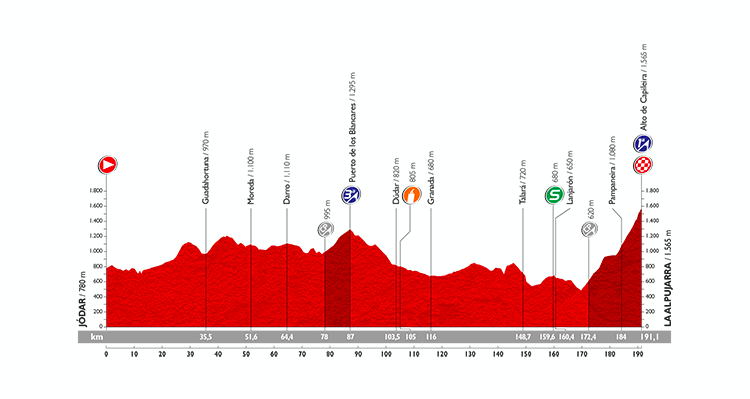
The first Cat. 1 summit finish of the 2015 Vuelta awaits on Stage 7. Like Thursday’s stage to Cazorla, Friday’s stage will put the peloton through another long day of rolling hills, but the finishing climb on Stage 7 is considerably more challenging.
For the first 170 kilometers of the day, the road takes on successive stretches of gradual climbs and gradual descents, with a single 9km Cat. 3 the most challenging of the many minor climb along the route. The final 20 kilometers of the stage, however, will offer a real test of uphill strength.
At around kilometer 170, the route angles upwards towards the official start of the Cat. 1 summit finish, the 18.7km Alto Capileira. The climb has an average gradient of 5%, but that doesn’t really tell the full story. The first 6 kilometers are a bit steeper than that average, and then the road flattens out for about 4km, and then it kicks up again for the rest of the way to the line. The final 9km angle upward at closer to 7%, with a particularly steep section near the finish of about 14%.
The Alto de Capileira will be hard enough to put the GC favorites to the test, with the irregular nature of the climb adding to the difficulty. Whether or not the red jersey hopefuls will be doing battle for the stage win as well as for positions on the overall leaderboard is another matter—the profile will be an appealing one for the breakaway. However, it will take a talented group to stay clear on such a tough day, and most of the top climbers in the Vuelta are still in relatively close GC contention, limiting the number of legitimate candidates for long-range success. I like the chances of the GC riders this early in the race.
Movistar’s two-pronged attack won’t be easy for anyone to counter. Alejandro Valverde has not been particularly aggressive so far in this race, relying on his fast finish to take his stage victory, but he has nevertheless looked strong. He knows the area, he is very motivated to build on his early advantage in the GC battle, and he can win with an attack or in a reduced sprint at the top of the climb if there is no separation at the line. Nairo Quintana may be more of a foil than anything right now. Obviously the two-time Tour de France runner-up is a major threat to win any stage with this sort of finish, but he has looked slightly less than 100% at this point in the race, and in the heat of southern Spain. He’s a danger, but more than anything his presence may boost Valverde’s chances.
A week ago I saw Fabio Aru as the favorite for Stage 7, but now I’m not sure how to judge his chances. He should be fresher than the rest of the top GC contenders in the Vuelta who are coming off the Tour de France, he showed nice form in the Tour of Poland, and this stage suits him perfectly, with a nice late launching pad that looks tailored to his skillset. However, he hasn’t looked quite as strong as expected so far in this race, so I can’t quite name him the outright favorite. Still, he’s an obvious candidate for success and it wouldn’t be any surprise if he attacked for the win. Mikel Landa could do damage as well on this climb.
Joaquim Rodríguez is another rider whose form is hard to judge right now—he has missed out on several opportunities so far in this Vuelta, letting others making successful attacks on stages that have seemed to suit him. But that may simply be because Rodríguez is focused entirely on the overall title, unwilling to risk his GC position in the hunt for stage wins. This stage certainly suits him. Daniel Moreno is another option for Katusha.
Chris Froome has quietly ridden very well in the early goings at the Vuelta. For whatever reason, many observers underrate Froome’s peak climbing ability, and I think some are underestimating him here. He’s not at his peak, of course, but if he’s even close to it he’s capable of leaving the entire peloton in the dust. Froome loves to make an early statement, and this is a prime opportunity to do just that on a long climb that suits him well. Nicolas Roche and Sergio Henao are other strong options for Sky.
Esteban Chaves has been brilliant so far in this Vuelta, and while both of his stage victories have involved an element of tactical boneheadedness from the likes of Katusha and Co., they wouldn’t have happened if Chaves weren’t on blazing form. This is a very long climb for the young Colombian to undertake but the likes of Valverde and Rodríguez have shown little interest in chasing him so far and that could be to his advantage yet again if he can survive the long road to the top and make a late strike.
Domenico Pozzovivo, Tejay van Garderen, Dan Martin, and Rafal Majka are others who could be in the mix for Stage 7.
As suggested for Stage 6, keep an eye on Caja Rural and Team Colombia for the likely breakaway contenders on Stage 7. It will be a tall order to hold off the pack on the Alto Capileira, but Pello Bilbao and Fabio Duarte are among those with a shot. Pierre Rolland, Joe Dombrowski, and Samuel Sánchez are other riders who could have success with a long-range strike.
VeloHuman Stage 7 Favorites
1. Alejandro Valverde | 2. Chris Froome | 3. Fabio Aru
Be sure to follow @VeloHuman on Twitter for more analysis and commentary during the race, and check back for the preview of the next stage after the conclusion of Stage 7. The VeloHuman overall Vuelta a España race preview is available here.
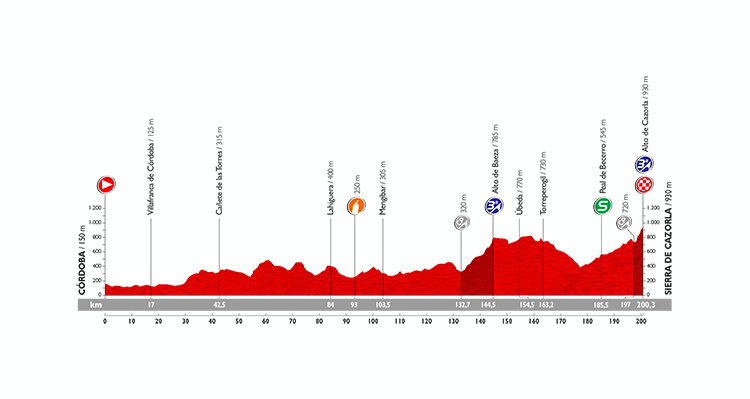
The Vuelta peloton will be tested with another uphill finish on Stage 6, and it should be a real challenge despite there being just two Cat. 3 climbs the menu. It’s not a short stage at 200 kilometers and the finale will be a difficult one.
After 130 kilometers of rolling hills comes the first categorized climb of 12km at an average gradient of a little under 4%. It’s not much but it will put some fatigue into the legs. Following a few more rollers and a descent comes the long climb to the finish line, which will last a lot longer than the official categorized finale. Apart from a few moments where the road evens out, it’s uphill from a little more than 20km out all the way to the line, at an average gradient close to 2% for the entirety of the long uphill stretch, which gets more difficult at the end.
The categorized finale itself starts at around 3km to go, and the climb has an average gradient of well over 6%, with a double digit stretch about a kilometer in that could serve as a nice launching pad for an enterprising climber. The road winds left and right a few times up toward the finish, where the gradient is closer to 7%.
The breakaway has a chance at success on this profile but this early in the race there are plenty of potential contenders still in the GC hunt who should be able to reel in any long-range hopefuls on the lengthy climb toward the finish. Expect the red jersey favorites to go toe to toe in the finale, even if it is only a Cat. 3 ascent.
The length of the stage and the fact that the last 20km are almost all uphill should whittle down the peloton and leave only the specialists in contention. Katusha has two. Joaquim Rodríguez has missed out on more than one excellent opportunity already in this race, but he has looked strong enough from a form standpoint and this will be another chance for him to shine. He needs to be aggressive, but he’ll be heard to catch if he does launch an attack in the finale. Daniel Moreno is a strong alternative, especially if the pack is still together near the top of the climb.
Alejandro Valverde already has one stage win in the Vuelta and has a nice opportunity to take a second (and the accompanying bonus seconds) on Stage 6. He can follow attacks rather than making them because he has so a strong sprint, and that makes him dangerous. Nairo Quintana could be interested in going on the move as well.
Dan Martin isn’t always the best at positioning himself for a timely strike, but if he can work that out he’s got the chops to make a move in this finale. Like Purito, he hasn’t quite delivered on the two stages that have seemed to suit him so far in the Vuelta a España, but form doesn’t appear to be an issue.
Fabio Aru has not been the strongest yet in this race but he has the team to set him up for a late strike and explosiveness to execute, if he’s feeling strong. The same is true for teammate Mikel Landa.
Nicolas Roche has been Sky’s strongest performer so far and could get active again, though don’t count out Chris Froome. He’s quietly looking pretty strong in this race, and he always likes an early opportunity to make a show of authority in a Grand Tour. Sergio Henao is another strong option for the black and blue squad.
Rafal Majka, Esteban Chaves, Samuel Sánchez, Bart de Clercq, and Domenico Pozzovivo are other riders to keep an eye on for Stage 6. Tom Dumoulin will have his work cut out for him defending his red jersey on the steep inclines of the final few kilometers.
If the big GC favorites and their support riders spend too much time looking at each other, the opportunists will have a chance at long-range success, either from the early break or with a late move once the initial break has been swept up. The list of potential candidates for the victory in that scenario includes practically every rider on Team Colombia and Caja Rural. Pello Bilbao and Rodolfo Torres stand out as particularly strong options.
VeloHuman Stage 6 Favorites
1. Joaquim Rodríguez | 2. Alejandro Valverde | 3. Dan Martin
Be sure to follow @VeloHuman on Twitter for more analysis and commentary during the race, and check back for the preview of the next stage after the conclusion of Stage 6. The VeloHuman overall Vuelta a España race preview is available here.
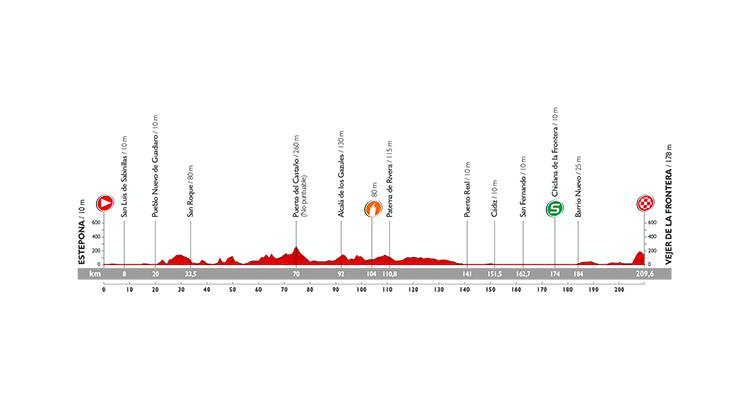
Stage 4: Estepona › Vejer de la Frontera – 209.6km
A cursory glance at the Stage 4 profile might lead you to expect a big bunch sprint at the end of the day. But take a closer look at the last 5km and it should be clear that the heavyweight sprinters won’t be in a happy place in this finale.
There isn’t a single categorized climb on the road from Estepona to Vejer de la Frontera, but things get very difficult just before the line after 200 mostly flat kilometers. With just over 4km to go, the road kicks up at a gradient of just over 10% for a little over a kilometer. After that initially vicious uphill stretch the grade eases a bit, but the climbing continues until there are about 2km to go, when the road flattens out, before angling downhill until there are just 500 meters left. Then the road kicks sharply upward again, getting into the double digits before easing to a gradient of a little over 4% at the finish.
A straightforward sprint with all the traditional speedsters in contention seems unlikely. First, the initial steep section could provide a launching pad for an aggressive puncheur to make an attack in the closing kilometers of the race. And if things are all together coming under the flamme rouge, the uphill drag to the line will favor a different sort of rider. Strong climbing legs will be as critical as explosiveness on Stage 4.
Peter Sagan has both in spades. He showed on Stage 3 that he’s not just taking the Vuelta a España as a long training ride, and having proven that he’s not afraid to go after the stages that suit him, he’s suddenly a dangerous contender in the stagehunting game. All that said, it’s still going to be hard to predict just when he’s going to put it all on the line to hunt down results in this race. The tough Stage 4 finish suits him very well, as it is likely to prove too difficult for anyone else with the same sort of speed, but there is always the possibility that Sagan just isn’t interested in expending the necessary effort to go for the win. If he does, he’ll be hard to beat. If he doesn’t, this is a wide open stage.
The finish looks great for Dan Martin, who showed strength on Stage 2 despite missing the day’s winning move. Martin has a Monument-winning ability to launch a late attack, but he’s also handier in a fast finish than most riders with his ability to climb should things stay together for a reduced sprint in the final few hundred meters. Martin is fresher than many of the star climbers in this race, and motivated to pick up a big result after a slow season.
Alejandro Valverde has the skillset to thrive at this finish and should be among the favorites, but form is a bit of a question mark. He was somewhat disappointing on a Stage 2 that seemed to suit him perfectly, just as he was a disappointment on the Mur de Huy and Mur de Bretagne in the Tour de France. If he’s worked through a bit of early-race sluggishness though, he’ll be up there fighting for the win.
The Katusha duo of Joaquim Rodríguez and Daniel Moreno should be anxious for a second chance after a missed opportunity on Stage 2. Rodríguez in particular looks strong and up for a challenge just like this where he can try a late attack, or rely on his decent uphill sprint.
John Degenkolb has shown flashes of the ability to take on something this steep, but he’s much better served when the tough climbs come earlier on in a stage—he’s capable of grinding it out over a long day of up and down and sticking it out for a flat sprint, but when the finish itself is this challenging, Degenkolb might struggle. Teammate Tom Dumoulin should be the best option for Giant-Alpecin. The double digits aren’t his forte but he’s got a nice turn of speed and a terrific ability to go solo when the opportunity presents itself.
Esteban Chaves took the peloton by surprise to take the Stage 2 win and the red jersey after a somewhat quiet season, but he won’t be able to stay out of the spotlight on Stage 4. All eyes will be on the race leader on the final climb. He’s still a threat but this isn’t a perfect finish for him compared to some of the other favorites, and he doesn’t have the element of surprise. Simon Gerrans would probably be OGE’s best option here, though his form is an unknown, as he’s coming back from an injury. If he’s healthy, he could contend for the win.
Carlos Barbero has had a lot of success this season on this sort of profile, though generally his results have come against far less imposing rivals. Still, don’t count him out against the Vuelta field—Caja Rural is on home turf and highly motivated to come away with a stage win in Spain’s biggest race.
Jelle Vanendert, Bart De Clercq, JJ Rojas, Nicolas Roche, Sergio Henao, Jasper Stuyven, Fabio Aru, and Domenico Pozzovivo are others to watch for Stage 4. Lastly, don’t completely count out Nacer Bouhanni. It will be a very tall order for the Frenchman to survive the steep stuff, but he looked mostly recovered from his Stage 2 crash in the sprint finish to Stage 3, and he has at times shown an ability to handle tough finales like this one.
VeloHuman Stage 4 Favorites
1. Peter Sagan | 2. Dan Martin | 3. Alejandro Valverde
Be sure to follow @VeloHuman on Twitter for more analysis and commentary during the race, and check back for the preview of the next stage after the conclusion of Stage 4. The VeloHuman overall Vuelta a España race preview is available here.
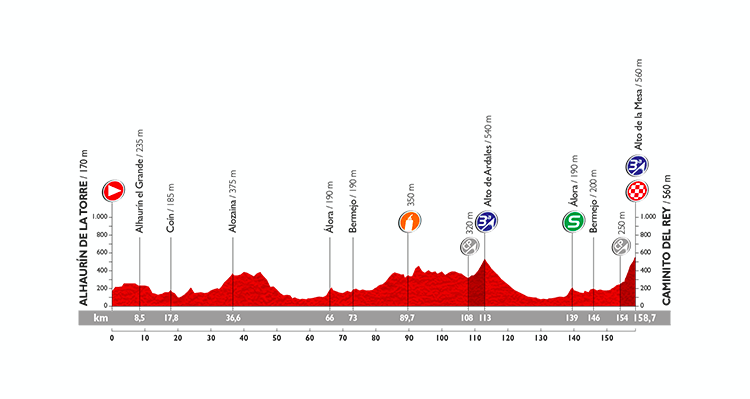
Stage 2: Alhaurín de la Torre › Caminito del Rey – 158.7km
After a strange opening TTT without GC implications, the Vuelta a España kicks off in earnest on Sunday’s Stage 2.
At 158.7 kilometers, Stage 2 is a short one, but a sting in the tail will bring the GC riders to the fore, which is rather unusual for such an early stage in a three-week race. The day finishes with a 4.7km climb at an average gradient over 6%, with a few steeper sections near the finish. It’s not L’Angliru, but it won’t be a cake walk either, especially this early in the race before many riders have gotten acclimated to the pace of a Grand Tour.
Without any separation on the GC leaderboard as of yet, the peloton will probably drive a hard pace to keep the break on a short leash, though it remains to be seen just which teams will do the work. The shortness of the stage should only increase the speed in the peloton. It’s likely that the pack will hit the final climb at a dogged pace, which could blunt any long-range moves. However, on the slopes of the ascent to the finish, things could change dramatically. Any hesitation could see an attack go clear on the steep stuff. In the event that that doesn’t happen, a strong finishing kick will come in handy, as the final few hundred meters do even out a bit.
Dan Martin is a specialist in this sort of finish, and delivered multiple near misses on similar late climbs in last month’s Tour de France. It’s been a disappointing year for Martin, but he’s shown strong form at times, and should be in the mix here in the Vuelta’s Stage 2. The fact that the top GC favorites probably won’t see him as too much of an overall threat could give him an edge should he try for an attack from a little ways out, and he also happens to have great finishing speed for a sprint should that be necessary. He has lived in Spain for some time now, and tends to do pretty well in his adopted home country, having taken his first Grand Tour stage win at the Vuelta back in 2011. In-form teammate Joe Dombrowski is another strong option for Cannondale-Garmin.
Alejandro Valverde was brilliant in the first half of the season, and if he still has anything left in the tank after a tough Tour de France, he’ll be in the mix for this finish, which suits him very well. Of the top GC riders in the race, he is far and away the fastest in a reduced sprint. He probably won’t be given any breathing room to go on the move, but if Movistar can keep a lid on any late attacks (and they have a team capable of taking control of the race), Valverde will be hard to beat. This finish isn’t hard enough to really favor Nairo Quintana, but don’t count him out either—Quintana is a danger any time the road goes up.
Katusha’s one-two punch has a great chance at success on this stage. Joaquim Rodríguez should come into the stage ready for a showdown, and the finish suits him very well. Expect to see him teaming up with Daniel Moreno to try to set the tone for Katusha early on in this race. Both should be a bit fresher than many of the top climbers in this Vuelta; Moreno didn’t race the Tour at all, and Rodríguez played a stagehunting role there instead of fighting for a GC result.
Astana’s Fabio Aru should also bring plenty of freshness into this finish. He was already showing strong form in the Tour of Poland. If he pours all his energy into an attack on the final climb, he could get some separation. Teammates Vincenzo Nibali and Mikel Landa are obvious options as well.
This short climb isn’t the sort of test typically seen as preferred terrain for Chris Froome, but when he’s motivated, he’s almost impossible to keep down; don’t underestimate his chances. Still, Sergio Henao could be the best option for Sky. The Colombian is on great form, and he’s got some pop for a late move or a finishing sprint.
This finish is probably a bit hard for a Peter Sagan who is in Spain to build up form for Worlds, but he deserves a mention ahead of a stage that he might have a chance at on peak form. The same is true for Simon Gerrans, coming back from a collarbone injury.
Domenico Pozzovivo may find the climb a bit too short for his liking, but he’ll be among the freshest riders in the entire race, and he could get some breathing room for an attack if the top favorites start looking at each other. Esteban Chaves, Samuel Sánchez, Carlos Barbero, Pello Bilbao, Rafal Majka, Jelle Vanendert, Daniel Navarro, and Pierre Rolland are others who will have a shot at success on Stage 2.
VeloHuman Stage 2 Favorites
1. Dan Martin | 2. Alejandro Valverde | 3. Joaquim Rodríguez
Be sure to follow @VeloHuman on Twitter for more analysis and commentary during the race, and check back for the preview of the next stage after the conclusion of Stage 2. The VeloHuman overall Vuelta a España race preview is available here.
The 2015 Tour de France may be over but the WorldTour rolls on. The Clásica de San Sebastián (or the Donostiako Klasikoa in Basque) is the next race on the docket. It’s a hilly event that has just the right profile to inspire plenty of attacks, in a region mad for cycling, and its position on the calendar makes it a tough race to predict—some of the stars of the Tour de France are in attendance hoping to get just a bit more out of their legs, while a few other big-name riders are returning to racing for the first time and hoping to get back up to speed quickly.
The San Sebastián organizers made a small but impactful change to the race route last season that led to an exciting finale, and the event returns to that successful parcours for 2015.
The race starts and finishes in the coastal town of San Sebastián, looping in and around the environs to make for a total race length of 219.2 kilometers.
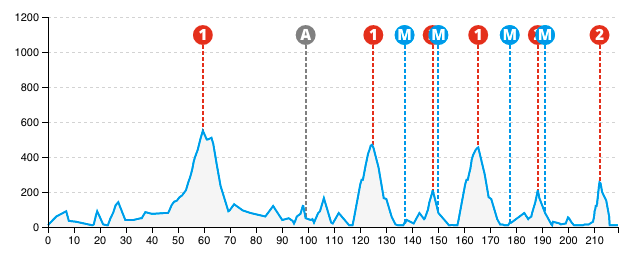
The harder climbs on San Sebastián profile are categorized as if this were a stage race, and there are six such challenges on the route. The Category 1 Iturburu climb, crested around kilometer 60, is no slouch, but it’s early enough to be more of a leg-softener than anything else.
Once the peloton hits the slopes of the Jaizkibel, the more enterprising riders in the bunch will have one opportunity after another to go on the attack, all the way to the last climb of the day less than 10km from the finish.
Things get more consistently difficult after the midway point of the route with the first trip up the Jaizkibel, the marquee climb of the race. It’s another Cat. 1 ascent, roughly 8 kilometers in length with an average gradient over 5%. After a descent, it’s not long before the riders reach the Cat. 2 Arkale, a short but steep climb and the third categorized test of the day. From the top of the Arkale, the pack will make a downhill trip right back to the foot of the Jaizkibel, where they’ll take on both the Jaizkibel and then the Arkale a second time.
After the second descent from the Arkale comes the final run-in to town, but there’s a tough climb along the road to the finish. The Bordako Tontorra climb to Igeldo is a short but steep Cat. 2 crested just over 7 kilometers from the finish. It’s less than 3km in length but with an average gradient nearing 10% and sections in the 20% range, it’s a hard road to the top. After the climb comes a descent into a flat finish.
The Contenders
The profile favors strong climbers with a lot of punch. It’s probably possible to attack from the more pure-climber-friendly Jaizkibel or from the Arkale and hold out to the finish, but it’s more likely that the race comes down to the last bump in the road, which is more suited to the Ardennes-style riders than the big stage racing stars.
That late climb shook up the race last year, providing Alejandro Valverde with a launching pad to go on the attack for the win. Because the parcours is so up-and-down already, the peloton is pretty thinned out by the time it reaches the final 10km—even if attacks on the Jaizkibel and Arkale are reeled in, it’s still very hard to keep things altogether on the last climb. In case it’s a small group that reaches the finish, a strong flatland kick will be important to anyone hoping to win.
However things play out, Valverde is capable of winning this race in pretty much any scenario, which is probably why he is a two-time champion. Coming off of a Tour de France podium, and in the middle of an excellent season (in which he dominated the hilly spring classics), it’s hard not to see Valverde as the clear favorite. He’s among the best climbers on the starlist who can thrive on pretty much any gradient, and he’s got more punch than most of his rivals. Valverde could win this with another late attack, or he could follow the moves in the finale and hold out for a reduced sprint. Giovanni Visconti is a good alternative for Movistar.
As good a candidate as Valverde is to win this race, however, the Clásica is still a pretty wide open event. It’s always hard to say how riders’ legs will react coming into the race. Valverde went very deep fighting for a Tour de France podium spot.
Philippe Gilbert is another former winner who has been on terrific form of late. If the pace is really high over the finale climb, the Philippe Gilbert of 2015 may have just a bit of trouble holding on all the way up, but if the peloton plays the early slopes cautiously, Gilbert will be well-positioned to make a late attack or to look for a sprint win. BMC has some serious firepower behind Gilbert, though—Greg Van Avermaet was in the Top 10 last year and is in great form this year, and Samuel Sánchez has been in the Top 10 several times over his career.
Joaquim Rodríguez has never won the race but he’s come close several times, and it’s no surprise that he does well here given the punchy-climber-friendly profile. He’ll probably need to launch a late attack if he wants to win, since he’ll have trouble outsprinting some of the other top favorites at the flat finish, but the Igeldo climb is the perfect place to do that. His form was good enough for two stage wins at the Tour, but he didn’t look terrific in the final week; however, he landed on the podium in the 2014 edition of the Clásica despite a lackluster Tour, so I won’t read too much into his not-great few days in the Alps. Daniel Moreno makes for an excellent foil—he’s been a bit quiet this season, but Purito and Moreno always make for a strong 1-2 punch.
Bauke Mollema was 2nd in this race last year and has been in the Top 10 all three times he’s made the start. Mollema is known as a strong climber but he’s also handy in a sprint. If he can get into a small group at the end of the day he will have a great shot at winning. For whatever reason, his kick is a bit underrated, and that can only help him potentially pull one over the more obvious Ardennes veterans in the finale. Julian Arredondo and Bob Jungels are other great options for Trek.
Etixx-QuickStep is loaded with talent in the form of Julian Alaphilippe, Rigoberto Urán, and Zdenek Stybar. Alaphilippe is probably best-suited to the profile, but he’s not raced in a little while so the form is a question mark. Urán looked decent in the Tour, and packs a nice sprint—he’s a rider to watch. Stybar will be a good bet as well, coming off of strong Tour de France in which he took a stage victory. He climbs better every year and he was 10th here last year.
2013 winner Tony Gallopin is not racing, but Lotto Soudal has a few good options in his stead with Tim Wellens and Jelle Vanendert. Both seem like good candidates to try an attack from a little ways out;
Dan Martin is an obvious candidate for success on the San Sebastián profile but he was not at his best in the last week of the Tour and if he’s feeling a bit rusty, a 200+ kilometer bike race might be tough. Ryder Hesjedal could pick up the slack if Martin isn’t up for it. Roman Kreuziger will lead Tinkoff-Saxo after Alberto Contador decided to back out of the start citing a fever—Kreuziger has a good track record in San Sebastián and will be worth keeping an eye on. Astana’s Luis Leon Sanchez is a two-time winner of the race, but he might not even be the best rider on his team. Mikel Landa has had an excellent season thus far and has the explosive climbing legs to try a move on slopes. He was 6th in this race back in 2013 before he had really even come close to the level at which he’s been racing this year.
Both of the Yates twins have a shot—Adam was riding well in last year’s edition of the race before crashing out of the lead group in the final few kilometers, and Simon may be even better suited to the profile. AG2R’s Romain Bardet is in good shape and has quietly become a dangerous one-day racer. Teammate Alexis Vuillermoz could look to launch himself on one of the late climbs. Rui Costa was forced to abandon the Tour de France by a variety of ailments, but this is a great parcours for him if he’s back to 100%.
Jarlinson Pantano, Sylvain Chavanel, Wilco Kelderman, and Thibaut Pinot are others who will hope to be involved with the other race favorites.
Pello Bilbao of Caja Rural is VeloHuman’s Under-the-radar rider to watch at the Clásica de San Sebastián. Bilbao is a talented all-rounder with the climbing legs to be in the mix as a stage race contender, but who also packs a nice finishing kick. He’s having a great year so far, having won a mountain stage at the Tour of Turkey and the overall at the Tour de Beauce, among other results. Caja Rural in general is having a very nice season, with quite a collection of wins at Continental Tour races; watch out for a long-range dig from Amets Txurruka or David Arroyo as well, and keep an eye on versatile fast finisher Carlos Barbero.
VeloHuman Top 10 Favorites
Winner: Alejandro Valverde Podium: Philippe Gilbert, Bauke Mollema Other Top Contenders: Joaquim Rodríguez, Greg Van Avermaet, Zdenek Stybar, Julian Alaphilippe, Romain Bardet, Dan Martin, Mikel Landa