Tag: Alexander Kristoff

  • Tour de France 2014 Post-race Impressions: Nibali Dominant, Others Ascendant

    Tour de France 2014 Post-race Impressions: Nibali Dominant, Others Ascendant

    Tour de France Wide

    Now that the 2014 Tour de France is officially in the books, there’s time to draw a few conclusions about what we’ve seen. Three weeks of racing offer enough storylines and takeaways for weeks of analysis, but I’ve distilled my impressions down to a select few major observations.

    A Worthy Winner

    Vincenzo Nibali did not want this race to be remembered as the Tour de France without Chris Froome and Alberto Contador, and the results he delivered in pursuit of a truly dominant performance were quite impressive. With four stage wins and several other Top 5s, a strong challenge for the polka dot jersey, and a gap of nearly eight minutes to his closest challenger, Nibali was in another universe compared to the competition in the race. It would have been nice to have seen him battling Froome and Contador, and as things stand right now, Froome is still the oddsmakers’ favorite for the 2015 Tour, but Nibali did all the right things to ensure his place in the history books as a worthy maillot jaune.
    Astana in Front

    We always knew that Nibali was a strong climber (one does not win the Vuelta and Giro without elite climbing ability) but he was up for it on every type of uphill challenge on the menu in this Tour, and avoided even one bad day. What’s more, he has developed into a top-notch time trialist, landing 4th in the Stage 20 chrono. And perhaps most importantly for this race, he displayed the sort of bike handling skills and racing savvy necessary to survive three weeks of riding on often rain-soaked and occasionally cobbled roads. There is a lot to be said for his ability to emerge unscathed from a Tour that dashed the hopes of so many other riders.

    A Lengthy Injury Report

    Speaking of those other riders: as much as Nibali did everything in his power to make this race his own, any rational analysis of this Tour has to include mention of the health issues that plagued so many riders and generated so many headlines. Alberto Contador was on fire this year and now he may not race again in 2014, and Chris Froome looked to be rounding back into shape before his multiple fractures took him out of the Tour. It would have undoubtedly been a very different Tour de France had they been in the mix in the mountains. They weren’t the only riders who suffered race-ending health problems. Mark Cavendish left the Tour on its very first day. Rui Costa was running well in the beginning of the race, but pneumonia hampered him as the Tour went on and ultimately he abandoned his campaign for a Top 10 overall. Andrew Talansky crashed and crashed again early on in the race and was just too banged up to continue riding at the level necessary to hang with the peloton. Andy Schleck suffered a serious knee injury which has put his next several months in doubt.

    Others made it to the Champs-Élysées but were noticeably lessened by ailments along the way. Among the big names in this camp were John Degenkolb, whose first several days were hampered by injury, Arnaud Demare, who battled sickness, and Richie Porte, whose tumble out of the GC Top 10 may have been partially due to a chest infection. In short, a number of big names struggled with health issues in this Tour de France. Those riders who did survive and thrive in the race are worth noting, but it’s important to view all of their successes in perspective.

    New Generation of Sprinters Here to Stay

    With four victories, Marcel Kittel was clearly the best “pure sprinter” in the race. We’ll never know how Mark Cavendish might have fared against the younger Kittel through three weeks of racing, but Kittel continues to assert himself as a dominant force in the top tier of fast men. This is his second straight year of four wins, but remember, he’s only 26! Alexander Kristoff, with a pair of stage wins, is planting his flag as a sprinting force as well, especially in the bunch gallops that follow long and/or rainy days. Peter Sagan is known as the rider to beat on the hilly days that end in reduced sprints, but Kristoff has carved out a niche of his own: he’s not as strong a climber as Sagan, but even flatter stages, if lengthy enough (and especially when wet) can wear out the other fast men, and it is in those scenarios that Alexander Kristoff shines brightest. Andre Greipel and Marcel Kittel were both in the mix on Stage 15, but Kristoff won anyway, much as he won the sprint finale of this year’s Milano-Sanremo despite the presence of Mark Cavendish.

    Peter Sagan may not have won a stage in this year’s Tour, but the nine Top 5 stage finishes that put him into the green jersey are undeniably impressive. It seems likely that with a stronger team, he’ll be able to focus more on winning and less on chasing down late moves; the question of “Where will Sagan land?” will be the biggest story of transfer season.

    Several other young non-winners were, nonetheless, strong performers on a number of stages as well. 22-year-old Bryan Coquard was always in the mix in the sprints, and 22-year-old Arnaud Demare and 25-year-old John Degenkolb delivered some nice results despite nagging ailments.

    A French Resurgence

    The 2014 Tour de France was a wonderful return to prominence for French cycling. Jean-Christophe Peraud, who has landed several impressive results in stage races in his career, put in a next-level performance to reach 2nd overall in cycling’s biggest event. He got stronger as the Tour went on, and benefitted from a top-notch team that also included 6th place finisher Romain Bardet, just 23 years old. A climbing specialist with serious talent and a high ceiling, Bardet now has a Top 10 in the Tour and in Liege-Bastogne-Liege on his 2014 resume (to go with several other nice results), and he should continue to develop as an uphill force.
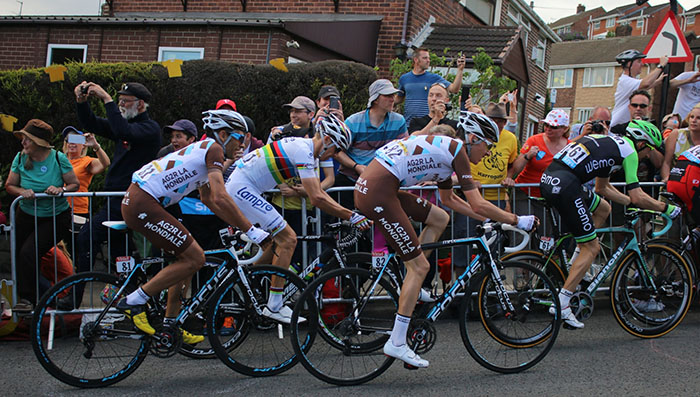
    AG2R Jenkin Road

    Thibaut Pinot finally took that step up that many expected after his 10th overall and stage victory in the 2012 Tour; a podium position in the Tour de France (ahead of Grand Tour winner Alejandro Valverde) will do wonders for his confidence. He seems to have gotten over his fear of descending, which was a major drawback to his game, but he developed into a much more well-rounded rider in other ways too, now seemingly capable of putting in a strong time trial and several straight good days in the mountains. He should only get stronger over the next few years.

    The GC riders weren’t the whole story for the French revival either. Consummate breakaway specialist Blel Kadri took a very long stage win in Gerardmer, and versatile Tony Gallopin spent time in the yellow jersey and later escaped Peter Sagan and a chasing pack to win Stage 11. He took an impressive victory in San Sebastian last year and continues to prove his wide array of talents that include climbing, soloing, and sprinting.

    Deserving Team Leaders

    BMC’s Tejay van Garderen recovered from a prior injury to race in this Tour, and then recovered from an early crash and a single bad day in the Pyrenees to land 5th on GC when all was said and done. 2013 was a rough year for the young American, who, despite winning both the Tour of California and the USA Pro Challenge, looked to have taken a step back as a Grand Tour rider in that year’s edition of La Grand Boucle. With Cadel Evans showing signs of slowing down, however, BMC backed van Garderen completely in this year’s Tour, and by consistently hanging with with the GC Top 10 types and then delivering a very strong time trial performance in the penultimate stage, van Garderen proved that he is back on track as a GC contender. He’s still just 25.

    Not far behind van Garderen on the GC leaderboard was Leopold Konig. Konig took a stage and 9th overall in the 2013 Vuelta, but 2014 hadn’t been going smoothly for the young Czech climber, who was slated for his first run at being a team leader in the Tour de France. A knee injury hampered his early season campaign and left him unable to prepare as well as he would have liked for this race. He overcame those obstacles and looked strong in the second and third week of the Tour, climbing to 9th on GC before the time trial on Stage 20. He proceeded to deliver the chrono of his life and jumped two more placings to finish 7th overall. It shouldn’t come as a complete surprise, as he has been delivering impressive time trial results somewhat under the radar over the last two years, but few expected him to land 5th in the ITT. If he can continue to show that sort of abiltiy against the clock, he will be a rider to watch in Grand Tours for years to come.

    Looking Ahead

    The last day of the Tour de France is not the last day of the cycling season! The Clasica de San Sebastian, a one-day race with a hilly profile designed to thrill, is less than a week away, with the Tour de Pologne and Eneco Tour soon after. Stay tuned for more previews, analysis, and rider interviews!

    -Dane Cash

    Photos by Adam Bowie, Sum_of_Marc, and Photigule.
  • Tour de France 2014: Stage 21 Preview

    Tour de France 2014: Stage 21 Preview

    Stage 21 Profile

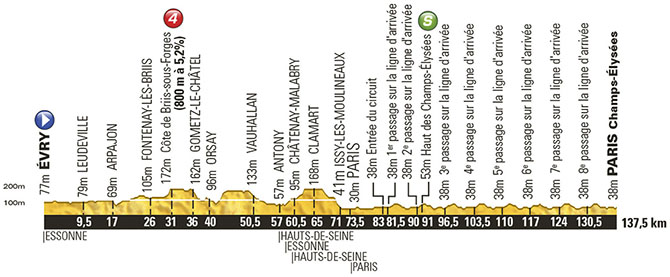
    Stage 21: Évry › Paris – 137.5 km

    With the time trial done and dusted (and won, unsurprisingly, by Tony Martin), only the Champs-Élysées finale remains in the 2014 Tour de France. Just 137.5 kilometers in length and quite flat, Stage 21 starts out in parade-like fashion, with champagne toasts and photo opportunities, and the pace remains pleasant until the peloton reaches Paris, when things start to speed up as the riders enter a 7 kilometer finishing circuit and begin an eight-lap journey to the end of the Tour de France. A few aggressive riders will attempt to break away from the pack on the circuit, but as the eighth lap and the final crossing of the line on the Champs-Élysées get closer and closer, the sprint teams will ramp up the pace, making it virtually impossible to stay away. Victory in the final stage of the Tour de France is one of the most prestigious prizes in the sport, and it’s rare that anything stands in the way of a sprinters’ battle royale on the Champs-Élysées.

    Marcel Kittel of Giant-Shimano won the Champs-Élysées finale of last year’s race, and he is in the hunt for his fourth stage win at this year’s Tour de France. All three of his victories so far came very early in the race, as he did struggle a bit on some of the tougher stages after the first week, but Stage 21 doesn’t have the sort of profile that is likely to take much out of the massive German sprinter. Kittel has established himself as a dominant force in tests of pure speed, and he will be the rider to beat on the Champs-Élysées.

    Lotto Belisol’s Andre Greipel does have a stage win under his belt in this year’s Tour, but he will be hungry for another here. In a drag race, few can match Marcel Kittel, but Greipel is probably the rider with the best chance of doing so. He has not done the best job of positioning himself in the many sprint stages of this race so far, but he has a strong support train and this is not a stage with too many obstacles for the powerhouse fast men to overcome on their way to the final few hundred meters. If he can nail the run-in, Greipel can challenge for victory on Stage 21.

    Katusha’s Alexander Kristoff typically prefers fast finishes that follow hard days in the saddle, but he’s also got plenty of pure sprinting ability. He’s looked particularly strong in this race, benefitting from a team that is more focused on his success than they usually are. 6th on the final stage of the 2013 edition of the Tour, he could contend for the win on the Champs-Élysées this year.

    Cannondale’s Peter Sagan will have one last chance at a stage victory in the 2014 Tour de France here in Paris. He doesn’t have the top speed of Marcel Kittel, but he was runner-up to Mark Cavendish in the final stage of the 2012 Tour, and given his talent and tendency to position himself well for the charge to the line, he can never be counted out.

    OPQS’s Mark Renshaw knows how to deliver a result on the Champs-Élysées, even though in the past his biggest successes have been all about providing an excellent leadout to someone else. This year, he’ll have a rare chance to be the featured rider on the final stage of the Tour, and he’s shown impressive speed in this race so far. FDJ’s Arnaud Demare has struggled to make it to the finish with the lead group in many of the sprint days in this race, but the journey to the line is quite short on this stage. If he’s there in the final few hundred meters, he could be in the mix. Europcar’s Bryan Coquard has racked up quite a few Top 10s so far in the Tour, and as a star of the track, he’ll enjoy the chance for a drag race to the line.

    Tinkoff-Saxo’s Daniele Bennati, Garmin-Sharp’s Ramunas Navardauskas, OGE’s Michael Albasini, and AG2R’s Samuel Dumoulin are outsiders who could land strong results on Stage 21, while Giant-Shimano’s John Degenkolb will be ready to step up for his team as a quality alternative should anything happen to Marcel Kittel.

    VeloHuman Stage Favorites

    1. Marcel Kittel | 2. Andre Greipel | 3. Alexander Kristoff

    As Stage 21 is the final stage of the race, this is the last VeloHuman preview of the 2014 Tour de France. I’ve had a blast previewing every day of racing, and I have particularly enjoyed hearing from those of you who have reached out to talk racing, to ask for an opinion on your favorite long shot, or just to say hello! I hope you’ll continue to stay connected by following @VeloHuman on Twitter and by checking out the brand new VeloHuman Facebook page.

    Lastly, an important note: while the Tour may be reaching its conclusion, VeloHuman is nowhere near done for the year! There are still rider interviews to come and plenty of favorites and outsiders to be named for races like the Vuelta a España, Il Lombardia, and the World Championship Road Race, so even after the last rider crosses the finish line on the Champs-Élysées, stay tuned for a whole lot more in 2014.

    -Dane Cash

  • Tour de France 2014: Stage 19 Preview

    Tour de France 2014: Stage 19 Preview

    Stage 19 Profile

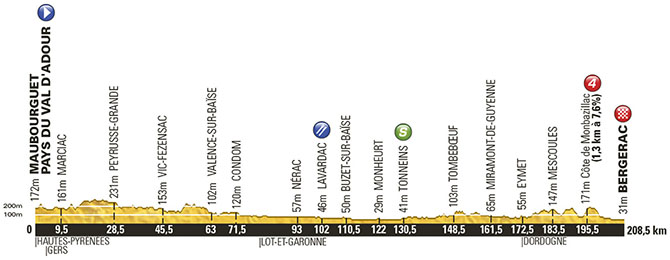
    Stage 19: Maubourguet Pays du Val d’Adour › Bergerac – 208.5 km

    Vincenzo Nibali closed out the final high mountain stage of the Tour de France with his fourth stage win, and now the peloton heads to flatter roads. At first glance, Stage 19 looks certain to be one for the sprinting heavyweights, with a mostly flat profile from start to finish. However, there could be a few complicating factors. For one, 208.5 kilometers of racing is no walk in the park. A long day, especially after some very intense climbing, could lead to some pained legs. At the end of this lengthy journey, the peloton must get over a few uncategorized bumps and then a Category 4 climb that comes about 13 km from the finish. It’s short at only 1.3 kilometers, but steep, with an average gradient of 7.6%. And, while the last few kilometers are flat, there are some twists and turns approaching the finish line. On top of these challenges, there is a chance of rain in the forecast, which always adds an element of uncertainty to the equation.

    On this profile, the sprinters’ teams should be able to control the race on Stage 19, and with a bunch gallop the likeliest outcome, Marcel Kittel, the fastest fast man in the Tour, has to be a top favorite. Giant-Shimano came here to win on the flats, and the entire team will be working to put Kittel in position to win a sprint finale. In a straight-up drag race, he’s pretty much unbeatable. As we saw on Stage 15, however, a combination of factors like distance and weather can take its toll on the heavy German. The Cat. 4 comes far enough from the finish that it shouldn’t cause too many problems for Kittel, but if the teams of the more versatile sprinters set a hard pace over the ascent and drive it all the way to the tricky final few kilometers, it’s possible that Kittel could have trouble getting into position for the charge to the line. GSH has a great backup plan in John Degenkolb, who has looked sharp in the past few sprint stages, and who is less likely to be troubled by the bumps in the road.

    Lotto Belisol’s Andre Greipel is a bit more capable of coping with the harder days than Marcel Kittel, and at his best, he has a finishing kick few can match. Still, his endurance will be put to the test if teams like Cannondale and Katusha decide to go full gas as the day nears its conclusion. Greipel does have the support of a strong leadout, which will be crucial for the technical run-in to the line.

    Katusha’s Alexander Kristoff took a strong second victory on Stage 15, which, though it was bit longer, shared similarities with this stage, a lengthy journey coming after some tough days in the mountains. Kristoff thrives in nasty weather, and his pair of wins in this Tour have put his impressive top speed on display. Stage 19 will be a good opportunity for him to pick up a third victory.

    Cannondale’s Peter Sagan has come so close so many times in this Tour de France, but he has yet to pick up the win he’s been hunting. The likely sprint finale on the Champs-Élysées, which will come at the end of a much easier day in the saddle, will be less favorable to Sagan; this is the better opportunity to get that victory. Like Kristoff, he’ll hope for the hardest race possible. He is very adept at navigating challenging corners, and that gives him an edge in the final few kilometers of the race.

    Europcar’s Bryan Coquard, AG2R’s Samuel Dumoulin, Tinkoff-Saxo’s Daniele Bennati, Orica-GreenEdge’s Michael Albasini, Garmin-Sharp’s Ramunas Navardauskas, and FDJ’s Arnaud Demare are other fast men with the potential to get involved. Mark Renshaw has placed well in the sprints so far, though OPQS could favor the chances of Matteo Trentin here; it’s also possible they’ll try to send Jan Bakelants, Michal Kwiatkowski, Niki Terpstra, or Tony Martin up the road and hope the tricky finale makes for a difficult chase. After so many tough mountains stages and with a crucial time trial on the menu for the GC men, it’s not completely out of the question that a well-planned move might be able to hold out here on Stage 19. Greg Van Avermaet, Tony Gallopin, Tommy Voeckler, Jens Keukeleire, and Sylvain Chavanel are other strong riders who might have this sort of tactic in mind.

    VeloHuman Stage Favorites

    1. Marcel Kittel | 2. Andre Greipel | 3. Alexander Kristoff

    There are only a few stages left in the 2014 Tour de France, but be sure to follow @VeloHuman on Twitter for live analysis of every one of them. Also check out VeloHuman’s brand new Facebook page to stay up-to-date with every post. The next preview will be up following the conclusion of Stage 19.

    Lastly, an important note: while the Tour may be nearing its conclusion, VeloHuman is nowhere near done for the year! There are still rider interviews to come and plenty of favorites and outsiders to be named for races like the Vuelta a España, Il Lombardia, and the World Championship Road Race, so even after the last rider crosses the finish line on the Champs-Élysées, stay tuned for a whole lot more in 2014.

    -Dane Cash

  • Tour de France 2014: Stage 15 Preview

    Tour de France 2014: Stage 15 Preview

    Stage 15 Profile

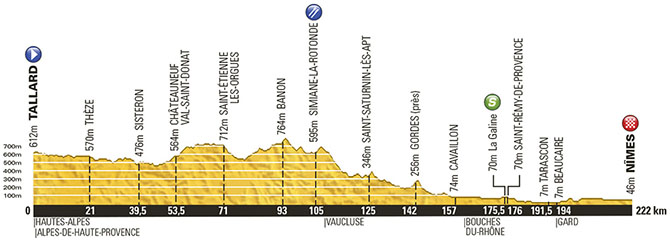
    Stage 15: Tallard › Nîmes – 222 km

    After a pair of tough days in the Alps (closed out by Rafal Majka’s stage victory in Risoul), the peloton will like the look of the Stage 15 profile: there isn’t a single categorized climb on the road from Tallard to Nîmes. With the Tour coming down out of the Alps and headed towards the Mediterranean coast, there are a few long downhill sections on the menu, and the final 65 kilometers are about as flat as a pancake. However, those hunting for success on Stage 15 can’t let the profile lull them into a false sense of security: the weather report is calling for rain, and crosswinds are always a possibility here. A number of roundabouts and a few turns near the finish could further complicate things. It’s also one of the longest stages in the Tour at 222 kilometers. A bunch sprint seems the most likely scenario, but it’s not a given that everyone will make it to the line, and even if all the familiar faces are there, those who are more capable of coping with tough conditions could be fresher for the finale.

    Still, although there is a long and possibly wet day ahead, Marcel Kittel will be the top favorite for Stage 15. He’s the fastest sprinter in the race and he has the best leadout, to boot. With no hills to put him in difficulty, his rivals will have to hope that he tires during the long the trip to the line, or that the weather causes enough chaos to force splits in the pack. If Kittel is there in the finale, he’ll be hard to beat. If he isn’t there, teammate John Degenkolb is a strong alternative.

    Lotto Belisol’s Andre Greipel had a slow start to this year’s Tour de France, but he quelled concerns of form with a convincing stage win in Reims. He will be extra hungry after a crash with Sylvain Chavanel put him out of contention for a sprint finish on Stage 11. He looks like the only rider who might challenge Kittel in a drag race.

    After his brilliant stage victory in Oyonnax, Katusha’s Alexander Kristoff might be third favorite anyway, but a nasty weather report will be especially to his liking, as will the length of the journey to the line. He is a proven performer in bad conditions and he is less prone to fatigue than his rivals. He will have another nice opportunity on Stage 15. Peter Sagan will also be pleased with the weather report. In a drag race, his chances are slim against Kittel and Greipel, but his elite bike handling skills and impressive endurance should help him position himself to take the best possible shot at victory here on Stage 15. He’s running out of opportunities to take a win in this Tour de France. FDJ’s Arnaud Demare appears to going strong again after a rough first week. He’s another tough rider who shouldn’t mind a classics-esque day.

    OPQS’s Mark Renshaw has picked up some nice results filling in for Mark Cavendish, and his team is particularly good at taking advantage of poor conditions. An attempt to force a split before the finish (or a sneaky attack from Tony Martin) wouldn’t be all that surprising. Europcar’s Bryan Coquard has not placed higher than 4th on a sprint stage in this race, but he has always been in the mix. With the constant possibility of crashes on rain-soaked roads, being in the right place at the right time might be all it takes to make the leap from 4th to 1st. Garmin-Sharp’s Ramunas Navardauskas, AG2R’s Samuel Dumoulin, IAM Cycling’s Heinrich Haussler, BMC’s Greg Van Avermaet, Tinkoff-Saxo’s Daniele Bennati, Movistar’s JJ Rojas, and OGE’s Simon Gerrans and Michael Albasini will be outside contenders for the likely sprint finish.

    VeloHuman Stage Favorites

    1. Marcel Kittel | 2. Andre Greipel | 3. Alexander Kristoff

    Be sure follow @VeloHuman on Twitter for live commentary on this and every stage of the 2014 Tour de France! With a rest day on tap after Stage 15, the next preview will be up on Monday, so stay tuned. In case you missed it, the overall Tour de France preview can be found here.

    -Dane Cash

  • Tour de France 2014: Stage 7 Preview

    Tour de France 2014: Stage 7 Preview

    Stage 7 Profile

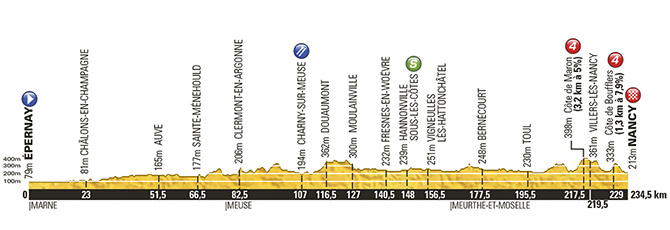
    Stage 7: Épernay › Nancy – 234.5 km

    With four days for the sprinters (including a Stage 6 that went to Andre Greipel) already on the books in the 2014 Tour de France, one could be forgiven for taking a cursory look at the Stage 7 profile and assuming that it’s certain to lead to another bunch sprint showdown. After all, a pair of Cat. 4 climbs are the only categorized uphill challenges on the menu. However, both of those climbs are crested in the final 20 kilometers of the day, and the second, though only 1.3 kilometers in total length, grades out at an average of 7.9%—and from the top it’s less than 6 km to the line, mostly downhill. What’s more, Stage 7 is 234.5 kilometers from start to finish, making it the second longest stage in the entire Tour de France.

    That last bump in the road could inspire the punchier riders to attempt escape close to the finish, especially after such a long day in the saddle. And with a few tough stages ahead and no certainty that the big sprinters will survive late attacks, the peloton could struggle finding the motivation to chase down the day’s breakaway, making a long-distance winner at least a possibility. There are a number of different potential scenarios for Stage 7, making it a hard one to predict. However it plays out, the favorites will be the riders with the endurance to handle all 234.5 km and the versatility and explosiveness to excel in what will likely be a challenging finale.

    As is often the case in the difficult hilly stages, Cannondale’s Peter Sagan will be a favorite for victory. If the peloton does bring this all back together before it’s too late, his team will likely have played a role, and more than any other speedster in the Tour de France, Sagan is capable of handling the steep stuff. If anything, he is himself a danger to put in a dig on the climb and then divebomb the descent all the way to the line. In a sprint, he is one of the fastest in the peloton, and it seems possible that the German duo generally regarded as a tier above him might struggle on the last ascent. This could be his best opportunity so far to pick up a win.

    Andre Greipel of Lotto Belisol, one of the aforementioned duo, is underrated in his ability to handle difficult days, but this might be a bit too much to ask; there just won’t be a lot of time for anyone who loses ground on the final climb to get back into contention, given the descent that follows. Meanwhile, Lotto’s sprint nemesis Giant-Shimano will be in a tough spot; normally this might be a day for Marcel Kittel to give leadership over to versatile John Degenkolb, but Degenkolb was injured in the Tour’s fifth stage and may not be able to contend. Obviously, if Kittel or Degenkolb manage to hold on for a sprint finish, they will be favorites, but that seems like a lot to ask.

    There are a few sprinters other than Sagan who do have a decent shot here, however. Katusha’s Alexander Kristoff relishes the extra-long days, and he’s not a bad climber either. He has come close to victory more than once so far in this Tour, and a stage that may see Kittel unable to contest the sprint is his best opportunity to finally get a victory. Ramunas Navardauskas is slotted in as Garmin-Sharp’s sprinter of note, and he is especially adept at fast finishes following tough days. FDJ’s Arnaud Demare normally displays decent uphill ability, but he crashed on Stage 6, and even after finding his way back to the bunch following the incident, he was later dropped before the sprint finish; he may not be at full strength here, though if he is feeling up for it, he’s a danger in a bunch gallop.

    Europcar’s Bryan Coquard, Trek’s Danny van Poppel, and OPQS’s Mark Renshaw have all performed well in the fast finishes so far, but even this does end in a sprint, surviving the difficult day could be too much to ask from them. Meanwhile, versatile quick men like Movistar’s JJ Rojas, AG2R’s Samuel Dumoulin, and IAM Cycling’s Heinrich Haussler, normally fringe contenders, could find themselves a bit better positioned than usual should this come down to a reduced bunch sprint.

    With a late climb coming after a long day of riding, we are certain to see plenty of punchy, aggressive riders trying to escape from the pack, or at least attempting to drop the speedsters that we’ve seen over and over again in the Tour’s many sprint stages so far. For these in-betweener, opportunist types, it may be a tough decision whether or not to try for a victory from the breakaway or from the peloton: I think the pack is the smarter choice here, but if a strong enough group makes the early move, it isn’t a given that the pack will reel them in.

    Either from the break or the peloton, Orica-GreenEdge has cards to play for Stage 7 in Simon Gerrans and Michael Albasini. Gerrans would have been a top favorite for the stage, but I’m not sure he’s back to full strength after his crash in the Tour’s first stage. If he is recovered by the time the peloton sets out from Épernay, though, he will have an excellent chance at victory: the Milano-Sanremo and Liege-Bastogne-Liege winner loves long, grueling days, and he excels on late climbs. Michael Albasini will be a more than able alternative for OGE. He has been very explosive this year, putting in a nice performance on the steep final climb of La Fleche Wallonne and nabbing sprint victories aplenty in the Tour de Romandie.

    Michal Kwiatkowski of OPQS always seems to be in the mix when a profile calls for an explosive finish. If any GC contenders decide to put the pressure on over Stage 7’s late bumps, expect Kwiatkowski to be right there at the end; he’s one of the two or three best sprinters of the General Classification riders. Movistar’s Alejandro Valverde is another. Belkin’s Bauke Mollema can be very explosive, and he’s underrated in the sprints even on a flat surface. Lampre’s Rui Costa loves to go on the attack on this sort of profile. And, of course, don’t rule out another attempted strike from yellow jersey wearer Vincenzo Nibali, who could see a steep ascent followed by a fast descent as a nice opportunity to pick up more time.

    BMC’s Greg Van Avermaet just missed out on victory in the Tour’s second stage when the lead group allowed Nibali to escape, leaving 2nd place as the best possible result for those behind, but he’ll have another opportunity here to make it into a late move on the climb and then attempt outsprint anyone around him in the finish. The rider who broke Van Avermaet’s heart in the Tour of Flanders earlier this year, Fabian Cancellara, will also relish this opportunity: the long, challenging days are his forte, and he will enter Stage 7 with a deadly combination of good form (which he has shown on a number of stages so far) and plenty of motivation (having been unable to pick up a victory just yet).

    Other riders who don’t mind a tough day of racing and who could look to escape from the pack, either in the day’s early break or late in the stage, include Europcar’s Tommy Voeckler and Cyril Gautier, Lotto Belisol’s Tony Gallopin, IAM Cycling’s Sylvain Chavanel, FDJ’s Arthur Vichot, OPQS’s Jan Bakelants, Garmin-Sharp’s Tom-Jelte Slagter, and Giant-Shimano’s Tom Dumoulin. Katusha’s Joaquim Rodriguez might have seen the late ascent as a nice opportunity to make a move, but he has not looked to be back to full strength just yet.

    VeloHuman Stage Favorites

    1. Peter Sagan | 2. Alexander Kristoff | 3. Michal Kwiatkowski

    Be sure follow @VeloHuman on Twitter for live commentary on this and every stage of the 2014 Tour de France! The next preview will be up after the conclusion of Stage 7, so stay tuned. In case you missed it, the overall Tour de France preview can be found here.

    -Dane Cash

  • Paris-Roubaix 2014 Preview

    Paris-Roubaix 2014 Preview

    ParisRoubaix2012

    The incomparable Paris-Roubaix runs for the 111th time this Sunday. The legendary race is a celebration of days long past, a relic that offers dangers and challenges unseen elsewhere in most of today’s other major contests. The trip is mostly a flat affair, but the rough cobbles, patches of mud, whirling dust clouds, fanatical spectators, and excessive length provide difficulties that no profile could display. Constant attacks at every juncture force splits and selections and require acute awareness at all times. A moment of lost concentration can also mean going down hard on the unforgiving surface. Experience navigating the difficulties and an extremely high tolerance for the bone-rattling pain of irregular roads are crucial at Paris-Roubaix.

    PRProfile

    51.1 total kilometers of cobbles lie along the 256 kilometer road from Compiegne to Roubaix. Some of those sections are in better shape in others, and each is given a rating (between one and five). The more difficult sections are often the site of attacks, with the race’s three five-star cobbled sections quite likely to force selection. First among them, the wooded Arenberg Trench greets the peloton (or what remains by that point) after 161 kilometers. The 2.4 kilometer stretch is extremely rough, and after what might constitute a whole day’s racing in a stage race, the abuse of riding over uneven stones takes its toll. The Mons-en-Pévèle is the next five-star section, 3 kilometers long with some sharp turns and generally a lot of mud, beginning around kilometer 208. Tom Boonen’s awesome long-distance strike in 2012 was launched just before this section was reached; even if it doesn’t launch the winning attack this year, it will still be sure to jettison a few riders from the pack. A few more easily rated sections follow the muddy stretch before the five-star Le Carrefour de l’Arbre is reached, the legendary 2.1 kilometers of uneven pave that must be overcome only 17 km before the finish line. It’s hard to drop anyone after this point, so if the race isn’t split up by the time the riders reach the Carrefour, expect fireworks from the riders hoping to avoid a sprint in the iconic Roubaix velodrome.

    Contenders for the Cobblestone Trophy

    Trek’s Fabian Cancellara comes into Sunday’s race looking to pick up his fourth cobblestone trophy (which is literally a cobblestone), and he enters the race as a big favorite thanks to both his resume in the classics generally and recent displays of current form. The four-time ITT world champion has one of the biggest engine’s in the sport, making it nearly impossible to drop him. Holding his wheel is an immense struggle on this terrain. But any riders capable of hanging on then must beat him in a sprint, which he has shown quite an aptitude in recently. He won last year’s edition by outsprinting Sep Vanmarcke after the two of them bridged a gap to Zdenek Stybar and Stijn Vandenbergh up the road, watched both of those riders run into spectators, and then continued on by themselves. This year, the sprinting ability that won him last year’s P-R carried him to 2nd place in Milano-Sanremo in March, and it put him atop the podium of his third Tour of Flanders last week when he made it into the winning attack and won a sprint to the line. Defeating Fabian Cancellara will be a very tall order for the other contenders in this race: he has the perfect combination of current form, ability, and experience to win this race. Stijn Devolder is still uncertain for this race after a crash filled Flanders, but if he’s here, he’s a great second.

    Tom Boonen has won Paris-Roubaix even more times than Cancellara; his 2012 victory after more than 50 kilometers riding solo is the stuff of legend. Various maladies kept him from contesting in 2013, but numerous results this year have shown that he has recaptured some form. Still, he has not quite returned to the level of two years past, and injury and personal misfortunes have made 2014 a difficult year; he was unable to hang with Cancellara in the Ronde. Paris-Roubaix is a different race, without the climbs of Flanders, and it may suit Boonen a bit more against the seemingly unstoppable Cancellara. What’s more, while his ability to put up sustained power numbers might be somewhat reduced, he still looks quite handy in a sprint, and he learned years ago that the best tactic against Cancellara is to remain glued on that wheel and hope for a sprint. He will also have plenty of help from star-studded Omega Pharma-Quick Step. Niki Terpstra has been a very active and very successful rider this spring, following up a 2nd place at E3 Harelbeke with a 6th place at the Tour of Flanders. He was 3rd in last year’s Paris-Roubaix, the next rider to cross the line after the Cancellara/Vanmarcke duo. Terpstra is a keen opportunist and an excellent soloist, and as one of a number of options on his team, he could benefit if the pack hesitates to follow. Zdenek Stybar was strong enough to still manage an 8th place despite running into a spectator last year. He hasn’t made as big an impression on this classics season as I initially expected, but he does have plenty of form and the bike handling skills of a cyclocross world champion. He also has a quick finish. 29 year-old teammate Stijn Vandernbergh was the other major spectator casualty of 2013, but he enters this year’s edition again on stellar form, having come in 4th in both the Ronde and E3 Harelbeke. He does not have the fastest sprint but he’s very aggressive and at the very least, he’s almost certain to try something on the tough cobbled sections.

    velodrome5

    The top challenger taking on favorite Cancellara and super-team OPQS is last year’s runner-up Sep Vanmarcke. Just 25, the Belkin rider has already been on the podiums of Gent-Wevelgem, the Tour of Flanders, and obviously Paris-Roubaix, each time showing good cycling acumen for planning the successful attacks and the engine to make them. Unfortunately, on all three of those occassions, his fellow attackers outsprinted him to the finish line. In 2014, he has been in the top 5 of all three WorldTour cobbled races, as well as other big spring contests Kuurne-Bruxelles-Kuurne and Omloop Het Nieuwsblad. His biggest challenge will be creating a real gap between other contenders, as a sprint finish simply will not do for him. I think he is one of the very few riders with a chance at getting ahead of Cancellara, and he will certainly give that venture a shot on Sunday. It’s a big ask, but one thing is for sure: he is an excellent bet to be on at least one of the three steps on the podium. Lars Boom is a very high quality support rider.

    Paris-Roubaix is a truly unique bike race, unlike any other in the grueling tests through which it parts participants. It is also unlike most of the other bike races that Peter Sagan, versatile as he is, has won in his life. Sagan did not ride this race last year. His 2011 attempt landed him 86th. The long, brutal days have challenged Sagan in his young career, and the flat parcours gives him fewer opportunities to gap the bigger riders. Still, counting out Peter Sagan is always a mistake. He already has a pair of fine wins on the WorldTour level, in Tirreno-Adriatico and at E3 Harelbeke, thanks to his good form in 2014. Winning a Monument is his central goal right now, and I think he will give this race 100%. He obviously has the sprint to beat most challengers if he makes it to the finish, and he’s an expert bike handler for the difficult cobbled stretches. Whether he can survive the carnage of attacks is the real question. I don’t think he will match Cancellara in Paris-Roubaix, but I don’t think it’s an impossible ask either.

    Milano-Sanremo winner Alexander Kristoff added to his remarkable track record in recent Monuments last weekend when he came in 5th in the Ronde, rolling across the line by himself after a failed but spirited attempt to bridge to Cancellara’s group. The Katusha rider has a special talent for sprinting after hard days in the saddle, and few are harder than Paris-Roubaix. Furthermore, P-R doesn’t have the climbers of Flanders, which will play into his hands, as he is not an expert climber. 9th in 2013, Kristoff looks even better this year and more likely to hang on during the attacks or even make his own attempts to bridge if necessary. Of the favorites, he has one of the fastest sprints. If he’s there at the finish, it’s hard to see him not winning the cobblestone trophy.  As usual, Luca Paolini makes a great second. Giant-Shimano’s John Degenkolb is the other big name sprinter who might be considered to at least have a shot at being there in the finish. He held on as long as he could in Flanders but was ultimately dropped on the final climbs on the race. It won’t be much easier in Paris-Roubaix, but the Gent-Wevelgem winner is on awesome form and on a good day and with some luck, making the final selection is not out of the question. If he can hold the right wheel to the end of the race, he’s one of the fastest finishers on the start list.

    BMC sends a powerful duo to the race in Taylor Phinney and Flanders runner-up Greg Van Avermaet. Phinney attacked early in 2013 but was unable to hold an advantage. He was twice winner of the U-23 edition of the race. The track star turned time trial specialist has a giant engine and he is handy in a sprint finish. He excels on the long flat days. Last week in Flanders he did an excellent job staying up the road for quite a while to keep the pressure of Greg Van Avermaet; Paris-Roubaix is definitely his style, and BMC will look to set him up for a strike more aimed at overall success here. Said teammate Van Avermaet is an excellent option as well, having ridden to 4th here in 2013. He looks in great shape in 2014, placing highly in a number of races even if he hasn’t managed to come up with the victories he has sought. Fewer hills give him fewer opportunities to show off his quality climbing abilities, but this is a race that rewards aggressive riders, and Van Avermaet fits that bill. In years past, Thor Hushovd challenged for the win here a few times, coming as close as 2nd place in 2010; he’s a bit past those golden years now, but the tough former World Champ deserves a namecheck at least. BMC has the talent to challenge the big favorites in this race.

    Team Sky also sends a good squad, with Edvald Boasson Hagen and Bradley Wiggins the featured riders for the contest. Boasson Hagen has been riding very well lately, mostly in support, and his time trialing skills and top-notch finishing kick could land him in a great position in Paris-Roubaix. Meanwhile, Bradley Wiggins decided that he would ride the cobbles of Paris-Roubaix this year, and though he does not really have a history of success in this race, he looked pretty good at last week’s Ronde van Vlaanderen. He’s not among the favorites, but he has shown an exceptional ability to succeed when he sets his mind to goals most would deem overly ambitious. Moreover, this is a race that can be won by an elite time trialist, and Bradley Wiggins is among the best in recent memory in that discipline. Geraint Thomas is supposedly riding this race in support of his teammates, but if for some reason he finds himself in position to make a move, he’s a very tough rider built for the days like these; his biggest knock is his propensity to crash, and Paris-Roubaix is nothing if not treacherous.

    Back in 2009, Filippo Pozzato managed to finish 2nd to Tom Boonen in Paris-Roubaix. He was also the victor at E3 that year, and 5th in Flanders. Things haven’t really gone the way the Lampre rider would have hoped in recent years, and he is yet to have much success this year, but he did finish with Degenkolb, Sagan, and Stybar in the small group chasing the attackers up the road in Flanders last week. Teammate Sacha Modolo seems unlikely to be there after such a tough day, but he’s one of best sprinters in the race if that somehow happens.

    Longer shots looking to animate the race include Wanty Groupe – Gobert’s Bjorn Leukemans (9th in De Ronde this year, and 4th at P-R in 2007), Garmin’s Sebastian Langeveld (10th in De Ronde this year, and 7th at P-R in 2013) and Johan Vansummeren (involved in a serious crash with a spectator, he had a rough Flanders this year, but he did win Paris-Roubaix in 2011 and has a host of other top 10s to his name), and AG2R’s Sebastien Turgot (a surprise 2nd place here in 2012) and Damien Gaudin. Long shots to somehow hang with the proven hardmen and sprint it out include FDJ’s Arnaud Demare (who looks very fast this season but who has not been able to survive the tough days to make it to the finish), Garmin’s Tyler Farrar, Movistar’s JJ Lobato, IAM’s Heinrich Haussler, and Tinkoff-Saxo’s Daniele Bennati.

    No exhaustive preview can account for every possibility in a crazy race like Paris-Roubaix. A puncture or crash could instantly ruin the hopes of any of the big favorites and open the contest for new contenders. Still, through all the uncertainty, this race has been dominated by a select group of riders in the past several years; as difficult as it is to win Paris-Roubaix, and as large a role as chance can play over miles and miles of cobbles, seven of the last nine editions have seen either Tom Boonen or Fabian Cancellara victorious. Sunday will offer a great showdown between both of these heavyweights, and also between the now old guard they represent and the rising stars of Vanmarcke, Sagan, Kristoff and others.

    VeloHuman Top 10 Favorites

    Winner: Fabian Cancellara
    Podium: Sep Vanmarcke, Tom Boonen
    Other Top Contenders: Alexander Kristoff, Zdenek Stybar, Niki Terpstra, Taylor Phinney, Peter Sagan, Greg Van Avermaet, Edvald Boasson Hagen

    VeloHuman recently joined the Twitterverse! Follow @VeloHuman for more analysis and commentary during the race, and be sure to come back soon for post-race thoughts and previews of Amstel Gold, La Fleche Wallonne, and the fourth monument of the year, Liege-Bastogne-Liege.

    -Dane Cash

    Photos by Olivier Moindroit and Christophe Duhem.