Tag: Classics

  • Gent-Wevelgem 2015 Preview

    Geraint Thomas provided an exciting start to the WorldTour leg of Classics season with his bold move to win E3 Harelbeke on Friday. Now it’s on to Gent-Wevelgem.

    The Route

    A 240 kilometer trek through Flanders, starting in Deinze (outside of Ghent) and ending in Wevelgem, the race has a flat enough finale that things are often decided in a sprint. However, cobbled climbs along the way often make things a bit more interesting, whittling the peloton down to the tougher riders in the crowd or helping to launch the more aggressive types to victory from afar. There are nine officially recognized climbs on the profile (several of those are repeat ascents of the same uphill challenge). They are all crested after the 110 kilometer mark and before the 200 kilometer mark—the first 100 km and the final 30 are relatively flat.
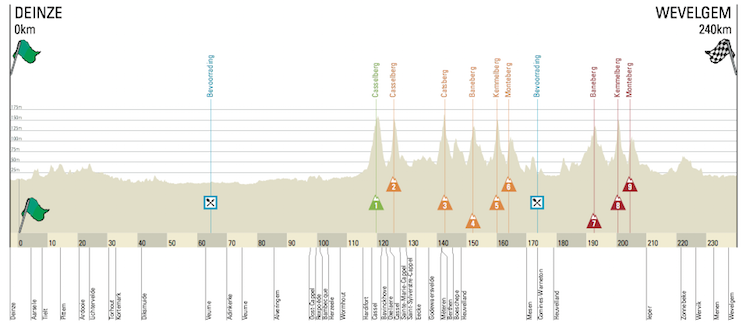
    Stage-1424087745

    The short but steep Baneberg, Kemmelberg, and Monteberg trio of climbs, a few kilometers southwest of Ieper, are done twice, and the conclusion of that second run-through also marks the end of the hellingen in Gent-Wevelgem. The difficult cobbles of the Kemmelberg, in particular, could be a battleground in this race, especially with the help of a common visitor to the event that seems scheduled to make another appearance in 2015: bad weather. As of Saturday, rain and very strong winds are both set to join the peloton for Gent-Wevelgem. Even with a less topographically challenging final 30 kilometers, the combination of tough cobbled climbs (and the often hairy descents that follow) in the middle of the day and likely difficult conditions throughout will surely do their damage.

    The Contenders

    The dearth of long climbs on the profile, especially close to the finish line, makes this a major target for the top sprinter’s in the peloton, but the bergs, the cobbles, the race distance, and the Flanders conditions will make the tougher quick men the top favorites for victory in this race, though a few of the more aggressive Classics specialists will certainly have a chance at taking this win for themselves.

    Alexander Kristoff is at home in terrible conditions, comfortable on the cobbles, capable of a little climbing, and usually fresher than most after a very long day. He also happens to pack a powerful sprint. Though probably just a hair behind the likes of Marcel Kittel in terms of pure speed, here in the Classics, Kristoff’s makes up for the just slightly lower velocity with pure grit. There is no guarantee that this race ends in a sprint, but if it does, it’s hard to look past Kristoff’s abilities. He’s likely to hold on longer than most even if a high pace over the cobbled climbs starts dropping other sprinters, and if he’s there at the end of the day, few can match him in speed.

    If he’s there as well, however, 2014 John Degenkolb will give Kristoff a run for his money. Already victorious over Kristoff in Milano-Sanremo, Degenkolb seems to get better and better every year both in the versatility department and in the top speed department. He’s a proven rider here in Gent-Wevelgem and on Flanders terrain in general. He might prefer a few more uphill challenges (his climbing legs are better than most) to maybe make things more selective but even if this race is contested in a large bunch sprint at the end of the day, Degenkolb will be a strong contender to repeat.

    Mark Cavendish doesn’t have the same sort of versatility as some of the more Classics-oriented quick men here, but he is probably the fastest in a battle of pure speed. It won’t be easy making it to the line in the lead group, especially given the weather forecast, but if Cavendish can do it, he’ll have a great chance here—EQS teammate Matteo Trentin (3rd in E3) will be a strong second option in the sprints. Lotto Soudal’s André Greipel, who often rivals Cav in the pure sprints in stage races, and who has come close here in the past, is another very fast rider who will hope to hold on for a sprint at the end of a long day.

    2014 runner-up Arnaud Démare has not had as much success early this season as he would have liked, but he is a big talent on this sort of parcours and motivated to prove himself as FDJ’s sole top name in the sprints this season. The rider he edged out for 2nd last year, Peter Sagan, will have an interesting choice to make this year: will he try to hold on for a sprint and test his luck against a pack of other fast finishers (as he did unsuccessfully in 2014) or will he launch a late attack and try to catch them all by surprise (as he did successfully in 2013, when he won the race)? The smart choice would seem to be to try to get away in a smaller group here, as he has not had much success in the bunch sprint lately. Either way, multi-talented Sagan is a threat in any scenario.

    Giacomo Nizzolo has never finished this race, but given his skillset, he’ll be in with a chance. He’s a powerful sprinter, with a recent win at the GP Nobili, who doesn’t mind a long day. Unfortunately for Nizzolo, he crashed out of Dwars Door Vlaanderen and his current level of readiness to face the difficult Belgian roads again in a major race is unclear.

    Nacer Bouhanni, Elia Viviani, Heinrich Haussler, Tyler Farrar, Sam Bennett, Jens Debusschere, and JJ Lobato are other quick men who will have a chance if it all comes down to a sprint.

    Several familiar names seem the most likely protagonists to shake up the race with a late attack. Sep Vanmarcke, on great form right now, 2nd here in 2010, and typically unfazed by bad weather, is a particularly dangerous rider right now. His continually improving sprinting ability makes his case even stronger. Pedal problems plagued slowed him at E3, but that should only make him hungrier for more racing these next few days.

    Greg Van Avermaet may not have the sprinting chops of the top quick men here but he could still win in a reduced gallop, if he is feeling comfortable and still confident after a bad crash at E3 Harelbeke.

    E3 Harelbeke winner Geraint Thomas is one of the sport’s most versatile riders, capable of soloing, climbing, and even sprinting at a high level. This parcours doesn’t suit him quite as well as E3’s did but there are still plenty of opportunities to attack here.

    The powerful EQS trio of Zdenek Stybar, Stijn Vandenbergh, and Niki Terpstra, MTN-Qhubeka’s new acquisition Edvald Boasson Hagen, Filippo Pozzato, Lars Boom, and Jurgen Roelandts are others with a chance of winning solo or from a small group.

    VeloHuman Top 10 Favorites

    Winner: Alexander Kristoff
    Podium: John Degenkolb, Mark Cavendish
    Other Top Contenders: Peter Sagan, Sep Vanmarcke, Greg Van Avermaet, Arnaud Démare, Giacomo Nizzolo, André Greipel, Matteo Trentin

    Be sure to follow @VeloHuman on Twitter for more race analysis.

    -Dane Cash
  • Sagan’s Surprise Power Failure Leaves Stybar Following the Wrong Wheel in E3 Harelbeke Finale

    Sagan’s Surprise Power Failure Leaves Stybar Following the Wrong Wheel in E3 Harelbeke Finale

    6533350201_47bffcdbb5_b

    When the gap between a dwindling E3 Harelbeke peloton and Peter Sagan, Geraint Thomas, and Zdenek Stybar had gone out to around one minute as the riders approached the finish line, it became clear that a victory in first Belgian Classic of the 2015 WorldTour would soon grace the palmares of one of the three riders up the road. One of them, Peter Sagan, had already won the race the year prior by outsprinting a small group of companions at the line, a group that included another member of the trio now fighting for this year’s honors, Geraint Thomas.

    Given Sagan’s impressive array of abilities, it was only natural for the third member of the trio to be focusing on the Slovakian defending champion in the waning moments of this year’s race over a rider he’d beaten here last year. But Zdenek Stybar’s decision to mark Sagan at the 2015 E3 Harelbeke did not pay off. Geraint Thomas launched a powerful attack in the last few kilometers of the race, and Stybar immediately got on Sagan’s wheel thinking the younger rider would give chase—but Sagan was cooked, and he faded immediately, leaving Stybar to launch an unsuccessful attempt to bridge a gap that had now grown too far.

    “I expected that Sagan would be a bit stronger, but he wasn’t,” Zdenek Stybar said after the race.

    Few would fault Stybar for such an expectation. Unfortunately for the former world cyclocross champion, the tremendous strength of Thomas left no room for error in the E3 finale.

    “He was really, really impressive the last four kilometers. I knew that if he went, I’d have to jump in his wheel but I thought that Sagan would do the same, and he didn’t have the legs anymore.”

    Sagan was not able to offer much of an explanation as to his sudden loss of power; in a post-race interview outside the Tinkoff-Saxo bus, he seemed at a loss for words when asked what had transpired, saying that something had “turned off.”

    “I felt good on Kwaremont but after, it was still a far way to go to the finish,” he said. Somewhere in between that difficult climb and the final 4 kilometers, Sagan ran out of gas. However it happened, and whenever he realized that he was scraping the bottom of the barrel, his surprise power failure was a pivotal moment in the race.

    After narrowly missing out on E3, Stybar and Sagan are already looking to next week’s Ronde van Vlaanderen, where the absence of one of two would-be top contenders (Fabian Cancellara and Tom Boonen) will certainly alter the narrative of the race. But when asked about what the upcoming Tour of Flanders might be like with its now somewhat reduced cast of star protagonists, both Stybar and Sagan were quick to point out there was plenty of competition still out there.

    “There are still enough guys who want to win the race,” said Stybar.

    “There’s also a lot of other riders who are really strong and we’ll have to see in the race,” said Sagan.

    In a day full of surprises, that agreement in the opinions of the two riders should not be much of a surprise: they both had front row seats to the show put on by one of strongest of those other riders today, one who will be hungry for more success in next week’s Ronde.

    -Dane Cash

    Photo by Reginald Dierckx.

  • E3 Harelbeke 2015 Preview

    E3 Harelbeke 2015 Preview

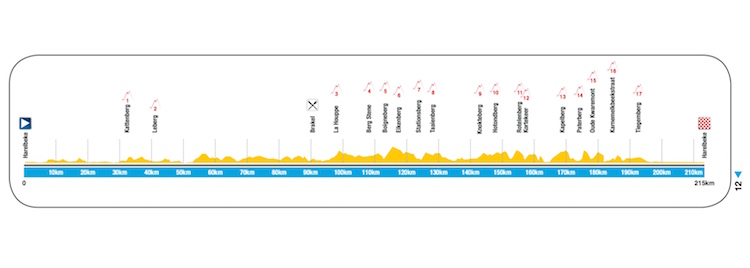
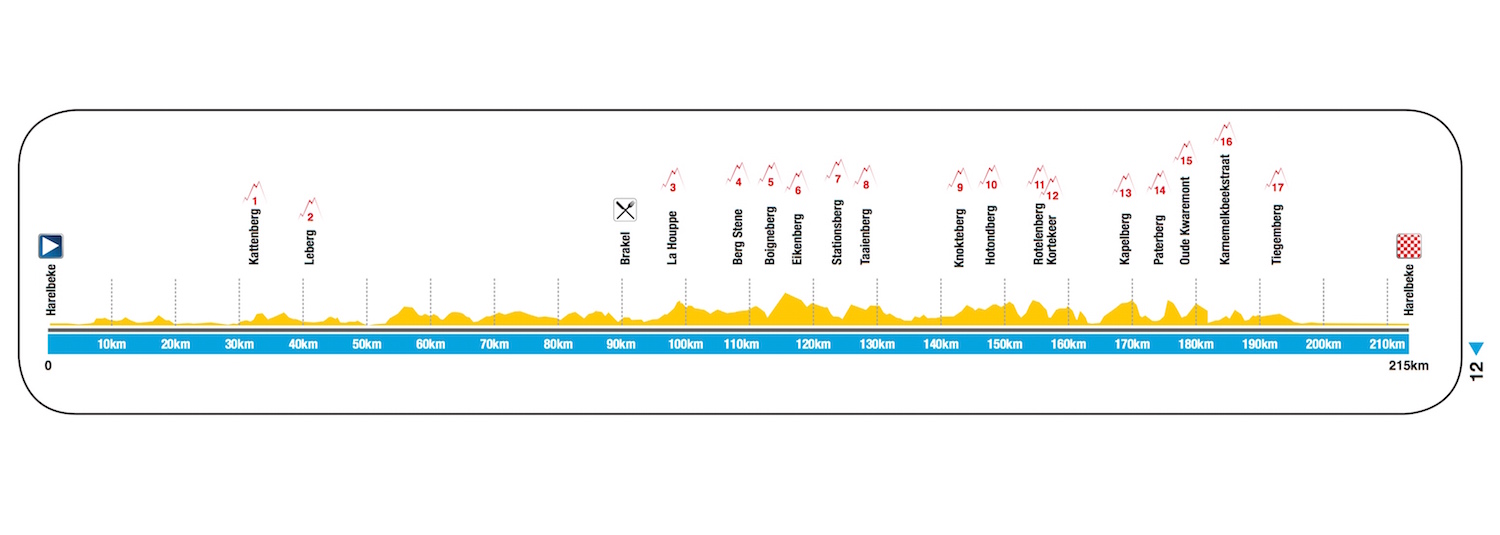
    E3_Profile_VH_

    After weeks and weeks of EuropeTour-level one-day races in Belgium, the final weekend in March ushers in the WorldTour stretch of Classics, opening with E3 Harelbeke. It’s typically a thriller, a race that takes advantage of the cobbled climbs in Flanders and balances them nicely with a long enough finishing straight to make the aggressors work extra hard to escape the pack. In short, an excellent way to kick off the next few weeks of marquee one-day events (the great appeal of this weekend’s racing was one topic covered in the Recon Ride podcast’s E3 + Gent-Wevelgem pre-race show, which is absolutely worth a listen).

    The Route

    E3 Harelbeke unsurprisingly starts and finishes in the town of Harelbeke, weaving through Flanders along a meandering and often cobbled 218-kilometer route that often crosses over itself. The profile contains 17 official climbs. The first half of the race contains only three of those climbs; the remaining fourteen come in rapid succession inside the second half of the day, finishing with around 22 km to go.

    Among those many short but steep climbs are several familiar Tour of Flanders battlegrounds, including the quick (700 meters in full) but vicious (12% average gradient) Paterberg at around kilometer 175 and the longer Oude Kwaremont that follows almost immediately after and is crested around kilometer 180. Even the climbs that don’t seem particularly imposing are made all the more so because of the fact that they’ll be conquered with barely a moment’s rest in between—that, and the constant bone-rattling that will accompany many of them.

    Things flatten out and ease up considerably, however, after the Tiegemberg with around 20 kilometer left in the race. From there it’s a less complicated (topographically, at least; this is Belgium after all, where the roads are never easy to race on) ride as the road loops into Harelbeke for the finish.

    The Contenders

    Though the length of the race doesn’t bring with it quite as much of an intimidation factor as that of Flanders or Paris-Roubaix, the cobbled, uphill challenges absolutely make this a favoring the Classics hard men, which makes it unsurprising that E3 Harelbeke has mostly come down to a late attacker surviving to the in several of the past few years. Still, Tom Boonen’s 2012 victory is an important reminder that this race can come down to a sprint. With so much ground left to cover after the Tiegemberg, it will only be a very strong attack that is capable of surviving a chasing pack in this race. Even in that scenario, a decent sprint could come in handy, if a small group crosses the line together (that’s what happened in 2014, when Peter Sagan outsprinted Geraint Thomas, Niki Terpstra, and Stijn Vandenbergh to win the day).

    Fortunately for anyone who likes to watch aggressive racing, several of the Classics season’s strongest aggressors are looking in sharp form right now, making powerful attacks a likelihood for E3 Harelbeke.

    34-year-old Fabian Cancellara, who looked good in a Milano-Sanremo that did not particularly suit his less-than elite field sprinting, has won E3 Harelbeke a whopping three times in his career. He won’t exact be able to fly under the radar, but he’s so strong it might not matter. On the other hand, Cancellara is facing a retirement relatively soon, and having won in the past, he may elect to ease off the gas just a tad in the upcoming Monuments. Classics veteran Stijn Devolder is a rider who could get involved as well for Trek.

    Peter Sagan, last year’s winner, is certainly in the hunt for Monument victories in 2015. It’s unclear how motivated he is to give it his all in this race after his win here last season failed to quiet critics of his inability to win “the big one.” Still, his combination of Classics-soloing prowess and a deadly sprint make him an obvious favorite once again.

    Unlike the aforementioned Cancellara and Sagan, Sep Vanmarcke combines a skillset well-tailored for E3 with a lack of any WorldTour results on his palmares as of yet in his career. Lately his climbing skills and his sprint have both been showing themselves nicely, and they complement his cobblestone-riding strength quite well in this eve. His team support is a bit less strong than it was in year’s past now that Lars Boom is off the team, but Vanmarcke is the total package for the Belgian Classics, and it would be a big surprise to see him doing anything other than attacking last in this race. Form, motivation, and an excellent combination of abilities make him a strong pick to finally win a race at the top level.

    Greg Van Avermaet is another rider who brings an excellent combination of form and motivation into E3. Van Avermaet is one of the peloton’s best late attackers who showed top-notch soloing form with a 3rd place in the opening time trial at Tirreno-Adriatico (not typically a discipline that sees him doing particularly well). And if he does launch a trademark attack but is unable to drop everyone else in the finale, his quickness to the line in a reduced sprint could make the difference here. His teammate Daniel Oss has been having a strong season and will be a rider to keep an eye on as well.

    Etixx-Quickstep and Team Sky both sport multiple-pronged attacks to light up this race as the cobbled and uphill sections start coming fast and furious. Zdenek Stybar, Niki Terpstra, and Stijn Vandenbergh head up a powerful EQS, with Stybar looking like the most fit for this race (his climbing legs and his finishing kick stand out among his teammates), especially after his Strade Bianche victory. Meanwhile, Geraint Thomas, who is such a good climber it’d be disingenuous to pigeonhole him as a “Classics specialist,” may be the strongest option on a strong Sky squad, though Ian Stannard is a major danger as well.

    After his Milano-Sanremo victory, John Degenkolb looks to be the class of the group of riders coming into this race hoping for a reduced sprint. His climbing ability will be particularly useful here in E3. Alexander Kristoff is another obvious name to watch in the sprint department; he doesn’t have Degenkolb’s uphill ability but he’s strong enough that he might be able to close gaps if he loses ground on the climbs; teammate Luca Paolini is an ideal supporter and deadly second.

    Lars Boom, Edvald Boasson Hagen, Sylvain Chavanel and Heinrich Haussler, Filippo Pozzato, Sebastian Langeveld, and Jurgen Roelandts are other top riders to watch for this race.

    VeloHuman Top 10 Favorites

    Winner: Sep Vanmarcke
    Podium: Greg Van Avermaet, Peter Sagan
    Other Top Contenders: Fabian Cancellara, Stijn Vandenbergh, Geraint Thomas, Zdenek Stybar, Ian Stannard, Niki Terpstra, John Degenkolb

    Be sure to follow @VeloHuman on Twitter for more analysis from the roadside in Flanders!

    -Dane Cash

  • The Recon Ride Podcast: E3 Harelbeke + Gent-Wevelgem 2015 Pre-race Show

    The Recon Ride Podcast: E3 Harelbeke + Gent-Wevelgem 2015 Pre-race Show

    RR_VH_Art_E3HWG2015 Episode 6: E3 Harelbeke + Gent-Wevelgem 2015 Pre-race Show
    The Recon Ride takes on both of the weekend’s WorldTour one-day events in a double pre-race show of E3 Harelbeke and Gent-Wevelgem.
    [powerpress]


    Sharing a weekend, many of the same riders, and similar Belgian terrain, E3 Harelbeke and Gent-Wevelgem make for a great pair of races. VeloHuman and Cyclocosm explore the routes, the startlists, and the narratives, with a bit of help from AG2R-La Mondiale’s Hugo Houle.

    Photo by shirokazan.

  • Milano-Sanremo 2015 Preview

    Milano-Sanremo 2015 Preview

    MSR_2014_Lead VH

    Milano-Sanremo, the first one-day race on the 2015 WorldTour and also the first “Monument Classic” of the season, has almost arrived! The grueling event, which will take riders from Italy’s Lombardy region to its Ligurian coast this Sunday, combines an overlong race distance with a few topographic features along the way, and often a sizeable dose of unpleasant weather. Even in a sport that prizes toughness, Milano-Sanremo demands grit and endurance on another level, which is why a big reason why its list of winners includes some of cycling most legendary hard men (one of the many topics discussed in the Recon Ride pre-race show, which you should also check out).

    The Route

    Though Milano-Sanremo has undergone a number of route changes in the past few years, the 293-kilometer route of the 2015 edition is similar to that of the 2014 edition (lacking a few of the climbs often planned for this race), with some alterations in the final kilometers. The peloton will set out from Milan and enjoy mostly flat roads for over a hundred kilometers. The pavement angles upward for the long, low-gradient climb of the Passo del Turchino a bit before the midway point, and that ascent is followed by a fast descent towards the coast.

    293 kilometers in total, the Milano-Sanremo parcours becomes more and more difficult near the finish line.
    293 kilometers in total, the Milano-Sanremo parcours becomes more and more difficult near the finish line.

    From there, it’s still over a hundred kilometers along the Mediterranean in the direction of San Remo. Things stay flat for a while, but around kilometer 240, the peloton will start to hit a few small bumps, leading into a pair of more difficult late climbs likely to break up the peloton before the finish. First comes the Cipressa, 5.6 kilometers at a 4.1% average gradient. The riders will reach the top with a little over 20 km to go, take on a fast descent, and then speed over flat roads until they hit the foot of the Poggio climb. 3.7 kilometers at 3.7%, the Poggio does have a few steep sections (one stretch of 8%), and its otherwise unimposing gradient is of course made much more intimidating by the fact that the riders won’t reach the climb until they’ve already ridden 280 kilometers. The top of the Poggio is 5.5 kilometers from the finish, and followed by a fast descent that doesn’t even out until there are only 2.3 kilometers to go. From there, it’s a flat run towards the finishing straight on the Via Roma, a classic conclusion to Milano-Sanremo that has returned after many years of being left out of the route. With the reintroduction of the Via Roma, the finish line in this year’s race is almost a kilometer closer to the bottom of the Poggio than it was last year.

    As of the day before the race, the weather forecast calls for some rain, though at the moment it seems the peloton may escape the torrential downpours common in the area this time of year.

    The Contenders

    Given the parcours, the likeliest outcome for Milano-Sanremo 2015 would appear to be a sprint showdown among the more versatile quick men of the peloton. The late climbs will give the opportunists a chance to try to get up the road and stay clear for the victory, and a few riders stand out as particularly likely protagonists in that scenario, but it won’t be easy to hold of the charging pack on these relatively low gradients. On the other hand, there are a few pure sprinters who might be favorites in any other high-speed finale but who might struggle here after such a long day.

    Katusha’s Alexander Kristoff is the defending champion, the victor of the 2014 edition in a bunch sprint that saw him well ahead of several very speedy finishers. Kristoff’s ability to survive the grueling distance without losing too much of his kick was crucial to his win over the other sprinters last year, and it remains a strong reason to expect big things from him again this year. Kristoff also has the experienced Luca Paolini to help him navigate the day’s difficulties. He has been in excellent form all season, winning sprints in several stage races, and that only makes him appear a stronger candidate here. The one question mark for Kristoff is whether he’ll be close enough to the front of the race as the Via Roma approaches. The reduced distance between the bottom of the Poggio descent and the finish line will give Kristoff less time to regain ground if he loses position on the last climb. Kristoff is not a bad climber, for a sprinter, but there are other quick men who can go uphill more comfortably, and they look to be Kristoff’s biggest challengers should this come down to a sprint.

    Tinkoff-Saxo’s Peter Sagan has been close to success in this race before, but he has come up short at the line. Gerald Ciolek (surprisingly) denied him of a victory in a reduced sprint in 2013, and although he came to the line with the main pack in 2014, he was a nonfactor in the sprint. The altered finish may benefit Sagan, whose climbing legs set him apart from the other quick men. More so than most, he is capable of launching a late attack on the Poggio, or at least holding the wheel of someone who does. If some of top sprinters in the peloton have faded by the time the finish nears, Sagan will be in a prime position to pick up his first Monument win.

    Another sprinter with capable climbing legs making the start is Giant-Alpecin’s John Degenkolb. His 2014 MSR campaign was ruined by a late puncture, but soon after, he took 2nd in Paris-Roubaix, proving that distance is not a problem for him. He has continually improved in the top speed department over the last few years, and even against the biggest-name sprinters in the world he can hold his own; when a long day and a late climb enter the equation, Degenkolb becomes even more dangerous. He hasn’t quite had the results he would have hoped for coming into the race, racking up a number of 2nd-places to go with one win early in the season in Dubai, but if he is timing his peak right around now, Degenkolb will be a great candidate for victory.

    Movistar’s Juan José Lobato sports an excellent combination of climbing legs and sprinting prowess, and he has used that skillset to pick up several wins already this season (denying Degenkolb on multiple occasions). He will hope to build on his 4th-place here last year, and with the form he has shown so far in 2015, that seems like a real possibility. Should Movistar feel that Lobato’s bid is in doubt near the end of the day, the team could try to send Alejandro Valverde up the road on one of the two late climbs.

    Michael Matthews of Orica-GreenEdge has a similarly fine-tuned skillset combining climbing legs and a vicious finishing kick. His Paris-Nice victory suggests that the form is there as well. For Matthews, the main question mark is whether he can handle the distance. He doesn’t really have any results to speak of in overlong races. He could certainly change that at this year’s Milano-Sanremo, but it will be a foray into new territory.

    Mark Cavendish headlines a collection of elite pure sprinters in attendance who will hope that their explosiveness is not too diminished by the time the peloton reaches the finish in San Remo. Cavendish has of course won this race in the past (in 2009) but it was a much younger Mark Cavendish taking the victory then. On last year’s parcours, similar to this year’s, Cavendish was with the main pack at the end of the day, but was unable to come away with more than a Top 5 after the long journey from Milan. With the Via Roma finish coming closer to the bottom of the Poggio, Cavendish will have to work even harder to maintain a strong position and his energy in the finale, making his candidacy as a top favorite questionable despite his legitimate claim to the title of fastest field sprinter on the startlist. Etixx-Quickstep does have alternatives on the roster in Michal Kwiatkowski and Zdenek Stybar, both on blazing form and capable of putting in a strong attack on a late climb in a one-day race.

    Like Mark Cavendish, André Greipel is another powerful pure sprinter hoping to survive the long day with his strong kick intact. Coming off a sprint stage win at Paris-Nice, Greipel clearly has the sprinting form to contend in a bunch gallop, and in fact, he has made it a stated goal of this season to finally pick up a big one-day victory after years of near misses. If his pursuit of such a target has led him to improve his power and endurance, he will be a real contender here. Lotto-Soudal may look to Tony Gallopin as a second card to play near the finale.

    The very long list of other quick men with a chance in a potential sprint, all of them with varying levels of versatility, includes Cofidis’s Nacer Bouhanni, the MTN-Qhubeka duo of Gerald Ciolek and Edvald Boasson Hagen, FDJ’s Arnaud Démare, Sky’s Ben Swift (3rd last year, though entering the race with uncertain form this year), Cannondale-Garmin’s Ramunas Navardauskas, IAM Cycling’s Heinrich Haussler, Lampre-Merida’s duo of Niccolo Bonifazio and Davide Cimolai, Astana’s Andrea Guardini, and Bora-Argon 18’s Sam Bennett.

    Fabian Cancellara headlines the list of riders who could be looking to jump clear of the peloton in the final few kilometers. This parcours, without some of the uphill challenges of past editions, will make it very difficult for anyone to get away from the pack, but if anyone can do it, Fabian Cancellara is a prime pick. His time trial victory in Tirreno-Adriatico suggests that he is in formidable soloing shape at the moment, and he has done a great deal to work on his sprint this year should he come to the line with a small group. Cancellara was a surprising 2nd in last year’s bunch sprint, suggesting that he’s even a danger if he can’t shed the pack on the Poggio or the Cipressa. Having landed podium results each of the last four years, another strong placing seems practically guaranteed this year. Giacomo Nizzolo, fresh off a GP Nobili victory, offers Trek another option.

    BMC’s duo of Philippe Gilbert and an on-form Greg Van Avermaet, Astana’s Vincenzo Nibali, Sky’s Geraint Thomas and Ian Stannard, IAM Cycling’s Sylvain Chavanel, and Lampre-Merida’s Pippo Pozzato and Rui Costa are other riders to keep an eye on when the attacks start to fly around the Cipressa and the Poggio.

    VeloHuman Top 10 Favorites

    Winner: Alexander Kristoff
    Podium: John Degenkolb, Peter Sagan
    Other Top Contenders: Fabian Cancellara, JJ Lobato, Michal Kwiatkowski, Greg Van Avermaet, Mark Cavendish, André Greipel, Michael Matthews

    Be sure to follow @VeloHuman on Twitter for live commentary and analysis of the race, and don’t forget to listen to the Recon Ride pre-race show for plenty more on the year’s first Monument. Check back soon for previews and roadside coverage of the upcoming Volta a Catalunya!

    -Dane Cash

    Photo by Martin Mystère.

  • The Recon Ride Podcast: Milano-Sanremo 2015 Pre-race Show

    The Recon Ride Podcast: Milano-Sanremo 2015 Pre-race Show

    RR_VH_Art_MSR2015

    Episode 4: Milano-Sanremo 2015 Pre-race Show
    The Recon Ride takes on the first Monument Classic of 2015.
    [powerpress]


    The first WorldTour one-day event on the calendar and the first “Monument” of the season, Sunday’s 293-kilometer ride from Milan to San Remo gives the Recon Ride podcast plenty to discuss. Will Alexander Kristoff defend his title? Can Peter Sagan finally get that marquee victory? Will an Italian rider show up to contend in a major Italian Classic? VeloHuman and Cyclocosm team up to cover all the major storylines.

    Photo by Martin Mystère.