Few one-week stage races consistently draw amazing startlists riding at a very high level of form quite like the Dauphiné. This year’s race is no exception. Most of the big Tour de France contenders will be in attendance to do battle in the Alps.
The Route
This year’s Critérium du Dauphiné is all about the climbers. The only time trial is the first stage of the race, and it’s a pure hill climb that will bring the lightweight mountain goats to the fore.
Then come four straight days for the stagehunters – stages ranging from sprinter-friendly to puncheur-oriented – before a mountainous three days close out the race. Stage 6 looks like the queen stage, with the fearsome hors categorie Col de la Madeleine halfway into the day and a Cat. 1 finale to close things out. The seventh and final stage is a tough one as well, with a late Cat. 1 into a Cat. 3 finish to provide a final test for the uphill specialists.
The General Classification Contenders
I see a quintet of riders as the top tier of GC favorites in this race. Chris Froome headlines the list. He’s won the Dauphiné in the past, and showing that he does like to do well in the race, and it goes without saying that when he’s at his best, he’s practically unstoppable in a stage race. It will also help to have a hugely impressive support squad. Any one of Mikel Landa, Michal Kwiatkowski, Sergio Henao, or Wout Poels could even contend for the win should Froome not be up for it.
Alberto Contador has been on the podium in the Dauphiné more than once and should challenge again this year. Motivation is the biggest question for the Spaniard – you get the feeling that it’s all about the Tour for Contador – but if he’s on his game he’ll be right there in the mix.
Fabio Aru will love the parcours. He’s not at the same level as Froome or Contador in the time trials, so this climber-centric route favors him. We haven’t had too many opportunities to see him up against a fully healthy and motivated Froome, so this will be a nice chance to gauge the two riders against one another.
Richie Porte doesn’t have the Grand Tour credentials of Froome, Contador, or Aru, but he’s a one-week star and should be in excellent shape. Unlike Aru, he’d probably prefer more TT mileage, but he’s still a threat to win the race.
Thibaut Pinot is the other name that stands out to me as a real contender for the overall victory. He’s had a strong year so far and motivation won’t be in question racing on French roads. Having put his problems with descending into the rearview mirror, he’ll thrive on the final few stages of this race.
The list of other contenders that come to mind includes Joaquím Rodríguez, Romain Bardet, Pierre Rolland, Daniel Moreno, Adam and Simon Yates, Louis Meintjes, and Bauke Mollema.
The Stagehunters
Alexander Kristoff and Nacer Bouhanni should battle for sprint victories (and there will be a few opportunities) with John Degenkolb another potential protagonist in the fast finishes if he’s feeling up to it.
Meanwhile, there are several punchy types and big engines to look for stage wins on the bumpier days, with Dan Martin, Julian Alaphilippe, Tony Gallopin, Greg Van Avermaet, Tony Martin, and Niki Terpstra all in attendance.
VeloHuman Top 10 Overall Favorites
Winner: Chris Froome Podium: Alberto Contador, Fabio Aru Other Top Contenders: Thibaut Pinot, Richie Porte, Joaquím Rodríguez, Pierre Rolland, Bauke Mollema, Mikel Landa, Sergio Henao
Episode 45: Critérium du Dauphine 2016 Pre-race Show
With the Giro d’Italia done and dusted, riders are preparing for the Tour de France with the most important “tune-up” race on the calendar. The Recon Ride previews the Critérium du Dauphiné.
[powerpress]
Some of the biggest names in the pro peloton are headed to France for the Critérium du Dauphiné. Dane Cash and Cosmo Catalano talk route, favorites, and storylines ahead of the eight-day stage race.
The Dauphiné marks the arrival of “Tour de France season,” drawing an always impressive startlist of top Tour talent hoping for a final tuneup before La Grande Boucle. The big names and mountainous parcours should make this year’s edition of the race a worthwhile attraction.
The Route
The 2015 Dauphiné route offers a healthy dose of difficult climbs. The only stage without a categorized climb is the TTT, and even that has some challenges.
The race kicks off with a bumpy stage 1 likely to favor a punchier rider, with eight categorized climbs, small though they may be, on the day. Stage 2 does have a Cat. 1 challenge on the menu, but a long flat finale could favor the sprinters. The Stage 3 TTT will likely have serious GC implications. 24.5 kilometers is long enough to open the sort of gaps that will have an impact in a one-week race, especially given a long, slightly uphill stretch in the second half of the stage.
Stage 4 will be a day for the sprinters or more versatile fast-finishers before the GC riders come to the fore again on Stage 5, which closes out with a one-two punch of categorized climbs. Stage 6 is another day that may have a GC impact, closing out with a Category 3 climb.
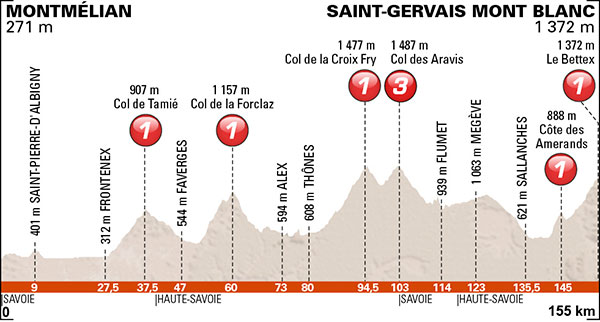
Stage 7 will probably be the most decisive stage of the 2015 Critérium du Dauphiné. After 30 flat kilometers, it’s up and down the rest of the way, with a total of five Cat. 1s along the route, including the summit finish.
Stage 7: Montmélian › Saint-Gervais Mont Blanc (155km) – A succession of difficult climbs will likely make Stage 7 the Dauphiné’s most hotly contested GC battleground.
None of the climbs are all that brutal by themselves but altogether they will provide plenty of launching pads for the uphill specialists. Stage 8 closes out the race with another Category 1 summit finish at Modane Valfréujs.
The General Classification Contenders
Two of cycling’s so-called “Big Four” will garner the most attention coming into the race: Chris Froome and Vincenzo Nibali. Froome has won the race before, the year he won the Tour de France, and he may be hoping to replicate his performance from 2013, where he came into the Tour riding high on the back of strong performances in the one-weekers. He’s had a decent, though not great, year so far, and this is an opportunity to get on track with a big success for his Tour bid this year. At his best, Froome is almost unstoppable, and he should be motivated to be close to his best here. The team trial suits Sky well. Nicolas Roche and Wout Poels are among Froome’s many strong teammates in attendance who will be valuable supporters or even potential alternatives should the need arise.
Vincenzo Nibali’s path to Tour de France victory was a bit different from Froome’s—the Italian all-rounder did not look nearly as strong in the run-up to the 2014 Tour, but peaked at the right time in July. If he’s looking to replicate that approach, he might not be quite at 100% here. If he’s gunning for victory though, he should love the climber-friendly profile, and Astana’s TTT squad looks strong too. This is a great parcours for Nibali, without any individual time trial to potentially set him back against his more chrono-adept rivals—motivation may be the key factor in determining how well he performs.
Last year’s winner Andrew Talansky was one of the most surprising winners of a WorldTour race all year, grabbing the Critérium du Dauphiné yellow jersey with a brilliant breakaway move on the final stage. The lack of a time trial in this year’s edition does not suit Talansky, the USA’s new national time trial champion, but with all of these climbs, the opportunities are there for plenty of action should he be hoping to get aggressive again this year. Teammate Daniel Martin is another option—individual time trials often tank his chances in stage races, and the absence of one here will make this an attractive event for him.
Alejandro Valverde will love the Dauphiné parcours. He’s been cycling’s most successful rider so far this season, landing on podiums almost at will, and he should be motivated to prove himself ready for the Tour with Nairo Quintana elsewhere. Movistar brings a strong team that includes Beñat Intxausti, who was great in the Giro.
Tejay van Garderen has looked great at times this season, and mediocre at other times. With the Tour on the horizon, though, he should be in strong form in this race, and with the strength of BMC’s world champion TTT squad, he should be set up for success. Van Garderen has focused on improving as a pure climber recently and that will come in handy here.
Despite a disappointing Ardennes campaign, Joaquim Rodríguez has shown flashes of brilliance in 2015. If he rides here like he did in País Vasco, he’ll be difficult to beat, especially with these sorts of climbs—the uphill challenges in the Dauphiné are many, but none of them are of the brutal, interminable sort that could put Rodríguez into trouble against the likes of Froome. Katusha Teammate Giampaolo Caruso should be a great second. Lampre’s Rui Costa is riding in the Dauphiné instead of the Tour de Suisse this year, eschewing a chance to win a fourth Suisse title in a row. He is hoping to make his mark on the Tour de France this season, which means that the form should be there. The profile, with its constant ups and downs but without any Ventoux-esque climbs, should suit him very well too.
Wilco Kelderman rode well here last year and should be primed for success with the Tour around the corner. Julian Alaphilippe will be eager to show that his success on the climbs in California was no fluke. Trek’s Bauke Mollema rode very well in Tirreno-Adriatico, and should be in the mix with the favorites in this race if he can show that sort of form here. AG2R’s two-pronged attack of Romain Bardet and Jean-Christophe Peraud won’t be easy to counter, assuming the French squad can hang tough in the TTT. Mathias Frank, Pierre Rolland, and Daniel Navarro, and Simon Yates are others with an outside chance at success in the General Classification.
The Stagehunters
The list of sprinters in this mountains race is rather thin, but not without talents. Nacer Bouhanni, Sacha Modolo, and Luka Mezgec look like the fastest finishers here, with Tyler Farrar, Edvald Boasson Hagen, Samuel Dumoulin, Kris Boeckmans, and Kevin Reza are others who could be in the mix in the bunch kicks.
Versatile quick men like Simon Gerrans, Ramunas Navardauskas, and Tony Gallopin will hope to challenge the more explosive GC types on the intermediate days, like Stage 1. And of course, watch out for any strong climbers who fall out of contention early with poor TTT performances to get involved in the breakaway conversation later on in the race.
VeloHuman Top 10 Overall Favorites
GC Winner: Chris Froome Podium: Alejandro Valverde, Vincenzo Nibali Other Top Contenders: Tejay van Garderen, Joaquim Rodríguez, Andrew Talansky, Rui Costa, Romain Bardet, Bauke Mollema, Wilco Kelderman
Be sure to follow @VeloHuman on Twitter for more analysis and commentary during the race!
Episode 15: Critérium du Dauphiné 2015 Pre-race Show The Recon Ride dives into the many storylines of the Critérium du Dauphiné.
[powerpress]
Dane Cash of VeloHuman and Cosmo Catalano of Cyclocosm take a closer look at the 2015 Critérium du Dauphiné, which boasts a strong startlist of contenders hoping to hone their Tour de France form in one last race before the sport’s biggest event.
The Dauphine was supposed to be a showdown between Tour favoritesChris Froome, Alberto Contador, Vincenzo Nibali, but other riders decided to crash the party, offering a chance for a number of stars beyond those big names to show off impressive form. At first, it did not look like any outsiders would have a chance. Chris Froome was impeccable in Stages 1 and 2, delivering a convincing victory in the opening time trial, and nabbing another stage win on the following day. Contador was not far behind in the ITT and just moments behind Froome on the second stage. Things seemed set for a showdown between the two, especially with Nibali showing signs of weakness: Astana’s GC man could not match the constant accelerations of his two rivals on the slopes of Stage 2. The coming days had plenty of surprises in store, however. Froome’s hard crash on Stage 6 raised a cloud of uncertainty over his race, but it was only the beginning of the surprises; Andrew Talanksy shocked the cycling world when his early attack on the final stage survived the immense efforts of a group of strong chasers, giving the American the overall victory ahead of Contador. Jurgen van den Broeck was another winner out of the move, sliding into 3rd overall. Meanwhile, Chris Froome couldn’t handle the pace of the chase and fell out of the Top 10 altogether, forced to be content with his two stage victories and the points jersey.
Unfortunately, Froome’s crash makes it difficult to draw any clear conclusions about his form coming into the Tour de France. He looked unstoppable on the first two stages, but it’s hard to say whether his vulnerability in the final two days was a result of his inability to match rival Contador, or pain from his injuries. With the way he rode the first mountain test, I have to imagine that his crash had a significant impact on him in the closing stages. Regardless, what could have been a major confidence booster for Froome in what has been an otherwise rough year was instead yet another disappointment. He goes into the Tour with question marks surrounding his campaign, no longer the sterling, heavy favorite he was in 2013.
Meanwhile, Alberto Contador made a strong statement: he put in a stellar opening time trial and matched Froome in the first climbing stage, even before Froome’s crash. He was by far the strongest climber of the GC riders in the penultimate day of racing. Though he was unable to reel in Talansky’s move on Stage 8, the strength he showed in his attempt was another impressive show of the excellent shape he is in. Even more encouragingly, he was able to deliver such a strong Dauphine despite lacking support from the big names that will support his Tour bid; top lieutenants like Roman Kreuziger and Nicolas Roche did not join him for this race. With the help of Tinkoff-Saxo’s first string, Contador will be an extremely difficult opponent in the Tour de France.
Vincenzo Nibali‘s 7th place in the final GC was not a bad performance, per se, but at no point in the race did he look the part of a Tour de France top contender. Time is running out for Nibali to find form in 2014 before his main objective.
Andrew Talanksy made the most emphatic statement of the Dauphine, and it wasn’t only due to his masterful attack in the final stage. He never would have been in contention for the overall had he not delivered strong performances throughout the race: 4th in the opening ITT, 5th in the mountainous 2nd stage, and the GC rider closest to Contador on Stage 7, Talansky was firing on all cylinders all week long, and he looks primed for another strong Tour de France (he was 10th last year). Jurgen van den Broeck can take many of the same positives away from the race: his podium position was the result of a consistent racing from the very first day of the Dauphine. He has been lacking that consistently recently. After a disappointing 2013, van den Broeck made a resounding statement to his team that he deserves another shot at the Tour GC this year.
Wilco Keldmeran followed up his 7th in the Giro with an excellent 4th at the Dauphine: carrying that level of form this far into June confirms that the 23-year-old is truly the real deal. Romain Bardet‘s 5th should offer a fair bit of consolation for his team; AG2R will be without Carlos Betancur come July’s main event. Adam Yates landed an impressive 6th; his Tour of Turkey victory and his 5th in the Tour of California were nice results, but a Top 10 in this race, one of the biggest one-week events of the year, is an undeniable confirmation of his talent.
Tejay van Garderen looked like a strong contender for the overall, but after faltering early he revealed that he had sustained a hip fracture in the Tour de Romandie; with that in mind, his 13th overall is not as disappointing. He did seem to get stronger as the race went on. Speaking of injuries and Top 15s, Leopold Konig notched an 11th place, which should give NetApp some hope that his recovery from a knee injury is coming along.
Among the stagehunters, Giant-Shimano’s Nikias Arndt took an impressive sprint win on a technical finishing circuit in the 3rd stage. It seems the Giant sprint train can do no wrong, no matter who is doing the sprinting (more on that train in the next Up-and-comer Q&A, so be sure to check back Monday). Simon Spilak was seen by many, including VH, as a potential outside contender for the overall victory, but whether due to heat or team leadership decisions, he instead spent the race hunting stage wins, and he secured one with a brave breakaway move on a hilly Stage 5. Teammate Yuri Trofimov, OPQS’s Jan Bakelants, Astana’s Lieuwe Westra, and Sky’s Mikel Nieve were other deserving breakaway victors.
Takeaways from the Tour de Suisse
For the second week in a row, the last stage of a major WorldTour race ended with brilliant fireworks to shake up the overall GC; again, an early attack stuck to the very end, overhauling the final leaderboard. Much like the Dauphine, the Tour de Suisse offered lots of insight into the form of some likely Tour de France protagonists, and it did it with plenty of excitement, to boot.
With his first opportunity as a Grand Tour leader approaching, Rui Costa delivered his third GC victory in the Tour de Suisse in grand style, on the back of some solid time trialing (his 3rd place in the Stage 7 chrono bettered even Fabian Cancellara) and stellar climbing, and with the help of the sharp racing mind for which he is well-known. His escapees held off a mad chase in the race’s final stage and he out-attacked all of them in the closing kilometers to take his first stage win and first overall victory in the rainbow jersey. It’s hard to know how Costa will fare in his inaugural run as his team’s featured GC rider in the Tour de France, but his performance in Switzerland makes a powerful statement about his form and his skillset, which is looking more well-rounded with every race.
Tony Martin of OPQS saw his chances at an impressive GC win slip through in fingers in the mountainous final stage, but he should still be very pleased with his trip to Switzerland. His ability to land a Top 10 in a very hilly race was impressive, and he won both time trials convincingly. That ITT success may not come as a big surprise, but Martin was not the bookies’ favorite in the first chrono due to its short length. With this form, he should be the favorite for the long time trial in the penultimate stage of the Tour de France, and he’ll also have earned trust from his team as a GC rider in chrono-heavy weeklong races to come.
Mathias Frank was a strong 2nd overall and, like Costa, his nice result was buoyed by a very impressive (and much improved) time trial skillset. That discipline is not traditionally seen as one of his strengths. This more complete game will serve him nicely in the upcoming Tour. Bauke Mollema, 3rd overall, did not time trial as well as expected in the Suisse, but he did climb at a very high level, an encouraging sign ahead of the Tour, especially after a slow start to his year.
Giant’s Tom Dumoulin is an established chrono talent who has flashed climbing chops as well, and he made a nice statement in this race; he used his skill against the clock to get ahead early and held on in the mountains for 5th. At just 23, he’s one of quite a number of exciting young up-and-comers for the Dutch team… again, check back Monday for more on Giant-Shimano’s young talent! Davide Formolo of Cannnondale was decidedly the revelation of the race. The 21-year-old was 4th at the Tour of Turkey, but few could have expected him to finish this major event ahead of Roman Kreuziger. He put in a pair of decent time trials and consistently climbed with the top GC riders, good for 7th overall.
Speaking of Roman Kreuziger, his Suisse was an up-and-down affair, and in the end, he settled for 8th overall. He did not time trial particularly well, and though climbed to a 2nd place finish on Stage 8, he missed the move on Stage 9 and therefore lost a chunk of time to his other rivals. It’s a disappointment for last year’s podium finisher, but it’s nothing to scoff at, and he certainly looks strong enough to play the role of elite domestique again for Alberto Contador.
Thibaut Pinot‘s 15th overall was a disappointment, but he battled sickness in the race and was unable to give it 100%. He still managed to find himself in the Top 10 on the Stage 7 time trial, which is a strong result in that discipline for him. I don’t think he’ll be too discouraged by his race.
For many observers, Bradley Wiggins will be seen as the biggest disappointment of the Suisse. He did not crack the Top 10 in the opening ITT, lost time in the following stages, crashed, and then abandoned. Sky reported that he had a chest infection coming into the Suisse, and his crash left him with a knee injury. Whatever the reason, Wiggins was unable to have much of an impact on the event. While Wiggins has already said that he won’t be on Sky’s Tour de France squad, the team has yet to make any official statements; unfortunately his forgettable trip to Switzerland probably won’t help whatever chance he still has. Teammate Sergio Henao was another victim of misfortune, this one more grave: he was hit by a car doing recon for the Stage 7 ITT, and he is out for the foreseeable future with a broken knee.
Wilco Kelderman may have been able to land a top GC result right after the Giro d’Italia, but Cadel Evans was not up for it; he finished 11th overall in the Tour de Suisse and never seemed to be a strong challenger. Fellow former Tour winner Andy Schleck was not a GC factor but he at least finished the race. Unfortunately his brother Frank crashed hard in Stage 3 and was forced to abandon.
Peter Sagan easily took his third Tour de Suisse Points jersey. He only came away with one stage victory, but he was consistently stellar over the whole first week, finishing in the Top 6 for six days in a row, and then notching the 15th best ITT in Stage 7. He looks very sharp. Mark Cavendish of OPQS took a convincing victory in Stage 4 to put the pure sprinters on notice that he’s feeling strong as the Tour approaches. Unfortunately, he was unable to contest the following stage: he was one of several riders to hit the deck in a crash in the last few hundred meters. Sacha Modolo survived the carnage to take a victory that day, and I doubt anyone will say that it was purely a lucky break as his rivals crashed behind him: he looked extremely fast in the final moments of the stage, and he’s been close to a victory like this for a while.
Johan Esteban Chaves deserves a paragraph of his own. Orica-GreenEdge obviously has a collection of brilliant sprinters, puncheurs, and breakaway artists, but they have been looking for a top-flight climber to score victories when the road goes up. Suddenly, they are flush with climbing young talent. Adam Yates has the makings of a star, as he proved in the Dauphine, and 24-year-old Johan Esteban Chaves Rubio, who, like Yates, also flashed brilliance in the Tour of California, made another loud statement this week with a victory on the Verbier climb. To boot, he did it with a late uphill surge from the pack of GC heavyweights, besting uphill stars like Roman Kreuzgier and Bauke Mollema. The future looks bright for OGE and their young climbers.
La Grande Boucle Awaits
The Tour de France is now less than two weeks away. In the interim, national championship races will put new riders into national jerseys, and the Tour’s biggest protagonists will get in their final days of preparation before the main event. VeloHuman has plenty in store: check back soon for another entry in the Up-and-comer Q&A Series, and get ready for Tour de France previews!
As one Grand Tour ends, the run-up to another begins. The Critérium du Dauphiné (I’m hereafter dropping the accents for various Internet-friendly reasons) is one of the most important stage races of the year. It is one of two major tuneup events for July’s Tour de France (the other being the Tour de Suisse). The balanced route of the Dauphine, which includes a time trial, flat stages, hilly stages, and some difficult mountains, offers excellent preparation for the Tour. Many of the likely stars of La Grande Boucle make the start to face off against their major rivals. Bradley Wiggins won in 2012 and Chris Froome was winner in 2013; both went on to win the Tour. With such an elite field and over sixty years of history, the Dauphine is a major event in its own right.
A quick note before I dive in: I’m not previewing individual stages, but I’ll be tweeting stage picks and live analysis, so remember to follow @VeloHuman on Twitter.
The Route
The 2014 edition of the Criterium du Dauphine wastes no time in kicking off the GC competition, beginning with a 10.4 kilometer individual time trial. It’s a short test but it includes a Category 4 climb (800 meters at 5.5%). It’s also somewhat technical, its route meandering through winding roads along the banks of the Saône. The distance won’t open up any massive gaps, but it will establish a small early advantage for some GC riders.
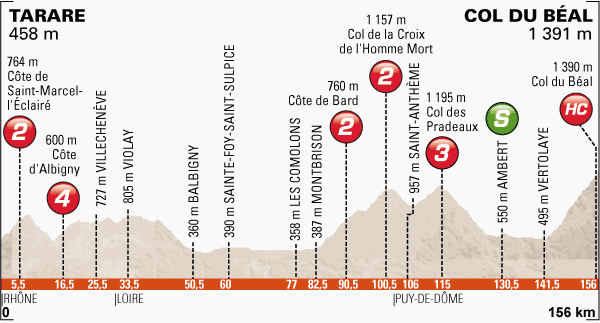
Stage 2: Tarare › Pays d’Olliergues-Col du Béal (156 km) – Things turn mountainous quickly with an HC-rated climb to close out the second stage.
Stage 2 guarantees that none of those riders who got out to an early lead on Day 1 can rest on their laurels: the 156 kilometer journey sets out from Tarare and crests five categorized climbs before one final ascent to the finish atop the Hors Categorie Col du Beal. 13.6 km at 6.6%, it’s not the hardest climb in the world but it’s certain to weed out pretenders before the race even enters its third day.
Stages 3 has some bumps, but with a long flat run in to the finish, it is unlikely to shake up the General Classification. Stage 4 rides on many of the same roads as Stage 16 of last year’s Tour de France (won from the break by Rui Costa). There is a challenging climb crested a little over 10km from the finish that might see GC attacks go clear.
Stage 5 is another hilly affair with a pair of Category 2 ascents in the final 50 km. Stage 6 is mostly flat, but it gets bumpy towards the end of the day, with a vicious little climb in the final few kilometers that could prove challenging for the sprinters.
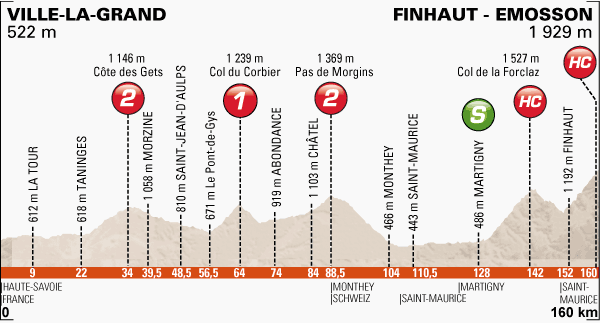
Stage 7: Ville-la-Grand › Finhaut-Emosson (160 km) – There is nowhere to hide on the final climb of the seventh stage, which has sections above 10%.
Stage 7 will pack quite a punch, challenging the riders with the Hors Categorie Col de la Forclaz (12.6 km at an 8.2% average) crested with 18 km to go, and then, after a short descent, another HC-rated climb to finish the day, 10.2 km at an 8% average, with a few extremely steep sections.
Things do not get much easier for Stage 8, which tosses in a pair of Cat. 1s to close out the day, and the Dauphine as a whole. The difficult conclusion ensures that nothing will be decided on GC until the very end of the race.
The overall route does not include any truly grueling ascents, but it is quite hilly, and the many days of ups and downs will certainly wear on the peloton, putting the climbers in the spotlight. Bonus seconds of 10-6-4 at the line will benefit the faster finishers. This year’s race includes far fewer time trial kilometers than recent editions have, which is likely to open things up a bit after recent domination from the chrono-loving Team Sky.
The General Classification Contenders
The startlist is stacked with talent (and it is important to note that it isn’t completely settled as of this writing), but there are two clear favorites for the overall victory. The first is Sky’s Chris Froome. Even with reduced time trial mileage, Froome is likely to excel in this race, as it is a very important part of his and his team’s program. After injury derailed the first few European races of his season, Froome got back on track in a major way at the Tour de Romandie, where he outclimbed almost everyone else and then won the time trial and with it, the General Classification.
Chris Froome looks to be back in top shape after struggling with injury early in 2014.
The importance of this race to Froome’s 2014 campaign is obvious given the talent his team is sending to back his efforts: constant lieutenant Richie Porte, runner-up in last year’s race, will make the start, an elite talent at all levels who makes a viable second should his team leader suffer misfortune. Porte has had a difficult year as well, but on talent alone he has to be considered a secondary contender for the overall. Geraint Thomas is another all-round talent likely to contribute in a big way (also, watch out for him in the opening ITT). David Lopez and Mikel Nieve are two of Sky’s top mountain domestiques. The British squad is fully committed to winning the Dauphine for the fourth straight time as part of a strong statement in the run-up to Froome’s Tour defense, and with the star finally back from his ailments, it’s hard to see past Sky here.
Alberto Contador of Tinkoff-Saxo is the rider most likely to challenge the Sky juggernaut. Contador has put in some of the finest racing of his life in 2014, winning Tirreno-Adriatico and Pais Vasco and coming in 2nd in Catalunya, climbing at an otherworldly level in every mountain stage. He will have several opportunities to attack on this climber-centric parcours. Few will be able to match him if he has maintained the form he showed at the beginning of the year, though he has not raced for two months, making that a bit of a question mark. Further, in the past, Contador has not focused on this race as heavily as Sky has, and that may be the case again this year; the squad Tinkoff-Saxo sends to support him is not nearly as strong as Chris Froome’s. Chief lieutenant Roman Kreuziger, for instance, will be absent, taking on the Tour de Suisse instead. At Contador’s best and most focused, that might not matter (especially with the very steep Stage 7 on the program), but there are enough concerns that Contador is the second of my two favorites rather than the first.
Astana’s Vincenzo Nibali is third favorite with the bookmakers in this race (just as he is in the upcoming Tour de France), but he enters the Dauphine with a number of question marks. Obviously the aggressive winner of the 2013 Giro (and runner-up of the 2013 Vuelta) is a top climber who will love the profile. He also has an excellent supporting cast. However, he has not had the 2014 that he would have hoped for, starting out very slowly and only really showing flashes of his form in the Tour de Romandie, where he still settled for 5th despite being one of the major favorites. If he has managed to build on his form and has reached that top level he is capable of, he will challenge for the victory, but that is not a given. Astana has the excellent all-rounder Jakob Fuglsang to help in the mountains or to act as an alternative if necessary. He has a knack for finding himself Top 10s even when riding for Nibali.
Katusha’s Simon Spilak has had a very impressive 2014. Always a strong climber, the 27-year-old is coming into his own as a featured rider for his team, soaring to new heights on the slopes but also sporting an improved time trial. He will be the guy for Katusha at the Tour de France, making this an important opportunity for him to make a statement. With the form that won him a stage and 2nd overall in Romandie, Spilak (something of a specialist in these one-week races) is primed to challenge for the victory against the very biggest names in the sport. He’ll also have last year’s 3rd place finisher Daniel Moreno on his side. Though Moreno has just finished a grueling Grand Tour, he can’t be counted out either: Katusha needs to find some results after Purito’s rough exit from the Giro.
Tejay van Garderen was having a very strong 2014 (with a 2nd in the Tour of Oman behind Chris Froome and a stage victory and 3rd overall in Catalunya among his results) before abandoning the Tour de Romandie following a crash. He returned to the USA to recover and is now back in Europe prepping for the Tour, where he will be BMC’s sole leader for the first time. The TvG of years past may have been more of a time trial specialist, which would at first glance make this a less favorable Dauphine than he’s used to, but he was climbing at an elite level early in the year, suggesting a refocused approach. If he’s recovered completely from his crash, he should contend here, especially given recent statements that suggest he is taking this race very seriously.
Fellow American Andrew Talansky has had an okay 2014. He landed in the Top 10 in Catalunya and looked good in Romandie until a dropped chain on a tough climb ruined his chances for a strong result. Like van Garderen, Talansky seems to have focused on improving his climbing this year (possibly even at the expense of his top-notch time trial) which will be crucial in this Dauphine. He tends to perform well in short stage races, even against top talent, and he’ll have recent Giro Top 10 finisher Ryder Hesjedal for support.
AG2R sends a powerful 1-2 punch with Jean-Christophe Peraud and Romain Bardet. Peraud was excellent in the spring, landing a string of great results capped off by a Criterium International victory. He cooled off at Romandie but with some time to return to form he should be able to play a role here. Teammate Romain Bardet is a sharp climbing with an aggressive streak. He’s looked good this year and, unlike many of the other contenders, he won’t be coming in cold, as he has just completed the Bayern Rundfahrt. The strong AG2R duo should be able to land at least one rider in the Top 10.
OPQS wunderkind Michal Kwiatkowski returns to racing after some time off. As usual, it’s hard to know what to expect. He is one of the most versatile riders in the sport and he does not have an off-switch, so it seems likely that he’ll be going 100% on every stage, but the mountains will be a challenge. He will be one of the top contenders for the opening ITT, and bonus seconds favor his fast finish, so he will at least be in the conversation. Jan Bakelants is another all-round talent who could decide to make a bid for the overall.
Movistar’s Beñat Intxausti gets a rare opportunity to ride for his own ambitions, as Tour leader Alejandro Valverde is riding the Route de Sud instead. When given these chances, Intxausti does not usually disappoint, and he was one of the strongest on the slopes in the Tour de Romandie. Igor Anton and John Gadret will offer more options on the climbs. NetApp-Endura’s Leopold Konig has struggled with a knee injury in 2014, but he returned to racing at Bayern Rundfahrt and looked strong there. At his best, he’s a top climber who shouldn’t be underestimated. Maintaining a high level of form for so long is a lot to ask of Belkin’s Wilco Kelderman but he has been nothing if not surprising in 2014, and bonus seconds favor his very fast finish. Lampre’s Damiano Cunego also has some Giro mileage in his legs, but like Kelderman, he’ll enjoy the chance to fight for bonus seconds. OGE’s young Adam Yates will hope to continue his excellent year against this top competition. Europcar’s Tommy Voeckler has not produced the sort of results he tends to aim for, but it’s a good route for him. Lotto Belisol’s Jurgen Van Den Broeck finally returns to racing. It’s been a very rough year for the Belgian, who has been bothered by a knee injury, but this is a very important race for him to prove that he belongs in Lotto’s Tour squad. Cofidis’s Daniel Navarro and Rein Taaramae and Trek’s duo of veteran Haimar Zubeldia and up-and-comer Bob Jungels are other outsiders.
The Stagehunters
While the Tour’s biggest GC names are making the Dauphine start in preparation for July’s big race, many of the top sprinters are conspicuously absent. The parcours may have something to do with it, as there aren’t a lot of sprinting opportunities here. Trek’s Giacomo Nizzolo, coming off his strong Giro, and FDJ’s Arnaud Demare, who has racked up quite a collection of wins this year, headline the list. Both excel on similar terrain, so it will be an interesting battle between the two in the flat finishes. OPQS’s Gianni Meersman, BMC’s Thor Hushovd, OGE’s Leigh Howard, and Giant-Shimano’s Reinardt Janse van Rensburg will hope to challenge them.
The list of versatile, quick finisher types who thrive on the hilly profiles is impressive. OGE’s Simon Gerrans and Daryl Impey, FDJ’s Arthur Vichot, Lampre’s Filippo Pozzato, Lotto’s Tony Gallopin, Europcar’s Cyril Gautier, BMC’s Greg Van Avermaet, and OPQS’s Zdenek Stybar could battle with some of the fast-finishing GC riders (Michael Kwiatkowski especially) for the intermediate days, though they’ll have to keep an eye on solo artists like Trek’s Jens Voigt, Astana’s Lieuwe Westra, Belkin’s Lars Boom, IAM’s Sylvain Chavanel, and Garmin’s Ramunas Navardauskas.
VeloHuman Top 10 GC Favorites
Winner: Chris Froome Podium: Alberto Contador, Simon Spilak Other Top Contenders: Vincenzo Nibali, Tejay van Garderen, Andrew Talansky, Beñat Intxausti, Romain Bardet, Richie Porte, Jakob Fuglsang
I won’t be previewing individual stages, but as usual I’ll have plenty of picks and analysis at the still relatively new @VeloHuman on Twitter! Also, be sure to come back soon, as there are plenty of big things coming at VeloHuman: previews of the Tour de Suisse and every stage of the Tour de France, as well as interviews with some fast-rising young pros! Stay tuned.