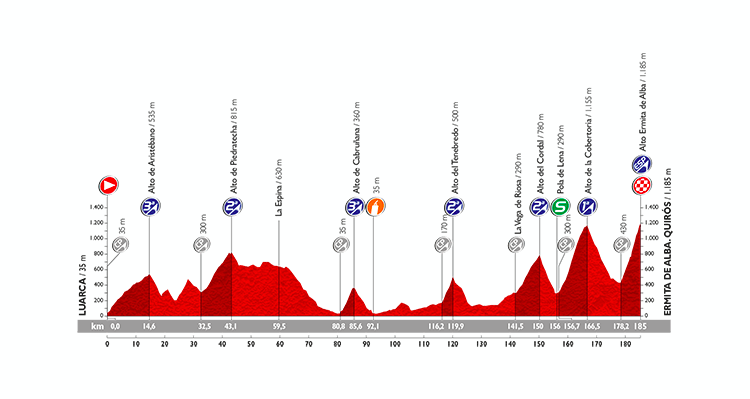
Stage 16: Luarca › Ermita de Alba – 185km
The Vuelta’s 16th stage will be among the hardest in the race. The road is angled sharply upward or downward for the majority of the day, and the finish is brutal.
The stage starts on a climb, the Cat. 3 Alto de Aristébano, which could spring the day’s main breakaway. If not, the agressors will have more opportunities to jump clear on the pair of uncategorized climbs that follow, or the Cat. 2 Alto de Piedratecha that comes next.
A less challenging stretch follows as the road slopes mostly downward from the top of the Piedratecha until about kilometer 80, where a short Cat. 3 awaits. Then comes another short climb, this time a Cat. 2, followed by a descent, a brief flat section, and then a trio of climbs that get progressively harder to close out the stage.
First up is the Cat. 2 Alto del Cordal, 8.5km at 5.7%. It’s more of a leg softener than anything. It’s followed by testy downhill into the vicious Alto de la Cobertoria, 9.8km at an 8.7% average gradient. The climb is harder than the metrics would suggest, as the average gradient is closer to 10% if you take out a less challenging final kilometer. Given the closeness of the GC battle, it would make sense for the red jersey hopefuls to initiate hostilities on this climb, even if there is a special-category ascent still to come. We’ll see if anyone has the guts to try.
One last downhill follows the Cat. 1 summit, and then it’s on to one of the most painful climbs in the race, the Alto Ermita de Alba.
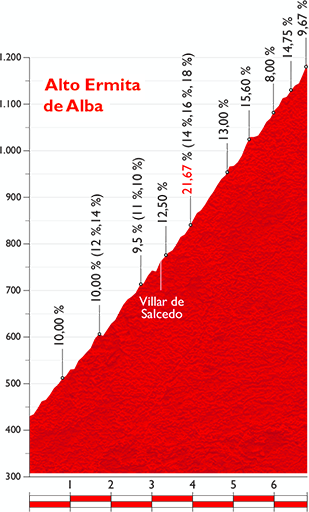
It’s only 6.8km, but the average gradient is 11.1%, with a particularly nasty midsection that kicks up over 21% for a little while. It’s not exactly easy after that, with gradients still hovering in or around the double digits for the rest of the way up.
There are still a few mountain stages to come in the Vuelta, but Stage 16 is the last day with a summit finish, and there’s a long, flat time trial on the horizon, which means that the climbing stars need to put everything they have into this showdown to build up an advantage. In terms of the stage victory itself, this does look like a great profile for the long-range specialists, with climbs from the get-go that will favor the more uphill-oriented riders in the battle to get into the break, and then a wild finale that will be very hard to control. On the other hand, the smart play from any team other than Giant-Alpecin will be to drive a torrid pace over the climbs to weaken those who aren’t as suited to the gradients. I see the peloton vs. breakaway showdown as a 50-50 proposition.
Joaquím Rodríguez has been stronger than Fabio Aru on the past two stages in a row, and Stage 16 will be considerably harder than Stages 14 or 15 were, with some incredibly steep sections that should open up serious gaps between riders at the end of the day. Rodríguez attacked efficiently and effectively on Stage 15 and I wouldn’t be surprised to see him take Stage 16 as well—the last climb suits him perfectly. In any case, I see Aru as the other top favorite out of the GC men.
Rafal Majka is very much in the conversation as well. He couldn’t follow Rodríguez on Stage 15 but smartly rode in Aru’s wheel for a little while before letting the Italian go on ahead, only to pass him again before the line. I’m not sure this climb suits him all that well as it is just so steep, but he’s looking fresh and aggressive at the moment.
Nairo Quintana is certainly looking better than he did earlier in the race and will be an excellent candidate for stage success because of his GC position, far enough behind the leaders that he may get some breathing room if he tries an attack again. With 3 minutes over Quintana, Aru and Rodríguez can afford to let him go on the move. The same could be said for Esteban Chaves, who is likely to lose ground in the coming time trial. Chaves is riding into completely unknown territory right now, contending into the third week of racing at a Grand Tour, but he doesn’t look to be slowing down much.
Should the break contest the win, I’m looking at the same names that have come up in that conversation so far. Rodolfo Torres is my top pick of potential candidates for long-range success, as he combines form and climbing ability with a clear interest in going on the move. He was in an early breakaway on Stage 15 that was ultimately reeled in before the main move got clear, and I expect him to try again on Stage 16. The same goes for Fabio Duarte. This final climb is one for the real specialists, and that makes both Colombians dangerous.
I also expect Sky to try to get someone into the breakaway. Sergio Henao finished within 2 minutes of Purito on Stage 15 despite working for Nieve most of the afternoon. He’s clearly in excellent shape. Ian Boswell, Nicolas Roche, and Vasil Kiryienka could also try to get involved in the break.
On form and ability, Mikel Landa of Astana and Giovanni Visconti of Movistar are obvious candidates to take this stage from a breakaway if they get up the road, but the big question is whether they will be gunning for the move or helping team leaders—Landa has shown a willingness to do his own thing despite team orders, and Visconti rides for a squad whose chances of making a GC impact are dwindling, but it’s hard to predict what they’ll do.
The Europcar quartet of Jérôme Cousin, Romain Sicard, Pierre Rolland, and Cyril Gautier, BMC’s Darwin Atapuma and Alessandro De Marchi, Kenny Elissonde, and Bart De Clercq are other riders to watch out for as potential stage winners from a breakaway move.
VeloHuman Stage 16 Favorites
1. Joaquím Rodríguez | 2. Fabio Aru | 3. Nairo Quintana
Don’t miss the latest Recon Ride podcast episode, and be sure to follow @VeloHuman on Twitter for more Vuelta a España analysis. Stage 16 is followed by a rest day, so the preview of Stage 17 will be up on Tuesday. In the meantime, keep an eye out for a new episode of the Recon Ride.