Tag: Fabian Cancellara

  • World Championships 2014: Road Race Preview

    World Championships 2014: Road Race Preview

    Ponferrada Worlds

    The Ponferrada World Championships will come to a close with the Men’s Elite Road Race. Cycling’s biggest stars have been training and riding in tuneup races for some time now, but the weekend of the main event has arrived. With the rainbow jersey on the line and a parcours that should make for a wide open race, it looks set to be quite a showdown.

    The Route

    The Road Race takes place on an 18.2 kilometer circuit in and around Ponferrada, Spain. The peloton will complete 14 laps of the circuit, making for a total race distance of 254.8 kilometers.

    Ponferrada Road Race Profile

    Each lap involves a pair of climbs and also pair of tricky descents that, especially as the day nears its conclusion, are likely to see plenty of action from the more aggressive riders in the pack. First in the circuit is the Confederación climb, 5.2 kilometers at an average of 3.3%. Despite the low gradient, the ascent starts out with a few stretches that hit 8%. After the riders crest the climb, they will take on a very sharp descent. Then comes the Mirador climb, 1.1 kilometers at 5.5% but with two stretches (at the beginning of the climb and again near the top) of around 10%. Another descent follows, and the road doesn’t flatten out until there are less than 2 kilometers remaining before the finish line. The last few kilometers involve a few twists and turns, including a sharp right hander in the final 1000 meters.

    There is a chance of rain in the forecast. If the conditions are poor, the technical downhills will get a lot more hectic, and what is already going to be a long day in the saddle will get a lot more uncomfortable.

    The Contenders

    A moderately challenging profile will become much more difficult as 14 laps are completed, but this is still a parcours that will appeal to those riders with a powerful kick. The Ponferrada circuit, much like a number of circuit races on the WorldTour calendar that have preceded it, has challenges to guarantee action before the finish while still allowing for a sprint as a likely outcome: the inclines never reach extreme gradients and the last kilometer is quite flat. Still, a lumpy journey of over 250 kilometers will greatly whittle down the pack, and a perfectly timed and determined escape attempt will have a chance at staying clear, and even if this does come down to a sprint, it will be a select group battling it out for the victory. As such, winning the rainbow jersey in 2014 will require decent climbing legs and the toughness to stay sharp after a long day in the saddle, and either the kick to outsprint the (likely somewhat reduced) peloton at the line, the power to get clear of the pack before the finish, or a blend of both, to stay with any late attackers and then outmatch them in a high-speed finale.

    No other rider in attendance combines current form, a well-tailored skillset, and a powerful team quite as well as Simon Gerrans. He proved that he is in top shape by sweeping the Canadian GPs (his second victory, in Montreal, was particularly dominant), and with Milano-Sanremo and Liege-Bastogne-Liege on his career palmares, he is a proven contender in sprint finishes that follow difficult days in the saddle in even the biggest races. The climbs shouldn’t be a problem for the Australian, who also has the power to glue himself to any aggressive wheels should any late attacks look particularly dangerous. Holding out for the sprint has been his strategy in these sorts of races lately, but he is also an accomplished attacker himself. In any scenario, he is a threat, and he leads a very powerful squad. Teammate Michael Matthews is a deadly alternative, even faster in a sprint and also capable of handling a few climbs. Matthews, still just 24, does not have the same resume for the very long days (though he has thrived on the hillier profiles in his career, none of his big wins have come after this much distance) but he has shown remarkable versatility and shouldn’t be counted out given the likelihood of a sprint. With Cadel Evans, Rohan Dennis, Adam Hansen, and Heinrich Haussler also in attendance, the Australian squad is loaded for this World Championship Road Race.

    As a reduced sprint does seem to be the most probable outcome, Peter Sagan is among the top favorites as well; no rider is as fast to the line after a hilly day as the 24-year-old Slovakian. When the Ponferrada Worlds circuit was revealed, Sagan was the first name that came to mind for many observers. However, form is a major question mark for the talented young rider, who has done little to prove himself in shape since his Tour de France. He has expressed his own doubts about his form in the media recently as well. It is that uncertainty that keeps him from being the top favorite. If he manages to marshal his ability by the time this race kicks off, however, or if this is all nothing more than a clever strategy to deflect attention from himself, Sagan will be very difficult to beat. It will be hard for anyone else who sprints as well as Peter Sagan to stick with the pack all the way through the 254.8 hilly kilometers to the line. He’s also a master escape artist, should the opportunity present itself to get away from the bunch. He leads a small team of only three riders, but this profile, which is less friendly to attackers than last year’s, somewhat downplays the importance of squadmates who might help chase down late moves.

    Spain’s Alejandro Valverde will need for this to be a selective race if he wants a chance at taking the rainbow jersey, but several climber-oriented teams are here to help with that ambition. Valverde has a terrific kick and he should be in the mix if this comes down to a reduced sprint. In front of a Spanish crowd and aware that this may be his last chance at the World Championship, he’ll be highly motivated to perform. Daniel Moreno is another fast finisher for the home country, while Joaquim Rodriguez and Luis Leon Sanchez present yet more options to make this an aggressive event.

    Poland’s Michal Kwiatkowski was among the Top 5 in all three of this year’s Ardennes Classics, showing his immense strength in the group finishes that come after long, bumpy days, but he’s also an elite solo artist and strong descender who could try to get away from the lead group in the final few kilometers if still contains a few of the purer sprinter types. An excellent Tour of Britain showed that he’s back on good form after a rough patch in the middle of the year. Strong seasons from a number of Polish riders guaranteed a large team for Poland in this race (which isn’t always the case), and that will boost Kwiatkowski’s chances.

    Among the likeliest late escapees is Fabian Cancellara, who eschewed the Worlds ITT this year to focus solely on this opportunity to take the rainbow jersey. No rider on this startlist can get clear of a charging peloton quite like Spartacus, and a constantly improving finishing kick makes him all the more dangerous should he reach the line in a small group; he showed it when he won the 2014 Ronde in a high-speed four-man showdown. He was even 2nd in a bunch sprint finish in Milano-Sanremo this year, ahead of the likes of Mark Cavendish. After 250 kilometers, many riders will start to lose steam, but Cancellara is not as easily weakened by distance. That puts him among the very strongest favorites here, and while his best chance at winning seems to be an attempt at a late move, he’s a contender in any scenario. His descending abilities make him even more dangerous. Though only consisting of two other riders, his team has firepower: Michael Albasini has the climbing legs to make it over these inclines and a particularly impressive burst of speed at the end of a hilly parcours, making a very strong second.

    Belgium has several cards to play for this circuit, and at least one of the squad’s many options should be in the mix for the podium. Greg Van Avermaet will almost certainly attempt to get clear alone or with a small group as the day nears its close, and with recent showings of good form, he is among the top favorites for victory at Worlds. He has had found it difficult so far in his career to turn near victories into actual wins on the biggest stages, but he has finished in the Top 7 in each his last four starts (with two victories), and should come into this race feeling confident. Former World Champions Philippe Gilbert and Tom Boonen haven’t shown quite the same strength recently as Van Avermaet, but both are specialists in selective one-day races. Sep Vanmarcke, though not as speedy at the line, is another strong rider after a tough day, and Jan Bakelants, Jelle Vanendert, and Tim Wellens are even further options.

    Defending champion Rui Costa has a difficult task ahead of him. As an uphill specialist, Costa is not as well-suited to this parcours, which doesn’t have the gradients he’d prefer. Still, he’s a strong attacker with underrated punch, and he has a knack for being in the mix on a wide variety of profiles.

    Rui Costa put in a strong performance ahead of high-level competition in Montreal, his final WorldTour race in the rainbow jersey.
    Rui Costa put in a strong performance against high-level competition in Montreal, his final WorldTour race in the rainbow jersey.

    A repeat win won’t be easy, but Costa clearly has the form (he was runner-up in the GP Montreal) and plenty of motivation to prove that he has what it takes to continually contend for the rainbow jersey. Expect a strong performance from him.

    France has a few strong options that seem to be flying a bit under the radar at the moment. Tony Gallopin has the skillset to thrive on the Ponferrada circuit: he is a quality sprinter (he charged to 3rd in the bunch finish in Montreal) and a particularly dangerous attacker on the hilly profiles. He took his two biggest career wins (San Sebastián in 2013 and a stage in the Tour de France) by soloing out of a small group and staying clear to the line. His versatility will allow him to be in the mix in several different race scenarios. Sylvain Chavanel is another rider who could feature in several different ways; he won in Plouay last month after escaping from a pack of sprinting hopefuls, and that may be exactly what’s on his mind here. Romain Bardet could also get involved, having shown some surprising ability in one-day races this year (in Liege-Bastogne-Liege and in Montreal). Nacer Bouhanni makes the start as well, hoping for a bigger bunch gallop. This circuit will greatly test his climbing legs, and he does not have much of a resume in races this long, but he showed improved uphill ability in the recent Vuelta, and it has increased his confidence in his ability to be involved in this sort of race. It would be a surprise if he held on all the way to the finish, but he’s among the fastest sprinters in this race, making him a favorite if he can hang on.

    Perhaps a bit more likely to hang on for a potential sprint is Germany’s John Degenkolb, who has landed his biggest results by surviving difficult days to thrive in reduced sprints. His victories in Paris-Tours, the Vattenfall Cyclassics, and Gent-Wevelgem and most of his nine career Vuelta stage wins, as well as his runner-up performance in this year’s Paris-Roubaix, have come that way. His finishing kick has been stronger this year than it has ever been before, though he may have given up just a little bit of his uphill ability getting there; more worrisome for his chances, however, is his recent bout with illness. Degenkolb was recently hospitalized while fighting an infection that he picked up in the Vuelta, and that trip certainly wasn’t a welcome addition to his training schedule. If the form is there, he could contend for the victory, but it’s hard to say how strong he is right now. Andre Greipel makes the start as well, though he’s a long shot to make it to the finish; Simon Geschke, a specialist on the hilly days, may be a better bet to survive. Tony Martin is another elite rider who can’t be counted out when a profile offers opportunities for solo moves.

    Alexander Kristoff will share John Degenkolb’s ambition of surviving the tough day for a sprint finish. He wasn’t much of a factor in Quebec or Montreal recently, but the Ponferrada circuit should be a bit less climber-oriented, and Kristoff also thrives on the very long days in the saddle, and the Worlds parcours always is a long one. He won’t have an easy time of holding out for a bunch finish, but it’s hard to imagine anyone beating him if he’s there. Edvald Boasson Hagen and Lars Petter Nordhaug are both strong alternatives on this profile.

    Tom Dumoulin was a top performer in Canada, 2nd in Quebec and 6th in Montreal. He has carried top-notch form into Ponferrada, and it helped him reach the podium in the ITT championship, where he was not far behind Tony Martin and Bradley Wiggins. Dumoulin would prefer a course more favorable to attackers, but he is an excellent solo artist who will have a better chance than most at pulling off a late strike, and he has an ever-improving finishing sprint to help him outgun a select group should it come to that.

    Tom Dumoulin has had a very strong September, with podium performances in Québec and in the World Championship ITT. His soloing ability makes him a threat in the Road Race.
    Tom Dumoulin has had a very strong September, with podium performances in Quebec and in the World Championship ITT. His soloing ability makes him a threat in the Road Race.

    Teammate Tom-Jelte Slagter is well-suited to this parcours, and will be another strong option. Garmin was riding for Ramunas Navardauskas in Canada, but Slagter was 11th in Quebec and 12th in Montreal, suggesting that the form is there right now. With versatile Bauke Mollema, Wout Poels, Wilco Kelderman, and Pieter Weening all making the start as well, the Dutch squad may not have any one rider among the top few favorites for the race, but there is a lot of firepower here for a strong outside bid at the rainbow stripes.

    The aforementioned Ramunas Navardauskas makes for a quality dark horse contender in this race, with just the right blend of climbing legs, attacking ability, and finishing kick to be dangerous on this profile. Ireland’s Dan Martin leads a small but capable squad, and the winner of last year’s Liege-Bastogne-Liege has both the form (which he proved with his first Grand Tour Top 10 in the Vuelta) and the skillset to make a challenge here. The Italian squad seems to be rallying behind Tour de France winner Vincenzo Nibali, who will hope to make an escape on the late climbs and then hold out on the last descent and final flat stretch; it may seem strange to mention the Italian team this late in the preview, but it’s hard to see their climber-centric squad selection as anything other than odd on this parcours. Daniele Bennati and Sonny Colbrelli could feature in a reduced sprint, while Alessandro De Marchi and Giovanni Visconti will be alternative options for a solo move. Unsurprisingly, Colombia also has a squad that will push for a very selective race, though it’s hard to name any one rider as their best hope; when at their best, Julian Arredondo, Carlos Betancur, and Rigoberto Uran all have the skillsets for this parcours, but none of them came out of the Vuelta on a particularly positive note. Zdenek Stybar of the Czech Republic, Denmark’s Matti Breschel, South Africa’s Daryl Impey, Russia’s Alexandr Kolobnev and Great Britain’s Ben Swift and Geraint Thomas are others on the list of potential protagonists on this parcours.

    VeloHuman Top 10 Favorites

    Winner: Simon Gerrans
    Podium: Peter Sagan, Fabian Cancellara
    Other Top Contenders: Alejandro Valverde, Michal Kwiatkowski, Greg Van Avermaet, Tony Gallopin, John Degenkolb, Alexander Kristoff, Rui Costa

    Be sure to follow @VeloHuman on Twitter for live analysis of the battle for the rainbow jersey! And stay tuned for post-race analysis and, of course, the preview of the season’s final Monument Classic, Il Lombardia.

    -Dane Cash

    Photos by Sean Rowe and Dane Cash.
  • Vuelta a España 2014: Stage 10 Preview

    Vuelta a España 2014: Stage 10 Preview

    Stage 10 Profile

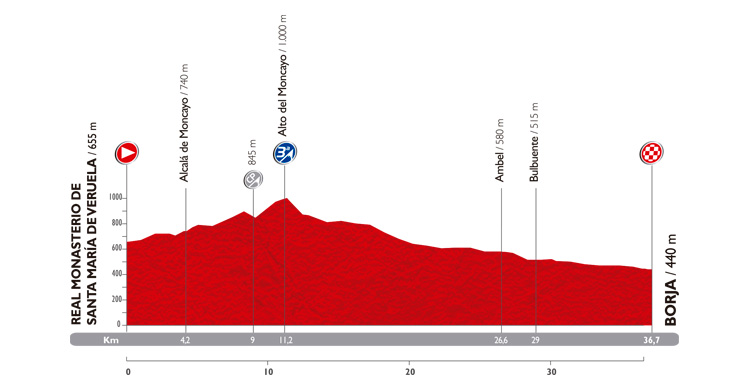
    Stage 10 (ITT): Real Monasterio de Santa María de Veruela › Borja – 36.7 km

    Winner Anacona led the peloton into the Vuelta’s first rest day with a win from the breakaway on Stage 9. Now it’s on to the critical Stage 10, a 36.7 km individual time trial. The parcours should open up some significant time gaps among the top GC contenders. The course starts out with a gentle uphill that leads into a short but steep Cat. 3 climb crested 11.2 kilometers into the stage. Then it’s all downhill to the finish. It’s not a straight-out run to the line, with some twists and turns along the way, but it’s not extremely technical. This is likely to be a very high speed chrono.

    Tony Martin is the big favorite for stage honors. This is route that will favor chrono specialists, and he is the world’s premier time trialist. He’s also a great descender. It’s hard to see anyone outmatching his engine over 36.7 kilometers.

    Behind Martin are several time trialing specialists and GC riders with top-notch chrono ability who should make the battle for Top 3 on the stage a tight one. Fabian Cancellara is obviously a prolific time trialist, and he’ll be one of the few riders with a shot of beating Martin in the World Champs later this month, but form is a bit in question at the moment. He has fallen off the pace even on a few of the flatter stages in this race, and though he’s likely give this time trial far more effort than he has on any stage so far, it may not be enough to match up with the likes of Martin. Cancellara is a strong descender and this is a nice parcours for him, but victory on Stage 10 would be a lot to ask.

    This ITT is central to the GC hopes of Chris Froome, and he is one of the few red jersey hunters who excels even on a flatter chrono profile. His time trial performances in this year’s Tour de Romandie and the Criterium du Dauphine were stellar, and if he can recapture that strength here, with motivation running high, he’s likely to be among the top finishers on the day.

    Alberto Contador is another GC rider with serious time trialing talent, and he’s a great descender to boot. If his time trialing engine is in as good shape as his climbing legs, he should be able to deliver a top-notch performance on Stage 10. Rigoberto Uran has developed into an elite talent against the clock as well, and he looks to be rounding into form in this race after a disappointing first mountain stage.

    Movistar’s Adriano Malori had a hot start to the year, winning a Tirreno-Adriatico time trial ahead of Martin and Cancellara. He hasn’t had as much success in the latter half of the season, but after post-crash injuries robbed him of a chance to take a Grand Tour ITT win in the Giro d’Italia, he’ll be motivated to go for this. Trek’s Kristof Vandewalle beat Malori by 3 seconds to take his first WorldTour win the Tour de Pologne chrono last month, and he’ll be another outsider for stage honors. BMC’s Rohan Dennis put in an underwhelming ride in the Eneco Tour’s time trial stage, but he’ll be eager to show his new team what he’s made of here. Bob Jungels (who is targeting this stage especially), Jesse Sergent, Tobias Ludvigsson, Vasil Kiryienka, Stef Clement, Jonathan Castroviejo, and GC riders Wilco Kelderman and Nairo Quintana (who has improved against the clock this year) are others who could be in the mix on Stage 10.

    VeloHuman Stage Favorites

    1. Tony Martin | 2. Chris Froome | 3. Fabian Cancellara

    Be sure follow @VeloHuman on Twitter for live commentary of this and every stage of the 2014 Vuelta a España! The next preview will be up after the conclusion of Stage 10, so stay tuned.

    -Dane Cash

  • Tour de France 2014: Stage 11 Preview

    Tour de France 2014: Stage 11 Preview

    Stage 11 Profile

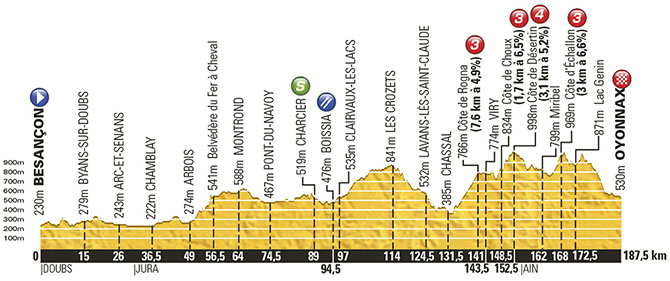
    Stage 11: Besançon › Oyonnax – 187.5 km

    The Tour’s eleventh stage follows its first rest day, a break the peloton desperately needed after Monday’s brutal stage that saw the abandonment of Alberto Contador and a hard-fought uphill battle (won by Vincenzo Nibali) to close out the day. The Stage 11 profile is not a flat one, but its hills pale in comparison to the Vosges climbs that injected pain into hundreds of legs over the weekend. It will be a welcome change for most of the riders in the Tour de France. Still, the climbs will play a role in how Stage 11 plays out; the toughest ascents of the stage come in quick succession as the day reaches its conclusion, with four categorized climbs less than 30 kilometers apart. Following the final Cat. 3, there is an uncategorized bump in the road and then a technical descent to Oyonnax and the finish line.

    The rolling profile makes this another good opportunity for a breakaway to succeed. It’s probably just a bit too challenging for the heavier sprinters, which will reduce the amount of fierpower committed to the chase. The barrage of late hills late and the long descent that follows will make it difficult for anyone to control the race even if they tried. However, this sort of intermediate stage is one of the few (along with the next day’s stage) in the race that isn’t likely to be dominated by a pure sprinter or a climbing star, making for a more open competition: almost every team in the Tour de France will try to take advantage of the opportunity to pick off a win. If a few strong teams miss the break, they’ll commit to reeling things in, and though this profile is lumpy, it’s not so lumpy as to guarantee the break’s success.

    The “favorites” (with the usual caveat that that is a loaded term on breakaway-friendly stages) will be decent climbers with either fast finishes or good soloing skills to try to escape late and maintain a gap on the descent.

    Cannondale’s Peter Sagan is the number one rider to watch on the stage. He shouldn’t struggle with the climbs, he’s a masterful descender, and he’s obviously a fast finisher. Dealing with the day’s breakaway will be his biggest challenge. He may try to get into the break himself, or he may go for this one from the pack, which would mean a lot of time on the front for his team. That versatility is what makes him such a strong contender.

    The same is true for both Simon Gerrans and Michael Albasini of Orica-GreenEdge. In Stage 7’s sprint finish, Gerrans looked to have recovered the strength he lost in his opening stage crash. The Stage 11 profile suits him perfectly, with an opportunity to escape on a late climb, or the possibility of a reduced sprint. Teammate Michael Albasini is another excellent option: the Swiss veteran is an expert at picking the right moves, and he’s got a fast finish, too. Orica-GreenEdge will have a lot of flexibility with this duo: they can try to put one of them into the breakaway and let the other ride it out in the pack, to cover both scenarios. Whether or not the stage goes to the break or to the peloton could hinge on whether Peter Sagan and at least one Orica-GreenEdge rider make it into the move: if not, Cannondale and OGE can be expected to get involved in the chase early.

    Trek’s Fabian Cancellara would be another top choice, but he has abandoned the race to focus on other objectives. Fellow classics protagonist BMC’s Greg Van Avermaet is still here, however, and he could be a contender thanks to his blend of good climbing legs, strong solo prowess, and a fast finish. OPQS has the quality duo of Jan Bakelants and Matteo Trentin to take on the difficult challenge of deciding between breakaway and peloton; both are excellent on hilly days and Trentin in particular is a dangerous option if he is in whatever group is fighting for the win when the day nears its conclusion. FDJ’s Arthur Vichot, Lotto Belisol’s Tony Gallopin, Garmin-Sharp’s Tom-Jelte Slagter, AG2R’s Samuel Dumoulin, Cofidis’s Julien Simon, Movistar’s JJ Rojas, Tinkoff-Saxo’s Daniele Bennati, and Garmin-Sharp’s Ramunas Navardauskas are other top contenders who could win Stage 11 from either the break or the peloton.

    If things do come back together at the end, it could be all about which of the big name sprinters survive the late climbs. Giant-Shimano’s John Degenkolb might be a top favorite were it not for the injury he suffered early on in this race. He’s still a rider to watch; normally, he’d be targeting this stage, which is probably too difficult for Marcel Kittel. Fellow German Andre Greipel can climb better than most people realize. This still might be a bit too much to ask, but if things regroup for a sprint and he does survive the bumpy road, he will obviously be a top favorite. Katusha’s Alexander Kristoff has a chance to hold on over the climbs, though this stage may not be long enough to favor his skillset even if he does. FDJ’s Arnaud Demare can normally handle a hill or two, but as of yet he has not looked recovered from injuries sustained crashing earlier in the Tour. Europcar’s Bryan Coquard, IAM Cycling’s Heinrich Haussler, and Tinkoff-Saxo’s Michael Morkov also have a shot of making it over the late bumps to contest a sprint if it should come to that.

    Other candidates will be more reliant on the breakaway’s chances. In addition to their duo of versatile fast finishers (Bennati and Morkov), Tinkoff-Saxo suddenly has a stable of options for breakaway success now that team leader Alberto Contador is out of the race. They’ll still be hoping to get something out of the Tour de France, and all-rounder talents Mick Rogers, Nicolas Roche, and Rafal Majka will be dangerous stagehunters with breakaway ambitions. Europcar’s Tommy Voeckler could give the early move another go after spending a long (and ultimately unsuccessful) day out front on Stage 10. His teammate Cyril Gautier may be a better option; the younger Gautier has looked sharp so far, while Voeckler has not looked his best. IAM Cycling’s Sylvain Chavanel is always a strong candidate to go for a long-distance win. On this profile and with Degenkolb still questionable, Tom Dumoulin may be the best option for Giant-Shimano; he’s been impressive on all levels of his game in this race; his soloing ability is well-known, but he has also flashed a decent sprint on two separate stages and he is showing off his able climbing legs with his Top 30 position on GC. Movistar’s Giovanni Visconti, Belkin’s Lars Boom and Sep Vanmarcke, OPQS’s Tony Martin, Trek’s Jens Voigt, and Cofidis’s Nicolas Edet are other potential long-range protagonists who could have a shot.

    On the off-chance that the GC contenders try to mix things up on Stage 11, watch out for a fast finisher like Alejandro Valverde, a strong descender like Vincenzo Nibali, or Michal Kwiatkowski, who qualifies as both.

    VeloHuman Stage Favorites

    1. Peter Sagan | 2. Simon Gerrans | 3. Greg Van Avermaet

    Be sure follow @VeloHuman on Twitter for live commentary on this and every stage of the 2014 Tour de France! The next preview will be up after the conclusion of Stage 11, so stay tuned. In case you missed it, the overall Tour de France preview can be found here.

    -Dane Cash

  • Tour de France 2014: Stage 5 Preview

    Tour de France 2014: Stage 5 Preview

    Stage 5 Profile

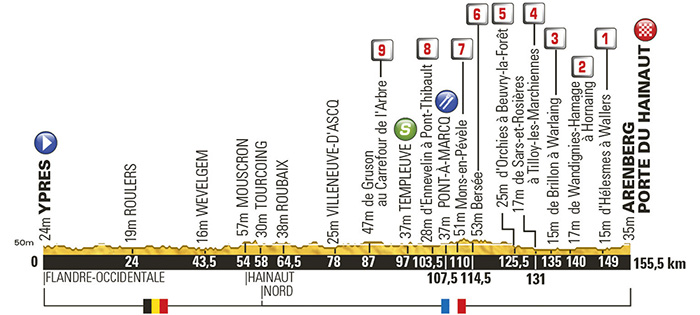
    Stage 5: Ypres › Arenberg Porte du Hainaut – 155.5 km

    Though Marcel Kittel’s unsurprising victory in a bunch sprint might suggest that the Tour’s fourth stage was an uneventful one, Chris Froome, Bauke Mollema, Niki Terpstra, and a number of Lotto Belisol leadout men were among the many riders to hit the deck on the day. Unfortunately for them, there will not be much time to recover from any injuries they may have sustained in their crashes, as one of the Tour’s most anticipated and potentially dangerous days awaits. Stage 5 is unique among the twenty-one stages of the Tour de France in that it features several stretches of cobbled roads. While the profile may be mostly flat, the peloton must overcome nine cobbled sectors, which begin at around the 87 km mark and then appear intermittently most of the way to the finish. Some of them are particularly difficult: Stage 5 includes visits to many of the most famous challenges ridden in the spring’s Paris-Roubaix, including sections of the Carrefour de l’Arbre and the Mons-en-Pévèle. The penultimate cobbled sector, Wandignies-Hamage à Hornaing, is the day’s longest at 3.7 km, and it comes less than 20 km from the finish. On top of the tough parcours, it may rain, which would make things even more hectic.

    On cobbles as difficult as these, punctures and mechanicals could wreak havoc on the peloton, threatening to end the GC hopes of those unfortunate enough to hit trouble. Most of those GC riders are particularly light, and therefore, even more susceptible to being bounced around on the bumpy roads. While they are holding on for dear life, a different group of riders will be locked in to hunt the stage victory. The stars of the spring Classics will have a rare opportunity to shine in a Grand Tour on Stage 5, and on their favored terrain they’re certain to make this an interesting race. A constant flow of attacks and counter-attacks is likely. Excellent bike handling skills and the ability to keep up with repeated accelerations getting into position for each cobbled sector will be crucial, just as they are in the Spring. It is important to note, however, that Stage 5 is nowhere near the length of Paris-Roubaix. At 155.5 kilometers, the bumpy road to the finish line will not wear out the pack in just the same way that more than 250 km of racing would.

    As such, while the powerful, aggressive classics stars will certainly feature prominently on Stage 5, the day is simply not difficult enough for a successful attack by a cobblestone specialist to be the only likely outcome. The cobbles will whittle down the peloton, but it is possible that this ends in a reduced sprint among the more capable quick men. With the outcome so difficult to predict, there is no clear favorite, though there are several riders who should be considered strong contenders.

    Fabian Cancellara is an obvious candidate to make a move on the cobbles. The three-time Paris-Roubaix winner had another excellent spring campaign in 2014 and he has looked good so far in this race. With so many teams focused on getting their GC leader safely to the finish, Cancellara could put in a dig from far out and remain solo all the way to the line; he certainly seems to be the likeliest candidate for an escape victory. What sets him apart here from the many classics-specialists here is his varied toolset; he is much more than a cobbled specialist, with soloing ability almost unrivaled in the peloton and a decent finishing kick as well, should he come to the line with a group. As this stage is not as long or as difficult as the spring classics, that broad toolset could be pivotal.

    BMC’s Greg Van Avermaet is always a likely attacker on difficult roads, and he has the extra-motivation of being well-positioned on GC; a small gap to those around him on the leaderboard could put him into yellow. Belkin’s Sep Vanmarcke is another of the classics specialists who will hope to get away; he has made a name for himself with terrific cobbled performances over the last two years, though victories in the biggest races have eluded him, as he has often found himself just behind Fabian Cancellara at the finish line. This will be a nice opportunity. Teammate Lars Boom will be a powerful ally and potential alternative; he’s strong on the cobbles but also very quick in a finish if he needs to be.

    Niki Terpstra of OPQS, winner of the 2014 Paris-Roubaix, will hopefully be feeling up for some aggressive riding the day after a crash. Jens Keukeleire and Matt Hayman of Orica-GreenEdge make a nice 1-2 for the cobbles, and OGE knows how to get off the front of the pack on a tough day. Lotto Belisol’s Jurgen Roelandts and possibly Tony Gallopin, IAM Cycling’s Sylvain Chavanel, Garmin’s Johan Van Summeren and Sebastian Langeveld, Katusha’s Luca Paolini, and possibly even Sky’s Geraint Thomas are other potential aggressors who know their way around a cobbled parcours.

    I think the long-distance attacker types will be most concerned not with each other, but with the potential for some of the more versatile sprinters to survive to the finish. Peter Sagan is more than capable of handling cobbled roads, and he is the first pick of the fast men who might be able to hold on for a sprint finish. He has finished in the Top 6 of every cobbled classic on the WorldTour calendar already in his young career. His biggest challenge in his spring campaigns has been the particularly long races, and he won’t have to worry about that here. He’s also capable of putting in a solo move of his own. I think he will have an excellent chance to pick up his first 2014 Tour de France victory on Stage 5.

    John Degenkolb, winner of this year’s Gent-Wevelgem and 2nd in Paris-Roubaix, will also have his sights set on this stage victory. If he can get those sorts of results in the more difficult spring races, he should have a great opportunity for more success here. Given the parcours, Giant-Shimano should back his ambitions over Marcel Kittel‘s on Stage 5, and that bodes well for Degenkolb’s chances. He has looked very fast all year, and although he didn’t win any stages in the recent Tour of California, he was inches away from besting Mark Cavendish twice. If he can stay at the front of affairs and if this stage does come down to a sprint, that sort of speed will make Degenkolb a top contender.

    Katusha’s Alexander Kristoff, constantly among the top sprinters in the spring in the past two years, and FDJ’s Arnaud Demare, 2nd at the 2014 edition of Gent-Wevelgem, could also be there at the end. Both showed off excellent speed in the Stage 4 finish behind Marcel Kittel.

    IAM Cycling’s Heinrich Haussler isn’t the rider he once was, but he has put up some decent results in the sprints here so far. Garmin’s versatile Ramunas Navardauskas, Europcar’s Bryan Coquard, and Trek’s Danny van Poppel will try their best to hold on to the end. OPQS’s Michal Kwiatkowski is always a name worth mentioning on a difficult day that could end in a reduced sprint; his team will be doing their best to keep him as close to the front as possible anyway. It’s not completely out of the question that Andre Greipel hangs on to the line, but it seems unlikely, especially if it rains.

    As the battle for stage supremacy rages around them, the lightweight GC riders will be doing their best to stay upright. This is a stage that could end a contender’s yellow jersey hopes in an instant. Whatever happens, Stage 5 should offer plenty of drama. It’s not one to miss.

    VeloHuman Stage Favorites

    1. Peter Sagan | 2. John Degenkolb | 3. Fabian Cancellara

    Be sure follow @VeloHuman on Twitter for live commentary on this and every stage of the 2014 Tour de France! The next preview will be up soon after the conclusion of Stage 5, so stay tuned. In case you missed it, the overall Tour de France preview can be found here.

    -Dane Cash

  • Paris-Roubaix 2014 Post-race Impressions: Terpstra Takes the Final Prize of the Cobbled Classics

    Paris-Roubaix 2014 Post-race Impressions: Terpstra Takes the Final Prize of the Cobbled Classics

    EmptyVelodrome2

    Niki Terpstra‘s beautiful solo move to bring the Netherlands its first Monument in a decade was a thrilling end to a thrilling cobbled classics season. Familiar faces were present throughout the season, ensuring that every race was a showdown between the most talented cobbled riders in the sport, but new blood had its day as well: each of the four biggest races went to a different victor, two of whom (John Degenkolb at Gent-Wevelgem and Terpstra at Paris-Roubaix) had never won a one-day classic on this level before. This P-R post-race will be somewhat different from what I usually produce for recaps: for most of the big riders in the race, Paris-Roubaix was the finale of a season, and now it’s time for a break, providing less cause to analyze this race in terms of what it means for the near future. Next week’s Ardennes Classics will draw a very different crowd. In other words, I’m looking at Paris-Roubaix and looking back on the cobbled classics to draw some final conclusions from those races.

    29-year-old Terpstra has been among the top classics riders in recent years, landing several high placings in the big races, but he has always functioned as more of a top lieutenant on super-team OPQS than as a player himself. He is a great teammate and a workhorse rider. However, when given more chances to make his own moves in the past few seasons, he has delivered, and steadily improved his results. He got an opportunity this week and now owns a Paris-Roubaix title, the grandest accomplishment of them all. Perhaps he was a surprise winner to some, but Terpstra stood on the podium of this race last year and has been hot all year, winning Dwars door Vlaanderen, coming in 2nd at E3, and landing a top 10 in Flanders. In my preview, I noted: “Terpstra is a keen opportunist and an excellent soloist, and as one of a number of options on his team, he could benefit if the pack hesitates to follow.” I’d say he made good on that promise with his brilliant solo move ahead of a star-studded group in Sunday’s final kilometers. He’s only a few weeks shy of 30, but he appears to still be improving as a rider.

    His team as a whole played their cards perfectly, finally delivering a victory. They’ve had the best squad (by a fair margin) in every race they’ve started this cobbled classics season, but at E3, Gent-Wevelgem, and De Ronde, they were only able land several riders in the Top 10s, never actually taking that final step to victory. When Tom Boonen jumped ahead very early on Sunday and stayed out front for tens of kilometers, it looked like a suicide move that was certain to leave him with nothing for the finish. OPQS, it turned out, was playing a clever game. With such firepower up front, the other big names were forced to exhaust themselves chasing, and no one could make a successful move past the breakers. When Boonen’s group was eventually reeled in and then the final select group started to form, Boonen himself may have been running low, but teammates Niki Terpstra and Zdenek Stybar had full tanks of high octane fuel. The former jumped, the group hesitated, and then it was too late for any of the tired riders to bring him back. Stybar and Boonen finished 5th and 10th, respectively; this time, OPQS can truly celebrate the triple top 10 performance, because one of those top 10ers actually won the race. With Stybar and Terpstra both hitting their stride and riders like Guillaume Van Keirsbulck in the wings, OPQS is in good hands for the near future even as Tom Boonen’s career enters its twilight years.

    Fabian Cancellara found himself on yet another Monument podium. He’ll be disappointed he did not win the race, but OPQS played Sunday’s affair just right and Cancellara’s team (lessened by the absence of Stijn Devolder) was not up for the challenge. At the start of the day, I would have said that 3rd overall was a less-than-stellar finish for the big favorite, but in the way the race played out, I felt that a podium finish (which required him to outsprint Zdenek Stybar, Sep Vanmarcke, and Peter Sagan in the velodrome) was actually quite a result given the makeup of the group in the final kilometers. Spartacus has now been on the podium of all three Monuments run so far this year, and he’s been on the podium of every one of the last 12 he’s raced. At 33, he is still showing an unbelievable ability to deliver big results in the biggest races, and he seems to have improved his sprint even as his soloing ability has maybe started to see a slight decline. Fellow pre-race favorite Sep Vanmarcke found himself in a very similar boat; there was very little he could do to get ahead of the pack with Boonen out front all day, and he was a tired, marked man in the finale. He was unable to get the victory he wanted this year, but he was among the best riders in every race he started, showing the kind of consistency that almost guarantees that he will one day be standing on the top of a major podium.

    John Degenkolb won Gent-Wevelgem’s sprint finish, but that race is much friendlier to sprinters than the brutal 260 kilometers of Paris-Roubaix. By making it to the Roubaix velodrome with the star-studded group of chasers just behind victorious Terpstra, he showed an amazing level of endurance that suggests he is capable of hanging on to win even the longest and most grueling of races. After such a long day, he still had enough energy to win the sprint for 2nd on one of the biggest stages in the sport. At only 25, Degenkolb is primed to take on Milano-Sanremo winner and fellow 2014 breakout star Alexander Kristoff in classics sprint finishes for years to come. Kristoff, by the way, had some horrible luck on Sunday, leaving the race in an ambulance after punctures and crashes ended his bid for victory. FDJ’s Arnaud Demare was another hardman-sprinter-with-a-bright-future who hit misfortunate after misfortune in the race. He punctured several times, but still made it in amongst the top 15, coming across the line in 12th place. After a great showing in Gent-Wevelgem, where he just missed out on victory behind John Degenkolb, the 22-year old looks poised for  success in the spring’s biggest events in the coming years.

    Peter Sagan‘s race was a mixed bag. Many did not expect him to make it to the final kilometers with the likes of Cancellara; he did, after riding an aggressive race that saw him bridge the gap to Boonen’s lead group and then hang on with the favorites before Terpstra’s decisive jump. Still, he seemed exhausted as the pack neared the velodrome. He was unable to put up much of a fight in the race for 2nd, rolling across the line 6th. It will be disappointing for him to have come close again, but I think it’s a positive sign: he’s been 2nd in Milano-Sanremo and the Ronde, but he had yet to make an impression on Paris-Roubaix, and he made a statement that this is a race he can contest as well when he hung with the big names on Sunday. Another spring without a Monument for Sagan, but he did add another classics win to his palmares at E3 Harelbeke and further experience in the long, brutal events for which he is so often named the favorite of the future.

    Sky landed a pair of riders among the top 10 finishers in Geraint Thomas and former Tour winner Bradley Wiggins. Many did not give Wiggins a chance in the slightest in this race; his performance, hanging with the biggest names in one-day racing, impressed me a great deal. There is still a lot left in his tank and I’m excited to see him in more races this year. Meanwhile, Geraint Thomas landed yet another good result, his third classics top 10 after a podium place in E3 and an 8th place in Flanders. Thomas made the most spirited attempt to chase Terpstra in the finale, but he did not get much help and was forced to resign himself to finishing with the group. Still, he has displayed an incredible array of talents this season; he has talked about the difficult choice between focusing on stage races vs. one-day events, and I think he could have a bright future in either one. Teammate Edvald Boasson Hagen crashed at an inopportune time in this race but didn’t seem strong on the day anyway—he was a good teammate this classics season, but for someone with such immense talent, his rather anonymous showings have been pretty disappointing. With a well-rounded combination of sprinting, climbing, and time trialing ability rivaled by few others in the sport, I wonder if he might be better off shifting his focus a bit later into the season, hunting points jerseys and circuit races like the Grand Prixes de Quebec and Montreal; Gent-Wevelgem remains really the only big classic race in which he has found success in his career.

    As a last note, Team BMC had a rash of misfortune late in the race. After Thor Hushovd put an admirable turn in at the front of affairs, things eventually started coming back together, and BMC began gathering its strength for Greg Van Avermaet and Taylor Phinney. Unfortunately, Van Avermaet crashed in a nasty corner and Phinney flatted on Le Carrefour. Bad luck is pretty much the name of the game in Paris-Roubaix, but it is a shame that we did not get a chance to see either rider in the finale, as late attacks are their forte.

    As the door closes on the cobbled classics, it opens on my favorite week of the season, with the Amstel Gold Race, La Fleche Wallonne, and Liege-Bastogne-Liege running one after another in the span of just one week. VeloHuman will be previewing all of them, with plenty of analysis on Twitter as well. Follow @VeloHuman for more, and check back here soon for the Amstel Gold Preview!

    -Dane Cash

    Photo by Luca Pedroni.

  • Paris-Roubaix 2014 Preview

    Paris-Roubaix 2014 Preview

    ParisRoubaix2012

    The incomparable Paris-Roubaix runs for the 111th time this Sunday. The legendary race is a celebration of days long past, a relic that offers dangers and challenges unseen elsewhere in most of today’s other major contests. The trip is mostly a flat affair, but the rough cobbles, patches of mud, whirling dust clouds, fanatical spectators, and excessive length provide difficulties that no profile could display. Constant attacks at every juncture force splits and selections and require acute awareness at all times. A moment of lost concentration can also mean going down hard on the unforgiving surface. Experience navigating the difficulties and an extremely high tolerance for the bone-rattling pain of irregular roads are crucial at Paris-Roubaix.

    PRProfile

    51.1 total kilometers of cobbles lie along the 256 kilometer road from Compiegne to Roubaix. Some of those sections are in better shape in others, and each is given a rating (between one and five). The more difficult sections are often the site of attacks, with the race’s three five-star cobbled sections quite likely to force selection. First among them, the wooded Arenberg Trench greets the peloton (or what remains by that point) after 161 kilometers. The 2.4 kilometer stretch is extremely rough, and after what might constitute a whole day’s racing in a stage race, the abuse of riding over uneven stones takes its toll. The Mons-en-Pévèle is the next five-star section, 3 kilometers long with some sharp turns and generally a lot of mud, beginning around kilometer 208. Tom Boonen’s awesome long-distance strike in 2012 was launched just before this section was reached; even if it doesn’t launch the winning attack this year, it will still be sure to jettison a few riders from the pack. A few more easily rated sections follow the muddy stretch before the five-star Le Carrefour de l’Arbre is reached, the legendary 2.1 kilometers of uneven pave that must be overcome only 17 km before the finish line. It’s hard to drop anyone after this point, so if the race isn’t split up by the time the riders reach the Carrefour, expect fireworks from the riders hoping to avoid a sprint in the iconic Roubaix velodrome.

    Contenders for the Cobblestone Trophy

    Trek’s Fabian Cancellara comes into Sunday’s race looking to pick up his fourth cobblestone trophy (which is literally a cobblestone), and he enters the race as a big favorite thanks to both his resume in the classics generally and recent displays of current form. The four-time ITT world champion has one of the biggest engine’s in the sport, making it nearly impossible to drop him. Holding his wheel is an immense struggle on this terrain. But any riders capable of hanging on then must beat him in a sprint, which he has shown quite an aptitude in recently. He won last year’s edition by outsprinting Sep Vanmarcke after the two of them bridged a gap to Zdenek Stybar and Stijn Vandenbergh up the road, watched both of those riders run into spectators, and then continued on by themselves. This year, the sprinting ability that won him last year’s P-R carried him to 2nd place in Milano-Sanremo in March, and it put him atop the podium of his third Tour of Flanders last week when he made it into the winning attack and won a sprint to the line. Defeating Fabian Cancellara will be a very tall order for the other contenders in this race: he has the perfect combination of current form, ability, and experience to win this race. Stijn Devolder is still uncertain for this race after a crash filled Flanders, but if he’s here, he’s a great second.

    Tom Boonen has won Paris-Roubaix even more times than Cancellara; his 2012 victory after more than 50 kilometers riding solo is the stuff of legend. Various maladies kept him from contesting in 2013, but numerous results this year have shown that he has recaptured some form. Still, he has not quite returned to the level of two years past, and injury and personal misfortunes have made 2014 a difficult year; he was unable to hang with Cancellara in the Ronde. Paris-Roubaix is a different race, without the climbs of Flanders, and it may suit Boonen a bit more against the seemingly unstoppable Cancellara. What’s more, while his ability to put up sustained power numbers might be somewhat reduced, he still looks quite handy in a sprint, and he learned years ago that the best tactic against Cancellara is to remain glued on that wheel and hope for a sprint. He will also have plenty of help from star-studded Omega Pharma-Quick Step. Niki Terpstra has been a very active and very successful rider this spring, following up a 2nd place at E3 Harelbeke with a 6th place at the Tour of Flanders. He was 3rd in last year’s Paris-Roubaix, the next rider to cross the line after the Cancellara/Vanmarcke duo. Terpstra is a keen opportunist and an excellent soloist, and as one of a number of options on his team, he could benefit if the pack hesitates to follow. Zdenek Stybar was strong enough to still manage an 8th place despite running into a spectator last year. He hasn’t made as big an impression on this classics season as I initially expected, but he does have plenty of form and the bike handling skills of a cyclocross world champion. He also has a quick finish. 29 year-old teammate Stijn Vandernbergh was the other major spectator casualty of 2013, but he enters this year’s edition again on stellar form, having come in 4th in both the Ronde and E3 Harelbeke. He does not have the fastest sprint but he’s very aggressive and at the very least, he’s almost certain to try something on the tough cobbled sections.

    velodrome5

    The top challenger taking on favorite Cancellara and super-team OPQS is last year’s runner-up Sep Vanmarcke. Just 25, the Belkin rider has already been on the podiums of Gent-Wevelgem, the Tour of Flanders, and obviously Paris-Roubaix, each time showing good cycling acumen for planning the successful attacks and the engine to make them. Unfortunately, on all three of those occassions, his fellow attackers outsprinted him to the finish line. In 2014, he has been in the top 5 of all three WorldTour cobbled races, as well as other big spring contests Kuurne-Bruxelles-Kuurne and Omloop Het Nieuwsblad. His biggest challenge will be creating a real gap between other contenders, as a sprint finish simply will not do for him. I think he is one of the very few riders with a chance at getting ahead of Cancellara, and he will certainly give that venture a shot on Sunday. It’s a big ask, but one thing is for sure: he is an excellent bet to be on at least one of the three steps on the podium. Lars Boom is a very high quality support rider.

    Paris-Roubaix is a truly unique bike race, unlike any other in the grueling tests through which it parts participants. It is also unlike most of the other bike races that Peter Sagan, versatile as he is, has won in his life. Sagan did not ride this race last year. His 2011 attempt landed him 86th. The long, brutal days have challenged Sagan in his young career, and the flat parcours gives him fewer opportunities to gap the bigger riders. Still, counting out Peter Sagan is always a mistake. He already has a pair of fine wins on the WorldTour level, in Tirreno-Adriatico and at E3 Harelbeke, thanks to his good form in 2014. Winning a Monument is his central goal right now, and I think he will give this race 100%. He obviously has the sprint to beat most challengers if he makes it to the finish, and he’s an expert bike handler for the difficult cobbled stretches. Whether he can survive the carnage of attacks is the real question. I don’t think he will match Cancellara in Paris-Roubaix, but I don’t think it’s an impossible ask either.

    Milano-Sanremo winner Alexander Kristoff added to his remarkable track record in recent Monuments last weekend when he came in 5th in the Ronde, rolling across the line by himself after a failed but spirited attempt to bridge to Cancellara’s group. The Katusha rider has a special talent for sprinting after hard days in the saddle, and few are harder than Paris-Roubaix. Furthermore, P-R doesn’t have the climbers of Flanders, which will play into his hands, as he is not an expert climber. 9th in 2013, Kristoff looks even better this year and more likely to hang on during the attacks or even make his own attempts to bridge if necessary. Of the favorites, he has one of the fastest sprints. If he’s there at the finish, it’s hard to see him not winning the cobblestone trophy.  As usual, Luca Paolini makes a great second. Giant-Shimano’s John Degenkolb is the other big name sprinter who might be considered to at least have a shot at being there in the finish. He held on as long as he could in Flanders but was ultimately dropped on the final climbs on the race. It won’t be much easier in Paris-Roubaix, but the Gent-Wevelgem winner is on awesome form and on a good day and with some luck, making the final selection is not out of the question. If he can hold the right wheel to the end of the race, he’s one of the fastest finishers on the start list.

    BMC sends a powerful duo to the race in Taylor Phinney and Flanders runner-up Greg Van Avermaet. Phinney attacked early in 2013 but was unable to hold an advantage. He was twice winner of the U-23 edition of the race. The track star turned time trial specialist has a giant engine and he is handy in a sprint finish. He excels on the long flat days. Last week in Flanders he did an excellent job staying up the road for quite a while to keep the pressure of Greg Van Avermaet; Paris-Roubaix is definitely his style, and BMC will look to set him up for a strike more aimed at overall success here. Said teammate Van Avermaet is an excellent option as well, having ridden to 4th here in 2013. He looks in great shape in 2014, placing highly in a number of races even if he hasn’t managed to come up with the victories he has sought. Fewer hills give him fewer opportunities to show off his quality climbing abilities, but this is a race that rewards aggressive riders, and Van Avermaet fits that bill. In years past, Thor Hushovd challenged for the win here a few times, coming as close as 2nd place in 2010; he’s a bit past those golden years now, but the tough former World Champ deserves a namecheck at least. BMC has the talent to challenge the big favorites in this race.

    Team Sky also sends a good squad, with Edvald Boasson Hagen and Bradley Wiggins the featured riders for the contest. Boasson Hagen has been riding very well lately, mostly in support, and his time trialing skills and top-notch finishing kick could land him in a great position in Paris-Roubaix. Meanwhile, Bradley Wiggins decided that he would ride the cobbles of Paris-Roubaix this year, and though he does not really have a history of success in this race, he looked pretty good at last week’s Ronde van Vlaanderen. He’s not among the favorites, but he has shown an exceptional ability to succeed when he sets his mind to goals most would deem overly ambitious. Moreover, this is a race that can be won by an elite time trialist, and Bradley Wiggins is among the best in recent memory in that discipline. Geraint Thomas is supposedly riding this race in support of his teammates, but if for some reason he finds himself in position to make a move, he’s a very tough rider built for the days like these; his biggest knock is his propensity to crash, and Paris-Roubaix is nothing if not treacherous.

    Back in 2009, Filippo Pozzato managed to finish 2nd to Tom Boonen in Paris-Roubaix. He was also the victor at E3 that year, and 5th in Flanders. Things haven’t really gone the way the Lampre rider would have hoped in recent years, and he is yet to have much success this year, but he did finish with Degenkolb, Sagan, and Stybar in the small group chasing the attackers up the road in Flanders last week. Teammate Sacha Modolo seems unlikely to be there after such a tough day, but he’s one of best sprinters in the race if that somehow happens.

    Longer shots looking to animate the race include Wanty Groupe – Gobert’s Bjorn Leukemans (9th in De Ronde this year, and 4th at P-R in 2007), Garmin’s Sebastian Langeveld (10th in De Ronde this year, and 7th at P-R in 2013) and Johan Vansummeren (involved in a serious crash with a spectator, he had a rough Flanders this year, but he did win Paris-Roubaix in 2011 and has a host of other top 10s to his name), and AG2R’s Sebastien Turgot (a surprise 2nd place here in 2012) and Damien Gaudin. Long shots to somehow hang with the proven hardmen and sprint it out include FDJ’s Arnaud Demare (who looks very fast this season but who has not been able to survive the tough days to make it to the finish), Garmin’s Tyler Farrar, Movistar’s JJ Lobato, IAM’s Heinrich Haussler, and Tinkoff-Saxo’s Daniele Bennati.

    No exhaustive preview can account for every possibility in a crazy race like Paris-Roubaix. A puncture or crash could instantly ruin the hopes of any of the big favorites and open the contest for new contenders. Still, through all the uncertainty, this race has been dominated by a select group of riders in the past several years; as difficult as it is to win Paris-Roubaix, and as large a role as chance can play over miles and miles of cobbles, seven of the last nine editions have seen either Tom Boonen or Fabian Cancellara victorious. Sunday will offer a great showdown between both of these heavyweights, and also between the now old guard they represent and the rising stars of Vanmarcke, Sagan, Kristoff and others.

    VeloHuman Top 10 Favorites

    Winner: Fabian Cancellara
    Podium: Sep Vanmarcke, Tom Boonen
    Other Top Contenders: Alexander Kristoff, Zdenek Stybar, Niki Terpstra, Taylor Phinney, Peter Sagan, Greg Van Avermaet, Edvald Boasson Hagen

    VeloHuman recently joined the Twitterverse! Follow @VeloHuman for more analysis and commentary during the race, and be sure to come back soon for post-race thoughts and previews of Amstel Gold, La Fleche Wallonne, and the fourth monument of the year, Liege-Bastogne-Liege.

    -Dane Cash

    Photos by Olivier Moindroit and Christophe Duhem.