On the heels of a thrilling Stage 20 that turned the Vuelta upside-down comes the final stage, very likely to end in a straightforward sprint.
Less than a hundred kilometers long and without any real climbs, the final stage of the Vuelta won’t be particularly hard. The main challenge will be the urban roads—after about 40km riding through the suburbs, the peloton will ride into a city circuit for 10 5.8km laps, and there are plenty of twists and turns in store.
Given the profile, a sprint is the likeliest scenario. A few of the quick men have stayed on in the race through the mountains for this opportunity, and they’re likely to put their teams on the front to keep things under control.
John Degenkolb has endured a long and challenging Vuelta without a stage win, but he should be the clear top dog among the sprinters left in the race. In terms of top speed, he’s the proven name here. However, Degenkolb has not been nearly as dominant as expected against a diminished field here, and while I still see him as the favorite, others will have their shot.
Danny Van Poppel is probably the strongest potential challenger to Degenkolb. Trek has had a great Vuelta and the team is highly motivated in the battle for stage wins. While Degenkolb has the edge over most riders here on pure speed, Van Poppel actually comes pretty close, and if he can win the battle for position he’s got a shot at a second Vuelta stage win.
Kristian Sbaragli won a messy Stage 10 to show off his sprinting chops and should be in the mix again on Stage 21. It’s likely to be a pretty hectic finale with all the cornering to be done, and that could help Sbaragli take another win over riders who might be faster in a test of pure speed.
José Joaquín Rojas, Max Richeze, Daniele Bennati, Tosh Van Der Sande, Tom Van Asbroeck, and Jean-Pierre Drucker are the outsiders with a shot in the likely sprint finish.
Of course, a late attack by the likes of Adam Hansen or Sylvain Chavanel can’t be ruled out: it’s been a long Vuelta and it’s possible someone could catch the sprinters’ teams off guard on a circuit that is technical enough to make things interesting.
VeloHuman Stage 21 Favorites
1. John Degenkolb | 2. Danny Van Poppel | 3. Kristian Sbaragli
The final stage of the Vuelta marks the 63rd and final Grand Tour stage preview from VeloHuman this season. Hopefully you’ve enjoyed all the action! Be sure to keep an eye out for the next few episodes of the Recon Ride podcast and for pre-race thoughts on the last few events of the season, and follow @VeloHuman for more analysis.
The Vuelta’s 19th stage, much like the Vuelta’s 18th stage, looks like a great day for the breakaway artists. The rouleurs will have this one final chance at a Vuelta stage win before a Stage 20 that will favor the strong climbers and then the sprinters’ Stage 21—that should make for an exciting battle.
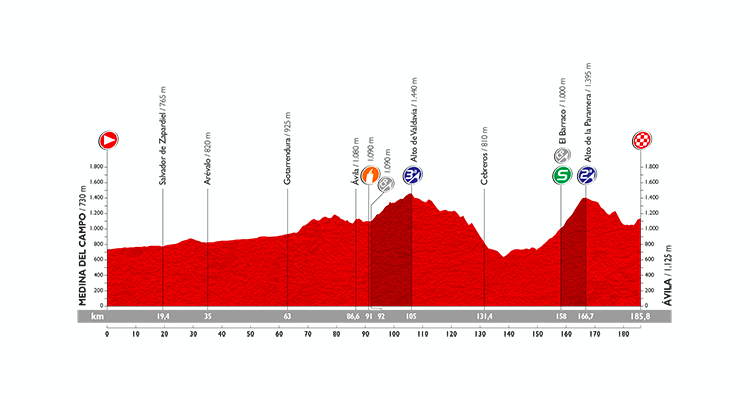
The profile is a lumpy one, but there are only two categorized climbs on the menu. The first 70km are very slightly uphill. The comes a succession of rollers that lead into the first official climb of the day, the Cat. 3 Alto de Valdavia. Then comes a long stretch of mostly downhill roads with a few little climbs along the way, running in to a short flat section from kilometer 140 to kilometer 150. From there, the road angles upward again for several kilometers, with a stretch of uncategorized climbing and then the Cat. 2 Alto de la Paramera, 8.7km at 4.5%. It’s not the hardest climb in the world but the uncategorized run-in will make it significantly more challenging, and the length is likely to rule out most of the sprinters on this stage.
After the KOM summit there are 19 mostly kilometers to the finish. It’s downhill most of the way, before the road angles upward in the last 2.5km, with a stretch of roughly 6% in the beginning before the gradients get a bit lower in the final km.
The long climb that comes relatively close to the finish will probably be too much for the sprinters, but not hard enough to spur all that much GC excitement in the leadup. That makes this an excellent day for the breakaway specialists, which of course means that there are no real favorites for Stage 19, though there are a few candidates for breakaway success whose chances look to be particularly strong.
After two and a half weeks of riding as a loyal Movistar lieutenant, Giovanni Visconti finally showed some interest in getting up the road on Stage 18, but he missed the main move and then found the task of bridging to the group to be too much. With that motivation in mind, he has to be among the top contenders for Stage 19. He can climb with the GC favorites on a good day, and also has a nice sprint, particularly in a hilly finale, making him dangerous here. José Joaquín Rojas made the breakaway on Stage 18, and if he has recovered well enough he’s a candidate from the break too.
Caja Rural’s José Goncalves couldn’t quite bridge to the leaders in the waning moments of Stage 18, but he’ll have another chance here if he’s got some energy left in the tank. This finish suits him perfectly. Pello Bilbao is another strong option for Caja Rural.
Julien Simon tends to fly under the radar, putting in Top 10s here and there but rarely nabbing a big win, but this stage suits him down to the ground. He can survive a climb, and he’s a very fast finisher, especially with a slight gradient at the line.
Alessandro De Marchi and Darwin Atapuma would prefer a more difficult parcours but both are strong in a breakaway scenario. The same is true for Cyril Gautier and Romain Sicard, who are running out of chances to deliver a Vuelta a España win for Europcar after several near misses.
Rubén Plaza and Kristijan Durasek are both excellent options for Lampre. Plaza won a not-dissimilar stage in the Tour this year.
Luis León Sánchez, Adam Hansen, Daryl Impey, Simon Gerrans, and Stephen Cummings are others to watch out for as potential candidates for long-range success on Stage 19.
If this does come down to the pack, a bunch sprint seems unlikely. John Degenkolb is the clear favorite in that scenario, but it’s more probable that the likes of Alejandro Valverde and Daniel Moreno (along with the faster finishers mentioned above who don’t make it into the break) battle it out for the stage from a more select group.
VeloHuman Stage 19 Favorites
1. Giovanni Visconti | 2. José Goncalvez | 3. Julien Simon
There are just four stages left in the 2015 Vuelta a España, and only three of them have climbs to speak of: anyone who isn’t satisfied with their GC position thus far has to put it all on the line in the next few days. That should make for an exciting finale.
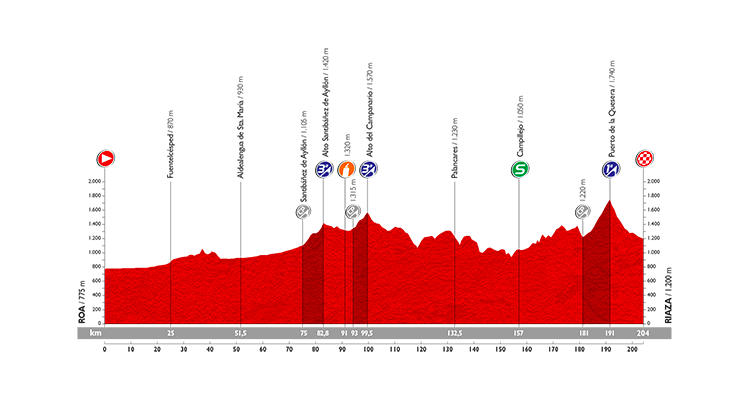
Stage 18 is a lumpy one, and while it may lack a summit finish, don’t underestimate the potential for action. The stage opens with a long false flat, a few rollers, and then a very long false flat (about 30km at a 1% gradient or so) that runs into the first of the stage’s three categorized climbs, the Cat. 3 Alto Santibáñez de Ayllón. After a downhill stretch comes another Cat. 3, and then the next 80 kilometers are a constant succession of short ups and downs that, while uncategorized, will likely inject some fatigue into the legs.
At kilometer 181, the riders will hit the final climb of the day, the cat. 1 Puerto de la Quesera. 10km at 5.2%, it starts out relatively easy before getting a bit more difficult after 4km. From the top, it’s only 13km to the finish, downhill all the way to the line.
In terms of the stage win, this one looks tailormade for the breakaway. The GC favorites put everything on the line on Stage 17 and might be bringing a bit of fatigue into the day, and without a summit finish, there might be bit less pace in the peloton late in the afternoon.
Alessandro De Marchi already has one breakaway stage victory in this Vuelta and a few of the days ahead will offer more opportunities for De Marchi’s aggressive brand of racing. He’s not a sprinter, nor is he an elite climber compared to the jersey hopefuls, but he’s excellent on rolling terrain.
Giovanni Visconti has the multi-fateced skillset to win. And a nice finishing kick to place highly at the line. Movistar politics are the big unknown here. but if he’s in the lead group near the end of the day, he’s a rider to watch.
Europcar has landed riders in break over and over agains in this Vuelta and this stage should continue that trend. Cyril Gautier has a strong track record on small climbs like this and Romain Sicard is having a great run so far.
Lampre-Merida’s Rubén Plaza took a Tour de France stage victory in July bolstered by his ability to put in a good performance on lumpy terrain. Caja Rural’s José Goncalves is well-suited to the parcours, though the team has so many options it’s hard to pick just one. Adam Hansen, Julien Simon, Stephen Cummings, and Niki Terpstra are others could be looking to win the early battle to get into the break.
Alejandro Valverde has to be to the top favorite if the red jersey hopefuls are fighting it out for the stage victory. With a sprint that is so much better than that of his rivals, he’s looking strong again, so the climbs shouldn’t trouble him.
Joaquím Rodriguez is also well-suited to success on the parcours. He needs to make something happen as soon as possible to still hold on to his slim chance at the red jersey. It shouldn’t come as a surprise if he tries something on the final climb.
VeloHuman Stage 18 Favorites
1. Alessandro De Marchi | 2. Giovanni Visconti | 3. José Goncalves
For the powerful engines in the Vuelta peloton who have been struggling in the mountains, the Stage 17 time trial, likely to play a pivotal role in deciding the overall winner of the race, is just what the doctor ordered.
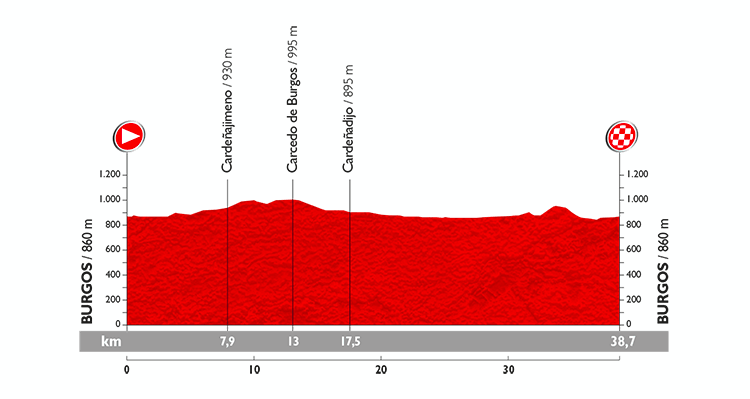
38.7 kilometers in full, it’s a time trial that suits the specialists—though perhaps a bit less than a quick glance at the profile would suggest. The first 10km trends generally uphill, with a few steeper stretches. Then it’s a quick downhill, a short roller, and a descent onto a long section of flat.
Around kilometer 30 there is another bump in the road, followed by a climb of about a kilometer at over 6%. Then comes a descent down into a flattish (slightly uphill finish).
While the parcours is far from a high-mountain time trial, it does have a few ups and downs and some technical stretches. We can expect the time trialing heavyweights to go really well, but I do see a few areas that will give the climbers at least something to be happy about.
Tom Dumoulin, currently 4th overall, is the best time trialist in the race by a significant margin, and he has everything on the line, as he is just 2 minutes away from the race lead. At his best, he would dominate this course, which suits him very well. However, an ITT after two weeks of hard racing and hanging with the GC favorites is uncharted territory for Dumoulin. I still see him as the favorite, and I expect him to do very well, but he might not perform quite to his peak ability after such a tough Vuelta.
Vasil Kiryienka will likely be his biggest challenger for the stage. Kiryienka has been excellent this year, and he has already taken a big Grand Tour time trial victory this season in the Giro. Unlike Dumoulin, he has not needed to go quite as deep in the Vuelta. He’s got strong climbing legs and won’t be troubled by the rollers on the course. In short, I think he will give Dumoulin a run for his money for Stage 17.
Luis León Sánchez was just 12 seconds behind Kiryienka in the that Giro TT. He’s on great form right now and will have a rare chance to do his own thing here. Like the aforementioned pair, he’s also handy on rolling climbs and should go very well on the parcours.
Nelson Oliveira is on great form right now and is strong in the discipline. He could contend for the stage win. Jurgen Van Den Broeck has turned himself into a TT specialist at this point in his career and has put up several nice results recently. Stephen Cummings, Maciej Bodnar, Niki Terpstra, Sylvain Chavanel, and Jerome Coppel are others to watch for on Stage 17.
I think Joaquím Rodríguez will do a bit better than most people seem to expect—despite his reputation for losing big in the ITTs, he’s become a respectable rider against the clock over the past few years. Unfortunately for Purito, I also think we will see Fabio Aru putting up a strong ride. Astana knows how important the time trials are and even though Aru is far from a chrono specialist, he’s got a strong engine and will be fresher than most riders after several tough days in the mountains. In the same vein, I see Rafal Majka doing particularly well on Stage 17. He’s shown ability against the clock even on flatter TTs in the past, and he’s got a great chance at podium in this Vuelta if he can put it all together here.
VeloHuman Stage 17 Favorites
1. Tom Dumoulin | 2. Vasil Kiryienka | 3. Luis León Sánchez
The Vuelta’s 16th stage will be among the hardest in the race. The road is angled sharply upward or downward for the majority of the day, and the finish is brutal.
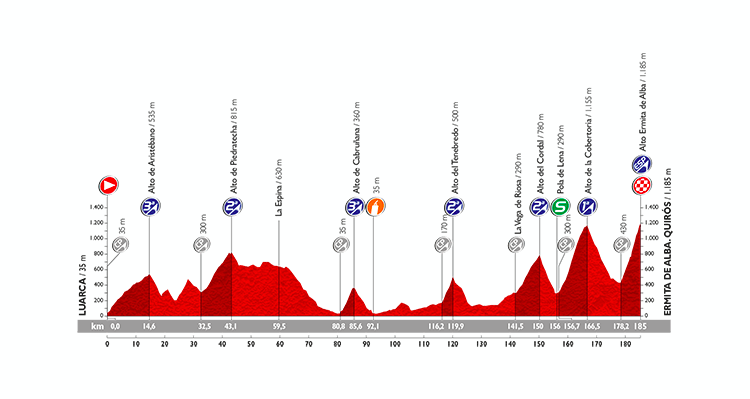
The stage starts on a climb, the Cat. 3 Alto de Aristébano, which could spring the day’s main breakaway. If not, the agressors will have more opportunities to jump clear on the pair of uncategorized climbs that follow, or the Cat. 2 Alto de Piedratecha that comes next.
A less challenging stretch follows as the road slopes mostly downward from the top of the Piedratecha until about kilometer 80, where a short Cat. 3 awaits. Then comes another short climb, this time a Cat. 2, followed by a descent, a brief flat section, and then a trio of climbs that get progressively harder to close out the stage.
First up is the Cat. 2 Alto del Cordal, 8.5km at 5.7%. It’s more of a leg softener than anything. It’s followed by testy downhill into the vicious Alto de la Cobertoria, 9.8km at an 8.7% average gradient. The climb is harder than the metrics would suggest, as the average gradient is closer to 10% if you take out a less challenging final kilometer. Given the closeness of the GC battle, it would make sense for the red jersey hopefuls to initiate hostilities on this climb, even if there is a special-category ascent still to come. We’ll see if anyone has the guts to try.
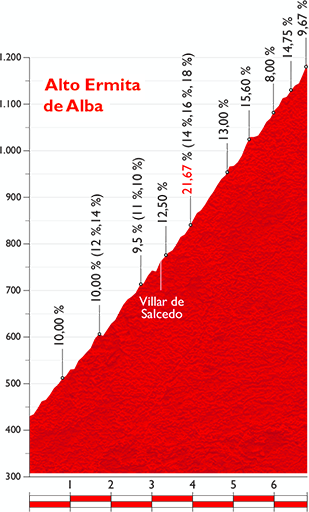
One last downhill follows the Cat. 1 summit, and then it’s on to one of the most painful climbs in the race, the Alto Ermita de Alba.
The gradients on the Alto Ermida de Alba are such that holding the wheel of the next rider in line will offer virtually no benefit—only the climbing specialists will be able to survive this climb.
It’s only 6.8km, but the average gradient is 11.1%, with a particularly nasty midsection that kicks up over 21% for a little while. It’s not exactly easy after that, with gradients still hovering in or around the double digits for the rest of the way up.
There are still a few mountain stages to come in the Vuelta, but Stage 16 is the last day with a summit finish, and there’s a long, flat time trial on the horizon, which means that the climbing stars need to put everything they have into this showdown to build up an advantage. In terms of the stage victory itself, this does look like a great profile for the long-range specialists, with climbs from the get-go that will favor the more uphill-oriented riders in the battle to get into the break, and then a wild finale that will be very hard to control. On the other hand, the smart play from any team other than Giant-Alpecin will be to drive a torrid pace over the climbs to weaken those who aren’t as suited to the gradients. I see the peloton vs. breakaway showdown as a 50-50 proposition.
Joaquím Rodríguez has been stronger than Fabio Aru on the past two stages in a row, and Stage 16 will be considerably harder than Stages 14 or 15 were, with some incredibly steep sections that should open up serious gaps between riders at the end of the day. Rodríguez attacked efficiently and effectively on Stage 15 and I wouldn’t be surprised to see him take Stage 16 as well—the last climb suits him perfectly. In any case, I see Aru as the other top favorite out of the GC men.
Rafal Majka is very much in the conversation as well. He couldn’t follow Rodríguez on Stage 15 but smartly rode in Aru’s wheel for a little while before letting the Italian go on ahead, only to pass him again before the line. I’m not sure this climb suits him all that well as it is just so steep, but he’s looking fresh and aggressive at the moment.
Nairo Quintana is certainly looking better than he did earlier in the race and will be an excellent candidate for stage success because of his GC position, far enough behind the leaders that he may get some breathing room if he tries an attack again. With 3 minutes over Quintana, Aru and Rodríguez can afford to let him go on the move. The same could be said for Esteban Chaves, who is likely to lose ground in the coming time trial. Chaves is riding into completely unknown territory right now, contending into the third week of racing at a Grand Tour, but he doesn’t look to be slowing down much.
Should the break contest the win, I’m looking at the same names that have come up in that conversation so far. Rodolfo Torres is my top pick of potential candidates for long-range success, as he combines form and climbing ability with a clear interest in going on the move. He was in an early breakaway on Stage 15 that was ultimately reeled in before the main move got clear, and I expect him to try again on Stage 16. The same goes for Fabio Duarte. This final climb is one for the real specialists, and that makes both Colombians dangerous.
I also expect Sky to try to get someone into the breakaway. Sergio Henao finished within 2 minutes of Purito on Stage 15 despite working for Nieve most of the afternoon. He’s clearly in excellent shape. Ian Boswell, Nicolas Roche, and Vasil Kiryienka could also try to get involved in the break.
On form and ability, Mikel Landa of Astana and Giovanni Visconti of Movistar are obvious candidates to take this stage from a breakaway if they get up the road, but the big question is whether they will be gunning for the move or helping team leaders—Landa has shown a willingness to do his own thing despite team orders, and Visconti rides for a squad whose chances of making a GC impact are dwindling, but it’s hard to predict what they’ll do.
The Europcar quartet of Jérôme Cousin, Romain Sicard, Pierre Rolland, and Cyril Gautier, BMC’s Darwin Atapuma and Alessandro De Marchi, Kenny Elissonde, and Bart De Clercq are other riders to watch out for as potential stage winners from a breakaway move.
Don’t miss the latest Recon Ride podcast episode, and be sure to follow @VeloHuman on Twitter for more Vuelta a España analysis. Stage 16 is followed by a rest day, so the preview of Stage 17 will be up on Tuesday. In the meantime, keep an eye out for a new episode of the Recon Ride.
The climbing continues in the Vuelta’s 15th stage. The 175.8km journey from Comillas to Sotres resembles Stage 14 in that it opens with a long stretch without many serious challenges before ramping up to a tough finishing climb.
The first 70 kilometers of Stage 15 consist mostly of small rolling hills. An uncategorized ascent then signals the start of the more difficult terrain. It’s followed by an intriguing Alto del Torno climb, a Cat. 2 of 10.1km at an average gradient of 3.2% that will likely be far more challenging than the metric indicate, thanks to its irregular nature. The road ascends in three successive steep sections broken up by a pair of quick downhills, which will make for a constantly changing pace that isn’t going to be particularly comfortable.
From the top it’s a fast descent into a flat section around 20km before an uncategorized bump, and then a final downhill into the finishing climb, the Alto de Sotres.
The double-digit gradients that close out Stage 15 will undoubtedly see gaps open up among the GC contenders.
A Cat. 1 of 12.7km at 7.9%, it’s one of the most difficult climbs in the race, an irregular ascent with a challenging opening third, an easier midsection, and a vicious final 3km that ascend into the double digits, with a stretch of 13% just before the finish line.
The last 70km of Stage 15 will make for an exhausting finale. The very steep final few kilometers will make this stage a critical day for the GC favorites, especially those who fear the time trial to come. In terms of the battle for stage honors, however, I think the breakaway specialists will have an excellent opportunity today. With the most difficult part of the stage at the very end of the final climb, it wouldn’t be particularly surprising to see the GC favorites hold off on major hostilities until the very end of the day.
The breakaway riders will likely open up a big advantage on the flat kilometers at the start of the stage where the GC teams will be less interested in driving the pace, and the rolling, irregular terrain that follows will make for a day that is difficult to control.
As such, I don’t see any one rider as the top favorite, but I see several potential long-range candidates with a great shot at success, and with the top-flight GC names as obvious favorites if everything comes back together.
Several potential breakaway candidates kept missed (or intentionally stayed away from) the Stage 14 break, which should make for a hotly contested fight to make the break on Stage 15.
Team Colombia has put riders in breakaways throughout this Vuelta a España, as expected, but the team has little to show for it so far. It would help if they could get either one of their two best climbers up the road. Rodolfo Torres got off to a slow start in the Vuelta, but he has looked good climbing with the overall GC favorites in the past few mountain stages. A breakaway stage win should be doable. Getting up the road may be his biggest challenge—Torres doesn’t have nearly as much experience making it into breakaway moves at this level as some of his teammates, who have made careers out of going off the front in Grand Tours. Fabio Duarte is certainly one of those riders, and near the end of a quiet season he’s finally starting to show some ability.
BMC will be in a great position to double up after Alessandro De Marchi’s Stage 14 win if Darwin Atapuma can get into the early move. A stage without much in the way of challenging descents should suit Atapuma, who is better at going up than going down.
Europcar’s Romain Sicard is looking very good right now and he has doggedly chased down breakaway attempts so far in the race and could get up the road again here, but now sitting within 4 minutes of the overall lead, he could find it hard to stick in the move. Cyril Gautier, Pierre Rolland, and Jérôme Cousin may be better options for the team.
Sky has several cards to play in the hunt for stage wins in the mountains: Vasil Kiryienka, Sergio Henao, Ian Boswell, and Nicolas Roche are all viable options, and all four will have a chance if they make the break.
Giovanni Visconti and Andrey Amador give Movistar two terrific candidates for breakaway success, but it’s hard to say how interested Movistar will be in the stagehunting game now that they appear to be back in the GC battle.
If Mikel Landa is in the early move, he’s an obvious candidate for long-range success, though it’s hard to say what’s on his mind now that he’s got one Vuelta stage win in the bag. Rubén Plaza, Bart De Clercq, Kenny Elissonde, Bert-Jan Lindeman, David Arroyo, José Goncalves, and Frank Schleck are others who could have success from afar.
Despite losing some ground to a few of his rivals, Fabio Aru looked strong on Stage 14, probably giving up time more as a function of attacking too early than anything else. He will again be among the favorites out of the group of GC contenders. He’s not afraid to go on the attack to build his advantage, either. Still, Nairo Quintana looks much-improved after a rough patch, and will be a formidable opponent on the steep stuff. I’m still not sure that he’s up to beating Aru on these vicious gradients, but it won’t be much of a surprise to see him leave the Italian behind either.
Joaquím Rodríguez should look like the look of the finale, and the slightly shorter final climb of Stage 15 should suit him better than the climb that closed out Stage 14. Purito has not been as aggressive as expected thus far in the Vuelta, but he has to know he is running out of opportunities to make a difference in this race.
Esteban Chaves continues to show his talents, and he could enjoy a longer leash now that he’s over a minute down on GC. Rafal Majka looked good, if not worldbeating, on Stage 14, and he might get some breathing room to launch an attack on Stage 15 as well.