Tag: Giant-Shimano

  • Giant-Shimano’s Lawson Craddock “Learned a Ton” from a Season of Ups and Downs, Targeting More Stage Race Success in 2015

    Giant-Shimano’s Lawson Craddock “Learned a Ton” from a Season of Ups and Downs, Targeting More Stage Race Success in 2015

    Craddock ToC

    After a long season riding at the WorldTour level for the first time in his career, American up-and-coming stage racing star Lawson Craddock is finally enjoying an extended period of time at home in Texas. The all-rounder made a strong debut in the top division this year with Giant-Shimano, highlighted by a 3rd overall (and a second straight Young Riders Classification win) in the Tour of California in May. Craddock also rode in his first WorldTour-level race in June at the Tour de Suisse and then took on his first Grand Tour at the Vuelta in August. Having spent a few weeks at home after the conclusion of his race calendar, he will soon head to Australia to make his first career start in January’s Tour Down Under. VeloHuman caught up with Craddock by phone to hear his thoughts on 2014 and what lies ahead.

    Craddock’s goal for this season, his inaugural WorldTour year, was first and foremost to learn, and now looking back on his first twelve months at the top division, he seems satisfied with his WorldTour education so far: “I learned a ton this season. And it’s more than just what you learn on the bike. You learn a lot about yourself off the bike, about what you can handle and what you can’t handle,” he said. “Overall, it’s been a good year, I’ve had some ups and had some downs, and it was a great learning experience. It sucks being away from family and my girlfriend for so long but it was a great experience. I really enjoyed the year with Giant-Shimano.”

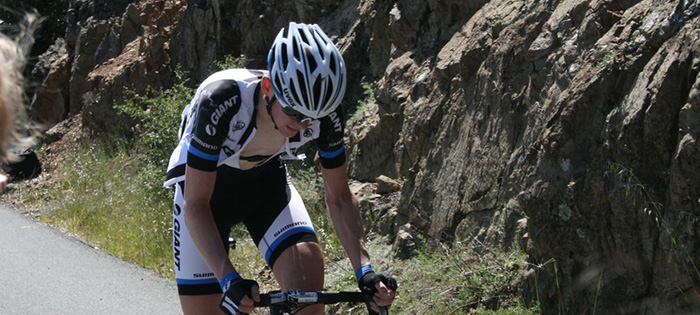
    One “up” among those ups and downs stands out well above the rest: Craddock’s excellent performance in the Tour of California. For Craddock, a spot on the podium and a successful defense of the Best Young Rider title were the welcome return on a serious investment of training. “I came into [the Tour of California] and I’d worked really hard. I went up to Ruidoso with Jasper Stuyven, a former teammate of mine, and really worked hard for three weeks straight and it showed. I was really happy with that and I think it gives me a lot to build on for the future,” he said.

    His success largely came on the back of a strong climbing performance on Mount Diablo in the race’s third stage. Known for his time trialing prowess early in his career, Craddock made it a major focus to improve as a climber, and has worked hard to transform himself into a more complete rider, capable of getting into the mix when the road goes up: in 2013, he took 7th in the USA Pro Challenge and 8th in the Tour of California, and in 2014 he made the step onto the podium in California. A strong, vocal support group has helped him to continually improve. “I’m just riding a lot more. You look back on my junior days and time trialing is my specialty but you look at where the most success comes from on the road and that’s the stage races. I kind of took a step back, I toned down a bit of the intensity and added a whole lot more hours and tried to drop a few pounds,” Craddock explained. “If you’re good at time trialing, chances are you’re good at climbing as well. You know, it took me a while to figure out how to do it the best way, but I had a really good support group behind me: Axel Merckx calling me a fatty pretty much every weekend, guys like Jim Miller really helping me take that next step in my career and change me from a time trialist into more of an all-round GC rider.”

    With the increased versatility, Craddock is hoping to reach a point where he can contend in the big stage races and ultimately the Grand Tours, though he is patient when it comes to expectations about his own development. “I take it step by step at a time; first you’ve got to finish a Grand Tour. I started the Vuelta this year and it didn’t go quite as well as I wanted it to. But you know, you’ve got to take certain steps in your career to progress. We’ll see. Maybe focus on the races like California, the Tour de Suisse and whatnot, and get successful at those before turning attention to something like a Grand Tour,” he said.

    Craddock’s run at the Vuelta, his first career Grand Tour start, ended earlier than he’d hoped, when he pulled out of the race during the 14th stage after a tiring two weeks spent largely on the front, putting in work for team leaders Warren Barguil and John Degenkolb. Craddock knew it was going to be a huge challenge entering the grueling Grand Tour, but that did not make it much easier. “Normally you ride the front for two or three days and then that’s about it. But when you’re doing a Grand Tour you’re on the front for thirteen days into a race and it’s just a whole new ballgame out there. But it was a great experience. And it definitely, although it did not end the year on a bright note, it gave me a lot of motivation to come back next year and improve myself, do what I know I’m capable of doing,” he said.

    Registering a DNF on Stage 14 after battling fatigue for so many long hours of constant work in the peloton was indeed one of the most difficult moments in his career, though the memory seems like it will only help drive him to continue to develop as a rider. “The sport is as tough, or I’d say even tougher mentally than it is physically. You put so much into a goal, and coming into this year my biggest goal was always to be at the Vuelta and finish the damn thing but you know, when you train as hard as you can and really stay focused and then see that things aren’t going as planned, and you’re getting dropped an hour and a half into a stage and you’re just not sure what’s going on, it’s definitely a tough pill to swallow. Especially climbing into the car was a really difficult thing for me to do, since that’s just not my mindset, I’m not a quitter,” Craddock said. “Hands down it was one of the hardest things I had to go through this year. But like I said, it just gives me all that much more motivation to come back next year.”

    With WorldTour and Grand Tour starts and a podium in a major pro stage race now under his belt, Craddock feels confident for 2015 and has noticed a difference in his form. “You do some WorldTour races like the Suisse and two weeks of the Vuelta and it definitely does change your body. What used to be an annoying pace to ride at, the high endurance, it’s now a comfortable pace for you to ride at. And I think, when you’re starting out with that as your base, you can definitely tell that there’s huge difference, you definitely see that you’ve taken a big step up,” he noted.

    Being surrounded by fellow young American talents should be a boon for Craddock as he continues to build that base: Giant-Shimano (Giant-Alpecin in 2015) signed Caleb Fairly and Carter Jones this offseason, bringing the team’s total of American riders aged 27 or younger to four. When asked what has drawn so many young American riders to the squad, Craddock first emphasized a very important detail about a few of his teammates: “First of all, I think Texan talent more than just American talent, because me, Chad [Haga], and Caleb are all Texans. So I think that’s something to be excited about, all three Texans on the WorldTour on the same team!” He then explained that his squad’s focus on and track record with rider development is very appealing. “I think you look at the team, you look at guys like Warren [Barguil] and Tom [Dumoulin], they came in as really strong Under-23 riders and the team has helped progress them into really strong GC riders and so you see that and I think that’s why it has such a high appeal towards the younger guys. You look at the team and you see the success that they’ve had with progressing riders. They’re not just putting riders off the deep-end and giving them too much to handle, they’re doing what they think is best and they’re thinking three, five, ten years down the road for us,” he said.

    Craddock has been in Texas enjoying time with family and friends and the easy access to Chinese and Mexican food while also putting in work with training partners Chad Haga, Carter Jones, Caleb Fairly, Nate Brown, and Gavin Mannion (Craddock noted that they call themselves the “Camp of Champs”), but the 22-year-old will head to Australia soon. Giant-Alpecin is bringing several of its biggest talents, but they know it will be a challenge battling the Australian riders at home. Craddock’s focus will be on putting in the work to position Marcel Kittel for the sprints and team GC leaders Tom Dumoulin and Simon Geschke for the overall. “You know, it’s Down Under, it’s going to be tough to beat the Australians, they’re always ripping on their home turf and especially in January, so it’s definitely going to be hard to beat them, but I think we’re coming with a really strong squad and obviously we’ve got Kittel for the sprints and we’ve got Tom and Geschke for the GC. We’re going to do everything that we can to put them in the best possible situation to get a result. I think it will be a lot of fun. The way things have been going I think we’ll have a lot of success . . . It’s definitely giving me a lot of motivation to train hard this last month and go out on those rainy days. But I’m excited to go. I’ve never been to Australia before. As long as I can go and do everything to help those guys out then I’ll walk away a happy man,” Craddock said.

    After the Tour Down Under, Craddock has his sights set on a few major targets for 2015, with an overall goal of gaining experience in the stage races, with some specific one-weekers in mind already. “I’d love to give the Vuelta another crack, but I think before that I’ll go straight back to Europe after Australia. I won’t do as many of those Belgian spring races as I did this year, kind of focus more on the weeklong stage races. Catalunya and Pais Vasco are in the schedule and obviously California is a really big goal for me. And I think because of this year and how things have been going already, it’s shaping up to be a good 2015,” he said.

    In terms of expectations and objectives, Craddock makes it clear that he still has a lot to learn, but he’s motivated and aiming high in the races that he thinks suit him best. Asked if what he’s learned and the numbers he’s seeing in his offseason training give him confidence that he can contend in more stage races in 2015, Craddock said, “I hope so. Maybe not so much in the bigger races but in the smaller races where I’ll have a chance to succeed. But I’m still really young and I’m still trying to learn as much as I can, racing the big weeklong races like Catalunya and Pais Vasco. I didn’t do those this year so I am not really sure what to expect. . . . We’ll just see and I’ll just take it as it comes.”

    -Dane Cash

    Photo by Naoto Sato.
  • VeloHuman Up-and-comer Q&A Series: Giant-Shimano’s Chad Haga

    VeloHuman Up-and-comer Q&A Series: Giant-Shimano’s Chad Haga

    Chad Haga climbing Mount Diablo at the 2014 Amgen Tour of California | Photo: Naoto Sato

    The WorldTour may be taking a break before the July’s Tour de France, but the VeloHuman Up-and-comer Q&A Series is here to hold you over until the racing picks back up again. In this third installment, VH talks to Giant-Shimano’s Chad Haga, on a brief summer break from competition. Chad joined the Dutch squad after a breakout 2013 in which he took 10th in the Tour of California, 2nd in the Volta ao Alentejo, and a stage at the Tour of Elk Grove. The 25-year-old American is something of a rarity in the peloton: he holds a bachelor’s degree (in mechanical engineering), having graduating from Texas A&M before kicking off his pro career. We talked about adapting to racing on the WorldTour and Giant-Shimano’s world-beating sprint train, among many other things.

    VH: Where are you spending summer break?

    CH: I’m staying in Lucca, Italy [Chad’s home base in Europe].

    VH: How are you settling in? You live with [Garmin-Sharp’s] Ben King, is that right?

    CH: Yep. Settling into Lucca specifically has gone pretty easily. It’s a laid back little town and the apartment is really well located inside the wall. Neither of us has a car and we get along just fine. The Italian lifestyle is great and the roads are terrific. That’s part of why I’m spending my break here. I haven’t spent a lot of time to experiencing the city or exploring, so I’m looking forward to doing that over the next few weeks.

    VH: How do you plan on spending your time off from racing?

    CH: Specifically, I’m not sure yet. I would like to make a trip over to Siena to see their famous horse races in July, Il Palio. I visited Siena last fall and learned about these races and thought that it would be really awesome to go, and now I’ve got the opportunity to do that. But besides that I don’t have any really detailed plans for how I’ll spend my break. So far I’ve just been doing a lot of relaxing and reading and playing the piano.

    VH: You were 10th overall in the 2013 Tour of California so obviously you’ve done big races in the past, and you’ve done well in them. But in March you started in your first WorldTour event, the Volta a Catalunya. You said in your blog that it was much harder than the prior year’s Tour of California. Can you describe what it is that makes racing at the WorldTour level so much more difficult?

    CH: At the WorldTour level, generally every race is longer. I added up all the race kilometers that I had last year compared to this year and divided by the number of race days and on average, every race is 30 kilometers longer, so you’re talking about close to an hour longer every single race, and on top of that it’s a higher level of racing. At the WorldTour races, there’s no Continental teams. Every single WorldTour team is there. It’s just a very high level of racing, it’s very demanding and that takes adjustment.

    VH: At Catalunya you were part of a squad that launched Luka Mezgec to three wins, and then in the Dauphiné you and the rest of Giant-Shimano drilled it on the front in the closing kilometers of the third stage to set up Nikias Arndt for victory. Have you been working a lot on the leadout in your training with the team?

    CH: That’s been a big area of development for me, learning how to do it and the skills and the technique and the mental training required to pull off something like that for a rider like me, who’s not so comfortable with it in the first place.

    VH: Obviously Giant-Shimano is doing something right with the leadouts because you’ve become this sprint powerhouse of the WorldTour. You’re winning stages in Catalunya and the Dauphiné with Mezgec and Arndt, and of course you have huge names like Marcel Kittel and John Degenkolb. Are you able to identify anything that Giant-Shimano is doing differently that is setting up all these guys for so many wins?

    CH: It seems to me that we do a very good job, when things go right and when things go wrong, either way, we always break down the stage in detail and analyze everything we did: what we did right and what we need to change. We just do a very good job of analyzing everything so that we can be even better in the future, and it seems to carry over from race to race and so we continue to get better at it.

    Photo: Giant-Shimano

    VH: What is the skillset that you feel you’ve improved the most since joining the team?

    CH: I guess it would have to be positioning. I still have a lot of work to do with that but I feel that I’ve gotten much better at staying with my teammates when it’s important, and the fight for position in leadouts and into the base of climbs.

    VH: You’re into music; do you listen to anything in particular when you’re on the trainer?

    CH: If I’m warming up for a time trial, it’s very specific music. For the past two years, the only thing I really listen to when I’m warming up for a time trial is a band called Periphery.

    VH: That’s a rock band right?

    CH: Yeah. They’re like . . . tech metal.

    VH: Was there a reason that that became your routine before the time trial?

    CH: I just love their music in the first place, it always gets me pumped up. I think the first time trial I listened to them, I won. It hasn’t always worked out that way since then but it’s my go-to warm up music.

    VH: You’re living in Italy and you’re riding for a Dutch team; are you picking up any languages? What’s the predominant language spoken on the team?

    CH: Well everybody speaks English, which is very good, I can communicate and bond with my teammates. But aside from that, there’s half a dozen other languages spoken on the team around the dinner table, so it’s a lot of different dialects and languages bouncing around.

    VH: Speaking of communicating and bonding, are there any veteran riders on the team that you’ve been able to form a relationship with and learn from so far?

    CH: Roy Curvers and [John] Degenkolb. I’ve done a lot of races with them and we get along well, and both of them have a lot of experience and can do a lot of teaching. I really enjoy racing with them and learning from them.

    VH: Where do you see yourself fitting in as a rider over the next few years? Obviously you have the all-rounder skillset, and you’re excellent in the time trial. What sort of races do you see yourself targeting?

    CH: I . . . (Chad laughs) have not thought that far ahead. I hope to be able to really compete for the GC in weeklong stage races, at the Tour of California level, 2.HC, and hopefully at the WorldTour level. In the meantime I really enjoy the opportunity to go on the attack and get into breakaways.

    VH: After your summer break is over, what is next on the program for 2014?

    CH: Race-wise, I don’t know yet, that’s still up in the air being decided. I go to a three-week altitude training camp in France during mid-July so that’s the most immediate thing on my calendar.

    VH: Do you have any particular goals for the rest of 2014?

    CH: I would really love to win something before the year ends, but I don’t have a target race in mind. I take every race as it comes and look for opportunities. I would love to get selected to race the Vuelta. I know that’s a possibility, so I have high hopes for that, and I’d love to return to the World Championships and race the team time trial.

    VH: Has Giant-Shimano given you an indication of what their expectations or goals are for you in your first year?

    CH: They don’t expect me to get a result in a specific race; there is no real target race in that sense. They just want me to work as hard as I can and learn as much as I can, and use this as a building year in the hope of having a breakout year next year. It helps a lot. There is pressure, of course, to do my job and work as hard as I can, but to not really have any weight on my shoulders makes for a really smooth transition to this level.

    VH: You have a mechanical engineering degree, so obviously you’re comfortable with math. Do you tend to pay a lot of attention to your power data while you’re riding, or do you try to ride according to how you feel and leave the analysis for after the race?

    CH: I have to cover up my data during the race because I will obsess over it to the detriment of my racing. I definitely analyze it very in-depth after the race, and then our team also has our own data guru for further analysis, but I save that for after the race, because otherwise I would never look up from my power meter!

    VH: I’m sure it was a big decision at first, but do you feel you’ve made the right call foregoing an engineering career for now?

    CH: Yeah, at least for now, I’m really glad I did. I’ve got the degree to fall back on, so I’m glad that I finished it, but I think this was the perfect opportunity to really go for it, so I have no regrets.

    VH: Was there a particular race, maybe during your very successful 2013, at which you felt “Hey, I have a future in this”?

    CH: I think that when I first realized that I might be on the cusp of a breakout year was in Portugal last year, at the start of the season. One of our first races, we did the Volta ao Alentejo. I never won anything which was really frustrating, but I was on the podium for multiple stages and on the GC, and was having a great ride. It was after that race where I was first contacted by a Pro Tour team, and I realized that this could actually happen.

    VH: What has been the biggest surprise in your first year?

    CH: Hm. Just that the racing is so much harder! I knew it was going to be harder, everybody told me it would be harder but you still don’t realize it until you get into the races and then you realize, “Hey wait a minute, this is freakin’ hard!”

    While some of his teammates are hunting stages in July’s Tour, Chad will be doing plenty of riding of his own, also in France. After that, there are a number of possibilities for his next race. Chad showed in this year’s Tour of California the toughness required to spend a long day out front in a very high level race, a good sign that the victory he is hunting may not be far off.

    -Dane Cash