As one Grand Tour ends, the run-up to another begins. The Critérium du Dauphiné (I’m hereafter dropping the accents for various Internet-friendly reasons) is one of the most important stage races of the year. It is one of two major tuneup events for July’s Tour de France (the other being the Tour de Suisse). The balanced route of the Dauphine, which includes a time trial, flat stages, hilly stages, and some difficult mountains, offers excellent preparation for the Tour. Many of the likely stars of La Grande Boucle make the start to face off against their major rivals. Bradley Wiggins won in 2012 and Chris Froome was winner in 2013; both went on to win the Tour. With such an elite field and over sixty years of history, the Dauphine is a major event in its own right.
A quick note before I dive in: I’m not previewing individual stages, but I’ll be tweeting stage picks and live analysis, so remember to follow @VeloHuman on Twitter.
The Route
The 2014 edition of the Criterium du Dauphine wastes no time in kicking off the GC competition, beginning with a 10.4 kilometer individual time trial. It’s a short test but it includes a Category 4 climb (800 meters at 5.5%). It’s also somewhat technical, its route meandering through winding roads along the banks of the Saône. The distance won’t open up any massive gaps, but it will establish a small early advantage for some GC riders.
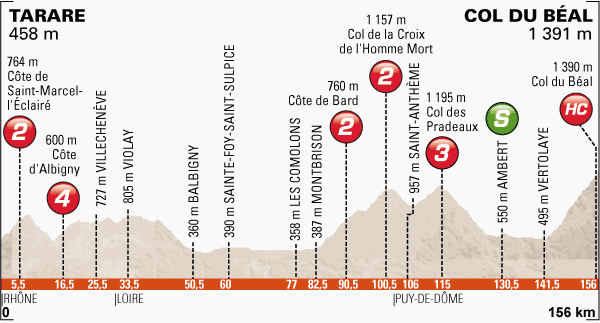
Stage 2 guarantees that none of those riders who got out to an early lead on Day 1 can rest on their laurels: the 156 kilometer journey sets out from Tarare and crests five categorized climbs before one final ascent to the finish atop the Hors Categorie Col du Beal. 13.6 km at 6.6%, it’s not the hardest climb in the world but it’s certain to weed out pretenders before the race even enters its third day.
Stages 3 has some bumps, but with a long flat run in to the finish, it is unlikely to shake up the General Classification. Stage 4 rides on many of the same roads as Stage 16 of last year’s Tour de France (won from the break by Rui Costa). There is a challenging climb crested a little over 10km from the finish that might see GC attacks go clear.
Stage 5 is another hilly affair with a pair of Category 2 ascents in the final 50 km. Stage 6 is mostly flat, but it gets bumpy towards the end of the day, with a vicious little climb in the final few kilometers that could prove challenging for the sprinters.
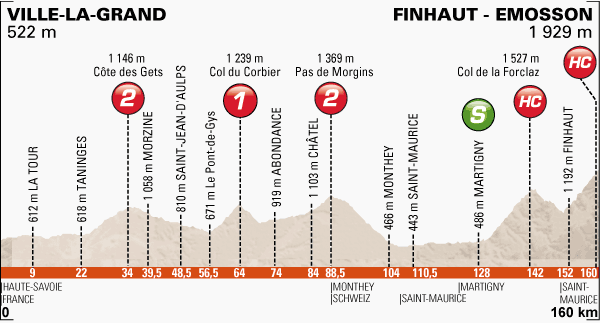
Stage 7 will pack quite a punch, challenging the riders with the Hors Categorie Col de la Forclaz (12.6 km at an 8.2% average) crested with 18 km to go, and then, after a short descent, another HC-rated climb to finish the day, 10.2 km at an 8% average, with a few extremely steep sections.
Things do not get much easier for Stage 8, which tosses in a pair of Cat. 1s to close out the day, and the Dauphine as a whole. The difficult conclusion ensures that nothing will be decided on GC until the very end of the race.
The overall route does not include any truly grueling ascents, but it is quite hilly, and the many days of ups and downs will certainly wear on the peloton, putting the climbers in the spotlight. Bonus seconds of 10-6-4 at the line will benefit the faster finishers. This year’s race includes far fewer time trial kilometers than recent editions have, which is likely to open things up a bit after recent domination from the chrono-loving Team Sky.
The General Classification Contenders
The startlist is stacked with talent (and it is important to note that it isn’t completely settled as of this writing), but there are two clear favorites for the overall victory. The first is Sky’s Chris Froome. Even with reduced time trial mileage, Froome is likely to excel in this race, as it is a very important part of his and his team’s program. After injury derailed the first few European races of his season, Froome got back on track in a major way at the Tour de Romandie, where he outclimbed almost everyone else and then won the time trial and with it, the General Classification.

The importance of this race to Froome’s 2014 campaign is obvious given the talent his team is sending to back his efforts: constant lieutenant Richie Porte, runner-up in last year’s race, will make the start, an elite talent at all levels who makes a viable second should his team leader suffer misfortune. Porte has had a difficult year as well, but on talent alone he has to be considered a secondary contender for the overall. Geraint Thomas is another all-round talent likely to contribute in a big way (also, watch out for him in the opening ITT). David Lopez and Mikel Nieve are two of Sky’s top mountain domestiques. The British squad is fully committed to winning the Dauphine for the fourth straight time as part of a strong statement in the run-up to Froome’s Tour defense, and with the star finally back from his ailments, it’s hard to see past Sky here.
Alberto Contador of Tinkoff-Saxo is the rider most likely to challenge the Sky juggernaut. Contador has put in some of the finest racing of his life in 2014, winning Tirreno-Adriatico and Pais Vasco and coming in 2nd in Catalunya, climbing at an otherworldly level in every mountain stage. He will have several opportunities to attack on this climber-centric parcours. Few will be able to match him if he has maintained the form he showed at the beginning of the year, though he has not raced for two months, making that a bit of a question mark. Further, in the past, Contador has not focused on this race as heavily as Sky has, and that may be the case again this year; the squad Tinkoff-Saxo sends to support him is not nearly as strong as Chris Froome’s. Chief lieutenant Roman Kreuziger, for instance, will be absent, taking on the Tour de Suisse instead. At Contador’s best and most focused, that might not matter (especially with the very steep Stage 7 on the program), but there are enough concerns that Contador is the second of my two favorites rather than the first.
Astana’s Vincenzo Nibali is third favorite with the bookmakers in this race (just as he is in the upcoming Tour de France), but he enters the Dauphine with a number of question marks. Obviously the aggressive winner of the 2013 Giro (and runner-up of the 2013 Vuelta) is a top climber who will love the profile. He also has an excellent supporting cast. However, he has not had the 2014 that he would have hoped for, starting out very slowly and only really showing flashes of his form in the Tour de Romandie, where he still settled for 5th despite being one of the major favorites. If he has managed to build on his form and has reached that top level he is capable of, he will challenge for the victory, but that is not a given. Astana has the excellent all-rounder Jakob Fuglsang to help in the mountains or to act as an alternative if necessary. He has a knack for finding himself Top 10s even when riding for Nibali.
Katusha’s Simon Spilak has had a very impressive 2014. Always a strong climber, the 27-year-old is coming into his own as a featured rider for his team, soaring to new heights on the slopes but also sporting an improved time trial. He will be the guy for Katusha at the Tour de France, making this an important opportunity for him to make a statement. With the form that won him a stage and 2nd overall in Romandie, Spilak (something of a specialist in these one-week races) is primed to challenge for the victory against the very biggest names in the sport. He’ll also have last year’s 3rd place finisher Daniel Moreno on his side. Though Moreno has just finished a grueling Grand Tour, he can’t be counted out either: Katusha needs to find some results after Purito’s rough exit from the Giro.
Tejay van Garderen was having a very strong 2014 (with a 2nd in the Tour of Oman behind Chris Froome and a stage victory and 3rd overall in Catalunya among his results) before abandoning the Tour de Romandie following a crash. He returned to the USA to recover and is now back in Europe prepping for the Tour, where he will be BMC’s sole leader for the first time. The TvG of years past may have been more of a time trial specialist, which would at first glance make this a less favorable Dauphine than he’s used to, but he was climbing at an elite level early in the year, suggesting a refocused approach. If he’s recovered completely from his crash, he should contend here, especially given recent statements that suggest he is taking this race very seriously.
Fellow American Andrew Talansky has had an okay 2014. He landed in the Top 10 in Catalunya and looked good in Romandie until a dropped chain on a tough climb ruined his chances for a strong result. Like van Garderen, Talansky seems to have focused on improving his climbing this year (possibly even at the expense of his top-notch time trial) which will be crucial in this Dauphine. He tends to perform well in short stage races, even against top talent, and he’ll have recent Giro Top 10 finisher Ryder Hesjedal for support.
AG2R sends a powerful 1-2 punch with Jean-Christophe Peraud and Romain Bardet. Peraud was excellent in the spring, landing a string of great results capped off by a Criterium International victory. He cooled off at Romandie but with some time to return to form he should be able to play a role here. Teammate Romain Bardet is a sharp climbing with an aggressive streak. He’s looked good this year and, unlike many of the other contenders, he won’t be coming in cold, as he has just completed the Bayern Rundfahrt. The strong AG2R duo should be able to land at least one rider in the Top 10.
OPQS wunderkind Michal Kwiatkowski returns to racing after some time off. As usual, it’s hard to know what to expect. He is one of the most versatile riders in the sport and he does not have an off-switch, so it seems likely that he’ll be going 100% on every stage, but the mountains will be a challenge. He will be one of the top contenders for the opening ITT, and bonus seconds favor his fast finish, so he will at least be in the conversation. Jan Bakelants is another all-round talent who could decide to make a bid for the overall.
Movistar’s Beñat Intxausti gets a rare opportunity to ride for his own ambitions, as Tour leader Alejandro Valverde is riding the Route de Sud instead. When given these chances, Intxausti does not usually disappoint, and he was one of the strongest on the slopes in the Tour de Romandie. Igor Anton and John Gadret will offer more options on the climbs. NetApp-Endura’s Leopold Konig has struggled with a knee injury in 2014, but he returned to racing at Bayern Rundfahrt and looked strong there. At his best, he’s a top climber who shouldn’t be underestimated. Maintaining a high level of form for so long is a lot to ask of Belkin’s Wilco Kelderman but he has been nothing if not surprising in 2014, and bonus seconds favor his very fast finish. Lampre’s Damiano Cunego also has some Giro mileage in his legs, but like Kelderman, he’ll enjoy the chance to fight for bonus seconds. OGE’s young Adam Yates will hope to continue his excellent year against this top competition. Europcar’s Tommy Voeckler has not produced the sort of results he tends to aim for, but it’s a good route for him. Lotto Belisol’s Jurgen Van Den Broeck finally returns to racing. It’s been a very rough year for the Belgian, who has been bothered by a knee injury, but this is a very important race for him to prove that he belongs in Lotto’s Tour squad. Cofidis’s Daniel Navarro and Rein Taaramae and Trek’s duo of veteran Haimar Zubeldia and up-and-comer Bob Jungels are other outsiders.
The Stagehunters
While the Tour’s biggest GC names are making the Dauphine start in preparation for July’s big race, many of the top sprinters are conspicuously absent. The parcours may have something to do with it, as there aren’t a lot of sprinting opportunities here. Trek’s Giacomo Nizzolo, coming off his strong Giro, and FDJ’s Arnaud Demare, who has racked up quite a collection of wins this year, headline the list. Both excel on similar terrain, so it will be an interesting battle between the two in the flat finishes. OPQS’s Gianni Meersman, BMC’s Thor Hushovd, OGE’s Leigh Howard, and Giant-Shimano’s Reinardt Janse van Rensburg will hope to challenge them.
The list of versatile, quick finisher types who thrive on the hilly profiles is impressive. OGE’s Simon Gerrans and Daryl Impey, FDJ’s Arthur Vichot, Lampre’s Filippo Pozzato, Lotto’s Tony Gallopin, Europcar’s Cyril Gautier, BMC’s Greg Van Avermaet, and OPQS’s Zdenek Stybar could battle with some of the fast-finishing GC riders (Michael Kwiatkowski especially) for the intermediate days, though they’ll have to keep an eye on solo artists like Trek’s Jens Voigt, Astana’s Lieuwe Westra, Belkin’s Lars Boom, IAM’s Sylvain Chavanel, and Garmin’s Ramunas Navardauskas.
VeloHuman Top 10 GC Favorites
Winner: Chris Froome
Podium: Alberto Contador, Simon Spilak
Other Top Contenders: Vincenzo Nibali, Tejay van Garderen, Andrew Talansky, Beñat Intxausti, Romain Bardet, Richie Porte, Jakob Fuglsang
I won’t be previewing individual stages, but as usual I’ll have plenty of picks and analysis at the still relatively new @VeloHuman on Twitter! Also, be sure to come back soon, as there are plenty of big things coming at VeloHuman: previews of the Tour de Suisse and every stage of the Tour de France, as well as interviews with some fast-rising young pros! Stay tuned.
-Dane Cash
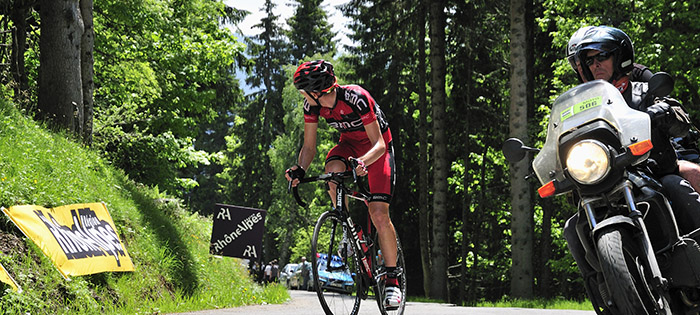
Photos by Georges Menager.