Heavy favorites Orica-GreenEdge probably didn’t need much help on Day 1, but they got it anyway, starting early enough to avoid some pouring rain. Their time withstood spirited efforts from Team BMC and Omega Pharma-Quick Step, putting Svein Tuft into the pink jersey for Stage 2. Movistar turned in a disappointing performance in the wet weather that left Nairo Quintana almost a minute back on rivals Rigoberto Uran and Cadel Evans. Uran and Evans have even bigger gap (about a minute and a half) on Joaquim Rodriguez, whose Katusha squad had a rough day. But by far the biggest story of Stage 1 was the nasty crash that took down Garmin-Sharp’s Daniel Martin and three other riders. Martin lost control on what appeared to be a rainslicked manhole cover, and went down very hard, breaking his collarbone and ultimately abandoning the race. After a heartbreaking crash ended his hope of winning Liege-Bastogne-Liege, Martin’s fortunes in 2014 have turned even worse. The would-be GC contender (and member of the VH pre-race Top 10) saw the biggest goal of his season slip away in the blink of an eye. Teammate Ryder Hesjedal was not one of those who crashed, but the squad had already dropped one of their members earlier in the course, and as team time trials are judged according to the performance of the fifth best rider, Hesjedal and the others who survived the incident were forced to stop and wait for Fabian Wegmann to catch back up and bring their number to five before they could continue. Rolling across the line in last place and almost three and a half minutes down, Hesjedal’s GC hopes are already dashed as well.
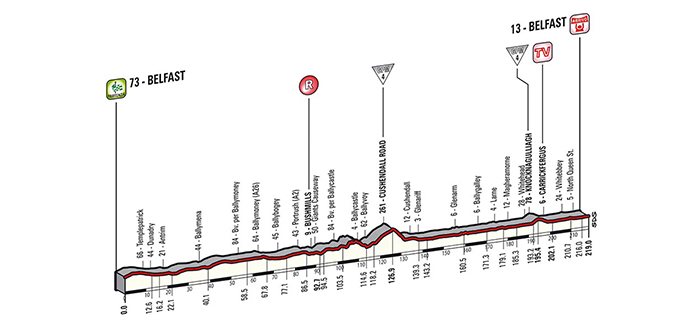
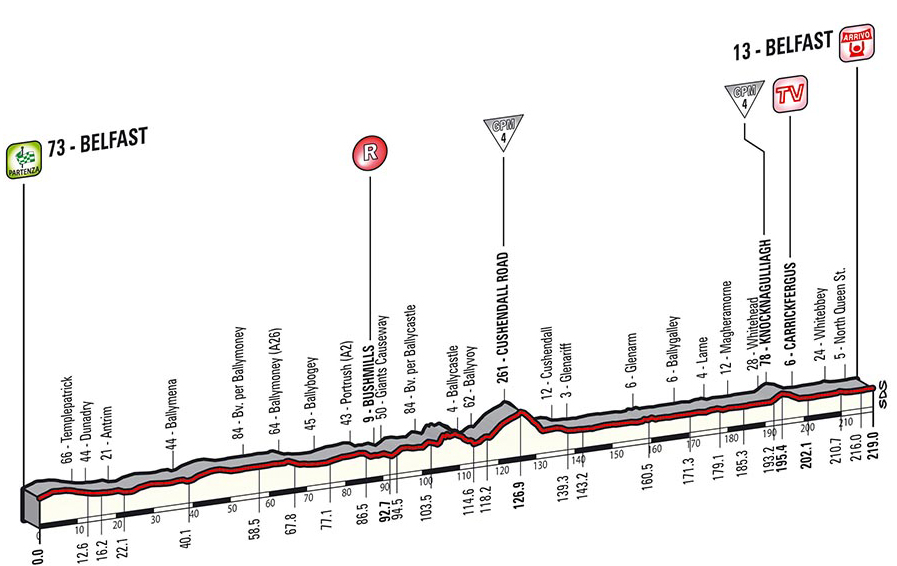
After an eventful opening chrono, road racing begins in earnest Saturday morning. Stage 2 also begins and ends in Belfast. It’s a 219 kilometer loop with only a pair of Category 4 climbs to challenge the peloton. The profile won’t provide many opportunities for riders to get away, and this early in the race, GC teams will look to marshal breakaways quickly. However, the first sprint stage of a Grand Tour is always a hectic affair, and the jockeying for position will be aggressive. Furthermore, it could rain, and winds will be high on the coastal roads. Today’s conditions proved perilous, and not just for Garmin; no one else got into any serious incidents but a number of other teams had riders slipping and sliding around the corners. With a high intensity sprint stage on tap for tomorrow, things could get hairy. It will no doubt be a nervous journey from start to finish.
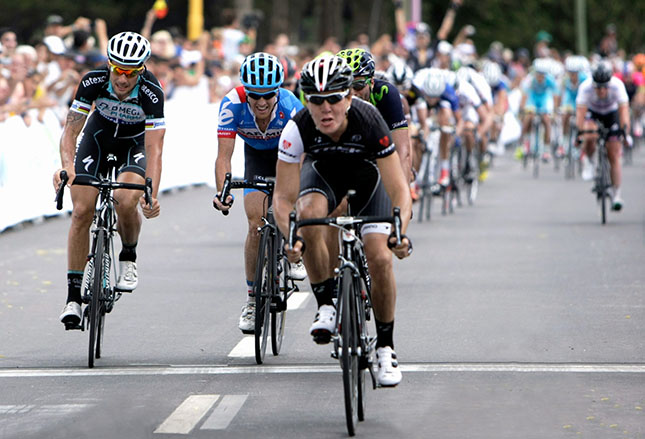
Should everyone manage to stay upright, this stage is very likely to end in a bunch sprint. Without many obstacles to slow him down, Marcel Kittel is the heavy favorite. Kittel was the best sprinter at last year’s Tour de France; in this Giro, without either of the sport’s other two top fast men, the gap to the next best sprinter is significant. He also benefits from a team completely committed to his cause—and GSH knows how to set their sprinters up for victory. In the event that Kittel does somehow get dropped before the final kilometers, Luka Mezgec is an attractive second option, on nice form this year.
The two men with the best chance to take on the GSH juggernaut will be Cannondale’s Elia Viviani and FDJ’s Nacer Bouhanni. Viviani is coming off a Tour of Turkey in which he beat Mark Cavendish in two stages, so it will be interesting to see him matched up against another of the top finishers in the game. Bouhanni has already collected several wins this season, but most of them have come against lower level fields. We’ll see how he does against Grand Tour competition.
Michael Matthews will hope to be the next pink jersey wearer for Orica-GreenEdge. Prognosticators often focus on his versatility, but don’t forget that he really does have the top end speed to be in the mix on a sprint stage. The also versatile Ben Swift of Team Sky looks very sharp this year. On the other hand, it’s always a possibility that Sky will go with Edvald Boasson Hagen, also speedy. Trek’s Giacomo Nizzolo seems to be back on form after his collarbone injury, and he has a nice team around him as well. Alessandro Petacchi rides for an OPQS outfit that knows how to handle the crosswinds. Should the conditions shake up the state of affairs on the stage, Petacchi could be a dangerous contender, and coming off a strong TTT, there is a slight chance that he could find himself in the pink jersey if he is among those benefitting from bonus seconds on the day. Garmin-Sharp will be shifting their focus to stage wins now that Martin and Hesjedal are out of contention for the pink: Tyler Farrar looks much improved this season.
Unless the rough conditions cause some sort of major shakeup, it’s hard to see anyone beating Kittel on the day, and really hard to see anyone other than the above names pulling off that surprise, but for further outsiders, look to AG2R’s Davide Appollonio, Neri Sottoli’s Francesco Chicchi, and Tinkoff-Saxo’s Manuel Belletti.
Welcome to the first of 21 stage previews for the 2014 Giro! In case you missed the overall race preview, you can find it here. As a quick note: I’ll be previewing every day of racing, all the way to Trieste, so you can check back every day for stage profiles and picks. There will also be plenty of live analysis on Twitter, so be sure to follow the new @VeloHuman for more.
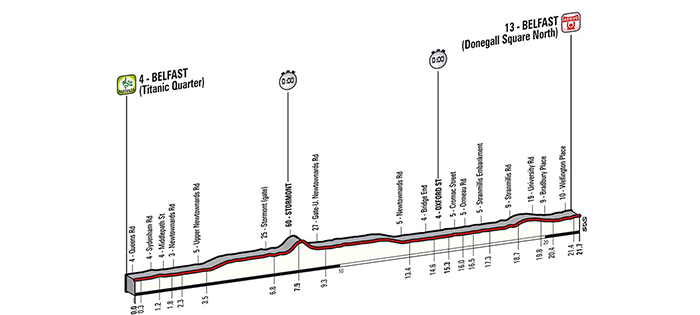
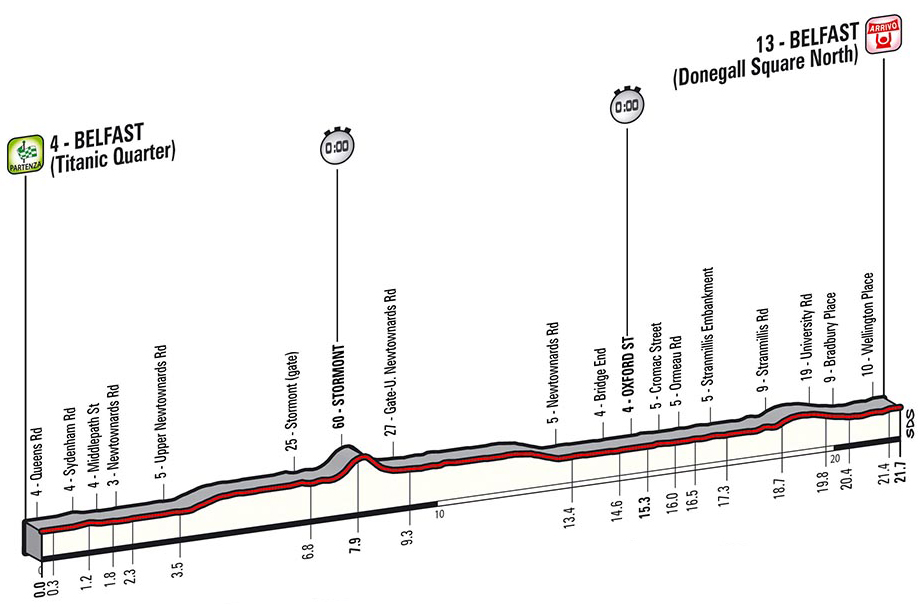
The Giro d’Italia gets underway with Friday’s 21.7 kilometer team time trial. The stage begins and ends in Belfast. The profile is not particularly challenging, with a minor bump at the first time check as essentially the only topographic feature. There are a few twists and turns, but it should be a relatively straightforward affair. I don’t think the time gaps will be huge but some of the smaller, more climbing-oriented teams will have to fight to limit their losses.
As is becoming more and more frequent in these types of races, Orica-GreenEdge looks to be the strongest squad for the day. The Aussie squad takes a pretty focused approach to these contests, and it tends to pay off (it did at last year’s Tour de France). The likes of Luke Durbridge, Michael Hepburn, Brett Lancaster, Cameron Meyer, and Svein Tuft won’t let this one get away easily. The goal may be to put Italian rider Ivan Santaromita into the pink jersey on day one, and it’s hard to see anyone keeping OGE from achieving that goal.
Also bringing a squad of chrono specialists, BMC may have the best shot at surprising GreenEdge, though I think it’s an outside shot. Movistar, led by Jonathan Castroviejo and Adriano Malori, would be the third pick. I’d be very surprised to see any other team winning the day. Cadel Evans and Nairo Quintana stand to gain an early advantage over their rivals on GC.
Time trials rarely allow for victors to come from left field, so I am going to eschew picking an unexpected to squad to pull away with the surprise win because I just don’t think it’s going to happen. I do, however, think that Belkin will outperform expectations; Wilco Kelderman is a strong TTist and his support staff is mostly made up of riders who are also good against the clock. Sky, despite being in the rare position of not having a major GC candidate for this Grand Tour, should turn in a strong performance as well. Meanwhile, I suspect that OPQS will perform at a level significantly lower than we normally see from the team in this discipline, as they are missing most of their big engines: sans Tony Martin, Niki Terpstra, and Michal Kwiatkowski, the Belgian squad won’t be as strong against the clock as they usually are.
Early season tuneup races have done their part to offer insight into riders’ form in 2014, but the main event of spring stage racing is now here. The 97th Giro d’Italia begins in Belfast Friday with a team time trial. After two more days on the island, the Giro heads to Italy. Continuing recent trends, a difficult, climber-centric parcours has drawn a climber-heavy field to the race.
Vincenzo Nibali won last year’s edition with a dominant display of ability, finishing with nearly five minutes between himself and the next best placed rider, Rigoberto Uran. Cadel Evans took the final podium place of 2013. To earn their results, all of the riders braved extreme weather that forced a stage cancellation. Ryder Hesjedal (winner in 2012) and Bradley Wiggins both dropped out of the race before it reached its final destination. Difficult conditions are commonplace here, a feature of the race that, like the Italian Alps, must be overcome on the way to victory. Nibali will not be on the startlist this year, but many of the other protagonists of the 96th edition will be returning, as will the Martelltal-climbing stage that was unfortunately cancelled last year. Before I dive further into to the route, a note: VeloHuman will be previewing every stage of the 2014 Giro, so be sure to check back often for daily profiles and picks. The Stage 1 Preview is already up! Also, follow @VeloHuman on Twitter for more analysis during the race!
The Route
The Giro d’Italia includes an introductory team time trial, two individual time trials (one essentially a hill climb), eight flat or flattish stages, five medium mountains stages (almost all ending uphill), and five high mountain stages, each with summit finishes. The parcours favors the more climbing-oriented GC contenders over those who sacrifice uphill ability for chrono-power. Bonus seconds of 10-6-4 at the finish and 3-2-1 at intermediate sprints will benefit the explosive riders and fast finishers.
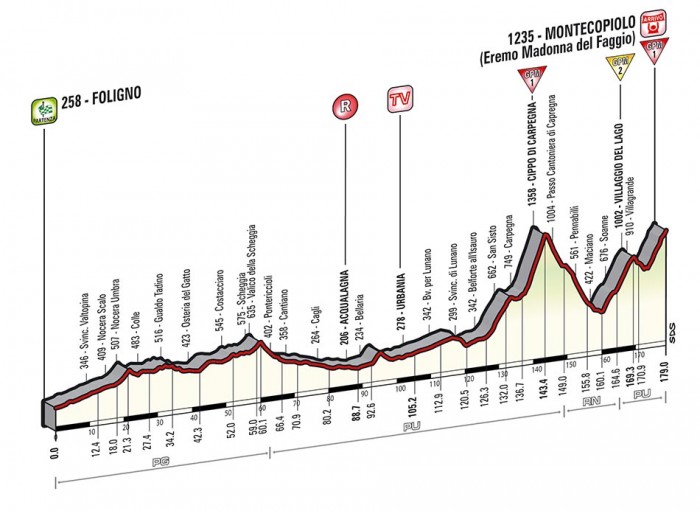
Stage 8 and the Montecopiolo will be an early test for the GC favorites.
Taking the race one stage at a time: the first week kicks off with a medium distance TTT that will create a few small gaps in GC before a trio of stages for the sprinters (riders will get a day off to travel to Italy for Stage 4). Uphill finishes on Stages 5 and 6 could create some light GC action. A hilly Stage 7 closes out the first week in advance of difficult mountain stages (8 and 9) in the beginning of the second week.
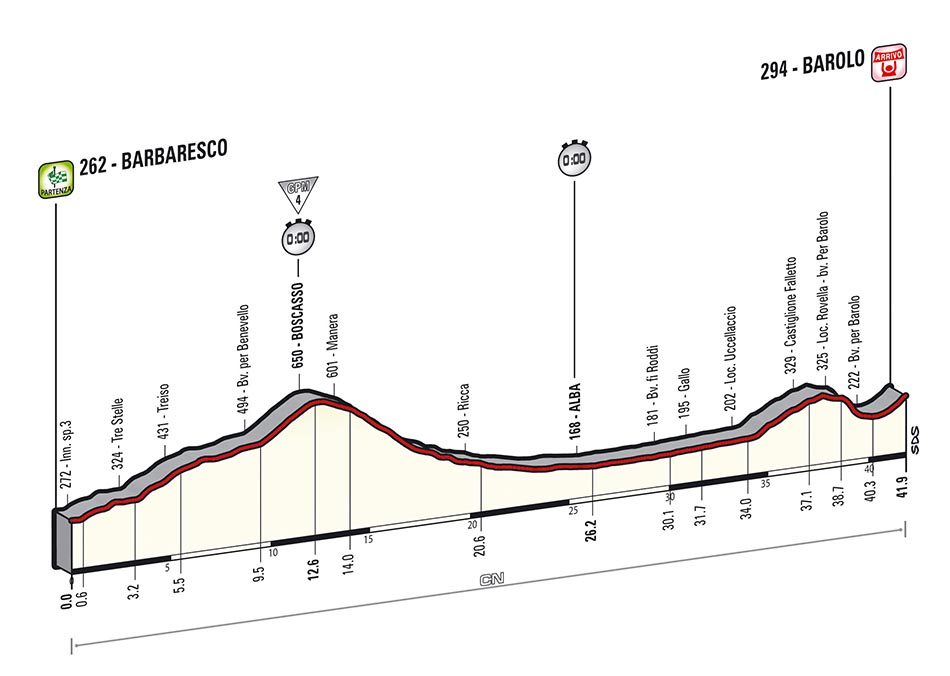
With so many days for the pure climbers, an individual time trial on Stage 12 will weed out a number of would-be GC contenders.
After a rest day, Stages 10 and 11 shouldn’t have many GC implications. The rolling 41.9 kilometer time trial that follows on the 12th stage will; it could be one of the most pivotal tests of the Giro. Stage 13 will likely be another day off the pink jersey hunters, but Stages 14-16 will throw three consecutive summit finishes at the peloton (albeit with a rest day before Stage 16).
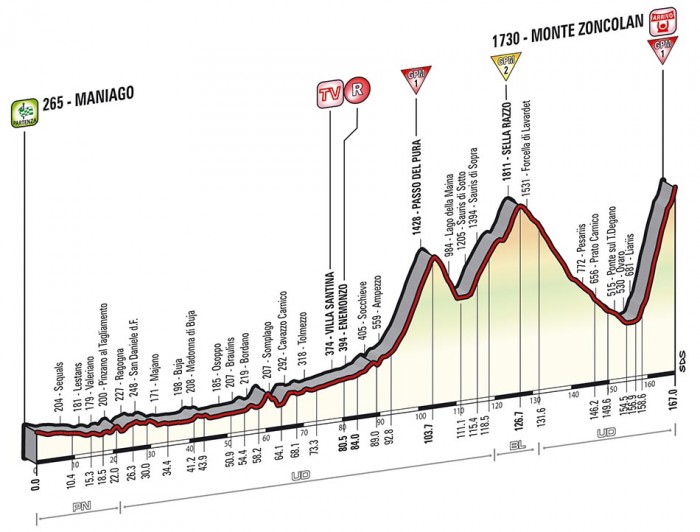
The fearsome Monte Zoncolan on Stage 20 guarantees suspense right up to the end.
Riders will save what energy they can on a bumpy but likely uneventful (at least for GC) Stage 17. The Rifugio Panarotta climb that closes out Stage 18 is roughly 16 kilometers at an approximately 8% average grade. Stage 19’s mountain time trial will be 26.8 kilometers of Category 1 climbing. And, of course, Stage 20 will throw down the gauntlet known as Monte Zoncolan, one of the most brutal climbs on the entire pro cycling calendar. 10 kilometers at around 12%, the summit finish will be a final test for the top riders in the race before the sprinters get their last hurrah in Stage 21, a 172 kilometer ride to Trieste and the podium presentation.
There are certainly a few early tests, but the action will really pick up in the second week, and all but two of the final eight stages are rife with extreme slopes and, as such, GC implications. The winner of this race will have to string together quite a few consistently strong performances in a row to come away victorious. With so many uphill finishes, a strong team of supporters will be crucial, as will an ability to avoid misfortune. There really aren’t many stages on which it’s okay for a rider to have a bad day.
The General Classification Contenders
The 2014 Giro d’Italia will kick off with two out-and-out favorites who stand, at least at the moment, head and shoulders above the competition. First and foremost is last year’s Tour de France runner-up, 24-year-old Nairo Quintana. A climbing superstar in a climber’s Grand Tour, Quintana looks just as strong in 2014 as he did in 2013. Quintana has shown that his elite ability to deliver on the mountains day after day after day is going strong in 2014, with nice performances in the Tour de San Luis, Tirreno-Adriatico, and the Volta a Catalunya. With this parcours, he enters the race with the title of favorite. He has had some time off racing, but that didn’t seem to be a problem before last year’s Tour, so I imagine he’ll be ready to roll. What’s more, he’ll have the full support of an elite Movistar team from the opening stage of the race, which was not the case in last year’s Tour de France, where Movistar set out to support Alejandro Valverde before altering their plan midway through the event. Jonathan Castroviejo and Adriano Malori will help set up Quintana nicely in the team time trial, and then riders like Eros Capecchi and Igor Anton will be strong workhorses when the road goes skyward.
Quintana’s main challenger looks to be Katusha’s Joaquim Rodriguez. The Spanish climber has earned quite a collection of Grand Tour podiums in his past few years, but he is still seeking an elusive Grand Tour victory. He came close in this very race in 2012, losing out on the victory and settling for 2nd after losing too many seconds in the final time trial. The 2014 Giro d’Italia is about as well-suited to Purito’s skillset as he could hope for; one of the time trials is basically a king of the hill competition, the other involves rolling ascents that will still favor his characteristics. Purito looked brilliant in the Volta a Catalunya in March, but had a rash of misfortune to follow, suffering injury in a crash at Amstel Gold. The crash derailed his Ardennes campaign and left him with some question marks coming into the Giro, his biggest target of the year. He will have had a few weeks to recover by the time the race kicks off, and the flattish first few days will give him further time to ride back into form, but the concerns are there. Still, Purito is a fighter and I imagine he’ll be among the top riders in the race, especially with bonus seconds on offer. Against a strong Movistar team and a number of other contenders, he’ll need to be gunning for every finish line. Fortunately, he’ll have top lieutenant Daniel Moreno at his side, another danger man for bonus seconds. The pair make a fearsome team and give Katusha a strong 1-2 punch. I think they’ll make the fight for the maglia rosa a close one.
Former Tour de France winner Cadel Evans looked excellent in the Tour Down Under, then rusty at Tirreno-Adriatico, and then back on to form at Pais Vasco. He was the best rider at the Giro del Trentino, facing many of the same names he’ll take on at the Giro d’Italia. He took 3rd in this race last year, and he’s out to prove he has at least another year in the tank. Given his recent performances, I think he’ll put in a strong race, but on this unforgiving profile, he may have a hard time keeping up with elite climbers. He will at least have a strong second in Grand Tour podium finisher Samuel Sanchez, who looks good, if not great yet, this season.
He doesn’t have the name recognition of a former yellow jersey holder or Olympic champion, but Domenico Pozzovivo is my pick for the rider most likely to challenge favorites Nairo Quintana and Joaquim Rodriguez. The Italian climber put in a Top 10 performance at last year’s Giro, but the real show came at the Vuelta a España, where he notched a 6th overall and displayed a newfound ability to deliver a top-shelf time trial. Always strong uphill, Pozzovivo’s recent discovery of chrono talent, along with a fair bit of general all-around improvement, make him a dangerous contender. He has been hot so far this season, delivering top 10s in every race he has undertaken, including landing 2nd in the Giro del Trentino and then flying to Liege to notch a 5th overall just two days later. The biggest hurdle to overcome will be questionable team support: he will be leading an AG2R squad without many of that outfit’s big names. Still, I think he will challenge the very best in this race.
Rigoberto Uran was the surprise runner-up in the 2013 edition, a result that built on a 7th overall and a young rider jersey from the previous year. No one was able to match Nibali in 2013, but Uran came closest, even beating him to the summit of the Altopiano de Montasio en route to a stage win. He lost big chunks of time on the chrono stages, but performed remarkably well for a rider who started the race as a lieutenant to Bradley Wiggins. He rides for a different team this year; OPQS signed him in the offseason to be their main GC rider. Uran has had a rocky start to 2014, landing 3rd overall against some big names in the Tour of Oman but otherwise delivering forgettable results in Tirreno-Adriatico, Catalunya, and Romandie. Still, the Giro is his main objective and it’s a race he knows, and it is important to remember that he’d done basically nothing last year leading into this race either. He also put in a stellar performance at the final ITT stage in the TdR this weekend, hinting that he may be stronger than his recent GC results would suggest. With a great team of supporters that includes Wout Poels and Thomas de Gendt, I think Uran will find himself at the pointy end of affairs in Italy.
Garmin sends a former Giro winner (as recently as 2012) in Ryder Hesjedal, but climbing specialist Dan Martin is probably the more dangerous rider for the squad. He’s won some serious climbers’ races, but GC success in a Grand Tour has eluded him so far. With the opening few stages taking place in Ireland, this year’s Giro is his main target. Martin’s form was a question mark right up until La Fleche Wallonne late last month, where he dispelled all concerns with a 2nd place performance atop the Mur; he continued to display stellar form in a title defense at Liege, where a late crash ruined an almost certain Top 5 placing, and possibly even an overall victory. However, one-day races are not Grand Tours, and Martin has had a penchant for running into problems in the longer races. Allergies and crashes have derailed his attempts in the past. Still, Martin knows that people question his ability to handle the Grand Tours, and I think he’s ready to silence his critics. The form is there, and unlike many of the other contenders, he doesn’t have too many miles on the tires yet this season. I think a Top 10 is within his reach, especially without many long, flat time trial miles. Teammate Hesjedal will be hoping for a resurgence; he has done very little since his overall victory here in 2012. Flashes of form at a few races last year suggest that he may still have top-level ability somewhere hidden away, but a lack of results so far this year make me skeptical of his chances.
Like cousin Dan Martin, Nicolas Roche is another GC rider looking forward to the start in his home country of Ireland. The 29-year-old really reached another level in last year’s Vuelta, landing in the Top 5 and nabbing a stage victory. He’s been rather quiet so far in 2014, but the Giro is easily the biggest objective of his year. Tinkoff-Saxo has another weapon in Rafal Majka, who finished 7th in 2013. He looks to be rounding into form this year, and he’ll love the mountainous route. With the Roche-Majka 1-2, Tinkoff-Saxo will be very active when the road goes up, and even without many results to go on in 2014, I think the pair will put at least one rider into the Top 10.
Astana won this race last year, and they send 2011 winner (after Contador was stripped of that title) Michele Scarponi this year. He has had a number of good, though not great performances so far in 2014, and was a fine 4th overall in last year’s race. Decent, if not world-beating, showings seem to be the name of the game for the aging Italian climber, and I think it’s likely we’ll get another here. His team does send a very strong team of lieutenants/alternatives to liven up the ascents: Mikel Landa has looked strong this year and young Fabio Aru was great again in the Giro del Trentino. A climber-centric route favors their skillsets.
Former Giro winner Damiano Cunego finally looks to have re-found some form here in 2014, climbing very well in Pais Vasco. Though it has now been a decade since his Grand Tour victory, Cunego is still only 32 years old. The route, and potential bonus seconds, suit the veteran. Lampre teammate Przemyslaw Niemiec may actually be a stronger option. Long an also-ran for the Italian squad, Niemiec has quietly put together some great recent results using his well-rounded skillset; his 6th overall at the 2013 Giro was one of a number of strong showings that year, and he looked great in Trentino this year. Diego Ulissi will likely be hunting stage wins in this race, as he has yet to show the sort of endurance to contend for a Grand Tour GC, but with the Cunego, Niemiec, and Ulissi trio, Lampre has one of the best uphill squads in the race.
The list of fellow Italian cycling stars of days past making renewed attempts at glory has even more names: for one, Ivan Basso, winner of the 2010 Giro d’Italia, is also in attendance. Unlike Scarponi or even Cunego, he has not had many recent showings of form, and he looked off the pace in Trentino and Romandie. I also question his team support. He may struggle to hang with the likes of Purito and Quintana as the uphill miles wear on. Androni Giacottoli’s Franco Pellizotti is yet another aging Italian star looking for another shot at success. 3rd here in 2009, Pellizotti has delivered a handful of decent showings in big races in the last year, including a respectable 9th in Trentino in April. Another respectable showing seems within his reach at the Giro d’Italia, though I don’t expect much of a serious GC challenge.
Belkin’s Wilco Kelderman looked sharp in Paris-Nice this year before a mechanical derailed his overall hopes. He’s a strong time trialist who might prefer a less climber-happy route, but Belkin, with star Robert Gesink sidelined indefinitely for health reasons and Bauke Mollema en route to the Giro, has a lot of faith in their young rider. Climber Steven Kruijswijk is along as well. Trek Factory Racing is also placing their faith in new blood. Robert Kiserlovski is coming into his own, with Top 10s in Tirreno-Adriatico and Catalunya. He was actually 10th in the Giro in 2010. As a rider who struggles against the clock, he’ll appreciate the overall parcours, though even with its rolling profile, Stage 12 will likely put a dent in his chances for General Classification. Kiserlovski is one of a number of strong up-and-comers for Trek; star youth Julian Arredondo is taking on his first Grand Tour and will look to animate the race when the road goes up, though stagehunting is a much more realistic goal for the GT rookie. Riccardo Zoidl is another Grand Tour newcomer, a well-rounded rider who looks sharp this season. Trek may not have a big name in this race, but I think we’re likely to see their kit mixing on a few mountain stages and maybe even on the fringes of the GC Top 10.
Sky’s bid for GC rests even further on the periphery. Kanstantin Siutsou has a Giro Top 10 to his name (in 2009) and Dario Cataldo has come close in the past, with a pair of 12th places on his palmares. Unfortunately for the pair, this is not a parcours that favors TT specialists. Pete Kennaugh is a late scratch due to illness.
Other outsiders include Europcar’s Pierre Rolland, who has not shown much of his uphill ability yet this year, but who will like all the mountains if he can find the form. OGE’s Ivan Santaromita is a talented climber who has not had many opportunities to ride for his own ambitions in his career, but the Australian squad will support him in his home Grand Tour. Finally, Team Colombia’s young Fabio Duarte is coming off a very impressive Giro del Trentino and will hope to make an impression for the Pro Continental squad at the top level.
The Stagehunters
As climber-centric as the parcours appears, there are still a number of stages that look like they will end in sprint finishes, due to the fact that most of the days that do not end in uphill charges look to have profiles that the sprinters can handle. Coastal winds and nerves could play their part, but Stages 2-4, all undertaken before any real climbing challenges, look like contests for the fast men, and this opportunity for bunch gallop finishes so early in the race has drawn a fine list of sprinters. At the same time, the scoring system behind the red points jersey was changed this year to offer more points on flat stages, meaning that the points classification is even more likely to go to a sprinter than in the past, further incentivizing participation by the fast men.
The biggest name among them is Giant-Shimano’s Marcel Kittel, who won four stages at last year’s Tour de France. Giant sends a squad to this race that is 100% devoted to picking up stage wins, with Kittel as their leader and the very talented (and hot in 2014) Luka Mezgec for the stages where Kittel doesn’t make the finish line. This is a surprisingly common occurrence for the young German fast man, who sacrifices a bit of versatility for all that top speed. With the combined Kittel-Mezgec front, it will be very hard to beat GSH in the sprints stages. Kittel might be the favorite for the points classification if that competition did not require you to finish the race, but it does, and he could struggle to hold on in the grueling final week, especially with the Tour as his main objective.
Giacomo Nizzolo, Tyler Farrar, and Fran Ventoso will hope to challenge for sprint victories.
Cannondale’s Elia Viviani is my pick for top non-Giant sprinter, and as an Italian rider with a strong focus on this race, he may be more inclined to stick it out all the way to Trieste. Viviani had a good 2013, but he has been lights out in 2014, beating Mark Cavendish twice in Turkey. It looks like he’s peaking at the perfect time, making him the most likely rider to challenge the GSH sprinting juggernaut. FDJ’s Nacer Bouhanni has been on fire this year, winning stages all over the map, and he has the top-end speed to challenge Kittel and Viviani. Giacomo Nizzolo looks strong for Trek after a collarbone injury derailed his early spring campaign. Nizzolo can handle tough days in the saddle and will also look to hang on when his fellow fast men start to abandon. Orica-GreenEdge’s Michael Matthews will lament the lack of more difficult hilly-but-not-too-mountainous stages that might drop his opponents and give him a chance to sprint from a smaller group, but as he showed in the final stage of last year’s Vuelta, he’s quite capable in a traditional sprintfest. Sky’s dynamic duo of Ben Swift and Edvald Boasson Hagen are in a similar boat. Of the two, EBH is very fast but Swift looks like the hotter hand right now. Garmin’s Tyler Farrar has had a resurgent 2014, posting nice results in the classics, and he’ll look to find some tangible success here. OPQS sends Alessandro Petacchi, who still looks remarkably fast in the twilight of his career. Lampre’s Roberto Ferrari is a constant also-ran these days, but he’ll hope to do better this year. Bardiani-CSF’s Sonny Colbrelli, Androni Giocattoli’s Manuel Belletti, Trek’s Boy van Poppel, Movistar’s Fran Ventoso, and AG2R’s Davide Appollonio can hold their own in the sprints as well.
A number of punchy, aggressive climber types are on the startlist looking for stages where they can go long. Bardiani’s Stefano Pirazzi, winner of last year’s KOM competition, will almost certainly go off the front as often as possible seeking another mountain jersey and breakaway wins. Androni Giocattoli’s Emanuele Sella will also be looking to repeat an aggressive Giro campaign.
Riders like Diego Ulissi and Julian Arredondo have the climbing chops to hang with the GC riders on at least a few stages but may not actually contend for the overall classification, and as such, they’re likely to have opportunities to hunt stage wins; other strong climbers who fall off the pace for GC will surely be doing the same. Also look for Cannondale’s Moreno Moser and Daniele Ratto, Neri Sottoli’s Simone Ponzi, Omega Pharma’s Wouter Poels, Europcar’s Yukiya Arashiro, and Astana’s Enrico Gasparotto, either on stages where punchy riders can match the GC men at a hilly finish or jump off the front of the pack.
Lastly, Adriano Malori of Movistar leads a small contingent of time trial specialists looking for success alongside the GC riders in both the team time trial and in Stage 12’s 41.9 kilometer chrono; squad mate Jonathan Castroviejo will be looking for the same. OGE sends a typically elite bunch to challenge in that discipline, with Luke Durbridge, Svein Tuft, Michael Hepburn, Brett Lancaster, and Cam Mayer all strong against the clock. Thomas de Gendt (3rd in the first time trial at last year’s Tour de France) may be focusing on the ITT as his main goal as well.
VeloHuman Favorites
General Classification
Winner: Nairo Quintana Podium: Joaquim Rodriguez, Domenico Pozzovivo Other Top Contenders: Cadel Evans, Michele Scarponi, Rigoberto Uran, Daniel Martin, Przemyslaw Niemiec, Rafal Majka, Nicolas Roche
Points Classification
Winner: Elia Viviani
I will be previewing every stage of the race here at VeloHuman.com, so if you’re looking for picks, make sure to bookmark the page; VeloHuman will bring you the stage profiles, favorites and outsiders for every day of racing. Now that you’ve read the overall race preview, check out the preview and favorites for the TTT on Stage 1! Also, there will be plenty more commentary and analysis on Twitter @VeloHuman. If you’re the type who can’t get enough cycling talk, you will be happy you followed. Hope to see you soon!