Tag: Greg van Avermaet

  • The Recon Ride Podcast: GP Québec + GP Montréal 2016

    The Recon Ride Podcast: GP Québec + GP Montréal 2016

    16GPMontrealQuebecvh

    Episode 56: GP Québec + GP Montréal 2016 Pre-race Show

    The Recon Ride previews the Grand Prix Cycliste de Québec and the Grand Prix Cycliste de Montréal, with a little help from top contenders Greg Van Avermaet and Tim Wellens.

    [powerpress]


    Dane Cash of VeloHuman and Cosmo Catalano of Cyclocosm talk Canadian GPs in a preview show that features both an Olympic gold medalist and a defending Montréal champion.

  • Ronde van Vlaanderen 2016 Preview

    Ronde van Vlaanderen 2016 Preview

    Ce5qt3eWAAAcol_ (1)

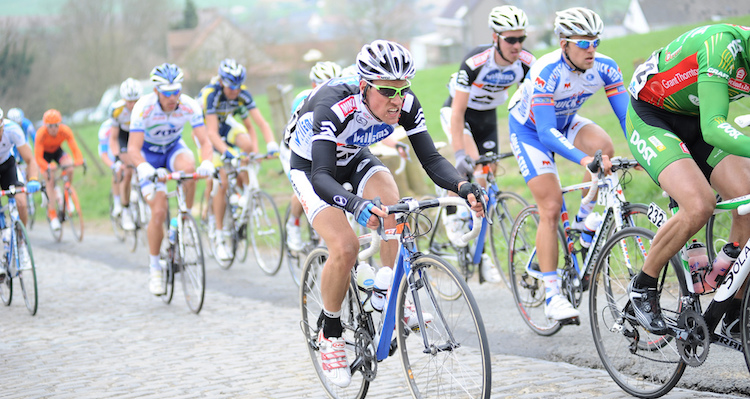
    The tuneup races are in the bag. Belgium’s biggest day of cycling is here. Sunday’s Tour of Flanders is the 100th edition of the monumental classic, and with several big names gunning for an elusive first monument win against two riders hoping to pick up a fourth career Ronde victory, it should be an entertaining show.

    The Route

    255 kilometers from start to finish, the Ronde van Vlaanderen is defined by its many climbs, most of which are cobbled. Officially, there are 18 climbs on the route. Many of them are crested more than once. The peloton will take on the challenging Oude Kwaremont/Paterberg double twice on the day, with the second visit to the difficult pairing marking the final two climbs on the profile. After the riders summit the Paterberg for the second time, it’s less than 20 kilometers of flat to the finish.

    The Contenders

    Hunting for a record-breaking fourth Flanders win in his final year as a pro, Fabian Cancellara is certainly among the favorites. There are several fast finishers among the top contenders, so Cancellara’s chances probably come down to his ability to power away on the late climbs using his incredible engine. Don’t be surprised if he pulls it off, even at age 35.

    Defending champion Alexander Kristoff has his work cut out for him this year. He may have won some races in the desert at the start of his 2016 campaign, but he just hasn’t quite looked as strong yet this year as he did in 2015. He won the race last year from a surprising two-man move, but he has not shown much of that escape ability since. It’s hard to say whether he can pull off that brilliant feat again, and given the tough profile, a big sprint (which would indeed favor him) seems unlikely.

    Peter Sagan, fresh off a second career Gent-Wevelgem win, looks ready to finally nab a monument win. He’ll be looking to force a selection on the climbs, but he can rely on his kick from a small group after that, as he combines soloing ability and sprinting chops like few others in the peloton, and appears to be in shape at the moment.

    Greg Van Avermaet also brings a terrific combination of top-end speed and solo prowess. He didn’t race at E3, where he would have been among the top favorites, but his overall victory at Tirreno-Adriatico proved his strong form. With Daniel Oss as a great second, BMC should expect big things Sunday.

    Sep Vanmarcke was having a quiet season until Gent-Wevelgem last week. Vanmarcke missed an early split but was able to work his way back into the mix, and then put in an attack that was reeled in only to make the final selection on the Kemmelberg not long after. The form looks to be there. And don’t underestimate him in a fast finish either—he’s steadily improved as a sprinter over the past few years.

    Tom Boonen may be in the running for a record-breaking fourth career Flanders win of his own, but Etixx-QuickStep will likely look to Zdenek Stybar and Niki Terpstra as the featured riders this weekend. They’ve both shown ability on this terrain and the form looks good at the moment.

    Sky has options too, with Michal Kwiatkowski, Geraint Thomas, Luke Rowe, and Ian Stannard all potential protagonists. Don’t overlook the Lotto-Soudal stable either. Youngster Tiesj Benoot and veteran Jurgen Roelandts are both riders to watch. Edvald Boasson Hagen, Lars Boom, Filippo Pozzato, Heinrich Haussler, and Matti Breschel are others worth watching in Flanders.

    VeloHuman Top 10 Race Favorites

    Winner: Greg Van Avermaet
    Podium: Peter Sagan, Sep Vanmarcke
    Other Top Contenders: Fabian Cancellara, Zdenek Stybar, Niki Terpstra, Tiesj Benoot, Michal Kwiatkowski, Alexander Kristoff, Edvald Boasson Hagen

    Photo by Dane Cash.

  • The Recon Ride Podcast: Ronde van Vlaanderen 2016

    The Recon Ride Podcast: Ronde van Vlaanderen 2016

    rvv16vh

    Episode 37: Ronde van Vlaanderen 2016 Pre-race Show

    The Recon Ride previews the Tour of Flanders, quite possibly the best race on the cycling calendar.

    [powerpress]


    Dane Cash and Cosmo Catalano dive into De Ronde van Vlaanderen, the Tour of Flanders, with a little help from CyclingTips U.S. Editor Neal Rogers.

    Photo by Dane Cash.

  • E3 Harelbeke 2016 Preview

    E3 Harelbeke 2016 Preview

    5563187461_9facdd1a6e_b

    Friday’s E3 Harelbeke is the first of three WorldTour-level cobbled classics in Belgium. Featuring many of the climbs used in the Tour of Flanders, it’s an excellent prep race for De Ronde hopefuls, and it’s also a big prize in its own right. Recent editions have offered plenty of excitement, with late attacks keeping things interesting until the end.

    The Route

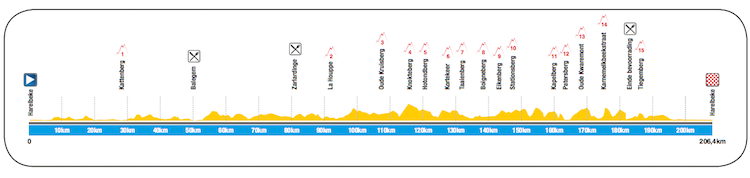
    206.4km in total, the race starts and finishes in Harelbeke, Belgium, traversing 15 climbs along the way. The Oude Kwaremont, among the most important climbs in the Tour of Flanders these days, offers a decisive launching pad late on in the stage, followed by the Karnemelkbeekstraat and the Tiegemberg.

    Screen Shot 2016-03-25 at 3.47.09 AM

    From there, however, it’s roughly 20 flattish kilometers to the finish—as such, anyone hoping to get clear on the hellingen will need a big engine to stay away in the finale.

    The Contenders

    This race has typically come down to a small group of escapees late on in the day, but a strong finishing kick can be very helpful given the less challenging final kilometers.

    Greg Van Avermaet has made a living with his late attacks, and he is sprinting at a very high level right now as well. He’s never won a one-day race on the WorldTour, but this seems like the perfect time to start.

    2014 winner Peter Sagan also has the right combination of skills to take the win. Motivation may be a question, but if he’s up for it, the world champ should be in the mix.

    Fabian Cancellara counts three E3 titles on his palmares. It’s hard to say whether he’s all that interested in this year’s edition of the event (his eyes may be firmly fixed on the upcoming Tour of Flanders), but he’s one of the best solo artists in the sport on this sort of parcours.

    Etixx-Quick-Step is loaded with options. Zdenek Stybar and Niki Terpstra are probably the best bets, though Tom Boonen has won this race a whopping five times. Stijn Vandenbergh is yet another card to play.

    Alexander Kristoff is one of the few sprinter types who might have a shot at holding on given the profile. This will be a nice test of form ahead of his Tour of Flanders defense.

    Sep Vanmarcke should love this parcours, and like Van Avermaet, he’s sprinting better than ever before these days should this come down to a small group. Vanmarcke was garnering plenty of pre-race attention this time last year, but things have quieted down in 2016 after his disappointing 2015 campaign. That could give him a chance to focus more on his goals and less on media appearances.

    Outsiders include Lotto-Soudal’s Tiesj Benoot and Jurgen Roelandts, Sky’s Luke Rowe and Ian Stannard, Lars Boom, Bryan Coquard, and Arnaud Démare, fresh off a Milano-Sanremo victory.

    VeloHuman Top 10 Race Favorites

    Winner: Greg Van Avermaet
    Podium: Zdenek Stybar, Peter Sagan
    Other Top Contenders: Fabian Cancellara, Sep Vanmarcke, Niki Terpstra, Alexander Kristoff, Tiesj Benoot, Jurgen Roelandts, Ian Stannard

    Photo: Cindy Trossaert (CC).

  • Grand Prix Cycliste de Montréal 2015 Preview

    Grand Prix Cycliste de Montréal 2015 Preview

    eCS26gb

    After Rigoberto Urán delivered a surprise win in Québec, the racing moves on the Montréal. A slightly hillier course could favor the attackers even more, which will make predicting an already unpredictable race quite a challenge!

    The Route

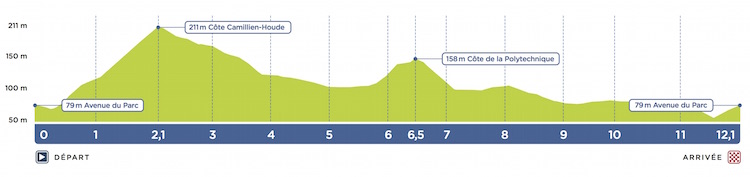
    The Grand Prix Cycliste de Montréal takes on 17 laps of a 12.1km circuit for a total distance of 205.7 kilometers. The race starts along the Avenue du Parc, makes a loop along the slopes of Mount Royal, and then finishes back where it started.
    GPC_MTL_PARCOURS_FR

    There are three uphill sections in each lap. After a short downhill from the starting line, the first and most difficult climb comes almost immediately: the Côte Camillien-Houde, 1.8 kilometers at an 8% average gradient. From the top, there is a fast descent, a brief flat section, and the next uphill test, the short but difficult Côte de la Polytechnique, 780 meters at a 6% average. There is a particularly steep 200m section of about 11% along the way. After another descent, things even out for a bit until the final 1100 meters: the riders will make a right turn heading south and shoot downhill on the Avenue du Parc, and then they will make a 180 degree turn to head right back up the Avenue in the other direction towards the finish. That final run-in is a 560m, 4% climb.

    The Contenders

    While the startlists are the same and many of the top contenders are the same, the Montréal circuit is, on the whole, harder than that of the GP Québec. “The two are different,” Rui Costa told VeloHuman from Québec. “Montreal is a race that I think is harder, and more open.”

    The Côte Camillien-Houde, crested 17 times, will put the heavier riders into serious difficulty and will likely see a smaller group coming into the final few laps than the peloton in Montréal. An attack on the 8% gradients has a decent chance of holding out over the final few up and down kilometers. The finish in Montreal, however, is a fair bit easier, which means that a select group of escapees could find themselves battling it out in a sprint. Orica-GreenEdge kept the race on lockdown last year, allowing a sizable bunch to finish together, but that was rather unusual for this race, and I’d expect a more select group to battle for the win this time around. Whatever the scenario, explosiveness and excellent climbing legs are important.

    It was not a real shocker to see an Etix-QuickStep rider take the win in Québec, given all the firepower they have, though Rigoberto Urán seemed like maybe the fourth best option on his team! In any case, EQS will have another excellent opportunity to nab the win in Montréal. Julian Alaphilippe looked strong in an escape attempt that was ultimately reeled in in Québec, and Michal Kwiatkowski looked particularly impressive chasing down Greg Van Avermaet. Despite Urán’s victory, I still see Alaphilippe and Kwiatkowski as the top EQS riders for Montréal, as Urán won’t be taking anyone by surprise this time; in fact, I’d be just as surprised if he won Montréal now that he’s no longer under the radar. Still, watch out for the Colombian: he’s got all the right skills for these races, and although he’s basically taken a two-year hiatus from contending in the Classics, there was a time when he was a top rider for the Ardennes and in Lombardy—and apparently still has those skills hiding under the hood.

    Rui Costa has won in Montréal in the past and was runner-up in 2014. Without Simon Gerrans around, I like his chances this year. He looks to be in good form. The biggest question is team leadership. Costa made it into the select group that appeared to have their shot at fighting for the Québec win before hesitation allowed the larger pack to catch back up, but then Lampre-Merida backed Diego Ulissi in the final sprint. The Italian could be a strong contender in Montréal as well. Both riders are great climbers with explosive side, and my first instinct is to see Costa as the man for Montréal given his past performances, but Lampre might not see it that way, which makes it harder to view Costa as an out-and-out favorite.

    For most of the day in Québec, BMC looked to be the strongest team in the race, contributing to the chase of the early break and then involving themselves in one attack after another. It didn’t work out in the end, but it showed the team’s strength and that bodes well for Greg Van Avermaet and Philippe Gilbert in Montréal. The selective profile will weed out some of the purer sprinters, but the less difficult finish will provide an excellent opportunity for both riders, who can rely on their impressive uphill speed, with a shot in a reduced sprint. I’m not sure either one is at full strength just yet with Worlds as such a major goal, but they’ll be close to their best. I like Van Avermaet a bit more than Gilbert, as he’s been coming to the GP Montréal for so many years running now, but both are contenders.

    Tony Gallopin, 3rd last year, showed good form with an 8th place in Québec. The way I see it, Montréal suits him better. He’s a excellent tactician who knows how to make an attack, and he has the fast finish to win out of a small group. He appears to be in terrific form as well. He was in the small group that made it up the Côte de la Montagne at the head of the race in Québec, and still managed to come in 8th in the final sprint after that group was swept up (Van Avermaet, also in that small group initially, could only manage 10th despite being near the front in the finale). In a wide-open race, I like Gallopin’s chances to turn last year’s third-place result into a win. If he doesn’t, Tim Wellens, Jurgen Roelandts, and Tiesj Benoot are other options for a loaded Lotto-Soudal.

    Michael Matthews was the runner-up in Québec and he’ll have a shot in Montréal, but I see the parcours as being just a bit too difficult to view him near the top of the favorites (oddsmakers disagree with me on this one). In any case, if Matthews is not able to handle the climbs, it shouldn’t be too much of a problem for OGE, who have Adam Yates (on blazing form at the moment), Simon Yates, and Michael Albasini too.

    Tom-Jelte Slagter is in the best form he’s been in all season. He was 4th in Québec, and although he’s had better results there in the past, I think Montréal suits him well too. He can handle tough climbs without too much trouble. Slagter isn’t going to Worlds, having suddenly found his form after the Dutch team selection, and I therefore expect he’ll be giving it everything he has to pull something off in Montréal. Ramunas Navardauskas and Ryder Hesjedal are other options for Cannondale-Garmin.

    Lars Petter Nordhaug won here in 2012 and count be counted out. Trek’s Bauke Mollema and Fabio Felline make for a great 1-2 punch. The same is true for Giant-Alpecin’s Simon Geschke and Warren Barguil. Europcar has Tommy Voeckler, while FDJ can rely on Arthur Vichot. AG2R is the French squad with the widest array of options: Romain Bardet, Alexis Vuillermoz, and Jan Bakelants are all potential contenders. I was very impressed with LottoNL-Jumbo in Québec, and see Robert Gesink and Wilco Kelderman liking this parcours even more—Sep Vanmarcke is another option for the men in yellow.

    Alexander Kristoff was surprisingly in the mix in Québec but it’s hard to see him holding on over the more challenging GP Montréal parcours. Hesitation at the head of the race late on in Québec helped his chances but I doubt he’ll get that kind of gift again, though obviously he’ll be a favorite if he’s there for a sprint.

    VeloHuman Top 10 Race Favorites

    Winner: Tony Gallopin
    Podium: Rui Costa, Tom-Jelte Slagter
    Other Top Contenders: Greg Van Avermaet, Michal Kwiatkowski, Philippe Gilbert, Julian Alaphilippe, Michael Matthews, Diego Ulissi, Bauke Mollema

    VeloHuman will be at the race so be sure to follow @VeloHuman on Twitter for more analysis!

  • Grand Prix Cycliste de Québec 2015 Preview

    Grand Prix Cycliste de Québec 2015 Preview

    GPCQ

    As the Vuelta rages on, another contingent of the WorldTour peloton is in North America for the Grands Prix Cyclistes of Québec and Montréal. The startlists in the Canadian GPs are always excellent, but the rosters are particularly impressive this year thanks to the presence of Worlds in Richmond, Virginia, which is far closer to Canada than it is to Europe (the Worlds prep storyline is just one of many covered in the latest Recon Ride, which is absolutely worth a listen). Friday’s GP Québec is the first race on the docket—and VH will be at the event in-person, so stay tuned here and on Twitter @VeloHuman.

    The Route

    The profile of the GP Québec always sets up an exciting race. The climbs aren’t too difficult by themselves, but repeated ascents, and the placement of steep gradients in the run-up to the line makes it a selective race.

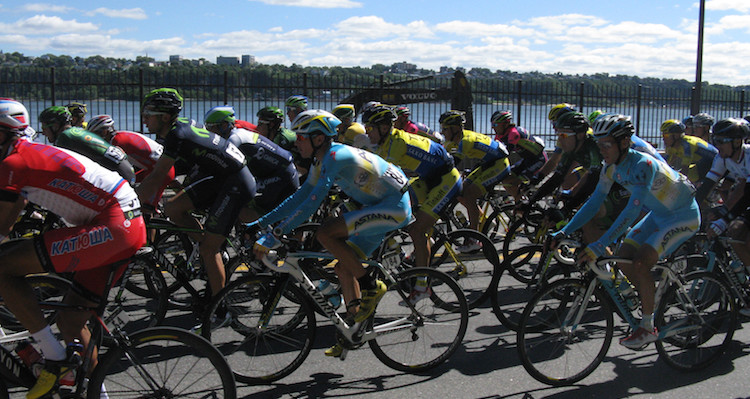
    The final few kilometers of the GP Québec typically make for a hectic finale.
    The final few kilometers of the GP Québec typically make for a hectic finale.

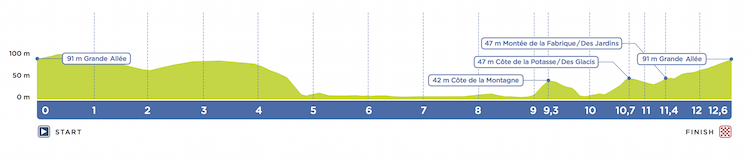
    The GP Québec is a circuit race of 16 laps of 12.6km each. The first 4 kilometers of the circuit are mostly flat. Then comes a steep descent down to the St. Lawrence River waterfront. After 4 flat kilometers by the river, things get challenging, as the road winds its way up one climb after another, gradually making its way back up to the start finish line. The final 3.5 km trend upward, but it’s an irregular ascent comprising several individual steeper sections with a few downhill and flat stretches in between. There are four official climbs: the Côte de la Montaigne (375m at 10%), the Côte de la Potasse (420m at 9%), the Montée de la Fabrique (190m at 7%), and then the run-up to the finish, which starts on the Montée du Fort and ends on the Grand Allée (1km at 4%).

    By themselves, the late climbs may not look like much, but taken in short succession so many times, they tend to whittle down the peloton before the final lap, when they serve as a springboard for countless attacks.

    The Contenders

    The GP Québec is a well-balanced circuit that can either come down to a selective sprint or a late attack. In either scenario, climbing legs are important. Strongmen tend to thrive even when a group kick decides the race, as the peloton is always lined out for the final few hectic kilometers, and it’s impossible for the traditional sprinters to stay as well-protected as they might on a flat Grand Tour stage.

    The 2014 winner, Simon Gerrans, is not here to defend his title. Combined with an excellent startlist, that makes for a wide open race. Almost every team in the race has a rider who could conceivably win, and some teams have two or even three riders who are legitimate threats. This race is always unpredictable (Robert Gesink won the 2013 edition in an uphill sprint ahead of Peter Sagan, for instance) but it’s even more difficult to predict how things will turn out this year.

    In any case, it’s probably safe to bet on BMC to put in a good ride. Philippe Gilbert won the race in 2011, and Greg Van Avermaet has been in the Top 10 every year since. Both riders are here for the 2015 edition. Van Avermaet loves the Canadian GPs and has come very close to winning both, and he looks to be on excellent form right now. The GP Québec suits him very well, with late climbs that appeal to the aggressive riders and a finish that could allow him to use his killer uphill sprint if a small group comes to the line. In the absence of Gerrans, Van Avermaet will be a strong contender for the win. So will Gilbert, of course, who has looked good all year. He won the sprint for 2nd in San Sebastián out of an impressive group, and showed good form in the Eneco Tour as well. BMC could send one of their leaders up the road in the finale, and allow the other to vie for the win in a small group kick, and given the versatility of both Belgians, either rider could play either role.

    Orica-GreenEdge may be without the defending champion, but that doesn’t mean they don’t have a race favorite in Canada. In fact, they have more than one. Michael Matthews could do the job of defending the title for the team if his squad can reel in all the inevitable late attacks. This will be a challenging finish for Matthews, who will have the battle to stay at the front of a lined-out pack, but if he can hold on until the end of the climb he will be a major threat. If not, OGE will still have other options. Michael Albasini is always deadly in an uphill sprint, and Adam and Simon Yates are both potential attackers.

    Etixx-QuickStep can rely on the 1-2 punch of Michal Kwiatkowski and Julian Alaphilippe, who both bring similar skillsets to the table. With Kwiatkowski on unknown form, Alaphilippe may be the better option. He has the speed to win a selective sprint on these gradients.

    Between Bauke Mollema, Fabio Felline, and Julián Arredondo, Trek should be able to come up with at least one top finisher. Lampre-Merida’s duo of Rui Costa and Diego Ulissi may be a bit better-suited to the somewhat harder Montréal race, but the extremely impressive startlist could make this race more selective than usual, and that could favor the pair. Costa always does well in Canada and will be hungry to get a late-season result after a disappointing summer. Ramunas Navardauskas was 3rd here last year and could be a threat again, but Cannondale-Garmin teammate Tom-Jelte Slagter may be the better option coming off of two Tour of Alberta stage wins and 3rd overall on GC. He hasn’t been on the best form for much of the season, but when he’s at his best, he’s terrific on just this sort of profile.

    Tony Gallopin will likely be the best option for Lotto-Soudal thanks to his skillset that combines a fast finish with excellent climbing legs, but Tim Wellens, Jurgen Roelandts, and Tiesj Benoot could also threaten. LottoNL-Jumbo is yet another team with multiple options: former winner Robert Gesink can’t be counted out, and Sep Vanmarcke is on great form and could nab a result if he can leave the bunch behind in the finale.

    Lars Petter Nordhaug, Alexey Lutsenko, Michael Valgren, Tommy Voeckler, Matti Breschel, and the AG2R trio of Jan Bakelants, Alexis Vuillermoz, and Romain Bardet are others who could shine in a selective finale—if the faster finishers all look at each other in the last few kilometers, it’s a real possibility that this race could go to a lone surprise attacker or a small group of them taking advantage of the hesitation of the bigger favorites.

    There are always sprinters making the trip to Québec who probably won’t have much of a shot at winning the race, but given the level of talent assembled they are at least worth mentioning. Alexander Kristoff, in excellent shape with Worlds around the corner, and Bryan Coquard, light enough to be a potential contender on the climbs, are probably the best candidates out of the bunch. Sam Bennett, Heinrich Haussler, Wouter Wippert, and Arnaud Démare are others in attendance.

    VeloHuman Top 10 Race Favorites

    Winner: Greg Van Avermaet
    Podium: Michael Matthews, Julian Alaphilippe
    Other Top Contenders: Tony Gallopin, Fabio Felline, Rui Costa, Philippe Gilbert, Sep Vanmarcke, Michael Albasini, Tom-Jelte Slagter

    Don’t miss the Recon Ride’s GP Québec (and Montréal) pre-race podcast, and be sure to follow @VeloHuman on Twitter for plenty more analysis during the race.