Episode 27: GP Québec + GP Montréal 2015 Pre-race Show The Recon Ride delivers a double dose of analysis, the with a pre-race show that takes on the GP Québec and its sister race, the GP Montréal. A few of the top names in attendance offer the insider’s take on North America’s only WorldTour races.
[powerpress]
For one weekend every year, WorldTour cycling crosses to the other side of the Atlantic for the Grande Prix Cycliste de Québec and Grand Prix Cycliste de Montréal. The courses tend to produce exciting racing, and thanks to Canada’s proximity to the Richmond world championships, the always-excellent startlists are even more impressive this year. Dane Cash of VeloHuman and Cosmo Catalano of Cyclocosm preview both events in one Recon Race pre-race show—with a little help from the three of biggest stars who have made the trip: Greg Van Avermaet, Michal Kwiatkowksi, and Romain Bardet.
The WorldTour heads to the Brittany region this weekend for the GP Ouest France. The hilly circuit race is often known by its former name, the GP Plouay, or simply as “Plouay,” the small Breton town where the race starts and finishes (the most recent Recon Ride episode covers this topic, among many others, in depth). Though the event may garner a bit less attention than the concurrently-running Vuelta, it is almost always an exciting race that draws a very impressive startlist, in no small part thanks to its appeal as a stepping stone to Worlds.
The Route
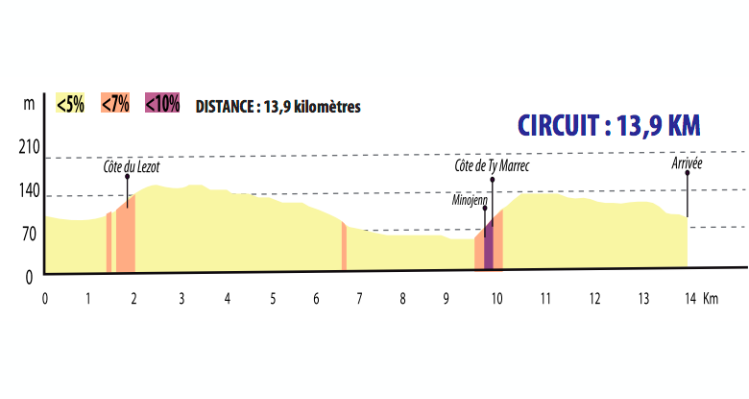
The 229.1km GP Ouest-France takes on the same terrain many times over, via eight laps on a 26.9km circuit and then a single lap on a reduced circuit of 13.9 kilometers.
Each of the long laps opens with a climb of the Côte du Lezot, a little over a kilometer in length and with much of that distance at a gradient in the realm of 6%. From the top, it’s a descent followed by a long gentle ascent up to the Chapelle Sainte-Anne des Bois. After a flat section and then a quick downhill run, the pack will take on the Côte de Ty Marrec, only about a kilometer in length but with a long stretch in the middle nearing 10%.
The final lap of the GP Ouest-France hits both of the major climbs of the longer circuit, with less ground to cover between the two challenges.
The shortened final lap will still look quite familiar, but with much less distance between the two harder climbs. The less challenging trip to the the Chapelle Sainte-Anne des Bois will not be a part of the last lap, which cuts out almost half the distance of the full lap, thereby bringing the ascents of the Côte du Lezot and the Côte de Ty Marrec closer together. From the top of the Ty Marrec it’s a gentle downhill run of about 3km to the finish line.
The Contenders
The GP Ouest-France parcours is deftly balanced in such a way that it’s never quite clear until the final moments of the race whether a late attacker or the sprinters will reign supreme. The course isn’t so hard as to automatically drop the fast finishers from contention, but the Côte de Ty Marrec comes late enough (in a day that is long and challenging enough as it is) to give the aggressive riders a chance at jumping clear of the pack and holding out for victory. In any case, thanks to the flatter finish, a strong sprint is a pretty helpful asset—whether the race comes down to a bunch kick or a small group, anyone hoping to win this race would do well to have some speed.
Greg Van Avermaet has the endurance to come into the finale fresh, the climbing legs and explosiveness to make or join or late move, and the finishing kick to win a reduced sprint. This is a wide open race, but he’s got to be among the top favorites for his versatility. His top-end speed, in particular, has improved over the past few years, to the point where he’s capable of winning a sprint even against specialists on a good day. He’s also got excellent form, having landed 2nd overall in the Eneco Tour. BMC has plenty of other cards to play in this race as well, with talents aplenty to potentially launch constant attacks every time the opportunities present themselves. Philippe Gilbert looks strong right now and is an obvious candidate to go on the move on the climbs, Ben Hermans is on the form of his life and was 7th in this race last year, and Dylan Teuns and Silvan Dillier are even further options for the Belgian squad.
Should a larger group make it to the finish, two riders stand out above the rest as favorites. The first is the rider who won the bunch sprint behind the winning move in last year’s race. Alexander Kristoff can handle a tough course, he’s among the fastest riders on the startlist, and looks to be in good form right now. Giacomo Nizzolo, who was next in line behind Kristoff last year, hasn’t had much luck beating the Norwegian in the past, but this race is a major target for Nizzolo (something he talked about in more detail in the latest Recon Ride) and the potentially messy sprint finale suits him very well. He was runner-up in 2013 to Filippo Pozzato, and has improved his kick since then. Fabio Felline gives Trek a nice alternative.
Etixx-QuickStep, as might be expected for a one-day race, brings a squad full of contenders. Julian Alaphilippe made the Top 10 in 2014 and seems best suited, with strong climbing legs and a fast finish in a reduced kick. Tom Boonen will be the sprinter of choice if this comes down to a bunch gallop, not a bad option to fall back on seeing as he’s on blazing form right now. Tony Martin and Stijn Vandenbergh are others with a shot.
Not to be outdone in the Belgian WorldTour team department, Lotto-Soudal also has options. Tim Wellens, fresh over a convincing Eneco Tour win, may be the most obvious candidate. He certainly has the skillset to thrive here. However, his biggest career successes have come when he has been able to rely on the element of surprise—he’s won the Eneco Tour twice in a row now after showing little in the way of form coming into that race. Whether he can still thrive when all eyes are on him is another matter. If not, Jurgen Roelandts may be the best option: he has actually made the Top 10 in this race three years in a row, and has shown great form this season. Tony Gallopin is another card to play. Jens Debuscherre and Tiesj Benoot are others to watch.
LottoNL-Jumbo doesn’t have quite the team firepower as the aforementioned squads but Sep Vanmarcke is on blazing form and just the sort of rider who might be able to nab a win after a long day of up and down in Plouay. He’s not bad in a sprint, and he’s highly motivated to get something out of a 2015 that has been somewhat disappointing. Moreno Hofland is the main option for the team if the race comes down to a big bunch kick.
Rui Costa was runner-up in 2012 and certainly has the aggressive style to take a win in this race, though he might not be back to 100% after a difficult Tour de France. Diego Ulissi and Davide Cimolai make fine alternatives for Lampre-Merida.
Marcel Kittel certainly deserves a mention as the fastest pure sprinter on the startlist, but it will be extremely difficult for him to make it all the way to the line given his general inability to handle uphill gradients. Sky’s duo of Elia Viviani and Ben Swift, FDJ’s Arnaud Démare, OGE’s Michael Albasini, Movistar’s JJ Lobato, Astana’s Borut Bozic, Europcar’s Bryan Coquard, and IAM Cycling’s Heinrich Haussler will be among the other fast finishers who will hope to hold out for a bunch kick.
Given the parcours and the race history, the list of outsiders who could have a chance with a late attack could encompass the entire roster of riders making the start, but to name just a few: Simon Yates, Ramunas Navardauskas, a strong AG2R tandem of Romain Bardet and Alexis Vuillermoz, Andrea Fedi, Tommy Voeckler, and Arthur Vichot are among the many riders who might be worth keeping an eye on when the peloton approaches the final climb of the Côte de Ty Marrec.
Lastly, VeloHuman’s Under-the-radar contender for the GP Ouest-France: Rasmus Guldhammer of Cult Energy. Guldhammer was 10th in the Vattenfall Cyclassics, showing off his sprinting ability against far more familiar quick men, but he’s also got the climbing chops to survive this parcours. In a reduced field, the former U23 Liège-Bastogne-Liège winner could put up a serious fight for the victory in Plouay.
VeloHuman Top 10 Race Favorites
Winner: Greg Van Avermaet Podium: Alexander Kristoff, Giacomo Nizzolo Other Top Contenders: Philippe Gilbert, Julian Alaphilippe, Tom Boonen, Jurgen Roelandts, Tim Wellens, Sep Vanmarcke, Arnaud Démare
Episode 24: GP Ouest-France 2015 Pre-race Show The Recon Ride takes on the GP Ouest-France, the always-exciting circuit race that starts and finishes in the small Breton town of Plouay, with some help from Giacomo Nizzolo.
[powerpress]
One of the more underrated events on the WorldTour calendar, Plouay’s GP Ouest-France usually offers plenty of thrills, with a parcours that makes it hard to predict whether the race will come down to a sprint or a late attack. Dane Cash of VeloHuman and Cosmo Catalano of Cyclocosm take a closer look at the route, the favorites, and the storylines ahead of the race, with a bit of extra insight from Trek’s Giacomo Nizzolo, runner-up in Plouay in 2013.
The WorldTour makes one last stop in Spring Classics territory for the weeklong Eneco Tour, a relatively young race that has nevertheless offered a healthy amount of high-caliber entertainment the past few years. While the race doesn’t visit any Alpine climbs, the cobbles and the short but steep uphill tests of Belgium and the Netherlands, familiar to anyone who enjoys bike racing in the spring, will provide plenty of challenges to sort out the General Classification. Bonus seconds tend to play a pretty important role as well, giving the fast finishers a leg up on those less inclined to get involved in the hunt for high stage placings.
The Route
The Eneco Tour opens with three straight relatively flat days that look good for the sprinters, though don’t be surprised if at least one of them ends up going to an aggressive attacker. Nothing is guaranteed a part of the world as prone to crosswinds and sketchy conditions.
Stage 4 is a 13.9km individual time trial. It doesn’t sound like much, but in a weeklong race without any mountains, it’s a critical stage for the GC hopefuls. Despite a somewhat visually deceiving official profile graphic, it’s quite flat (and not particularly technical) and will favor the powerhouse specialists.
Stage 5 will take the peloton into Amstel Gold Race territory, pitting the riders up against some of the climbs of that one-day classic (although the stage avoids the Cauberg). The final few kilometers involve multiple short but steep climbs, and then a downhill run into the finishing straight.
Stage 6 should play out like a mini-Liège-Bastogne-Liège, taking on some of the same challenges and offering a similar profile: numerous climbs that are just a bit tougher than those of the previous stage.
The Eneco Tour concludes with a visit to the heartland of the Cobbled Classics in Belgium, where the peloton will take on multiple ascents of the legendary Muur van Geraardsbergen.
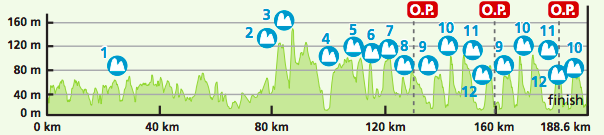
Stage 7: St.Pieters-Leeuw › Geraardsbergen (188.6km) – The Eneco Tour’s final stage is up-and-down from start to finish, with plenty of cobbled stretches to make things even tougher.
The challenging cobbled climbs will give the strongmen one last shot at a WorldTour victory in Flanders this season.
The General Classification Contenders
Given the Classics-esque feel of the Eneco Tour, it shouldn’t come as much of a surprise that many of the big names of the spring are making the start at this race. The more versatile among them will have a shot at the overall victory here.
Tim Wellens was the surprise victor last year (he launched an attack on that year’s Liège-Bastogne-Liege-esque stage 6 that catapulted him into the lead) and he returns this year with a strong Lotto-Soudal team. The route certainly suits Wellens, a true all-round talent who can handle this terrain well, though form has been a question mark for Wellens this season. The 24-year-old has not quite had the 2015 he was probably hoping for. Still, he’s a proven threat in this race who can’t be counted out. His team is stacked with other versatile talents as well: Tiesj Benoot, Jens Debuscherre, Jürgen Roelandts, and Thomas De Gendt are all capable supporters or alternatives if Wellens isn’t up for it.
Greg Van Avermaet and Philippe Gilbert head a powerful BMC squad. It would be a big surprise if at least one of them was not involved in the fight for the overall victory. I see Van Avermaet as the slightly more likely of the pair to lead the team, though both are very well-suited to the race and in sharp form. Van Avermaet’s recent climbing performances and a relatively newfound ability to time trial will come in especially handy in this race. He won the Muur van Geraardsbergen stage in 2014 and is sure to contend there again, and his cobblestone skills and finishing speed coupled with the best form of his life on the climbs and against the clock give him an edge in this race. He was 5th overall last year. Motivation is likely through the roof after a frustrating Clásica San Sebastián. Gilbert is a dangerous contender in his own right, however, 7th last year and the winner of multiple Eneco Tour stages in the past, and coming off a San Sebastián runner-up performance. Jempy Drucker and Daniel Oss round out a very strong BMC roster.
Lars Boom won the Eneco Tour back in 2012 and he was 2nd in 2014. He is very strong against the clock and on the cobbles, and always seems to climb better than you might expect on the Eneco Tour’s uphill tests. He should be right up there fighting for the overall victory. Andriy Grivko is another excellent option on an Astana team that is surprisingly well-suited to this race. Grivko was 3rd in 2013 and 4th last year, and he has the climbing legs and time trialing skills to make up for a relative lack of cobblestone prowess.
Etixx-QuickStep will be without 2013 overall winner Zdenek Stybar but that doesn’t mean they aren’t loaded with options. Julian Alaphillipe, one of the big stars of this year’s Ardennes Classics, is the most obvious choice. He is untested on the cobblestones but he should be among the best riders in the race on Stages 6 and 7, and can put in a nice ITT on a short course as well. Niki Terpstra is another excellent option—he tends to perform surprisingly well on the climbs of the Eneco Tour, and the rest of the terrain suits him perfectly. Tom Boonen is of course another rider to watch out for on EQS.
Simon Spilak may seem out of place among the many Classics stars on the startlist, but as a balanced rider with both strong climbing legs and a strong time trial, he can’t be overlooked in this race. Viacheslav Kuznetsov is a dark horse on the Katusha squad to watch out for—he’s comfortable on this terrain and was 11th overall in 2014.
It hasn’t been the best season for Wilco Kelderman, but like Simon Spilak he is an excellent all-round talent and a danger in pretty much any stage race. He also has a nice finishing kick to hunt down bonus seconds. Trek is without Fabian Cancellara but Fabio Felline could surprise some people with his climbing legs and time trialing skills. Lampre-Merida’s Diego Ulissi certainly has the climbing chops to handle the climbs and the finishing speed to nab bonus seconds. If he can survive the conditions and the cobblestones, he’s also pretty good against the clock in a short ITT.
Jan Bakelants, Lars Petter Nordhaug, Jens Keukeleire, Gorka Izagirre, Michael Rogers, Simon Geschke, Tom-Jelte Slagter, and Sebastian Langeveld are others on the list of outsiders hoping to contend for the Eneco Tour GC title.
The Stagehunters
André Greipel is the biggest name in a long list of fast finishers making the start, a list that also includes Giacomo Nizzolo, Arnaud Démare, Sacha Modolo, Elia Viviani, JJ Lobato, Moreno Hofland, Heinrich Haussler, Ramunas Navardauskas, Nikias Arndt, and Andrea Guardini. Greipel is in a class of his own out of that bunch, but coming off the Tour, motivation and form aren’t guaranteed. The sprinters should have three chances to hunt for stage victories at the beginning of the race.
Also watch out for Classics specialists like Filippo Pozzato, Ian Stannard, and StijnVandenbergh who might not be contenders for the General Classification, but who will nevertheless be dangerous on their preferred terrain in the hunt for stage victories. Practically the entire Topsport team fits this description as well.
VeloHuman Top 10 Overall Favorites
GC Winner: Greg Van Avermaet Podium: Lars Boom, Tim Wellens Other Top Contenders: Philippe Gilbert, Julian Alaphilippe, Andriy Grivko, Niki Terpstra, Diego Ulissi, Simon Spilak, Wilco Kelderman
Be sure to follow @VeloHuman on Twitter for more analysis and commentary during the race!
Episode 22: Eneco Tour 2015 Pre-race Show The WorldTour returns to Classics territory for the Eneco Tour, and the Recon Ride is here with all the analysis you need to prepare for the big race.
[powerpress]
Dane Cash of VeloHuman and Cosmo Catalano of Cyclocosm join forces to cover all the storylines of the 2015 Eneco Tour, with a little help from Classics specialist Jürgen Roelandts of Lotto-Soudal.
Joaquim Rodríguez’s Stage 12 win closed out three straight days with late HC-rated climbs, and now the Tour de France transitions to a stretch of slightly less mountainous stages—but that doesn’t mean things will get all that much easier. Stage 13 is a relatively long, hilly day with three categorized climbs (a Cat. 3, a Cat. 4, and a Cat. 4) in the last 70 kilometers. The final official climb comes 30km from the line, but it’s followed by a short uncategorized bump and then a longer one to La Primaube, just 10km from the finish. From there it’s downhill until the final 2.5km, where the road flattens out until 570 meters from the line. Then things kick sharply upward at a 9.6% gradient to the finish. The final drag to the line is not categorized, but it’s the sort of challenge that will serve to dramatically reduce the speed of heavier sprinter-types in the final moments of the stage.
A bumpy parcours late on in the stage and a finale that isn’t all that sprinter-friendly both favor the chances of the early breakaway. A tired peloton, limping along after three brutal days in the Pyrenees, could bid good riddance to the riders up the road. Then again, there aren’t a whole lot of stages for the fast finishers in this race, and that could inspire those teams with more versatile quick men to try to keep this one under control for the uphill sprint at the end of the day. Stage 13 looks to be yet another day where the outcome of the breakaway vs. peloton battle will be extremely tough to predict. In any case, the favorites for success will be punchy finishers with the endurance to still have something in the tank after a long day of racing, with those capable of winning from afar holding an extra advantage over those who will need to stay in the pack to have a shot.
Peter Sagan seems as likely as anyone to win Stage 13, though the nature of the profile makes it hard to call him a “favorite.” The finale is steeper than he’d prefer but the high-gradient stretch is short enough that his impressive finishing kick should outweigh (figuratively) the fact that he’s heavier than the more specialized puncheurs in the race. Sagan is on terrific form at the moment and this stage presents a fine opportunity for him to pick up a victory. He also can’t be ruled out as a possible long-range contender.
This should be an excellent day for Tony Gallopin: hilly with a sting in the tail, but not so mountainous as to bring the GC favorites sailing past on the high gradients. Ignoring other race circumstances, punchy, aggressive Gallopin would look the perfect candidate for a stage win. However, Lotto Soudal may decide that André Greipel has a chance in a potential sprint, even with this gradient (which I think is too steep for him), which could leave Gallopin riding a support role. Moreover, Gallopin’s decent GC position could keep him from getting involved in a potentially stage-winning breakaway. He will still be among the most dangerous riders to watch on Stage 13, but there are factors that may be a bit beyond his control that could hold him back.
Greg Van Avermaet has been in the mix on several stages so far in the 2015 Tour, and has climbed admirably to high placings on days with short steep finishes. This certainly qualifies. With the number of hilly days on tap, Van Avermaet has a great chance of coming away with a victory soon—if he sees this as a good opportunity, he could try to get into an early break, and that makes him especially dangerous.
Edvald Boasson Hagen has also put in several good rides so far, and this bumpy parcours suits him very well. He doesn’t quite have the finishing kick he used to, but he’s got a sharp eye for opportunities to escape the pack, and this is a good profile for such a talent.
Dan Martin will be a top favorite either from a breakaway (and he showed on Stage 11 that he’s not afraid to get up the road) or from the bunch in an uphill sprint. This finale is tailormade to his talents. He’s come close to success several times so far in this race—if he can manage to position himself better on Stage 13 than he has on previous stages, Martin has the explosiveness to take a win. Teammate Ryder Hesjedal could have a shot as well. He’s got more punch than many realize, and has a knack for getting into breakaways at this point in his career.
EQS has several very strong options for the stage. It’s probably too steep for Mark Cavendish, but Zdenek Stybar should thrive on the final climb. Matteo Trentin and even Rigoberto Urán could be in the mix as well. Michal Kwiatkowski, at his best, would love this stage, but after a brutal day in the breakaway, and not on top form, it seems unlikely that Kwiatkowski will be able to mount that much of a challenge for stage honors.
Katusha’s, Joaquim Rodríguez might also be a bit too tired after his Stage 12 win to try another day in the breakaway, but the steep kick to the line does suit the punchy Spaniard.
The Tommy Voeckler of 2015 is a far cry from the Tommy Voeckler of 2012, but the Stage 13 profile suits him nevertheless. Compatriot Sylvain Chavanel has been actively battling to get into the breakaway so far in the 2015 Tour, and could look to get aggressive on here. This intermediate stage looks good for his skillset. Another Frenchman, the explosive Alexis Vuillermoz, is deadly on the high gradients and capable of getting into a move if he sees the opportunity. He’d probably prefer a longer drag to the line, but will still be one to watch on Stage 13.
John Degenkolb has flashed impressive ability even on the very steep stuff during his career, but this will be a bigger challenge than he’d prefer, and for him to have any chance at winning, the stage will have to come down to a sprint, which isn’t even close to a given. He’s still got to be among the favorites in that scenario, but it’s going to be a tough ask for the versatile German. Bryan Coquard, Michael Matthews, Davide Cimolai, and Alexander Kristoff are other versatile fast finishers whose chances will rely on this stage coming down to a sprint from the peloton, though should that happen, they’ll also have to fight with a number of aforementioned puncheurs and the more explosive GC types, with Alejandro Valverde far and away the biggest name in that department. In an uphill bunch kick, expect the Flèche Wallonne winner to shine. Few riders on this startlist are as well-suited to a finish like this.
VeloHuman Stage 13 Favorites
1. Peter Sagan | 2. Greg Van Avermaet | 3. Tony Gallopin
Don’t forget: you can find plenty more Tour de France analysis in the most recent Recon Ride podcast episode. Be sure to follow @VeloHuman on Twitter for more commentary during the race, and check back for the preview of the next stage after the conclusion of Stage 13.