Tag: Jan Bakelants

  • Tour de France 2015: Stage 16 Preview

    Tour de France 2015: Stage 16 Preview

    PROFIL16

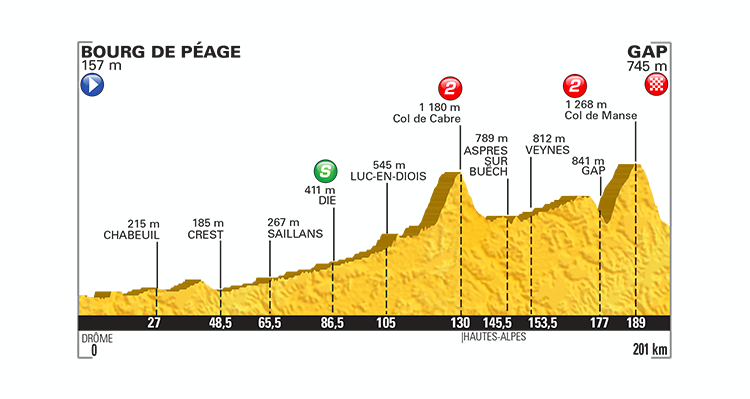
    Stage 16: Bourg-de-Péage › Gap – 201km

    In the final day of racing before the second rest day at the Tour, the peloton will take on a deceptively challenging 201km Stage 16 from Bourg-de-Péage to Gap. It’s the very definition of a transition stage, with the route taking the riders right into the foothills of the Alps in preparation for several tough days in the high mountains.

    As such, the road takes a gentle upward bent for the first 120 kilometers that, despite lacking any categorization, will certainly put a bit of fatigue into the legs. Then comes the Cat. 2 Col de Cabre, 9.1km at 4.6%—it’s not an extremely difficult climb, but coming after a sustained gradient, it will hurt a lot more than the metrics might suggest.

    A quick descent leads down to another uncategorized upward drag, before a speedy downhill into the second and final climb of the day, the Col de Manse. A Category 2 ascent at 8.9 kilometers at 5.6%, it’s another uphill test that will do more damage than the gradient would suggest.

    From the top, it’s a steep, technical descent almost all the way to the finish line. Things only flatten out inside the final 4 kilometers.

    The Tour has a great appreciation for Gap and for this particular route to the line—the race has finished there several times, especially in recent years. Every race is different, but if past trips to Gap are any indication of how this stage might play out, the breakaway will have a great chance, and the GC riders should be on their toes.

    This is an excellent profile for a long-range move. The sprinters won’t really have a shot at the stage, and the Alps loom large, which will likely inspire the GC types to take it easy for most of the stage, at least until the final climb of the day. That will give the early breakaway an advantage, and even if an early move gets reeled in, others will likely be primed to jump clear as soon as the catch is made. Whatever the scenario, it will take a large engine, strong climbing legs, and excellent descending skills to win Stage 16. It’s long, there are a lot of vertical meters, and the descent into Gap is quite difficult—difficult enough to ruin Joseba Beloki’s career via a nasty crash, and difficult enough to force Lance Armstrong to show off his cyclocross skills when run off the road, when the Tour visited the same downhill in 2003.

    Given the high likelihood of breakaway success (I rate odds of a long-range win at better than even) on Stage 16, there is really no single top favorite—there are only riders who will be more likely to succeed on the day.

    Predicting which riders will make it into the main break has been an especially difficult proposition recently, with the teams of the GC outsiders putting in a lot of work to protect minor placings on the leaderboard. Plenty of riders at the fringes of and just beyond the Top 10 will be hoping to get up the road for stage honors here but that could be difficult given the competition.

    Jan Bakelants has the wide array of talents, and the knack for getting into long-range moves, to thrive on Stage 16. He flashed excellent form on Stage 13, outclimbing nearly everyone on the steep uphill finale. If he’s in the lead group near the end of the day, the late climb and then the descent into gap will be an excellent opportunity for Bakelants to go in pursuit of a stage win. Alexis Vuillermoz and Romain Bardet give AG2R two more great options.

    Michal Kwiatkowski is among the best descenders in the Tour de France peloton. On form, he combines uphill ability and finishing speed better than almost anyone in the race as well. At his best, Kwiatkowski would be a hot favorite for this stage, but he’s clearly not at 100% in this race. Still, Kwiatkowski has been active in the breakaway game and if he can hold on over the final climb, he’ll be deadly in the downhill run to the line.

    Tinkoff-Saxo’s stated main ambition coming into the Tour de France was Alberto Contador’s GC campaign, but the team’s stagehunting aspirations have grown stronger and stronger as the race has gone on. This is an excellent profile for Tinkoff-Saxo’s stagehunters. Peter Sagan won’t have an easy time getting into the breakaway, but it’s certainly a possibility, and if he’s in the lead group at the end of the day, he’s got to be the top favorite. But even if Sagan misses out on a successful breakaway move, the team has other great options from afar. Michael Rogers is an excellent descender and won a similar stage from the break in last year’s Tour de France. Rafal Majka is in good form as well, and he’s a good bet to try to jump clear on the late climb.

    Joaquim Rodríguez already has a pair of 2015 Tour wins, one from the breakaway. Rodríguez isn’t quite at his best form, but he’s still a stronger climber than most other potential breakaway candidates for the stage victory. The biggest question mark for Purito will be whether he tries to get into the move here, or whether he saves energy for the Alps.

    Europcar also has options. Tommy Voeckler will appreciate the profile, and Cyril Gautier looks to be on very good form in this Tour (and has been active so far trying to get up the road). Pierre Rolland could try to get clear on the Col de Manse as well.

    Vincenzo Nibali’s Grand Tour-winning climbing ability and elite descending skills will make him a top contender—if he’s at the front of the race at the end of Stage 16. Nibali’s current Top 10 GC position, though, may have his fringe GC rivals riding defensively to try to keep him from getting up the road, either in the early breakaway, or even late on in the day on the last climb. He’s got a great chance at Tour de France redemption via a stage win with this profile, but it won’t be a cakewalk getting clear of the peloton.

    Sylvain Chavanel, Greg Van Avermaet, Dan Martin, Ryder Hesjedal, Jarlinson Pantano, Jakob Fuglsang, Wilco Kelderman, Simon Geschke, Rigoberto Urán, and Simon Yates are other candidates on the very long list of potential contenders from afar on Stage 16.

    Regardless of whether the break is reeled in, the GC teams will likely drive a hard pace on the final climb—the Col de Manse has opened up gaps on the GC leaderboard in the past, and the day before a rest day in this year’s race, some of the more enterprising climbers in the pack could be on the lookout for opportunities to put their rivals into danger. That will make for a tough day in the peloton, likely to drop most of the traditional quick men from contention if the break does get caught.

    Alejandro Valverde will be a favorite from the pack on Stage 16, given his strong descending abilities and terrific finishing kick. Tony Gallopin, whose climbing legs are more impressive right now than they’ve ever been, will have a great shot if this comes down to the pack as well, given his downhill skills and his impressive top-end speed. Chris Froome and Nairo Quintana can’t be counted out either. The latter has tried to test the former at every opportunity he’s gotten so far.

    Michael Matthews, Matteo Trentin, Robert Gesink, Bauke Mollema, and John Degenkolb are others who will have a shot with the potential for a reduced sprint from the peloton.

    VeloHuman Stage 16 Favorites

    1. Jan Bakelants | 2. Joaquim Rodríguez | 3. Alejandro Valverde

    With a rest day on tap following Stage 16, the next stage preview will be up on Tuesday—in the meantime, check out the latest episode of the Recon Ride podcast, which previews the final five stages!

    -Dane Cash

  • Eneco Tour 2013 Pre-race Outlook

    Eneco

    All-rounder Roundup

    The weeklong drought of WorldTour racing since Weening took the Tour de Pologne in grand style with a strong final stage performance is finally over. The Eneco Tour is here, and WT cycling is finally returning to the territory of the spring classics, with the occasional crosswinds, cobbles, and short but steep climbs to keep things interesting.

    In years past, this has been a race whose outcome has been almost wholly determined by time trialing prowess, with one or two stages against the clock providing the brunt of the time gaps, and a number of flat stages in between. Organizers have gradually provided more and more bumps in the road to liven up the GC, with last year seeing an ascent of the Muur van Geraardsbergen (formerly of the Tour of Flanders) in the queen stage, a climb that shook up the leaderboard and gave Lars Boom the victory and Niki Terpstra a podium position.

    This year’s Eneco Tour is the hilliest yet. Stages 1-4 will be for the sprinters (though hills on Stage 2 might reduce the pack a bit), but then the GC battle will heat up on some difficult roads. The Stage 5 time trial is short — 13.2 km — but technical and lumpy, too. Stage 6 combines the roads of Amstel Gold and Liege-Bastogne-Liege, and Stage 7 returns to Geraardsbergen. Last year’s GC was dominated by time trialists who were capable of staying with the pack on the tougher classics-style climbs. This year’s hills should be even more selective in terms of the overall leaderboard. The winner will be a true all-rounder, who can possibly nab bonus seconds at the finish lines, produce a top-tier time against the clock, and climb at a high level.

    Last year’s winner, Lars Boom, is a capable climber, a top-notch time trialist, and a good enough handler to take on the technical course. He’s likely to repeat a high level performance; however, his results this year have not been as impressive as he might have liked; he didn’t make the podium in the Dutch time trial championships, his classics campaign was disappointing, and he did not produce any remarkable results in the Tour de France. Moreover, the hilly route may be a bit too much to ask from Boom to expect an outright victory. A podium may be doable, especially with the support of a strong team Belkin. The Dutch squad may have another rider better suited to this year’s edition, coming off a strong win in the Tour of Denmark: Wilco Kelderman. Kelderman is already sporting top 10s in this year’s Tour Down Under and Tour de Romandie, and he is targeting this race. He is a good climber who should be able to hang on when the road goes up: the 22-year old could be primed for a high finish.

    Serious competition could come from another Benelux squad, Omega Pharma-Quick Step. Sylvain Chavanel was second last year and also in 2009. His 11th in the San Sebastián might not have been as great as he’d hoped for, but he managed to hang with a group of strong-climbing chasers to show good form after a disappointing Tour de France. He won the French time trial championship in June and, despite lacking a signature World Tour win this year, he’s managed a number of top 10s in stage races and classics in 2013. With help from a team well-suited to succeed low country crosswinds, Chavanel should be able to hang on the hilly stages, even if he loses a few seconds to climbing specialists atop summit finishes, and he’s sure to place highly in the time trial. Teammate Niki Terpstra, 3rd last year, may find the parcours a bit trying, but he’s another strong bet for a good finish.

    Bradley Wiggins leads Team Sky at the Eneco Tour. At his best, he’s certainly able to hang on on these types of climbs, and he’s one of the strongest time trialists in the world (and one who thrives with a hill or two in a race against the clock). He showed last week in the Tour de Pologne that he’s still capable of dominating the discipline, winning by nearly a minute over Fabian Cancellara. The big question is, of course, whether or not the 2012 Tour de France winner is targeting the General Classification here. His big target for the year is the World Championship time trial, and he will surely look to outshine the competition on the Eneco Tour’s fifth stage. Only time will tell whether he plans on fighting for GC. If so, it’s hard to look past his combination of skills.

    Orica GreenEdge is primed to get plenty of sponsorship time on camera with a strong team of all-rounders on the start list. Svein Tuft has done well in past Eneco Tours and figures to at least place highly in the Stage 5 TT. However, last year’s hills proved his undoing, and this year’s parcours will not do him any favors. Teammates Pieter Weening (fresh of a Tour de Pologne win) and Sebastian Langeveld (top 10s this year in Paris-Roubaix, the Tour of Flanders, and E3 Harelbeke, and 9th in last year’s Eneco Tour) are maybe stronger candidates for GC this year.

    lieuwe

    Lieuwe Westra won the Dutch TT championship and he’s got the package of all-rounder skills necessary to finish highly. Unfortunately, Westra was forced to pull out of the Tour de France due to some health problems. He seems to be recovered, but the question marks remain, enough to keep him out of my podium predictions. If he’s healthy, I can see him winning the whole thing, and Dutch squad Vacansoleil would sure love to have something to be proud of this year, currently sitting at dead last in the UCI team rankings.

    RadioShack-Leopard sends Belgians Jan Bakelants and Stijn Devolder to the Eneco Tour. Devolder’s past few years have been frustrating in terms of results, but he did just win the Belgian national championship race. Bakelants was third in that championship race, and just took a stage in the Tour de France in impressive style. He was 10th in last year’s edition of the Eneco Tour, and a capable all-rounder. A repeat top 10 might be doable, as Bakelants is the type of rider who should not be too troubled by some added inclines. Maxime Monfort of RadioShack is a bit of a dark horse to keep in mind: it’s unclear whether he’s targeting the Eneco Tour, but he’s a Belgian with strong all-rounder capabilities who had a good under the radar Tour de France (14th overall).

    Philippe Gilbert has had an immensely disappointing season in the rainbow jersey, but top 10s in Amstel Gold and Liege-Bastogne-Liege and a 2nd place at Brabantse Pijl suggest that he’s not totally off-form in 2013. He’s also not a bad time trialist when he puts his mind to it, nabbing second at the Belgian champs this year. The final two stages fit the skill set of the Boar of the Ardennes, and he’s was champing at the bit all Tour while riding in support of disappointing teammates. A stage win would be completely within reasonable expectations of the Gilbert of 2011 (when he was 2nd overall and took a stage), but it is unclear whether he’s got much of that old self left. Still, he deserves a mention not just as a stage win contender, but as a possible GC threat, with the support of a strong team BMC.

    Argos-Shimano’s stable of sprinter talent shouldn’t make you forget young Tom Dumoulin, who scored podium positions in the Dutch road and TT champs. He is targeting the Eneco Tour and should be up to the variety of challenges the weeklong race poses. I tend to use a “Watch Out For” tag to tip young up-and-comers or dark horses who could be boom or bust type picks, but I really think Dumoulin will be in the top 10 overall, so he merits mention as more than just a sleeper pick.

    Moreno Moser leads the Cannondale attack after a top 10 in San Sebastián and a great showing on the double d’Huez ascent in the Tour. He’s only 22 so the word “inconsistent” probably isn’t appropriate, but his results have been a bit hard to predict. He lacks much in the way of time trialing results in his young career, but this one is a short one, with a pair of lumps. Moser could do well in the GC if he can deliver on the hard uphill finishes.

    Simon Spilak leads Katusha, and he certainly has the climbing and TTing chops to compete. Weeklong stage races have been his forte. However, after a strong start to the season, Spilak’s form is in question this August.

    Stagehunters

    The sprinting and pure time trailing talent in attendance at the Eneco Tour should make for some exciting individual stage finishes. Headlining the fast men are Marcel Kittel and Andre Greipel. Theo Bos and Mark Renshaw of Belkin, Tyler Farrar, Yauheni Hutarovich, Danny van Poppel, Ben Swift, Gert Steegmans, Daniele Bennati, Arnaud Demare, Elia Viviani, Francisco Ventoso, JJ Rojas, and Daryl Impey could also feature in the bunch sprints.

    Contenders for the win in the time trial will also be numerous, with a number of pure TT stars in attendance beyond those riders who can TT and climb well enough for GC. Svein Tuft and Taylor Phinney headline the list of guys who might find the week as a whole too hilly, but who could perform highly in the time trial. Both have done well time trailing here before (and in GC, as well, though this year will likely prove too lumpy). Alex Dowsett, who won the first ITT at the Giro and took the national title in Britain, is also in attendance. Wiggins, mentioned above, might be interested in GC, but he is certainly interested in coming away with a win in Stage 5, and if I had to pick one name for the stage win, it would be his.

    VeloHuman Predictions

    General Classification Winner

    Sylvain Chavanel

    GC Podium

    Wilco Kelderman, Lars Boom

    Other Strong GC Contenders

    Bradley Wiggins, Tom Dumoulin, Philippe Gilbert, Lieuwe Westra, Moreno Moser

    Stages

    Stage 1: Koksijde > Ardooie | 175.3km | Flat

    Stage 2: Ardooie > Brussel | 176.9km | Medium Mountains

    Stage 3: Oosterhout › Schouwen-Duiveland | 187.3km | Flat

    Stage 4: Essen › Vlijmen | 169.6km | Flat

    Stage 5: Sittard-Geleen › Sittard-Geleen | 13.2 | ITT

    Stage 6: Riemst › Aywaille | 150km | Medium Mountains

    Stage 7: Tienen › Geraardsbergen | 208km | Medium Mountains

    -Dane Cash

    Photos by Wouter de Bruijn and Georges Ménager.

  • Tour de France 2013 Day 3: Where We Stand After Three Stages, and Looking Ahead to Stages 4-7

    Day3PicCrop

    Day 3: A Wild Corsican Start

    Eschewing a prologue this year, the Amaury Sport Organization decided to kick of the Tour de France with a flat stage and two hilly stages, ensuring action from the get go. We knew stage 1 would be hairy, ridden at times on narrow, windy roads even if it was flat, but we never could have predicted the crash-ridden affair that was. The Orica-GreenEdge team bus arrived at the finish late and (according to them team) was waved through the finish line toward the parking area… despite the fact that the gantry (a structure built set up several meters above the finish line that serves multiple purposes for signage and timing) had already been put in place. Predictably, the bus got stuck under the apparatus when the riders were less than an hour out, and what was initially a humorous affair turned crazy when the race staff could not manage to get the bus out. Over race radio, they informed the riders of an incident, and officially moved the finish line 3km closer… Minutes later, as the riders were closing in on the new makeshift finish line, staff succeeded in moving the bus, and back over race radio came the organizers, letting the riders know that the finish was now the original finshing line. Moments later (probably largely as a result of the confusion and rapid change in tempo), a few riders touched wheels and a massive crash took down a number of big names, including Peter Sagan, Tony Martin, and Alberto Contador. Stage favorite Mark Cavendish stayed upright but was stuck behind the carnage. A severely reduced bunch escaped the mess and among them was, Marcel Kittel, who managed to gallop to the stage win, his first in the Tour de France. Typically, if a crash occurs in the last three kilometers of a race, riders are given the time of the group they were with pre-crash; therefore, while the crash did not occur within there kilometers of the original finish, what with all the confusion about the finishing line caused through no fault of the riders, it was all but expected procedure when race organizers gave all riders the same time for overall classification on the day. While Tony Martin had to take a trip to the hospital, and others suffered bruises and cuts, nobody was too seriously injured.

    Marcel Kittel wore yellow for Stage 2, and all 198 original riders managed to made the start, scabs and sore elbows be damned. Unfortunately for Kittel, the hills proved to much for the young rider, and he was dropped from the bunch, along with Cavendish and Greipel, well before the finish line. What looked like Sagan’s day to lose became much more exciting when a group of six riders struck out for glory from the pack after the day’s final descent with only a few kilometers to go, Sylvain Chavanel among them. Sagan and the rest of the peloton gave vigorous chase and rounded up all but Radioshack’s Jan Bakelants, who managed to huff and puff his way to a one second victory over the hard charging sprinters. With it came the yellow jersey and a 1 second lead over the others. Sagan took second on the day.

    Stage 3 was even hillier, and once again, the flatland sprinters found themselves distanced on the climbs, leaving familiar names like Peter Sagan, Edvald Boasson Hagen and Simon Gerrans to duke it out for the win. Gerrans enjoyed a perfect leadout round the final corners and down the straightaway, and despite Sagan’s best efforts to ride Orica-GreenEdge’s wheels (a number of Cannondale riders couldn’t hang on over the climbs) before launching toward the finish, he ran out of road and Gerrans claimed Orica’s first ever Tour de France win. Sagan nabbed another second and with it, the green jersey, while Bakelants remains in yellow with his single second lead over everyone else. Despite not yet bagging a stage win, Sagan sits in a strong position in the points competition with two near-wins to Cavendish/Greipel’s combined zero top 20s. All three have managed to keep it close in intermediate sprints.

    Now, I’ll look ahead to the next stretch of racing. We’ve moved to the mainland, and kick it off with a team time trial followed by three days before the Pyrenees.

    Stage 4: Nice > Nice | 25km | TTT

    Stage 4’s team time trial is too flat and too short to see large time gap’s form, so I don’t think it will have too lasting an impact on the overall general classification; however, with 70+ riders sitting a one second back on Jan Bakelants and a number of non-selective stages to come, the highest placed rider on the winning team tomorrow will likely wear the yellow jersey for several days. Stage 1’s craziness shakes up the team time trial. Had some big names, including world’s-greatest-time-trialist, Tony Martin, not taken a hard fall in that mess, I’d consider this a showdown between Omega Pharma-Quick Step and Sky, both of whom bring very strong teams to the Tour. Without Martin (OPQS) or Geraint Thomas (Sky) at full strength, it’s going to be harder to predict; but I’d still take OPQS and Sky over the others. Omega Pharma’s 23-year old Michał Kwiatkowski stands to win yellow if his team can deliver a victory, and if they do, he might even be able to hold it for several days, being a capable climber. Chris Froome, Richie Porte, and Edvald Boasson Hagen will lead a powerful Sky team against them with the possibility of EBH taking yellow if they win. I don’t think I have any surprise names for this one teamwise, as the team time trial is a discipline that favors the strong teams. Other contenders include BMC, Garmin-Sharp, Belkin, Orica-GreenEdge, and Movistar — people seem to underrate Rui Costa and Nairo Quintana as time trialists.

    Stage Favorites:

    1. Omega Pharma-Quick Step | 2. Sky

    Stage 5: Cagnes-sur-Mer > Marseille | 228.5 | Flat

    With an early Category 3 climb and then three Cat 4s, it’s no gimme that Cavendish, Greipel, and Kittel will make it to Marseille with the bunch. But the Missile and Gorilla know they have to make up a lot of ground for the green after missing out completely on the sprints at three straight finishes. If they don’t make it, obviously we can expect Sagan, EBH, Goss/Impey/Gerrans, and possibly John Degenkolb (though he failed to make it with the pack in both the second and third stages). However, I think most of the bunch gallopers are going to make it, and this could be Cavendish’s first stage win of the Tour. Hopefully, all three of Cav (probably), Greipel (probably), and Kittel (maybe) make it, so we can get a better idea of how each is doing form-wise in comparison to one another.

    Stage Favorites:

    1. Mark Cavendish | 2. Andre Greipel

    Stage 6: Aix-en-Provence > Montpellier | 176.5km | Flat

    A single Cat 4 climb stands out on an otherwise pancake-esque route. Barring a crash, it should be a day for the heavy hitter sprinters. GC contenders will try to stay clear of any messes. Peter Sagan will have a good opportunity to see whether his team, built almost completely around providing him with a strong leadout on the flats, can get him in contention here, especially after lackluster team showings on stage 2 and 3.

    Stage Favorites:

    1. Mark Cavendish | 2. Andre Greipel | 3. Marcel Kittel

    Stage 7: Montpellier > Albi | 205.5km | Medium Mountains

    The day’s four climbs in order: Cat 3, Cat 2, Cat 3, Cat 4. Unfortunately for the breakaway artists, there are roughly thirty downhill kilometers leading into the finish line, meaning that while a breakaway might survive for a while, it seems likely that the Sagan types in the peloton will charge hard on the descending roads to sweep them up after the flatland sprinters are dropped. On the other hand, with the Pyrenees looming, the GC types might want to hold off, which works in favor of the break. It’s a perfect day for Orica-GreenEdge, a team with a number of riders who are capable of winning in a breakaway AND winning in a reduced sprint, making either scenario favorable for the Australian squad. If I had to make a pick, I’d bet the group comes back together on the descent, pitting Sagan against whomever Orica-GreenEdge is riding behind and other versatile riders with fast finishes, like Francesco Gavazzi (Astana), or Edvald Boasson Hagen or Michał Kwiatkowski if they don’t mind going all out the day before they take to the high mountains. Given the likelihood of strong performances in Stage 4’s TTT from a number of teams who have good sprinter-with-climbing-ability types, one of the riders gunning for this stage win could be sporting the yellow jersey in the blur of the bunch sprint… if they manage to catch the breakaway.

    Stage Favorites:

    1. Peter Sagan | 2. Francesco Gavazzi

    -Dane Cash

    Photo by Jean François Bonachera.