After two comparatively easy days, the Vuelta a España peloton returns to the mountains for Stage 14.
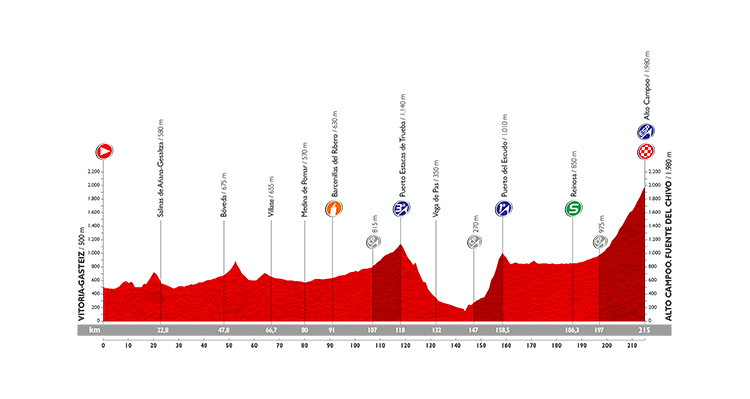
It’s a long one at 215 total kilometers, and though it opens with 80km without categorized climbs, things get pretty tricky after that.
At around kilometer 80 the road angles upward gently for 27 long kilometers into the foot of the first categorized climb of the stage, the Cat. 3 Puerto Estacas de Trueba. Officially the climb is only 11km at 2.9%, but taken with the uphill stretch prior to the categorized section it’s nearly 40km of climbing. The average gradient across that entire span may be less than 2% but that is still a very long time to be going upward.
The Cat. 3 summit is followed by a fast descent into the foot of a Cat. 1, the 11.5km Puerto del Escudo. The average gradient of 6.4% doesn’t really tell the whole story—the first 4km are not very steep but then the road kicks into the double digits for several prolonged stretches.
From the top of the Cat. 1 the riders will take a very brief downhill and then a long flat stretch before starting the final climb, the special-category 18km Alto Campoo, which has an average gradient of 5.5%. Again, the early slopes are relatively easy but the climb gets harder as it goes on.
Stage 14 is very long, and the three categorized climbs will be tough enough to put plenty of hurt into the legs. The profile, as with any mountainous profile, will give the breakaway a chance, especially if the GC riders are less inclined to ride a hard tempo with two more mountain stages ahead. On the other hand, the pace in the pack is likely to pick up on that long late flat section in preparation for a long final climb, which could doom a move up the road. With a few stages that could appeal more to the breakaway coming up, some long-range specialists could opt to keep the powder dry.
Among the GC riders in the race, Fabio Aru looks the strongest right now, and his team packs serious punch. If Aru wants to gain time on his rivals, he should be able to pull it off, as he’s just looked that good so far. However, with the overall victory very much in his reach, Aru could be focused entirely on the two riders within a minute of his lead, and that could open the door for others.
Rafal Majka has looked strong on every summit finish of the Vuelta so far. He’s currently sitting 4th overall, and while his deficit to Aru is not so great that Astana will just let him get up the road without a thought, he may be able to land an attack if there is any hesitation while Aru watches those closer to his lead. This is a great finishing climb for Majka, who might be just a bit behind some of the top GC men on the extreme gradients, but who is excellent in a sustained attack from a few kilometers out.
Joaquím Rodríguez needs to get moving if he wants to have a chance at winning the overall Vuelta title. Currently 2nd overall, this may be the best chance he’s going to get at a Grand Tour victory for the rest of his career. He has looked strong so far, though not dominant. He’s the most explosive rider within striking distance of the overall title, though, and if he can team up with Daniel Moreno to launch a move on this final climb, he’s got a shot at stage success.
Esteban Chaves, a bit further down on GC now, should have plenty of freedom to go hunting for another stage win. Alejandro Valverde has not looked at his best in the past few stages, but if he can recover some strength, he’s an obvious candidate for stage success now that he, too, is less of a GC threat. Movistar will want to do everything possible to get another stage win out of the Vuelta with sickness laying Nairo Quintana low.
Mikel Nieve is Sky’s best hope of coming away from the Vuelta with a result and he should get some breathing room. This climb suits him well.
It’s going to take a strong climber to win this stage from a breakaway, but there are a few good candidates for a successful long-range attack on Stage 14. Rodolfo Torres, Fabio Duarte, Giovanni Visconti, Andrey Amador, Vasil Kiryienka, and Darwin Atapuma are among the riders who could have a chance in that scenario.
VeloHuman Stage 14 Favorites
1. Rafal Majka | 2. Fabio Aru | 3. Joaquím Rodríguez
Stage 11: Andorra la Valle › Cortals d’Encamp – 138km
The Vuelta a España visits Andorra for Stage 11, and some are calling it the hardest Vuelta stage ever. I haven’t reviewed every Vuelta stage since 1935 to really get a clear, definitive sense of whether that’s true, but it’s certainly going to be really, really hard.
It’s actually a very short stage at just 138km, and none of the climbs are longer than 12km. It’s the steepness and unceasing nature of the climbs that makes this stage such a challenge: from the moment they leave the start line until they cross the finish line, the riders will be ascending vicious uphill gradients or flying down harrowing descents.
The first half of the stage is composed of a trio of Cat. 1s, all of them followed by technical, steep downhills. Then comes the special-category Collada de la Gallina, 11.7km at 8.5%, after which the pack will descend on a gradient about as steep as the one they just climbed.
That quartet of brutal tests would be enough for most mountain stages, but the Vuelta’s 11th stage concludes with a leg-breaking one-two punch. First it’s the Cat. 2 Alto de la Comella, 4km at a whopping 9.5%, and after a quick descent it’s an uncategorized uphill run into the Cat. 1 finishing climb.
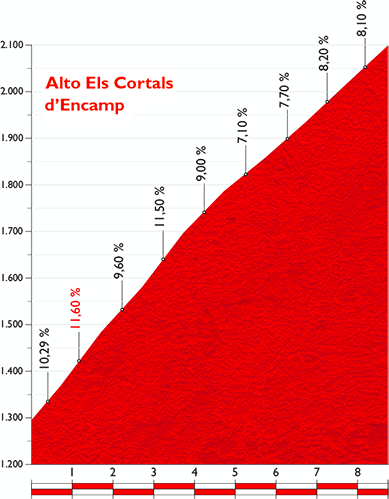
Stage 11 finally comes to an end atop the Alto Els Cortals d’Encamp, 8.7km at a 9.1% average gradient.
The Alto Els Cortals d’Encamp is a pretty regular climb—but it’s 8.7km at an average of 9.1%. Taking on two climbs of over 9% in such quick succession after such a tough day will probably see several big names see their GC campaigns go up in flames—there is just no way that everyone makes it up super-steep gradients unscathed.
On such a short stage, the pace is going to be high. In terms of trying to predict who will come out on top on this brutal day in Andorra, it’s already hard enough drawing conclusions from the earlier climbing stages in the race (which really can’t compare to this one), but the fact that this profile is pretty breakaway-friendly will further complicate things. However, this early queen stage will be a good opportunity for anyone who is feeling strong to make a huge statement in the GC fight, so we could see the top favorites testing each other early, and that will make it tough for a breakaway (as will the brutal finishing climb). That being the case, I see the top GC riders as better stage candidates than any individual breakaway candidates, especially since none of the long-range specialists have really established themselves just yet in this Vuelta.
Fabio Aru was the strongest rider on Stage 7 and among the strongest on Stage 9. I’d like his chances better if Vincenzo Nibali were still in the race, and if Mikel Landa were still a GC threat that could potentially go up the road and force others to chase, but Aru should still be a great pick for Stage 11. The final climb suits him well, brutally steep and long enough that he’ll really have a chance to launch a move from a little ways out as is his custom. I wouldn’t be surprised if some of his rivals were watching each other instead of him, giving him a chance to get up the road. The aforementioned Mikel Landa could have a chance as well if the team decides to let him go stagehunting.
Chris Froome did not look good on Stage 7 but came roaring back on Stage 9, suggesting that he’s starting to come around. This isn’t the sort of stage that screams Sky Train, but I think it’s sort of a misconception that Froome can only handle long, low-gradient climbs. He’s among the best in the world on the steep stuff, too, and he’s got more punch than people realize. I wouldn’t be surprised to see him tapping out his own pace early on the final climb only to leave his rivals behind in the finale. Nicolas Roche and Mikel Nieve have looked strong as well, and Sky, a squad that seems to understanding how little benefit there is to be gained from riding in a group on this gradients, will probably green light attacks if either is feeling good.
36-years-old or no, Joaquím Rodríguez has looked unflappable thus far in the Vuelta. He’s played things far more conservatively than expected, but he has also managed to stay right up there on all the important stages in the race. This stage might be a little too hard for the Spanish veteran, but if he can survive until the finale he’ll have a great place to go on the move. He’s a public proponent of Andorran cycling, and will be highly motivated to get something out of this one.
Nairo Quintana suffered a bit in the heat in the first week, but the Vuelta a España is entering cooler territory—and Quintana appears to be heating up. He’ll appreciate the consistently high gradients. Meanwhile, teammate Alejandro Valverde did not look quite as strong on Stage 9 as he had earlier in the week, so it could be Quintana’s time to make a statement.
Rafal Majka finished 5th on Stage 9 and probably has some intention of getting active here on Stage 11. While this profile will be a challenge, he should be fresher than many of the top climbers in the race, having ridden the Tour as a domestique and stagehunter instead of as a GC contender.
As amazing as Tom Dumoulin has been, I have a hard time seeing him staying in touch with the big climbing favorites on Stage 11. He can’t be ruled out, as he has defied expectation so far, but it would be a huge surprise. Esteban Chaves, on the other hand, should actually be pretty well-suited to the finishing climb, if he can recover from a bad day on Stage 9. Domenico Pozzovivo hasn’t been stellar in the Vuelta just yet, but if he can work his way into shape he should be able to get into the mix on this stage.
If the favorites are hesitant to put each other under pressure on this brutal stage, it wouldn’t be too much of a surprise to see someone sneak clear and win this stage from a breakaway. Stage 11 will have huge implications for the King of the Mountains Classification, so anyone with long-term KOM aspirations would do well to jump into the move.
We don’t have much to go on yet in terms of clear markers of climbing form from the long-ranges specialists, but Samuel Sánchez, Cyril Gautier, Jerome Cousin, Omar Fraile, José Goncalvez, Fabio Duarte, Rodolfo Torres, Daniel Navarro, Bart De Clercq, Gianluca Brambilla, Pierre Rolland, and Jurgen Van Den Broeck are all on the long list of riders with potential to play a role from afar on Stage 11.
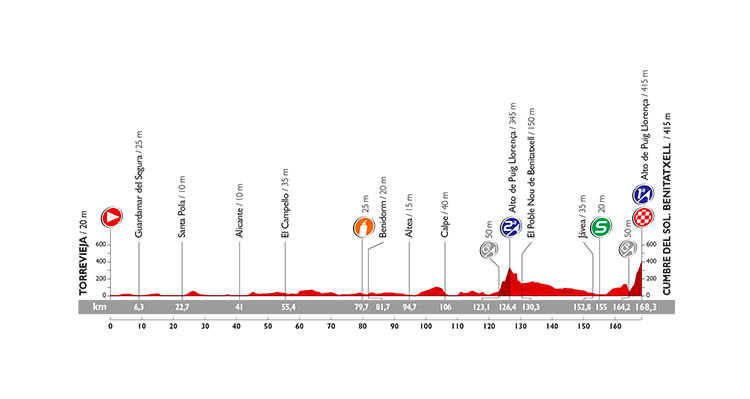
The Vuelta takes on another GC-oriented stage in its ninth day. Most of the relatively short stage is flat, but things get a bit more difficult in the final 50km. A Cat. 2 trip up the Alto de Puig Llorenca comes first, 3.3km at a steep 8.9%. Then comes a steep descent, followed by a more gentle stretch of downhill that extends for over 20km to the intermediate sprint at kilometer 155. Afterward comes a small uncategorized bump, another steep descent, and then the second trip up the Puig Llorenca, from a different side this time. The average gradient is again 8.9%, but it’s a 4.1km journey to the finish line at the top. A particularly brutal stretch of 19% awaits right in the middle of the climb, and the final few hundred meters hit the double digits again.
At just 4.1 kilometers long, the finishing climb is not exactly the Stelvio, but its vicious gradients will make for an explosive challenge. Now that Stage 7 has offered a glimpse of what’s what in this GC showdown, the stronger riders could seize the opportunity to put their rivals into the red zone on the extreme slope.
After a challenging, hot first week, and with an escapee-friendly profile, Stage 9 could appeal to the breakaway specialists. The usual favorites among the GC men haven’t exactly shown a great deal of interest in fighting for stage wins. However, none of the marquee climbers have fallen too far out of contention just yet in this Vuelta, and it will take a pretty strong group to survive if the peloton does ramp up the pace in preparation for the final climb, so it’s hard to see any individual breakaway candidates as top favorites over the heavy hitters in the red jersey battle.
The short but brutally steep climb should suit Joaquim Rodríguez. Based on his skillset, he has to be seen as a favorite. However, Rodríguez has been very conservative so far in the race, and that makes it harder to view him as anything close to a consensus top pick for the stage. He can’t expect to hesitate his way to a stage win, or a Vuelta win for that matter. If he goes on the move, he’ll be deadly. The same is true for Katusha teammate Daniel Moreno.
Fabio Aru was the strongest rider on Stage 7, opening up a significant gap on his rivals when he launched his move on the final climb. Unlike Rodríguez, he took risks on that stage, and he might be looking to do so again here. This climb doesn’t suit him all that well compared to a few of the extremely explosive climbers on the startlist, but I think he’s strong enough to win anyway. Mikel Landa makes for a fine alternative for Astana.
Esteban Chaves has shown already in this Vuelta that this sort of climb suits him well. Getting into the second week of the race, Chaves is entering unknown territory, but he hasn’t shown signs of slowing down yet, and he could find himself in the mix again on Stage 9.
Alejandro Valverde has looked strong so far in the Vuelta, but maybe not at peak form. He also isn’t particularly keen on jumping clear of the pack, which he’ll probably need to do to win this stage. Still he’s always a danger, as is Nairo Quintana, who could light up this race at any minute once he starts getting back to his best.
Domenico Pozzovivo should find the terrain to his liking, and after a slow start he looks to be getting stronger. Unlike most of the other red jersey hopefuls, Pozzovivo doesn’t have a Grand Tour in his legs, and could find himself feeling a lot fresher than his rivals. He also might get a bit of leeway if he goes on the attack, as the likes of Movistar and Katusha look at each other instead of anyone else.
Nicolas Roche will find this gradient extreme, but he has looked good so far, as has Sky teammate Mikel Nieve. I’m not ready to write Chris Froome off yet either, though I still probably won’t write him off even if he loses ground on this stage, for that matter, as I think he’s riding himself back into form at the moment.
Rafal Majka, Samuel Sánchez, and Louis Meintjes are others to watch on the final climb.
If the GC favorites don’t feel like putting their teams to work chasing down escapees, Pello Bilbao, Rodolfo Torres, Fabio Duarte, Gianluca Brambilla, Alessandro De Marchi, Bart De Clercq, Daniel Navarro, and Cyril Gautier are among the many riders who could find success in the early break or with a late strike.
Be sure to follow @VeloHuman on Twitter for more analysis and commentary during the race, and check back for the preview of the next stage after the conclusion of Stage 9. The VeloHuman overall Vuelta a España race preview is available here. Also, don’t miss the latest Recon Ride, which covers all the big storylines ahead of Sunday GP Ouest-France.
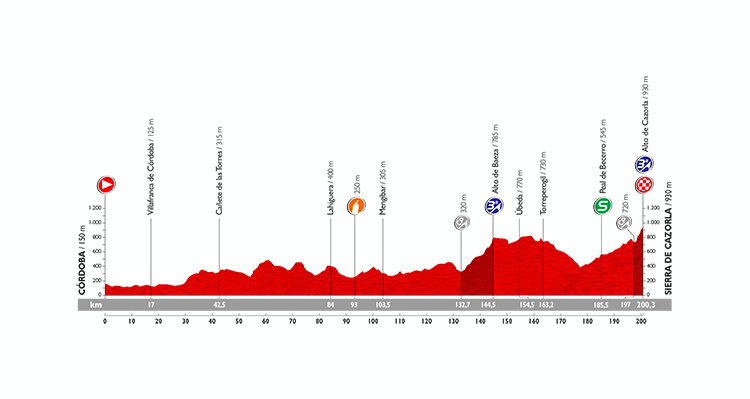
The Vuelta peloton will be tested with another uphill finish on Stage 6, and it should be a real challenge despite there being just two Cat. 3 climbs the menu. It’s not a short stage at 200 kilometers and the finale will be a difficult one.
After 130 kilometers of rolling hills comes the first categorized climb of 12km at an average gradient of a little under 4%. It’s not much but it will put some fatigue into the legs. Following a few more rollers and a descent comes the long climb to the finish line, which will last a lot longer than the official categorized finale. Apart from a few moments where the road evens out, it’s uphill from a little more than 20km out all the way to the line, at an average gradient close to 2% for the entirety of the long uphill stretch, which gets more difficult at the end.
The categorized finale itself starts at around 3km to go, and the climb has an average gradient of well over 6%, with a double digit stretch about a kilometer in that could serve as a nice launching pad for an enterprising climber. The road winds left and right a few times up toward the finish, where the gradient is closer to 7%.
The breakaway has a chance at success on this profile but this early in the race there are plenty of potential contenders still in the GC hunt who should be able to reel in any long-range hopefuls on the lengthy climb toward the finish. Expect the red jersey favorites to go toe to toe in the finale, even if it is only a Cat. 3 ascent.
The length of the stage and the fact that the last 20km are almost all uphill should whittle down the peloton and leave only the specialists in contention. Katusha has two. Joaquim Rodríguez has missed out on more than one excellent opportunity already in this race, but he has looked strong enough from a form standpoint and this will be another chance for him to shine. He needs to be aggressive, but he’ll be heard to catch if he does launch an attack in the finale. Daniel Moreno is a strong alternative, especially if the pack is still together near the top of the climb.
Alejandro Valverde already has one stage win in the Vuelta and has a nice opportunity to take a second (and the accompanying bonus seconds) on Stage 6. He can follow attacks rather than making them because he has so a strong sprint, and that makes him dangerous. Nairo Quintana could be interested in going on the move as well.
Dan Martin isn’t always the best at positioning himself for a timely strike, but if he can work that out he’s got the chops to make a move in this finale. Like Purito, he hasn’t quite delivered on the two stages that have seemed to suit him so far in the Vuelta a España, but form doesn’t appear to be an issue.
Fabio Aru has not been the strongest yet in this race but he has the team to set him up for a late strike and explosiveness to execute, if he’s feeling strong. The same is true for teammate Mikel Landa.
Nicolas Roche has been Sky’s strongest performer so far and could get active again, though don’t count out Chris Froome. He’s quietly looking pretty strong in this race, and he always likes an early opportunity to make a show of authority in a Grand Tour. Sergio Henao is another strong option for the black and blue squad.
Rafal Majka, Esteban Chaves, Samuel Sánchez, Bart de Clercq, and Domenico Pozzovivo are other riders to keep an eye on for Stage 6. Tom Dumoulin will have his work cut out for him defending his red jersey on the steep inclines of the final few kilometers.
If the big GC favorites and their support riders spend too much time looking at each other, the opportunists will have a chance at long-range success, either from the early break or with a late move once the initial break has been swept up. The list of potential candidates for the victory in that scenario includes practically every rider on Team Colombia and Caja Rural. Pello Bilbao and Rodolfo Torres stand out as particularly strong options.
VeloHuman Stage 6 Favorites
1. Joaquim Rodríguez | 2. Alejandro Valverde | 3. Dan Martin
Be sure to follow @VeloHuman on Twitter for more analysis and commentary during the race, and check back for the preview of the next stage after the conclusion of Stage 6. The VeloHuman overall Vuelta a España race preview is available here.
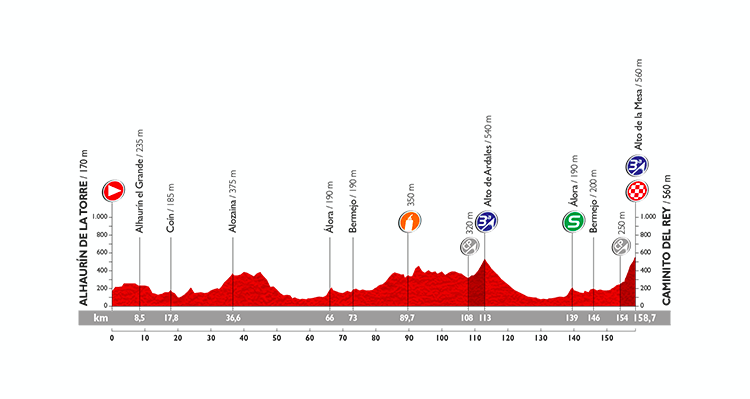
Stage 2: Alhaurín de la Torre › Caminito del Rey – 158.7km
After a strange opening TTT without GC implications, the Vuelta a España kicks off in earnest on Sunday’s Stage 2.
At 158.7 kilometers, Stage 2 is a short one, but a sting in the tail will bring the GC riders to the fore, which is rather unusual for such an early stage in a three-week race. The day finishes with a 4.7km climb at an average gradient over 6%, with a few steeper sections near the finish. It’s not L’Angliru, but it won’t be a cake walk either, especially this early in the race before many riders have gotten acclimated to the pace of a Grand Tour.
Without any separation on the GC leaderboard as of yet, the peloton will probably drive a hard pace to keep the break on a short leash, though it remains to be seen just which teams will do the work. The shortness of the stage should only increase the speed in the peloton. It’s likely that the pack will hit the final climb at a dogged pace, which could blunt any long-range moves. However, on the slopes of the ascent to the finish, things could change dramatically. Any hesitation could see an attack go clear on the steep stuff. In the event that that doesn’t happen, a strong finishing kick will come in handy, as the final few hundred meters do even out a bit.
Dan Martin is a specialist in this sort of finish, and delivered multiple near misses on similar late climbs in last month’s Tour de France. It’s been a disappointing year for Martin, but he’s shown strong form at times, and should be in the mix here in the Vuelta’s Stage 2. The fact that the top GC favorites probably won’t see him as too much of an overall threat could give him an edge should he try for an attack from a little ways out, and he also happens to have great finishing speed for a sprint should that be necessary. He has lived in Spain for some time now, and tends to do pretty well in his adopted home country, having taken his first Grand Tour stage win at the Vuelta back in 2011. In-form teammate Joe Dombrowski is another strong option for Cannondale-Garmin.
Alejandro Valverde was brilliant in the first half of the season, and if he still has anything left in the tank after a tough Tour de France, he’ll be in the mix for this finish, which suits him very well. Of the top GC riders in the race, he is far and away the fastest in a reduced sprint. He probably won’t be given any breathing room to go on the move, but if Movistar can keep a lid on any late attacks (and they have a team capable of taking control of the race), Valverde will be hard to beat. This finish isn’t hard enough to really favor Nairo Quintana, but don’t count him out either—Quintana is a danger any time the road goes up.
Katusha’s one-two punch has a great chance at success on this stage. Joaquim Rodríguez should come into the stage ready for a showdown, and the finish suits him very well. Expect to see him teaming up with Daniel Moreno to try to set the tone for Katusha early on in this race. Both should be a bit fresher than many of the top climbers in this Vuelta; Moreno didn’t race the Tour at all, and Rodríguez played a stagehunting role there instead of fighting for a GC result.
Astana’s Fabio Aru should also bring plenty of freshness into this finish. He was already showing strong form in the Tour of Poland. If he pours all his energy into an attack on the final climb, he could get some separation. Teammates Vincenzo Nibali and Mikel Landa are obvious options as well.
This short climb isn’t the sort of test typically seen as preferred terrain for Chris Froome, but when he’s motivated, he’s almost impossible to keep down; don’t underestimate his chances. Still, Sergio Henao could be the best option for Sky. The Colombian is on great form, and he’s got some pop for a late move or a finishing sprint.
This finish is probably a bit hard for a Peter Sagan who is in Spain to build up form for Worlds, but he deserves a mention ahead of a stage that he might have a chance at on peak form. The same is true for Simon Gerrans, coming back from a collarbone injury.
Domenico Pozzovivo may find the climb a bit too short for his liking, but he’ll be among the freshest riders in the entire race, and he could get some breathing room for an attack if the top favorites start looking at each other. Esteban Chaves, Samuel Sánchez, Carlos Barbero, Pello Bilbao, Rafal Majka, Jelle Vanendert, Daniel Navarro, and Pierre Rolland are others who will have a shot at success on Stage 2.
VeloHuman Stage 2 Favorites
1. Dan Martin | 2. Alejandro Valverde | 3. Joaquim Rodríguez
Be sure to follow @VeloHuman on Twitter for more analysis and commentary during the race, and check back for the preview of the next stage after the conclusion of Stage 2. The VeloHuman overall Vuelta a España race preview is available here.
The 2015 Tour de France may be over but the WorldTour rolls on. The Clásica de San Sebastián (or the Donostiako Klasikoa in Basque) is the next race on the docket. It’s a hilly event that has just the right profile to inspire plenty of attacks, in a region mad for cycling, and its position on the calendar makes it a tough race to predict—some of the stars of the Tour de France are in attendance hoping to get just a bit more out of their legs, while a few other big-name riders are returning to racing for the first time and hoping to get back up to speed quickly.
The San Sebastián organizers made a small but impactful change to the race route last season that led to an exciting finale, and the event returns to that successful parcours for 2015.
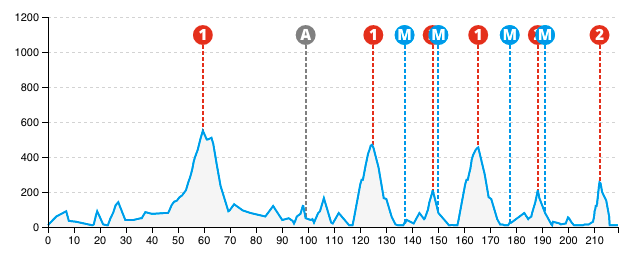
The race starts and finishes in the coastal town of San Sebastián, looping in and around the environs to make for a total race length of 219.2 kilometers.
The harder climbs on San Sebastián profile are categorized as if this were a stage race, and there are six such challenges on the route. The Category 1 Iturburu climb, crested around kilometer 60, is no slouch, but it’s early enough to be more of a leg-softener than anything else.
Once the peloton hits the slopes of the Jaizkibel, the more enterprising riders in the bunch will have one opportunity after another to go on the attack, all the way to the last climb of the day less than 10km from the finish.
Things get more consistently difficult after the midway point of the route with the first trip up the Jaizkibel, the marquee climb of the race. It’s another Cat. 1 ascent, roughly 8 kilometers in length with an average gradient over 5%. After a descent, it’s not long before the riders reach the Cat. 2 Arkale, a short but steep climb and the third categorized test of the day. From the top of the Arkale, the pack will make a downhill trip right back to the foot of the Jaizkibel, where they’ll take on both the Jaizkibel and then the Arkale a second time.
After the second descent from the Arkale comes the final run-in to town, but there’s a tough climb along the road to the finish. The Bordako Tontorra climb to Igeldo is a short but steep Cat. 2 crested just over 7 kilometers from the finish. It’s less than 3km in length but with an average gradient nearing 10% and sections in the 20% range, it’s a hard road to the top. After the climb comes a descent into a flat finish.
The Contenders
The profile favors strong climbers with a lot of punch. It’s probably possible to attack from the more pure-climber-friendly Jaizkibel or from the Arkale and hold out to the finish, but it’s more likely that the race comes down to the last bump in the road, which is more suited to the Ardennes-style riders than the big stage racing stars.
That late climb shook up the race last year, providing Alejandro Valverde with a launching pad to go on the attack for the win. Because the parcours is so up-and-down already, the peloton is pretty thinned out by the time it reaches the final 10km—even if attacks on the Jaizkibel and Arkale are reeled in, it’s still very hard to keep things altogether on the last climb. In case it’s a small group that reaches the finish, a strong flatland kick will be important to anyone hoping to win.
However things play out, Valverde is capable of winning this race in pretty much any scenario, which is probably why he is a two-time champion. Coming off of a Tour de France podium, and in the middle of an excellent season (in which he dominated the hilly spring classics), it’s hard not to see Valverde as the clear favorite. He’s among the best climbers on the starlist who can thrive on pretty much any gradient, and he’s got more punch than most of his rivals. Valverde could win this with another late attack, or he could follow the moves in the finale and hold out for a reduced sprint. Giovanni Visconti is a good alternative for Movistar.
As good a candidate as Valverde is to win this race, however, the Clásica is still a pretty wide open event. It’s always hard to say how riders’ legs will react coming into the race. Valverde went very deep fighting for a Tour de France podium spot.
Philippe Gilbert is another former winner who has been on terrific form of late. If the pace is really high over the finale climb, the Philippe Gilbert of 2015 may have just a bit of trouble holding on all the way up, but if the peloton plays the early slopes cautiously, Gilbert will be well-positioned to make a late attack or to look for a sprint win. BMC has some serious firepower behind Gilbert, though—Greg Van Avermaet was in the Top 10 last year and is in great form this year, and Samuel Sánchez has been in the Top 10 several times over his career.
Joaquim Rodríguez has never won the race but he’s come close several times, and it’s no surprise that he does well here given the punchy-climber-friendly profile. He’ll probably need to launch a late attack if he wants to win, since he’ll have trouble outsprinting some of the other top favorites at the flat finish, but the Igeldo climb is the perfect place to do that. His form was good enough for two stage wins at the Tour, but he didn’t look terrific in the final week; however, he landed on the podium in the 2014 edition of the Clásica despite a lackluster Tour, so I won’t read too much into his not-great few days in the Alps. Daniel Moreno makes for an excellent foil—he’s been a bit quiet this season, but Purito and Moreno always make for a strong 1-2 punch.
Bauke Mollema was 2nd in this race last year and has been in the Top 10 all three times he’s made the start. Mollema is known as a strong climber but he’s also handy in a sprint. If he can get into a small group at the end of the day he will have a great shot at winning. For whatever reason, his kick is a bit underrated, and that can only help him potentially pull one over the more obvious Ardennes veterans in the finale. Julian Arredondo and Bob Jungels are other great options for Trek.
Etixx-QuickStep is loaded with talent in the form of Julian Alaphilippe, Rigoberto Urán, and Zdenek Stybar. Alaphilippe is probably best-suited to the profile, but he’s not raced in a little while so the form is a question mark. Urán looked decent in the Tour, and packs a nice sprint—he’s a rider to watch. Stybar will be a good bet as well, coming off of strong Tour de France in which he took a stage victory. He climbs better every year and he was 10th here last year.
2013 winner Tony Gallopin is not racing, but Lotto Soudal has a few good options in his stead with Tim Wellens and Jelle Vanendert. Both seem like good candidates to try an attack from a little ways out;
Dan Martin is an obvious candidate for success on the San Sebastián profile but he was not at his best in the last week of the Tour and if he’s feeling a bit rusty, a 200+ kilometer bike race might be tough. Ryder Hesjedal could pick up the slack if Martin isn’t up for it. Roman Kreuziger will lead Tinkoff-Saxo after Alberto Contador decided to back out of the start citing a fever—Kreuziger has a good track record in San Sebastián and will be worth keeping an eye on. Astana’s Luis Leon Sanchez is a two-time winner of the race, but he might not even be the best rider on his team. Mikel Landa has had an excellent season thus far and has the explosive climbing legs to try a move on slopes. He was 6th in this race back in 2013 before he had really even come close to the level at which he’s been racing this year.
Both of the Yates twins have a shot—Adam was riding well in last year’s edition of the race before crashing out of the lead group in the final few kilometers, and Simon may be even better suited to the profile. AG2R’s Romain Bardet is in good shape and has quietly become a dangerous one-day racer. Teammate Alexis Vuillermoz could look to launch himself on one of the late climbs. Rui Costa was forced to abandon the Tour de France by a variety of ailments, but this is a great parcours for him if he’s back to 100%.
Jarlinson Pantano, Sylvain Chavanel, Wilco Kelderman, and Thibaut Pinot are others who will hope to be involved with the other race favorites.
Pello Bilbao of Caja Rural is VeloHuman’s Under-the-radar rider to watch at the Clásica de San Sebastián. Bilbao is a talented all-rounder with the climbing legs to be in the mix as a stage race contender, but who also packs a nice finishing kick. He’s having a great year so far, having won a mountain stage at the Tour of Turkey and the overall at the Tour de Beauce, among other results. Caja Rural in general is having a very nice season, with quite a collection of wins at Continental Tour races; watch out for a long-range dig from Amets Txurruka or David Arroyo as well, and keep an eye on versatile fast finisher Carlos Barbero.
VeloHuman Top 10 Favorites
Winner: Alejandro Valverde Podium: Philippe Gilbert, Bauke Mollema Other Top Contenders: Joaquim Rodríguez, Greg Van Avermaet, Zdenek Stybar, Julian Alaphilippe, Romain Bardet, Dan Martin, Mikel Landa