Tag: Joaquim Rodriguez

  • Tour de France 2015: Stage 18 Preview

    Tour de France 2015: Stage 18 Preview

    PROFIL18

    Stage 18: Gap › Saint-Jean-de-Maurienne – 186.5km

    Simon Geschke’s Stage 17 breakaway win concluded just the first of four tough Alpine stages. With another day at the Tour de France comes another day in the mountains. Stage 18 features more categorized climbs (seven in total) than any stage in the Tour de France, and a few of them are quite challenging.

    The climbing starts right away with the 6.3km, 7%-gradient Col Bayard, which will certainly see some action as riders try to get into an early move. After the top of the climb and a descent thats eases into a stretch of more gentle downhill, the profile is up and down for the rest of the day. Three Cat. 3 climbs lead into the Cat. 2 Col de la Morte, only 3.1km in length but with a harsh 8.4% average gradient.

    From the top it’s a very steep descent of about 15 kilometers, after which the road angles upward again, climbing for a not-insignificant stretch to the official start of the Col du Glandon.

    21.7km a 5.1%, and coming after a bit of uncategorized climbing at that, the Cat. 1 Col du Glandon is an irregular ascent with numerous stretches that get up near and over 10%. There are plenty of places to attack on the very long way up, and the sheer magnitude of the climb will make it an unpleasant trip for everyone involved.
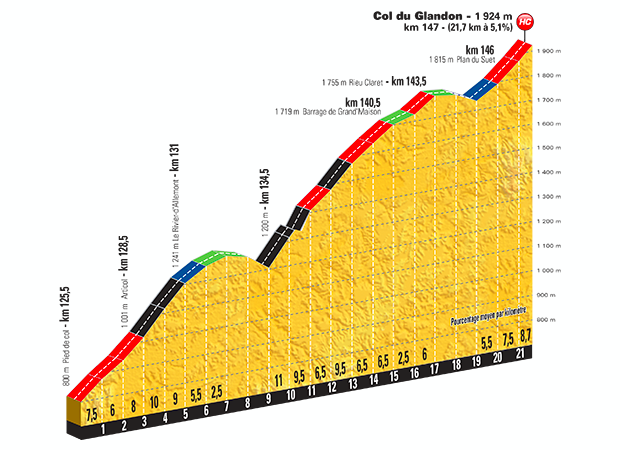
    The riders will have already been going uphill for a while by the time they hit the official start of the very long Col du Glandon, which has a number of very steep stretches to inject some serious hurt into the legs.
    The riders will have already been going uphill for a while by the time they hit the official start of the very long Col du Glandon, which has a number of very steep stretches to inject some serious hurt into the legs.

    But the day doesn’t end at the top of the climb—a 20km descent follows into the final climb of the day, the Cat. 2 Lacets de Montvernier. 3.4km at 8.2%, it’s one last jumping off point for the punchy, enterprising riders in this Tour, with the top of the ascent coming 10km from the finish.

    So many categorized climbs, and so many short steep stretches, will make Stage 18 an attackers’ playground. Expect to see plenty of action on the earlier climbs. If the morning aggressors are reeled in, expect to see plenty more attackers on the Col de la Morte and then the Col du Glandon. It could be some time before a solid break is formed. And even if the early break is reeled in sometime before the final 20km, the Lacets de Montvernier will be a great launching pad for one last strike for glory.

    The Tour has already seen plenty of big, successful breakaway moves, with Sky and Movistar content to fight it out in the GC battle well behind the breaks. The fact that the hardest climb of the day comes so far from the line might help temper the pace in the peloton. Controlling this stage will be a big challenge anyway, given the profile. With so many strong climbers well out of the overall race leadership competition, it seems likely that plenty of talented riders will find themselves up the road on battling for Stage 18 from a long-range move. Only a serious injection of pace from the pack on the Col du Glandon can keep this together.

    In any case, the Stage 18 winner will almost certainly be a top-notch climber with good descending skills as well. Joaquim Rodríguez tried and tried again to get up the road on Stage 17 but the peloton kept reeling in the early moves. I’m betting he’ll resume that effort on Stage 18. Of the strong climbers in the Tour de France who aren’t any GC threat whatsoever, Rodríguez is one of the very strongest. He should thrive on this brutal day, and he doesn’t even need to attack on the Col du Glandon if he doesn’t want to, since the short but very steep test near the end of the stage suits him perfectly. The finishing straight even kicks up slightly to favor him in a late uphill sprint if he finds himself in that situation. As always, the question mark will be whether Purito gets up the road. If he’s there, he’s a major threat.

    Romain Bardet kept the powder dry on Stage 17, but he could try to go on the move on Stage 18. This profile doesn’t suit him quite as much, but he’s still among the top climbers in the race, and he has plenty of motivation to get something out of the Tour before it leaves the Alps. Alternatively, AG2R could send Alexis Vuillermoz up the road here instead. Vuillermoz has shown in the past that he’s capable on the long, hard climbs, and the steep final climb suits him very well.

    Ryder Hesjedal has been active in the breakaways in 2015 Tour but he hasn’t been particularly successful. He’ll have another chance here on a stage that suits his characteristics. Teammate Dan Martin is another solid candidate for long-range success—the profile, especially the late climb, is a good one for him. Unfortunately, Martin suffered from illness in the second week of the Tour, and his current form is a question mark. Andrew Talansky will probably be a bit exhausted after Stage 17 but he is, at his best, a Grand Tour GC rider who should have the endurance for back-to-back hard days if he has it in his mind to get involved here.

    BMC’s Samuel Sánchez has been quietly riding an excellent Tour de France, currently sitting 13th overall despite riding in support of Tejay van Garderen for most of the race. Now that his team leader has abandoned the Tour, Sánchez could look to go on the move. It’s hard to imagine a better profile for the elite descender and punchy climber. If Sánchez can get up the road, he’ll be a top favorite for stage honors. Damiano Caruso is worth keeping an eye on as well.

    Europcar, a team looking for a 2016 sponsor, has yet to come away with a stage victory in this Tour, but this is a golden opportunity. Pierre Rolland tried to get into the break on Stage 17 and could look to get on the move again on Stage 18. Cyril Gautier doesn’t have a Tour de France white jersey in his palmarès, but he may be an even better bet. The up and down suits him very well. Tommy Voeckler isn’t what he once was as a racer but this is a great profile for him as well.

    Jakob Fuglsang is among the top climbers in the Tour and way down on GC; if he were clear in his motivations of taking every opportunity available to go stagehunting from the break, he’d be a strong pick—but he’s been very quiet since his 2nd-place finish on Stage 12. If he’s up there, he’s a strong contender but he might be waiting a little bit longer to go for it . . . or he might even have resigned himself back to being a domestique again that Vincenzo Nibali seems set on fighting for the Top 5.

    Jarlinson Pantano (who is surprisingly fast at the line), Rigoberto Urán, Jan Bakelants, Wilco Kelderman, Michael Rogers, Rafal Majka, Thibaut Pinot, and, if he’s not too exhausted, Stage 17 winner Simon Geschke are other riders worth watching as potential candidates to take a Stage 18 victory from afar.

    Tony Gallopin would be one of my top contenders from the breakaway for this stage but he has shown very little interest in getting up the road in this race, and he’s looked exhausted in the past few days. The profile suits him but I’m not sure he’s got the strength at this point. On the flipside, don’t rule out Peter Sagan—the HC-rated climb of the Col du Glandon is very difficult and not really Sagan’s style, but he’s looked to be incredibly strong this month and if he can hold on over the top of the climb he’s got a great shot at the stage win if he’s in the lead group.

    Should the main breakaway be reeled in by the peloton on Stage 18, Alejandro Valverde will be an obvious favorite with the late short climb and then the flat finish. He excels in both scenarios. If Robert Gesink can hold on over the day’s challenging climbs, he’s another rider to keep an eye on late in the day. The Top 5 is a real possibility and Gesink has some punch.

    Vincenzo Nibali will also like the look of the profile, given the very long descent on tap late in the day, followed by the short ramp that could provide an opportunity to go on the attack if he hasn’t distanced the GC men yet, though Chris Froome and Nairo Quintana are always potential stage winners themselves when there are mountains involved.

    VeloHuman Stage 18 Favorites

    1. Joaquim Rodríguez | 2. Romain Bardet | 3. Alejandro Valverde

    Don’t forget: you can find plenty more Tour de France analysis in the most recent Recon Ride podcast episode. Be sure to follow @VeloHuman on Twitter for more commentary during the race, and check back for the preview of the next stage after the conclusion of Stage 18.

    -Dane Cash
  • Tour de France 2015: Stage 17 Preview

    Tour de France 2015: Stage 17 Preview

    PROFIL17

    Stage 17: Digne-les-Bains › Pra Loup – 161km

    The first of four challenging days in the Alps, Stage 17 comes on the heels of a rest day (which gave VH and Cyclocosm time to team up for one last Tour de France Recon Ride episode). Hopefully, the riders will have gotten in every bit of recovery they need, because the next few stages will put everyone to the test.

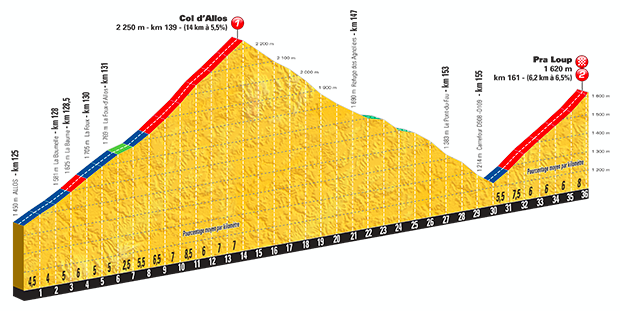
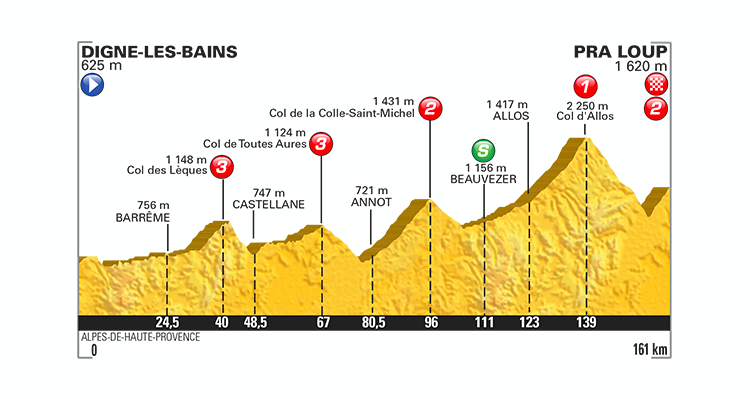
    Relatively short at 161km, Stage 17 follows the same route of Stage 5 of the 2015 Critérium du Dauphiné, won by Romain Bardet. The stage opens on a short climb, with about 30km of flat to follow, and then it’s up and down all the way to the line. A pair of Cat. 3s and then an 11km (at 5.2%) Cat. 2 are the appetizers of the day before a 1-2 punch of climbs (that happen to be Category 1 and Category 2 climbs, respectively) to close things out.

    The Cat. 1 Col d’Allos is really just the second half of a long uphill stretch that starts much earlier. The peloton will be going upward for over 30 kilometers, with an average grade of about 3% over the long haul. The official climb of the Col d’Allos is 14km in length at 5.5%. It starts out at relatively low gradients, but it stays at 6% or more for the final 6 kilometers.

    Neither of the final two climbs of Stage 17 is comparatively all that difficult, but together, with plenty of vertical meters already in the legs, they'll make for a hard day of racing.
    Neither of the final two climbs of Stage 17 is comparatively all that difficult, but together, with plenty of vertical meters already in the legs, they’ll make for a hard day of racing.

    After a long, tricky descent from the Col d’Allos comes the final climb of the day, the 6.2km, 6.5% ascent to Pra Loup. It’s a pretty steady uphill drag, with the final kilometer getting a bit steeper at 8%.

    The rolling profile, and the lack of any HC-rated climbs, makes this a great day for the breakaway, but it’s never easy getting a great read of the motivations of the teams in the pack. Several of the fringe GC contenders have shown interest in trying to get up the road, but others have been cagey about that prospect and had their teams policing potential escapes. We saw this on Stage 14 when IAM Cycling chased the break because the squad wasn’t pleased with the presence of GC outsiders in the move who might have threatened Mathias Frank’s Top 10 bid. The makeup of the Stage 17 break will help determine whether the pack chases it down, as will the plans of Movistar and Tinkoff-Saxo, who could be hoping to test the waters, knowing some riders struggle after a rest day. To me, it’s another toss-up day between the pack and the break.

    For a possible breakaway win, look to the strong climbers whose GC aspirations have faded. Romain Bardet will be an obvious pick after taking the win here in the Dauphiné. He’s already spent plenty of time up the road in this Tour de France, and he’s come close to stage victories so far twice. He’s not at his very best form-wise, but he’ll still be able to beat most anyone else on this profile if he’s in the breakaway. Teammates Alexis Vuillermoz and Jan Bakelants will be worth watching as well—these climbs aren’t so hard as to put them out of contention from a long-range move.

    Jakob Fuglsang beat Bardet to the top of the Plateau de Beille on Stage 12, and the long, steady climbs of the day suit him. He’s in good form and Astana is hoping to salvage something from this Tour despite Vincenzo Nibali’s GC failings. The biggest question for Fuglsang is whether he’ll go on the attack here, or wait until the following stages to try a breakaway move.

    That’s also a question for Joaquim Rodríguez, who has kept his powder dry over the last few stages for a big mountain push. The Stage 17 finish is excellent for Rodríguez, a short steep wall after a not-that-hard climb, but he may have the KOM points of the next few stages in mind. If he’s in the lead group at the end of the day he’ll be a top favorite.

    Pierre Rolland should shine on this profile, if he can manage to get up the road either early on, or with a late attack—Cyril Gautier and Romain Sicard could try to get in the mix as well. Compatriot Thibaut Pinot looked very strong coming into the Tour de France but his form has been nowhere near expectations so far. This isn’t a perfect profile for him (he’s never been the world’s best descender) but he’ll likely be very active in the hunt for a stage win in the mountains.

    Rafal Majka could threaten if he decides to try to get in the break. Dan Martin was sick during the last few stages but says he’s recovering now, and this is an excellent stage profile for him. Teammate Ryder Hesjedal will be worth watching as well. Michal Kwiatkowski, Rigoberto Urán, Louis Meintjes, Serge Pauwels, Adam and Simon Yates, Wilco Kelderman, and Rafael Valls are other potential dangers in a long-range move.

    If the peloton does reel in the break, Alejandro Valverde will be the hot favorite for stage victory with this final climb, which is not hard enough to open up huge gaps and will instead favor Valverde’s excellent finishing kick. A potentially aggressive Nairo Quintana will give Movistar a great 1-2 punch for Stage 17.

    Tony Gallopin has the speed at the line to challenge Valverde if this comes down to a reduced sprint among the GC types. He’d be a stronger contender if he hadn’t looked exhausted during the stage to Gap, but perhaps after a rest day he will have recovered some strength.

    Vincenzo Nibali’s ability to descend and his aggressive streak will serve him well if he decides to go on the hunt for a stage win here.

    Chris Froome may decide to play this safe and stay in the wheels, but if he is interested, he’s looked strong enough so far in this Tour de France that he can distance his GC rivals, with the exception of maybe Nairo Quintana, at a moment’s notice if he is so motivated. Sky’s Geraint Thomas will be one to watch with this finish as well.

    Robert Gesink and Bauke Mollema could both surprise people if this comes down to a group finish—both are speedier at the line than many realize.

    VeloHuman Stage 17 Favorites

    1. Alejandro Valverde | 2. Romain Bardet | 3. Joaquim Rodríguez

    Don’t forget: you can find plenty more Tour de France analysis in the most recent Recon Ride podcast episode. Be sure to follow @VeloHuman on Twitter for more analysis and commentary during the race, and check back for the preview of the next stage after the conclusion of Stage 17.

    -Dane Cash

  • Tour de France 2015: Stage 16 Preview

    Tour de France 2015: Stage 16 Preview

    PROFIL16

    Stage 16: Bourg-de-Péage › Gap – 201km

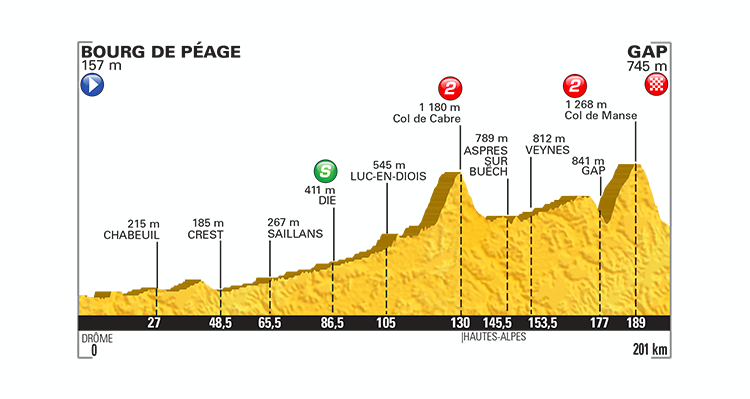
    In the final day of racing before the second rest day at the Tour, the peloton will take on a deceptively challenging 201km Stage 16 from Bourg-de-Péage to Gap. It’s the very definition of a transition stage, with the route taking the riders right into the foothills of the Alps in preparation for several tough days in the high mountains.

    As such, the road takes a gentle upward bent for the first 120 kilometers that, despite lacking any categorization, will certainly put a bit of fatigue into the legs. Then comes the Cat. 2 Col de Cabre, 9.1km at 4.6%—it’s not an extremely difficult climb, but coming after a sustained gradient, it will hurt a lot more than the metrics might suggest.

    A quick descent leads down to another uncategorized upward drag, before a speedy downhill into the second and final climb of the day, the Col de Manse. A Category 2 ascent at 8.9 kilometers at 5.6%, it’s another uphill test that will do more damage than the gradient would suggest.

    From the top, it’s a steep, technical descent almost all the way to the finish line. Things only flatten out inside the final 4 kilometers.

    The Tour has a great appreciation for Gap and for this particular route to the line—the race has finished there several times, especially in recent years. Every race is different, but if past trips to Gap are any indication of how this stage might play out, the breakaway will have a great chance, and the GC riders should be on their toes.

    This is an excellent profile for a long-range move. The sprinters won’t really have a shot at the stage, and the Alps loom large, which will likely inspire the GC types to take it easy for most of the stage, at least until the final climb of the day. That will give the early breakaway an advantage, and even if an early move gets reeled in, others will likely be primed to jump clear as soon as the catch is made. Whatever the scenario, it will take a large engine, strong climbing legs, and excellent descending skills to win Stage 16. It’s long, there are a lot of vertical meters, and the descent into Gap is quite difficult—difficult enough to ruin Joseba Beloki’s career via a nasty crash, and difficult enough to force Lance Armstrong to show off his cyclocross skills when run off the road, when the Tour visited the same downhill in 2003.

    Given the high likelihood of breakaway success (I rate odds of a long-range win at better than even) on Stage 16, there is really no single top favorite—there are only riders who will be more likely to succeed on the day.

    Predicting which riders will make it into the main break has been an especially difficult proposition recently, with the teams of the GC outsiders putting in a lot of work to protect minor placings on the leaderboard. Plenty of riders at the fringes of and just beyond the Top 10 will be hoping to get up the road for stage honors here but that could be difficult given the competition.

    Jan Bakelants has the wide array of talents, and the knack for getting into long-range moves, to thrive on Stage 16. He flashed excellent form on Stage 13, outclimbing nearly everyone on the steep uphill finale. If he’s in the lead group near the end of the day, the late climb and then the descent into gap will be an excellent opportunity for Bakelants to go in pursuit of a stage win. Alexis Vuillermoz and Romain Bardet give AG2R two more great options.

    Michal Kwiatkowski is among the best descenders in the Tour de France peloton. On form, he combines uphill ability and finishing speed better than almost anyone in the race as well. At his best, Kwiatkowski would be a hot favorite for this stage, but he’s clearly not at 100% in this race. Still, Kwiatkowski has been active in the breakaway game and if he can hold on over the final climb, he’ll be deadly in the downhill run to the line.

    Tinkoff-Saxo’s stated main ambition coming into the Tour de France was Alberto Contador’s GC campaign, but the team’s stagehunting aspirations have grown stronger and stronger as the race has gone on. This is an excellent profile for Tinkoff-Saxo’s stagehunters. Peter Sagan won’t have an easy time getting into the breakaway, but it’s certainly a possibility, and if he’s in the lead group at the end of the day, he’s got to be the top favorite. But even if Sagan misses out on a successful breakaway move, the team has other great options from afar. Michael Rogers is an excellent descender and won a similar stage from the break in last year’s Tour de France. Rafal Majka is in good form as well, and he’s a good bet to try to jump clear on the late climb.

    Joaquim Rodríguez already has a pair of 2015 Tour wins, one from the breakaway. Rodríguez isn’t quite at his best form, but he’s still a stronger climber than most other potential breakaway candidates for the stage victory. The biggest question mark for Purito will be whether he tries to get into the move here, or whether he saves energy for the Alps.

    Europcar also has options. Tommy Voeckler will appreciate the profile, and Cyril Gautier looks to be on very good form in this Tour (and has been active so far trying to get up the road). Pierre Rolland could try to get clear on the Col de Manse as well.

    Vincenzo Nibali’s Grand Tour-winning climbing ability and elite descending skills will make him a top contender—if he’s at the front of the race at the end of Stage 16. Nibali’s current Top 10 GC position, though, may have his fringe GC rivals riding defensively to try to keep him from getting up the road, either in the early breakaway, or even late on in the day on the last climb. He’s got a great chance at Tour de France redemption via a stage win with this profile, but it won’t be a cakewalk getting clear of the peloton.

    Sylvain Chavanel, Greg Van Avermaet, Dan Martin, Ryder Hesjedal, Jarlinson Pantano, Jakob Fuglsang, Wilco Kelderman, Simon Geschke, Rigoberto Urán, and Simon Yates are other candidates on the very long list of potential contenders from afar on Stage 16.

    Regardless of whether the break is reeled in, the GC teams will likely drive a hard pace on the final climb—the Col de Manse has opened up gaps on the GC leaderboard in the past, and the day before a rest day in this year’s race, some of the more enterprising climbers in the pack could be on the lookout for opportunities to put their rivals into danger. That will make for a tough day in the peloton, likely to drop most of the traditional quick men from contention if the break does get caught.

    Alejandro Valverde will be a favorite from the pack on Stage 16, given his strong descending abilities and terrific finishing kick. Tony Gallopin, whose climbing legs are more impressive right now than they’ve ever been, will have a great shot if this comes down to the pack as well, given his downhill skills and his impressive top-end speed. Chris Froome and Nairo Quintana can’t be counted out either. The latter has tried to test the former at every opportunity he’s gotten so far.

    Michael Matthews, Matteo Trentin, Robert Gesink, Bauke Mollema, and John Degenkolb are others who will have a shot with the potential for a reduced sprint from the peloton.

    VeloHuman Stage 16 Favorites

    1. Jan Bakelants | 2. Joaquim Rodríguez | 3. Alejandro Valverde

    With a rest day on tap following Stage 16, the next stage preview will be up on Tuesday—in the meantime, check out the latest episode of the Recon Ride podcast, which previews the final five stages!

    -Dane Cash

  • Tour de France 2015: Stage 14 Preview

    Tour de France 2015: Stage 14 Preview

    PROFIL14

    Stage 14: Rodez › Mende – 178.5km

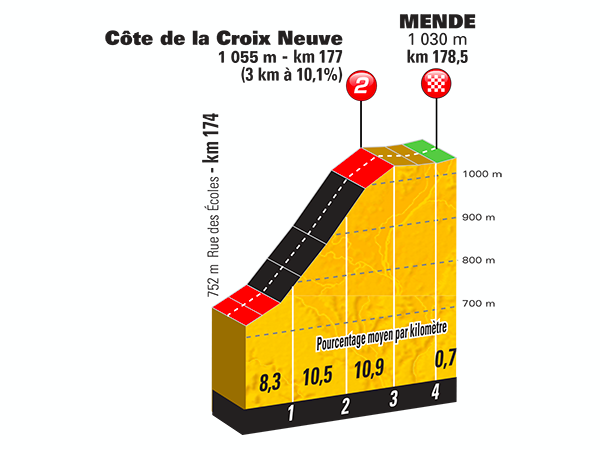
    Greg Van Avermaet snagged a hilltop victory in the Tour’s 13th stage, and more hills await on Stage 14. The day opens with 44 kilometers of roads that slope gently upward, with a short Cat. 4 climb along the way. Then comes a fast descent into a very long (about 80 kilometers) stretch of flat roads, which could see the peloton taking a relatively leisurely approach after several tough days on the bike. With about 40km to go in the stage, things get bumpy again. First comes the Cat. 2 Côte de Sauveterre, 9km at 6%. After the downhill and then a short flat section comes the Cat. 4 Côte de Chabrits, followed by another downhill into the final climb. The Cat. 2 Côte de la Croix Neuve, 3km at 10.1%, is short but extremely challenging test.

    Before the riders reach the Stage 14 finish line in Mende, they'll have to overcome the steep Côte de la Croix Neuve. Anyone feeling a bit below 100% will be found out quickly on the double-digit gradient.
    Before the riders reach the Stage 14 finish line in Mende, they’ll have to overcome the steep Côte de la Croix Neuve. Anyone feeling a bit below 100% will be found out quickly on the double-digit gradient.

    It’s steep throughout, especially near the midway point. From the top of the climb it’s about 1.5km of flat to the finish, with a sharp right-hander and then a hard left on the way to the line.

    Stage 14 will be yet another breakaway-friendly stage—an up-and-down finale and a late climb that is far too hard for the sprinters are typically good ingredients for a successful long-range move. Still, this final climb might even be hard enough to inspire the GC teams to set up a high pace to set up a late battle. If the pack fights it out for the win, only the strongest climbers will be able to survive the Côte de la Croix Neuve to be in the mix for a stage win via either a move on the steep stuff or a very reduced sprint. The last time the Tour finished here, Joaquim Rodríguez, Alberto Contador, and Alexandre Vinokourov were the first three riders across the line. The potential breakaway scenario (which looks to be about a 50/50 proposition) will give the less Alpine-inclined riders a better shot at stage success, but strong climbing legs will still be very important on a final climb with an average gradient over 10%.

    Joaquim Rodríguez will be among the top favorites in this explosive finale if he’s in the lead group, and the fact that he’s well behind on GC and now potentially in the hunt for breakaway wins makes him all the more dangerous. The profile of the majority of the stage (the relatively easy first 140 kilometers, that is) isn’t one that stands out as a likely jumping off point for a Purito breakaway, however, so it’s not a given that he’ll get up the road. He’s a favorite, but there are so many other factors at play on this stage besides the puncheur-friendly finish that make it impossible to name anyone a no-doubt contender.

    Given his performances so far, Alexis Vuillermoz will be a rider to watch closely on Stage 14. The extreme gradient of the final climb suits him very well, and he’s especially dangerous given his ability to get up the road, as he’s not a GC threat. Teammates Romain Bardet and Jan Bakelants might be hoping to get involved too.

    Dan Martin did not perform as well as expected on Stage 13 but he could bounce back for a bid at Stage 14 success. The finale is probably a bit hard for him against the top GC favorites but he’ll have a shot from the break. Teammate Ryder Hesjedal will likely be on the lookout for opportunities to get into the breakaway mix as well.

    Pierre Rolland tends to target stages with bumpier profiles throughout for his long-range moves, but a finale with plenty of launching pads for a classic Rolland attack make him impossible to count out. Compatriot and Europcar teammate Thomas Voeckler will also have a shot if he can get into the day’s breakaway.

    Michal Kwiatkowski, Adam Yates, Rafael Valls, Jakob Fuglsang, Rafal Majka, and Julián Arredondo are other strong long-range candidates for Stage 14.

    Of the riders whose stage hopes rest within the pack, Alejandro Valverde is certainly among the favorites—the steep late climb will drop all the non-elite ascenders from contention, and the flat finish will give Valverde a chance to use his top-notch sprint. His biggest obstacle will be reining in the inevitable attacks from his rivals. This may be only a Cat. 2, but it’s steep enough that it could spur Chris Froome into action—he was very strong on the Mur de Huy and this longer trip up suits him even more. Despite his firm hold on the yellow jersey, Froome has not seemed particularly interested in allowing the other riders at the top of the GC leaderboard opportunities to shorten the gap. Valverde’s teammate Nairo Quintana and the always dangerous Alberto Contador will also be in the mix if this comes down a GC battle.

    Geraint Thomas, Robert Gesink, Bauke Mollema, Tony Gallopin, and Greg Van Avermaet (who is climbing better than ever) will be hoping to hold on on the steep stuff for a potential reduced sprint on the short section of flat that precedes the finish line. The Côte de Sauveterre is probably too hard for Peter Sagan, but don’t count him out entirely—despite his inability to win a stage so far in the Tour, he’s on great form at the moment.

    VeloHuman Stage 14 Favorites

    1. Joaquim Rodríguez | 2. Alejandro Valverde | 3. Chris Froome

    Don’t forget: you can find plenty more Tour de France analysis in the most recent Recon Ride podcast episode. Be sure to follow @VeloHuman on Twitter for more commentary during the race, and check back for the preview of the next stage after the conclusion of Stage 14.

    -Dane Cash

  • Tour de France 2015: Stage 8 Preview

    Tour de France 2015: Stage 8 Preview

    PROFIL8

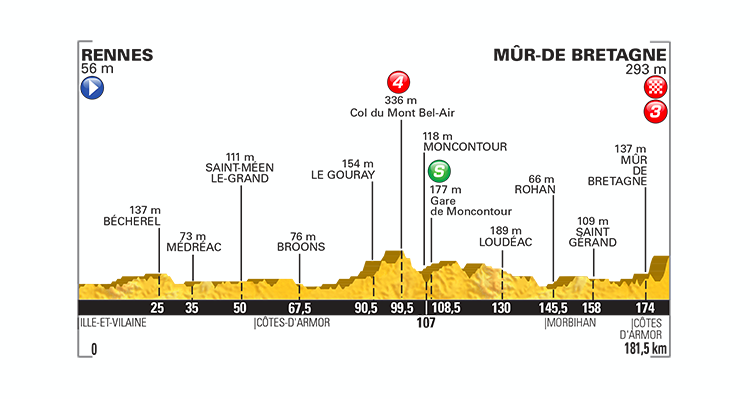
    On the heels of Mark Cavendish’s big sprint victory on Stage 7, the Tour de France heads into a stretch of more GC-oriented days, starting with the 181.5-kilometer Stage 8. It is another day that could come down to a showdown near the finish, but a steep climb to the line will bring a different set of riders to the fore.

    The action kicks off in Rennes, Brittany. The first half of the stage is mostly flat, with the first of two categorized climbs finally appearing around the midway point of the action. It’s only a Cat. 4, and not likely to see much of a shakeup. That climb is followed by a descent and then a few gentle ups and downs, which roll all the way to the finish, where things will get interesting.

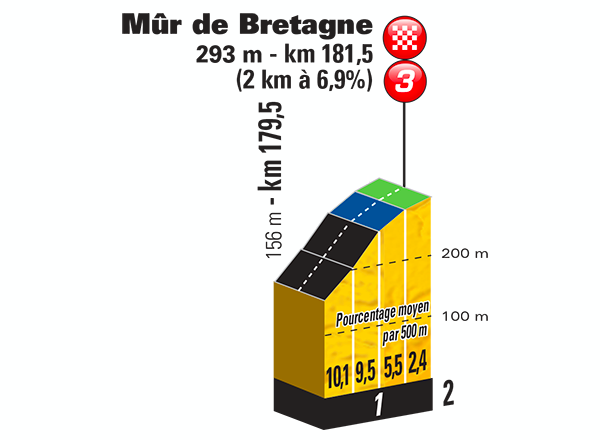
    Stage 8 finishes atop the Mûr-de-Bretagne climb, 2 kilometers in length with a challenging average gradient of 6.9%—but the average gradient doesn’t tell the full story. The first kilometer of the ascent has sections in the double digits, and averages just under 10%. After this steep opener, things ease off in the second half of the climb, with the gradient gradually decreasing into the final 500 meters, which angle upward at only 2.4%.

    Steep at first, but easing off halfway through, the Mûr-de-Bretagne will make for a thrilling, though hard to predict, Stage 8 finale.
    The steep incline of the Mûr-de-Bretagne will make for a thrilling, through hard to predict, Stage 8 finale.

    The vicious gradients that open the Mûr-de-Bretagne will keep the traditional sprinters from contending for the stage victory. That will, in turn, likely lead to a less organized chase in the bunch, which could help out any breakaway riders who manage to get up the road. What’s more, the upcoming team time trial will probably have the GC teams inclined  to take this stage easy, rather than putting the pressure on all day. There are bonus seconds on offer at the line, and there are plenty of strong puncheurs in this race who will have a great chance at this finish if their teams keep the stage under control, but the early break does have a very real chance at going the distance on this stage—it seems to be about a 50/50 proposition to me. As such, no rider should be seen as “the favorite” for the stage, though there are plenty of riders who will be favored if they are in the lead group inside the final 10 kilometers: the battle for stage honors, whether that battle is being fought within a small group of breakers or the larger bunch, will likely come down to the final climb, which will suit riders that have some combination of strong climbing legs and a fast finish.

    If the pack is able to reel in the early move, Joaquim Rodríguez, who won on the Mur de Huy a few days ago, will like the look of this one. He has flashed strong form in this Tour, and he has both the climbing prowess to launch a move early on this climb, and the finishing kick to outsprint a small group around him if he nears the finish line with company. Having the also explosive Giampaolo Caruso gives Katusha options.

    At his best, Alejandro Valverde would love this profile, but form has been a question mark for Valverde so far in this Tour de France. On the Mur de Huy, where he won earlier this season in La Flèche Wallonne, he was unable to muster even a Top 10. This is another opportunity for him to use a skillset tailormade for this sort of finale, but his inability to make much an impact on this Tour so far can’t be ignored on a stage where he’d otherwise probably rank as my top favorite. Valverde’s teammate Nairo Quintana will be a rider to watch as well with this gradient—the diminutive Colombian doesn’t have Valverde’s top speed but few riders are as dangerous on gradients in the double digits. With a likelihood of gaps in this finale, Quintana will be locked in and should be in the mix at the front of the pack.

    Dan Martin showed great form on Stage 3 on his way to 4th place, a result that would have been better if he hadn’t been way behind the head of the race before starting his charge through the ranks of riders struggling to make it to the top of the Mur. The extreme gradients on the lower slopes of that climb may have hindered Martin, who is very explosive but has never favored the double-digit slopes. The Mûr-de-Bretagne will be another great opportunity for him if this does come down to a group finish, especially with more space between the 10% gradient and the finish line in which Martin can make up ground he loses to the more effective climbers.

    Chris Froome doesn’t have the Ardennes track record of Purito, Valverde, or Martin, but he’s an elite climber with an elite team around him that is fully dedicated to putting him into the perfect position for the uphill finishes. He was very strong on the Mur de Huy, and if this comes down to the GC men, I’d bet he’ll be right up there again here on Stage 8, with bonus seconds on the line. GC rival Vincenzo Nibali was not all that far behind, rolling across the line in 7th on Stage 3. Already down more than a minute on Froome, Nibali could try to get clear on the climb to earn a few seconds back on GC.

    Peter Sagan won’t be able to match the GC favorites on the high gradients, but could hang on for the easier final kilometer if no one is too aggressive early on. The main factor playing against Sagan is the fact that the team may have him on domestique duty to help Alberto Contador, who is also a danger with this sort of gradient so close to the line.

    A kilometer at over 9% might just be too much to ask of John Degenkolb, but he will have a shot at stage honors here if the pack can reel in the early breakaway. Rui Costa has been quiet so far in this Tour but should like this finish, as should another fast-finishing fringe GC contender, Bauke Mollema. Warren Barguil, a more-explosive-than-many-realize Tejay van Garderen, Robert Gesink, AG2R’s Romain Bardet and a surprising Alexis Vuillermoz, and Rigoberto Urán are others who could thrive in this finale if things come together before the line.

    Tony Gallopin has the versatility to challenge for victory here in a variety of scenarios. He’s deadly in a long-range move, and capable in a reduced sprint as well. With the ability to weigh his options and determine his strategy out on the road, Gallopin has a great chance here. Teammate Tim Wellens is another rider to watch—he’s a smart attacker who can be very dangerous in a breakaway. Edvald Boasson Hagen, Michal Kwiatkowski, Zdenek Stybar, Julian Arredondo, and Simon Yates are just a few of the other riders who can threaten for stage success either from the breakaway or from the bunch.

    VeloHuman Stage 8 Favorites

    1. Joaquim Rodríguez | 2. Alejandro Valverde | 3. Tony Gallopin

    Be sure to follow @VeloHuman on Twitter for more analysis and commentary during the race, and check back for the preview of the next stage after the conclusion of Stage 8. The VeloHuman overall Tour de France race preview is available here.

    -Dane Cash

  • Tour de France 2015: Stage 3 Preview

    Tour de France 2015: Stage 3 Preview

    PROFIL3

    Stage 3: Antwerp › Huy – 159.5km

    Following a thrilling Stage 2 that, despite it’s Greipel-won sprint finale, saw several GC contenders lose chunks of time, the Tour de France will throw another stage with potential GC implications at the peloton early on in the race. The Tour may be leaving the Netherlands but it isn’t leaving the “Low Countries” altogether—Stage 3 will take the riders from Antwerp to Wallonia’s Ardennes region for a finish in Flèche Wallonne territory. The yellow jersey hopefuls will again need to be on their toes with this profile.

    It’s not a long stage at 159.5km (not nearly as long as La Flèche Wallonne), but things get bumpy late in the day, especially in the final 20 kilometers, where the pack will hit the Cat. 4 Cote d’Ereffe, and then a quick uncategorized ascent, and then the Cat. 4 Cote de Cherave before the stage finish on the classic Mur de Huy. It’s only 1.3km from the bottom to the top but the winding road up the Mur averages 9.6%, with a 19% section along the way. The Cat. 3 finish will have GC contenders and climbing-oriented stagehunters alike vying for position on the vicious gradient.

    Alejandro Valverde won La Flèche Wallonne this year for the third time in his career. An elite climber with a devastating kick uphill, he has to be the favorite here. Very few riders can explode ahead like Valverde on a climb like this, and given his brilliant form all season, there’s little reason to think he won’t be ready for lunch here on Stage 3. The motivation to charge up the Mur will be sky-high after Movistar’s big losses on Stage 2. Teammate Nairo Quintana, top-notch climber that he is, will also be a rider to watch. He doesn’t have the finishing speed that Valverde has, but anything with a gradient in the 9% range is favored terrain for Quintana.

    Joaquim Rodríguez is another past Flèche Wallonne winner with a chance. He had a disappointing Ardennes campaign this season but has also shown flashes of brilliance this season (his País Vasco was incredible). He did crash on Stage 2, however, which may have left him a bit banged up coming into this stage.

    Dan Martin has never won La Flèche Wallonne, but he’s been close multiple times. After a poor run in this year’s Ardennes, Martin is looking for some success in this Tour, and this is a great stage for him. He should be in the mix for the victory.

    Julian Arredondo is typically very strong on this sort of finish, though he’s never actually landed a Flèche Wallonne Top 10. He lost a chunk of time on Stage 2 but will have a shot at redemption here. His teammate Bauke Mollema also has a nice upward kick, with several great results on the Mur in the past.

    Orica-GreenEdge has multiple options for Stage 3. Michael Albasini is probably the team’s best bet, as he has done well on this climb in the past, though form is a bit of a question mark for Albasini. Simon Gerrans, excellent in an uphill sprint, is another option. Simon Yates, who has been in great shape pretty much all season long, could surprise people. He doesn’t have much Ardennes experience yet but this is a good profile for him.

    World champ Michal Kwiatkowski has had good results on the Mur in the past and could shine in Stage 3. Meanwhile, his teammate Rigoberto Urán is suddenly in the GC conversation after an under-the-radar start. He has a great finishing kick and could continue to surprise people here if he can position himself well to battle it out with the big favorites. Vincenzo Nibali, Wilco Kelderman, Rui CostaTim Wellens, and possibly even Peter Sagan will like the profile as well. And don’t count out Chris Froome just because he’s not an Ardennes specialist—this is a steep finishing climb in a Tour de France stage, and that’s reason enough for Froome to be seen as a big threat.

    VeloHuman Stage 3 Favorites

    1. Alejandro Valverde | 2. Joaquim Rodríguez | 3. Dan Martin

    Be sure to follow VeloHuman on Twitter for more analysis and commentary during the race, and check back for the preview of the next stage after the conclusion of Stage 3. The VeloHuman overall Tour de France race preview is available here.

    -Dane Cash