Tag: Joaquim Rodriguez

  • Il Lombardia 2014 Preview

    Il Lombardia 2014 Preview

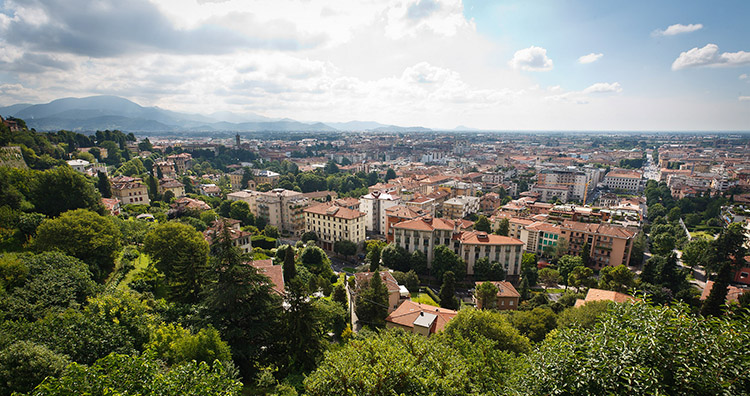
    Bergamo

    Worlds may be over, but the 2014 cycling season isn’t quite done yet. There are still two events on the WorldTour calendar, including the final Monument of the year, Il Lombardia (formerly the Giro di Lombardia, the Tour of Lombardy). It’s a race with a lot of history, and the parcours (though updated this year) always provides plenty of uphill challenges to make for an exciting day; in recent years, those challenges have proven ideal for climbing specialist Joaquim Rodriguez, who has won the previous two editions.

    The Route

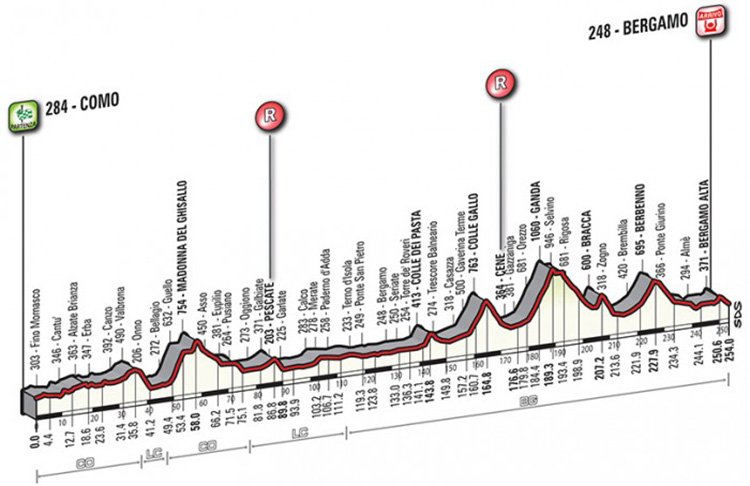
    Still a scenic ride through the hilly Lombardy region of Italy, the “Race of the Falling Leaves” has a new route with new climbs to overcome this year. Instead of starting in Bergamo, Il Lombardia 2014 will finish there, setting out from Como and weaving alongside lakes and over several climbs before the line after a total of 254 kilometers. The first vertical challenge is the Madonna del Ghisallo, which, in previous editions, featured much later in the route. This year, it will be crested only 58 kilometers into the race, but it will still inject plenty of pain into the legs early in the day. Roughly 8.6 kilometers at around a 6.2% average grade, the climb is significantly harder than those general numbers would suggest due to its irregular nature. Things flatten out for a few kilometers in the middle of the ascent, but on both sides of this reprieve are stretches where the gradient jumps over 10%.
    Il Lombardia Profile

    After the Madonna del Ghisallo, things ease off for a while as the road heads toward Bergamo, which the riders will pass through a little over 130 kilometers into the race before embarking on a long, wide loop that will take them over some challenging climbs on the way back to Bergamo for the finish. The tough stuff starts in earnest with the Colle Gallo (7.4 km at 6%) after about 157 kilometers, and from there it’s mostly up and down to the line. After a fast descent comes the hardest climb of the race, the Passo di Ganda, 9.2 kilometers at 7.3%. Crested about 65 kilometers from the finish, it’s certain to force some selection. A tricky descent follows, interrupted by a short but very steep climb to Bracca, and then another downhill stretch to the foot of the Berbenno climb, which is likely to be a major battleground. 5.5 kilometers at 5.3%, there are a few particularly steep stretches early on, maxing out at 10%. From the top, it’s less than 30 kilometers from the finish line. The peloton will take on a fast descent and then ride on relatively flat roads until the final climb of the day, the Bergamo Alta. It’s only a little over a kilometer to the top, but the average gradient is a demanding 7.9%, and once the climb is crested less than 4 km remain to the line, mostly downhill and with plenty of twists and turns along the way; the winner of the race will likely be one of the first few riders over the Bergamo Alta, as there isn’t much room to recover lost ground after the climb. The ensuing downhill gradient flattens out for the final 500 meters of the race, which could set up a reduced sprint to the line if a small group of riders are together in the lead.

    As an autumn race, Il Lombardia is no stranger to difficult conditions. Purito’s two victories have both been rainy affairs, and there is again a chance of rain this year; with so many descents on the docket, wet roads would certainly shake up an already unpredictable race.

    The Contenders

    The Final Monument Classic of the season, Il Lombardia tends to draw most of the top specialists of the hilly one-day events looking to take one last big prize on the year; the 2014 edition of the race is no exception. Joaquim Rodriguez returns to Il Lombardia hoping to collect his third straight win. It won’t be easy. He has been on decent form in the second half of his season, but he wasn’t quite at the level he’d planned to be during the Vuelta and he did not make as much of an impact at Worlds as maybe he’d hoped. Still, he has been unstoppable in Lombardy in the past few seasons, landing three straight podium performances, and he put in a strong ride (to take 5th) in this week’s Milano-Torino. I’m not sure the new parcours suits him quite as well as past editions did, but Purito is motivated to get more out of this year than he has so far. Katusha has a lot of firepower in the race to support Rodriguez or to provide alternatives. Daniel Moreno was 6th in this race last year and is a particularly strong sprinter even on flat roads should he find himself in shootout late, and he showed good form in Milano-Torino, coming in 3rd. The winner of that race also happens to ride for Katusha: Giampaolo Caruso, always aggressive and having a strong year (he was 4th in Liege-Bastogne-Liege), will be another weapon in Il Lombardia, as will Alexandr Kolobnev. The team will need all hands on deck, given the startlist and a less Purito-friendly profile, to defend their title.

    Alejandro Valverde was runner-up in 2013 and the alterations to the route should be just fine with him; he couldn’t stay with Rodriguez on the Villa Vergano climb last year, and he no longer has to worry about that this year. Valverde’s versatile skillset makes him a difficult opponent. He may have Grand Tour-winning climbing talent, but he also has an especially strong sprint, and that could be critical to victory here. Few riders likely to survive the entire day at the head of affairs are as quick at the finish as Valverde; expect to see his rivals do everything they can in an attempt to drop him before the final few kilometers (which will be a pretty tall order). They know that Valverde, coming off a podium performance at Worlds, is probably the top favorite for the race, even with Rodriguez here looking for a third straight win. Movistar also has Giovanni Visconti and several top climbers in attendance, among them, Beñat Intxausti and Ion Izagirre.

    One rider who may have the top speed to challenge even Valverde in a reduced sprint finale is new World Champion Michal Kwiatkowski. His daring escape from the peloton in the Ponferrada finale may be his most famous accomplishment so far in his career, but his finishing kick is very impressive in and of itself. If he can hold on over the tough climbs, he can contest the victory in a number of ways, whether that means launching another bold move or holding on for a group finish. The rainbow jersey isn’t the only threat on a loaded OPQS team: Rigoberto Uran is a two-time podium finisher in this race, Pieter Serry was an impressive 7th last year, and Wout Poels and Gianluca Brambilla have been particularly strong in 2014.

    Garmin-Sharp’s Daniel Martin has been 8th, 4th, and even 2nd in this race already in his career; the 2013 Liege-Bastogne-Liege winner thrives in the hillier one-day races, and Il Lombardia definitely qualifies. Martin’s sprinting chops seem to have improved this year should a small group reach the line together, and he should again be one of the top contenders in the race. Ryder Hesjedal and Tom-Jelte Slagter will give Garmin-Sharp a strong, multi-facted attack plan.

    Tinkoff-Saxo’s Alberto Contador may not have the one-day resume to match his stage-racing palmares, but on a climber-friendly parcours, few are as dangerous. He will need to get clear of the faster finishers, but the abundance of ascents, especially the Berbenno climb (though not especially challenging by itself, it does have steep stretches and it comes near the end of a day full of ups and downs) will give him opportunities. Success in the Monument Classics has eluded Contador so far in his career but he’s had a brilliant year and looked to still be on strong form even in October with a 6th place in Milano-Torino. Teammate Oliver Zaugg was the surprise winner of this race in 2011, and he’s not having a bad year himself.

    The back-to-back Giro di Lombardia victories of BMC’s Philippe Gilbert may seem like a lifetime ago now, but he should still be a threat on this parcours. Coming off a strong ride at Worlds, where he was really the only rider in the first chase group doing any work attempting to close down Michal Kwiatkowski and still landed 7th, Gilbert looks to be on good form. The short climb that closes out this race will be a nice potential launching pad for Gilbert; alternatively, he could rely on his strong sprint if he sticks with the lead group over the top. Samuel Sanchez, a four-time podium finisher here, can’t be overlooked either. 6th overall in this year’s hotly contested Vuelta is nothing to sneeze at, and his age probably hasn’t diminished his elite descending skills, which will come in handy here. Tejay van Garderen and Cadel Evans bring even more firepower for BMC.

    Now former World Champion Rui Costa wasn’t able to make it into the Gerrans/Valverde move in Ponferrada, but he finished respectably with the group behind, and the form he showed in Montreal isn’t likely to have faded just yet. This is an excellent profile for Costa, who is particularly adept at breaking away from the pack on hillier days and capable in a reduced sprint as well, and he is highly motivated to pick up more victories this season.

    AG2R may have explosive Carlos Betancur and Tour de France runner-up Jean-Christophe Peraud on the startlist, but Romain Bardet looks to be the team’s strongest option, having shown some surprising one-day racing chops this season (10th in Liege-Bastogne-Liege and 5th in Montreal). Il Lombardia suits him about as well as any classic on the calendar, and he’ll be among the most dangerous potential escapees on the late climbs. Rinaldo Nocentini, 2nd in Milano-Torino, is obviously on terrific form and could be in contention as well, as could Domenico Pozzovivo.

    Belkin’s Bauke Mollema has the uphill talent to get involved at the business end of the race, and an underrated finishing kick, especially after a lumpy day (he outsprinted Joaquim Rodriguez for 2nd in the Clasica de San Sebastian in August). With Wilco Kelderman, another very complete rider, Lars Petter Nordhaug, and Laurens Ten Dam as well, Belkin has options. Lotto-Belisol is another team with several different weapons here: Tony Gallopin will hope to stick with the premium climbing favorites over the harder ascents so that he can challenge for victory with a late escape or in a reduced sprint finish, while Tim Wellens and Jelle Vanendert are both excellent bets to get aggressive on the hills. Orica-GreenEdge, as might be expected in a race with this many hills, also has a stacked squad, with Michael Albasini, an excellent climber with a fast finish, probably the strongest option and Daryl Impey, Esteban Chaves, Pieter Weening, and Adam and Simon Yates all dangerous, too. Astana has elite uphill talent Fabio Aru, who may not have the classics experience, but who can attack on a climb better than almost anyone in the professional peloton; meanwhile, Enrico Gasparotto is an always-underrated contender in the hilly one-day races, and he was 5th in last year’s Tour of Lombardy. FDJ’s Thibaut Pinot, Cannondale’s strong and on-form Alessandro De Marchi, Davide Formolo, and Damiano Caruso, Giant-Shumano’s Tom Dumoulin, Warren Barguil, and Simon Geschke, Bardiani’s Edoardo Zardini, Europcar’s Cyril Gautier, Trek’s Frank Schleck (a decent 9th in Milano-Torino) and Julian Arredondo, and Caja Rural’s Luis Leon Sanchez are on the long list of outside contenders who will hope to be in the mix as well. Sky’s Ben Swift deserves the final mention; it seems highly unlikely that he’d survive to the finish, but he’s a more capable climber and one-day racer than most other sprinters, and this profile at least leaves the door open just a bit.

    VeloHuman Top 10 Favorites

    Winner: Alejandro Valverde
    Podium: Joaquim Rodriguez, Michal Kwiatkowski
    Other Top Contenders: Daniel Martin, Alberto Contador, Daniel Moreno, Philippe Gilbert, Rui Costa, Romain Bardet, Bauke Mollema

    Be sure to follow @VeloHuman on Twitter for live commentary and analysis, and check back soon for the preview of the final race of the 2014 season, the Tour of Beijing, and more interviews and analysis!

    -Dane Cash

    Photo by Matthew Peoples.
  • Vuelta a España 2014: Stage 20 Preview

    Vuelta a España 2014: Stage 20 Preview

    Stage 20 Profile

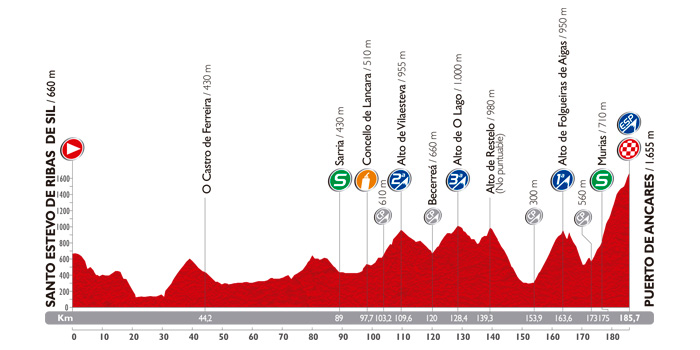
    Stage 20: Santo Estevo de Ribas de Sil › Puerto de Ancares – 185.7 km

    Following an Adam Hansen victory on a day without many GC implications, Stage 20, the final mountain stage of the 2014 Vuelta a Espana, is here. The parcours should make for quite a showdown. There are four categorized climbs on the profile, and a few more uncategorized challenges, and the constant barrage of ascents will be an uncomfortable experience for a peloton that has been racing for three weeks. The final 32 kilometers are particularly difficult. The Alto de Folgueiras de Aigas is 9.7 kilometers long at an average of 6.7%; just the sort of test to wear out the legs before the vicious final climb of the 2014 Vuelta. The Puerto de Ancares is a monstrous challenge, 12.7 km at 8.7%. Several stretches are significantly steeper (one such stretch, at 12%, comes in the last 2 km), and there aren’t many easy sections to offer respite. The last mountain stage of the last Grand Tour of the year would likely see aggressive riding regardless, but this final climb practically guarantees that the attacks will fly.

    The up-and-down second half will make it hard for the peloton to control the race, but as this is the last opportunity for the uphill specialists to shake up the General Classification, the GC men aren’t likely to hold back when the road goes up, which will make it hard for anyone up the road to stay clear. One thing is for certain: it will take an elite pair of climbing legs to win on this stage.

    Several very steep sections on the final climb will favor the ultra-lightweight climber types, and few of them are as in-shape right now as race leader Alberto Contador. He’ll be able to follow the attacks, rather than make them, and he’s already shown how dangerous that makes him. His rivals will certainly throw everything they have at him, but when it’s mattered most in this race, Contador has not shown much weakness on the climbs.

    Chris Froome has gotten much stronger over the course of this Vuelta, and he’s not going to let this chance to move up the leaderboard get away without a fight. The profile may look to suit some of his rivals a bit better, but Froome has looked strong enough these past few days that it may not matter. Expect to see him attempt a big attack on Stage 20 to try to open up a sizable gap to the rest of the GC contenders.

    Joaquim Rodriguez should appreciate the steep finish. He’s been just a bit less strong on the climbs than he might have hoped coming into the Vuelta, but he’ll still have an opportunity to pick up the stage win here. He’s far enough back on the General Classification now that he may get a little bit of breathing room for Contador and Froome if he tries something.

    Alejandro Valverde probably won’t get any space to attempt a move, but he’s still a danger. He seems content to hold wheels and hope for sprints even on the climbs that suit him, and that aversion to major risks, while it has kept him from ever picking up any huge gaps to his GC rivals, does make him a constant danger for stage success.

    Fabio Aru will have a great opportunity to add to his tally of stage wins with this steep finale; Contador and Co. have shown on multiple occasions that they won’t chase down his attacks, and that gives him even more of an edge than he already has thanks to his awesome uphill ability. Repeating what’s been said in most of the other mountain stage previews so far, Dan Martin, Samuel Sanchez, Daniel Navarro, and Warren Barguil are others who look strong right now and who will probably have freedom to put in moves from the pack.

    It’s always hard to predict potential breakaway protagonists, but at least this profile whittles down the list of realistic long-distance contenders to those with immense uphill talent. Ryder Hesjedal has been on excellent form in the Vuelta so far and this long day of climbing suits his one-time-Grand-Tour-winning skillset perfectly. Przemyslaw Niemiec is another rider with GC-style ability who should have a chance if he goes from afar; Damiano Cunego will be a strong card for Lampre-Merida to play as well. Alessandro De Marchi will love the constant up and down. Louis Meintjes has gotten stronger as this race has progressed, and he’ll have a nice opportunity if he can get into a move here on Stage 20. Romain Sicard, Mikel Landa, Wout Poels, Adam Yates and Esteban Chaves, Laurens Ten Dam, David Arroyo, Cadel Evans, and Mikel Nieve are others who might find success in a long-distance strike.

    VeloHuman Stage Favorites

    1. Alberto Contador | 2. Chris Froome | 3. Joaquim Rodriguez

    Be sure follow @VeloHuman on Twitter for live commentary of this and every stage of the 2014 Vuelta a España! The final preview will be up after the conclusion of Stage 20, so stay tuned. Also, don’t miss VH’s coverage the GPs Quebec and Montreal! The Quebec post-race is already up, and the Montreal preview is coming soon!

    -Dane Cash

  • Vuelta a España 2014: Stage 18 Preview

    Vuelta a España 2014: Stage 18 Preview

    Stage 18 Profile

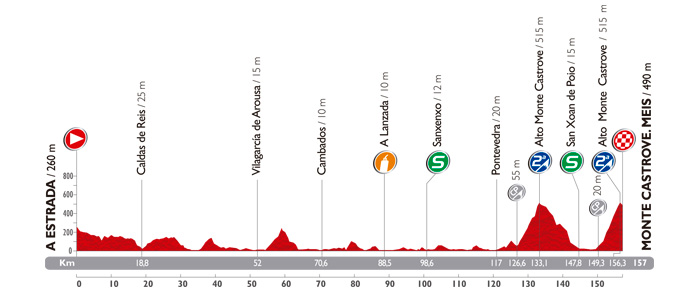
    Stage 18: A Estrada › Monte Castrove. Meis – 157 km

    Following John Degenkolb’s strong win on the Vuelta’s final real sprinters’ day, Stage 18 will bring to the fore those who prefer charging up a gradient. Very short at only 157 kilometers, Stage 18 nevertheless packs a punch in the finale. After they’ve spent most of the day riding on relatively flat roads, the peloton will have to climb the Alto Monte Castrove twice to close out the day. It’s short, but its 7% average grade will do plenty of damage, and with the finish line coming just over a half a kilometer after the riders crest the climb for the second time, only those with punchy climbing legs will have a chance at being positioned to contest the stage victory.

    Since this finish is too difficult for the pure sprinters’ teams to drive the pace, the breakaway will have a chance at staying away on Stage 18, but if Movistar or Katusha decide to keep things on a short leash so that their GC men might have a shot at the bonus seconds on offer, it will be hard for anyone to succeed for afar here. Katusha and Movistar should be keen on controlling this one, because Joaquim Rodriguez and Alejandro Valverde have to be among the top favorites for stage honors. The narrow uphill road of the final climb suits Purito quite well, and it’s hard to imagine him not delivering an all-out attack in the waning moments of the race. Daniel Moreno has just the right skillset for the Alto Monte Castrove as well. Meanwhile, Alejandro Valverde packs quite the uphill kick himself, and he also has the strongest sprint among the riders in the GC Top 5. If he can hold the wheels of the attackers in the last ascent, he’ll have an excellent opportunity to nab a victory and valuable bonus seconds on Stage 18.

    Dan Martin has already come close to a stage victory in this race using his top-notch punchy climbing legs, and he has maintained a high level of form even into the third week. He has a great chance here to finally pick up the stage win he’s been hunting. Fabio Aru may not have the Ardennes resume that Purito, Valverde, Moreno, and Martin have, but he is an elite climber who has a knack for exploding out of the pack on the very steep stuff.

    Chris Froome is getting stronger every day in this race, and if he can drop his rivals with an attack from far enough out, he’ll have a shot at victory on Stage 18 even on a short climb like this. Race leader Alberto Contador, on the other hand, doesn’t need to attack, and therefore will have the luxury of being able to follow the wheels he wants to follow. That puts him into a good position to pick up another win in much the same way he won Stage 16, when he allowed Chris Froome to drive the pace until an opportunity to fly past presented itself.

    Wilco Kelderman hasn’t had quite the level of form in this Vuelta a España that he displayed in the Giro, but he has a very fast finish and is a dangerous rider in a post-climb sprint. Samuel Sanchez, Warren Barguil, and Daniel Navarro are others on the fringes of the GC leaderboard who could hope to get involved in this sort of finish, while Philippe Gilbert and Michael Matthews will hope that they can hang with the GC-oriented climbers on the incline and outgun them in the final few moments for stage honors.

    Should a long-distance move take the day, Ryder Hesjedal, Alessandro De Marchi, Luis Leon Sanchez, Adam Yates, Wout Poels, Alexey Lutsenko, Louis Meintjes, and Alexandr Kolobnov are among those who should be considered good candidates for success on a profile that turns hilly quite suddenly in the last 30 kilometers.

    VeloHuman Stage Favorites

    1. Alejandro Valverde | 2. Joaquim Rodriguez | 3. Dan Martin

    Be sure follow @VeloHuman on Twitter for live commentary of this and every stage of the 2014 Vuelta a España! The next preview will be up after the conclusion of Stage 18, and there is plenty of GP Quebec and GP Montreal coverage coming very soon as well, so stay tuned!

    -Dane Cash

  • Vuelta a España 2014: Stage 16 Preview

    Vuelta a España 2014: Stage 16 Preview

    Stage 16 Profile

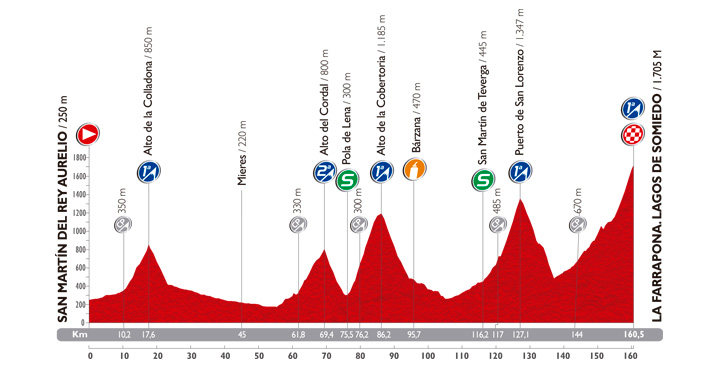
    Stage 16: San Martín del Rey Aurelio › La Farrapona. Lagos de Somiedo – 160.5 km

    After another tough day won by Przemyslaw Niemiec, Stage 16 closes out a trio of critical mountain stages in style, with no fewer than four Category 1 climbs (and a Cat. 2 thrown in for good measure), and the challenging profile won’t wait until the end of the day to test the peloton. The stage starts with 10 kilometers of slight incline before the first Cat. 1 is reached, the Alto de Colladona. After a tricky descent off the climb the riders will continue to go slightly downhill for another thirty kilometers or so, during which they will try to save as much energy as possible: after kilometer 60, it’s steep climbs or white-knuckle descents pretty much all the way to the finish line. First comes the Cat. 2 Alto del Cordal, followed by a descent right to the foot of the vicious Alto de la Cobertoria climb, a Cat. 1 of 10 kilometers at 8.8% (and it comes only halfway through the stage). From the top, the riders will take on a very technical downhill journey to Barzana, where the negative gradient will become gentler, but it won’t even out completely. When it does, after another 10 kilometers or so, the road kicks up again almost immediately, heading uphill in an uncategorized trip to the bottom of the categorized Puerto de San Lorenzo, another steep slope of 10.1 km at 8.5%. From the top it’s one more tricky descent the leads to one more uncategorized uphill trip to the foot of one more Cat. 1 climb: La Farrapona. It’s a long journey to the summit finish, 16.5 kilometers in total, and though the average gradient may seem manageable at 6.2%, the final 4 kilometers ratchet up the difficulty, with several stretches pushing over 10%.

    While the Vuelta’s sixteenth stage is followed by a rest day and is one of the last opportunities the GC contenders will have to put each other under pressure in the mountains (two factors that could spur the red jersey hunters to a fast pace and a more likely catch of the morning break), the profile itself looks perfect for any aggressive riders who manage to get up the road. Early climbs will give the uphill specialists a good chance of getting into the day’s move, and the constant up-and-down will make it very difficult for anyone to control the race. This breakaway vs. GC bunch battle looks to be another tossup, which will again make it difficult to name anyone the clear favorite to take stage honors.

    This very steep final climb should be yet another opportunity for Joaquim Rodriguez to get some separation from his rivals on the General Classification. He was unable to get clear of the rest of the red jersey hunters early on the last climb of Stage 15, and then spent most of the rest of the ascent letting Alberto Contador drive the pace, only sailing past in the final few hundred meters to steal a few seconds at the line. However, he won’t have many chances to get ahead after Stage 16, and the slope suits his style nicely. With time running out in this Vuelta, it’s hard to imagine that Katusha won’t look for stage honors and bonus seconds here. Daniel Moreno, as usual, will be a dependable second on these gradients.

    Alberto Contador may have lost a bit of time to Rodriguez and Valverde on Stage 15, but only after pulling both of them up the mountain for quite some time. He continues to show impressive strength in this race, and a stage like this, with so many vertical meters on the day, will allow him to put his otherworldly uphill endurance on display.

    Chris Froome again landed a good result after riding his own pace up a tough final climb on Stage 15. On peak form, he has the endurance to thrive on a hard stage like this; it will be interesting to see how he does despite not necesarilly being at his best. Alejandro Valverde took 2nd on Stage 15, but his nice result there didn’t necessarily show a whole lot more strength than we’ve seen just yet, as it came with a late jump around Alberto Contador (whom he’d been following for the last several kilometers) in the final few hundred meters. Stage 16 is one of the last chances for the climbers to create some space on the leaderboard, which should lead to more attacks on the final climb, and that will require more from Valverde. If he’s in a lead group in the last hundred meters, his sprint obviously makes him a top favorite, but that scenario will only occur if a lot of things go right for the 2008 winner of this race.

    Dan Martin showed immense ability on Stage 15, finishing 11 seconds behind Chris Froome despite spending several kilometers just before the final climb chasing the pack after crashing. He’s far enough behind on GC that he should have a bit of freedom to put in a late dig. Fabio Aru, in a similar position, remains a nice candidate for stage honors with this steep finish if it is, in fact, the GC men who are vying for the day. Robert Gesink, Daniel Navarro, and Samuel Sanchez are others on the fringes of the GC battle who have shown strength in the past few mountain days and who are also good candidates to get clear of the rest of the GC types on the final ascent.

    Several potential long-distance protagonists kept their powder dry and stayed in the pack on Stage 15. Ryder Hesjedal was one of them, but he did expend a lot of energy dragging Dan Martin back to the GC group after Martin’s crash. He’ll still be among the favorites if he gets into the day’s move, but it would be an impressive ride indeed if he were to succeed here after two tough days on the bike. David Arroyo was 8th on the stage that Hesjedal won from the break, and this will be another great opportunity for the pure climber to try for a long-range strike. Teammate Amets Txurruka is a good candidate to give it a go as well. Esteban Chaves has fallen out of GC contention in this Vuelta, and he could be hoping to get into the break on Stage 16, which has a steep finale that suits him; teammate Adam Yates is another likely long-distance hopeful. Astana’s Mikel Landa, Stage 15 winner Przemyslaw Niemiec of Lampre-Merida (if he still has anything left in the tank after two days in the break), his teammate Damiano Cunego, Belkin’s Laurens Ten Dam, OPQS’s Gianluca Brambilla and Wouter Poels, MTN-Qhubeka’s Sergio Pardilla and Louis Meintjes, Lotto Belisol’s Bart de Clercq, and Cannondale’s Alessandro De Marchi are other good candidates for breakaway success.

    VeloHuman Stage Favorites

    1. Joaquim Rodriguez | 2. Alberto Contador | 3. Daniel Martin

    Be sure follow @VeloHuman on Twitter for live commentary of this and every stage of the 2014 Vuelta a España! With a rest day on tap after Stage 16, the next preview will be up on Tuesday, so stay tuned for more.

    -Dane Cash

  • Vuelta a España 2014: Stage 14 Preview

    Vuelta a España 2014: Stage 14 Preview

    Stage 14 Profile

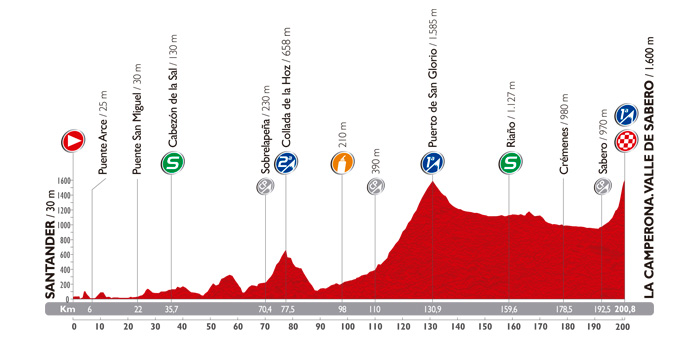
    Santander › La Camperona. Valle de Sabero – 200.8 km

    Stage 13, won by Dani Navarro, saw a skirmish among the GC riders in its final few kilometers, but the impending fourteenth stage of the Vuelta will likely be an intense battle among the top overall contenders of this race. The uphill challenges on Stage 14 are daunting. Things get started with 70 kilometers of mostly gentle roads before the Cat. 2 Collada de la Hoz kicks off the day’s categorized climbing. After cresting that ascent and then riding a tricky downhill, the peloton will take on approximately twenty kilometers of false flat at a slight incline before reaching the bottom of the Puerto de San Glorio, 20.9 kilometers long at a 5.8% average grade. There are sure to be some tired legs in the pack once they reach the top after over forty kilometers going uphill, but there will still be challenges yet to come on the day. Following a fast descent comes a long stretch of mostly flat roads before the final test. After 192.5 kilometers in the saddle, the peloton will reach the foot of La Camperona, a vicious 8.3 kilometer climb whose average gradient of 7.5% doesn’t really tell the whole story. Things start out relatively easy, but with around 2 kilometers to go, the road kicks up sharply, and it stays in the 15% range, touching well over 20% at points, until the final hundred meters or so, where things ease off to be only a little under 9% in the run to the line.

    A profile like this will be absolutely brutal for all but the most lightweight climbing specialists. The GC contenders will be locked in on the final ascent, knowing that a bad day could lead to serious losses on such a steep climb (especially after some hard uphill riding earlier in the day). Stage 14 is likely to end in a major showdown for the red jersey hunters. Whether or not they are riding for stage honors will depend on how they play the run-in to La Camperona; if the pace is kept high over the flat section that precedes the final climb, with riders jostling for position as the slopes approach, the morning break will be doomed. However, there are some tough mountain days to come in the days ahead, which could lead to enough hesitation in the pack that if a truly top-notch climber is up the road, he might have a chance.

    The top favorite to shine on this profile is Katusha’s Joaquim Rodriguez, the peloton’s premier uphill charger. He has put in attacks here and there in this race, but nothing has really stuck so far. This time, the parcours is perfect, and he needs to land a blow soon or he’ll have run out of opportunities to claw back time from those ahead of him on the leaderboard. He has the also explosive Daniel Moreno as an elite second.

    Race leader Alberto Contador has been up to every challenge thrown his way in this race so far, and he should continue to shine here. His biggest weakness is his lack of team support, but he may be strong enough for that not to matter. He’s not the type to rest on his laurels (or his current race lead), and if he sees an opportunity to pick up more time on his rivals, he will.

    Movistar’s Alejandro Valverde is very dangerous on the extreme gradients, and he’s within striking distance of the overall lead. A strong ride seems likely on Stage 14, but he needs to get more aggressive in this race if he wants to move up to that coveted first spot in the General Classification.

    Astana’s Fabio Aru took the eleventh stage of the race with a perfectly timed attack as the finish line approached, and he is still far enough back on GC that the riders at the very top of the leaderboard might give him some leeway if he tries to go on the move again. He has the skillset to achieve more success here. Garmin-Sharp’s Daniel Martin is in a similar boat, and he’s shown with repeated attempts to get away on the steep stuff that he’s highly motivated to get results on these climbs.

    Robert Gesink, who looked strong in an ultimately unsuccessful attempt to get clear of the GC bunch on Stage 11, Samuel Sanchez, Stage 13 winner Daniel Navarro, and Warren Barguil are other riders in the GC conversation who could enjoy a bit of freedom and potentially success if they attempt to get clear on the last climb. Chris Froome, who has at times looked very strong, and at times looked to be lacking something in this race, will be put to the test on this gradient; at his best he’d be a top candidate for success, but there won’t be anywhere to hide if he’s not feeling in peak condition when the road shoots skyward on Stage 14. Teammate Mikel Nieve could look to get something of his own if Sky decides to set him loose.

    If the pack does put in the effort to keep the breakaway on a tight leash early in the day, it will be very hard for anyone up the road to stay clear all the way to the top of the final climb, but should the GC contenders spend the stage looking at each other instead of worrying about the break, it’s possible that a strong uphill talent could hold out for victory here. Trek’s Julian Arredondo, Garmin-Sharp’s Ryder Hesjedal, Astana’s Mikel Landa, OGE’s Esteban Chaves and Adam Yates, Lampre’s Przemyslaw Niemiec, Cannondale’s Alessandro De Marchi, and Belkin’s Laurens Ten Dam are on the list of strong-climbing riders who might be able to succeed from the morning breakaway; alternatively, some of the aforementioned group could look to put in a dig a bit closer to the finish line, still benefitting from being far enough out of GC contention that they might be given some breathing room.

    VeloHuman Stage Favorites

    1. Joaquim Rodriguez | 2. Fabio Aru | 3. Alberto Contador

    Be sure follow @VeloHuman on Twitter for live commentary of this and every stage of the 2014 Vuelta a España! The next preview will be up after the conclusion of Stage 14, so stay tuned.

    -Dane Cash

  • Vuelta a España 2014: Stage 11 Preview

    Vuelta a España 2014: Stage 11 Preview

    Stage 11 Profile

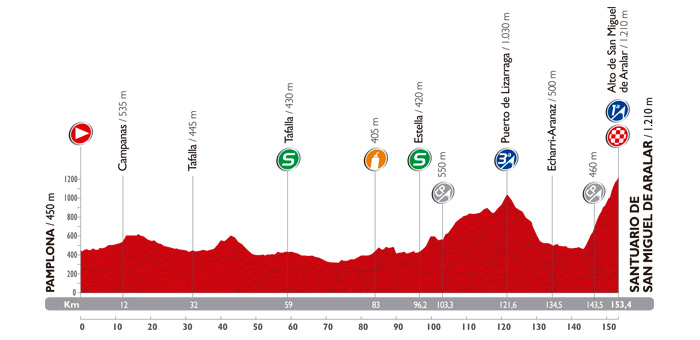
    Stage 11: Pamplona › Santuario de San Miguel de Aralar – 153.4 km

    Even after a tough time trial (won by Tony Martin) that saw Alberto Contador take the red jersey and Nairo Quintana and Chris Froome lose a lot of time, dramatically shaking up the General Classification of this race, the peloton won’t have a chance to rest on Stage 11. Another summit finish is on tap. The first two thirds of the stage are relatively tame, without any categorized climbs, but things get a bit more difficult with around 50 kilometers to go, when the road rises at the Puerto de Lizarraga, a Cat. 3 of 18.3 long kilometers with an average grade of 2.6%. It’s an uneven climb with a steep stretch at the top, so it is harder than the low gradient indicates. From the top it’s a tricky descent of about 9 kilometers, and then a stretch of flat before the final climb, a 9.9 kilometer Category 1 with an average gradient of 7.5%. It’s a fairly steady climb, except for a short 14% section at around 2.5 km from the top. The summit finish marks 153.4 kilometers in the saddle, making Stage 10 the second shortest non-TT day in the race: this is likely going to be a fast-paced affair.

    The breakaway will have its chance of taking this stage, but if the GC contenders decide to keep the early aggressors on a tight leash, it will be hard for anyone up the road to stay away with a late flat section (likely to see an injection of pace as the GC men jostle for position) and then a tough final climb. Katusha is among the teams who will hope that the battle for stage honors will come down to the GC contenders. Joaquim Rodriguez put in a respectable time trial on Stage 10 to stay within striking distance of the GC title, and he has already shown that he’s on the offensive in this race. The steep section near the finish should be a perfect place for him to strike out for a gap and for bonus seconds. Daniel Moreno makes for a dangerous ally. Katusha’s elite uphill talents will be very hard to keep under control in the last few kilometers of the race.

    Alberto Contador no longer has to gain ground on anyone, as the race leader, but without a strong team helping him, sitting tight and waiting for the attacks may not be the best idea. He’s obviously on excellent form, far more so than he was willing to admit publicly at the start of the race, and he’s not the type to rest on his laurels with a great opportunity for more success right in front of him.

    Nairo Quintana may have gone down hard on Stage 10 but Movistar isn’t out of this race yet. If the young Colombian wants to get back into this Vuelta a España, he’ll need to attack early and often. Alternatively, if he shifts his attention to helping Alejandro Valverde, attacking early and often (and forcing the other GC riders to chase) would still be a good strategy. Quintana’s form is an unknown after his fall, but if he’s feeling strong enough to attack, he probably will. That would give Valverde the opportunity to latch onto any wheels that go chasing after, and should this come down a sprint (things are a bit easier at the very top), Valverde would of course be the heavy favorite among the top GC contenders. Even if Quintana isn’t at his best, Valverde will still likely be in the mix on Stage 11 on his own. He has looked sharp in this Vuelta and he’s running out of opportunities to add another Grand Tour to his palmares.

    Chris Froome, on the other hand, showed in the Stage 10 ITT that he’s just not at his best in this race, giving up nearly a minute to Alberto Contador on a parcours that looked to suit him quite well. He’s still one of the top climbers in the Vuelta, though, with Mikel Nieve as a valuable second, so it would be unwise to overlook Team Sky on this final climb.

    Rigoberto Uran put in a great chrono and is now sitting in 3rd overall. He struggled to hold the pace on the first climbing stage of the Vuelta, but since then he’s looked stronger every day. He’s got a nice sprint and if he can hold onto the lead group to the line he’ll have a shot. Fabio Aru has been flying a bit under the radar in this Vuelta but he has looked to be in excellent shape thus far. More than two minutes behind on GC, he might be allowed some room if he puts in an attack, and this final climb suits him very well. Daniel Martin is another rider who could get aggressive. He tried an attack on Stage 9 but was reeled in; he’ll be on the lookout for another opportunity here. Esteban Chaves, who had a very rough day in the ITT, will at least now be less of a marked man should he try to put in a dig on his favored terrain. If he can pick himself up after his disappointing chrono, he could be in the mix (he might even try to his luck in the break). Winner Anacona, unlike compatriot Chaves, had a very impressive ride against the clock on Stage 10 after a very impressive breakaway victory on Stage 9, and those performances have put him into the GC conversation. That will make it harder to successfully attack the pack on the climb, but with the form he’s shown, he still has a shot at a good result on Stage 11 even from the pack and with the top GC contenders watching him more closely.

    Should the GC riders allow an early move to stay up the road all day, the long list of potential protagonists for stage honors from afar would include OGE’s Adam Yates, FDJ’s Thibaut Pinot and Kenny Elissonde, Garmin’s Ryder Hesjedal and Andrew Talansky, Lampre’s Jose Serpa and Przemyslaw Niemiec, Trek’s Julian Arredondo, BMC’s Cadel Evans, Astana’s Mikel Landa, Cannondale’s Alessandro De Marchi, Caja Rural’s David Arroyo and Amets Txurruka, Belkin’s Laurens Ten Dam, Europcar’s Romain Sicard, and Sky’s Dario Cataldo, among others.

    VeloHuman Stage Favorites

    1. Joaquim Rodriguez | 2. Alberto Contador | 3. Alejandro Valverde

    Be sure follow @VeloHuman on Twitter for live commentary of this and every stage of the 2014 Vuelta a España! The next preview will be up after the conclusion of Stage 11, so stay tuned.

    -Dane Cash