Tag: John Degenkolb

  • Vuelta a España 2014: Stage 3 Preview

    Vuelta a España 2014: Stage 3 Preview

    Stage 3 Profile

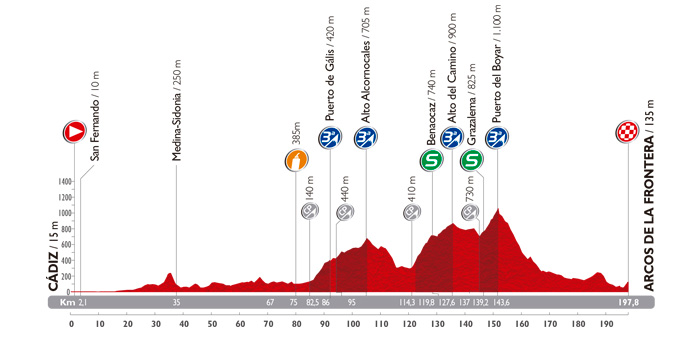
    Stage 3: Cádiz › Arcos de la Frontera – 197.8 km

    After a very flat second stage won, somewhat predictably, by Nacer Bouhanni, the peloton will take on a moderately bumpy Stage 3. The riders will enjoy approximately 80 kilometers of flat roads after they set out from the start (on an aircraft carrier, no less) in Cádiz before taking on a few hills in the middle of the stage. Following the journey up and over a series of Cat. 3 climbs, the riders will begin a long descent. After things flatten out, a short, uncategorized bump must be overcome with roughly 10 km to go, followed by a flat stretch that will last until a little bit after the peloton reaches the 2-km-to-go mark. Then things get interesting. The road kicks upward for most of the remainder of the journey to the line, only flattening out in the last few hundred meters. It’s not a categorized climb, but it’s enough of an incline to give the lighter riders a significant advantage. When the pack hits the slope, those who specialize in these sorts of ascents will drive a furious pace to put pressure on their heavier rivals. Some riders could try to launch their bid for glory early while the gradient is high, while the less able climbers will hope to hold on until things flatten out.

    The parcours of Stage 3 should favor the more versatile fast finishers, the riders who are at their best sprinting for victory up a bit of an incline and at the end of a harder day in the saddle. An intermediate profile like this might look breakaway-friendly, but there are plenty of well-rounded quick men on this startlist who will find this stage well-suited to their talents, and their motivation to keep this together for a group finish will be high. A long, late flat section will help with a chase. The first uncategorized bump in the final 20 km might see a few attacks, but it’s not a difficult enough challenge to be a great launchpad, and it will be hard to stay away with another flat stretch to follow. The likeliest outcome here seems to be a group reaching the last uphill drag mostly intact to fight it out over the final two kilometers.

    It’s hard to draw up a better profile for Peter Sagan than this. The climbs in the middle of Stage 3 will not be a problem for him, but some of his rivals for a sprint could suffer. Likely arriving relatively fresh at the finish line, he’ll appreciate the last uphill kick at the end of the day; he’s always fast, but his talents should be especially apparent in the fight for position that will occur in the last kilometer when the road is at a bit of a gradient. The Slovakian star doesn’t come without question marks though. He has said that he’s in this Vuelta a España to prepare for the World Championships, and he did a rare turn as a leadout man in Stage 2 rather than chasing victory himself. Stage 3 looks like a golden opportunity but his motivation is uncertain. Oscar Gatto is a decent alternative in place of Sagan should Cannondale decide to go in that direction.

    John Degenkolb is another rider with a particular knack for this sort of profile. His top speed rivals Sagan’s, and unlike many other big-name sprinters of that caliber, he doesn’t lose his edge when the road tilts upward. If things hold together for a sprint at the end of Stage 3, Degenkolb will have a great chance at victory, and even if some of the punchier types try to create separation on the late incline, he’s shown before that he is strong enough to latch onto the right wheel to avoid being left behind when the road tilts upward.

    Michael Matthews will love this parcours. His only complaint might be that Stage 3 isn’t bumpy enough in the middle of the day to cause more problems for other fast finishers, but either way, he’ll be a top favorite with an uphill stretch just before the line. His climbing legs have been amazing this year.

    The final hundred meters may be flat, but the battle to be in front on the last uphill section will be critical for anyone hoping to take this stage, and nobody can charge uphill quite like BMC’s Philippe Gilbert. He will go full gas on the incline section and hope to get enough of an advantage to hold on for the win when things flatten out.

    Alejandro Valverde of Movistar is another rider who can rely on his explosiveness to put space between himself and some of the heavier sprinters on the late climb. Katusha’s Daniel Moreno is on strong form for this Vuelta and could try the same, as might his teammates Joaquim Rodriguez and Alexandr Kolobnev.

    Trek’s Fabian Cancellara is typically strong in a finish like this, but don’t count out his very impressive 22-year-old teammate Jasper Stuyven, 4th on Stage 2 and capable of handling a few hills. Fabio Felline crashed in the second stage, but normally this finish would suit him too. Filippo Pozzato, Daniel Martin, Moreno Hofland, Anthony Roux, Nathan Haas, Gerald Ciolek, Luis Leon Sanchez, Tom Boonen, and even Cadel Evans are others who could find Stage 3 to their liking. The profile may be a bit bumpy for Nacer Bouhanni, but his team did a great job taking care of him in the finale of the second stage and it’s not out of the question that he makes it to this finish in a good place.

    VeloHuman Stage Favorites

    1. John Degenkolb | 2. Peter Sagan | 3. Michael Matthews

    Be sure follow @VeloHuman on Twitter for live commentary of this and every stage of the 2014 Vuelta a España! The next preview will be up after the conclusion of Stage 3, so stay tuned. In case you missed it, the overall race preview can be found here.

    -Dane Cash
  • Vuelta a España 2014: Stage 2 Preview

    Vuelta a España 2014: Stage 2 Preview

    Stage 2 Profile

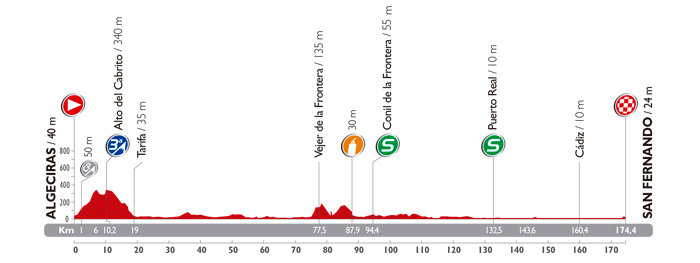
    Stage 2: Algeciras › San Fernando – 174.4 km

    With the opening TTT (won by Movistar) now in the rear mirror, the Vuelta a España gets into road racing proper in its second stage. After an early Cat. 3, Stage 2 offers over 160 kilometers of racing without a single categorized climb. It’s hard to see anything other than a sprint decided this stage, though a few factors could add some excitement to the day. For one, this route runs along coastal roads susceptible to high winds. The first road stage of a Grand Tour is always nervous enough as it is, and things will be all the more stressful if the winds pick up.

    What’s more, the finale is a tricky one, with a succession of hard turns (right, left, right, and right again into the finishing straight) inside the last kilometer and a half. A technical sprint run-in on the first mass start day of the race could be a recipe for crashes, and the GC men will have their fingers crossed that they can simply make it to the Stage 2 finish line unscathed.

    The fastest of the fast men will be the favorites here. Giro Points Classification winner Nacer Bouhanni has elite top-end speed and would be dangerous enough in a drag race on a long straightaway, but he really shines in a hectic finale like this. His ability to position himself perfectly even without a great leadout, combined with some amazing acceleration, puts him at the top of the list of contenders.

    Cannondale’s Peter Sagan is another rider who is quite capable in a technical finish. His versatility shouldn’t take away from the fact that he’s one of the best sprinters in the field. Coming into the race, form and motivation were both question marks; it’s unclear what he is hoping to get out of this Vuelta, which he is using to prepare for the World Championships. However, after Cannondale’s strong TTT, a top result on Stage 2 could put him into the leader’s jersey, and that should drive him to go for this. He has the ability to win this stage.

    Giant-Shimano’s John Degenkolb shouldn’t lack for motivation to hunt a victory here. He has looked sharp in sprint finishes this year, but was unable to pick up a victory in the Tour de France. With a top-notch leadout to guide him through the last few kilometers, he should be in the mix.

    Michael Matthews of Orica-GreenEdge had a terrific Vuelta in 2013, taking two stage victories. Known for his versatile skillset, he is also just plain fast, and even on a flat course he’s a contender.

    Astana’s Andrea Guardini has been on fire this month, winning twice in Denmark and then picking up a WorldTour victory in the Eneco Tour. He will have another opportunity here on Stage 2 of the Vuelta. Lampre can choose between the speedy Maximiliano Richeze and Roberto Ferrari. OPQS has Tom Boonen, who becomes even more dangerous on a windy day when his team’s classics prowess can be put to good use. The longlist of others who should be in the mix includes AG2R’s Yauheni Hutarovich, Belkin’s Moreno Hofland, Garmin-Sharp’s Nathan Haas, IAM Cycling’s Matteo Pelucchi, Lotto Belisol’s Jens Debusschere, MTN Qhubeka’s Gerald Ciolek, and even BMC’s Philippe Gilbert.

    VeloHuman Stage Favorites

    1. Nacer Bouhanni | 2. John Degenkolb | 3. Peter Sagan

    Be sure follow @VeloHuman on Twitter for live commentary of this and every stage of the 2014 Vuelta a España! The next preview will be up after the conclusion of Stage 2, so stay tuned. In case you missed it, the overall race preview can be found here.

    -Dane Cash
  • Tour de France 2014: Stage 12 Preview

    Tour de France 2014: Stage 12 Preview

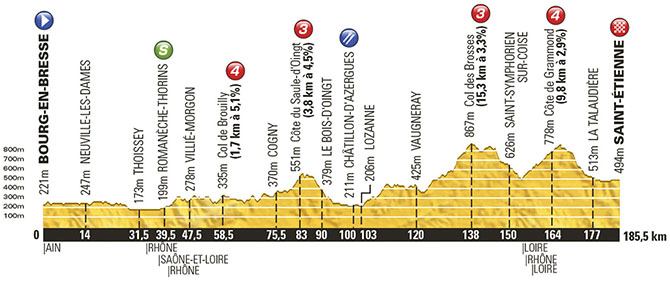
    Stage 12 Profile

    Stage 12: Bourg-en-Bresse › Saint-Étienne – 185.5 km

    The undulating finale of the Tour’s eleventh stage served as an excellent launching pad for Tony Gallopin to outfox Peter Sagan and a charging pack of fast finishers. Late climbs again await the peloton on Stage 12. The first of two major ascents near the end of the day is a 15.3 kilometer Category 3 climb that averages 3.3%. It’s not the sort of steep wall that the puncheurs will love, but it is long enough to put some of the heavier riders under pressure. It is followed by a fast descent and then a 9.8 kilometer Cat. 4 that averages 2.9%. Again, the gradient itself is not all that demanding, but it will be a long way for the sprinters to travel on an incline, especially if there are teams driving the pace up front. After another descent, things flatten out for the final few kilometers toward the finish.

    The bumpy road to Saint-Étienne will give a breakaway some chance of going the distance on Stage 12, but there are quite a few teams in this Tour de France whose featured sprinters have decent climbing legs. If those teams cooperate, it will be hard for anyone who gets up the road to survive. As such, while the opportunists will certainly put in the effort to make this interesting all the way to the line, the favorites will be the fast finishers with the uphill talent to make it over the late climbs without losing ground to the pack.

    As usual, chief among the more versatile sprinter types is Cannondale’s Peter Sagan. His frustration at being constantly forced to decide between closing down moves on his own or letting them go clear and hoping others will do the chasing is mounting, but Stage 12 may be his best opportunity for victory left in this race. The final climbs aren’t as steep as they were in the eleventh stage, the last descent isn’t as tricky, and there is a longer flat run-in to the line. The race should be a bit easier to control. Still, easier doesn’t mean easy: Cannondale will need some help from other teams to keep the early breakaway and any attacks on the climbs on a short leash, and even if things come together for a sprint, the young Slovakian will probably be facing some stiff competition.

    The list of riders who will hope to rival Sagan if this does comes down to a sprint is headlined by Giant-Shimano’s John Degenkolb. These late hills will probably too much for the team’s other star fast-man Marcel Kittel, but they has a capable alternative in Degenkolb. Runner-up on Stage 11, he is clearly feeling much better now than he was feeling last week. If he is, indeed, back to full strength, Sagan will have his hands full on Stage 12: Degenkolb at peak form should be able to handle these climbs, and he has been extremely fast this year, coming very close to beating Mark Cavendish twice in the Tour of California, and rather handily defeating Peter Sagan in a sprint in Gent-Wevelgem.

    Orica-GreenEdge has an excellent lineup for the hilly stages, but they are still without a win in this Tour de France. This will be another good opportunity pick up that elusive victory. Simon Gerrans has landed some strong results in the reduced bunch sprints we’ve seen, and Michael Albasini is an excellent alternative with a similar skillset. OGE could try to put one in the break and let the other hang back in the pack to cover both potential scenarios.

    OPQS’s Matteo Trentin continues to deliver impressive performances in the sprints on the hilly days, following up his earlier stage win with a nice 3rd place on Stage 11. He will be strong option for his team here on Stage 12, with the added versatility of being able to jump into the early move if that looks to be the smart decision. Michal Kwiatkowski will, as usual, be another versatile card for the team to play.

    Movistar’s JJ Rojas, AG2R’s Samuel Dumoulin, and Tinkoff-Saxo’s Daniele Bennati should enjoy an opportunity to battle a somewhat reduced bunch if this comes to a sprint. Lotto Belisol’s Andre Greipel, on the other hand, will be put to the limit trying to make it to the line, but it could happen, and it should go without saying that he’ll be a top favorite for a sprint if he’s still in the pack. Katusha’s Alexander Kristoff and FDJ’s Arnaud Demare could hold on for a bunch finish, and they will be dangerous if they are there. Europcar’s Bryan Coquard, OPQS’s Mark Renshaw, and IAM Cycling’s Heinrich Haussler have a chance to be in the mix as well.

    Lotto Belisol’s Tony Gallopin, BMC’s Greg Van Avermaet, Garmin-Sharp’s Tom-Jelte Slagter, Cofidis’s Julien Simon, Garmin-Sharp’s Ramunas Navardauskas, and FDJ’s Arthur Vichot are fast finishers but they’ll have a hard time against the top sprinters. They will have to decide whether to try their luck in the bunch or attempt a long-range attack on Stage 12. It will take a strong group and some tactical riding for a move off the front to take this one from a hungry pack of sprinters. Strong candidates for success who will likely see a long-distance strike as their only chance at a stage win include Tinkoff-Saxo’s Nicolas Roche and Michael Rogers, Giant-Shimano’s Tom Dumoulin, Lotto Belisol’s Adam Hansen, Belkin’s Lars Boom and Sep Vanmarcke, Europcar’s Tommy Voeckler and Cyril Gautier, OPQS’s Tony Martin and Jan Bakelants, and IAM Cycling’s Sylvain Chavanel.

    VeloHuman Stage Favorites

    1. Peter Sagan | 2. John Degenkolb | 3. Simon Gerrans

    Be sure follow @VeloHuman on Twitter for live commentary on this and every stage of the 2014 Tour de France! The next preview will be up after the conclusion of Stage 12, so stay tuned. In case you missed it, the overall Tour de France preview can be found here.

    -Dane Cash
  • Tour de France 2014: Stage 5 Preview

    Tour de France 2014: Stage 5 Preview

    Stage 5 Profile

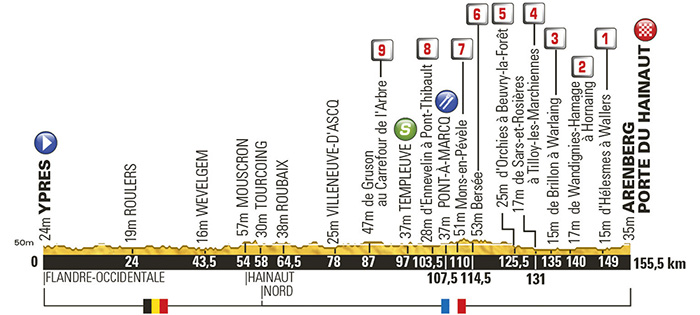
    Stage 5: Ypres › Arenberg Porte du Hainaut – 155.5 km

    Though Marcel Kittel’s unsurprising victory in a bunch sprint might suggest that the Tour’s fourth stage was an uneventful one, Chris Froome, Bauke Mollema, Niki Terpstra, and a number of Lotto Belisol leadout men were among the many riders to hit the deck on the day. Unfortunately for them, there will not be much time to recover from any injuries they may have sustained in their crashes, as one of the Tour’s most anticipated and potentially dangerous days awaits. Stage 5 is unique among the twenty-one stages of the Tour de France in that it features several stretches of cobbled roads. While the profile may be mostly flat, the peloton must overcome nine cobbled sectors, which begin at around the 87 km mark and then appear intermittently most of the way to the finish. Some of them are particularly difficult: Stage 5 includes visits to many of the most famous challenges ridden in the spring’s Paris-Roubaix, including sections of the Carrefour de l’Arbre and the Mons-en-Pévèle. The penultimate cobbled sector, Wandignies-Hamage à Hornaing, is the day’s longest at 3.7 km, and it comes less than 20 km from the finish. On top of the tough parcours, it may rain, which would make things even more hectic.

    On cobbles as difficult as these, punctures and mechanicals could wreak havoc on the peloton, threatening to end the GC hopes of those unfortunate enough to hit trouble. Most of those GC riders are particularly light, and therefore, even more susceptible to being bounced around on the bumpy roads. While they are holding on for dear life, a different group of riders will be locked in to hunt the stage victory. The stars of the spring Classics will have a rare opportunity to shine in a Grand Tour on Stage 5, and on their favored terrain they’re certain to make this an interesting race. A constant flow of attacks and counter-attacks is likely. Excellent bike handling skills and the ability to keep up with repeated accelerations getting into position for each cobbled sector will be crucial, just as they are in the Spring. It is important to note, however, that Stage 5 is nowhere near the length of Paris-Roubaix. At 155.5 kilometers, the bumpy road to the finish line will not wear out the pack in just the same way that more than 250 km of racing would.

    As such, while the powerful, aggressive classics stars will certainly feature prominently on Stage 5, the day is simply not difficult enough for a successful attack by a cobblestone specialist to be the only likely outcome. The cobbles will whittle down the peloton, but it is possible that this ends in a reduced sprint among the more capable quick men. With the outcome so difficult to predict, there is no clear favorite, though there are several riders who should be considered strong contenders.

    Fabian Cancellara is an obvious candidate to make a move on the cobbles. The three-time Paris-Roubaix winner had another excellent spring campaign in 2014 and he has looked good so far in this race. With so many teams focused on getting their GC leader safely to the finish, Cancellara could put in a dig from far out and remain solo all the way to the line; he certainly seems to be the likeliest candidate for an escape victory. What sets him apart here from the many classics-specialists here is his varied toolset; he is much more than a cobbled specialist, with soloing ability almost unrivaled in the peloton and a decent finishing kick as well, should he come to the line with a group. As this stage is not as long or as difficult as the spring classics, that broad toolset could be pivotal.

    BMC’s Greg Van Avermaet is always a likely attacker on difficult roads, and he has the extra-motivation of being well-positioned on GC; a small gap to those around him on the leaderboard could put him into yellow. Belkin’s Sep Vanmarcke is another of the classics specialists who will hope to get away; he has made a name for himself with terrific cobbled performances over the last two years, though victories in the biggest races have eluded him, as he has often found himself just behind Fabian Cancellara at the finish line. This will be a nice opportunity. Teammate Lars Boom will be a powerful ally and potential alternative; he’s strong on the cobbles but also very quick in a finish if he needs to be.

    Niki Terpstra of OPQS, winner of the 2014 Paris-Roubaix, will hopefully be feeling up for some aggressive riding the day after a crash. Jens Keukeleire and Matt Hayman of Orica-GreenEdge make a nice 1-2 for the cobbles, and OGE knows how to get off the front of the pack on a tough day. Lotto Belisol’s Jurgen Roelandts and possibly Tony Gallopin, IAM Cycling’s Sylvain Chavanel, Garmin’s Johan Van Summeren and Sebastian Langeveld, Katusha’s Luca Paolini, and possibly even Sky’s Geraint Thomas are other potential aggressors who know their way around a cobbled parcours.

    I think the long-distance attacker types will be most concerned not with each other, but with the potential for some of the more versatile sprinters to survive to the finish. Peter Sagan is more than capable of handling cobbled roads, and he is the first pick of the fast men who might be able to hold on for a sprint finish. He has finished in the Top 6 of every cobbled classic on the WorldTour calendar already in his young career. His biggest challenge in his spring campaigns has been the particularly long races, and he won’t have to worry about that here. He’s also capable of putting in a solo move of his own. I think he will have an excellent chance to pick up his first 2014 Tour de France victory on Stage 5.

    John Degenkolb, winner of this year’s Gent-Wevelgem and 2nd in Paris-Roubaix, will also have his sights set on this stage victory. If he can get those sorts of results in the more difficult spring races, he should have a great opportunity for more success here. Given the parcours, Giant-Shimano should back his ambitions over Marcel Kittel‘s on Stage 5, and that bodes well for Degenkolb’s chances. He has looked very fast all year, and although he didn’t win any stages in the recent Tour of California, he was inches away from besting Mark Cavendish twice. If he can stay at the front of affairs and if this stage does come down to a sprint, that sort of speed will make Degenkolb a top contender.

    Katusha’s Alexander Kristoff, constantly among the top sprinters in the spring in the past two years, and FDJ’s Arnaud Demare, 2nd at the 2014 edition of Gent-Wevelgem, could also be there at the end. Both showed off excellent speed in the Stage 4 finish behind Marcel Kittel.

    IAM Cycling’s Heinrich Haussler isn’t the rider he once was, but he has put up some decent results in the sprints here so far. Garmin’s versatile Ramunas Navardauskas, Europcar’s Bryan Coquard, and Trek’s Danny van Poppel will try their best to hold on to the end. OPQS’s Michal Kwiatkowski is always a name worth mentioning on a difficult day that could end in a reduced sprint; his team will be doing their best to keep him as close to the front as possible anyway. It’s not completely out of the question that Andre Greipel hangs on to the line, but it seems unlikely, especially if it rains.

    As the battle for stage supremacy rages around them, the lightweight GC riders will be doing their best to stay upright. This is a stage that could end a contender’s yellow jersey hopes in an instant. Whatever happens, Stage 5 should offer plenty of drama. It’s not one to miss.

    VeloHuman Stage Favorites

    1. Peter Sagan | 2. John Degenkolb | 3. Fabian Cancellara

    Be sure follow @VeloHuman on Twitter for live commentary on this and every stage of the 2014 Tour de France! The next preview will be up soon after the conclusion of Stage 5, so stay tuned. In case you missed it, the overall Tour de France preview can be found here.

    -Dane Cash
  • Paris-Roubaix 2014 Post-race Impressions: Terpstra Takes the Final Prize of the Cobbled Classics

    Paris-Roubaix 2014 Post-race Impressions: Terpstra Takes the Final Prize of the Cobbled Classics

    EmptyVelodrome2

    Niki Terpstra‘s beautiful solo move to bring the Netherlands its first Monument in a decade was a thrilling end to a thrilling cobbled classics season. Familiar faces were present throughout the season, ensuring that every race was a showdown between the most talented cobbled riders in the sport, but new blood had its day as well: each of the four biggest races went to a different victor, two of whom (John Degenkolb at Gent-Wevelgem and Terpstra at Paris-Roubaix) had never won a one-day classic on this level before. This P-R post-race will be somewhat different from what I usually produce for recaps: for most of the big riders in the race, Paris-Roubaix was the finale of a season, and now it’s time for a break, providing less cause to analyze this race in terms of what it means for the near future. Next week’s Ardennes Classics will draw a very different crowd. In other words, I’m looking at Paris-Roubaix and looking back on the cobbled classics to draw some final conclusions from those races.

    29-year-old Terpstra has been among the top classics riders in recent years, landing several high placings in the big races, but he has always functioned as more of a top lieutenant on super-team OPQS than as a player himself. He is a great teammate and a workhorse rider. However, when given more chances to make his own moves in the past few seasons, he has delivered, and steadily improved his results. He got an opportunity this week and now owns a Paris-Roubaix title, the grandest accomplishment of them all. Perhaps he was a surprise winner to some, but Terpstra stood on the podium of this race last year and has been hot all year, winning Dwars door Vlaanderen, coming in 2nd at E3, and landing a top 10 in Flanders. In my preview, I noted: “Terpstra is a keen opportunist and an excellent soloist, and as one of a number of options on his team, he could benefit if the pack hesitates to follow.” I’d say he made good on that promise with his brilliant solo move ahead of a star-studded group in Sunday’s final kilometers. He’s only a few weeks shy of 30, but he appears to still be improving as a rider.

    His team as a whole played their cards perfectly, finally delivering a victory. They’ve had the best squad (by a fair margin) in every race they’ve started this cobbled classics season, but at E3, Gent-Wevelgem, and De Ronde, they were only able land several riders in the Top 10s, never actually taking that final step to victory. When Tom Boonen jumped ahead very early on Sunday and stayed out front for tens of kilometers, it looked like a suicide move that was certain to leave him with nothing for the finish. OPQS, it turned out, was playing a clever game. With such firepower up front, the other big names were forced to exhaust themselves chasing, and no one could make a successful move past the breakers. When Boonen’s group was eventually reeled in and then the final select group started to form, Boonen himself may have been running low, but teammates Niki Terpstra and Zdenek Stybar had full tanks of high octane fuel. The former jumped, the group hesitated, and then it was too late for any of the tired riders to bring him back. Stybar and Boonen finished 5th and 10th, respectively; this time, OPQS can truly celebrate the triple top 10 performance, because one of those top 10ers actually won the race. With Stybar and Terpstra both hitting their stride and riders like Guillaume Van Keirsbulck in the wings, OPQS is in good hands for the near future even as Tom Boonen’s career enters its twilight years.

    Fabian Cancellara found himself on yet another Monument podium. He’ll be disappointed he did not win the race, but OPQS played Sunday’s affair just right and Cancellara’s team (lessened by the absence of Stijn Devolder) was not up for the challenge. At the start of the day, I would have said that 3rd overall was a less-than-stellar finish for the big favorite, but in the way the race played out, I felt that a podium finish (which required him to outsprint Zdenek Stybar, Sep Vanmarcke, and Peter Sagan in the velodrome) was actually quite a result given the makeup of the group in the final kilometers. Spartacus has now been on the podium of all three Monuments run so far this year, and he’s been on the podium of every one of the last 12 he’s raced. At 33, he is still showing an unbelievable ability to deliver big results in the biggest races, and he seems to have improved his sprint even as his soloing ability has maybe started to see a slight decline. Fellow pre-race favorite Sep Vanmarcke found himself in a very similar boat; there was very little he could do to get ahead of the pack with Boonen out front all day, and he was a tired, marked man in the finale. He was unable to get the victory he wanted this year, but he was among the best riders in every race he started, showing the kind of consistency that almost guarantees that he will one day be standing on the top of a major podium.

    John Degenkolb won Gent-Wevelgem’s sprint finish, but that race is much friendlier to sprinters than the brutal 260 kilometers of Paris-Roubaix. By making it to the Roubaix velodrome with the star-studded group of chasers just behind victorious Terpstra, he showed an amazing level of endurance that suggests he is capable of hanging on to win even the longest and most grueling of races. After such a long day, he still had enough energy to win the sprint for 2nd on one of the biggest stages in the sport. At only 25, Degenkolb is primed to take on Milano-Sanremo winner and fellow 2014 breakout star Alexander Kristoff in classics sprint finishes for years to come. Kristoff, by the way, had some horrible luck on Sunday, leaving the race in an ambulance after punctures and crashes ended his bid for victory. FDJ’s Arnaud Demare was another hardman-sprinter-with-a-bright-future who hit misfortunate after misfortune in the race. He punctured several times, but still made it in amongst the top 15, coming across the line in 12th place. After a great showing in Gent-Wevelgem, where he just missed out on victory behind John Degenkolb, the 22-year old looks poised for  success in the spring’s biggest events in the coming years.

    Peter Sagan‘s race was a mixed bag. Many did not expect him to make it to the final kilometers with the likes of Cancellara; he did, after riding an aggressive race that saw him bridge the gap to Boonen’s lead group and then hang on with the favorites before Terpstra’s decisive jump. Still, he seemed exhausted as the pack neared the velodrome. He was unable to put up much of a fight in the race for 2nd, rolling across the line 6th. It will be disappointing for him to have come close again, but I think it’s a positive sign: he’s been 2nd in Milano-Sanremo and the Ronde, but he had yet to make an impression on Paris-Roubaix, and he made a statement that this is a race he can contest as well when he hung with the big names on Sunday. Another spring without a Monument for Sagan, but he did add another classics win to his palmares at E3 Harelbeke and further experience in the long, brutal events for which he is so often named the favorite of the future.

    Sky landed a pair of riders among the top 10 finishers in Geraint Thomas and former Tour winner Bradley Wiggins. Many did not give Wiggins a chance in the slightest in this race; his performance, hanging with the biggest names in one-day racing, impressed me a great deal. There is still a lot left in his tank and I’m excited to see him in more races this year. Meanwhile, Geraint Thomas landed yet another good result, his third classics top 10 after a podium place in E3 and an 8th place in Flanders. Thomas made the most spirited attempt to chase Terpstra in the finale, but he did not get much help and was forced to resign himself to finishing with the group. Still, he has displayed an incredible array of talents this season; he has talked about the difficult choice between focusing on stage races vs. one-day events, and I think he could have a bright future in either one. Teammate Edvald Boasson Hagen crashed at an inopportune time in this race but didn’t seem strong on the day anyway—he was a good teammate this classics season, but for someone with such immense talent, his rather anonymous showings have been pretty disappointing. With a well-rounded combination of sprinting, climbing, and time trialing ability rivaled by few others in the sport, I wonder if he might be better off shifting his focus a bit later into the season, hunting points jerseys and circuit races like the Grand Prixes de Quebec and Montreal; Gent-Wevelgem remains really the only big classic race in which he has found success in his career.

    As a last note, Team BMC had a rash of misfortune late in the race. After Thor Hushovd put an admirable turn in at the front of affairs, things eventually started coming back together, and BMC began gathering its strength for Greg Van Avermaet and Taylor Phinney. Unfortunately, Van Avermaet crashed in a nasty corner and Phinney flatted on Le Carrefour. Bad luck is pretty much the name of the game in Paris-Roubaix, but it is a shame that we did not get a chance to see either rider in the finale, as late attacks are their forte.

    As the door closes on the cobbled classics, it opens on my favorite week of the season, with the Amstel Gold Race, La Fleche Wallonne, and Liege-Bastogne-Liege running one after another in the span of just one week. VeloHuman will be previewing all of them, with plenty of analysis on Twitter as well. Follow @VeloHuman for more, and check back here soon for the Amstel Gold Preview!

    -Dane Cash

    Photo by Luca Pedroni.

  • E3 Harelbeke, Gent-Wevelgem, and Volta a Catalunya Post-race Impressions: Wrapping up the Weekend

    E3 Harelbeke, Gent-Wevelgem, and Volta a Catalunya Post-race Impressions: Wrapping up the Weekend

    VoltaMotocrop

    Tuning Up at the Highest Level

    The last week of March was positively full of WorldTour racing, and each day offered insights into who is on form and who is not in early 2014. Because of the major implications of the one-day races for the upcoming Monuments, and the golden opportunity to view the form of the top GC riders on the planet during their heavyweight bout in the mountains of Catalunya, I decided the races were worth a few minutes spent cataloging some post-race impressions.

    Takeaways from E3 Harelbeke and Gent-Wevelgem

    Peter Sagan picked up the second major spring classic victory of his career last Friday at E3 Harelbeke, sticking a late attack with Geraint Thomas, Niki Terpstra, and Stijn Vandenbergh and rather easily outsprinting the rest of the escapees to the line. Sep Vanmarcke and Tony Gallopin jumped from the chasing pack for the next placings and then Borut Bozic led the bunch over the line, with Tyler Farrar, Fabian Cancellara (who put in a valiant effort trying to track down the escapees despite being delayed by a crash), Greg van Avermaet and a banged up Tom Boonen following, among others. Two days later in Gent-Wevelgem, the peloton ate up attacks one by one to force a bunch sprint, but not without danger along the way. Crashes wreaked havoc on the peloton all day, downing the likes of Ian Stannard (who fractured a vertebra), Andre Greipel (who broke a collarbone), and Tyler Farrar and slowing Cancellara. Enough stayed upright for a bunch finish. MSR winner Alexander Kristoff jumped first, but Sagan, John Degenkolb, and Arnaud Demare charged past as he faded. Degenkolb took the win with Demare 2nd and Sagan 3rd. Sep Vanmarcke was an impressive 4th. Boonen (despite an injured thumb) pulled in 5th.

    Sagan’s strength in the successful E3 move shows that he’s on a very high level in the area of his game he’ll need most in the upcoming Tour of Flanders. Meanwhile, he couldn’t match high octane Degenkolb and Demare in the sprint. I’m beginning to think he has made a conscious decision to angle towards improving his climbing and endurance possibly at the expense of pure sprinting this year; Flanders will be a good indicator of things.

    Fellow E3 top finisher Geraint Thomas looked very sharp, certainly back on the level after a messy crash in Paris-Nice. With Stannard out for the foreseeable future, Thomas’s showing is important for Sky’s classics campaign. The climbs and distance of Flanders will be a good opportunity for him to show off his skillset.

    Gent-Wevelgem brought John Degenkolb the spring classic he’d been seeking. He burst onto the scene with a dominating Vuelta performance in 2012 and has built on that promise. I look forward to the next stage race that he and Sagan attend together. Arnaud Demare was very close behind him at the line. He will be disappointed at coming so close, but it was a good showing that bodes well for the future.

    Despite a lack of success during the weekend, Cancellara showed continued power in his efforts at the front of the peloton in both races. E3 and Gent-Wevelgem are big events but Cancellara has his eyes on the Monumental prizes, and he looks sharp. Rival Tom Boonen took a backseat to Niki Terpstra in Harelbeke but he was quite quick in the Gent-Wevelgem finish. Like Cancellara, he looks ready for Flanders and Paris. Terpstra was doomed to 2nd when the E3 break was unable to drop Sagan, but he did look quite strong. Zdenek Stybar was active during the weekend and will relish the more difficult contests to come.

    Sep Vanmarcke was one of the strongest riders in both races. He managed a 5th place in E3 despite running into mechanical issues on the day, and surprised many (including me) with his sprint to 4th on Sunday. It was nice to see him giving the races his all even when victory seemed out of the picture. He has been everywhere in the early season classics, and I think he’s likely to mix it up with Cancellara, Boonen, and Sagan in the next two weeks.

    Andre Greipel missed out on a golden opportunity to pick up a big classics victory, and now he’ll miss time for injury to boot. It’s a shame for the German sprinter, who is a true gentleman of the sport, and who obviously has the talent to succeed in one-day races as well as in the Grand Tour sprints he’s known for.

    Other takeaways from the E3 Harelbeke/Gent-Wevelgem weekend: Topsport Vlaanderen’s Tom Van Asbroeck looks primed for a bright future, getting into the Top 10 mix in G-W after already notching some semi-classic success in 2014. Jurgen Roelandts sniped the final Top 10 spot in G-W despite a last minute designation as team leader after Greipel went down. He has looked very strong across the first few weeks of classics season, and now that he won’t be on teammate duty, he could pose a threat in the race he took 3rd in last year, Flanders. Alternativley, Lotto could look to success from Tony Gallopin, who looked sharp on the climbs in Paris-Nice and who was strong at the E3 finish.

    Takeaways from the Volta a Catalunya

    The heavyweight GC competition may have been the big story in Spain, but first, a quick word on the stagehunters. While John Degenkolb was prepping for his days on the cobbles, teammate Luka Mezgec was absolutely cleaning up the sprints in Catalunya, earning a hat trick of victories against the likes of Leigh Howard and Roberto Ferrari. He’s a versatile rider who can hang on over the climbs (kind of like Degenkolb) and he packs a heck of a punch… He also shares youth with Giant’s other star sprinters: Mezgec, like Degenkolb and Marcel Kittel, is only 25! OPQS youth Julian Alaphillipe (just 21!), a cyclocross transfer, looked strong as well in Catalunya with three top 5 stage finishes.

    Now to the GC contenders. Joaquim Rodriguez won the mountainous 3rdstage, taking the race lead, which he successfully defended through to the final podium. Alberto Contador was 2nd on the day, and he defended that position through to the final podium as well. Tejay van Garderen, 4th on stage 3, improved his position by winning a cold, dreary, foggy stage 4, and he hold on for 3rdoverall. Romain Bardet was just behind, both on the stage and in the GC. Nairo Quintana and Chris Froome were strong throughout the race, but could not match their rivals at the top, settling for 5th and 6th, respectively.

    There was plenty of insight to be gleaned from the climbers’ battle, but there are also some caveats. Starting with the insight: Purito quickly proved that his time away from racing was not spent on the couch. He was simply too strong on his way up La Molina, and if there were any concerns about his 2014 form heading into the month of the Ardennes classics, I’d say he dispelled them. Contador was among the top climbers on both decisive stages, and active on other days as well. Having just put in a Herculean effort in Tirreno-Adriatico, he still managed to challenge for the overall victory here, and if his performance in Italy did not say it emphatically enough, he is most definitely back. Meanwhile, Froome and Quintana, while among the best riders in the race, were not on the level of Purito and Contador. However, I think it is dangerous to draw too many conclusions from their performances. As was noted in the original preview, Quintana was still taking anti-biotics to stave of illness at the start of the race, and Froome was coming off of back pain that sidelined him for Tirreno-Adriatico and subsequent training. Given the circumstances, Quintana and Froome looked fine in Catalunya and I don’t think either is concerned.

    To my mind, Tejay van Garderen made the biggest statement of the race. Despite lurking at the top levels of the sport in the past two years, Tejay had yet to take a WorldTour victory before last week. He remedied that with a beautiful uphill charge through the mist on a stage 4 whose conditions were so bad that the only TV coverage came in the final ten minutes of the race. After last year’s disappointing Tour de France, Tejay looks to be better than ever, and winning a stage with a quick upward burst is even more impressive, as van Garderen is not really known for explosiveness. To stand on the podium in a race without a time trial against such high level competition bodes extremely well for van Garderen. AG2R’s Romain Bardet, who narrowly missed the stage 4 victory behind van Garderen, was vindicated after a series of misfortunes kept him from contending in Paris-Nice with his 4th overall here, on the same time as Nairo Quintana.

    Garmin will be pleased with Andrew Talansky’s 7th place, just behind Froome himself. The American was still rounding into form at Tirreno-Adriatico, and it looks like he is progressing nicely ahead of his first big target of the season, the Tour de Romandie. Meanwhile, teammates Dan Martin and Ryder Hesjedal both look to coming along as well (Martin is targeting the Ardennes and the Giro), from the same position of uncertainty.

    Warren Barguil was another statement-maker. Two Vuelta wins last year put the young French Giant-Shimano rider on the map, but as both came in breakaways, he had yet to mix it up with the big GC riders. Barguil crossed the line in the stage 4 finish behind Chris Froome, and ended the race 9th overall. According to ProCyclingStats, he’s set to start the Ardennes classics for GSH, and with Tom Dumoulin (winner of the Criterium International ITT) he makes a dangerous duo with the potential for serious long range strikes.

    The stars of E3 and Gent-Wevelgem take on the biggest prizes of the classics season in the next two weeks, starting in Flanders on Sunday. Meanwhile, many of the top names from Catalunya will head across Spain to start in the Tour of the Basque country, with Amstel, La Fleche Wallonne, and Liege to follow.

    The Tour of Flanders and Tour of the Basque country are the next previews on the docket. As usual, I’ll also be tweeting plenty of analysis of the action; be sure to follow the new @VeloHuman on Twitter!

    -Dane Cash

    Photo by Mossos.