“Ardennes Week” gets underway this Sunday in the Netherlands (not actually in the Belgian Ardennes) at the Amstel Gold Race. The peloton’s punchier stars will have a shot at classics glory on a profile chock-full of short but steep climbs.
The Route
258 kilometers in total, the Amstel Gold Race parcours involves 34 small climbs, but more often than not everything comes down to the final uphill challenge of the day: the Cauberg. The riders will actually climb it four times, but the last one comes just 1.8 kilometers from the finish line, and it’s likely to be the key moment in the race.
A little over a kilometer at a little under 6%, the Cauberg isn’t actually all that hard compared to other famous cycling climbs, but at the end of a long day it does take its toll. Attacks are guaranteed—the question is whether an aggressor can hang on all the way to the line. If not, we’ll likely see a reduced sprint.
The Contenders
Michal Kwiatkowski is the defending champion, and having shown terrific form in winning E3 Harelbeke, he looks like a strong contender again in 2016. It’s hard to say whether the Amstel Gold Race will go to a lone attacker or to a speedster in a small group, but Kwiatkowski is a threat in either scenario. Sergio Henao, Wout Poels, and Ben Swift are other strong options for Sky.
Orica-GreenEdge has a powerful one-two punch in Michael Matthews and Simon Gerrans. Gerrans might be the one trying to mix it up on the climb, leaving Matthews to battle it out in a sprint if the Cauberg is not as selective.
BMC’s Philippe Gilbert is a three-time Amstel Gold Race winner, and an obvious potential protagonist. His form is a question mark, especially given his recent finger injury, but Gilbert can never be counted out in this event. Samuel Sánchez and Ben Hermans are other strong options for the team.
Rui Costa nabbed fourth here last year and he could contend again this year. He’s deceptively speedy and has a great eye for opportunities to get away, so watch out for him late in the race. Diego Ulissi gives Lampre another card to play—he’s great in a reduced sprint after a tough day.
Julian Alaphilippe and Brabantse Pijl winner Petr Vakoc make for a strong Etixx duo. Daniel Moreno could get involved for Movistar, with Alejandro Valverde sitting this race out. Lotto-Soudal looks strong with Tony Gallopin, Jelle Vanendert, and Tim Wellens. Europcar’s Bryan Coquard could struggle to hold on over the climbs but he’s a threat in a sprint.
Fabio Felline, Bauke Mollema, Wilco Kelderman, Enrico Gasparotto, Edvald Boasson Hagen, Tom-Jelte Slagter, Alexis Vuillermoz, Joaquím Rodríguez, and Tom Dumoulin are others with a shot.
VeloHuman Top 10 Race Favorites
Winner: Michal Kwiatkowski Podium: Michael Matthews, Philippe Gilbert Other Top Contenders: Simon Gerrans, Rui Costa, Julian Alaphilippe, Tony Gallopin, Tim Wellens, Petr Vakoc, Fabio Felline
The 107th edition of Milano-Sanremo gets underway Saturday. 291 kilometers of racing through north-western Italy, the event is a classic in every sense of the word, but unique among the classics in its appeal to sprinters and hardmen alike.
The Route
This year’s Milano-Sanremo route sticks to the recent formula: the first 235km feature only one climb, the Passo del Turchino, and then comes a succession of small ascents sure to launch attacks. The two key climbs are the Cipressa, 5.6km with a 4.1% gradient (summitted just over 21km from the finish) and the subsequent Poggio, a little under 4km at a little under 4% (summitted a little over 5km from the finish).
The race concludes on the iconic Via Roma, with a long finishing straight that usually treats fans to a high-speed showdown.
The Contenders
The Poggio and Cipressa spring attacks every year, but neither climb is hard enough to really favor the escapees. It’s certainly a possibility that someone aggressive can jump clear here, but the bunch kick specialists seem more likely to thrive—in particular, those bunch kick specialists with the endurance to ride for six hours while keeping a sprint in the tank.
2015 winner John Degenkolb fits that bill, but injury has forced him to miss out on the race; he won’t be defending his crown Saturday, leaving the title open for the taking.
2014 winner Alexander Kristoff will be in attendance. He narrowly missed out on the win last year when he opened his sprint far too early, but still managed to come in second. A proven performer at this distance who has looked sharped so far in 2016, Kristoff will have the eyes of the whole peloton on him when the riders roll into Sanremo.
Peter Sagan has come close here in years past and seems like a lock to do so again this year, but he might not have the top-end speed to compete on this parcours. Plus, the distance may get to him—he still has yet to take a victory in a Monument Classic. For Sagan, it will be important to drop or get clear of the likes of Alexander Kristoff.
Michael Matthews of Orica-GreenEdge found himself on the podium in 2015 and should have only gotten better since then. The 26-year-old has yet to take that big one-day win and he is probably just a tad behind Kristoff in the speed department, but he has looked very strong so far in 2016. Former winner Simon Gerrans should be a strong ally.
That trio looks to be a cut above the rest if this come downs to a sprint, but there are quite a few others who could be in the mix.
Fernando Gaviria is a hot name right now given his strong results so far this year and his great top-end speed, but it’s really, really hard to win Sanremo without having ever raced a big classic. If he’s not up for this, Etixx does have Tom Boonen on the squad. Nacer Bouhanni is another sprinter who can never been ignored, though this is a very difficult race that might be too much for the Frenchman who has never been a huge classics star.
Ben Swift, Elia Viviani, Arnaud Demare, Niccolo Bonifazio, and Giacomo Nizzolo are others who should be to hold their own in a sprint.
Fabian Cancellara will be among those hoping to deny the sprinters their shot at the win. He has won Milano-Sanremo in the past and proved his form in the Tirreno-Adriatico time trial. It won’t be easy for him to escape the bunch, but he’ll probably try.
Greg Van Avermaet is another rider who will probably need to break free from the peloton to make something happen here, but if his early season results are any indication, he has all the form in the world right now. He’s also got a lot of speed for a reduced sprint.
Edvald Boasson Hagen is yet another versatile guy who has looked strong this season, and he brings the complete package with his ability to both solo and sprint. Dimension Data teammate Mark Cavendish, a former winner here, has said that Boasson Hagen will be the one to watch.
Vincenzo Nibali will almost certainly make some kind of late attack in this race. His defending skills will give him an edge if he can escape the peloton on the Cipressa or the Poggio.
Tony Gallopin, Tim Wellens, Geraint Thomas, Zdenek Stybar, and Sep Vanmarcke are others who could try to take advantage of the late climbs to make something happen.
VeloHuman Top 10 Race Favorites
Winner: Alexander Kristoff Podium: Peter Sagan, Michael Matthews Other Top Contenders: Fabian Cancellara, Greg Van Avermaet, Vincenzo Nibali, Fernando Gaviria, Nacer Bouhanni, Edvald Boasson Hagen, Mark Cavendish
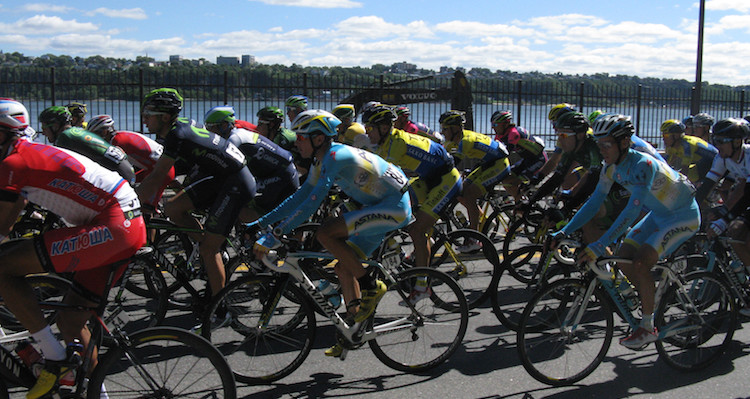
As the Vuelta rages on, another contingent of the WorldTour peloton is in North America for the Grands Prix Cyclistes of Québec and Montréal. The startlists in the Canadian GPs are always excellent, but the rosters are particularly impressive this year thanks to the presence of Worlds in Richmond, Virginia, which is far closer to Canada than it is to Europe (the Worlds prep storyline is just one of many covered in the latest Recon Ride, which is absolutely worth a listen). Friday’s GP Québec is the first race on the docket—and VH will be at the event in-person, so stay tuned here and on Twitter @VeloHuman.
The Route
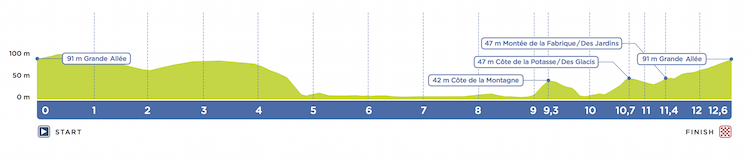
The profile of the GP Québec always sets up an exciting race. The climbs aren’t too difficult by themselves, but repeated ascents, and the placement of steep gradients in the run-up to the line makes it a selective race.
The final few kilometers of the GP Québec typically make for a hectic finale.
The GP Québec is a circuit race of 16 laps of 12.6km each. The first 4 kilometers of the circuit are mostly flat. Then comes a steep descent down to the St. Lawrence River waterfront. After 4 flat kilometers by the river, things get challenging, as the road winds its way up one climb after another, gradually making its way back up to the start finish line. The final 3.5 km trend upward, but it’s an irregular ascent comprising several individual steeper sections with a few downhill and flat stretches in between. There are four official climbs: the Côte de la Montaigne (375m at 10%), the Côte de la Potasse (420m at 9%), the Montée de la Fabrique (190m at 7%), and then the run-up to the finish, which starts on the Montée du Fort and ends on the Grand Allée (1km at 4%).
By themselves, the late climbs may not look like much, but taken in short succession so many times, they tend to whittle down the peloton before the final lap, when they serve as a springboard for countless attacks.
The Contenders
The GP Québec is a well-balanced circuit that can either come down to a selective sprint or a late attack. In either scenario, climbing legs are important. Strongmen tend to thrive even when a group kick decides the race, as the peloton is always lined out for the final few hectic kilometers, and it’s impossible for the traditional sprinters to stay as well-protected as they might on a flat Grand Tour stage.
The 2014 winner, Simon Gerrans, is not here to defend his title. Combined with an excellent startlist, that makes for a wide open race. Almost every team in the race has a rider who could conceivably win, and some teams have two or even three riders who are legitimate threats. This race is always unpredictable (Robert Gesink won the 2013 edition in an uphill sprint ahead of Peter Sagan, for instance) but it’s even more difficult to predict how things will turn out this year.
In any case, it’s probably safe to bet on BMC to put in a good ride. Philippe Gilbert won the race in 2011, and Greg Van Avermaet has been in the Top 10 every year since. Both riders are here for the 2015 edition. Van Avermaet loves the Canadian GPs and has come very close to winning both, and he looks to be on excellent form right now. The GP Québec suits him very well, with late climbs that appeal to the aggressive riders and a finish that could allow him to use his killer uphill sprint if a small group comes to the line. In the absence of Gerrans, Van Avermaet will be a strong contender for the win. So will Gilbert, of course, who has looked good all year. He won the sprint for 2nd in San Sebastián out of an impressive group, and showed good form in the Eneco Tour as well. BMC could send one of their leaders up the road in the finale, and allow the other to vie for the win in a small group kick, and given the versatility of both Belgians, either rider could play either role.
Orica-GreenEdge may be without the defending champion, but that doesn’t mean they don’t have a race favorite in Canada. In fact, they have more than one. Michael Matthews could do the job of defending the title for the team if his squad can reel in all the inevitable late attacks. This will be a challenging finish for Matthews, who will have the battle to stay at the front of a lined-out pack, but if he can hold on until the end of the climb he will be a major threat. If not, OGE will still have other options. Michael Albasini is always deadly in an uphill sprint, and Adam and Simon Yates are both potential attackers.
Etixx-QuickStep can rely on the 1-2 punch of Michal Kwiatkowski and Julian Alaphilippe, who both bring similar skillsets to the table. With Kwiatkowski on unknown form, Alaphilippe may be the better option. He has the speed to win a selective sprint on these gradients.
Between Bauke Mollema, Fabio Felline, and Julián Arredondo, Trek should be able to come up with at least one top finisher. Lampre-Merida’s duo of Rui Costa and Diego Ulissi may be a bit better-suited to the somewhat harder Montréal race, but the extremely impressive startlist could make this race more selective than usual, and that could favor the pair. Costa always does well in Canada and will be hungry to get a late-season result after a disappointing summer. Ramunas Navardauskas was 3rd here last year and could be a threat again, but Cannondale-Garmin teammate Tom-Jelte Slagter may be the better option coming off of two Tour of Alberta stage wins and 3rd overall on GC. He hasn’t been on the best form for much of the season, but when he’s at his best, he’s terrific on just this sort of profile.
Tony Gallopin will likely be the best option for Lotto-Soudal thanks to his skillset that combines a fast finish with excellent climbing legs, but Tim Wellens, Jurgen Roelandts, and Tiesj Benoot could also threaten. LottoNL-Jumbo is yet another team with multiple options: former winner Robert Gesink can’t be counted out, and Sep Vanmarcke is on great form and could nab a result if he can leave the bunch behind in the finale.
Lars Petter Nordhaug, Alexey Lutsenko, Michael Valgren, Tommy Voeckler, Matti Breschel, and the AG2R trio of Jan Bakelants, Alexis Vuillermoz, and Romain Bardet are others who could shine in a selective finale—if the faster finishers all look at each other in the last few kilometers, it’s a real possibility that this race could go to a lone surprise attacker or a small group of them taking advantage of the hesitation of the bigger favorites.
There are always sprinters making the trip to Québec who probably won’t have much of a shot at winning the race, but given the level of talent assembled they are at least worth mentioning. Alexander Kristoff, in excellent shape with Worlds around the corner, and Bryan Coquard, light enough to be a potential contender on the climbs, are probably the best candidates out of the bunch. Sam Bennett, Heinrich Haussler, Wouter Wippert, and Arnaud Démare are others in attendance.
VeloHuman Top 10 Race Favorites
Winner: Greg Van Avermaet Podium: Michael Matthews, Julian Alaphilippe Other Top Contenders: Tony Gallopin, Fabio Felline, Rui Costa, Philippe Gilbert, Sep Vanmarcke, Michael Albasini, Tom-Jelte Slagter
Don’t miss the Recon Ride’s GP Québec (and Montréal) pre-race podcast, and be sure to follow @VeloHuman on Twitter for plenty more analysis during the race.
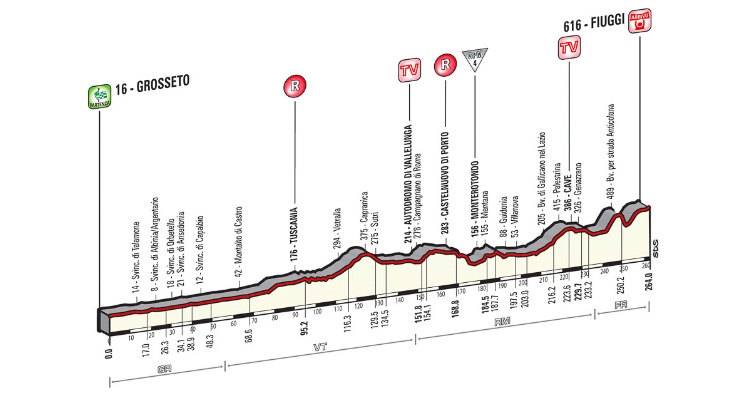
Prior to the start, Stage 6 of the Giro d’Italia did not look like it was going to create many headlines, but a compelling first week of this race took another twist when Alberto Contador hit the deck hard in the finishing sprint as André Greipel was taking the stage victory. The Giro should offer yet another intriguing day of racing on Stage 7, the longest day of the race, with a parcours that could set up several different scenarios.
There is just one categorized climb on this stage, and it is a Cat. 4 at that, but second half of the profile, and in particular the final 50km, involve a lot of up-and-down. The finale in particular has some challenges—there is a short but somewhat steep climb with around 20km to go, then a sharp descent, then a stretch of over 5km at over 4%, followed by a flatter run-in to a finish that kicks up once again in the last kilometer. The final 350 meters rise at between 3 and 4%. It’s nothing terribly steep, but the riders are sure to hit it at a very high pace, and after a very long day, it’s going to hurt. The punchier riders are going to be able to hold their positions better into the finale, and they’ll also be better-suited to the finale because of it’s gradient.
The bumpy nature of this stage and its position just before a difficult mountain day will combine to make this a tough one to predict. It’s possible this comes down to a bunch sprint, with some of the purer sprinters holding on. With this finale, it’s also possible that Stage 7 puts the bigger quick men into difficulty, leaving the more versatile types to fight it out in a reduced sprint. And it’s always possible that a breakaway takes the win, bolstered by the fact that many will be saving energy for the difficult Stage 8 on the horizon. The breakaway scenario could also see some of those same versatile riders trying their luck with a long-range move, as well as several breakaway specialists.
Michael Matthews is the most obvious choice of favorites to win this stage in a sprint. He’s got the climbing chops to potentially survive the late bumps in the road and the finishing kick to be deadly the last few kilometers, even if there are other speedsters around.
JJ Lobato is also among the favorites, thanks to his top-notch uphill speed. Lobato thrives in a small uphill finishes, and that’s what this is. After a slow start to his Giro d’Italia, he seems to have found his legs. Fabio Felline, 2nd on Stage 3, should be able to hold on if this comes down to a group finish, and he’s a dangerous young rider in that potential scenario.
Philippe Gilbert is also a great uphill charger, who adds the breakaway factor to the conversation—he’s already been in a breakaway in this race, and he showed great form to take 3rd in that stage despite spending time out front and then getting caught by the pack. Gilbert is fully capable of winning this stage from the pack or from afar, and that makes him a top-level favorite.
Diego Ulissi would probably prefer more climbing, but like Gilbert, he’s a punchy finisher with the capacity to win with a long-range strike or in a reduced bunch sprint. Bardiani-CSF’s Sonny Colbrelli and Enrico Battaglin, Giant-Alpecin’s Simon Geschke, Southeast’s Francesco Gavazzi, Orica-GreenEdge’s Simon Gerrans and Simon Clarke, CCC’s Grega Bole, Katusha’s Luca Paolini, and IAM Cycling’s Heinrich Haussler and Sylvain Chavanel are others with the versatility to be in the mix whether they stick with the peloton or go from afar. Adam Hansen, Giovanni Visconti, Maciej Paterski, and Stefano Pirazzi (as with most intermediate stages, Bardiani-CSF will be overflowing with options here) are among those who will likely need to be in the day’s breakaway to have a chance on Stage 7, but who will be very dangerous if they’re up there.
Giacomo Nizzolo told the Recon Ride that he’s interested in this stage, but it will be pretty tough for the purer sprinters like Nizzolo to survive those late climbs after such a long day. Still, it’s worth keeping an eye on Nizzolo and his bunch sprint rivals like André Greipel, Sacha Modolo, Elia Viviani, Luka Mezgec, and Moreno Hofland.
VeloHuman Stage 7 Favorites
1. Michael Matthews | 2. Philippe Gilbert | 3. Juan José Lobato
Be sure to follow @VeloHuman on Twitter for more race analysis, and remember to check back after the conclusion of Stage 7 for the preview of the next stage.
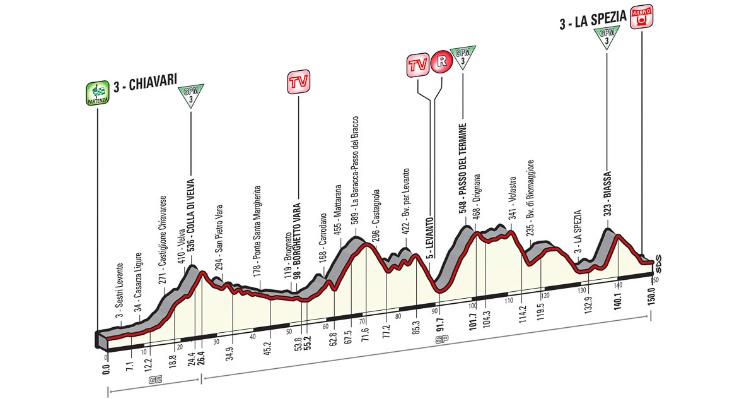
Michael Matthews took Stage 3 of the Giro d’Italia, and he should like the looks of Stage 4 as well. The route contains only three officially categorized climbs, but a fair bit of up and down, and the final climb is crested 10 kilometers from the finish, with steep sections of over 10% near the top and with 7km of descent to follow before a flat run-in to the line.
It’s another day that will likely have the breakaway specialists hoping to make something happen, but this early in the race, and with so many versatile fast finishers on the startlist, the peloton should keep them within striking distance. A reduced sprint between the survivors of the sting in the tail of this route, the Biassa climb, seems the most likely outcome (and even if a break does make it, expect to see at least a few of the upcoming names trying their luck from afar too).
Orica-GreenEdge has more than option on this sort of parcours, with two of the best riders for a reduced sprint on the roster. Michael Matthews, wearing the pink jersey, is an obvious candidate after his victory on Stage 3. He shines in selective sprints. If some of the purer climbers inject the pace on the final ascent, he may have trouble maintaining his position, but the way he’s been riding this year, especially the way he was glued onto Philippe Gilbert’s wheel on the Cauberg in the Amstel Gold Race, would suggest that he’s capable of a challenge like this. If he can’t, Simon Gerrans might be able to take up the slack. This is a perfect parcours for Gerrans and on any other day he might be the very top favorite, but having the pink jersey wearer on his own team means he might defer to his compatriot here. Either way, both are dangerous, as is Simon Clarke.
Philippe Gilbert came close to the win in Stage 3, and this is another great profile for him, perhaps even better, with a late climb that could see him putting pressure onto his rivals. It’s a flat finish but he’s a strong sprinter who can outmatch most climbers.
Fabio Felline is also a great candidate, one who defeated Matthews and Gilbert both at a similar finish in País Vasco. He’s in great shape right now, and an excellent climber who should have no problem with the parcours. If this comes down to a reduced sprint, expect to see him up there again, probably fighting it out with the same names that battled for the win in Sestri Levante.
Diego Ulissi spent a lot of time in the breakaway on Stage 3, and in the end, did not contend for a finish that suited him quite well. He’s got a great sprint and he’s a terrific climber; for Ulissi, this stage will be all about whittling down the pack to the right combination of opponents that he can outlast in a bunch kick.
Juan José Lobato lost contact on the difficult profile of Stage 3 but he’ll have another chance here. Southeast’s Francesco Gavazzi, Bardiani-CSF’s Enrico Battaglin, EQS’s Gianni Meersman, and CCC’s Greg Bole are others on the list of in-between types with the versatility to handle some climbing and the finishing kicks to win a reduced sprint. A more selective day could see the likes of Tom-Jelte Slagter, Sergey Lagutin, Damiano Caruso, Paolo Tiralongo, Damiano Cunego, and speedy GC contender Rigoberto Urán in the mix. Of course, there’s always the possibility that the day isn’t so hard as to drop all of the purer sprinters, leaving a small window open for riders like André Greipel, Giacomo Nizzolo, Moreno Hofland, and Elia Viviani.
VeloHuman Stage 4 Favorites
1. Michael Matthews | 2. Fabio Felline | 3. Philippe Gilbert
Don’t forget to follow @VeloHuman on Twitter for more analysis during the race, and be sure to check back after the conclusion of Stage 4 for the preview of the next stage.
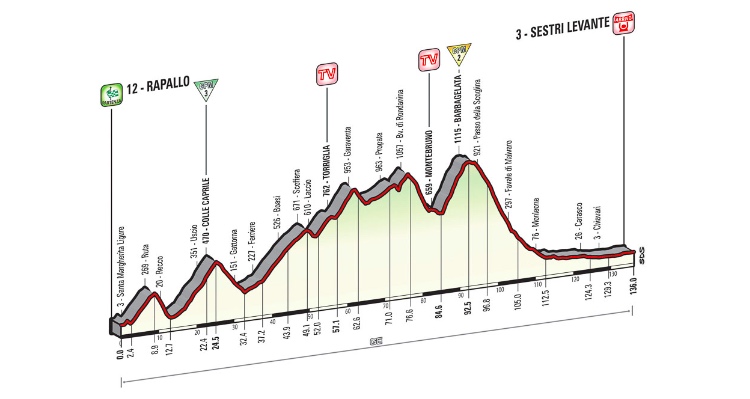
With Elia Viviani’s Stage 2 victory kicking off the road racing proper in this Giro d’Italia, the peloton will take on a short but intriguing third stage. Officially, the route only contains two categorized climbs (an early Cat 3. and a later Cat. 2), but for the first 112 kilometers of racing, there is barely a km of flat road. The road goes up and down and up again (with a general skyward trend for the first 92km) for quite a while. Most of the climbing is at a low gradient, but the riders will ascend from seaside Rapallo into the hills and reach an altitude of 1115 meters, the top of the Cat. 2 Barbagelata climb before a long descent to Monleone, after which they’ll only have 23km remaining to the finish. It’s a flat run-in to Sestri Levante and the line, but it won’t be easy getting there.
There aren’t all that many vicious gradients to face here but the Barbagelata climb is no cake-walk, 5.7km at 8%, and it comes after the pack will have already done a great deal of climbing. It is almost a certainty that some of the heavier riders in the peloton will lose contact before all is said and done, and with a long descent to follow, there won’t be all that much time to rejoin the main group.
A breakaway will likely get clear early and hold out an advantage over the bumpier parts of the stage, but with a flat run-in to the line and a likelihood of a few fast finishers still hanging around, it’s hard to see a breakaway surviving. The most probable scenario on Stage 3 would seem to be a reduced sprint.
Pink jersey wearer Michael Matthews is one of cycling’s best in the aforementioned scenario. He’s fast enough to beat the pure sprinters when he’s on a very good day; against a tired out pack, likely whittled down by the day’s climbing, he’ll be tough to beat, especially with the strong Orica-GreenEdge team helping him out. Simon Gerrans could be a deadly alternative.
JJ Lobato is one of the few riders who deserves to be considered as strong a favorite as Matthews, because he, too, can handle some climbing, and he’s already beaten Matthews in a sprint this year more than once. Movistar is mostly in this Giro for stage wins, and this is a great opportunity for Lobato. He has cooled off a bit after a very hot start to the season but that’s no reason to overlook him here.
Trek’s Giacomo Nizzolo will try to hold on and will obviously be among the favorites if he can, but Fabio Felline, who won a stage in País Vasco last month, could be the better bet for Trek. He’s a terrific climber who placed in the Top 10 on GC at the Criterium International. Etixx-QuickStep’s Gianni Meersman is another very versatile fast finisher who will probably appreciate the profile.
The obvious sprinter candidates, including Elia Viviani, André Greipel, Sacha Modolo, and Luka Mezgec, will all do their best here too, but the gradients will be a real challenge.
BMC’s Philippe Gilbert can be speedy in a reduced sprint, and could look to get involved, with Tom-Jelte Slagter, Enrico Battaglin and Sonny Colbrelli, Francesco Gavazzi, Heinrich Haussler, and Grega Bole potentially in the mix as well if some of the purer speed guys are missing. If the pack is seriously whittled in the mountains, the likes of Diego Ulissi and even Rigoberto Urán could thrive here.
Don’t forget to follow @VeloHuman on Twitter for more analysis of the Giro d’Italia. Be sure to check back after the conclusion of Stage 3 for the preview of the next stage. And, of course, there is still plenty of insight to be gleaned from the Recon Ride pre-race podcast, which you should definitely give a listen if you have already…