Tag: Niki Terpstra

  • Vuelta a España 2015: Stage 13 Preview

    Vuelta a España 2015: Stage 13 Preview

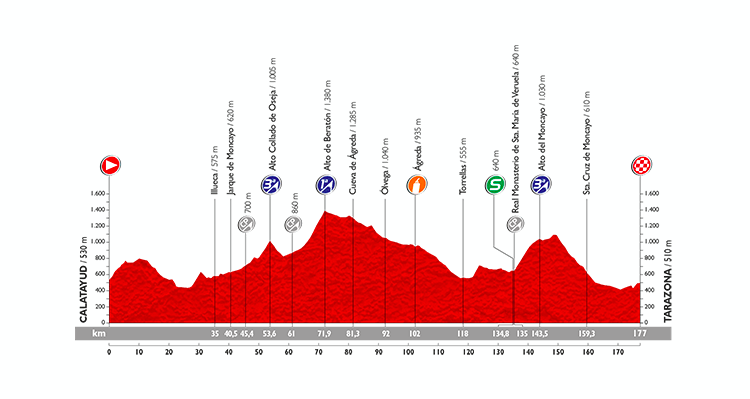
    PROFIL13

    Stage 13: Calatayud › Tarazona – 178km

    As the Vuelta gets lumpier and lumpier, we can probably start to expect more and more breakaway victories. Stage 13 is a great place for the long-range hopefuls to get on track for the week ahead.

    Things open with a bit of up-and-down before an uphill run-in into a Cat. 3. Officially the climb is only 8.2km but by the time the riders reach the top they will have been ascending for over 18km at a low gradient. After a quick downhill comes a relatively easy Cat. 1, 10.9km at a bit under 5%. From there the road heads downward again for nearly 50km before things flatten out for a short stretch.

    The final categorized climb, a Cat. 3 of 8.5km at 4.5%, officially peaks at a little over 30km before the finish. The road still angles upward slightly for a few more kilometers, but then it’s a long downhill run that only evens out inside the final 10km.

    There is another small bump that starts with a little under 2.5km left in the stage, but the road flattens out near the flamme rouge for a relatively straightforward finale.

    None of the climbs on Stage 13 are particularly difficult, but it’s hard to see the peloton reeling in the early move: the up-and-down profile will make things hard to control, and the stage is too easy to entice the GC teams to contribute to pushing the pace. The sprinters will have a chance on Stage 13, but it seems much more likely that this one will go down to the breakaway specialists.

    As such, there are no real “favorites” for the stage, only riders who seem like good candidates for a win from afar.

    Europcar is usually pretty adept at getting riders into breakaways, and they have multiple options in the Vuelta. The challenge will be turning opportunities into success, which they haven’t achieved much of this year. On ability, Cyril Gautier should be their top choice on this profile. He’s got good climbing legs and packs some punch for a late escape or a reduced sprint. Still, it’s difficult to predict whether he’ll even try to get in the move at all. Romain Sicard and Jerome Cousin have been very active for Europcar in this Vuelta and they may get the nod to go up the road instead.

    Niki Terpstra has tried his luck with a few escape attempts so far in the Vuelta, and this profile should him more than many of the those that remain. He’s not the world’s greatest climber but he’s got plenty of pop and excellent soloing ability. Young Spaniard Carlos Verona is another option for Etixx-QuickStep.

    After a rough outing on Stage 11, Movistar is probably looking to get more active in the breakaway game. Giovanni Visconti is an excellent option for this stage, with just the right skillset for the profile, and he’ll be among the favorites if he can get into the breakaway.

    Adam Hansen has been a little bit quieter than expected in the breakaway game up to this point in the race, but Stage 13 suits him well. He’d probably prefer a more techincal run-in though.

    Alessandro De Marchi has been quiet all season, but he has finally started to show some interest in getting active. He could be BMC’s best option, as these climbs may not be challenging enough to appeal to Darwin Atapuma or Samuel Sánchez.

    Caja Rural will almost certainly send someone up the road, but it’s hard to say who it will be. Omar Fraile has been very active off the front sweeping up KOM points but now that he has a big lead in that classification, the team may be more interested in a stage win. Pello Bilbao and José Goncalves, both of whom have looked particularly good this year, are their best options to pull that off.

    Miguel Angel Rubio was Colombia’s breakaway man on Stage 12, which could mean someone else makes the attempt on Stage 13. Carlos Quintero has been active so far. Rubén Plaza, who has been riding well since June, and Kristijan Durasek, who does have a bit of speed for a fast finish, give Lampre-Merida a pair of strong options. Stephen Cummings, AG2R’s Rinaldo Nocentini and Blel Kadri, Cannondale-Garmin’s Alex Howes and Ben King, and Sylvain Chavanel are other riders on the list of potential long-range candidates for Stage 13 success.

    In the (unlikely) event that this does come down to a sprint, John Degenkolb is the favorite, despite his lack of wins so far, while Tosh Van der Sande, José Joaquín Rojas, Danny Van Poppel, and Kristian Sbaragli will also probably be in the mix.

    VeloHuman Stage 13 Favorites

    1. Cyril Gautier | 2. Niki Terpstra | 3. José Goncalves

    Don’t miss the latest Recon Ride podcast episode, and be sure to follow @VeloHuman on Twitter for more race analysis. The preview of the next stage will be up after the conclusion of Stage 13.

  • Paris-Roubaix 2014 Post-race Impressions: Terpstra Takes the Final Prize of the Cobbled Classics

    Paris-Roubaix 2014 Post-race Impressions: Terpstra Takes the Final Prize of the Cobbled Classics

    EmptyVelodrome2

    Niki Terpstra‘s beautiful solo move to bring the Netherlands its first Monument in a decade was a thrilling end to a thrilling cobbled classics season. Familiar faces were present throughout the season, ensuring that every race was a showdown between the most talented cobbled riders in the sport, but new blood had its day as well: each of the four biggest races went to a different victor, two of whom (John Degenkolb at Gent-Wevelgem and Terpstra at Paris-Roubaix) had never won a one-day classic on this level before. This P-R post-race will be somewhat different from what I usually produce for recaps: for most of the big riders in the race, Paris-Roubaix was the finale of a season, and now it’s time for a break, providing less cause to analyze this race in terms of what it means for the near future. Next week’s Ardennes Classics will draw a very different crowd. In other words, I’m looking at Paris-Roubaix and looking back on the cobbled classics to draw some final conclusions from those races.

    29-year-old Terpstra has been among the top classics riders in recent years, landing several high placings in the big races, but he has always functioned as more of a top lieutenant on super-team OPQS than as a player himself. He is a great teammate and a workhorse rider. However, when given more chances to make his own moves in the past few seasons, he has delivered, and steadily improved his results. He got an opportunity this week and now owns a Paris-Roubaix title, the grandest accomplishment of them all. Perhaps he was a surprise winner to some, but Terpstra stood on the podium of this race last year and has been hot all year, winning Dwars door Vlaanderen, coming in 2nd at E3, and landing a top 10 in Flanders. In my preview, I noted: “Terpstra is a keen opportunist and an excellent soloist, and as one of a number of options on his team, he could benefit if the pack hesitates to follow.” I’d say he made good on that promise with his brilliant solo move ahead of a star-studded group in Sunday’s final kilometers. He’s only a few weeks shy of 30, but he appears to still be improving as a rider.

    His team as a whole played their cards perfectly, finally delivering a victory. They’ve had the best squad (by a fair margin) in every race they’ve started this cobbled classics season, but at E3, Gent-Wevelgem, and De Ronde, they were only able land several riders in the Top 10s, never actually taking that final step to victory. When Tom Boonen jumped ahead very early on Sunday and stayed out front for tens of kilometers, it looked like a suicide move that was certain to leave him with nothing for the finish. OPQS, it turned out, was playing a clever game. With such firepower up front, the other big names were forced to exhaust themselves chasing, and no one could make a successful move past the breakers. When Boonen’s group was eventually reeled in and then the final select group started to form, Boonen himself may have been running low, but teammates Niki Terpstra and Zdenek Stybar had full tanks of high octane fuel. The former jumped, the group hesitated, and then it was too late for any of the tired riders to bring him back. Stybar and Boonen finished 5th and 10th, respectively; this time, OPQS can truly celebrate the triple top 10 performance, because one of those top 10ers actually won the race. With Stybar and Terpstra both hitting their stride and riders like Guillaume Van Keirsbulck in the wings, OPQS is in good hands for the near future even as Tom Boonen’s career enters its twilight years.

    Fabian Cancellara found himself on yet another Monument podium. He’ll be disappointed he did not win the race, but OPQS played Sunday’s affair just right and Cancellara’s team (lessened by the absence of Stijn Devolder) was not up for the challenge. At the start of the day, I would have said that 3rd overall was a less-than-stellar finish for the big favorite, but in the way the race played out, I felt that a podium finish (which required him to outsprint Zdenek Stybar, Sep Vanmarcke, and Peter Sagan in the velodrome) was actually quite a result given the makeup of the group in the final kilometers. Spartacus has now been on the podium of all three Monuments run so far this year, and he’s been on the podium of every one of the last 12 he’s raced. At 33, he is still showing an unbelievable ability to deliver big results in the biggest races, and he seems to have improved his sprint even as his soloing ability has maybe started to see a slight decline. Fellow pre-race favorite Sep Vanmarcke found himself in a very similar boat; there was very little he could do to get ahead of the pack with Boonen out front all day, and he was a tired, marked man in the finale. He was unable to get the victory he wanted this year, but he was among the best riders in every race he started, showing the kind of consistency that almost guarantees that he will one day be standing on the top of a major podium.

    John Degenkolb won Gent-Wevelgem’s sprint finish, but that race is much friendlier to sprinters than the brutal 260 kilometers of Paris-Roubaix. By making it to the Roubaix velodrome with the star-studded group of chasers just behind victorious Terpstra, he showed an amazing level of endurance that suggests he is capable of hanging on to win even the longest and most grueling of races. After such a long day, he still had enough energy to win the sprint for 2nd on one of the biggest stages in the sport. At only 25, Degenkolb is primed to take on Milano-Sanremo winner and fellow 2014 breakout star Alexander Kristoff in classics sprint finishes for years to come. Kristoff, by the way, had some horrible luck on Sunday, leaving the race in an ambulance after punctures and crashes ended his bid for victory. FDJ’s Arnaud Demare was another hardman-sprinter-with-a-bright-future who hit misfortunate after misfortune in the race. He punctured several times, but still made it in amongst the top 15, coming across the line in 12th place. After a great showing in Gent-Wevelgem, where he just missed out on victory behind John Degenkolb, the 22-year old looks poised for  success in the spring’s biggest events in the coming years.

    Peter Sagan‘s race was a mixed bag. Many did not expect him to make it to the final kilometers with the likes of Cancellara; he did, after riding an aggressive race that saw him bridge the gap to Boonen’s lead group and then hang on with the favorites before Terpstra’s decisive jump. Still, he seemed exhausted as the pack neared the velodrome. He was unable to put up much of a fight in the race for 2nd, rolling across the line 6th. It will be disappointing for him to have come close again, but I think it’s a positive sign: he’s been 2nd in Milano-Sanremo and the Ronde, but he had yet to make an impression on Paris-Roubaix, and he made a statement that this is a race he can contest as well when he hung with the big names on Sunday. Another spring without a Monument for Sagan, but he did add another classics win to his palmares at E3 Harelbeke and further experience in the long, brutal events for which he is so often named the favorite of the future.

    Sky landed a pair of riders among the top 10 finishers in Geraint Thomas and former Tour winner Bradley Wiggins. Many did not give Wiggins a chance in the slightest in this race; his performance, hanging with the biggest names in one-day racing, impressed me a great deal. There is still a lot left in his tank and I’m excited to see him in more races this year. Meanwhile, Geraint Thomas landed yet another good result, his third classics top 10 after a podium place in E3 and an 8th place in Flanders. Thomas made the most spirited attempt to chase Terpstra in the finale, but he did not get much help and was forced to resign himself to finishing with the group. Still, he has displayed an incredible array of talents this season; he has talked about the difficult choice between focusing on stage races vs. one-day events, and I think he could have a bright future in either one. Teammate Edvald Boasson Hagen crashed at an inopportune time in this race but didn’t seem strong on the day anyway—he was a good teammate this classics season, but for someone with such immense talent, his rather anonymous showings have been pretty disappointing. With a well-rounded combination of sprinting, climbing, and time trialing ability rivaled by few others in the sport, I wonder if he might be better off shifting his focus a bit later into the season, hunting points jerseys and circuit races like the Grand Prixes de Quebec and Montreal; Gent-Wevelgem remains really the only big classic race in which he has found success in his career.

    As a last note, Team BMC had a rash of misfortune late in the race. After Thor Hushovd put an admirable turn in at the front of affairs, things eventually started coming back together, and BMC began gathering its strength for Greg Van Avermaet and Taylor Phinney. Unfortunately, Van Avermaet crashed in a nasty corner and Phinney flatted on Le Carrefour. Bad luck is pretty much the name of the game in Paris-Roubaix, but it is a shame that we did not get a chance to see either rider in the finale, as late attacks are their forte.

    As the door closes on the cobbled classics, it opens on my favorite week of the season, with the Amstel Gold Race, La Fleche Wallonne, and Liege-Bastogne-Liege running one after another in the span of just one week. VeloHuman will be previewing all of them, with plenty of analysis on Twitter as well. Follow @VeloHuman for more, and check back here soon for the Amstel Gold Preview!

    -Dane Cash

    Photo by Luca Pedroni.
  • Ronde van Vlaanderen 2014 Post-race Impressions: Cancellara in a Class of His Own

    Ronde van Vlaanderen 2014 Post-race Impressions: Cancellara in a Class of His Own

    Koppenberg

    Quickly Summing Up the Action at the 2014 Tour of Flanders

    Pais Vasco kicked off today in Ordizia (check out the VeloHuman preview!), which means that De Ronde 2014 is now history. Sunday’s battle on the cobbles of East Flanders made for an incredibly exciting contest, with action enough for several races throughout the long day on the road. At times, it looked like anyone’s game, with constant crashes and daring attacks providing plenty of uncertainty to keep things interesting. Riders were dropping like flies with each climb. As the front of the pack approached the last few hillingen with two-time winner Fabian Cancellara among them, an air of inevitability started to creep in. The other contenders sensed it and did what they could, with Greg Van Avermaet and Stijn Vandenbergh going off the nose a bit over 30 km out. When Spartacus jumped from the chasers on the brutal Oude Kwaremont on his way to track them down, only Sep Vanmarcke could follow up the bone-rattling cobbles; fellow pre-race favorites Peter Sagan and Tom Boonen were unable to hang on.

    From there, it was a matter of Cancellara and Vanmarcke catching the men in front, which they did, and the foursome hanging on ahead of the pack. Their bid was successful, leading to a four man sprint for the 94th Tour of Flanders. A game of cat and mouse ensued, with each rider jockeying for the best position and trying to plan the perfect time to turn on the ignition, but even with 3-to-1 odds, the Belgian trio could not match Cancellara in the final gallop. Spartacus delivered again Sunday to pick up his 3rd win in the Monument Classic, with Greg Van Avermaet 2nd and Sep Vanmarcke a disappointed 3rd.

    Lessons Learned Along the Road to Oudenaarde

    Fabian Cancellara‘s 3rd Ronde van Vlaanderen victory is his seventh Monument. That ties him with Tom Boonen, and it does not look like Spartacus is slowing yet. He has shined on the two biggest stages of the year, outclassing some of the best sprinters in the world on his way to a 2nd place in Milano-Sanremo and then using his sprint again even more effectively to take De Ronde. Though the Trek rider just turned 33 this March, both his finishing kick and his powerful engine seem to be as strong as ever. He has said that he may retire within the next few years, but given his current form, he’s likely to fill those years with more success, especially in the most beloved one-day races on the calendar, which also happen to be the most grueling—and therefore suit him perfectly. This Sunday’s Paris-Roubaix will be the perfect place for the strongest of strongmen to take yet another major victory. He enters as the big favorite after this dominant show.

    Perhaps the second biggest story of the Ronde van Vlaanderen was Peter Sagan‘s inability to match Cancellara on the Oude Kwaremont. Despite showing strong form in several big races so far this season, Sagan had no answer for Spartacus on the brutal final hillingen. It would be hard and probably incorrect to pinpoint any one reason why his ability to nab races like Gent-Wevelgem and E3 Harelbeke has not translated into a Monument yet. A few factors come to mind. First, he does seem sapped of power when the odometer gets over 240 kilometers, as it does in these races. His Milano-Sanremo 2014 sprint was far less impressive than it usually is, and his uphill burst seemed drastically reduced when Cancellara turned on the afterburners in this weekend’s Tour of Flanders. Sagan’s team support, or lack thereof, may be another major factor—Sagan does not have Cancellara’s ability to carry on over tens of kilometers alone, and while it can’t be said that Cannondale does not surround the young Slovakian with talent, he is too often left without assistance at key moments in a race. Whatever has held him back, I don’t think it necessarily counts him out for this Sunday’s Paris-Roubaix, even if it seems to suit him less than other races. The truth of the matter is that any rider can have an off-day when he least wants to, and it’s always possible that Sagan just hasn’t gotten his best days to line up with the biggest races yet.

    Sep Vanmarcke impressed me more than most other riders in the race with his ability to jump up the Oude Kwaremont behind Cancellara. It is a serious climb, meaning that even if he has yet to win a big race this season, Vanmarcke is on serious form. In my mind, Vanmarcke is right with four-time winner Tom Boonen as top challengers to Cancellara in Paris-Roubaix. Without the uphill mileage of the Ronde, the Hell of the North may be a better shot for Vanmarcke. He’s perfected the art of holding Cancellara’s wheel, and, learning from the best, one day soon he might just time his own attack perfectly.

    What more can I say about Greg Van Avermaet that hasn’t already been said? It’s hard not to root for the 28-year old, a constant fixture in the spring classics. The BMC rider has shown in Omloop Het Nieuwsblad and on Sunday in Flanders that he is in great shape in 2014, and with such a high probability of a good placing in almost every race he takes on, it seems likely that one of these days, he might win the final sprint to the line or solo away and stay out until the finish line. Better tactics (not wasting energy trying to drop Stijn Vandenbergh) will help as well.

    Tom Boonen was unable to hang with the lead group on Sunday, but he did manage to end up a respectable 7th. His thumb seems to still be affecting him; I’d say he ran a decent race given his injury, and hopefully, he will continue to heal and challenge for Paris-Roubaix. OPQS as a whole will (and should) be very disappointed with the way things turned out. Their best placed rider Stijn Vandenbergh did not come close in the sprint. Niki Terpstra tried to pick up Boonen’s slack with an attempt to bridge to the final foursome, but was unsuccessful. Zdenek Stybar was among the big group of chasers but did not manage to make waves. They will look to bounce back in Paris-Roubaix. With last year’s 3rd place finisher (Terpstra) and 6th place finisher (Stybar, who might have been on the podium himself if not for a spectator crash) lining up alongside Tom Boonen (another week removed from his thumb injury) in a race he has dominated, they are set up nicely.

    Milano-Sanremo winner Alexander Kristoff forced himself further into the Paris-Roubaix conversation with a 5th place in the Ronde van Vlaanderen. It would have been something if the Katusha hardman had won the bunch sprint behind the leading group as he did last year, but his 2014 performance, while landing him a 5th instead of 4th, was arguably more impressive, as it involved him jumping into an attempt to bridge with only one other rider (Niki Terpstra) and then going it alone for the closing minutes of the race. The fact that he was able to be up there when Sagan and John Degenkolb had fallen away speaks volumes about Kristoff’s talent. His abilities shine brightest on the toughest days. Paris-Roubaix is one such day, and Kristoff will look to improve on his 2013 result, 9th place, in this edition. Without climbs but with all the brutality of a cobbled Monument Classics, P-R could be a great stage for Kristoff.

    Cancellara’s dominance, the rise of Kristoff and Vanmarcke, and the continued disappointment for Sagan may be the biggest takeaways from the 2014 Ronde, but in my mind they come with a major caveat. On the harsh cobbles of the spring classics, races can change in an instant (Cancellara knows this better than anyone thanks to his 2012 crash). Any rider can have a great day or a terrible day, and the conditions of the Monuments tend to push this fact to its extremes. In short, Fabian Cancellara was the most dominant rider on Sunday and he’ll enter Paris-Roubaix the favorite, but when the gears start turning and the adrenaline gets pumping, it only takes one perfectly-timed move by one in-form challenger to shake things up. As usual, VeloHuman will be previewing the excitement to come, and tweeting more thoughts @VeloHuman on Twitter (be sure to follow!).

    -Dane Cash

    Photo by Mark Blacknell. Video courtesy of CyclingHub.

