Episode 6: E3 Harelbeke + Gent-Wevelgem 2015 Pre-race Show The Recon Ride takes on both of the weekend’s WorldTour one-day events in a double pre-race show of E3 Harelbeke and Gent-Wevelgem.
[powerpress]
Sharing a weekend, many of the same riders, and similar Belgian terrain, E3 Harelbeke and Gent-Wevelgem make for a great pair of races. VeloHuman and Cyclocosm explore the routes, the startlists, and the narratives, with a bit of help from AG2R-La Mondiale’s Hugo Houle.
Milano-Sanremo, the first one-day race on the 2015 WorldTour and also the first “Monument Classic” of the season, has almost arrived! The grueling event, which will take riders from Italy’s Lombardy region to its Ligurian coast this Sunday, combines an overlong race distance with a few topographic features along the way, and often a sizeable dose of unpleasant weather. Even in a sport that prizes toughness, Milano-Sanremo demands grit and endurance on another level, which is why a big reason why its list of winners includes some of cycling most legendary hard men (one of the many topics discussed in the Recon Ride pre-race show, which you should also check out).
The Route
Though Milano-Sanremo has undergone a number of route changes in the past few years, the 293-kilometer route of the 2015 edition is similar to that of the 2014 edition (lacking a few of the climbs often planned for this race), with some alterations in the final kilometers. The peloton will set out from Milan and enjoy mostly flat roads for over a hundred kilometers. The pavement angles upward for the long, low-gradient climb of the Passo del Turchino a bit before the midway point, and that ascent is followed by a fast descent towards the coast.
293 kilometers in total, the Milano-Sanremo parcours becomes more and more difficult near the finish line.
From there, it’s still over a hundred kilometers along the Mediterranean in the direction of San Remo. Things stay flat for a while, but around kilometer 240, the peloton will start to hit a few small bumps, leading into a pair of more difficult late climbs likely to break up the peloton before the finish. First comes the Cipressa, 5.6 kilometers at a 4.1% average gradient. The riders will reach the top with a little over 20 km to go, take on a fast descent, and then speed over flat roads until they hit the foot of the Poggio climb. 3.7 kilometers at 3.7%, the Poggio does have a few steep sections (one stretch of 8%), and its otherwise unimposing gradient is of course made much more intimidating by the fact that the riders won’t reach the climb until they’ve already ridden 280 kilometers. The top of the Poggio is 5.5 kilometers from the finish, and followed by a fast descent that doesn’t even out until there are only 2.3 kilometers to go. From there, it’s a flat run towards the finishing straight on the Via Roma, a classic conclusion to Milano-Sanremo that has returned after many years of being left out of the route. With the reintroduction of the Via Roma, the finish line in this year’s race is almost a kilometer closer to the bottom of the Poggio than it was last year.
As of the day before the race, the weather forecast calls for some rain, though at the moment it seems the peloton may escape the torrential downpours common in the area this time of year.
The Contenders
Given the parcours, the likeliest outcome for Milano-Sanremo 2015 would appear to be a sprint showdown among the more versatile quick men of the peloton. The late climbs will give the opportunists a chance to try to get up the road and stay clear for the victory, and a few riders stand out as particularly likely protagonists in that scenario, but it won’t be easy to hold of the charging pack on these relatively low gradients. On the other hand, there are a few pure sprinters who might be favorites in any other high-speed finale but who might struggle here after such a long day.
Katusha’s Alexander Kristoff is the defending champion, the victor of the 2014 edition in a bunch sprint that saw him well ahead of several very speedy finishers. Kristoff’s ability to survive the grueling distance without losing too much of his kick was crucial to his win over the other sprinters last year, and it remains a strong reason to expect big things from him again this year. Kristoff also has the experienced Luca Paolini to help him navigate the day’s difficulties. He has been in excellent form all season, winning sprints in several stage races, and that only makes him appear a stronger candidate here. The one question mark for Kristoff is whether he’ll be close enough to the front of the race as the Via Roma approaches. The reduced distance between the bottom of the Poggio descent and the finish line will give Kristoff less time to regain ground if he loses position on the last climb. Kristoff is not a bad climber, for a sprinter, but there are other quick men who can go uphill more comfortably, and they look to be Kristoff’s biggest challengers should this come down to a sprint.
Tinkoff-Saxo’s Peter Sagan has been close to success in this race before, but he has come up short at the line. Gerald Ciolek (surprisingly) denied him of a victory in a reduced sprint in 2013, and although he came to the line with the main pack in 2014, he was a nonfactor in the sprint. The altered finish may benefit Sagan, whose climbing legs set him apart from the other quick men. More so than most, he is capable of launching a late attack on the Poggio, or at least holding the wheel of someone who does. If some of top sprinters in the peloton have faded by the time the finish nears, Sagan will be in a prime position to pick up his first Monument win.
Another sprinter with capable climbing legs making the start is Giant-Alpecin’s John Degenkolb. His 2014 MSR campaign was ruined by a late puncture, but soon after, he took 2nd in Paris-Roubaix, proving that distance is not a problem for him. He has continually improved in the top speed department over the last few years, and even against the biggest-name sprinters in the world he can hold his own; when a long day and a late climb enter the equation, Degenkolb becomes even more dangerous. He hasn’t quite had the results he would have hoped for coming into the race, racking up a number of 2nd-places to go with one win early in the season in Dubai, but if he is timing his peak right around now, Degenkolb will be a great candidate for victory.
Movistar’s Juan José Lobato sports an excellent combination of climbing legs and sprinting prowess, and he has used that skillset to pick up several wins already this season (denying Degenkolb on multiple occasions). He will hope to build on his 4th-place here last year, and with the form he has shown so far in 2015, that seems like a real possibility. Should Movistar feel that Lobato’s bid is in doubt near the end of the day, the team could try to send Alejandro Valverde up the road on one of the two late climbs.
Michael Matthews of Orica-GreenEdge has a similarly fine-tuned skillset combining climbing legs and a vicious finishing kick. His Paris-Nice victory suggests that the form is there as well. For Matthews, the main question mark is whether he can handle the distance. He doesn’t really have any results to speak of in overlong races. He could certainly change that at this year’s Milano-Sanremo, but it will be a foray into new territory.
Mark Cavendish headlines a collection of elite pure sprinters in attendance who will hope that their explosiveness is not too diminished by the time the peloton reaches the finish in San Remo. Cavendish has of course won this race in the past (in 2009) but it was a much younger Mark Cavendish taking the victory then. On last year’s parcours, similar to this year’s, Cavendish was with the main pack at the end of the day, but was unable to come away with more than a Top 5 after the long journey from Milan. With the Via Roma finish coming closer to the bottom of the Poggio, Cavendish will have to work even harder to maintain a strong position and his energy in the finale, making his candidacy as a top favorite questionable despite his legitimate claim to the title of fastest field sprinter on the startlist. Etixx-Quickstep does have alternatives on the roster in Michal Kwiatkowski and Zdenek Stybar, both on blazing form and capable of putting in a strong attack on a late climb in a one-day race.
Like Mark Cavendish, André Greipel is another powerful pure sprinter hoping to survive the long day with his strong kick intact. Coming off a sprint stage win at Paris-Nice, Greipel clearly has the sprinting form to contend in a bunch gallop, and in fact, he has made it a stated goal of this season to finally pick up a big one-day victory after years of near misses. If his pursuit of such a target has led him to improve his power and endurance, he will be a real contender here. Lotto-Soudal may look to Tony Gallopin as a second card to play near the finale.
The very long list of other quick men with a chance in a potential sprint, all of them with varying levels of versatility, includes Cofidis’s Nacer Bouhanni, the MTN-Qhubeka duo of Gerald Ciolek and Edvald Boasson Hagen, FDJ’s Arnaud Démare, Sky’s Ben Swift (3rd last year, though entering the race with uncertain form this year), Cannondale-Garmin’s Ramunas Navardauskas, IAM Cycling’s Heinrich Haussler, Lampre-Merida’s duo of Niccolo Bonifazio and Davide Cimolai, Astana’s Andrea Guardini, and Bora-Argon 18’s Sam Bennett.
Fabian Cancellara headlines the list of riders who could be looking to jump clear of the peloton in the final few kilometers. This parcours, without some of the uphill challenges of past editions, will make it very difficult for anyone to get away from the pack, but if anyone can do it, Fabian Cancellara is a prime pick. His time trial victory in Tirreno-Adriatico suggests that he is in formidable soloing shape at the moment, and he has done a great deal to work on his sprint this year should he come to the line with a small group. Cancellara was a surprising 2nd in last year’s bunch sprint, suggesting that he’s even a danger if he can’t shed the pack on the Poggio or the Cipressa. Having landed podium results each of the last four years, another strong placing seems practically guaranteed this year. Giacomo Nizzolo, fresh off a GP Nobili victory, offers Trek another option.
BMC’s duo of Philippe Gilbert and an on-form Greg Van Avermaet, Astana’s Vincenzo Nibali, Sky’s Geraint Thomas and Ian Stannard, IAM Cycling’s Sylvain Chavanel, and Lampre-Merida’s Pippo Pozzato and Rui Costa are other riders to keep an eye on when the attacks start to fly around the Cipressa and the Poggio.
VeloHuman Top 10 Favorites
Winner: Alexander Kristoff Podium: John Degenkolb, Peter Sagan Other Top Contenders: Fabian Cancellara, JJ Lobato, Michal Kwiatkowski, Greg Van Avermaet, Mark Cavendish, André Greipel, Michael Matthews
Be sure to follow @VeloHuman on Twitter for live commentary and analysis of the race, and don’t forget to listen to the Recon Ride pre-race show for plenty more on the year’s first Monument. Check back soon for previews and roadside coverage of the upcoming Volta a Catalunya!
Episode 4: Milano-Sanremo 2015 Pre-race Show The Recon Ride takes on the first Monument Classic of 2015.
[powerpress]
The first WorldTour one-day event on the calendar and the first “Monument” of the season, Sunday’s 293-kilometer ride from Milan to San Remo gives the Recon Ride podcast plenty to discuss. Will Alexander Kristoff defend his title? Can Peter Sagan finally get that marquee victory? Will an Italian rider show up to contend in a major Italian Classic? VeloHuman and Cyclocosm team up to cover all the major storylines.
With November in full swing, most of the high-profile moves of the 2014 transfer season have been completed. As always, some teams took advantage of the open market to make considerable upgrades to their rosters, while others did not take steps to improve, or worse, saw talented riders leave and failed to replace them. Only time will tell which of the many newsworthy signings will be success stories and which will go down as major missteps. Still, several squads stand out as having positioned themselves nicely for future success with their additions this fall. Some teams have improved by adding big-name stars, and others have solidified their rosters by signing multiple solid contributors that should fit into new roles nicely.
One of the peloton’s highest-profile teams landed the highest-profile addition of the offseason. Tinkoff-Saxo signed Peter Sagan after several months of rumors, immediately making a squad already full of GC-style talent suddenly a danger in the classics and sprints. Given the opportunity to pick up one of the sport’s most electrifying young stars, Oleg Tinkoff was resolute in his pursuit of Sagan. The decision made by the Slovakian to ride for Tinkoff-Saxo does comes with a question mark or two: he never had enough support at Cannondale, and while the Bjarne Riis outfit he joins for 2015 is obviously packed with talent for mountain stages in Grand Tours, its supporting cast for the classics and sprints does not stand out quite as much in the peloton. It remains to be seen how effective they can be in closing down the late attacks that so often derail Sagan’s hopes. Meanwhile, in terms of overall transfer season wins and losses, Tinkoff-Saxo did lose Nicolas Roche, but new signing Robert Kiserlovski, who notched a Grand Tour Top 10 this year at the Giro, should fill his absence nicely.
Tinkoff-Saxo’s loss of Nicolas Roche was Team Sky’s gain. A frustrating 2014 inspired the British squad to pull out all the stops this transfer season, and that meant adding proven Grand Tour Top 10 riders Nicolas Roche and Leopold Konig, both of whom should provide the team with deluxe domestique power in the Tour de France as well as options for overall contention in the Giro and Vuelta. Wouter Poels is another strong signing—the Dutch all-rounder took a big step forward this season and will provide Sky with both a capable challenger in the hilly classics and one-week races and a proven domestique (his support was an integral part of Rigoberto Uran’s podium performance in the 2014 Giro) for the Grand Tours. The influx of GC talent should more than make up for the loss of Dario Cataldo, who is headed to Astana for 2015. Sky also picked up a major talent for the sprints in Elia Viviani. The 25-year-old Italian was erratic this season but he has flashed remarkable top speed on occasion (he bested Mark Cavendish in two stages of the Tour of Turkey) and there is still time for him to develop. Team Sky’s more GC-oriented signings got a bit more press this transfer season, but Viviani is the new addition most likely to rack up the victories in 2015. The signing of Viviani, along with the rise of Ian Stannard and Geraint Thomas as Classics protagonists and Ben Swift as a fast finisher for the intermediate stages, will soften the impact that the exit of Edvald Boasson Hagen will have on the team’s stage-hunting and one-day racing ambitions, an impact Sky did not seem too concerned with anyway; they were in no rush to re-sign the Norwegian after a pair of lackluster seasons.
A change of scenery could be just what Edvald Boasson Hagen needs, and he’ll get it at MTN-Qhubeka. The South African outfit added a stable of fast-finishing talents looking for a fresh start: in addition to EBH (who still has plenty of room to grow), they also signed Matt Goss, Tyler Farrar, and Theo Bos, among others. Goss, despite his lack of recent results, only just turned 28, and a change of pace could get him back on track in the sprints. Farrar may never beat Mark Cavendish in a one-on-one sprint battle again, but he is still capable of contesting flat profiles at the WorldTour level and he still has plenty of ability in the classics (he was 2nd in Dwars door Vlaanderen and Scheldeprijs this season, and 8th at the E3 Harelbeke). Theo Bos had a very successful 2014, winning races on three different continents, and should continue to deliver for his new team. MTN-Qhubeka may only be a Pro Continental Squad, but their transfer season talent haul was among the biggest in the whole pro scene.
Fellow Pro Conti outfit Cofidis made a big splash of their own, but rather than loading up on multiple speedsters, they focused almost all of their attention on a single powerhouse sprinter. Nacer Bouhanni’s decision to drop to a second division squad after winning five Grand Tour stages and the Giro points jersey this season is unconventional to say the least, but apparently FDJ only had room for one star sprinter (Arnaud Demare), leaving Bouhanni looking for a new ride. He still wanted to be with a French outfit, and Cofidis will likely get invited to the races he’s targeting, so it does make some sense for the young sprinting mega-talent. For Cofidis, it’s a coup; after several seasons in the middle of the Pro Continental pack, they now have a star capable of consistently challenging for victories in some of cycling’s biggest events.
Trek Factory Racing was another team that boosted their stock significantly with the addition of one rider: Bauke Mollema. Mollema didn’t have quite the 2014 that many expected, but he’s a consistent Grand Tour Top 10 rider (with Top 5 potential) who is also adept at shorter stage races and one-day classics. Andy Schleck’s retirement was big news but Trek had been without an elite GC talent for some time, and Mollema provides that ability, more than making up for the loss of Robert Kiserlovski.
Team BMC gets the final mention among transfer season winners. Their signings were not as flashy as Team Sky’s or Tinkoff-Saxo’s, and they are jettisoning quite a few riders to boot, but in additions like Damiano Caruso, Jempy Drucker, and Alessandro De Marchi, BMC was able to pick up several bright talents just hitting their prime. Caruso (a surprise Top 10 in the Vuelta) provides the team’s GC ambitions with a much needed injection of youthful talent, Drucker adds firepower to the Classics lineup, and De Marchi brings his elite stagehunting talents and a potential for stage race KoM jerseys to the table. These all come in addition to rising star all-rounder Rohan Dennis, who arrived as a midseason transfer. BMC may not have grabbed many big headlines this fall, but they filled several needs and that will help them improve across the board in 2015.
A year from now, it will undoubtedly be easier to evaluate the 2014 transfer season, but at the very least, the teams that have made the investments in riders like Leopold Konig and Alessandro De Marchi have put themselves in strong positions to succeed next year. The new transfers will have their chances to prove themselves soon; riders are returning to training after end-of-season vacations, and the start of the 2015 road season proper will arrive before long.
The Ponferrada World Championships will come to a close with the Men’s Elite Road Race. Cycling’s biggest stars have been training and riding in tuneup races for some time now, but the weekend of the main event has arrived. With the rainbow jersey on the line and a parcours that should make for a wide open race, it looks set to be quite a showdown.
The Route
The Road Race takes place on an 18.2 kilometer circuit in and around Ponferrada, Spain. The peloton will complete 14 laps of the circuit, making for a total race distance of 254.8 kilometers.
Each lap involves a pair of climbs and also pair of tricky descents that, especially as the day nears its conclusion, are likely to see plenty of action from the more aggressive riders in the pack. First in the circuit is the Confederación climb, 5.2 kilometers at an average of 3.3%. Despite the low gradient, the ascent starts out with a few stretches that hit 8%. After the riders crest the climb, they will take on a very sharp descent. Then comes the Mirador climb, 1.1 kilometers at 5.5% but with two stretches (at the beginning of the climb and again near the top) of around 10%. Another descent follows, and the road doesn’t flatten out until there are less than 2 kilometers remaining before the finish line. The last few kilometers involve a few twists and turns, including a sharp right hander in the final 1000 meters.
There is a chance of rain in the forecast. If the conditions are poor, the technical downhills will get a lot more hectic, and what is already going to be a long day in the saddle will get a lot more uncomfortable.
The Contenders
A moderately challenging profile will become much more difficult as 14 laps are completed, but this is still a parcours that will appeal to those riders with a powerful kick. The Ponferrada circuit, much like a number of circuit races on the WorldTour calendar that have preceded it, has challenges to guarantee action before the finish while still allowing for a sprint as a likely outcome: the inclines never reach extreme gradients and the last kilometer is quite flat. Still, a lumpy journey of over 250 kilometers will greatly whittle down the pack, and a perfectly timed and determined escape attempt will have a chance at staying clear, and even if this does come down to a sprint, it will be a select group battling it out for the victory. As such, winning the rainbow jersey in 2014 will require decent climbing legs and the toughness to stay sharp after a long day in the saddle, and either the kick to outsprint the (likely somewhat reduced) peloton at the line, the power to get clear of the pack before the finish, or a blend of both, to stay with any late attackers and then outmatch them in a high-speed finale.
No other rider in attendance combines current form, a well-tailored skillset, and a powerful team quite as well as Simon Gerrans. He proved that he is in top shape by sweeping the Canadian GPs (his second victory, in Montreal, was particularly dominant), and with Milano-Sanremo and Liege-Bastogne-Liege on his career palmares, he is a proven contender in sprint finishes that follow difficult days in the saddle in even the biggest races. The climbs shouldn’t be a problem for the Australian, who also has the power to glue himself to any aggressive wheels should any late attacks look particularly dangerous. Holding out for the sprint has been his strategy in these sorts of races lately, but he is also an accomplished attacker himself. In any scenario, he is a threat, and he leads a very powerful squad. Teammate Michael Matthews is a deadly alternative, even faster in a sprint and also capable of handling a few climbs. Matthews, still just 24, does not have the same resume for the very long days (though he has thrived on the hillier profiles in his career, none of his big wins have come after this much distance) but he has shown remarkable versatility and shouldn’t be counted out given the likelihood of a sprint. With Cadel Evans, Rohan Dennis, Adam Hansen, and Heinrich Haussler also in attendance, the Australian squad is loaded for this World Championship Road Race.
As a reduced sprint does seem to be the most probable outcome, Peter Sagan is among the top favorites as well; no rider is as fast to the line after a hilly day as the 24-year-old Slovakian. When the Ponferrada Worlds circuit was revealed, Sagan was the first name that came to mind for many observers. However, form is a major question mark for the talented young rider, who has done little to prove himself in shape since his Tour de France. He has expressed his own doubts about his form in the media recently as well. It is that uncertainty that keeps him from being the top favorite. If he manages to marshal his ability by the time this race kicks off, however, or if this is all nothing more than a clever strategy to deflect attention from himself, Sagan will be very difficult to beat. It will be hard for anyone else who sprints as well as Peter Sagan to stick with the pack all the way through the 254.8 hilly kilometers to the line. He’s also a master escape artist, should the opportunity present itself to get away from the bunch. He leads a small team of only three riders, but this profile, which is less friendly to attackers than last year’s, somewhat downplays the importance of squadmates who might help chase down late moves.
Spain’s Alejandro Valverde will need for this to be a selective race if he wants a chance at taking the rainbow jersey, but several climber-oriented teams are here to help with that ambition. Valverde has a terrific kick and he should be in the mix if this comes down to a reduced sprint. In front of a Spanish crowd and aware that this may be his last chance at the World Championship, he’ll be highly motivated to perform. Daniel Moreno is another fast finisher for the home country, while Joaquim Rodriguez and Luis Leon Sanchez present yet more options to make this an aggressive event.
Poland’s Michal Kwiatkowski was among the Top 5 in all three of this year’s Ardennes Classics, showing his immense strength in the group finishes that come after long, bumpy days, but he’s also an elite solo artist and strong descender who could try to get away from the lead group in the final few kilometers if still contains a few of the purer sprinter types. An excellent Tour of Britain showed that he’s back on good form after a rough patch in the middle of the year. Strong seasons from a number of Polish riders guaranteed a large team for Poland in this race (which isn’t always the case), and that will boost Kwiatkowski’s chances.
Among the likeliest late escapees is Fabian Cancellara, who eschewed the Worlds ITT this year to focus solely on this opportunity to take the rainbow jersey. No rider on this startlist can get clear of a charging peloton quite like Spartacus, and a constantly improving finishing kick makes him all the more dangerous should he reach the line in a small group; he showed it when he won the 2014 Ronde in a high-speed four-man showdown. He was even 2nd in a bunch sprint finish in Milano-Sanremo this year, ahead of the likes of Mark Cavendish. After 250 kilometers, many riders will start to lose steam, but Cancellara is not as easily weakened by distance. That puts him among the very strongest favorites here, and while his best chance at winning seems to be an attempt at a late move, he’s a contender in any scenario. His descending abilities make him even more dangerous. Though only consisting of two other riders, his team has firepower: Michael Albasini has the climbing legs to make it over these inclines and a particularly impressive burst of speed at the end of a hilly parcours, making a very strong second.
Belgium has several cards to play for this circuit, and at least one of the squad’s many options should be in the mix for the podium. Greg Van Avermaet will almost certainly attempt to get clear alone or with a small group as the day nears its close, and with recent showings of good form, he is among the top favorites for victory at Worlds. He has had found it difficult so far in his career to turn near victories into actual wins on the biggest stages, but he has finished in the Top 7 in each his last four starts (with two victories), and should come into this race feeling confident. Former World Champions Philippe Gilbert and Tom Boonen haven’t shown quite the same strength recently as Van Avermaet, but both are specialists in selective one-day races. Sep Vanmarcke, though not as speedy at the line, is another strong rider after a tough day, and Jan Bakelants, Jelle Vanendert,and Tim Wellens are even further options.
Defending champion Rui Costa has a difficult task ahead of him. As an uphill specialist, Costa is not as well-suited to this parcours, which doesn’t have the gradients he’d prefer. Still, he’s a strong attacker with underrated punch, and he has a knack for being in the mix on a wide variety of profiles.
Rui Costa put in a strong performance against high-level competition in Montreal, his final WorldTour race in the rainbow jersey.
A repeat win won’t be easy, but Costa clearly has the form (he was runner-up in the GP Montreal) and plenty of motivation to prove that he has what it takes to continually contend for the rainbow jersey. Expect a strong performance from him.
France has a few strong options that seem to be flying a bit under the radar at the moment. Tony Gallopin has the skillset to thrive on the Ponferrada circuit: he is a quality sprinter (he charged to 3rd in the bunch finish in Montreal) and a particularly dangerous attacker on the hilly profiles. He took his two biggest career wins (San Sebastián in 2013 and a stage in the Tour de France) by soloing out of a small group and staying clear to the line. His versatility will allow him to be in the mix in several different race scenarios. Sylvain Chavanel is another rider who could feature in several different ways; he won in Plouay last month after escaping from a pack of sprinting hopefuls, and that may be exactly what’s on his mind here. Romain Bardet could also get involved, having shown some surprising ability in one-day races this year (in Liege-Bastogne-Liege and in Montreal). Nacer Bouhanni makes the start as well, hoping for a bigger bunch gallop. This circuit will greatly test his climbing legs, and he does not have much of a resume in races this long, but he showed improved uphill ability in the recent Vuelta, and it has increased his confidence in his ability to be involved in this sort of race. It would be a surprise if he held on all the way to the finish, but he’s among the fastest sprinters in this race, making him a favorite if he can hang on.
Perhaps a bit more likely to hang on for a potential sprint is Germany’s John Degenkolb, who has landed his biggest results by surviving difficult days to thrive in reduced sprints. His victories in Paris-Tours, the Vattenfall Cyclassics, and Gent-Wevelgem and most of his nine career Vuelta stage wins, as well as his runner-up performance in this year’s Paris-Roubaix, have come that way. His finishing kick has been stronger this year than it has ever been before, though he may have given up just a little bit of his uphill ability getting there; more worrisome for his chances, however, is his recent bout with illness. Degenkolb was recently hospitalized while fighting an infection that he picked up in the Vuelta, and that trip certainly wasn’t a welcome addition to his training schedule. If the form is there, he could contend for the victory, but it’s hard to say how strong he is right now. Andre Greipel makes the start as well, though he’s a long shot to make it to the finish; Simon Geschke, a specialist on the hilly days, may be a better bet to survive. Tony Martin is another elite rider who can’t be counted out when a profile offers opportunities for solo moves.
Alexander Kristoff will share John Degenkolb’s ambition of surviving the tough day for a sprint finish. He wasn’t much of a factor in Quebec or Montreal recently, but the Ponferrada circuit should be a bit less climber-oriented, and Kristoff also thrives on the very long days in the saddle, and the Worlds parcours always is a long one. He won’t have an easy time of holding out for a bunch finish, but it’s hard to imagine anyone beating him if he’s there. Edvald Boasson Hagen and Lars Petter Nordhaug are both strong alternatives on this profile.
Tom Dumoulin was a top performer in Canada, 2nd in Quebec and 6th in Montreal. He has carried top-notch form into Ponferrada, and it helped him reach the podium in the ITT championship, where he was not far behind Tony Martin and Bradley Wiggins. Dumoulin would prefer a course more favorable to attackers, but he is an excellent solo artist who will have a better chance than most at pulling off a late strike, and he has an ever-improving finishing sprint to help him outgun a select group should it come to that.
Tom Dumoulin has had a very strong September, with podium performances in Quebec and in the World Championship ITT. His soloing ability makes him a threat in the Road Race.
Teammate Tom-Jelte Slagter is well-suited to this parcours, and will be another strong option. Garmin was riding for Ramunas Navardauskas in Canada, but Slagter was 11th in Quebec and 12th in Montreal, suggesting that the form is there right now. With versatile Bauke Mollema, Wout Poels, Wilco Kelderman, and Pieter Weening all making the start as well, the Dutch squad may not have any one rider among the top few favorites for the race, but there is a lot of firepower here for a strong outside bid at the rainbow stripes.
The aforementioned Ramunas Navardauskas makes for a quality dark horse contender in this race, with just the right blend of climbing legs, attacking ability, and finishing kick to be dangerous on this profile. Ireland’s Dan Martin leads a small but capable squad, and the winner of last year’s Liege-Bastogne-Liege has both the form (which he proved with his first Grand Tour Top 10 in the Vuelta) and the skillset to make a challenge here. The Italian squad seems to be rallying behind Tour de France winner Vincenzo Nibali, who will hope to make an escape on the late climbs and then hold out on the last descent and final flat stretch; it may seem strange to mention the Italian team this late in the preview, but it’s hard to see their climber-centric squad selection as anything other than odd on this parcours. Daniele Bennati and Sonny Colbrelli could feature in a reduced sprint, while Alessandro De Marchi and Giovanni Visconti will be alternative options for a solo move. Unsurprisingly, Colombia also has a squad that will push for a very selective race, though it’s hard to name any one rider as their best hope; when at their best, Julian Arredondo, Carlos Betancur, and Rigoberto Uran all have the skillsets for this parcours, but none of them came out of the Vuelta on a particularly positive note. Zdenek Stybar of the Czech Republic, Denmark’s Matti Breschel, South Africa’s Daryl Impey, Russia’s Alexandr Kolobnev and Great Britain’s Ben Swift and Geraint Thomas are others on the list of potential protagonists on this parcours.
VeloHuman Top 10 Favorites
Winner: Simon Gerrans Podium: Peter Sagan, Fabian Cancellara Other Top Contenders: Alejandro Valverde, Michal Kwiatkowski, Greg Van Avermaet, Tony Gallopin, John Degenkolb, Alexander Kristoff, Rui Costa
Be sure to follow @VeloHuman on Twitter for live analysis of the battle for the rainbow jersey! And stay tuned for post-race analysis and, of course, the preview of the season’s final Monument Classic, Il Lombardia.
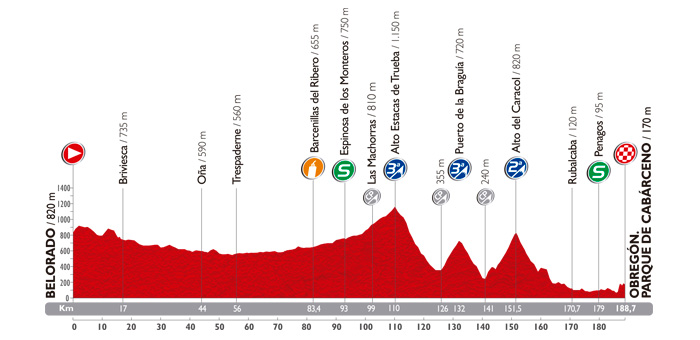
Stage 13: Belorado › Obregón. Parque de Cabárceno – 152.2 km
Following a very flat Stage 12 that, unsurprisingly, ended in a sprint (won by John Degenkolb), the Vuelta’s thirteenth stage will be a more unpredictable affair. The Stage 13 parcours is a tale of two halves. The opening 95 kilometers of racing take place on mostly flat, mostly straight roads. After the first intermediate sprint near the midpoint of the stage, however, the road begins to twist and turn through a stretch of tough hills. First on tap is a Cat. 3, with a fast descent to follow, and then another Cat. 3 and another fast descent, and then a tough Category 2 and yet another downhill. Even after the descent from the Cat. 2, it is still an undulating journey to the line, with a few uncategorized challenges yet to come. The finish is a lumpy affair: at 2.5 km to go, the road kicks up dramatically for a short but steep (a few sections push 10%) climb, which will be an attractive potential launching pad for the punchier riders. Then comes a series of short ups and downs before things flatten out for the final hundred meters of straightaway.
The Stage 13 profile is one of the most breakaway-friendly in this race. Given the tough finish, the teams of the pure sprinters won’t be all that motivated to keep the early move in check, and even if the pack does try to maintain control of the day, the up-and-down, winding roads on the second half of the stage won’t make it easy. The opportunists, especially those with some punch or at least decent climbing legs and a nice finishing kick for the final straightaway, will be licking their lips at this opportunity to pick up a Grand Tour stage win.
No single rider qualifies as the favorite in a stage like this, but there is a very long list of riders who could shine. BMC’s Philippe Gilbert is certainly one of them: the late rise is a perfect launching pad for the uphill charger, and he could look to get into the breakaway to contest the victory after a long day up the road. If Gilbert is in the lead group as the day nears its conclusion, whether that lead group is the main bunch or a small breakaway contingent, he’ll be hard to beat in the final few kilometers. His teammate Cadel Evans can’t be counted out either: with the climbing legs to handle the undulating profile and a nice finishing kick, and sitting more than 30 minutes behind on GC, Evans could try something from afar on Stage 13.
Cannondale’s Peter Sagan is another strong finisher who isn’t afraid to get into the long-range moves. After starting the Vuelta in domestique mode while riding himself back into form, he’s now showing much more interest in battling for stage wins. He won’t be allowed into the day’s break without a fight, but if he is in the move he’ll be a top favorite; if he isn’t, and if things do come back together, he’ll be a top favorite in that scenario as well. His teammate Alessandro De Marchi is an elite breakaway specialist, and though he doesn’t have the same punchy style as Sagan, he is a tough rider who handles this sort of climbing particularly well. He has already taken one stage in this race. Oscar Gatto is yet another Cannondale rider with a chance to go for a long one here.
Ryder Hesjedal is on the hunt for stage wins after falling out of GC contention in this Vuelta, and he does have a bit more explosiveness than many realize. He will be a top contender if he’s in the early break. Teammate Nathan Haas is very strong on a profile like this, and he knows how to play the breakaway game; he’s another good option for Garmin-Sharp.
Luis Leon Sanchez has not been much of a factor in the higher-profile races this season, but Stage 13 does have a parcours that will suit him very nicely. A strong soloist who can climb and sprint quite well, he will be dangerous if he can get into the day’s breakaway. Caja Rural teammate Amets Txurruka is always dangerous on a lumpy profile as well.
Trek has an impressive collection of riders who could be in the mix from afar in a hilly stage like this with Julian Arredondo, Bob Jungels, Fabio Felline, and Fabian Cancellara all potential protagonists here. Katusha’s Alexandr Kolobnev and Giampaolo Caruso, Lampre-Merida’s Damiano Cunego, OGE’s Adam Yates, Lotto Belisol’s Adam Hansen, Astana’s Alexey Lutsenko, and OPQS’s Pieter Serry and Tony Martin are others who will be well-suited to breakaway success on Stage 13.
If the peloton does reel in the day’s breakaway before the finish line, a select few sprinters with good climbing legs and the more explosive GC riders will join the list of potential protagonists. In that scenario, Michael Matthews of Orica-GreenEdge will be the top favorite, having put his impressive climbing form on display in his Stage 3 victory. Belkin’s Paul Martens might have a chance of holding on for a potential sprint. John Degenkolb of Giant-Shimano won’t have an easy time surviving the late climbs, but it’s not out of the question that he makes it to the last hundred meters of flat to contest a sprint. Garmin-Sharp’s Daniel Martin, Katusha’s Daniel Moreno and Joaquim Rodriguez, BMC’s Samuel Sanchez, Movistar’s Alejandro Valverde, Belkin’s Robert Gesink (who possesses an underrated finishing kick), Astana’s Fabio Aru, and race leader Alberto Contador of Tinkoff-Saxo will also be contenders if Stage 13 is contested by the main pack.
VeloHuman Stage Favorites
1. Philippe Gilbert | 2. Michael Matthews | 3. Peter Sagan
Be sure follow @VeloHuman on Twitter for live commentary of this and every stage of the 2014 Vuelta a España! The next preview will be up after the conclusion of Stage 13, so stay tuned.

 Episode 6: E3 Harelbeke + Gent-Wevelgem 2015 Pre-race Show