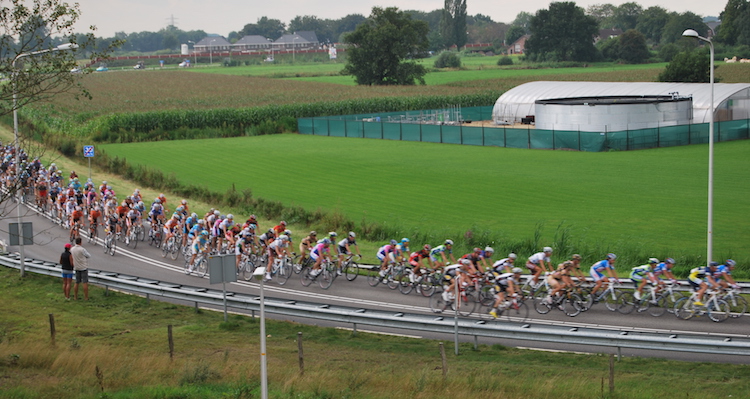
“Ardennes Week” gets underway this Sunday in the Netherlands (not actually in the Belgian Ardennes) at the Amstel Gold Race. The peloton’s punchier stars will have a shot at classics glory on a profile chock-full of short but steep climbs.
The Route
258 kilometers in total, the Amstel Gold Race parcours involves 34 small climbs, but more often than not everything comes down to the final uphill challenge of the day: the Cauberg. The riders will actually climb it four times, but the last one comes just 1.8 kilometers from the finish line, and it’s likely to be the key moment in the race.
A little over a kilometer at a little under 6%, the Cauberg isn’t actually all that hard compared to other famous cycling climbs, but at the end of a long day it does take its toll. Attacks are guaranteed—the question is whether an aggressor can hang on all the way to the line. If not, we’ll likely see a reduced sprint.
The Contenders
Michal Kwiatkowski is the defending champion, and having shown terrific form in winning E3 Harelbeke, he looks like a strong contender again in 2016. It’s hard to say whether the Amstel Gold Race will go to a lone attacker or to a speedster in a small group, but Kwiatkowski is a threat in either scenario. Sergio Henao, Wout Poels, and Ben Swift are other strong options for Sky.
Orica-GreenEdge has a powerful one-two punch in Michael Matthews and Simon Gerrans. Gerrans might be the one trying to mix it up on the climb, leaving Matthews to battle it out in a sprint if the Cauberg is not as selective.
BMC’s Philippe Gilbert is a three-time Amstel Gold Race winner, and an obvious potential protagonist. His form is a question mark, especially given his recent finger injury, but Gilbert can never be counted out in this event. Samuel Sánchez and Ben Hermans are other strong options for the team.
Rui Costa nabbed fourth here last year and he could contend again this year. He’s deceptively speedy and has a great eye for opportunities to get away, so watch out for him late in the race. Diego Ulissi gives Lampre another card to play—he’s great in a reduced sprint after a tough day.
Julian Alaphilippe and Brabantse Pijl winner Petr Vakoc make for a strong Etixx duo. Daniel Moreno could get involved for Movistar, with Alejandro Valverde sitting this race out. Lotto-Soudal looks strong with Tony Gallopin, Jelle Vanendert, and Tim Wellens. Europcar’s Bryan Coquard could struggle to hold on over the climbs but he’s a threat in a sprint.
Fabio Felline, Bauke Mollema, Wilco Kelderman, Enrico Gasparotto, Edvald Boasson Hagen, Tom-Jelte Slagter, Alexis Vuillermoz, Joaquím Rodríguez, and Tom Dumoulin are others with a shot.
VeloHuman Top 10 Race Favorites
Winner: Michal Kwiatkowski Podium: Michael Matthews, Philippe Gilbert Other Top Contenders: Simon Gerrans, Rui Costa, Julian Alaphilippe, Tony Gallopin, Tim Wellens, Petr Vakoc, Fabio Felline
The WorldTour makes one last stop in Spring Classics territory for the weeklong Eneco Tour, a relatively young race that has nevertheless offered a healthy amount of high-caliber entertainment the past few years. While the race doesn’t visit any Alpine climbs, the cobbles and the short but steep uphill tests of Belgium and the Netherlands, familiar to anyone who enjoys bike racing in the spring, will provide plenty of challenges to sort out the General Classification. Bonus seconds tend to play a pretty important role as well, giving the fast finishers a leg up on those less inclined to get involved in the hunt for high stage placings.
The Route
The Eneco Tour opens with three straight relatively flat days that look good for the sprinters, though don’t be surprised if at least one of them ends up going to an aggressive attacker. Nothing is guaranteed a part of the world as prone to crosswinds and sketchy conditions.
Stage 4 is a 13.9km individual time trial. It doesn’t sound like much, but in a weeklong race without any mountains, it’s a critical stage for the GC hopefuls. Despite a somewhat visually deceiving official profile graphic, it’s quite flat (and not particularly technical) and will favor the powerhouse specialists.
Stage 5 will take the peloton into Amstel Gold Race territory, pitting the riders up against some of the climbs of that one-day classic (although the stage avoids the Cauberg). The final few kilometers involve multiple short but steep climbs, and then a downhill run into the finishing straight.
Stage 6 should play out like a mini-Liège-Bastogne-Liège, taking on some of the same challenges and offering a similar profile: numerous climbs that are just a bit tougher than those of the previous stage.
The Eneco Tour concludes with a visit to the heartland of the Cobbled Classics in Belgium, where the peloton will take on multiple ascents of the legendary Muur van Geraardsbergen.
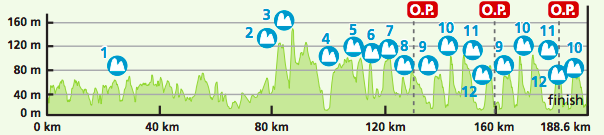
Stage 7: St.Pieters-Leeuw › Geraardsbergen (188.6km) – The Eneco Tour’s final stage is up-and-down from start to finish, with plenty of cobbled stretches to make things even tougher.
The challenging cobbled climbs will give the strongmen one last shot at a WorldTour victory in Flanders this season.
The General Classification Contenders
Given the Classics-esque feel of the Eneco Tour, it shouldn’t come as much of a surprise that many of the big names of the spring are making the start at this race. The more versatile among them will have a shot at the overall victory here.
Tim Wellens was the surprise victor last year (he launched an attack on that year’s Liège-Bastogne-Liege-esque stage 6 that catapulted him into the lead) and he returns this year with a strong Lotto-Soudal team. The route certainly suits Wellens, a true all-round talent who can handle this terrain well, though form has been a question mark for Wellens this season. The 24-year-old has not quite had the 2015 he was probably hoping for. Still, he’s a proven threat in this race who can’t be counted out. His team is stacked with other versatile talents as well: Tiesj Benoot, Jens Debuscherre, Jürgen Roelandts, and Thomas De Gendt are all capable supporters or alternatives if Wellens isn’t up for it.
Greg Van Avermaet and Philippe Gilbert head a powerful BMC squad. It would be a big surprise if at least one of them was not involved in the fight for the overall victory. I see Van Avermaet as the slightly more likely of the pair to lead the team, though both are very well-suited to the race and in sharp form. Van Avermaet’s recent climbing performances and a relatively newfound ability to time trial will come in especially handy in this race. He won the Muur van Geraardsbergen stage in 2014 and is sure to contend there again, and his cobblestone skills and finishing speed coupled with the best form of his life on the climbs and against the clock give him an edge in this race. He was 5th overall last year. Motivation is likely through the roof after a frustrating Clásica San Sebastián. Gilbert is a dangerous contender in his own right, however, 7th last year and the winner of multiple Eneco Tour stages in the past, and coming off a San Sebastián runner-up performance. Jempy Drucker and Daniel Oss round out a very strong BMC roster.
Lars Boom won the Eneco Tour back in 2012 and he was 2nd in 2014. He is very strong against the clock and on the cobbles, and always seems to climb better than you might expect on the Eneco Tour’s uphill tests. He should be right up there fighting for the overall victory. Andriy Grivko is another excellent option on an Astana team that is surprisingly well-suited to this race. Grivko was 3rd in 2013 and 4th last year, and he has the climbing legs and time trialing skills to make up for a relative lack of cobblestone prowess.
Etixx-QuickStep will be without 2013 overall winner Zdenek Stybar but that doesn’t mean they aren’t loaded with options. Julian Alaphillipe, one of the big stars of this year’s Ardennes Classics, is the most obvious choice. He is untested on the cobblestones but he should be among the best riders in the race on Stages 6 and 7, and can put in a nice ITT on a short course as well. Niki Terpstra is another excellent option—he tends to perform surprisingly well on the climbs of the Eneco Tour, and the rest of the terrain suits him perfectly. Tom Boonen is of course another rider to watch out for on EQS.
Simon Spilak may seem out of place among the many Classics stars on the startlist, but as a balanced rider with both strong climbing legs and a strong time trial, he can’t be overlooked in this race. Viacheslav Kuznetsov is a dark horse on the Katusha squad to watch out for—he’s comfortable on this terrain and was 11th overall in 2014.
It hasn’t been the best season for Wilco Kelderman, but like Simon Spilak he is an excellent all-round talent and a danger in pretty much any stage race. He also has a nice finishing kick to hunt down bonus seconds. Trek is without Fabian Cancellara but Fabio Felline could surprise some people with his climbing legs and time trialing skills. Lampre-Merida’s Diego Ulissi certainly has the climbing chops to handle the climbs and the finishing speed to nab bonus seconds. If he can survive the conditions and the cobblestones, he’s also pretty good against the clock in a short ITT.
Jan Bakelants, Lars Petter Nordhaug, Jens Keukeleire, Gorka Izagirre, Michael Rogers, Simon Geschke, Tom-Jelte Slagter, and Sebastian Langeveld are others on the list of outsiders hoping to contend for the Eneco Tour GC title.
The Stagehunters
André Greipel is the biggest name in a long list of fast finishers making the start, a list that also includes Giacomo Nizzolo, Arnaud Démare, Sacha Modolo, Elia Viviani, JJ Lobato, Moreno Hofland, Heinrich Haussler, Ramunas Navardauskas, Nikias Arndt, and Andrea Guardini. Greipel is in a class of his own out of that bunch, but coming off the Tour, motivation and form aren’t guaranteed. The sprinters should have three chances to hunt for stage victories at the beginning of the race.
Also watch out for Classics specialists like Filippo Pozzato, Ian Stannard, and StijnVandenbergh who might not be contenders for the General Classification, but who will nevertheless be dangerous on their preferred terrain in the hunt for stage victories. Practically the entire Topsport team fits this description as well.
VeloHuman Top 10 Overall Favorites
GC Winner: Greg Van Avermaet Podium: Lars Boom, Tim Wellens Other Top Contenders: Philippe Gilbert, Julian Alaphilippe, Andriy Grivko, Niki Terpstra, Diego Ulissi, Simon Spilak, Wilco Kelderman
Be sure to follow @VeloHuman on Twitter for more analysis and commentary during the race!
The 2015 Tour de France may be over but the WorldTour rolls on. The Clásica de San Sebastián (or the Donostiako Klasikoa in Basque) is the next race on the docket. It’s a hilly event that has just the right profile to inspire plenty of attacks, in a region mad for cycling, and its position on the calendar makes it a tough race to predict—some of the stars of the Tour de France are in attendance hoping to get just a bit more out of their legs, while a few other big-name riders are returning to racing for the first time and hoping to get back up to speed quickly.
The San Sebastián organizers made a small but impactful change to the race route last season that led to an exciting finale, and the event returns to that successful parcours for 2015.
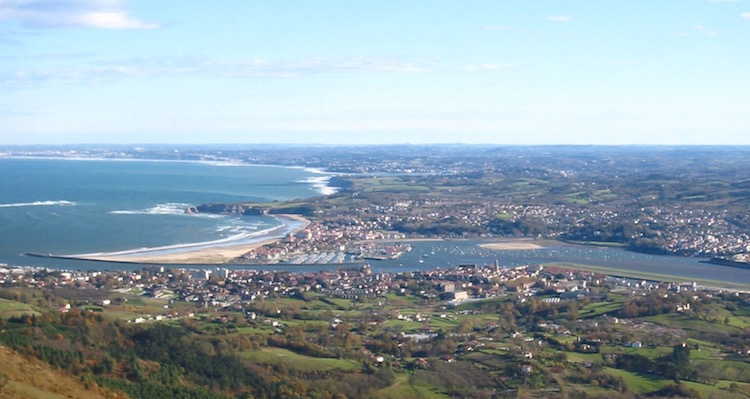
The race starts and finishes in the coastal town of San Sebastián, looping in and around the environs to make for a total race length of 219.2 kilometers.
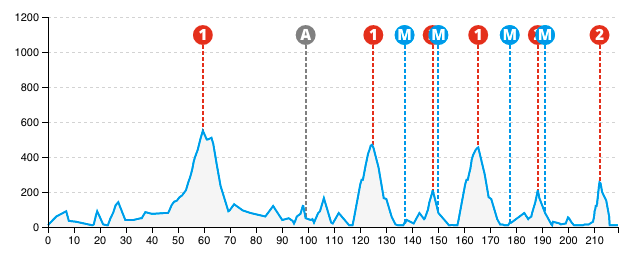
The harder climbs on San Sebastián profile are categorized as if this were a stage race, and there are six such challenges on the route. The Category 1 Iturburu climb, crested around kilometer 60, is no slouch, but it’s early enough to be more of a leg-softener than anything else.
Once the peloton hits the slopes of the Jaizkibel, the more enterprising riders in the bunch will have one opportunity after another to go on the attack, all the way to the last climb of the day less than 10km from the finish.
Things get more consistently difficult after the midway point of the route with the first trip up the Jaizkibel, the marquee climb of the race. It’s another Cat. 1 ascent, roughly 8 kilometers in length with an average gradient over 5%. After a descent, it’s not long before the riders reach the Cat. 2 Arkale, a short but steep climb and the third categorized test of the day. From the top of the Arkale, the pack will make a downhill trip right back to the foot of the Jaizkibel, where they’ll take on both the Jaizkibel and then the Arkale a second time.
After the second descent from the Arkale comes the final run-in to town, but there’s a tough climb along the road to the finish. The Bordako Tontorra climb to Igeldo is a short but steep Cat. 2 crested just over 7 kilometers from the finish. It’s less than 3km in length but with an average gradient nearing 10% and sections in the 20% range, it’s a hard road to the top. After the climb comes a descent into a flat finish.
The Contenders
The profile favors strong climbers with a lot of punch. It’s probably possible to attack from the more pure-climber-friendly Jaizkibel or from the Arkale and hold out to the finish, but it’s more likely that the race comes down to the last bump in the road, which is more suited to the Ardennes-style riders than the big stage racing stars.
That late climb shook up the race last year, providing Alejandro Valverde with a launching pad to go on the attack for the win. Because the parcours is so up-and-down already, the peloton is pretty thinned out by the time it reaches the final 10km—even if attacks on the Jaizkibel and Arkale are reeled in, it’s still very hard to keep things altogether on the last climb. In case it’s a small group that reaches the finish, a strong flatland kick will be important to anyone hoping to win.
However things play out, Valverde is capable of winning this race in pretty much any scenario, which is probably why he is a two-time champion. Coming off of a Tour de France podium, and in the middle of an excellent season (in which he dominated the hilly spring classics), it’s hard not to see Valverde as the clear favorite. He’s among the best climbers on the starlist who can thrive on pretty much any gradient, and he’s got more punch than most of his rivals. Valverde could win this with another late attack, or he could follow the moves in the finale and hold out for a reduced sprint. Giovanni Visconti is a good alternative for Movistar.
As good a candidate as Valverde is to win this race, however, the Clásica is still a pretty wide open event. It’s always hard to say how riders’ legs will react coming into the race. Valverde went very deep fighting for a Tour de France podium spot.
Philippe Gilbert is another former winner who has been on terrific form of late. If the pace is really high over the finale climb, the Philippe Gilbert of 2015 may have just a bit of trouble holding on all the way up, but if the peloton plays the early slopes cautiously, Gilbert will be well-positioned to make a late attack or to look for a sprint win. BMC has some serious firepower behind Gilbert, though—Greg Van Avermaet was in the Top 10 last year and is in great form this year, and Samuel Sánchez has been in the Top 10 several times over his career.
Joaquim Rodríguez has never won the race but he’s come close several times, and it’s no surprise that he does well here given the punchy-climber-friendly profile. He’ll probably need to launch a late attack if he wants to win, since he’ll have trouble outsprinting some of the other top favorites at the flat finish, but the Igeldo climb is the perfect place to do that. His form was good enough for two stage wins at the Tour, but he didn’t look terrific in the final week; however, he landed on the podium in the 2014 edition of the Clásica despite a lackluster Tour, so I won’t read too much into his not-great few days in the Alps. Daniel Moreno makes for an excellent foil—he’s been a bit quiet this season, but Purito and Moreno always make for a strong 1-2 punch.
Bauke Mollema was 2nd in this race last year and has been in the Top 10 all three times he’s made the start. Mollema is known as a strong climber but he’s also handy in a sprint. If he can get into a small group at the end of the day he will have a great shot at winning. For whatever reason, his kick is a bit underrated, and that can only help him potentially pull one over the more obvious Ardennes veterans in the finale. Julian Arredondo and Bob Jungels are other great options for Trek.
Etixx-QuickStep is loaded with talent in the form of Julian Alaphilippe, Rigoberto Urán, and Zdenek Stybar. Alaphilippe is probably best-suited to the profile, but he’s not raced in a little while so the form is a question mark. Urán looked decent in the Tour, and packs a nice sprint—he’s a rider to watch. Stybar will be a good bet as well, coming off of strong Tour de France in which he took a stage victory. He climbs better every year and he was 10th here last year.
2013 winner Tony Gallopin is not racing, but Lotto Soudal has a few good options in his stead with Tim Wellens and Jelle Vanendert. Both seem like good candidates to try an attack from a little ways out;
Dan Martin is an obvious candidate for success on the San Sebastián profile but he was not at his best in the last week of the Tour and if he’s feeling a bit rusty, a 200+ kilometer bike race might be tough. Ryder Hesjedal could pick up the slack if Martin isn’t up for it. Roman Kreuziger will lead Tinkoff-Saxo after Alberto Contador decided to back out of the start citing a fever—Kreuziger has a good track record in San Sebastián and will be worth keeping an eye on. Astana’s Luis Leon Sanchez is a two-time winner of the race, but he might not even be the best rider on his team. Mikel Landa has had an excellent season thus far and has the explosive climbing legs to try a move on slopes. He was 6th in this race back in 2013 before he had really even come close to the level at which he’s been racing this year.
Both of the Yates twins have a shot—Adam was riding well in last year’s edition of the race before crashing out of the lead group in the final few kilometers, and Simon may be even better suited to the profile. AG2R’s Romain Bardet is in good shape and has quietly become a dangerous one-day racer. Teammate Alexis Vuillermoz could look to launch himself on one of the late climbs. Rui Costa was forced to abandon the Tour de France by a variety of ailments, but this is a great parcours for him if he’s back to 100%.
Jarlinson Pantano, Sylvain Chavanel, Wilco Kelderman, and Thibaut Pinot are others who will hope to be involved with the other race favorites.
Pello Bilbao of Caja Rural is VeloHuman’s Under-the-radar rider to watch at the Clásica de San Sebastián. Bilbao is a talented all-rounder with the climbing legs to be in the mix as a stage race contender, but who also packs a nice finishing kick. He’s having a great year so far, having won a mountain stage at the Tour of Turkey and the overall at the Tour de Beauce, among other results. Caja Rural in general is having a very nice season, with quite a collection of wins at Continental Tour races; watch out for a long-range dig from Amets Txurruka or David Arroyo as well, and keep an eye on versatile fast finisher Carlos Barbero.
VeloHuman Top 10 Favorites
Winner: Alejandro Valverde Podium: Philippe Gilbert, Bauke Mollema Other Top Contenders: Joaquim Rodríguez, Greg Van Avermaet, Zdenek Stybar, Julian Alaphilippe, Romain Bardet, Dan Martin, Mikel Landa
What looked set to be a very uninteresting Stage 10 turned quite interesting when a breakaway managed to stay clear, giving Nicola Boem a stage victory, and things got even crazier when Richie Porte lost nearly 3 minutes on the General Classification due to an untimely puncture and an ensuing penalization for receiving a wheel from a non-teammate. The interesting action should continue on Stage 11, which has the profile for plenty more compelling racing at the Giro d’Italia.
There are no long, brutal climbs, but it will be an exhausting day of truly constant up and down. There is a Cat. 3 climb almost from the gun, followed by three uncategorized climbs (and descents) that could easily merit at least Category 4 status in their own rights, and then another Cat. 3 before a descent to the foot of a climb that the riders will have to take on four consecutive times. The Tre Monti climb is apparently worthy of Category 4 status . . . but only on one of the four trips up, the penultimate one. It’s a little over 4km at an average over 4%, but it’s an irregular ascent with a few steeper stretches. After the first ascent, the riders will descend toward the Imola racetrack and cross over the finish line for the first time, and from there, they’ll embark on three laps in a circuit that will take them back up the Tre Monti and back down to the track.
The descent into the finish is not technical, but the downhill run from the top of the Tre Monti only flattens out inside the final km, though, so any ground lost on the climb and ensuing descent will be hard to make up before the final crossing of the finish line.
With so many climbs on the menu, it’s hard to see a sprint happening, for many reasons. First, the pure sprinters probably won’t make it too the finish. Categorized or not, there are some tough uphill challenges to overcome on Stage 11. What’s more, the profile is perfect for a long-range move, either the morning breakaway or, if that is swept up, later attacks on the climbs—it will be extremely difficult for the peloton to control this race, and the Giro’s peloton has not shown itself to be particularly interested in inter-team cooperation. Even if the day does somehow see a large, compact lead group coming into the finish, with less than a kilometer of flat running into the line, the surviving sprinters won’t have much of an opportunity to get into position for the final kick to the line, and it’s likely to get pretty messy. This one is a challenge to predict.
In terms of the potential victory-by-long-range scenario, Orica-GreenEdge has a number of riders they might send up the road, chief among them, Simon Gerrans and Simon Clarke. In recent seasons, Gerrans has made a name for himself by waiting for reduced sprints on hillier days (and he’ll of course be a danger in that scenario here), but he’s always had a great talent as a breakaway specialist, and he could try to get up the road here. Simon Clarke has spent plenty of time in breakaways in this race already, and will be a strong candidate again here.
Philippe Gilbert should be an obvious name for this sort of stage, given the profile. It will be a fierce fight to get into the breakaway, but his talent for climbing small hills like the ones that will kick off the racing on Stage 11 will give him a great chance to get involved if he goes for it.
Diego Ulissi has already won a stage in this race, showing off his excellent form right now. Like Gerrans, he’s got a great finishing kick, which means he’ll be deadly if he’s in the lead group at the end of the day—he can use his great climbing legs to stay at the front of a group over the last climb without necessarily needing to attack knowing that he can rely on the fast finish to win.
Tom-Jelte Slagter looked very strong on Stage 9 and will like the look of this profile, though it’s hard to pick one Cannondale-Garmin rider here with so many breakaway options among Tom Danielson, Davide Formolo, David Villella, and Ryder Hesjedal.
Simon Geschke, Sylvain Chavanel, Maciej Paterski, Adam Hansen, Giovanni Visconti, Stefano Pirazzi, Edoardo Zardini, Enrico Battaglin, Sonny Colbrelli, Grega Bole, and Rinaldo Nocentini are just some of the many other potential long-range victory candidates on this stage, most of whom will also be a dangerous if a reduced peloton contests this finish in a compact group.
Should this all come back together, Michael Matthews will be among the top names to add to the above list of stage victory candidates—Orica-GreenEdge really does have a wealth of options on this sort of profile. Trek’s Fabio Felline and Movistar’s Juan José Lobato are others who could get involved if everything goes their way; that is, if they can hold on over the difficult parcours, if the morning breakaway is swept up, and if no one gets clear on the final climb.
VeloHuman Stage 11 Favorites
1. Simon Gerrans | 2. Philippe Gilbert | 3. Diego Ulissi
Be sure to follow @VeloHuman on Twitter for more race analysis, and check back after the conclusion of Stage 11 for the preview of the next stage. Also, don’t miss the most recent episode of the Recon Ride podcast!
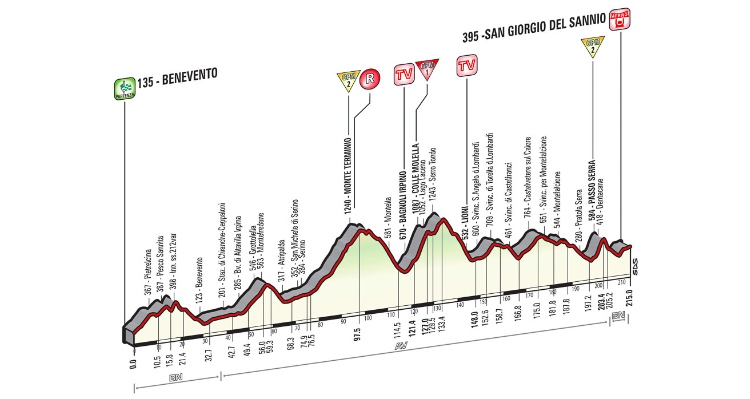
Stage 9: Benevento › San Giorgio del Sannio – 224km
Beñat Intxausti was the breakaway victor on an unpredictable Giro Stage 8, and the Stage 9 that follows will be even more unpredictable, and probably even more breakaway-friendly.
The riders will set out from Benevento and take on a few small ups and downs before coming to a brutal pairing of climbs. First they’ll hit the slopes of the overlong Monte Termino, a 20km Cat. 2 with a 4.2% average gradient. After the descent, the riders will immediately begin the Cat. 1 Colle Molella, 9.5km at an average gradient of 6.3%, but with a long steep stretch near the KOM marker—and after a brief flat section following the mountains points, the road continues to climb for a few more kilometers!
Then comes another descent and a long stretch of ups and downs before the third and final categorized climb of the day, the Cat. 2 Passo Serra, only 3.6km long but with an 8% average gradient. It will be a great launching pad for the aggressors, as it’s followed by a steep descent and then a short climb that leads into the mostly flat final 3km.
With climbs throughout, three major KOM opportunities, and a finish that probably won’t be all that enticing for the GC favorites, this is stage screams breakaway. Even if Astana or Tinkoff-Saxo or a team that has missed the break decide to set a high tempo late in the day, it will be extremely difficult to control the race on this profile. Stage 9 looks great for a punchy, aggressive rider, most likely from a long-range move, although the same type of rider would be favored if the peloton mops up the early breakaway as well. Regardless, as with any breakaway-friendly stage, this one will be very hard to predict.
Stefano Pirazzi was not in the breakaway on Stage 7 or Stage 8. It’s hard to imagine he won’t try to be in the early move here. He’s not the best climber in the race, and he isn’t the punchiest finisher, but he’s terrific on long, hilly days, and he finds an extra gear when he’s up the road. With a Giro KOM jersey and a Giro stage win in his palmarès, he knows how to ride on this kind of parcours, and if he can get into the breakaway, he will be extremely hard to beat.
Diego Ulissi already has a stage win in the race, and he’ll be looking for another here. He won’t be afraid to get into the breakaway, and if he’s at the lead group at the finish, he’ll be among the top favorites no matter who he’s with.
Philippe Gilbert doesn’t have any stage wins yet, but he has similar abilities on the short, steep climbs, and he’s been aggressive trying to get up the road so far in this race. A dropped chain ruined his chances on Stage 7, so he’ll have his eyes open for another chance on this profile that suits his punchy skillset. Simon Gerrans, 3rd on Stage 7, made his bones earlier in his career as a breakaway specialist, and although he may be better known for his killer instinct in reduced bunch sprints these days, he has the added dimension of being capable of winning from a far on a stage like this. Teammate Simon Clarke has already spent plenty of time in the breaks and will like the profile too.
Sylvain Chavanel, Edoardo Zardini, Adam Hansen, Beñat Intxausti, Simon Geschke, Carlos Betancur, Tom-Jelte Slagter, Darwin Atapuma, Ryder Hesjedal, and Esteban Chaves (now way behind on GC) are other potential protagonists who could get the chance to go from afar.
Giovanni Visconti is a special case deserving of his own paragraph. From the profile alone I might name him the top favorite for Stage 9, but when weighing his chances one must add a rather rare variable to the equation: he’s only 1:16 down on GC. It’s hard to tell whether the GC favorites will let him get up the road. Even if he misses the early break he’ll still have a chance from the pack, as he combines excellent climbing legs with a nice kick, but it’s a major question mark whether he’ll be given any room on this stage.
Of the riders less likely to be given any room to roam, in-form Fabio Aru and Mikel Landa are obvious choices with a steep late climb, as is Alberto Contador. Rigoberto Urán looks stronger than he did earlier on in the race and he sports a strong sprint if it comes to that. Damiano Caruso is also quick to the line.
And of course, keep an eye out for versatile fast-finishers Fabio Felline, Juan José Lobato, and Michael Matthews—all three could have a chance on Stage 9 depending on the way things play out.
VeloHuman Stage 9 Favorites
1. Stefano Pirazzi | 2. Diego Ulissi | 3. Philippe Gilbert
Be sure to follow @VeloHuman on Twitter for more race analysis. Stage 9 is followed by a rest day, so check back on Monday for the preview of the next stage. In the meantime, keep an eye out for the next episode of the Recon Ride podcast!
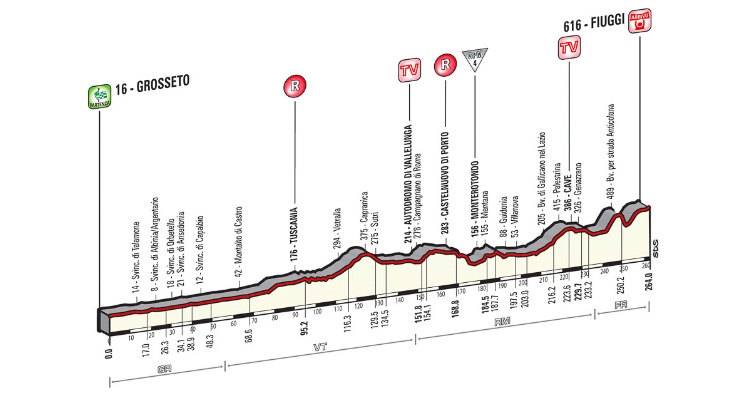
Prior to the start, Stage 6 of the Giro d’Italia did not look like it was going to create many headlines, but a compelling first week of this race took another twist when Alberto Contador hit the deck hard in the finishing sprint as André Greipel was taking the stage victory. The Giro should offer yet another intriguing day of racing on Stage 7, the longest day of the race, with a parcours that could set up several different scenarios.
There is just one categorized climb on this stage, and it is a Cat. 4 at that, but second half of the profile, and in particular the final 50km, involve a lot of up-and-down. The finale in particular has some challenges—there is a short but somewhat steep climb with around 20km to go, then a sharp descent, then a stretch of over 5km at over 4%, followed by a flatter run-in to a finish that kicks up once again in the last kilometer. The final 350 meters rise at between 3 and 4%. It’s nothing terribly steep, but the riders are sure to hit it at a very high pace, and after a very long day, it’s going to hurt. The punchier riders are going to be able to hold their positions better into the finale, and they’ll also be better-suited to the finale because of it’s gradient.
The bumpy nature of this stage and its position just before a difficult mountain day will combine to make this a tough one to predict. It’s possible this comes down to a bunch sprint, with some of the purer sprinters holding on. With this finale, it’s also possible that Stage 7 puts the bigger quick men into difficulty, leaving the more versatile types to fight it out in a reduced sprint. And it’s always possible that a breakaway takes the win, bolstered by the fact that many will be saving energy for the difficult Stage 8 on the horizon. The breakaway scenario could also see some of those same versatile riders trying their luck with a long-range move, as well as several breakaway specialists.
Michael Matthews is the most obvious choice of favorites to win this stage in a sprint. He’s got the climbing chops to potentially survive the late bumps in the road and the finishing kick to be deadly the last few kilometers, even if there are other speedsters around.
JJ Lobato is also among the favorites, thanks to his top-notch uphill speed. Lobato thrives in a small uphill finishes, and that’s what this is. After a slow start to his Giro d’Italia, he seems to have found his legs. Fabio Felline, 2nd on Stage 3, should be able to hold on if this comes down to a group finish, and he’s a dangerous young rider in that potential scenario.
Philippe Gilbert is also a great uphill charger, who adds the breakaway factor to the conversation—he’s already been in a breakaway in this race, and he showed great form to take 3rd in that stage despite spending time out front and then getting caught by the pack. Gilbert is fully capable of winning this stage from the pack or from afar, and that makes him a top-level favorite.
Diego Ulissi would probably prefer more climbing, but like Gilbert, he’s a punchy finisher with the capacity to win with a long-range strike or in a reduced bunch sprint. Bardiani-CSF’s Sonny Colbrelli and Enrico Battaglin, Giant-Alpecin’s Simon Geschke, Southeast’s Francesco Gavazzi, Orica-GreenEdge’s Simon Gerrans and Simon Clarke, CCC’s Grega Bole, Katusha’s Luca Paolini, and IAM Cycling’s Heinrich Haussler and Sylvain Chavanel are others with the versatility to be in the mix whether they stick with the peloton or go from afar. Adam Hansen, Giovanni Visconti, Maciej Paterski, and Stefano Pirazzi (as with most intermediate stages, Bardiani-CSF will be overflowing with options here) are among those who will likely need to be in the day’s breakaway to have a chance on Stage 7, but who will be very dangerous if they’re up there.
Giacomo Nizzolo told the Recon Ride that he’s interested in this stage, but it will be pretty tough for the purer sprinters like Nizzolo to survive those late climbs after such a long day. Still, it’s worth keeping an eye on Nizzolo and his bunch sprint rivals like André Greipel, Sacha Modolo, Elia Viviani, Luka Mezgec, and Moreno Hofland.
VeloHuman Stage 7 Favorites
1. Michael Matthews | 2. Philippe Gilbert | 3. Juan José Lobato
Be sure to follow @VeloHuman on Twitter for more race analysis, and remember to check back after the conclusion of Stage 7 for the preview of the next stage.