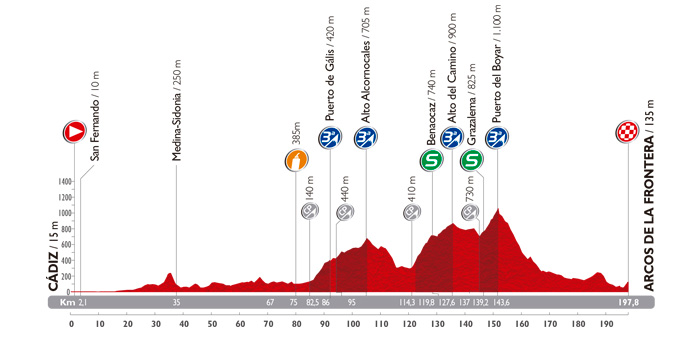
After a very flat second stage won, somewhat predictably, by Nacer Bouhanni, the peloton will take on a moderately bumpy Stage 3. The riders will enjoy approximately 80 kilometers of flat roads after they set out from the start (on an aircraft carrier, no less) in Cádiz before taking on a few hills in the middle of the stage. Following the journey up and over a series of Cat. 3 climbs, the riders will begin a long descent. After things flatten out, a short, uncategorized bump must be overcome with roughly 10 km to go, followed by a flat stretch that will last until a little bit after the peloton reaches the 2-km-to-go mark. Then things get interesting. The road kicks upward for most of the remainder of the journey to the line, only flattening out in the last few hundred meters. It’s not a categorized climb, but it’s enough of an incline to give the lighter riders a significant advantage. When the pack hits the slope, those who specialize in these sorts of ascents will drive a furious pace to put pressure on their heavier rivals. Some riders could try to launch their bid for glory early while the gradient is high, while the less able climbers will hope to hold on until things flatten out.
The parcours of Stage 3 should favor the more versatile fast finishers, the riders who are at their best sprinting for victory up a bit of an incline and at the end of a harder day in the saddle. An intermediate profile like this might look breakaway-friendly, but there are plenty of well-rounded quick men on this startlist who will find this stage well-suited to their talents, and their motivation to keep this together for a group finish will be high. A long, late flat section will help with a chase. The first uncategorized bump in the final 20 km might see a few attacks, but it’s not a difficult enough challenge to be a great launchpad, and it will be hard to stay away with another flat stretch to follow. The likeliest outcome here seems to be a group reaching the last uphill drag mostly intact to fight it out over the final two kilometers.
It’s hard to draw up a better profile for Peter Sagan than this. The climbs in the middle of Stage 3 will not be a problem for him, but some of his rivals for a sprint could suffer. Likely arriving relatively fresh at the finish line, he’ll appreciate the last uphill kick at the end of the day; he’s always fast, but his talents should be especially apparent in the fight for position that will occur in the last kilometer when the road is at a bit of a gradient. The Slovakian star doesn’t come without question marks though. He has said that he’s in this Vuelta a España to prepare for the World Championships, and he did a rare turn as a leadout man in Stage 2 rather than chasing victory himself. Stage 3 looks like a golden opportunity but his motivation is uncertain. Oscar Gatto is a decent alternative in place of Sagan should Cannondale decide to go in that direction.
John Degenkolb is another rider with a particular knack for this sort of profile. His top speed rivals Sagan’s, and unlike many other big-name sprinters of that caliber, he doesn’t lose his edge when the road tilts upward. If things hold together for a sprint at the end of Stage 3, Degenkolb will have a great chance at victory, and even if some of the punchier types try to create separation on the late incline, he’s shown before that he is strong enough to latch onto the right wheel to avoid being left behind when the road tilts upward.
Michael Matthews will love this parcours. His only complaint might be that Stage 3 isn’t bumpy enough in the middle of the day to cause more problems for other fast finishers, but either way, he’ll be a top favorite with an uphill stretch just before the line. His climbing legs have been amazing this year.
The final hundred meters may be flat, but the battle to be in front on the last uphill section will be critical for anyone hoping to take this stage, and nobody can charge uphill quite like BMC’s Philippe Gilbert. He will go full gas on the incline section and hope to get enough of an advantage to hold on for the win when things flatten out.
Alejandro Valverde of Movistar is another rider who can rely on his explosiveness to put space between himself and some of the heavier sprinters on the late climb. Katusha’s Daniel Moreno is on strong form for this Vuelta and could try the same, as might his teammates Joaquim Rodriguez and Alexandr Kolobnev.
Trek’s Fabian Cancellara is typically strong in a finish like this, but don’t count out his very impressive 22-year-old teammate Jasper Stuyven, 4th on Stage 2 and capable of handling a few hills. Fabio Felline crashed in the second stage, but normally this finish would suit him too. Filippo Pozzato, Daniel Martin, Moreno Hofland, Anthony Roux, Nathan Haas, Gerald Ciolek, Luis Leon Sanchez, Tom Boonen, and even Cadel Evans are others who could find Stage 3 to their liking. The profile may be a bit bumpy for Nacer Bouhanni, but his team did a great job taking care of him in the finale of the second stage and it’s not out of the question that he makes it to this finish in a good place.
VeloHuman Stage Favorites
1. John Degenkolb | 2. Peter Sagan | 3. Michael Matthews
Be sure follow @VeloHuman on Twitter for live commentary of this and every stage of the 2014 Vuelta a España! The next preview will be up after the conclusion of Stage 3, so stay tuned. In case you missed it, the overall race preview can be found here.
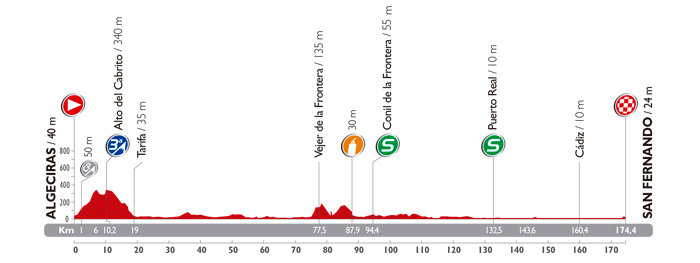
With the opening TTT (won by Movistar) now in the rear mirror, the Vuelta a España gets into road racing proper in its second stage. After an early Cat. 3, Stage 2 offers over 160 kilometers of racing without a single categorized climb. It’s hard to see anything other than a sprint decided this stage, though a few factors could add some excitement to the day. For one, this route runs along coastal roads susceptible to high winds. The first road stage of a Grand Tour is always nervous enough as it is, and things will be all the more stressful if the winds pick up.
What’s more, the finale is a tricky one, with a succession of hard turns (right, left, right, and right again into the finishing straight) inside the last kilometer and a half. A technical sprint run-in on the first mass start day of the race could be a recipe for crashes, and the GC men will have their fingers crossed that they can simply make it to the Stage 2 finish line unscathed.
The fastest of the fast men will be the favorites here. Giro Points Classification winner Nacer Bouhanni has elite top-end speed and would be dangerous enough in a drag race on a long straightaway, but he really shines in a hectic finale like this. His ability to position himself perfectly even without a great leadout, combined with some amazing acceleration, puts him at the top of the list of contenders.
Cannondale’s Peter Sagan is another rider who is quite capable in a technical finish. His versatility shouldn’t take away from the fact that he’s one of the best sprinters in the field. Coming into the race, form and motivation were both question marks; it’s unclear what he is hoping to get out of this Vuelta, which he is using to prepare for the World Championships. However, after Cannondale’s strong TTT, a top result on Stage 2 could put him into the leader’s jersey, and that should drive him to go for this. He has the ability to win this stage.
Giant-Shimano’s John Degenkolb shouldn’t lack for motivation to hunt a victory here. He has looked sharp in sprint finishes this year, but was unable to pick up a victory in the Tour de France. With a top-notch leadout to guide him through the last few kilometers, he should be in the mix.
Michael Matthews of Orica-GreenEdge had a terrific Vuelta in 2013, taking two stage victories. Known for his versatile skillset, he is also just plain fast, and even on a flat course he’s a contender.
Astana’s Andrea Guardini has been on fire this month, winning twice in Denmark and then picking up a WorldTour victory in the Eneco Tour. He will have another opportunity here on Stage 2 of the Vuelta. Lampre can choose between the speedy Maximiliano Richeze and Roberto Ferrari. OPQS has Tom Boonen, who becomes even more dangerous on a windy day when his team’s classics prowess can be put to good use. The longlist of others who should be in the mix includes AG2R’s Yauheni Hutarovich, Belkin’s Moreno Hofland, Garmin-Sharp’s Nathan Haas, IAM Cycling’s Matteo Pelucchi, Lotto Belisol’s Jens Debusschere, MTN Qhubeka’s Gerald Ciolek, and even BMC’s Philippe Gilbert.
VeloHuman Stage Favorites
1. Nacer Bouhanni | 2. John Degenkolb | 3. Peter Sagan
Be sure follow @VeloHuman on Twitter for live commentary of this and every stage of the 2014 Vuelta a España! The next preview will be up after the conclusion of Stage 2, so stay tuned. In case you missed it, the overall race preview can be found here.
While some of the pro peloton is in Spain taking on the year’s final Grand Tour, a number of other riders will be in Hamburg to take on the Vattenfall Cyclassics. The first of several late summer circuit races on the WorldTour calendar, the event offers the sprinting heavyweights a rare opportunity to take a one-day victory at the highest level. It’s a lengthy race at 247.2 kilometers, and there are a few bumps along the way, but it almost invariably ends with a bunch gallop.
The Route
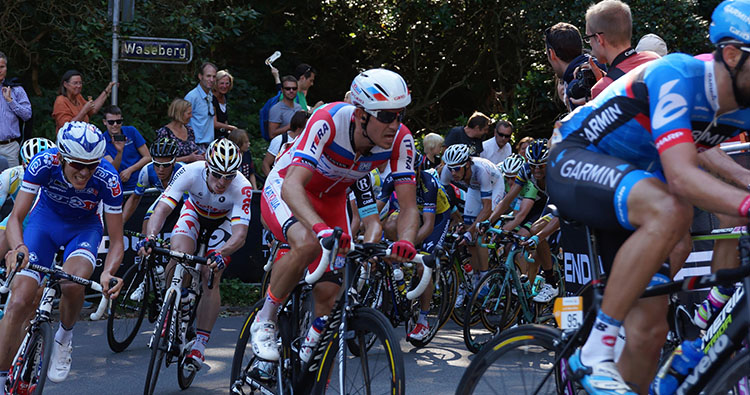
The race starts and finishes in Hamburg, with a route that will take the peloton in several loops through the city and its outskirts. The terrain is not particularly undulating throughout, but it does become a bit more challenging as the race wears on. After a long and mostly flat first half, the riders face four climbs of the Waseberg, the only real uphill test that must be overcome before the finish. It’s not even a full kilometer to the top, but after a long day, repeated trips up the steep climb will wear down some of the heavier riders. Generally, the Waseberg is the site of attacks, and though in recent editions they’ve all been closed down before the line (which comes roughly 15 km after the last ascent), the potential for a late game of cat and mouse does make for a hectic finale.
Weather has played a role in this race in the past, and it may again in the 2014 edition of the Vattenfall Cyclassics. There is a possibility of rain and a likelihood of high winds in the forecast, which could make this journey from start to finish a bit more stressful.
The Contenders
With a sprint as the most probable outcome, a fast finish will be the most important asset for anyone to be considered a main contender here. Endurance to survive a long day in the saddle and arrive at the finale fresh will help. The big-name sprinters, especially those who are comfortable sprinting after 240 kilometers, will be the top favorites. Last year’s winner John Degenkolb fit the bill perfectly, but he is in Spain for the Vuelta. However, there are plenty of other top quick men on this startlist (the field is probably even stronger than it was last year) to battle it out for the win.
Katusha’s Alexander Kristoff was 3rd in the 2013 edition of the race, and given his impeccable form right now, he will have an excellent opportunity to improve on that this year. The Milano-Sanremo winner is at his best after a lengthy race, he doesn’t mind a few bumps on the way to the line, and his top speed has reached new heights this season, making him among the most likely winners of the race. Bad weather will only increase his chances. The very quick Alexey Tsatevich makes for a powerful teammate.
Andre Greipel took 2nd place for the second consecutive time in 2013 and he’ll again be a strong contender in 2014. He is one of the fastest sprinters in the world, and he has made it through this parcours to the seemingly inevitable bunch finish in the past. However, he’s been a bit of a mystery over the past two months, at times showing off the blazing top speed for which he is well-known, and at other times widely missing the mark in races that seemed to suit him. He’ll need to put it all together to come away with the win here, and he hasn’t had a perfect run-up to race after withdrawing from the Eneco Tour due to illness. The possibility of rain won’t help either. Still, if he is feeling good and positions himself well, he’ll be hard to beat.
Marcel Kittel is the best pure sprinter on this startlist, with the Tour success to prove it. In a straight contest of speed, he is very rarely beaten, especially with the help of the Giant-Shimano leadout. However, as impressive as Kittel is as a sprinter, he doesn’t have the same versatility as teammate and 2013 winner John Degenkolb; he struggles with even minor challenges in a profile, and after 245 kilometers, he may be a different rider entirely from the speed machine that won the sprint down the Champs-Elysees. He’s certainly a contender, but he needs to prove that he can handle long days with a few bumps along the way before he is favored to win a race like this. The team may rely on Luka Mezgec as a capable alternative. Mezgec has taken his game to a new level in 2014, collecting win after win in the spring and showing good form lately in the Tour de Pologne and the Eneco Tour. He is a bit more capable than Kittel on the tougher parcours. Simon Geschke is another nice alternative; should this race be more selective than it usually is, he’s a dangerous rider in a reduced sprint.
OPQS brings a team loaded with firepower, with sprinting star Mark Cavendish leading the way. He’ll be eager to reassert himself in a bunch gallop after his early exit from the Tour de France, and he’s obviously among the very best sprinters here, with only Kittel and Greipel as potential rivals for pure speed. Still, while he’s a bit more likely to make it to the line than the aforementioned Kittel, there is a difference between surviving and arriving to the finale with fresh legs, as this year’s Milano-Sanremo (where several riders outmatched him even in a sprint) showed. Gianni Meersman is a terrific alternative if necessary, having shown brilliant form at the recent Tour de Wallonie, and Tour de l’Ain. The versatile Meersman should have no problem at all with the profile or the length of the race, and he may have more left in the tank than others by the end of the day. The same is true for Matteo Trentin, who will be yet another option for OPQS. Mark Renshaw, who showed in the Tour de France that he still has a lot of speed, deserves a mention too.
FDJ’s Arnaud Demare took the biggest win of his career here in 2012, and he has the skillset to fight for the overall victory again this year. Apart from a forgettable, illness-marred Tour de France campaign, he’s had a strong season so far, and he’ll be motivated to show that he’s back to his best in this race. 2nd in Gent-Wevelgmen in March, Demare is especially strong after a long day in the saddle, making him a top favorite for victory.
Trek’s Giacomo Nizzolo was 3rd in the 2012 Vattenfall Cyclassics. He’s had an odd year, with quite a collection of nice sprinting performances but only two victories (in the Tour de San Luis and the recent Tour de Wallonie). Timing has been a bit of an issue on a number of occasions, and this race’s often chaotic finale won’t help with that, but the route and profile suit him perfectly, and Trek has a fast group of riders in attendance to strengthen his chances. Given the possibility that the likes of Kittel, Cavendish, and Greipel may not make it all the way to the line with the lead group, Nizzolo could contend for the win.
Lampre-Merida’s Sacha Modolo has shown flashes of brilliance in 2014, but he’s missed out on several races that looked to be good opportunities as well. Crashes haven’t helped. If he can hang on here, he’s extremely fast and should be in the mix for the victory. Europcar’s Bryan Coquard has won some smaller races this season and will hope to put his strong finish on display on a bigger stage in Hamburg. Sky’s Ben Swift would probably prefer a few more hills on the profile, but he’s a good sprinter in any scenario, and the length of the race alone could give him an advantage (like it did in Milano-Sanremo this year, where he was 3rd); much the same could be said for his teammate Edvald Boasson Hagen, who, though he has had a year to forget, did win this very race back in 2011. NetApp-Endura’s Sam Bennett is another very quick rider who becomes more dangerous when the route to the finish line has a few challenges along the way. Movistar’s JJ Lobato, BMC’s Thor Hushovd, Garmin-Sharp’s Tyler Farrar (winner of both the 2009 and 2010 edition), Orica-GreenEdge’s Matt Goss, Tinkoff-Saxo’s Matti Breschel, and AG2R’s Davide Appollonio are others who could contend in a sprint.
Despite a historical precedent of bunch finishes deciding this race, a few teams have brought some talented riders, several of them familiar classics specialists, who will try to make things interesting by applying pressure as the long day nears its finish. BMC’s Greg Van Avermaet, OGE’s Simon Gerrans, Michael Albasini, and Jens Keukeleire, Astana’s Enrico Gasparotto, and Belkin’s Sep Vanmarcke and Lars Boom look to be the likeliest protagonists for a late move or success in a sprint from a small group.
VeloHuman Top 10 Favorites
Winner: Alexander Kristoff Podium: Arnaud Demare, Giacomo Nizzolo Other Top Contenders: Andre Greipel, Mark Cavendish, Marcel Kittel, Gianni Meersman, Luka Mezgec, Sacha Modolo, Ben Swift
Stage 1 (TTT): Jerez de la Frontera › Jerez de la Frontera – 12.6 km
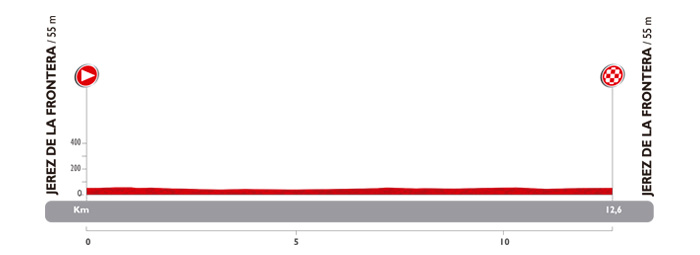
The 2014 Vuelta a España gets underway with a short, flat team time trial in Jerez de la Frontera. At only 12.6 kilometers, the route shouldn’t see any massive time gaps between teams, but motivation to put in a strong ride will still be high; in this Vuelta, which seems likely to be hotly contested, every second will count, and the GC riders will want to get off to a strong start. Moreover, several teams are packing some serious chrono talent and will have their sights set on showing off their ability against the clock in the opening stage of the race.
One such team looks to be the top favorite for this TTT. Fabian Cancellara headlines a powerful Trek squad loaded with talent that also includes Jesse Sergeant, Kristof Vandewalle, and Bob Jungels. That’s a lot of firepower. They’re a little light on cumulative experience with so much youth in the team, but this is a goal for Trek and they have the talent to go for the win.
OPQS should contend for stage victory as well. They will be led by World Champ Tony Martin and the team will be driven to put Rigoberto Uran, suddenly a top-notch chrono rider in his own right, into a good position on GC.
Sky has a number of workhorse time trialists to help place Chris Froome (obviously a stellar time trialist himself) into a good spot on the leaderboard on the first stage, and it would be a surprise to see anything other than a great performance from them on Stage 1.
BMC and Movistar are also well-staffed for a race against the clock and could be in the mix for stage honors. Orica-GreenEdge is without a number of their stronger time trialists in this Vuelta, but Brett Lancaster, Cam Meyer, and Michael Matthews (very fast in a short time trial) should give them a shot at a good result.
While they aren’t on the same level as Trek, Giant-Shimano could surprise some people on Stage 1. They have several young chrono talents in Lawson Craddock, Chad Haga, and Tobias Ludvigsson that will be able to drive a high pace on the stage. Cannondale is another team that could outperform expectations; a shorter time trial like this suits a number of their riders.
VeloHuman Stage Favorites
1. Trek Factory Racing | 2. Omega Pharma – Quick-Step | 3. Team Sky
Be sure follow @VeloHuman on Twitter for live commentary of this and every stage of the 2014 Vuelta a España! The next preview will be up after the conclusion of Stage 1, so stay tuned. In case you missed it, the overall race preview can be found here.
The third and final Grand Tour of the 2014 season has arrived and it should be quite the event. The Vuelta a España has a reputation as an opportunity for riders who have missed out on earlier season goals to take one last shot at glory in a major stage race. With injuries derailing the plans of so many of the sport’s biggest names who had been targeting other races on the calendar in 2014, that reputation will be taken to a new level in the year’s edition of the Vuelta. The startlist is overflowing with talent, with past winners of the General, Points, and Mountain Classifications of all three Grand Tours and multiple past World Champions in attendance. It’s shaping up to be a star-studded showdown.
The Route
The parcours of the 2014 Vuelta looks to be a bit less challenging than several recent editions have been, but that may only lead to a closer GC battle and more competition for bonus seconds at stage finishes. Most of the stages likely to have major GC implications sit roughly in the middle of the three-week period. That means that those who have arrived a bit off of peak form will take every available opportunity in the opening stages to ride themselves into shape before the real mountains appear. Once they do, the GC battle will be on, and with a few consecutive days of decisive racing packed into the second week, things could start to shape up long before the final stages of the race are underway. Still, the Tour de France should serve as a reminder of just how difficult Grand Tour racing can be, even on the stages that don’t look likely to shake up the GC, and even if the leaderboard looks set by the time the third week is in full swing, there are no guarantees in this sport; the riders will have to maintain focus all the way to the finish if they want to come out on top.
The Vuelta opens with a short, flat team time trial that is unlikely to have too big an effect on the General Classification. Stage 2 shouldn’t be much more eventful for the red jersey hunters. Stages 3 through 5 have a few hills along the way or at the finish line that could make for interesting stage battles, but probably won’t affect the overall leaderboard.
Stage 6: Benalmádena › La Zubia (167.1 km) – The Alto Cumbres Verdes that closes the stage isn’t a legbreaker, but it will offer the first real battleground for the climbing specialists in this Vuelta.
Stage 6 presents the first real mountain challenge of the Vuelta, with a summit finish. A 4.6 kilometer climb at an average gradient of 7.8% won’t decide the Vuelta by any means, but it will at least be a chance to see who is on strong form in this race. Stage 7 has hills throughout but nothing that will challenge the GC men, and the breakaway artists and more punchy riders will look to pick up a victory, while Stage 8 is almost guaranteed to end in a sprint.
Stage 9, the final stage before the first rest day of the Vuelta, will offer a major mountain showdown, finishing with the double challenge of a Cat. 2 climb followed almost immediately by a Cat. 1 summit finish.
Stage 10 (ITT): Real Monasterio de Santa María de Veruela › Borja (36.7 km) – A long downhill section will favor the powerful chrono specialists and could contribute to significant gaps among the GC riders.
Following their day off, the peloton will take on a stage likely to have a major impact on the overall outcome of the Vuelta: a 36.7 kilometer time trial. After an early Cat. 3, the remainder of the parcours is downhill, which will allow the real power specialists to put their skills on display, and could lead to significant gaps on the GC leaderboard. There won’t be much time for the red jersey seekers to rest after the chrono, with another mountaintop finish waiting on Stage 11.
Stages 12 and 13 should go to those riders who have come to the Vuelta looking for stage victories, but Stage 14 kicks of a trio of tough mountain days, with a difficult parcours that includes two Category 1 climbs (include the La Camperona summit finish). Stage 15 and the challenging Lagos de Covadonga climb come next, before a brutal Stage 16 that includes four Category 1 climbs, including the arduous La Farrapona climb to the finish line, 16.5 kilometers at an average gradient of 6.2%.
After a welcome rest day, a flat Stage 17 will provide the sprinters with another shot at victory. Stage 18 ends with a Cat. 2 climb that the puncheurs will love, while the a late hill on Stage 19 could set up a showdown between fast finishers and explosive opportunists.
Stage 20: Santo Estevo de Ribas de Sil › Puerto de Ancares (185.7 km) – The challenging Puerto de Ancares climb will offer a final opportunity for the uphill specialists to put their talents on display in this Vuelta.
The Puerto de Ancares climb that closes out Stage 20 will offer a battleground for a final mountain showdown among the GC contenders. It’s a harsh 12.7 kilometer ascent that averages 8.7% and includes several long stretches with gradients well over 10%. If the Vuelta hasn’t been decided already, this will be the site of a furious uphill battle.
The final stage of the Vuelta a España is a flat, 9.7 kilometer time trial that will offer those who specialize in short chronos a chance to shine on a big stage. The overall contenders will be on their toes, but only the slightest of GC gaps will be under threat with such a short route.
The General Classification Contenders
The startlist is full of GC talent, with several riders who could conceivably win this race. Many of the biggest names come with question marks. As such, it’s hard to call any one rider the out-and-out favorite to take this Vuelta a España. Still, a few riders stand out above the competition as the most likely contenders, with two in particular in a class of their own: Chris Froome of Team Sky and Nairo Quintana of Movistar.
Froome’s all-round talent speaks for itself. The winner of the 2013 Tour de France is one of the world’s best climbers and also an elite time trialist. At his best and most motivated, he is rarely defeated in a stage race. It doesn’t seem likely motivation will be much of a problem here: having dropped out of a Tour de France in which he was the favorite for a repeat success, this is the last real opportunity for both Froome and his mighty Team Sky to get any major results out of a season they entered with high expectations. Form is the only real question mark for Froome. He was back on the bike pretty quickly after injuries forced him out of the Tour, but it’s not easy to build a season around a race in July only to switch goals and hope for peak form in August and September. On the other hand, if the last three years are any indication, perhaps the biggest predictor of success in this race is a lack of Grand Tour mileage earlier in the year: for each of the past three winners, the Vuelta was the only three-week race undertaken that season. Froome’s very early exit from the Tour could leave him fresher than many of his top rivals in this race who already have a Giro or Tour under their belts. He also has multiple Grand Tour Top 10 finisher Mikel Nieve as a strong second, along with other reliable supporters like Phil Deignan (who has had a nice year for Sky), Dario Cataldo, Peter Kennaugh, and Vasil Kiryienka.
Nairo Quintana put his uphill mastery on display in last year’s Tour de France, climbing his way to 2nd place in that race despite not even being team leader at the start. He followed up that excellent performance with a victory at the 2014 Giro d’Italia, where he was clearly the strongest rider, overcoming an early illness to win rather handily. He has made big strides a time trialist over the past season, developing into a more complete rider every day, and he showed by winning the Vuelta a Burgos that after an extended break from racing following the Giro d’Italia, form isn’t an issue. The Giro mileage is there, but Quintana has obviously had time to recover, and he’ll benefit from an always powerful Movistar lineup. Alejandro Valverde makes the start as well, and while his disappointing 4th in the Tour de France (despite the absence of Contador and Froome) would suggest that his days of challenging for Grand Tour victory are coming to a close, especially with the added fatigue of having just raced in one, he’s still a consistent performer in three-week races who seems likely to put in a Top 10 result. The ability to launch a two-pronged assault on the steep stuff makes Movistar a very dangerous team, even if Froome is at 100%.
Katusha’s Joaquim Rodriguez had high hopes for this season, and everything looked to be going according to plan when he won the Volta a Catalunya, but injuries sustained in a nasty crash at the Giro derailed his campaign there and knocked him out of competition for a while. He decided to use the Tour de France as an opportunity to ride back into form (it should be noted that riding one Grand Tour as preparation for another is a rather unconventional plan these days), and though he was unable to come up with any big results in that race, he showed with a podium performance in the very challenging Clasica San Sebastian that followed that he was rounding into shape. With bonus seconds likely to be of some importance in this Vuelta, this is an excellent parcours for Rodriguez, who can hunt mountain bonus seconds better than most, a trait that will help him challenge for the win in his home Grand Tour. Trusted lieutenant Daniel Moreno is here as well. He has not had as strong a year as he had in 2013 (when he was 10th in the Vuelta and racked up several victories on the season), but he did just put in a great ride at the Vuelta a Burgos, finishing only 3 seconds behind Quintana on GC. Like Rodriguez, Moreno has a lot of punch in the hunt for time bonuses, and in addition to acting as Purito’s top teammate, he could land a decent overall result himself.
The nasty tibia fracture he suffered in the tenth stage of the Tour de France puts Alberto Contador a bit further down in this preview than he typically merits in a Grand Tour pre-race discussion, but he’s stil certainly worth mentioning. At full strength, he’s unmatched on the climbs and strong against the clock, and he possesses the killer instinct to deliver when the stakes are high. Unfortunately, he’s not likely to be at full strength, as an injury like the one that forced him out of the Tour is not quickly overcome. Still, Contador was flying in the run-up to the Tour and he will be highly motivated to put whatever remains of that form to good use. He has said he is targeting stage wins in this race, but Contador isn’t the type to back down if he should find himself still in the mix for GC as the race drags on. If he does manage to recover his strength and get involved in the battle, he’ll obviously be a top conteder. That’s a big ask, and as it stands, he’s certainly not the favorite he might be without the recent injury, but he also can’t be counted out.
Rigoberto Uran of OPQS showed his top-notch climbing legs and explosiveness on the way to a 2nd overall finish in the 2013 Giro, but he reached a new level as a GC rider this year, flashing great ability against the clock. Form is a question mark, as he was a bit off the pace in the recent Tour de l’Ain, his first race back from a long post-Giro break, but he has a history of performing well even after long periods out of competition. Uran has the talent to battle it out for the podium. He has a great team backing him too, with Wout Poels, who was brilliant in support of Uran in the Giro, on the squad as well. Don’t be surprised to see Poels looking for opportunities to succeed on his own either.
Last year’s winner Chris Horner, now riding for Lampre-Merida, had another difficult start to his season after being seriously injured when hit by a car while training. He was unable to follow up his strong 2013 finish with any big results in the early part of this year, but he looked strong in the Tour de France, where he rode in support of Rui Costa while still getting back to his best. He certainly looked to be closing in on that top level with his 2nd overall in the recent Tour of Utah. He’s another year older but that doesn’t seem to make much of a difference with Horner, who proved in last year’s race that he should not be underestimated when the road goes up. Lampre has a very nice squad of support riders and potential alternatives with Przemyslaw Niemiec (fresh off a 5th overall in Poland), Damiano Cunego, and the underrated Jose Serpa.
Update: In accordance with the rules of the MPCC, of which Lampre-Merida is a member, defending champion Chris Horner has been withdrawn from the Vuelta startlist due to low cortisol levels.
Giro 3rd place finisher Fabio Aru leads a strong Astana team. He thrives in the high mountains, and although this parcours may not have the grueling climbs of the Giro, Aru has the skillset to benefit from bonus seconds as well. The biggest concern for the 24-year-old will be staying strong throughout all three weeks: he has never raced two Grand Tours in one year, so it’s unclear how his body will respond. If he can hold up over the course of the Vuelta, he’ll be a dangerous contender. Tanel Kangert and rising talent Mikel Landa will also make the start.
Garmin-Sharp has several GC options. Explosive climber Dan Martin had designs of Giro glory, but crashed out on the very first day. In fact, the list of big races over the last two seasons in which Martin has crashed or come down with illness is surprisingly long. However, Martin was always planning to ride this Vuelta, and having crashed out of the Giro before finishing a single stage, he comes into this race with the major boon of not having finished another GT so far this season. It’s a good route for him, and he showed excellent form in the recent Tour de l’Ain, so if he can stay healthy for three weeks, a strong performance could be in the cards. Garmin-Sharp also sends 2014 Giro Top 10 finisher Ryder Hesjedal, who could put in a decent ride, as well as Andrew Talansky. Talansky is supposedly riding the race in support of his teammates, having withdrawn from the Tour following several crashes, but he’s been hot this year and he’s been 7th in this race in the past, so it’s not out of the question that he puts in a GC challenge in 2014.
With fewer truly brutal climbs than typically feature in the Giro or the Tour, this is a nice parcours for Belkin’s Wilco Kelderman, a strong time trialist who also has the ability to pick up bonus seconds in group finishes. The question for Kelderman will be whether he is strong enough yet (at just 23-years-old) to ride well through the second half of a Giro-Vuelta double. He was on good form at the Tour of Utah and certainly has the skillset to battle among the Top 10. Robert Gesink is another great option for Belkin. Having missed a large portion of the season with heart problems, Gesink showed good form in Poland and, of course, he doesn’t have any Grand Tour miles in his legs yet this season. This is a nice opportunity for him to get back into the mix. Laurens Ten Dam is here as well, coming off a nice 8th overall in the Tour de France. He might still have something left in the tank to challenge for the Top 10, and at the very least he’s an excellent teammate for the mountains.
AG2R sends Carlos Betancur, who spent months out of competition after the Ardennes Classics and did not look on form in his recent run at the Vuelta a Burgos. He has a lot of ground to make up if he wants to be in the conversation, but on raw talent he’s one of the best riders in the race and is worthy of a mention. BMC sends the one-two punch of Cadel Evans and Samuel Sanchez. Both are obviously well past their primes, but on a somewhat tamer course like this, and still packing strong finishing kicks for bonus seconds, both could have a shot at good results. FDJ’s Thibaut Pinot makes the start following his stellar Tour de France, but maintaing his great form all the way through a podium performance at the Tour and into this race isn’t easy, and he has said outright that he’s hunting stage success and possibly the King of the Mountains jersey. Still, he’s worth keeping an eye on.
Giant-Shimano’s Warren Barguil made the 2013 Vuelta his coming out party with two stage wins, and now he returns with even bigger aspirations. He has not landed many big results yet this year but he was climbing well at the Tour de Pologne and he has a strong team of young, talented all-rounders (like Lawson Craddock and Chad Haga) around him. Coming into the race fresh and without any Grand Tour mileage this season, Barguil could put in a good ride. Orica-GreenEdge enters uncharted territory in this race; for once, they have a rider with some GC potential in Johan Esteban Chaves. A terrific climber, Chaves has taken stages in the Tour de Suisse and the Tour of California this year, and he has the talent to land a decent result.
Lotto Belisol appears to be backing Maxime Monfort for GC; Jurgen Van Den Broeck is on the startlist but it seems likely that he’ll be in the hunt for stages rather than mixing it up on GC. Trek has a lot of firepower in the race, and they aim to support Haimar Zubeldia as their GC rider over other talents (like strong climber Julian Arredondo) in the squad. Actually challenging for the podium may be too much to ask for Zubeldia, but he has a knack for landing Top 10 results. Cofidis’s Daniel Navarro, FDJ’s Kenny Elissonde, MTN-Qhubeka’s Sergio Pardilla and Louis Mentjes, and Caja Rural’s David Arroyo are other outsiders who will hope to be in the mix for General Classification.
The Stagehunters
The quality of riders looking for stage wins in this race is also particularly high. Nacer Bouhanni, Giro Points Classification winner and, more recently, winner of a stage at the Eneco Tour, will hope to pick up more 2014 victories in the sprints. Peter Sagan, John Degenkolb, and Michael Matthews are all in attendance as well, and they’ll look to challenge Bouhanni for the flatter bunch finishes and fight it out amongst themselves when the tougher profiles leave the heavier sprinters behind. We should be in for some great battles between the three versatile riders on the hillier stages. I like Degenkolb a lot in this race; when healthy, he’s been very fast this year, and he’ll be highly motivated after being slowed by an injury in the Tour.
Other sprinting talents making the start include Tom Boonen, Roberto Ferrari and Maximiliano Richeze, Yauheni Hutarovich, Moreno Hofland, Daniele Bennati, Gerald Ciolek, Andrea Guardini, Jens Debusschere, Fabio Felline, and Matteo Pelucchi. Philippe Gilbert will likely be in the mix on the flatter stages, and he’ll obviously be a top candidate to battle it out with the GC men for the shorter uphill finishes.
It’s worth noting that while most of the top fast men are likely to at least put up decent showings in the Points Classification, the Vuelta points jersey quite often goes to a climber thanks to the number of uphill finishes and an equally weighted points system regardless of the profile. Sagan, Matthews, Degenkolb, and Bouhanni (in that order, in my mind) all have a shot, but one will have to rise well above the others to make a legitimate run at a classification more likely to be won by the uphill specialists with the explosiveness to pick up stage wins.
Several great time trialists are in attendance hoping to pick up victories with two individual chronos on the menu. Fabian Cancellara and Tony Martin headline the list, with the extremely talented Adriano Malori also among the best riders against the clock on the startlist. In addition to the many names with good time trialing ability already mentioned in the GC section of the preview, we’ll probably also see Kristof Vandewalle and Bob Jungels (who talked to VH this week about his goals for the Vuelta), Rohan Dennis, Jesse Sergent, Manuel Quinziato, and Brett Lancaster shining in the ITTs.
Many of those strong solo artists are also likely to be protagonists for long-range success in the breakaway-friendly intermediate stages, along with versatile riders like Luis Leon Sanchez, Nathan Haas, and Adam Hansen. Julian Arredondo headlines a list of climbing specialists who are ostensibly here for mountain stage wins and should be given some freedom to get up the road once they’ve dropped from the GC leaderboard. Along with whoever among the aforementioned GC riders resorts to hunting stages after falling out of contention for the overall, Adam Yates, Alessandro Di Marchi, Amets Txurruka, and Yuri Trofimov are others who could fight it out with the red jersey hunters for stage honors in the mountains.
VeloHuman Favorites
General Classification
Winner: Chris Froome Podium: Nairo Quintana, Joaquim Rodriguez Other Top Contenders: Rigoberto Uran, Alejandro Valverde, Fabio Aru, Wilco Kelderman, Daniel Martin, Daniel Moreno, Alberto Contador
Points Classification
Winner: Joaquim Rodriguez
VeloHuman will be previewing every stage of the 2014 Vuelta a España, with profiles, favorites, and outsiders for every day of racing. The preview of Stage 1 is already up! There will be plenty more commentary and analysis on Twitter, so be sure to follow @VeloHuman if you haven’t already.
-Dane Cash
Photos by Tom Raftery, Manuel Quiroga, and Gerben van Heijningen.
The WorldTour returns to the land of the Spring Classics for one week in August, and that week is upon us: the 2014 Eneco Tour is here. A seven-day ride through Belgium and the Netherlands, the Eneco Tour was for many years a race decided almost exclusively by one day of time trialing, but recent years have seen more and more challenges added to the parcours to guarantee that the battle for General Classification rages across the whole week. With classics specialists having a chance to show their strength one last time on the WorldTour calendar and several riders nearing peak form for the upcoming Vuelta, competition tends to be fierce, and the 2014 edition should continue the trend.
The Route
The first two stages take place on mostly flat profiles that aren’t likely to shake up the General Classification. Stage 3 is a short (9.6 km) time trial that certainly will; however, this is not the Eneco Tour of old. Strength against the clock will always be important in a weeklong race with a chrono stage and no real mountains, but there are enough challenges in this year’s Eneco Tour to make the fight for overall victory a much more drawn-out affair.
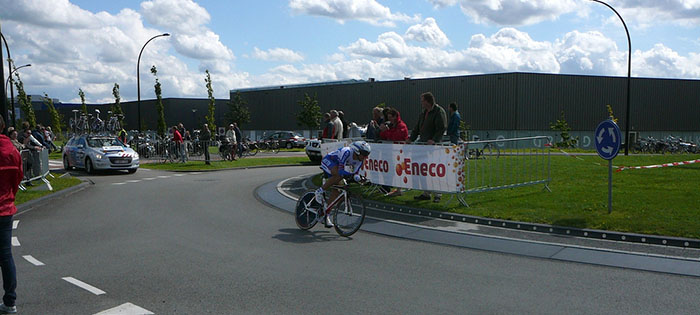
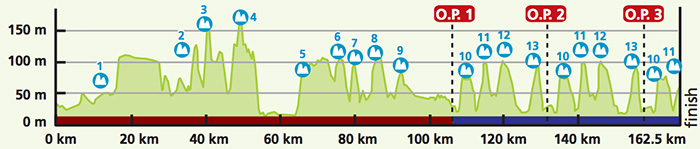
Stage 5: Geraardsbergen › Geraardsbergen (162.5 km) – It isn’t as long as De Ronde, but the Eneco Tour’s fifth stage visits many of the same challenging landmarks.
Stage 4 takes place in the same region as the spring’s Gent-Wevelgmen, traversing some of the same roads. Fittingly, the next stage will put the peloton through a number of difficult tests made famous by the Tour of Flanders. With two full climbs up the legendary Muur van Geraardsbergen before finishing there after 160 kilometers (with visits to other familiar Ronde climbs, like the Kruisberg and Bosberg, along the way), Stage 5 is a very difficult day that is certain to play a major role in the General Classification of the Eneco Tour.
Stage 6 offers no respite: with nonstop steep climbs all the way from start to finish, including multiple trips up and over La Redoute, one of the toughest challenges of April’s Liege-Bastogne-Liege, it will bring the punchy climbers to the fore. The seventh and final stage of the race is yet another day of nonstop climbing, as the Eneco Tour culminates with a visit to Amstel Gold Race country and many of the same short, steep climbs (though not the Cauberg) that feature in that event. While the weekend of familiar challenges won’t present the riders with any single stages nearing the length of the grueling spring classics, several consecutive very difficult days will guarantee some serious selection on the GC leaderboard.
The General Classification Contenders
Zdenek Stybar returns to the race as the defending champion, with the always impressive Omega Pharma-Quick Step squad backing his campaign for a repeat victory. Strong in the time trial, capable on the shorter climbs, and even handy in a sprint for bonus seconds, Stybar has the versatile toolset to compete, though this edition of the race is even harder than last year’s and uphill ability is at an even higher premium. However, the Czech star showed his climbing mettle in the 2013 Eneco Tour, putting in his best work on the very hilly stages, and he put his climbing form on display as recently as last weekend when he landed 10th the Clasica de San Sebastian. Still, while he put in Top 10 performances in both Milano-Sanremo and Paris-Roubaix in the spring, Stybar has not landed as many big results so far this season as might have been expected, and these climbs will really put him to the test. In short, it will be a challenge holding on to his title against some very dangerous rivals. OPQS does have plenty of strong, versatile lieutenants to put the pressure on from all angles, with the likes of Niki Terpstra and Matteo Trentin (among others) in attendance and capable of getting in to the mix on all kinds of different terrain.
2013 runner-up Tom Dumoulin is an elite time trialist who may lament the fact that the chrono stage is 3.6 kilometers shorter in this year’s race, but he’s also a strong climber who should appreciate the climbing challenges that await. 2nd to Tony Martin in Stage 20 ITT in the 2014 Tour de France, he’s on sharp form this summer. He’s also shown a bit more explosiveness this season, which will be a major asset here. His skillset puts him in an excellent position to better his result from last year. Hilly parcours specialist Simon Geschke will be an excellent second.
Sky’s Geraint Thomas has all the skills necessary to fight for the top step on the podium. He has not had much of a break from racing since winning the Bayern Rundfahrt at the beginning of June, but it’s hard to draw up a better parcours for a rider who combines cobblestone prowess with good climbing legs and a particular affinity for short time trials. If he can hold on to top form all the way through the race, he will be very hard to beat. Teammate Edvald Boasson Hagen is actually a two-time winner of the Eneco Tour, but the recent increased focus on uphill tests do not favor his toolset as much as past editions did, and he may be hunting stages and playing lieutenant in this year’s race. Ian Stannard has finally returned from his long break following a serious injury suffered in the spring, and Sky will be glad to see him back on the bike in the WorldTour’s return to the Low Countries.
BMC’s Philippe Gilbert was running well in the 2013 edition before a crash forced him to abandon the race. He’s been dealing with illness recently but his top-notch performance in the RideLondon Classic suggests that he’s back to full strength and ready to contest the 2014 edition of this race. He excels in the shorter time trials, and with the Ardennes-style final two stages, I like his chances to stand on the overall podium. As is standard operating procedure for such a powerhouse team, BMC has plenty of other options: Greg Van Avermaet showed excellent form with an 8th place finish in a very difficult Clasica de San Sebastian, and the sort of climbing chops required to land a good result in that race will be crucial for the last few stages of the Eneco Tour. New acquisition Rohan Dennis, a good climber with an elite time trial, could also try to get into the mix, and Steve Cummings, great in the short chronos, is yet another option, having a strong season so far.
Trek’s Fabian Cancellara is on the startlist after cutting his Tour de France campaign short to prepare for later season goals. Despite its classics-season feel, this has never been a race he’s targeted, and it’s hard to say where it ranks on his list of 2014 goals. As the sport’s most dominant classics rider right now, Cancellara will obviously be among the top favorites if he has the form and drive to hunt for the overall victory. It’s hard to see past him whenever the Muur van Geraardsbergen is involved. His classics prowess hasn’t extended into Ardennes results in his career, but he can usually handle some short climbs, and he’s obviously a top candidate in the time trial stage. Stijn Devolder is always a dangerous teammate.
Belkin’s Lars Boom has had a great deal of success in the Eneco Tour in the past, winning in 2012, but the parcours is no longer one that suits his style quite as well, and the last two stages will be a major challenge. Bauke Mollema may be the GC rider of choice here, given the back-to-back Ardennes-like stages that close out the race. 2nd in San Sebastian, he’s clearly carried some strong form out of the disappointing Tour de France, and his underrated sprinting ability will be a major asset in a race where bonus seconds often play a significant role in the GC results. Sep Vanmarcke is also on the startlist; the parcours is probably a bit bumpy for him, but he proved in the Tour de France that he doesn’t mind a few climbs. Garmin-Sharp has Ramunas Navardauskas and Sebastian Langeveld, the former very strong in a short time trial and on up-and-down profiles, the latter a proven classics talent who was 3rd in this race back in 2009. Lotto Belisol’s two-pronged attack of Jelle Vanendert and Tim Wellens will love the look of the final two stages and could surprise some people. Bjorn Leukemans of Wanty-Groupe Gobert has a knack for landing good results on this sort of terrain. OGE’s Jens Keukeleire is a rising classics talent who could be in the mix, while teammate Michael Hepburn will likely spend at least a little time near the top of the GC leaderboard given the early position of the time trial in the race. Peter Sagan initially seemed set to participate (and contend) in this race, but he is no longer on Cannondale’s roster to make the start; Moreno Moser looks to be the team’s main hope on this parcours.
The Stagehunters
In a race without any real mountains, so many riders who spend most of their stage-racing days hunting stage victories have a rare real shot at the General Classification (and are therefore among the many aforementioned potential overall protagonists), but there are still a few sprinting heavyweights and time trialing specialists yet to be mentioned who will be searching for individual wins in the Eneco Tour.
The list of strong sprinters includes Lotto Belisol’s Andre Greipel, FDJ’s Nacer Bouhanni, Giant-Shimano’s Luka Mezgec, Lampre-Merida’s Sacha Modolo, and Trek’s Giacomo Nizzolo as likely contenders for a bunch gallop. Tyler Farrar, who did not look great in the Tour of Poland but who tends perform well in the Low Countries, Matti Breschel, OGE’s Leigh Howard and Matt Goss, Movistar’s JJ Rojas and JJ Lobato, Barry Markus, Andrea Guardini, Bryan Coquard, and Tom Boonen could also feature in the sprints.
Plenty of strong chrono riders were already named as possible GC contenders, but watch out for Alex Dowsett, Patrick Gretsch, Jesse Sergeant, and David Millar in the ITT as well.
VeloHuman Top 10 GC Favorites
Winner: Tom Dumoulin Podium: Zdenek Stybar, Philippe Gilbert Other Top Contenders: Geraint Thomas, Greg Van Avermaet, Fabian Cancellara, Bauke Mollema, Ramunas Navardauskas, Rohan Dennis, Jelle Vandendert
As usual, I’ll be tweeting plenty of live analysis during the race, so follow @VeloHuman on Twitter to stay connected. Also, be sure to come back soon for more previews, interviews, and analysis: the Vuelta a España is right around the corner!