After two comparatively easy days, the Vuelta a España peloton returns to the mountains for Stage 14.
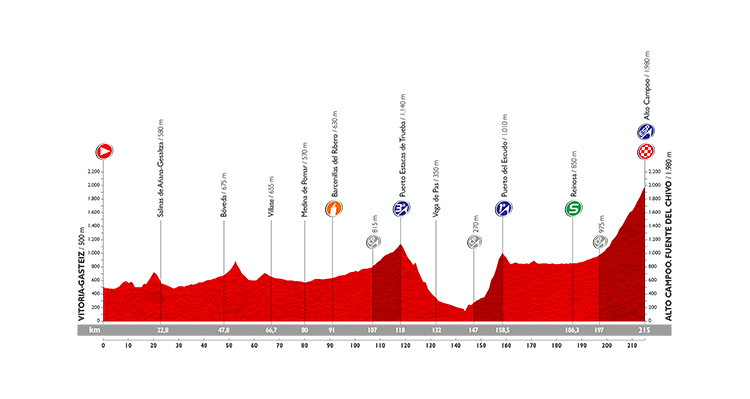
It’s a long one at 215 total kilometers, and though it opens with 80km without categorized climbs, things get pretty tricky after that.
At around kilometer 80 the road angles upward gently for 27 long kilometers into the foot of the first categorized climb of the stage, the Cat. 3 Puerto Estacas de Trueba. Officially the climb is only 11km at 2.9%, but taken with the uphill stretch prior to the categorized section it’s nearly 40km of climbing. The average gradient across that entire span may be less than 2% but that is still a very long time to be going upward.
The Cat. 3 summit is followed by a fast descent into the foot of a Cat. 1, the 11.5km Puerto del Escudo. The average gradient of 6.4% doesn’t really tell the whole story—the first 4km are not very steep but then the road kicks into the double digits for several prolonged stretches.
From the top of the Cat. 1 the riders will take a very brief downhill and then a long flat stretch before starting the final climb, the special-category 18km Alto Campoo, which has an average gradient of 5.5%. Again, the early slopes are relatively easy but the climb gets harder as it goes on.
Stage 14 is very long, and the three categorized climbs will be tough enough to put plenty of hurt into the legs. The profile, as with any mountainous profile, will give the breakaway a chance, especially if the GC riders are less inclined to ride a hard tempo with two more mountain stages ahead. On the other hand, the pace in the pack is likely to pick up on that long late flat section in preparation for a long final climb, which could doom a move up the road. With a few stages that could appeal more to the breakaway coming up, some long-range specialists could opt to keep the powder dry.
Among the GC riders in the race, Fabio Aru looks the strongest right now, and his team packs serious punch. If Aru wants to gain time on his rivals, he should be able to pull it off, as he’s just looked that good so far. However, with the overall victory very much in his reach, Aru could be focused entirely on the two riders within a minute of his lead, and that could open the door for others.
Rafal Majka has looked strong on every summit finish of the Vuelta so far. He’s currently sitting 4th overall, and while his deficit to Aru is not so great that Astana will just let him get up the road without a thought, he may be able to land an attack if there is any hesitation while Aru watches those closer to his lead. This is a great finishing climb for Majka, who might be just a bit behind some of the top GC men on the extreme gradients, but who is excellent in a sustained attack from a few kilometers out.
Joaquím Rodríguez needs to get moving if he wants to have a chance at winning the overall Vuelta title. Currently 2nd overall, this may be the best chance he’s going to get at a Grand Tour victory for the rest of his career. He has looked strong so far, though not dominant. He’s the most explosive rider within striking distance of the overall title, though, and if he can team up with Daniel Moreno to launch a move on this final climb, he’s got a shot at stage success.
Esteban Chaves, a bit further down on GC now, should have plenty of freedom to go hunting for another stage win. Alejandro Valverde has not looked at his best in the past few stages, but if he can recover some strength, he’s an obvious candidate for stage success now that he, too, is less of a GC threat. Movistar will want to do everything possible to get another stage win out of the Vuelta with sickness laying Nairo Quintana low.
Mikel Nieve is Sky’s best hope of coming away from the Vuelta with a result and he should get some breathing room. This climb suits him well.
It’s going to take a strong climber to win this stage from a breakaway, but there are a few good candidates for a successful long-range attack on Stage 14. Rodolfo Torres, Fabio Duarte, Giovanni Visconti, Andrey Amador, Vasil Kiryienka, and Darwin Atapuma are among the riders who could have a chance in that scenario.
VeloHuman Stage 14 Favorites
1. Rafal Majka | 2. Fabio Aru | 3. Joaquím Rodríguez
The Tour de Pologne is the first stage race that follows the Tour de France on the WorldTour calendar. Now in its seventy-first year, it tends to be an exciting and often unpredictable contest, as many riders are coming into the race following La Grande Boucle, hoping to maintain their form for one more week, while others are returning to competition after long midseason breaks, and are therefore in unknown condition. Pieter Weening was the surprise winner of the 2013 edition. Daniel Martin and Moreno Moster both picked up their first WorldTour victories here. Expect more of the unexpected in this year’s journey through Poland.
The Route
The Tour de Pologne opens with several days that aren’t likely to impact the General Classification: the fast men should reign supreme at the beginning of this week of racing. Stage 1 has a few small hills, but it’s not likely to see any significant separation and will probably end in a sprint. Stages 2 and 3 are almost guaranteed to come down to a bunch gallop, while Stage 4 at least closes out with a succession of small rollers to open the door for some moves (though a sprint is again a likelihood).
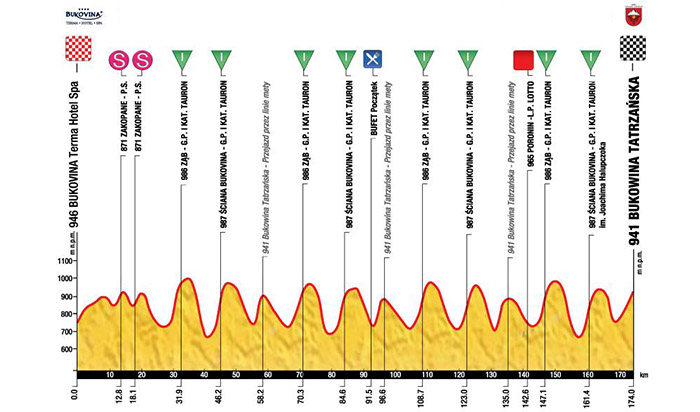
Stage 6: Bukovina Terma Hotel Spa › Bukowina Tatrzańska (174 km) – A constant barrage of tough climbs will guarantee fireworks on the penultimate stage of the race.
Stage 5 will be a jarring transition, with some early uphill challenges and then an arduous skyward trip to the Štrbské Pleso resort that is repeated not once, but twice, with the third and final ascent climbing higher than the first two to a summit finish line. Stage 6 is an even harder day of climbing, with almost no flat sections across 174 kilometers of racing.
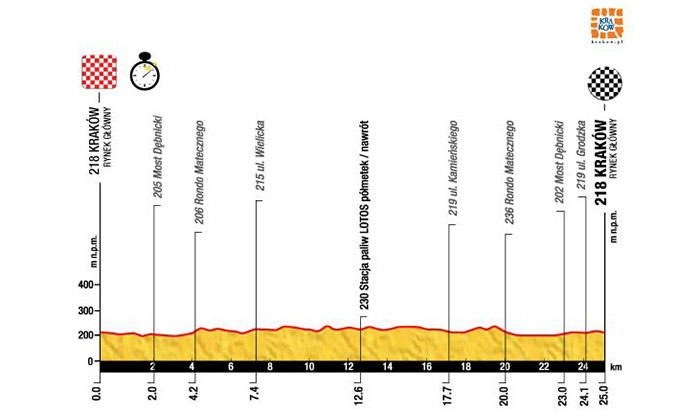
Stage 7 (ITT): Kraków › Kraków (25 km) – The chrono that concludes the race will play a major part in deciding the final General Classification.
The seventh and final stage of the Tour of Poland is a 25 kilometer race against the clock that starts and finishes in Kraków. It’s a mostly flat affair that will really favor the powerful time trialing experts, and it’s likely to play an integral role in deciding the overall winner.
The General Classification Contenders
A few early hills, a pair of tough mountain stages, and a high-speed chrono make this a profile for the well-rounded riders. The the time trial, in particular, will have a big impact on the overall leaderboard: a 25 km ITT may not seem like much, but with only two real climbing stages to open up any serious gaps on GC, it will be a pivotal test for the contenders.
As unpredictable as the Tour de Pologne tends to be, Rafal Majka will enter the race as a top favorite. He’s a star climber who just won two stages and the King of the Mountains classification in the Tour de France, showcasing stellar form right now, but he has also developed considerably as a soloist this year, putting in a ride good for 4th in the Giro’s first (and less climber-friendly) ITT. With the motivation of performing in front of his home crowd, Majka has the tools to better the 4th overall he notched in the 2013 edition of this race.
The winner of that 2013 running of the Tour de Pologne, Pieter Weening, will be another likely protagonist in the GC battle. He’s had an up-and-down year, anonymous in some races but also winning a stage at the Giro d’Italia and the recent Giro della Toscana. When he is locked in, he’s a major talent, and this is a race in which he’s had a lot of success; in addition to his recent overall victory, he also has been 2nd overall and a stage winner in the past. Versatile Cameron Meyer will be a great teammate.
Movistar’s Ion Izagirre was runner-up in 2013 and looks to be on good form right now, having put in a strong ride in support of Alejandro Valverde in the Tour de France. The 25-year-old can deliver a nice time trial and while the high-gradient climbs can be a bit of a challenge for him, the uphill tests in this Tour de Pologne should be within his capabilities. Movistar also has Beñat Intxausti, who has shown immense talent in various races throughout his career (he was 8th in the Giro and outclimbed Rui Costa and Dan Martin to win the Tour of Beijing last year), but who has also been a nonfactor in plenty of races where he might have been expected to thrive. Eros Capecchi (6th in the 2013 Tour of Poland) and Andrey Amador are other options.
Sky’s Dario Cataldo will like the look of the profile. A strong time trialist who is also capable of powering up the less steep climbs quite nicely, he has the skillset to succeed here. Sky is desperate to find a shred of success right now and Cataldo is a tough competitor who came close to delivering results on a number of occasions in this year’s Giro. This could be his opportunity. Kanstantsin Siutsou, great in the ITT, and up-and-comer Sebastian Henao, great on the climbs, are other options.
Trek has a very strong squad for this race, with several potential GC contenders. It will be interesting to see how they play this: Bob Jungels should land a nice result on the final time trial, though the climbs will be a big challenge for him. Giro d’Italia King of the Mountains Julian Arredondo, on the other hand, shouldn’t have much trouble with those climbs, but he doesn’t have much ability against the clock. The same is true for Robert Kiserlovski, 10th overall in this year’s Giro. In other words, depending on how they decide to take on this race, Trek will have the firepower to light up the mountain stages, or to help support their more capable time trialist through them. Given all of the talent in the roster, it seems likely that they’ll have at least one rider in the mix for the Tour of Poland GC.
Wouter Poels of OPQS has an excellent skillset to contend. Known for punchy climbing ablility, he has developed into a good time trialist as well. He was 4th here in 2011 and has had a great year so far. Teammate Thomas De Gendt is another potential protagonist, with a top-notch time trial. He’s been an inconsistent rider on the climbs recently, sometimes showing great uphill form, sometimes struggling mightily, but if he can put together a pair of good days during the mountain stages, he could be in the mix.
Garmin-Sharp’s Ryder Hesjedal isn’t the rider he was in 2012 when he won the Giro, but he did land a decent 9th in that race this year, and followed that up with some strong riding in support of Andrew Talansky during the Dauphine. He hasn’t raced since, but this will be an important step in his Vuelta preparation. 23-year-old Nathan Brown, good against the clock and capable on climbs that aren’t too steep, could be a nice dark horse candidate.
Belkin’s Robert Gesink enters the race with unknown form, without many racing days in 2014 as a result of a heart condition that required surgery in the spring. A great all-round talent when at his best, he will be a rider to watch in this race. It’s hard to say how he’ll do: if the intense training he’s been doing out of competition has pulled him back into form, he’ll could contend here; on the other hand, it wouldn’t be a surprise to see him fall off the pace early.
AG2R’s Christophe Riblon was on the podium of last year’s race, but he’s done very little so far in 2014. He did spend a lot of time putting in work for his teammates in the Tour de France, however, so it wouldn’t be a complete surprise to see him in the mix despite a lack of results this year: he’s obviously a great climber but he’s not bad in the ITT either. Astana’s Fabio Aru established himself as an elite uphill specialist in this year’s Giro d’Italia, but it will be a big ask for him to separate himself enough from the pack on the steep stuff to counteract the inevitable losses in a mostly flat ITT. Janez Brajkovic could be a nice alternative for the team. The chrono will be a major obstacle for Giant-Shimano’s Warren Barguil, but he’s a great climber who should be starting to round into form for the Vuelta. BMC has a very strong nice three-pronged attack in Steve Cummings, Samuel Sanchez, and Peter Velits. Lotto Belisol’s Maxime Monfort, Cannondale’s Davide Formolo, Damiano Caruso, and Moreno Moser, FDJ’s Alexandre Geniez, Lampre-Merida’s Przemyslaw Niemiec (who will try to get something out of this season in his home race after a crash doomed his Giro hopes), RusVelo’s Ilnur Zakarin, and CCC Polsat Polkowice’s Davide Rebellin are other outsiders who could be looking to land a GC result.
The Stagehunters
With several stages likely to end in sprints, the fast men will feature prominently in this race. Lampre’s Sacha Modolo looks to be the class of the bunch (with teammate Roberto Ferrari as a nice alternative), while Belkin’s Theo Bos, Giant-Shimano’s Luka Mezgec, OGE’s Michael Matthews, Movistar’s Juan Jose Lobato, Sky’s Ben Swift (and Edvald Boasson Hagen), and Garmin-Sharp’s Tyler Farrar will be other top contenders in the sprints. AG2R’s Yauheni Hutarovich and Davide Appollonio, BMC’s Thor Hushovd, OPQS’s Nikolas Maes, and Astana’s Francesco Gavazzi will also hope to be in the mix for the bunch finishes.
In addition to the many strong time trialists already mentioned as potential GC contenders, there will be several other chrono specialists in attendance, with Movistar’s Adriano Malori the top name on the list. OGE’s Brett Lancaster, Belkin’s Jack Bobridge, and Giant-Shimano’s Tobias Ludviggson are others with the potential to deliver against the clock.
VeloHuman Top 10 GC Favorites
Winner: Rafal Majka Podium: Pieter Weening, Dario Cataldo Other Top Contenders: Ion Izagirre, Wout Poels, Bob Jungels, Christophe Riblon, Ryder Hesjedal, Robert Gesink, Fabio Aru
As usual, VH will be tweeting plenty of live analysis during the race, so follow @VeloHuman on Twitter for more. Also, be sure to check back in a few days for the preview of the Eneco Tour!
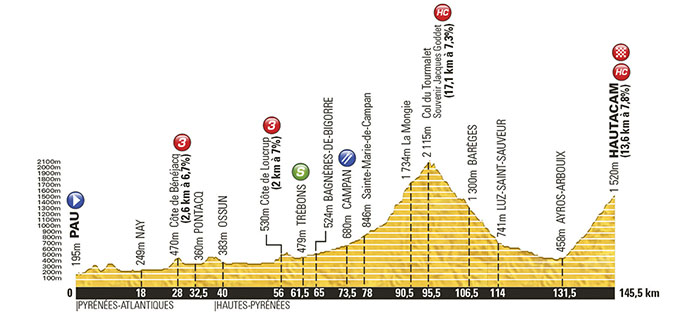
After Rafal Majka’s victorious charge up the Pla d’Adet climb, only one mountain stage remains in the 2014 Tour de France. It’s another very short stage at only 145.5 kilometers, but the profile is daunting. Following a mostly flat first half with only a pair of short Cat. 3s to challenge them, the peloton will reach the foot of one of cycling’s most iconic climbs: the Col du Tourmalet. 17.1 kilometers at 7.3%, the Tourmalet is a mammoth ascent with nowhere to hide, especially after the first 5 kilometers, when things really kick upward (above 8%) and stay there for most of the remainder of the climb. The unforgiving slopes of the Tourmalet will blow the pack apart, but the summit is crested with 50 km still remaining on the stage; from there, it’s a very long, high-speed descent to the bottom of the Hautacam climb. 13.6 kilometers at a 7.8% average gradient, Hautacam has a particularly nasty midsection, with a lengthy stretch above 11%, the perfect launching pad for anyone hoping to put in one last mountain attack in this Tour de France.
Stage 18 is the final chance for the climbers to make their mark on this race. To this point, the hard mountain stages have been dominated by a select group of riders; Vincenzo Nibali and Tinkoff-Saxo have left little glory for the other uphill specialists in the Tour. Hopefully, this last opportunity for glory will provide some very exciting racing. The pack will move at a high speed on such a short stage, and the fight to get out front early will be fierce. The breakaway will have a shot at staying ahead all day, but only if it is composed of some real uphill strength; the GC contenders will most likely set a furious pace up these climbs.
The top favorite for victory on the final Hors Categorie climb of the Tour de France is the race’s best climber, Vincenzo Nibali. He already has three wins to his name, but taking a fourth victory on the last mountain stage of the Tour, and possibly even the polka dot jersey, would really accentuate his utter dominance of this race. He wants the 2014 Tour de France to be remembered as Vincenzo Nibali’s race, not as the race won by Nibali after the abandonment of Chris Froome and Alberto Contador. With a flat day on the horizon and such a comfortable lead, there isn’t much reason not to go full gas on Stage 18, and if the GC men sweep up the day’s break before the Hautacam summit finish, Nibali will obviously be the one to beat for stage honors.
AG2R’s Jean-Christophe Peraud has made his mark over the last few stages as one of the only riders capable of holding Nibali’s wheel when the road goes up. He has an excellent team around him, and he’s just 8 seconds off the podium. Given his strong time trialing ability, 2nd overall may be within his reach. He will be highly motivated, and the day’s two long climbs suit him well. If the GC riders are at the head of the race as the end of the day nears, and if Peraud sees a chance at the stage win, he’s going to go for it: he has had a lot of success in the last few years, notching several high placings in big races, but he’s never actually won a race at the WorldTour level. He’s on the form of his life right now, and this could be his best chance to take that win. I also expect his teammate Romain Bardet to be aggressive on Stage 18, with the fight for the young rider’s classification so close right now. He hasn’t looked as strong as Peraud these past few days, but anything can happen on this final opportunity for the climbers to make their mark.
FDJ’s Thibaut Pinot is Bardet’s main rival for the white jersey. He is also holding onto a very tenuous podium position at the moment. His descending woes appear to be behind him, which is important given the long descent from the summit of the Tourmalet, but he’ll need to put in a top-notch performance going uphill as well if he wants to keep his spot in the Top 3. He is in excellent shape right now and another good day seems likely. Movistar’s Alejandro Valverde is in a similar position: his 2nd overall is threated by a charging Jean-Christophe Peraud, and he’ll need to be at the top of his game to stay where he is on the leaderboard. He struggled on the early slopes of the Pla d’Adet climb, but recovered nicely to finish with Pinot’s group. Unlike those challenging him for his spot on the podium, Valverde has a lot of experience protecting a Top 3 overall position on the final climbs of a Grand Tour. He also has a stellar support squad. If he draws on all of that experience and all of that support, he could be in for a strong day.
BMC’s Tejay van Garderen put in a much stronger performance on Stage 17 than he had on the stage prior, and with that bad day behind him he can look for another nice result here; he’s been a bit more aggressive on the climbs this year than we’ve seen in the past. Belkin’s Bauke Mollema and Laurens Ten Dam both looked okay on the Pla d’Adet and despite being 7th and 8th overall, respectively, they could have some freedom to get up the road given the huge time gap between themselves and those higher up the leaderboard. The same is true for Leopold Konig, in 9th, who, despite having a bad day on Stage 17, has otherwise looked very impressive on the climbs in this Tour de France. In 10th but well out of contention time-wise, Pierre Rolland is nonthreatening enough that he may even be allowed into the early move again. He will be coming off a long day spent out front already, but he’s recovered from tough mountain stages a bit better than you might expect for a rider who has already taken on the Giro this year, and his aggressive style and experience will come in handy on these climbs.
The success or failure of the breakaway will depend largely on the caliber of climbers in the move. Tinkoff-Saxo’s Rafal Majka is one of the highest caliber climbers in the race, but it’s hard to say whether he’ll try to get out front early here. He took the stage victory and a massive collection of KOM points at the summit of the Pla d’Adet, but unfortunately for his polka dot ambitions, Vincenzo Nibali wasn’t far behind, and the race leader is still well within striking distance of the KOM jersey that Majka currently wears. The young Polish climber will need to play Stage 18 just right to keep that jersey. He could get into the break, but having already spent a long day up the road, it’s a lot to ask to go for more long-distance success here; he put in a nice performance on the Chamrousse climb with a late attack after sticking in the pack, and that will be an option on Stage 18 as well. Whatever he decides, Majka will be again be a favorite for stage honors. If Majka doesn’t go up the road, Tinkoff-Saxo may send Michael Rogers in search of a second stage win. When so many familiar breakaway protagonists tried for the long-distance strike on Stage 17, Rogers hung with the pack, and with the energy he saved there, he’s one of the few who might have a chance at winning Stage 18 from afar. Nicolas Roche, who had such a strong ride up the Pla d’Adet, is another long-range option for Tinkoff-Saxo.
Katusha’s Joaquim Rodriguez saw his KOM hopes take a huge hit on the Pla d’Adet, where it was all too clear that he’s still not at his best. However, he has shown enough ability to be considered a dangerous contender if he can get into the breakaway. Even well off his peak form, Purito’s experience alone is enough to keep him in the conversation. More than most, he knows how to win mountain stages in Grand Tours, and as hard as it will be to win this stage with a long-distance strike, Joaquim Rodriguez can’t be counted out. Yuri Trofimov is another option for Katusha.
Sky’s Mikel Nieve spent most of Stage 17 in the bunch and he could be in the hunt from the breakaway on Stage 18, with Geraint Thomas, Richie Porte, and David Lopez as early move alternatives for the team. Europcar’s Tommy Voeckler is another potential long-range protagonist who will be coming off a quiet day. Christophe Riblon, Brice Feillu, Jose Serpa, Chris Horner, Jurgen Van Den Broeck (now almost three minutes outside the Top 10), Alessandro De Marchi, Giovanni Visconti, Steven Kruijswijk, Beñat Intxausti, Ion Izagirre, Frank Schleck, and Haimar Zubeldia are others who might have a chance at stage glory if they launch from afar.
There are only a few stages left in the 2014 Tour de France, but be sure to follow @VeloHuman on Twitter for live analysis of every one of them. Also check out VeloHuman’s brand new Facebook page to stay up-to-date with every post. The next preview will be up following the conclusion of Stage 18.
Lastly, an important note: while the Tour may be nearing its conclusion, VeloHuman is nowhere near done for the year! There are still rider interviews to come and plenty of favorites and outsiders to be named for races like the Vuelta a España, Il Lombardia, and the World Championship Road Race, so even after the last rider crosses the finish line on the Champs-Élysées, stay tuned for a whole lot more in 2014.
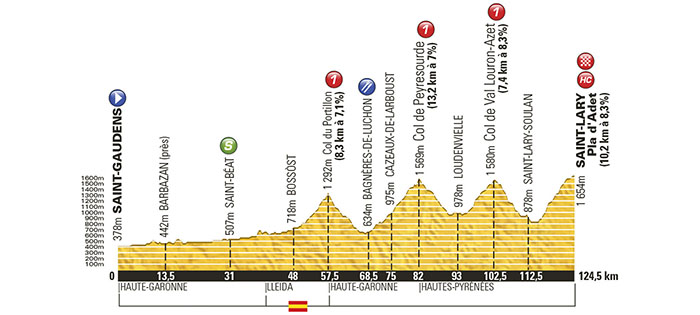
Stage 17: Saint-Gaudens › Saint-Lary Pla d’Adet – 124.5 km
A hard first day in the Pyrenees (won by VeloHuman’s top Stage Favorite, Michael Rogers) dealt serious blows to the podium hopes of a number of riders in this race, but things won’t get any easier on Stage 17. The steak knife-esque profile throws three Category 1 climbs (the second one is particularly brutal, 13.2 km at a 7% gradient) and some tricky descents at the peloton before culiminating in an HC-rated finale, a 10.2 kilometer, 8.3% ascent to Pla d’Adet. The early slopes of this last climb are particularly harsh, with sections hovering around 10%. Overall, Stage 17 is a short one at only 124.5 kilometers, but there will be more than enough challenges on the menu to wear down even the climbing specialists.
At least in terms of stage glory, it could be another day for the breakaway. There is still one more brutal day in the Pyrenees to come, and the GC types may not be that interested in doing any chasing if a big group gets up the road. A constantly up-and-down profile and some positively serpentine roads in the second half of the day will further help the cause of those in the early move. Still, the final climb will be a very harsh test, and even if the survivors of the break have a nice gap at the foot of it, it will be a challenge holding on to the top. Whatever the scenario, an abundance of uphill power will be a prerequisite for success on Stage 17.
With three Cat. 1s and an HC-rated summit finish up for grabs, this stage will be pivotal for those hunting the polka dot jersey. Rafal Majka and Joaquim Rodriguez cannot afford to miss the breakaway. Both kept their powder dry on the very long road to Bagnères-de-Luchon, knowing that this battleground was ahead. Majka proved to be the strongest on Stage 14 and generally looks to be more on-form rider at the moment. He is a true all-round talent, with the uphill ability to handle the steep stuff, the endurance to spend the day out front, and a decent kick, too. Still, Purito is improving every day, and the irregular slope of the final climb is just the sort of challenge he enjoys when he is at his best. Should Majka and Rodriguez both be there at the end of the day, we should be in for an entertaining spectacle. Tinkoff-Saxo has an in-form Nicolas Roche and an obviously strong Michael Rogers as other long-range options, while Katusha could try to put Simon Spilak or Yuri Trofimov up the road as well.
Sky has a lot of options for an attempt at breakaway success: Mikel Nieve is a terrific climber who could attempt the long one here, with David Lopez, Vasil Kiryienka, and Geraint Thomas as nice alternatives. As much of an uphill talent as he is when he’s at his best, Richie Porte at least deserves a mention, in case he recovers from his ailments enough to give this a go. Cannondale’s Alessandro De Marchi has put in some brave long-distance efforts so far and this will be another opportunity to get out front. Lampre-Merida’s Chris Horner is free to go on the move now that Rui Costa is out of the race. It’s hard to say where he is right now in terms of form, but on peak ability he’s obviously a very dangerous rider. Teammate Jose Serpa could also try to get involved in the break, having flashed some nice form on Stage 16. Europcar had a very disappointing first day in the Pyrenees, missing out on the victory despite having two riders in the lead group on the road in the last 10 kilometers, and also seeing Pierre Rolland tumble out of the Top 10 on GC. It’s almost a certainty that they will try to get into the early move on Stage 17, with Rolland now far enough down on the overall leaderboard that he may be given some room. Cyril Gautier and Tommy Voeckler will find this profile to be very challenging but they may give it a shot anyway. Lotto’s Jurgen Van Den Broeck and Trek’s Frank Schleck both lost a lot of time on Stage 16 and could also hope to get up the road to pull back into contention for the GC Top 10. Brice Feillu, Christophe Riblon, Blel Kadri, Steven Kruijswijk, Giovanni Visconti, John Gadret, and Tony Martin are other strong talents who might try to go for this one from afar.
Should the pack make the effort to reel any early attackers back in, Stage 17 will probably come down to a battle royale among the General Classification’s very best climbers on the final slope. The tough uphill tests in the middle of the day will do their damage and could see some contenders fall away, and some tricky descending could contribute to gaps as well, but even if a sizable group reaches the foot of the last climb, it will get blown apart on the vicious gradients. It’s hard to see past Astana’s Vincenzo Nibali on a brutal finishing climb like this. He’s looked bulletproof in this race, and that’s not likely to change here. FDJ’s Thibaut Pinot has emerged as one of the few riders who might have a chance to engage him uphill. With his huge advantage on the leaderboard, Nibali may give Pinot a chance to get up the road towards the end of the day, and the young Frenchman is on the form of his life; he’ll jump at any opportunity to land a result. Movistar’s Alejandro Valverde might also have a shot: if he can hang on at the head of affairs all the way to the top of the final climb, things do flatten out for the final 200 meters, and Valverde is the best sprinter among the top GC men.
A bit further down on the leaderboard, Leopold Konig is not going to trouble any of the top GC contenders, and he has looked particularly strong recently, hanging with the podium favorites on Stage 16. He came close to a stage win when he put in a late attack on the last climb of Stage 13, and he could try to go just that little bit further to victory here. Romain Bardet lost a lot of time on Stage 16 and he may try to claw back some seconds, but he’ll need to recover his form quickly: he did not look good on the Port de Balès. Teammate Jean-Christophe Peraud looks considerably stronger right now. Belkin’s Laurens Ten Dam is one other rider to watch; at 11:12 off the lead, he’s no threat to the anyone in the Top 5 if he should decide to strike ahead for glory late on Stage 17. He appears to be a lot stronger than teammate Bauke Mollema right now.
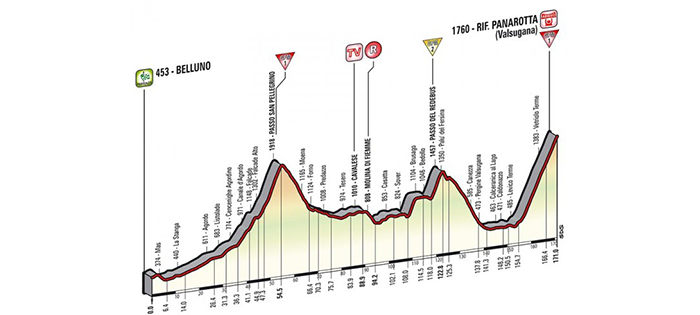
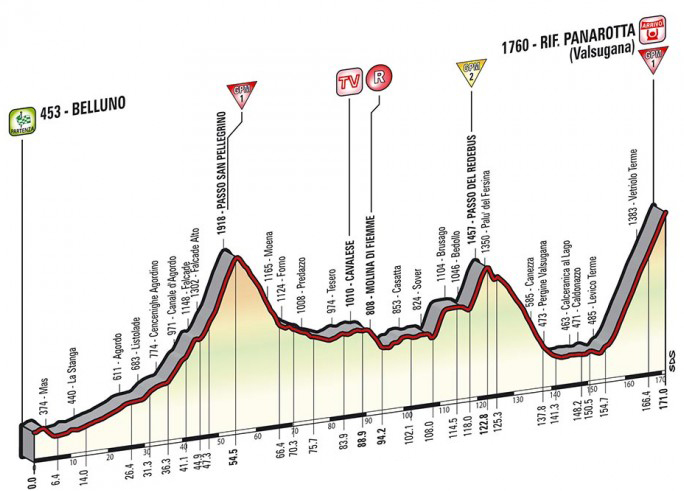
Stage 18: Belluno > Rif. Panarotta (Valsugana) – 171 km
Culminating with the Category 1 Rifugio Panarotta climb, the Giro’s eighteenth stage is sure to offer fireworks. However, with an all-important uphill time trial on the horizon followed by the nasty Monte Zoncolan the day after, the GC contenders may decide to temper their efforts on Stage 18, which could open things up to a breakaway for the second day in a row (Stefano Pirazzi got into the day’s big move on Stage 17 and ultimately took the win). Once again, it wouldn’t make sense to call any one rider the singular favorite, but several riders do deserve to be considered contenders.
The profile is a mountainous one, with the Passo San Pellegrino as the first categorized climb on the menu. It’s a Cat. 1, 18.5 kilometers at an average of 6.2%. While it officially starts some 36 km into the race, by that point the road has already been going uphill, albeit gently, for about 30 kilometers! In other words, the first hour and a half of racing will take a lot out of the riders. From the top of the climb, it’s a descent followed by some ups and downs into the short but steep Passo del Redebus climb. Then comes a long descent and a flat section before the finale, a 15.9 kilometer, 7.9% average gradient ascent to the Rifugio Panarotta.
As difficult as the day looks, Stage 19’s time trial and Stage 20’s climax atop Monte Zoncolan finish may prove more decisive for GC. That could see the main maglia rosa contenders trying to keep their powder dry. On the other hand, Nairo Quintana has a significant GC lead, and his rivals know that their time is running out. Some of them are also probably not likely to fancy their chances against the clock. If they decide to use Stage 18 as an opportunity to take back time, anyone up the road will struggle to maintain an advantage on the final climb; it’s yet another day that, to me, is a tossup to go to the break or to the GC riders.
As the best climber in the race, Nairo Quintana is the first favorite among the overall contenders. As I like to point out in these breakaway-friendly scenarios, I’m not sure I’d bet on him against the field, but given the uncertainty that comes with trying to predict who will make the breakaway, let alone survive out front, his chances are at least as good as any other one rider in the race. His team can drive a very hard pace on the ascents, and even though he is now in the leader’s jersey, I don’t think he will just sit around and let attackers go by him on the final climb. I wouldn’t be surprised if he is driven to extend his lead to quiet critics of his unpopular Stelvio descent.
Astana’s Fabio Aru has had an amazing Giro d’Italia, but with a time trial approaching, he may feel the pressure to make an attack on this stage, and he’s looked strong enough to be a real contender for a victory. Nobody could match him on the Montecampione ascent, and he hasn’t shown any signs of fading. Europcar’s Pierre Rolland could have similar motivation. Time trialing has never been a strong suit. However, after two weeks of being given a lot of a leeway to make attacks due to his relatively non-threatening GC position, Rolland is now a marked man. It will be interesting to see how he responds, and whether he’s able to ride with the big favorites now that he won’t find it as easy to escape from long distance.
At 1:41 down, Rigoberto Uran knows he needs to act, so he could try to put Quintana under pressure here. Domenico Pozzovivo is even further down, making an attack likely. Young guns Rafal Majka and Wilco Kelderman have not been afraid to try late moves when they’ve seen openings. Garmin’s Ryder Hesjedal made huge gains in GC and looked excellent on Stage 16 but, like Rolland, he’ll now find that his rivals won’t give him the same kind of freedom that he’s had up till now. BMC’s Cadel Evans has been losing time in the mountains and he will have his work cut out for him holding onto the final podium spot—this is a steep final ascent.
Should the maglia rosa hunters take a reserved approach, the morning breakaway could stick. A number of strong climbers could be weighing their chances in either scenario. He has not featured as prominently lately as he did in the first several stages, but Trek’s Julian Arredondo cannot sit idle here. There are too many KOM points on offer for him to miss the breakaway. If he can get into the day’s move, he will be a strong contender for stage honors. His countryman Fabio Duarte was 2nd behind Fabio Aru on the Montecampione climb. If he makes the break, he probably won’t waste his energy trying to pick up early mountain points, and that could leave him better prepared for the finale. Team Colombia squadmates Robinson Chalapud and Jarlinson Pantano are further strong options. Katusha’s Daniel Moreno looked very strong on Stage 15 and is running out of chances to get something positive out of this race, so he could try to strike here. Androni Giacotolli’s Franco Pellizotti is in a similar boat.
Other potential long-distance candidates include Sky’s Dario Cataldo and Sebastian Henao, Astana’s Mikel Landa, Lampre’s Przemyslaw Niemiec and Damiano Cunego, FDJ’s Alexandre Geniez, Tinkoff-Saxo’s Nicolas Roche, and Neri Sottoli’s Matteo Rabottini.
Friday’s time trial will have major GC implications, so be on the lookout for the preview after the conclusion of Stage 18. Also, be sure to follow @VeloHuman on Twitter for more analysis during the race.
As exciting as Purito’s second Monument win in rainy Northern Italy was, it wasn’t particularly surprising. Tommy Voeckler tried to make things interesting with one of his characteristic long distance attacks, and at one point he had a fairly decent gap, but his solo move was doomed to fail when the contenders actually decided to chase him down as they closed in on Lecco, and all his grimaces were for naught. From then it was a battle between the favorites who had survived hard climbs and tough conditions, and despite the fact that everyone knew it was coming, Joaquim Rodriguez was able to distance all of them with his own decisive late attack.
Inches away from victory in the World Championship after a nearly successful late uphill strike, Rodriguez was clearly on elite form, and primed for a major win, even if it didn’t come on the World Championship stage. He won Il Lombardia last October, and this year, the external conditions and his physical condition echoed 2012: he shot off the front of an elite group of survivors at the same time as he did last year on the Villa Vergano, and again soloed to the victory in the rain, escaping a spirited pursuit from Alejandro Valverde, Dan Martin, and Rafal Majka.
Takeaways
At 34, it seems like Rodriguez is riding at the highest level in his career, more explosive on the climbs than ever. As Chris Froome is officially out of the Tour of Beijing, the victory in Lombardy gives Joaquim Rodriguez his third WorldTour Numero Uno, and just as he did in 2012, it was a late move on an Italian ascent that nabbed him his biggest win of the year and the overall title. The rider who spent so many years coming up just short in one-day events made it look easy, and expected, on his way to another highly coveted achievement, the top of the rankings.
The other strong performers weren’t all that surprising either, though I’ll make a few brief notes to at least provide a few takeaways other than “Purito is really good, but we knew that already.” For one, Alejandro Valverde has been a hot rider all season, and, like Purito, has stood on the podium in a boatload of huge races: Liege-Bastogne-Liege, the Vuelta a España, the World Championship Road Race, and now Il Lombardia. He took the points classification at the Vuelta for his constant presence near the top of the leaderboard on stage after stage. And yet, Valverde will finish the year without a single WorldTour victory. His showings these past two weekends have typified what was all too common for the Green Bullet this year: he hung at the head of the peloton and made it onto the back of every move except the final, successful, race-winning one, and outsprinted everyone else in his pack of pursuers for 2nd or 3rd. Obviously he still has a ton of talent, but he’s come up just short so many times this year, and it makes me wonder whether he might not have benefitted from taking a few more risks trying to get into late moves or making his own.
Rafal Majka will be a name to watch in 2013. Top 10 at the Giro and on the podium in Lombardy, Majka was one of a group of four riders, the other three of whom have all won Monument classics, who were clearly the best climbers in the race. He turned 24 in September, which means he’ll be 24 almost all of next season, too, and it seems likely that by this time in 2014, he’ll have officially won his first pro race. Saxo Bank has to be excited to have such a talented young rider coming into his own just as their team leader is starting to draw questions. Right behind him, Dan Martin has had a year both immensely satisfying (victories in Liege-Bastogne-Liege, the Volta a Cataluyna, and a stage in the Tour de France) and extremely frustrating (illness derailed his top 10 bid in the Tour de France and he crashed out of the Vuelta a España and the World Championship Road Race). Sunday was a bit of both for the Irish star: with only a few hundred meters to go, the Garmin rider was a sprint against Majka away from a podium spot in his second Monument of the year when a mechanical/crash ruined his shot. He settled for 4th. It was hard to predict his form coming into Lombardy because of his bad fortune in so many races leading up to this one, but he showed that he’s hot right now and goes into the Tour of Beijing as a leading candidate for victory, assuming he doesn’t have another crash or mechanical issue when it matters.
I’m most interested in mentioning the rider who finished 5th: Enrico Gasparotto. If you’re keeping score at home, you may have missed the fact that Gasparotto has now been in the top 10 in Il Lombardia, GP Montreal, Liege-Bastogne-Liege, and Amstel Gold after winning Amstel Gold in 2012, and yet, he is constantly overlooked by prognosticators (like me) for teammate Vincenzo Nibali. Gasparotto obviously can sprint and attack on the slopes, and maybe next time he takes on a one-day climber’s race, he should get a little bit more respect; even if Nibali hadn’t crashed, the Shark doesn’t have much of a sprint and hasn’t shown the kind of explosive bursts of the Purito/Valverde/Moreno/Martin variety. Gasparotto, on the other hand, won a huge race (Amstel Gold) last year and has almost kept pace with these other huge names on numerous occasions since. To Nibali: he crashed out on wet Italian roads, something he managed to deftly avoid during his dominant Giro d’Italia (he did crash in the rain during the Grand Tour, but he was able to get back on the bike and keep going). He crashed and clearly burned up energy the past weekend at the Champs race as well. Obviously, he’ll be frustrated with these occurrences, but I’m not sure how great a shot he has in these sorts of races anyway. Hopefully we’ll have a few chances next year to see him at 100% and not on the deck in crunch time.
The rest of your top 10 finished together: the sprint for 6th was rather easily won by the ever present Dani Moreno (what a year for Rodriguez’s friend and lieutenant, and behind him were young Pieter Serry (watch out for him next year as a third or fourth option for OPQS in the climber’s classics after top 10s here and in San Sebastian this year), aging Franco Pellizotti, Italian champ Ivan Santaromia, and late-form-finder Robert Gesink. Ivan Basso, Thibaut Pinot, Domenico Pozzovivo, and Nairo Quintana were among the riders also finishing in Moreno’s group who didn’t make it in the sprint for the rest of the top 10 positions.
Peter Sagan couldn’t hang with the group over the early climbs and was out of the wet very early. Gilbert and Van Avermaet were both able to stay with the main contenders all the way to the final decisive climb, and they finished respectively in the top 20. Meanwhile, I wasn’t thrilled that Movistar wasted now world champion Rui Costa as a domestique once again, but perhaps he was tired after a week of photo opportunities and didn’t have the legs to contend for the victory. Diego Ulissi and Rigoberto Uran both fell off the pace when the going got tough, disappointingly, and Ulissi’s teammate Michele Scarponi abandoned due to illness.
All things considered, this year’s Il Lombardia managed to stay very exciting despite its similarity to both last week’s World Championship race and last year’s edition of Il Lombardia. Purito made the viewing experience worth it, and became a two-time Monument winner in the process.