With Fabio Aru’s Stage 20 victory closing out the climber-oriented days of the 2015 Giro d’Italia, just one stage remains in the race.
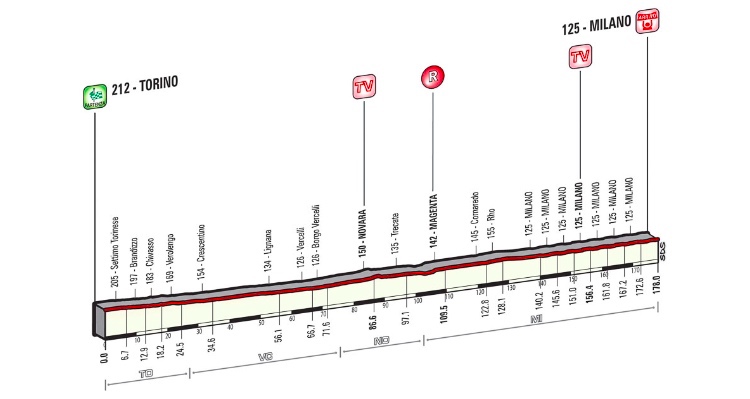
Stage 21 is pan-flat from the start in Turin to the finish in Milan. It’s a profile the sprinters will love. The racing closes out with seven laps of a 5.4km circuit, and things get a bit technical in the second half of each lap, with multiple corners and a roundabout. That means that the final trip around the circuit will likely be hectic. The last kilometer, however, is a straightaway to the finish line, one that will likely see the big-name sprinters still in this race getting up to some very high speeds.
High-speed finishes are great for Sacha Modolo, whose two stage victories so far in this Giro make him the de facto favorite again here. His leadout support has been outstanding so far in the race, and he’s able to finish it off with a powerful finishing kick. All of the other quick men will have their eyes on the men in fuschia in Milan.
Giacomo Nizzolo is now up seven career 2nd-place finishes in Giro d’Italia sprints, but this may represent the best opportunity he’s ever had to finally take a victory. A technical run-in to the line suits his bike-handling skills, and the long straight finish suits his blazing top speed. The perfect flatness of the profile should help hide one of the weaknesses of his never-ending campaign to finally win a Giro stage: a leadout train that has always disappeared late in the race. Without any climbs to wear them out, Trek will have no excuses for leaving Nizzolo alone in this Stage 21 finale.
Elia Viviani started the Giro hot with a stage win, but he’s cooled since then. Still, for pure speed when at his best, Viviani is right up there with the other top names in this race, and can’t be counted out here.
Luka Mezgec won the final stage of last year’s Giro d’Italia, and he’ll benefit from the an always skilled Giant-Alpecin leadout in the tricky final few kilometers of this stage. He should be up there fighting for the overall win. LottoNL-Jumbo’s Moreno Hofland could be up there as well.
Davide Appollonio, Heinrich Haussler, and Kevin Reza are other riders to watch in the probable sprint finish of Stage 21.
Be sure to follow @VeloHuman on Twitter for live analysis of Stage 21, and check back soon for plenty more pre-race coverage of the Critérium du Dauphiné, the Tour de Suisse, and, of course, the Tour de France.
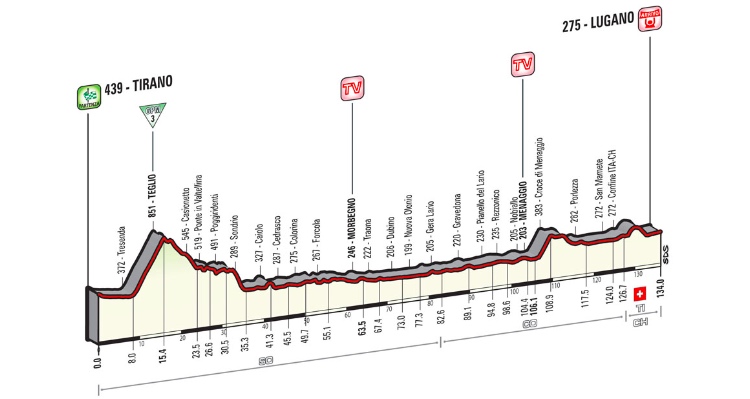
The fact that a climber (like stage winner Mikel Landa) would win Stage 16 was obvious from the profile alone, but the Stage 17 profile could be deceiving. It’s a mostly flat stage, with only a single categorized climb on offer (a very early Cat. 3) and just 134km of racing from start to finish (in Lugano, Switzerland). At first glance, it looks like a great day for the sprinters.
But we’re now into the Giro’s final week, and there will be some tired sprinters in the bunch. What’s more, the peloton just took on a brutal day of climbing, and there are more brutal days of climbing ahead. Combine those facts with the fact that the Giro peloton has already displayed an inability to control the breakaway on what appear to be clear sprinters’ days and you have a recipe for another potential opportunity to for the aggressors to steal one from the quick men.
I see it is a 50-50 proposition on this stage. So many sprinters have left the race that it will be harder for those remaining to do the job of keeping the breakaway controlled, but at the same time, this profile is one that should allow them to do so if they manage to stay organized. In any case, at least in terms of naming favorites, the three top sprinters left in this race are certainly stronger individual favorites than any one rider who trying his luck in the crapshoot that is getting into a breakaway on a stage like this. If it does come down to a sprint, a challenging finale with a few late corners will make this an exciting, if somewhat dangerous, stage finish.
Giacomo Nizzolo nearly came away with the elusive victory he has so long sought in the Giro d’Italia on Stage 13, but Sacha Modolo closed the door on him in the final 100 meters with a strong kick and a not-altogether-noble swerve toward the barriers. Still, Nizzolo looked quite strong there despite a complete lack of leadout support in the final 2km, and he’s shown several times in his career an ability to position himself well in a technical finale, even if he doesn’t always time his subsequent sprint kick successfully. This stage suits him, and he’s strong right now; if the breakers are caught, he has a great chance to finally get that win. Sacha Modolo meanwhile, with the powerful Lampre-Merida leadout to guide him to the line, has his own great chance here, a chance to double up on Giro victories. His teammates did a brilliant job to put him in position to win Stage 13, and they’ll be eager to do so again here. He’s looking strong right now too.
Elia Viviani obviously looked great on Stage 2, but since then he hasn’t been quite as impressive. Still, he should be right up there in terms of top speed with the remaining sprinters left in the race and therefore will be among the favorites in a potential sprint here on Stage 17.
Luka Mezgec has shown flashes of that sort of speed in the past but he’s been a bit lackluster in the sprints in this Giro. Giant-Alpecin is nearing the finish of a Grand Tour in which they’ve achieved very little, however, which could motivate them to perform here before the race goes back into the high mountains where they will have little opportunity to impact the events. Alessandro Petacchi, JJ Lobato, Moreno Hofland, and Davide Appollonio are other options for a potential sprint finish.
If a breakaway goes clear, strong engines Sylvain Chavanel (of Swiss team IAM Cycling) and Silvan Diller (of Switzerland) will be among the top riders to keep an eye on. Philippe Gilbert, Fabio Felline, Giovanni Visconti, and Patrick Gretsch are others on the list of riders who might have the energy to get up the road after a hard day in the mountains, though the list of riders with a chance here if Stage 17 does go to the breakaway is almost endless.
Be sure to follow @VeloHuman on Twitter for more race analysis, and check back after the conclusion of Stage 17 for the preview of the next stage. Also, don’t miss the most recent episode of the Recon Ride podcast!
The peloton has now had its first official rest day, but Stage 10 should give at least the GC riders another relaxing day in Italy—the profile is not particularly challenging.
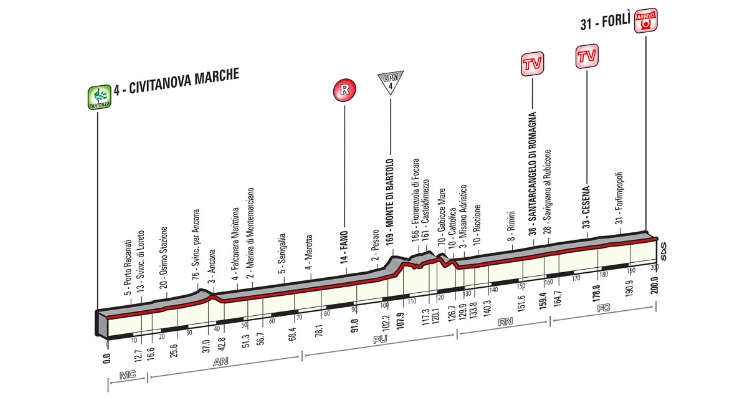
The first 100 kilometers of Stage 10 are almost completely flat. The next 30 kilometers offer a few very small climbs, including a single Cat. 4 ascent, but after that, it’s pancake-flat again all the way to the finish line in Forlì. A pair of intermediate sprint points late the day will offer a preview of the probable sprinters’ battle to come. The combination of a sharp right-hander with a little more than a kilometer to go and a sharp left hander inside the final kilometer will probably be the route’s most compelling feature, as it will make for a stressful finale.
This should be a day for a big bunch kick—anything else would be a massive failure by the teams of the quick men. André Greipel is the startlist’s top-name sprinter, and after poorly timing his finishing kick on Stage 2, he got things right and powered to the win on Stage 6 to stake his claim to favorite status in the Giro’s fast finishes. With a strong leadout and a pure focus on just this sort of stage, Greipel is the rider to watch—still, he’s prone to having a bad day here and there, and that means that plenty of other speedsters will have their eyes on the possibility of a win here.
Behind Greipel the picture is a bit less clear, with several riders looking to have similar chances to come away with a stage win here. Sacha Modolo, like Greipel, is extremely fast on his good days but also prone to disappearing on others. He’s one of the few riders here with a good chance of beating even an on-point André Greipel.
Elia Viviani doesn’t have as much leadout support as his rivals but he proved that that doesn’t mean he can’t compete when he won Stage 2. It will be interesting to see if he expends energy trying to nab red jersey points at the intermediate sprints, however—that may take a bit out of him late in the day. The same is true for Giacomo Nizzolo, who has been active at the intermediates so far. In any case, both are top options on this day.
Matteo Pelucchi has been practically anonymous in eight of the race’s nine stages so far . . . but he was runner-up to Greipel on Stage 6, and in a stage without any uphill challenges like Stage 10, he has another great opportunity. Moreno Hofland is another sprinter who has been a runner-up in a flat finish (on Stage 2) and he should be in the mix as well. Luka Mezgec has the always well-marshaled Giant-Alpecin leadout to help him into the final few kilometers, and he’s looked good so far.
Tom Boonen, Michael Matthews, Juan José Lobato, Manuel Belletti, and Nicola Ruffoni are others with a chance on this stage.
Be sure to follow @VeloHuman on Twitter for more race analysis, and check back after the conclusion of Stage 10 for the preview of the next stage. Also, don’t miss the most recent episode of the Recon Ride podcast!
Road racing gets underway at the Giro d’Italia with a mostly flat Stage 2. A single Cat. 4 climb inside the final 60 kilometers is the only official categorized acent of the day. The finish has a few bumps, though, and the road to the line angles ever so slightly uphill.
With the general classification still completely unsettled and a profile without many big challenges, this looks like a sprinters’ stage all the way. There are several candidates for victory—although there are plenty of big-name fast finishers in the race, none comes in as the clear favorite for one reason or another.
André Greipel has the strongest track record and, at his best, probably the fastest kick. He’s probably the best bet to win Stage 2, though he’s here without much of a leadout and he’s not the most consistent rider in the world, often disappearing on days that would seem to suit him.
Giacomo Nizzolo can handle a slightly uphill finish and he’s highly motivated in this Giro d’Italia, with a dedicated leadout train to position him well among the favorites. Few can match him for top speed. Sacha Modolo is also extremely quick, and coming off a nice stage win in the Tour of Turkey. He can run hot and cold, but if he’s feeling good, he will be hard to beat.
Elia Viviani is a strong sprinter who won’t have as much support as he’d like, given the fact that Sky is here for Richie Porte; still, I think he’s capable of coming away with a victory in a straight-up bunch kick. Nacer Bouhanni showed last year that you don’t need an elite leadout to win big sprints in the Giro. Luka Mezgec does have a strong leadout squad but little in the way of recent results. Still, he’s a danger.
Michael Matthews of Orica-GreenEdge can’t be underestimated even if a big bunch gallop. He’s been successful in that scenario before. With the slight uphill drag at the line, he’ll be an even stronger candidate for victory. The same is true for JJ Lobato, who has had a nice year so far.
Other candidates for victory in the likely sprint are Matteo Pelucchi, Alessandro Petacchi, Moreno Hofland, and the EQS duo of Gianni Meersman and Tom Boonen.
The Tour de Pologne is the first stage race that follows the Tour de France on the WorldTour calendar. Now in its seventy-first year, it tends to be an exciting and often unpredictable contest, as many riders are coming into the race following La Grande Boucle, hoping to maintain their form for one more week, while others are returning to competition after long midseason breaks, and are therefore in unknown condition. Pieter Weening was the surprise winner of the 2013 edition. Daniel Martin and Moreno Moster both picked up their first WorldTour victories here. Expect more of the unexpected in this year’s journey through Poland.
The Route
The Tour de Pologne opens with several days that aren’t likely to impact the General Classification: the fast men should reign supreme at the beginning of this week of racing. Stage 1 has a few small hills, but it’s not likely to see any significant separation and will probably end in a sprint. Stages 2 and 3 are almost guaranteed to come down to a bunch gallop, while Stage 4 at least closes out with a succession of small rollers to open the door for some moves (though a sprint is again a likelihood).
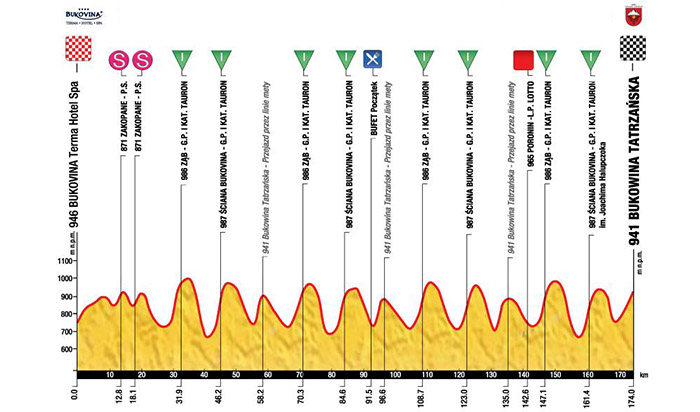
Stage 6: Bukovina Terma Hotel Spa › Bukowina Tatrzańska (174 km) – A constant barrage of tough climbs will guarantee fireworks on the penultimate stage of the race.
Stage 5 will be a jarring transition, with some early uphill challenges and then an arduous skyward trip to the Štrbské Pleso resort that is repeated not once, but twice, with the third and final ascent climbing higher than the first two to a summit finish line. Stage 6 is an even harder day of climbing, with almost no flat sections across 174 kilometers of racing.
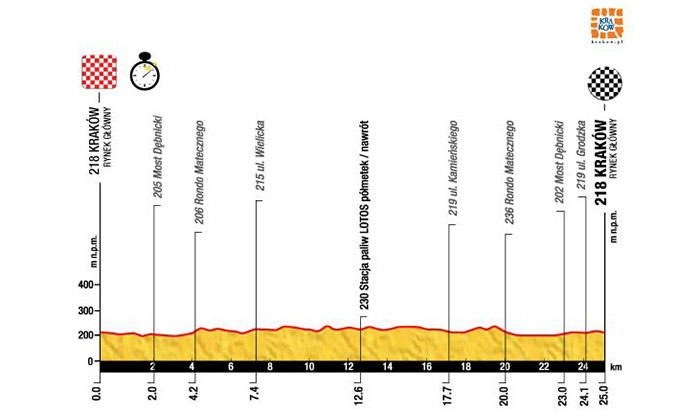
Stage 7 (ITT): Kraków › Kraków (25 km) – The chrono that concludes the race will play a major part in deciding the final General Classification.
The seventh and final stage of the Tour of Poland is a 25 kilometer race against the clock that starts and finishes in Kraków. It’s a mostly flat affair that will really favor the powerful time trialing experts, and it’s likely to play an integral role in deciding the overall winner.
The General Classification Contenders
A few early hills, a pair of tough mountain stages, and a high-speed chrono make this a profile for the well-rounded riders. The the time trial, in particular, will have a big impact on the overall leaderboard: a 25 km ITT may not seem like much, but with only two real climbing stages to open up any serious gaps on GC, it will be a pivotal test for the contenders.
As unpredictable as the Tour de Pologne tends to be, Rafal Majka will enter the race as a top favorite. He’s a star climber who just won two stages and the King of the Mountains classification in the Tour de France, showcasing stellar form right now, but he has also developed considerably as a soloist this year, putting in a ride good for 4th in the Giro’s first (and less climber-friendly) ITT. With the motivation of performing in front of his home crowd, Majka has the tools to better the 4th overall he notched in the 2013 edition of this race.
The winner of that 2013 running of the Tour de Pologne, Pieter Weening, will be another likely protagonist in the GC battle. He’s had an up-and-down year, anonymous in some races but also winning a stage at the Giro d’Italia and the recent Giro della Toscana. When he is locked in, he’s a major talent, and this is a race in which he’s had a lot of success; in addition to his recent overall victory, he also has been 2nd overall and a stage winner in the past. Versatile Cameron Meyer will be a great teammate.
Movistar’s Ion Izagirre was runner-up in 2013 and looks to be on good form right now, having put in a strong ride in support of Alejandro Valverde in the Tour de France. The 25-year-old can deliver a nice time trial and while the high-gradient climbs can be a bit of a challenge for him, the uphill tests in this Tour de Pologne should be within his capabilities. Movistar also has Beñat Intxausti, who has shown immense talent in various races throughout his career (he was 8th in the Giro and outclimbed Rui Costa and Dan Martin to win the Tour of Beijing last year), but who has also been a nonfactor in plenty of races where he might have been expected to thrive. Eros Capecchi (6th in the 2013 Tour of Poland) and Andrey Amador are other options.
Sky’s Dario Cataldo will like the look of the profile. A strong time trialist who is also capable of powering up the less steep climbs quite nicely, he has the skillset to succeed here. Sky is desperate to find a shred of success right now and Cataldo is a tough competitor who came close to delivering results on a number of occasions in this year’s Giro. This could be his opportunity. Kanstantsin Siutsou, great in the ITT, and up-and-comer Sebastian Henao, great on the climbs, are other options.
Trek has a very strong squad for this race, with several potential GC contenders. It will be interesting to see how they play this: Bob Jungels should land a nice result on the final time trial, though the climbs will be a big challenge for him. Giro d’Italia King of the Mountains Julian Arredondo, on the other hand, shouldn’t have much trouble with those climbs, but he doesn’t have much ability against the clock. The same is true for Robert Kiserlovski, 10th overall in this year’s Giro. In other words, depending on how they decide to take on this race, Trek will have the firepower to light up the mountain stages, or to help support their more capable time trialist through them. Given all of the talent in the roster, it seems likely that they’ll have at least one rider in the mix for the Tour of Poland GC.
Wouter Poels of OPQS has an excellent skillset to contend. Known for punchy climbing ablility, he has developed into a good time trialist as well. He was 4th here in 2011 and has had a great year so far. Teammate Thomas De Gendt is another potential protagonist, with a top-notch time trial. He’s been an inconsistent rider on the climbs recently, sometimes showing great uphill form, sometimes struggling mightily, but if he can put together a pair of good days during the mountain stages, he could be in the mix.
Garmin-Sharp’s Ryder Hesjedal isn’t the rider he was in 2012 when he won the Giro, but he did land a decent 9th in that race this year, and followed that up with some strong riding in support of Andrew Talansky during the Dauphine. He hasn’t raced since, but this will be an important step in his Vuelta preparation. 23-year-old Nathan Brown, good against the clock and capable on climbs that aren’t too steep, could be a nice dark horse candidate.
Belkin’s Robert Gesink enters the race with unknown form, without many racing days in 2014 as a result of a heart condition that required surgery in the spring. A great all-round talent when at his best, he will be a rider to watch in this race. It’s hard to say how he’ll do: if the intense training he’s been doing out of competition has pulled him back into form, he’ll could contend here; on the other hand, it wouldn’t be a surprise to see him fall off the pace early.
AG2R’s Christophe Riblon was on the podium of last year’s race, but he’s done very little so far in 2014. He did spend a lot of time putting in work for his teammates in the Tour de France, however, so it wouldn’t be a complete surprise to see him in the mix despite a lack of results this year: he’s obviously a great climber but he’s not bad in the ITT either. Astana’s Fabio Aru established himself as an elite uphill specialist in this year’s Giro d’Italia, but it will be a big ask for him to separate himself enough from the pack on the steep stuff to counteract the inevitable losses in a mostly flat ITT. Janez Brajkovic could be a nice alternative for the team. The chrono will be a major obstacle for Giant-Shimano’s Warren Barguil, but he’s a great climber who should be starting to round into form for the Vuelta. BMC has a very strong nice three-pronged attack in Steve Cummings, Samuel Sanchez, and Peter Velits. Lotto Belisol’s Maxime Monfort, Cannondale’s Davide Formolo, Damiano Caruso, and Moreno Moser, FDJ’s Alexandre Geniez, Lampre-Merida’s Przemyslaw Niemiec (who will try to get something out of this season in his home race after a crash doomed his Giro hopes), RusVelo’s Ilnur Zakarin, and CCC Polsat Polkowice’s Davide Rebellin are other outsiders who could be looking to land a GC result.
The Stagehunters
With several stages likely to end in sprints, the fast men will feature prominently in this race. Lampre’s Sacha Modolo looks to be the class of the bunch (with teammate Roberto Ferrari as a nice alternative), while Belkin’s Theo Bos, Giant-Shimano’s Luka Mezgec, OGE’s Michael Matthews, Movistar’s Juan Jose Lobato, Sky’s Ben Swift (and Edvald Boasson Hagen), and Garmin-Sharp’s Tyler Farrar will be other top contenders in the sprints. AG2R’s Yauheni Hutarovich and Davide Appollonio, BMC’s Thor Hushovd, OPQS’s Nikolas Maes, and Astana’s Francesco Gavazzi will also hope to be in the mix for the bunch finishes.
In addition to the many strong time trialists already mentioned as potential GC contenders, there will be several other chrono specialists in attendance, with Movistar’s Adriano Malori the top name on the list. OGE’s Brett Lancaster, Belkin’s Jack Bobridge, and Giant-Shimano’s Tobias Ludviggson are others with the potential to deliver against the clock.
VeloHuman Top 10 GC Favorites
Winner: Rafal Majka Podium: Pieter Weening, Dario Cataldo Other Top Contenders: Ion Izagirre, Wout Poels, Bob Jungels, Christophe Riblon, Ryder Hesjedal, Robert Gesink, Fabio Aru
As usual, VH will be tweeting plenty of live analysis during the race, so follow @VeloHuman on Twitter for more. Also, be sure to check back in a few days for the preview of the Eneco Tour!