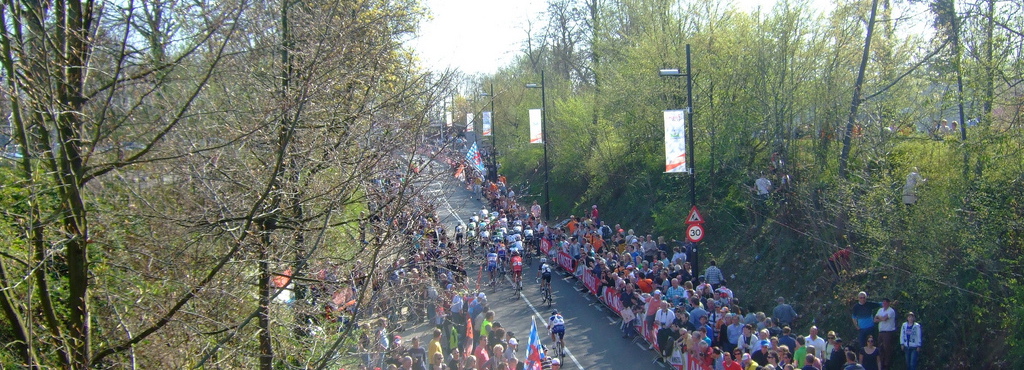
Tag: Simon Gerrans

  • Tour de France 2014: Stage 12 Preview

    Tour de France 2014: Stage 12 Preview

    Stage 12 Profile

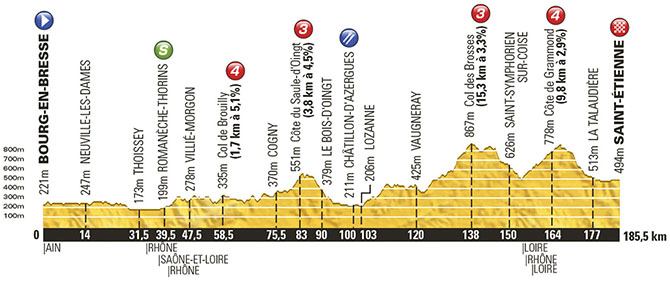
    Stage 12: Bourg-en-Bresse › Saint-Étienne – 185.5 km

    The undulating finale of the Tour’s eleventh stage served as an excellent launching pad for Tony Gallopin to outfox Peter Sagan and a charging pack of fast finishers. Late climbs again await the peloton on Stage 12. The first of two major ascents near the end of the day is a 15.3 kilometer Category 3 climb that averages 3.3%. It’s not the sort of steep wall that the puncheurs will love, but it is long enough to put some of the heavier riders under pressure. It is followed by a fast descent and then a 9.8 kilometer Cat. 4 that averages 2.9%. Again, the gradient itself is not all that demanding, but it will be a long way for the sprinters to travel on an incline, especially if there are teams driving the pace up front. After another descent, things flatten out for the final few kilometers toward the finish.

    The bumpy road to Saint-Étienne will give a breakaway some chance of going the distance on Stage 12, but there are quite a few teams in this Tour de France whose featured sprinters have decent climbing legs. If those teams cooperate, it will be hard for anyone who gets up the road to survive. As such, while the opportunists will certainly put in the effort to make this interesting all the way to the line, the favorites will be the fast finishers with the uphill talent to make it over the late climbs without losing ground to the pack.

    As usual, chief among the more versatile sprinter types is Cannondale’s Peter Sagan. His frustration at being constantly forced to decide between closing down moves on his own or letting them go clear and hoping others will do the chasing is mounting, but Stage 12 may be his best opportunity for victory left in this race. The final climbs aren’t as steep as they were in the eleventh stage, the last descent isn’t as tricky, and there is a longer flat run-in to the line. The race should be a bit easier to control. Still, easier doesn’t mean easy: Cannondale will need some help from other teams to keep the early breakaway and any attacks on the climbs on a short leash, and even if things come together for a sprint, the young Slovakian will probably be facing some stiff competition.

    The list of riders who will hope to rival Sagan if this does comes down to a sprint is headlined by Giant-Shimano’s John Degenkolb. These late hills will probably too much for the team’s other star fast-man Marcel Kittel, but they has a capable alternative in Degenkolb. Runner-up on Stage 11, he is clearly feeling much better now than he was feeling last week. If he is, indeed, back to full strength, Sagan will have his hands full on Stage 12: Degenkolb at peak form should be able to handle these climbs, and he has been extremely fast this year, coming very close to beating Mark Cavendish twice in the Tour of California, and rather handily defeating Peter Sagan in a sprint in Gent-Wevelgem.

    Orica-GreenEdge has an excellent lineup for the hilly stages, but they are still without a win in this Tour de France. This will be another good opportunity pick up that elusive victory. Simon Gerrans has landed some strong results in the reduced bunch sprints we’ve seen, and Michael Albasini is an excellent alternative with a similar skillset. OGE could try to put one in the break and let the other hang back in the pack to cover both potential scenarios.

    OPQS’s Matteo Trentin continues to deliver impressive performances in the sprints on the hilly days, following up his earlier stage win with a nice 3rd place on Stage 11. He will be strong option for his team here on Stage 12, with the added versatility of being able to jump into the early move if that looks to be the smart decision. Michal Kwiatkowski will, as usual, be another versatile card for the team to play.

    Movistar’s JJ Rojas, AG2R’s Samuel Dumoulin, and Tinkoff-Saxo’s Daniele Bennati should enjoy an opportunity to battle a somewhat reduced bunch if this comes to a sprint. Lotto Belisol’s Andre Greipel, on the other hand, will be put to the limit trying to make it to the line, but it could happen, and it should go without saying that he’ll be a top favorite for a sprint if he’s still in the pack. Katusha’s Alexander Kristoff and FDJ’s Arnaud Demare could hold on for a bunch finish, and they will be dangerous if they are there. Europcar’s Bryan Coquard, OPQS’s Mark Renshaw, and IAM Cycling’s Heinrich Haussler have a chance to be in the mix as well.

    Lotto Belisol’s Tony Gallopin, BMC’s Greg Van Avermaet, Garmin-Sharp’s Tom-Jelte Slagter, Cofidis’s Julien Simon, Garmin-Sharp’s Ramunas Navardauskas, and FDJ’s Arthur Vichot are fast finishers but they’ll have a hard time against the top sprinters. They will have to decide whether to try their luck in the bunch or attempt a long-range attack on Stage 12. It will take a strong group and some tactical riding for a move off the front to take this one from a hungry pack of sprinters. Strong candidates for success who will likely see a long-distance strike as their only chance at a stage win include Tinkoff-Saxo’s Nicolas Roche and Michael Rogers, Giant-Shimano’s Tom Dumoulin, Lotto Belisol’s Adam Hansen, Belkin’s Lars Boom and Sep Vanmarcke, Europcar’s Tommy Voeckler and Cyril Gautier, OPQS’s Tony Martin and Jan Bakelants, and IAM Cycling’s Sylvain Chavanel.

    VeloHuman Stage Favorites

    1. Peter Sagan | 2. John Degenkolb | 3. Simon Gerrans

    Be sure follow @VeloHuman on Twitter for live commentary on this and every stage of the 2014 Tour de France! The next preview will be up after the conclusion of Stage 12, so stay tuned. In case you missed it, the overall Tour de France preview can be found here.

    -Dane Cash

  • Tour de France 2014: Stage 11 Preview

    Tour de France 2014: Stage 11 Preview

    Stage 11 Profile

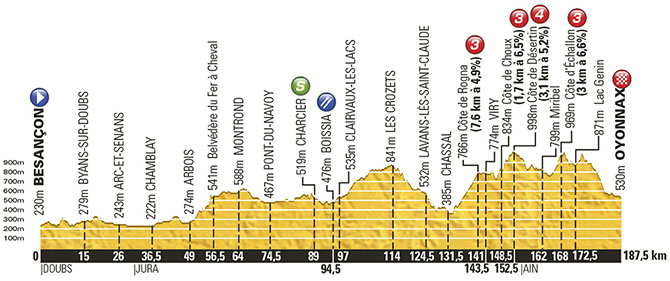
    Stage 11: Besançon › Oyonnax – 187.5 km

    The Tour’s eleventh stage follows its first rest day, a break the peloton desperately needed after Monday’s brutal stage that saw the abandonment of Alberto Contador and a hard-fought uphill battle (won by Vincenzo Nibali) to close out the day. The Stage 11 profile is not a flat one, but its hills pale in comparison to the Vosges climbs that injected pain into hundreds of legs over the weekend. It will be a welcome change for most of the riders in the Tour de France. Still, the climbs will play a role in how Stage 11 plays out; the toughest ascents of the stage come in quick succession as the day reaches its conclusion, with four categorized climbs less than 30 kilometers apart. Following the final Cat. 3, there is an uncategorized bump in the road and then a technical descent to Oyonnax and the finish line.

    The rolling profile makes this another good opportunity for a breakaway to succeed. It’s probably just a bit too challenging for the heavier sprinters, which will reduce the amount of fierpower committed to the chase. The barrage of late hills late and the long descent that follows will make it difficult for anyone to control the race even if they tried. However, this sort of intermediate stage is one of the few (along with the next day’s stage) in the race that isn’t likely to be dominated by a pure sprinter or a climbing star, making for a more open competition: almost every team in the Tour de France will try to take advantage of the opportunity to pick off a win. If a few strong teams miss the break, they’ll commit to reeling things in, and though this profile is lumpy, it’s not so lumpy as to guarantee the break’s success.

    The “favorites” (with the usual caveat that that is a loaded term on breakaway-friendly stages) will be decent climbers with either fast finishes or good soloing skills to try to escape late and maintain a gap on the descent.

    Cannondale’s Peter Sagan is the number one rider to watch on the stage. He shouldn’t struggle with the climbs, he’s a masterful descender, and he’s obviously a fast finisher. Dealing with the day’s breakaway will be his biggest challenge. He may try to get into the break himself, or he may go for this one from the pack, which would mean a lot of time on the front for his team. That versatility is what makes him such a strong contender.

    The same is true for both Simon Gerrans and Michael Albasini of Orica-GreenEdge. In Stage 7’s sprint finish, Gerrans looked to have recovered the strength he lost in his opening stage crash. The Stage 11 profile suits him perfectly, with an opportunity to escape on a late climb, or the possibility of a reduced sprint. Teammate Michael Albasini is another excellent option: the Swiss veteran is an expert at picking the right moves, and he’s got a fast finish, too. Orica-GreenEdge will have a lot of flexibility with this duo: they can try to put one of them into the breakaway and let the other ride it out in the pack, to cover both scenarios. Whether or not the stage goes to the break or to the peloton could hinge on whether Peter Sagan and at least one Orica-GreenEdge rider make it into the move: if not, Cannondale and OGE can be expected to get involved in the chase early.

    Trek’s Fabian Cancellara would be another top choice, but he has abandoned the race to focus on other objectives. Fellow classics protagonist BMC’s Greg Van Avermaet is still here, however, and he could be a contender thanks to his blend of good climbing legs, strong solo prowess, and a fast finish. OPQS has the quality duo of Jan Bakelants and Matteo Trentin to take on the difficult challenge of deciding between breakaway and peloton; both are excellent on hilly days and Trentin in particular is a dangerous option if he is in whatever group is fighting for the win when the day nears its conclusion. FDJ’s Arthur Vichot, Lotto Belisol’s Tony Gallopin, Garmin-Sharp’s Tom-Jelte Slagter, AG2R’s Samuel Dumoulin, Cofidis’s Julien Simon, Movistar’s JJ Rojas, Tinkoff-Saxo’s Daniele Bennati, and Garmin-Sharp’s Ramunas Navardauskas are other top contenders who could win Stage 11 from either the break or the peloton.

    If things do come back together at the end, it could be all about which of the big name sprinters survive the late climbs. Giant-Shimano’s John Degenkolb might be a top favorite were it not for the injury he suffered early on in this race. He’s still a rider to watch; normally, he’d be targeting this stage, which is probably too difficult for Marcel Kittel. Fellow German Andre Greipel can climb better than most people realize. This still might be a bit too much to ask, but if things regroup for a sprint and he does survive the bumpy road, he will obviously be a top favorite. Katusha’s Alexander Kristoff has a chance to hold on over the climbs, though this stage may not be long enough to favor his skillset even if he does. FDJ’s Arnaud Demare can normally handle a hill or two, but as of yet he has not looked recovered from injuries sustained crashing earlier in the Tour. Europcar’s Bryan Coquard, IAM Cycling’s Heinrich Haussler, and Tinkoff-Saxo’s Michael Morkov also have a shot of making it over the late bumps to contest a sprint if it should come to that.

    Other candidates will be more reliant on the breakaway’s chances. In addition to their duo of versatile fast finishers (Bennati and Morkov), Tinkoff-Saxo suddenly has a stable of options for breakaway success now that team leader Alberto Contador is out of the race. They’ll still be hoping to get something out of the Tour de France, and all-rounder talents Mick Rogers, Nicolas Roche, and Rafal Majka will be dangerous stagehunters with breakaway ambitions. Europcar’s Tommy Voeckler could give the early move another go after spending a long (and ultimately unsuccessful) day out front on Stage 10. His teammate Cyril Gautier may be a better option; the younger Gautier has looked sharp so far, while Voeckler has not looked his best. IAM Cycling’s Sylvain Chavanel is always a strong candidate to go for a long-distance win. On this profile and with Degenkolb still questionable, Tom Dumoulin may be the best option for Giant-Shimano; he’s been impressive on all levels of his game in this race; his soloing ability is well-known, but he has also flashed a decent sprint on two separate stages and he is showing off his able climbing legs with his Top 30 position on GC. Movistar’s Giovanni Visconti, Belkin’s Lars Boom and Sep Vanmarcke, OPQS’s Tony Martin, Trek’s Jens Voigt, and Cofidis’s Nicolas Edet are other potential long-range protagonists who could have a shot.

    On the off-chance that the GC contenders try to mix things up on Stage 11, watch out for a fast finisher like Alejandro Valverde, a strong descender like Vincenzo Nibali, or Michal Kwiatkowski, who qualifies as both.

    VeloHuman Stage Favorites

    1. Peter Sagan | 2. Simon Gerrans | 3. Greg Van Avermaet

    Be sure follow @VeloHuman on Twitter for live commentary on this and every stage of the 2014 Tour de France! The next preview will be up after the conclusion of Stage 11, so stay tuned. In case you missed it, the overall Tour de France preview can be found here.

    -Dane Cash

  • Tour de France 2014: Stage 7 Preview

    Tour de France 2014: Stage 7 Preview

    Stage 7 Profile

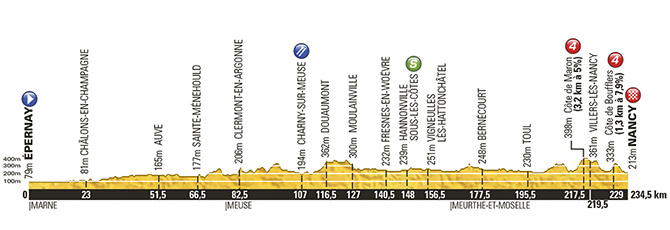
    Stage 7: Épernay › Nancy – 234.5 km

    With four days for the sprinters (including a Stage 6 that went to Andre Greipel) already on the books in the 2014 Tour de France, one could be forgiven for taking a cursory look at the Stage 7 profile and assuming that it’s certain to lead to another bunch sprint showdown. After all, a pair of Cat. 4 climbs are the only categorized uphill challenges on the menu. However, both of those climbs are crested in the final 20 kilometers of the day, and the second, though only 1.3 kilometers in total length, grades out at an average of 7.9%—and from the top it’s less than 6 km to the line, mostly downhill. What’s more, Stage 7 is 234.5 kilometers from start to finish, making it the second longest stage in the entire Tour de France.

    That last bump in the road could inspire the punchier riders to attempt escape close to the finish, especially after such a long day in the saddle. And with a few tough stages ahead and no certainty that the big sprinters will survive late attacks, the peloton could struggle finding the motivation to chase down the day’s breakaway, making a long-distance winner at least a possibility. There are a number of different potential scenarios for Stage 7, making it a hard one to predict. However it plays out, the favorites will be the riders with the endurance to handle all 234.5 km and the versatility and explosiveness to excel in what will likely be a challenging finale.

    As is often the case in the difficult hilly stages, Cannondale’s Peter Sagan will be a favorite for victory. If the peloton does bring this all back together before it’s too late, his team will likely have played a role, and more than any other speedster in the Tour de France, Sagan is capable of handling the steep stuff. If anything, he is himself a danger to put in a dig on the climb and then divebomb the descent all the way to the line. In a sprint, he is one of the fastest in the peloton, and it seems possible that the German duo generally regarded as a tier above him might struggle on the last ascent. This could be his best opportunity so far to pick up a win.

    Andre Greipel of Lotto Belisol, one of the aforementioned duo, is underrated in his ability to handle difficult days, but this might be a bit too much to ask; there just won’t be a lot of time for anyone who loses ground on the final climb to get back into contention, given the descent that follows. Meanwhile, Lotto’s sprint nemesis Giant-Shimano will be in a tough spot; normally this might be a day for Marcel Kittel to give leadership over to versatile John Degenkolb, but Degenkolb was injured in the Tour’s fifth stage and may not be able to contend. Obviously, if Kittel or Degenkolb manage to hold on for a sprint finish, they will be favorites, but that seems like a lot to ask.

    There are a few sprinters other than Sagan who do have a decent shot here, however. Katusha’s Alexander Kristoff relishes the extra-long days, and he’s not a bad climber either. He has come close to victory more than once so far in this Tour, and a stage that may see Kittel unable to contest the sprint is his best opportunity to finally get a victory. Ramunas Navardauskas is slotted in as Garmin-Sharp’s sprinter of note, and he is especially adept at fast finishes following tough days. FDJ’s Arnaud Demare normally displays decent uphill ability, but he crashed on Stage 6, and even after finding his way back to the bunch following the incident, he was later dropped before the sprint finish; he may not be at full strength here, though if he is feeling up for it, he’s a danger in a bunch gallop.

    Europcar’s Bryan Coquard, Trek’s Danny van Poppel, and OPQS’s Mark Renshaw have all performed well in the fast finishes so far, but even this does end in a sprint, surviving the difficult day could be too much to ask from them. Meanwhile, versatile quick men like Movistar’s JJ Rojas, AG2R’s Samuel Dumoulin, and IAM Cycling’s Heinrich Haussler, normally fringe contenders, could find themselves a bit better positioned than usual should this come down to a reduced bunch sprint.

    With a late climb coming after a long day of riding, we are certain to see plenty of punchy, aggressive riders trying to escape from the pack, or at least attempting to drop the speedsters that we’ve seen over and over again in the Tour’s many sprint stages so far. For these in-betweener, opportunist types, it may be a tough decision whether or not to try for a victory from the breakaway or from the peloton: I think the pack is the smarter choice here, but if a strong enough group makes the early move, it isn’t a given that the pack will reel them in.

    Either from the break or the peloton, Orica-GreenEdge has cards to play for Stage 7 in Simon Gerrans and Michael Albasini. Gerrans would have been a top favorite for the stage, but I’m not sure he’s back to full strength after his crash in the Tour’s first stage. If he is recovered by the time the peloton sets out from Épernay, though, he will have an excellent chance at victory: the Milano-Sanremo and Liege-Bastogne-Liege winner loves long, grueling days, and he excels on late climbs. Michael Albasini will be a more than able alternative for OGE. He has been very explosive this year, putting in a nice performance on the steep final climb of La Fleche Wallonne and nabbing sprint victories aplenty in the Tour de Romandie.

    Michal Kwiatkowski of OPQS always seems to be in the mix when a profile calls for an explosive finish. If any GC contenders decide to put the pressure on over Stage 7’s late bumps, expect Kwiatkowski to be right there at the end; he’s one of the two or three best sprinters of the General Classification riders. Movistar’s Alejandro Valverde is another. Belkin’s Bauke Mollema can be very explosive, and he’s underrated in the sprints even on a flat surface. Lampre’s Rui Costa loves to go on the attack on this sort of profile. And, of course, don’t rule out another attempted strike from yellow jersey wearer Vincenzo Nibali, who could see a steep ascent followed by a fast descent as a nice opportunity to pick up more time.

    BMC’s Greg Van Avermaet just missed out on victory in the Tour’s second stage when the lead group allowed Nibali to escape, leaving 2nd place as the best possible result for those behind, but he’ll have another opportunity here to make it into a late move on the climb and then attempt outsprint anyone around him in the finish. The rider who broke Van Avermaet’s heart in the Tour of Flanders earlier this year, Fabian Cancellara, will also relish this opportunity: the long, challenging days are his forte, and he will enter Stage 7 with a deadly combination of good form (which he has shown on a number of stages so far) and plenty of motivation (having been unable to pick up a victory just yet).

    Other riders who don’t mind a tough day of racing and who could look to escape from the pack, either in the day’s early break or late in the stage, include Europcar’s Tommy Voeckler and Cyril Gautier, Lotto Belisol’s Tony Gallopin, IAM Cycling’s Sylvain Chavanel, FDJ’s Arthur Vichot, OPQS’s Jan Bakelants, Garmin-Sharp’s Tom-Jelte Slagter, and Giant-Shimano’s Tom Dumoulin. Katusha’s Joaquim Rodriguez might have seen the late ascent as a nice opportunity to make a move, but he has not looked to be back to full strength just yet.

    VeloHuman Stage Favorites

    1. Peter Sagan | 2. Alexander Kristoff | 3. Michal Kwiatkowski

    Be sure follow @VeloHuman on Twitter for live commentary on this and every stage of the 2014 Tour de France! The next preview will be up after the conclusion of Stage 7, so stay tuned. In case you missed it, the overall Tour de France preview can be found here.

    -Dane Cash

  • Tour de France 2014: Stage 2 Preview

    Tour de France 2014: Stage 2 Preview

    Stage 2 Profile

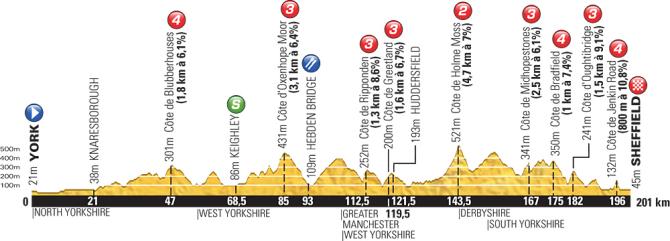
    Stage 2: York › Sheffield – 201 km

    After a chaotic finale that saw Mark Cavendish and Simon Gerrans hit the deck very hard and Marcel Kittel ride on to win the day, the opening stage of the 2014 Tour de France is officially in the books. The excitement should continue on Stage 2, and hopefully for more positive reasons. As wild as the finish to the first stage was, for most of the day the riding was pretty tame, as a flat profile led to a mostly controlled journey, but things will be quite different on the second stage. Undulating is too gentle a word for the profile. With seven categorized climbs in the final 90 kilometers, all of them at 6% or greater, and a few uncategorized ascents climb to boot, Stage 2 has the look of an Ardennes Classic. The last four categorized ascents come in quick succession, closing out with the Jenkin Road climb with just 5 kilometers remaining. It is only 800 meters long but at a wicked 10.8% average grade. The barrage of late uphill tests are sure to inspire attacks. And while it obviously isn’t as long as Liege-Bastogne-Liege, it is the second longest stage in the first two weeks of the race at 201 kilometers; anyone still searching for Grand Tour form could get worn down and found out early. The high mountains may still be a ways off, but Stage 2’s journey from York to Sheffield should offer plenty of fireworks.

    Given the profile, it seems likely that the stage will come down to either a late attack, or a sprint among the day’s survivors. As early as it is in the Tour de France, the former will be hard-earned, as the GC squads will be determined to deny any opportunists a chance to get ahead. However things play out, the explosive, well-rounded types with the versatility to win either in a late move or from a reduced sprint will be the favorites for victory.

    Cannondale’s Peter Sagan will be the top favorite for Stage 2. Unlike most of his sprinting rivals, he should be able to handle the constant up-and-down, and he has the ability to win the day with an aggressive strike or from a sprint. This stage looks made for his versatile array of talents, and he proved in the Tour de Suisse and again in the first stage that he’s on excellent all-around form right now.

    Orica-GreenEdge’s Simon Gerrans is another top contender, for many of the same reasons, with the biggest question mark being his health following his crash. The 2014 Liege-Bastogne-Liege winner relishes a profile like this, with plenty of opportunities to attack, or at least to whittle down the pack. An excellent puncheur, he will be one of the most dangerous men in the peloton if he does decide to make a late move, but don’t underestimate his sprint either: he actually defeated Sagan in a reduced sprint in the 2013 Tour de France. Unfortunately, his hard fall near the Harrogate finish line will cloud his chances for Stage 2; it’s hard to know how well he will feel after such a bad crash. Teammate Michael Albasini could be another option, especially as a card to play on the late climbs.

    Movistar’s Alejandro Valverde, one of the most successful Ardennes riders of his generation, is an obvious choice here; for him, motivation could be the determining factor. While he, too, could contend for Stage 2 in a variety of ways, he may be more concerned with staying safe for GC. If he does decide to get into the mix, he will be a strong candidate for victory.

    Behind Gerrans and Valverde at Liege-Bastogne-Liege was Michal Kwiatkowski of Omega Pharma-Quick Step. He has all the tools for success, but his form is questionable right now. If he’s feeling good, he will be a contender. GC riders other than Valverde and Kwiatkowski who could find themselves among the favorites if the pack really starts to thin out include Bauke Mollema and Rui Costa.

    The difficult profile, and the likelihood of an animated race, will probably be too much for “pure” sprinters Marcel Kittel and Andre Greipel. (Mark Cavendish may be out of the race with a shoulder injury after his crash; even if he makes the start it seems unlikely that he’ll be capable of contending). Obviously if one of the big sprinters is there at the finish, he will be a favorite, but it will be a big ask. Kittel’s teammate John Degenkolb, however, leads a select group of non-Sagan sprinters who at least have a chance of surviving the difficult day. Also in this group are Movistar’s JJ Rojas, Tinkoff-Saxo’s Daniele Bennati, and FDJ’s Arnaud Demare and, to a lesser extent, Katusha’s Alexander Kristoff and Lampre-Merida’s Sacha Modolo. I wouldn’t really call him a sprinter, but fast-finishing Ramunas Navardauskas (3rd on the opening stage) could excel in a reduced sprint as well.

    Quite a few riders stand out as potential protagonists for late attacks. Garmin-Sharp’s Tom-Jelte Slagter, FDJ’s Arthur Vichot, Lotto Belisol’s Tony Gallopin, Europcar’s Tommy Voeckler, and, if he is feeling up to it, Katusha’s Joaquim Rodriguez will like the short, steep challenges that Stage 2 has to offer. Fabian Cancellara, Sylvain Chavanel, Greg Van Avermaet, Jan Bakelants, and Geraint Thomas are all strong soloists with the climbing legs to put in a long distance strike.

    VeloHuman Stage Favorites

    1. Peter Sagan | 2. Simon Gerrans | 3. Michal Kwiatkowski

    Be sure follow @VeloHuman on Twitter for live commentary on this and every stage of the 2014 Tour de France! The preview of Stage 3 will be up soon after the conclusion of Stage 2, so stay tuned. In case you missed it, the overall Tour de France preview can be found here.

  • Amstel Gold Race, La Fleche Wallonne, and Liege-Bastogne-Liege Post-race Impressions: Ardennes Week in Review

    Amstel Gold Race, La Fleche Wallonne, and Liege-Bastogne-Liege Post-race Impressions: Ardennes Week in Review

    4538801735_f7d8f76af3_b

    Three Ardennes week contests, three different winners, all of them among the biggest names in the one-day racing—Philippe Gilbert, Alejandro Valverde, and Simon Gerrans are all past Monument Classic winners, so it doesn’t get much bigger than that. Gilbert’s return to form was the big story of the beginning of the week: his win at Brabantse Pijl suggested that he had recovered some of his 2011 abilities, but he confirmed his rediscovery with a resounding victory over the Cauberg at the Amstel Gold Race. The recently revamped parcours looked like it might favor a final sprint, but Gilbert was just too hard to chase down on his beloved terrain. An aggressive Jelle Vanendert was a fine 2nd, and then Gerrans outsprinted Valverde and Kwiatkowski for 3rd in a surprising preview of the Liege-Bastogne-Liege showdown. Joaquim Rodriguez was an unfortunate casualty of Amstel, going down hard in an early crash.

    Wednesday’s La Fleche Wallonne ended as it so often does in a climactic uphill sprint. Alejandro Valverde finally came good on months and months (stretching back to 2012) of elite form without a WorldTour victory. Daniel Martin roared back into relevance, nabbing 2nd place. And Michal Kwiatkowski, in 3rd, continued to display the sort of ability that suggests dominance in these sorts of races is not far away.

    The grand finale in Liege came down to the final 5 km (just like Amstel and La Fleche Wallonne had); attacks from bigger favorites were quickly reeled in all day, but Giampaolo Caruso and Domenico Pozzovivo jumped ahead as the finish line approached and the chase to bring them back last until the closing moments. Dan Martin looked poised to bridge and possibly pass them just 300 meters from the finish, but he hit the dock rounding the last corner in a heartbreaking stroke of misfortune. Simon Gerrans, Alejandro Valverde, and Michal Kwiatkowski sailed past Martin and then the men up the road, and it was a sprint for victory, with Gerrans taking the win and his second career Monument after Milano-Sanremo. Valverde was 2nd. Kwiatkowski landed on another major podium in 3rd, but going wide around a crashed Dan Martin forced him to play catchup with Gerrans and Valverde at the very end, so I wonder what might have been for him as well.

    Takeaways from the Ardennes Classics

    There were plenty of surprise performances in the Ardennes Classics, but at the very top were names we’ve seen so often in the past, with a lot of similarity between the three races as well. All three basically came down to the last five minutes. All three were won by big-name one-day stars, over the age of thirty. The podium of the finale race, Liege, was made up of riders who had already stood on an Ardennes podium earlier in the week.

    I suppose the results speak for themselves for race winners Gilbert, Valverde, and Gerrans. Valverde, especially, was on his game all week; interestingly, he won the race I would have imagined favored him the least. He has stayed in top-shelf shape for a long while this season, and now he’ll get some well-deserved time off to prep for the Tour de France. 4th, 1st, and 2nd across three Ardennes races is quite a haul for the 34-year-old.

    Philippe Gilbert took a proud Amstel victory to put himself back among the favorites in these races but did fade a bit in La Fleche Wallonne and Liege-Bastogne-Liege. Still, winning Brabantse Pijl and Amstel Gold and notching Top 10s in La Fleche Wallonne and LBL are very worthy results, and they suggest that Gilbert has regained both form and confidence after a rocky period. He’s been around the sport for a while, but at age 31 he still has a lot of racing left in his career, and it’s good to see him righting a downward trend.

    Simon Gerrans might have come up with a winning strategy for Liege after showing his form with 3rd place at Amstel: he skipped La Fleche Wallonne and recharged his batteries, and was the strongest in the sprint to the Monumental finish. It’s really been an amazing string of years for the Australian rider who started his career as more of a rouleur than anything. He completed the impressive achievement of nabbing stage wins in all three Grand Tours earlier in his career as a breakaway specialist, but he has developed into one of the premier punchy fast finishers in the sport. Since 2012, he has won two Monuments, two Tours Down Under, and two National Championships in Australia, in addition to a host of other victories and some time in the yellow jersey at the Tour de France. He does not appear to be slowing down even as he approaches 34.

    In my opinion, Joaquim Rodriguez was the biggest loser of the Ardennes Classics, showing such excellent form at Catalunya only to fall victim to an unfortunate crash-caused injury at Amstel Gold. He had been focused so hard on Liege this year; it’s a big shame he was unable to contest that race. Hopefully, recovers quickly for his other big goal of the season, the Giro d’Italia. Teammate Daniel Moreno was unable to pick up the slack by repeating last year’s success; by most standards he had a decent Ardennes campaign as one of the few riders to be in the Top 10 of all three races, but three consecutive 9th place finishes are a disappointment for last years winner atop the Mur de Huy. Like Purito, Carlos Betancur was on fire early this season and looking set for big things in these races, for which he is so perfectly built, only to be laid low by injury. AG2R did not adjust well in Amstel Gold or La Fleche Wallonne, unable to pick up results there worthy of the year they are having, but they did make up for it somewhat by placing two riders in the Top 10 at Liege. Romain Bardet continued a strong 2014 with a 10th place, looking like a great bet for the future. Domenico Pozzovivo flew in from his 2nd overall at the Giro Del Trentino to pick up 5th on the day, quite a performance. He looks very strong for next month’s Giro d’Italia.

    Daniel Martin‘s Ardennes week was quite a roller coast ride, and it ended on a cruel, sour note. He abandoned Amstel with knee issues, raising concerns about his health for the next few races, exploded up the Mur for 2nd at La Fleche Wallonne, quelling concerns about his health, and then just when it seemed he might be in for continued success at Liege, he went down hard in the last seconds of the contest. At least in terms of looking ahead, he does appaer to be very strong for the upcoming Giro d’Italia, but it’s hard to think of anything more demoralizing than what happened to Martin as the race came to a close today. Teammate Tom-Jelte Slagter was a bit of a happier note for Garmin; the 24-year old was 5th at La Fleche Wallonne and 6th at LBL, which is pretty darn impressive, especially given the starpower at the top. He’s been showing the sort of skillset that does well in these races, but until this week, he hadn’t confirmed that promise with results. In Martin (only 27) and Slagter, Garmin will likely feature pretty prominently in the Ardennes Classics for many years to come.

    Michal Kwiatkowski was 5th, 3rd, and 3rd, second to only Valverde in consistent top performances across the week. On the one hand, two podiums (including one in a Monument) are pretty unbelievable for the 23 year old, and a confirmation of the amazing talent he has shown so early in his career. On the other hand, I don’t think anyone who has been following the sport closely really needs further confirmation of his talents, and he’s probably a bit frustrated to have come so close so many times (after being 2nd in Pais Vasco). He will take a break from racing before the Tour. Hopefully it will give him time to recharge and be at his best for the sport’s biggest show.

    I can’t say I saw Jelle Vanendert‘s strong week coming. Tony Gallopin appeared to be the better option for Lotto leading up to the race after Vanendert’s relatively anonymous 2013, but 2nd at Amstel (ahead of Ardennes winners Valverde and Gerrans) and 6th at La Fleche Wallonne were great results for the Belgian. He’s really an Ardennes specialist, but hopefully we will see him with continued form in more 2o14 races with rolling terrain.

    Belkin’s Bauke Mollema was unable to come up with a Top 10 at Liege-Bastogne-Liege, but he delivered his best Amstel and La Fleche Wallonne to date. The 27 year old has rallied wonderfully after a slow start to the season, and his reassuring performances come at a time of great uncertainty for a team that has lost Robert Gesink indefinitely due to a heart health issue.

    I found Vincenzo Nibali‘s Ardennes campaign to be very underwhelming. He did not feature prominently in any of the three races. After a fairly anonymous first two contests, I figured he might be saving up for Liege, but he was unable to hold on when things started splitting up at the finish. I think he really wants to win that big one-day race soon, but the Tour de France is probably a bigger target for the 2013 Giro d’Italia winner at the moment. Rui Costa crashed out of LBL after missing out in Amstel and LFW. The World Champ will be very disappointed—he started the season hot at Paris-Nice but he hasn’t managed to deliver results in the past few weeks. He’ll look to the Tour de Romandie as his next target, and with Chris Froome something of a question mark with a chest infection, things could open up for the opportunist rainbow jersey wearer.

    Trek’s Julian Arredondo continued to show nice form in 2014: he just barely missed the top 10, coming in 11th, at La Fleche Wallonne, and though he was ultimately unable to make anything happen. he was very active off the front at LBL. At a time when their big name climbers (the Schlecks) are really struggling, Trek must be pleased to have struck gold in young Arredondo. Another youngster who looked sharp was Cofidis’s Rudy Molard, among the top 20 in both La Fleche Wallonne and LBL. Results like that without much team support make him a name to remember in the future.

    Share your own thoughts in the comments, or give me a holler on Twitter @VeloHuman! Also keep an eye out early Monday for the Tour de Romandie preview! It should be a great race. Lastly, the Giro d’Italia is right around the corner, and as usual there will be a big overall preview as well as previews of each individual stage, so make sure you tune back in to VeloHuman!

    -Dane Cash

    Photo by Ed W.

  • Amstel Gold Race 2014 Preview

    Amstel Gold Race 2014 Preview

    Amstel2013Cropped2

    After an exciting appetizer at Brabantse Pijl (won by a resurgent Philippe Gilbert ahead of an impressive Michael Matthews), the week of races known as the Ardennes Classics is here! The Amstel Gold Race kicks off on Sunday. The undulating 250 kilometer jaunt through the Limburg province is perhaps the biggest cycling event in the Netherlands. The course has changed in recent years, its finish moving from the summit of the legendary Cauberg to a flat straightaway about 1.8 kilometers after the top of the climb. The punchy riders will still attempt to get away on the last bump in the road, but with more room to bring back escapees, things are more likely to come together for a sprint among a larger group of survivors now. Still, to make it to this finish at the front of the pack, a rider has to be seriously capable on the steep stuff (like the 1.1 kilometer, 8.8% average Eyserbosweg with 20 km to go), and a great bike handler as well: the journey from starting city Maastricht to the finish line in Valkenburg is notorious for its challenging twists and tight turns, and after 250 kilometers, keeping one’s concentration through the corners is not easy.

    AmstelProfile

    Last year, Roman Kreuziger was allowed to bridge into a break up the road with 20 kilometers remaining. He attacked from the group, and held on for victory. Kreuziger went on to land a number of great results in 2014, including a 5th place in the Tour de France, and looking back, it seems funny that a rider of his caliber was given the chance to ride ahead, but prior to Amstel, he had not picked up the results we’ve come to expect from him since. I don’t think the successful long range attack scenario will be repeated this year. For one, it’s not often that a rider as good as Kreuziger flies under the radar like he did early in 2014. Second, now that it’s happened once, the big favorites will act to stop it from happening again. I think it’s more likely this race comes down to the final kilometers.

    The Contenders

    Though the new parcours opens Amstel up for a number of different kinds of riders (which makes previews and predictions quite difficult, by the way!), I see three favorites for the race, all of them great climbers, high endurance riders, and very fast finishers. Favored most among the bookmakers is Movistar’s Alejandro Valverde, who has flown through the early season, racking up victories in a number of Continental races, including a Roma Maxima win against some big names. The Ardennes star was 2nd last year, winning the gallop to the line behind the victorious Kreuziger. He’s an excellent climber who won’t struggle with the bumps in the road, he has Grand Tour winning endurance, he’s a quality bike handler, and he packs a powerful sprint. This race is tailormade for his skillset, and he can win it either with a late attack or at the head of a group of fast finishers. Movistar backs his effort with the climb-happy likes of Ion Izagirre and Beñat Intxausti.

    OPQS sends a typically powerhouse squad to support the fast-rising Michal Kwiatkowski, who took 4th in the race in 2013. He’s only gotten stronger since then, taking a big win at Strade Bianche earlier in the year and landing 2nd overall in Pais Vasco last week. Perhaps even more relevant than his runner-up in GC in that race was his taking of the points jersey thanks to five top 3 finishes in the race’s six stages. A number of those placings came due to his top-notch sprint. Still, despite his constant displays of amazing talent, Kwiatkowski has yet to actually pull off a WorldTour win, with a resume full of near misses so far in his very young career. The first one is always a challenge, but this race really suits his skillset, and OPQS sends a stellar group of versatile riders to help. Jan Bakelants, Wout Poels, newcomer Julian Alaphilippe, and Pieter Serry are all good on the rolling hills. It’s hard to think of a better teammate to ride tempo than world ITT champ Tony Martin. Zdenek Stybar is a wildcard who, despite not having a resume in this race, is one of the best on a challenging road map. Don’t be surprised to see him break for the line as the kilometers wind down.

    The third of my three favorites for Amstel Gold 2014 is the man who won in 2010 and 2011, and came in 6th and 5th in 2012 and 2013: BMC’s Philippe Gilbert. I probably don’t need to point out that he is no longer the rider who won the Ardennes triple in 2011 or the World Championship race in 2012. Still, he’s coming off a great demonstration of form at this week’s Brabantse Pijl, where he outsprinted the extremely quick Michael Matthews only a few minutes after going deep into the red trying to bridge a gap to a late breakaway. Amstel is a race he knows how to win: the Cauberg is perhaps his favorite hunting ground, launching him into the rainbow jersey in 2012. It’s hard to see him not at the front of the race in the home stretch, and then it is just a question of whether he can escape from the pack on the final slope, or outsprint whoever remains at the end. Greg Van Avermaet makes a fine second. Samuel Sanchez (7th in 2012) is another card for BMC to play.

    Roman Kreuziger again leads Tinkoff-Saxo. He won’t be allowed up the road the way he was in 2013, but he’s still a great contender to be there at the end. His status as a marked man did not stop him from landing a podium performance in the Clasica San Sebastian last year.

    Joaquim Rodriguez was 2nd in this race in 2011, but the new finish is less tailored to his uphill ability. He has a quick sprint, but he’ll have to be in pretty select company in the final kilometer to be a favorite, and I’m not sure the Cauberg is long enough to force that sort of selection. Teammate Daniel Moreno may actually be a better option. He followed up his La Fleche Wallonne victory last year with a number of great results that showed his excellent finishing move. This pair works extremely well together, and at least one of them should be fighting for a top result. Alexandr Kolobnev has been among the Top 10 here in the past.

    Orica-GreenEdge is another squad with a few excellent options. Simon Gerrans took 3rd here last year and in 2011. He was on fire at the opening of the season in the Tour Down Under, but illness derailed his early spring campaign, leaving him unable to contest the biggest race he’s ever won, Milano-Sanremo. A fine showing in Brabantse Pijl suggests he’s back on the level; he was very active in that race, off the front for a huge chunk of time. Like Valverde and Kwiatkowski, he has the climbing legs to handle the dogfight sure to ensue on the Cauberg, and a very fast sprint to challenge for victory among the survivors. Teammate Michael Matthews will hope to be one of those survivors, and it’s quite possible that the very capable climber, who just nabbed 2nd at Brabantse Pijl, will be there at the end. If he is, he’s one of the very best sprinters on the startlist, fast enough to win the final stage of the Vuelta 2013, a sprinters’ battle royale. He rode well in Pais Vasco, picking up a stage win, and was climbing at a very high level in Paris-Nice. Matching the likes of Valverde and Gilbert up the Cauberg will be a tall order, but I’m not counting him out. Daryl Impey, Simon Clark, Michael Albasini, and Pieter Weening give Orica-GreenEdge a team tailored perfectly for these rolling hills.

    Sky’s Ben Swift is the other top-notch sprinter with a decent shot at hanging on over the Cauberg. If either Matthews or Swift are in the lead group in the final kilometer, it’s hard to see anyone outgunning them to the finish line. Swift showed at Milano-Sanremo that extremely long, grueling days of racing are within his power–he took 3rd in that race ahead of some real sprinting class. Then, in the Vuelta a Pais Vasco, he hung on over some very difficult climbs to take victory in the 5th stage ahead of none other than my two biggest favorites for Amstel Gold, Alejandro Valverde and Michael Kwiatkowski. It’s all happening very fast for Swift, who dealt with painful injuries over the past two seasons. Now that he’s suddenly back to winning ways, it’s hard to predict just how much he can do. Amstel will be a great test. Meanwhile, Geraint Thomas is firing on all cylinders this year. Sky has yet another contender in Edvald Boasson Hagen, who, despite lacking experience in the Ardennes Classics, has the all-rounder skillset to be a dangerous player here.

    Garmin packs a strong 1-2 punch in Tom-Jelte Slagter and Daniel Martin. Slagter has been on fire in 2014, winning two stages at Paris-Nice and climbing very well in Pais Vasco. He’s an explosive rider who loves the short steep climbs and can finish quickly as well. Dan Martin has started his season later than usual in an attempt to time his peak just right for the Ardennes Classics and the Giro d’Italia. With a flat finish, Amstel is probably worst-suited of the three Ardennes races for Martin, but the Liege-Bastogne-Liege defending champ and 2011 runner-up in Lombardia is made for long, rolling parcours like this one. He looked okay in Catalunya and in this week’s Brabantse Pijl. La Fleche Wallonne and Liege might be a bigger goal, but the Cauberg could see him test his legs. Ryder Hesjedal is here too, and versatile Nathan Haas is coming on strong this year as well. Lampre packs a great 1-2-3 punch in Diego Ulissi, Rui Costa, and a resurgent Damiano Cunego. Ulissi was brilliant in the Tour Down Under, picking up a podium spot, and he has a few good results in smaller Italian races since then. World Champ Rui Costa looked good in Paris-Nice and this is a good parcours for him with plenty of opportunities to attack, but Pais Vasco left some question marks about his form. Damiano Cunego won Amstel Gold back in 2008, but his career has, to put it lightly, taken a bit of a dip since then. However, he has looked great in 2014, nailing a 4th place in Strade Bianche and riding with the big favorites in Pais Vasco; his ITT kept him out of the top 10 of the race but only barely. For the first time in a while, a podium is within his reach here. Astana has a very well-rounded team with several matches to burn and options for many different scenarios. Vincenzo Nibali is still looking for that elusive big one-day win, and he loves to fire off attacks on days like these. His chief lieutenant Jakob Fuglsang has been more aggressive than usual lately and that could help here. Enrico Gasparotto was a pretty surprising winner of this race in 2012. I don’t think he’s still at that level, but the explosive climbs suit him. Maxim Iglinskiy was Astana’s other surprise Ardennes winner in 2012 when he took Liege-Bastogne-Liege. Like Gasparotto, he has not done much since to suggest maintained form, but his skillset at least deserves a mention. Francesco Gavazzi and Borut Bozic present strong sprinting options should a larger group arrive. With so many weapons, I think Astana has a great chance of landing at least one rider in the top 10; I just have no idea which of their riders it will be.

    Belkin’s Bauke Mollema would normally be a contender here (back-to-back top 10s in 2012 and 2013) but his form is questionable so far in 2014; still, he’ll like the profile. AG2R’s Carlos Betancur would be among the chief favorites but a nagging knee injury makes him a big question mark for Amstel. If he shows the same formhere he showed in Paris-Nice, he’ll be back among the favorites where he belongs for La Fleche Wallonne; teammate Romain Bardet is another great climber. Lotto’s Tony Gallopin managed to overcome a very late flat to finish on the Brabantse Pijl podium and he’s a good outside bet here, with Jurgen Van Den Broeck starting as well. French national champion Arthur Vichot took a big stage victory for FDJ on the final day of Paris-Nice and landed on the podium there; he can climb and sprint well. Other outsiders include Giant’s Tom Dumoulin and Simon Geschke, Bardiani-CSF’s Sonny Colbrelli and Enrico Battaglin, Wanty – Groupe Gobert’s Bjorn Leukemans (he has been 7th here three times, and has looked sharp in 2014), Trek’s Andy and Frank Schleck, CCC’s Davide Rebellin (winner of this race way back in 2004), Cannondale’s Marco Marcato and Daniello Ratto. Lastly, Europcar sends Thomas Voeckler, but Bryan Coquard is apparently on the startlist as well, and should he somehow make it to the finish line with the lead group, he’s probably the fastest sprinter in the race.

    VeloHuman Top 10 Favorites

    Winner: Michal Kwiatkowski
    Podium: Alejandro Valverde, Philippe Gilbert
    Other Top Contenders: Simon Gerrans, Daniel Moreno, Diego Ulissi, Michael Matthews, Ben Swift, Tom-Jelte Slagter, Roman Kreuziger

    As usual, I’ll be tweeting plenty of live analysis during the race from the new VeloHuman Twitter account, so if you don’t already, remember to follow @VeloHuman for more! And come back soon for previews of La Fleche Wallonne, Liege-Bastogne-Liege, and the Tour de Romandie!

    -Dane Cash

    Photo by flowizm.