Tag: Stage 16

  • Vuelta a España 2014: Stage 16 Preview

    Vuelta a España 2014: Stage 16 Preview

    Stage 16 Profile

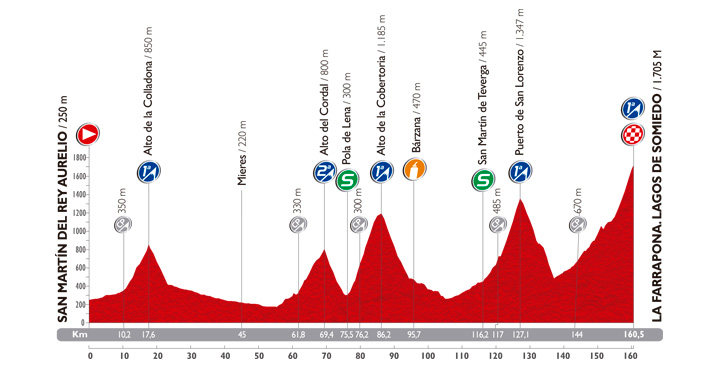
    Stage 16: San Martín del Rey Aurelio › La Farrapona. Lagos de Somiedo – 160.5 km

    After another tough day won by Przemyslaw Niemiec, Stage 16 closes out a trio of critical mountain stages in style, with no fewer than four Category 1 climbs (and a Cat. 2 thrown in for good measure), and the challenging profile won’t wait until the end of the day to test the peloton. The stage starts with 10 kilometers of slight incline before the first Cat. 1 is reached, the Alto de Colladona. After a tricky descent off the climb the riders will continue to go slightly downhill for another thirty kilometers or so, during which they will try to save as much energy as possible: after kilometer 60, it’s steep climbs or white-knuckle descents pretty much all the way to the finish line. First comes the Cat. 2 Alto del Cordal, followed by a descent right to the foot of the vicious Alto de la Cobertoria climb, a Cat. 1 of 10 kilometers at 8.8% (and it comes only halfway through the stage). From the top, the riders will take on a very technical downhill journey to Barzana, where the negative gradient will become gentler, but it won’t even out completely. When it does, after another 10 kilometers or so, the road kicks up again almost immediately, heading uphill in an uncategorized trip to the bottom of the categorized Puerto de San Lorenzo, another steep slope of 10.1 km at 8.5%. From the top it’s one more tricky descent the leads to one more uncategorized uphill trip to the foot of one more Cat. 1 climb: La Farrapona. It’s a long journey to the summit finish, 16.5 kilometers in total, and though the average gradient may seem manageable at 6.2%, the final 4 kilometers ratchet up the difficulty, with several stretches pushing over 10%.

    While the Vuelta’s sixteenth stage is followed by a rest day and is one of the last opportunities the GC contenders will have to put each other under pressure in the mountains (two factors that could spur the red jersey hunters to a fast pace and a more likely catch of the morning break), the profile itself looks perfect for any aggressive riders who manage to get up the road. Early climbs will give the uphill specialists a good chance of getting into the day’s move, and the constant up-and-down will make it very difficult for anyone to control the race. This breakaway vs. GC bunch battle looks to be another tossup, which will again make it difficult to name anyone the clear favorite to take stage honors.

    This very steep final climb should be yet another opportunity for Joaquim Rodriguez to get some separation from his rivals on the General Classification. He was unable to get clear of the rest of the red jersey hunters early on the last climb of Stage 15, and then spent most of the rest of the ascent letting Alberto Contador drive the pace, only sailing past in the final few hundred meters to steal a few seconds at the line. However, he won’t have many chances to get ahead after Stage 16, and the slope suits his style nicely. With time running out in this Vuelta, it’s hard to imagine that Katusha won’t look for stage honors and bonus seconds here. Daniel Moreno, as usual, will be a dependable second on these gradients.

    Alberto Contador may have lost a bit of time to Rodriguez and Valverde on Stage 15, but only after pulling both of them up the mountain for quite some time. He continues to show impressive strength in this race, and a stage like this, with so many vertical meters on the day, will allow him to put his otherworldly uphill endurance on display.

    Chris Froome again landed a good result after riding his own pace up a tough final climb on Stage 15. On peak form, he has the endurance to thrive on a hard stage like this; it will be interesting to see how he does despite not necesarilly being at his best. Alejandro Valverde took 2nd on Stage 15, but his nice result there didn’t necessarily show a whole lot more strength than we’ve seen just yet, as it came with a late jump around Alberto Contador (whom he’d been following for the last several kilometers) in the final few hundred meters. Stage 16 is one of the last chances for the climbers to create some space on the leaderboard, which should lead to more attacks on the final climb, and that will require more from Valverde. If he’s in a lead group in the last hundred meters, his sprint obviously makes him a top favorite, but that scenario will only occur if a lot of things go right for the 2008 winner of this race.

    Dan Martin showed immense ability on Stage 15, finishing 11 seconds behind Chris Froome despite spending several kilometers just before the final climb chasing the pack after crashing. He’s far enough behind on GC that he should have a bit of freedom to put in a late dig. Fabio Aru, in a similar position, remains a nice candidate for stage honors with this steep finish if it is, in fact, the GC men who are vying for the day. Robert Gesink, Daniel Navarro, and Samuel Sanchez are others on the fringes of the GC battle who have shown strength in the past few mountain days and who are also good candidates to get clear of the rest of the GC types on the final ascent.

    Several potential long-distance protagonists kept their powder dry and stayed in the pack on Stage 15. Ryder Hesjedal was one of them, but he did expend a lot of energy dragging Dan Martin back to the GC group after Martin’s crash. He’ll still be among the favorites if he gets into the day’s move, but it would be an impressive ride indeed if he were to succeed here after two tough days on the bike. David Arroyo was 8th on the stage that Hesjedal won from the break, and this will be another great opportunity for the pure climber to try for a long-range strike. Teammate Amets Txurruka is a good candidate to give it a go as well. Esteban Chaves has fallen out of GC contention in this Vuelta, and he could be hoping to get into the break on Stage 16, which has a steep finale that suits him; teammate Adam Yates is another likely long-distance hopeful. Astana’s Mikel Landa, Stage 15 winner Przemyslaw Niemiec of Lampre-Merida (if he still has anything left in the tank after two days in the break), his teammate Damiano Cunego, Belkin’s Laurens Ten Dam, OPQS’s Gianluca Brambilla and Wouter Poels, MTN-Qhubeka’s Sergio Pardilla and Louis Meintjes, Lotto Belisol’s Bart de Clercq, and Cannondale’s Alessandro De Marchi are other good candidates for breakaway success.

    VeloHuman Stage Favorites

    1. Joaquim Rodriguez | 2. Alberto Contador | 3. Daniel Martin

    Be sure follow @VeloHuman on Twitter for live commentary of this and every stage of the 2014 Vuelta a España! With a rest day on tap after Stage 16, the next preview will be up on Tuesday, so stay tuned for more.

    -Dane Cash
  • Tour de France 2014: Stage 16 Preview

    Tour de France 2014: Stage 16 Preview

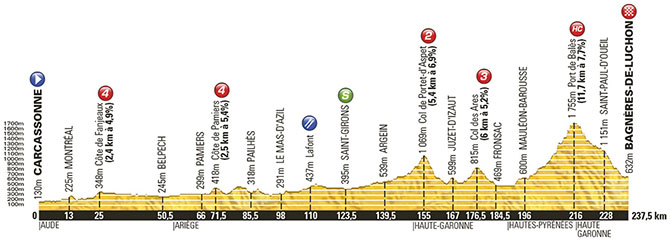
    Stage 16 Profile

    Stage 16: Carcassonne › Bagnères-de-Luchon – 237.5 km

    A flat stage (won by Alexander Kristoff) and a rest day may have given the peloton some time to gather strength, but three tough stages in the Pyrenees await. The first, Stage 16, is the longest day of racing the Tour de France has to offer, 237.5 kilometers from start to finish. The road gets hillier as the stage wears on, punctuated by an HC-rated climb crested with 21.5 kilometers remaining on the day. 11.7 kilometers long at an average gradient of 7.7%, it’s not the hardest Hors Categorie climb in the Tour, but it will be tough on the legs after so many kilometers of racing. From the top, it’s a fast, long, and at some points technical descent towards the finish, only flattening out for about 2 kilometers before the line.

    The succession of ups and downs late in the race will make this stage a difficult one for the pack to control, and with two very challenging stages to come, the motivation to do so may not be particularly strong. Stage 16 looks like a great opportunity for a breakaway to stay clear to the line. Whoever wins this stage (regardless of whether that victory comes from the pack or the early move) will have to be a strong climber and a capable descender: the final ascent and the downhill that follows will see some aggressive riding that could decide the day.

    As on any breakaway-friendly stage, there is no obvious favorite here, but there are several riders who have the skillset to pick up the win and who could try to get a headstart with a long-distance move. It would be a big surprise not to see Tinkoff-Saxo with a man in the day’s breakaway. Rafal Majka has quickly refound the legs that drove him to such a strong performance in the Giro, and out of the climbing specialists not in GC contention in the Tour de France, he’s one of the very strongest. However, he’s now a legitimate contender for the mountains classification and with plenty of KOM points on offer over the days to come, he may decide to save energy on this long day. If he does hold back from the early move, teammate Michael Rogers might be the one to watch: he put his strong descending skills on display during in his first stage win at the 2014 Giro, and he put his strong climbing legs on display in his second. He is on excellent form right now, finishing the last two mountain stages with the riders at the fringes of the GC Top 10 battle. Nicolas Roche is another great option for the team.

    Joaquim Rodriguez will be thinking hard on how he’ll want to play the three stages to come to maximize his ability to contend on the climbs. He’s getting stronger as the Tour goes on, and he will be a favorite if he gets into the breakaway, but he may not be trying to go from that far out on Stage 16. Simon Spilak and Yuri Trofimov are, as usual, nice alternatives for Katusha.

    OPQS is another team with options. Michal Kwiatkowski is out of GC contention after a few bad days in the Alps, but he’s had a rest day to recover some energy. He’s a very aggressive rider who could try to get into a long-range move, and though he might struggle to make it up this climb with the GC powerhouses, against the competition within a breakawy, he’d have a fighting chance. He’s an excellent descender and a great sprinter, making him a nice candidate. Teammate Tony Martin is also a very strong descender, and given his impressive engine, he’s less likely to be fatigued after a long day in the saddle. Versatile Jan Bakelants is yet another option.

    Lampre-Merida’s Rui Costa is almost 13 minutes back on GC, and may have some freedom to go up the road. Frank Schleck is almost two minutes behind him, and while not a great descender, he’s been climbing very well. Cannondale’s Alessandro De Marchi has been active in the breakaways and although he has fallen short so far, he’s shown nice form. His teammate Peter Sagan may actually be one to watch here as well: this final climb is tough, but it’s not so tough that his survival is out of the question. If he makes it up in the lead group, it’s hard to see anyone outmatching him on the long descent or a potential sprint finale. Movistar’s Giovanni Visconti, Sky’s Mikel Nieve and Geraint Thomas (or even Richie Porte, if he has recovered some of his strength), Europcar’s Cyril Gautier and Tommy Voeckler, IAM Cycling’s Sylvain Chavanel, AG2R’s Christophe Riblon and Blel Kadri, OGE’s Michael Albasini and Simon Gerrans, Lotto Belisol’s Tony Gallopin, and Bretagne-Séché Environnement’s Brice Feillu are other riders who might like the look of the Stage 16 profile and who could be protagonists from afar.

    If this all comes back together before or on the slopes of the Port de Balès climb, expert descender Vincenzo Nibali and fast-finishing Alejandro Valverde will be among the top favorites: the final ascent is tough, but there are hard days ahead with slopes better designed for GC action, and if riders crest the summit in groups, the fight for stage success will be all about the descent and the sprint to the line. Valverde reported mechanical issues during Stage 14, suggesting that his relatively poor showing on the final climb there was not an issue of form. He’s not a bad descender, and his sprint would give him an edge for this stage if he is in the lead group near the end of the day.

    It is possible that attacks from some of the strong-climbing riders a bit further down on GC are allowed up the road on the final ascent: in that case, watch out for NetApp-Endura’s Leopold Konig, who is looking very sharp right now, and Europcar’s Pierre Rolland, who rarely misses an opportunity to strike for glory. One other rider to keep an eye on is AG2R’s Romain Bardet. With a time trial approaching, he knows he needs to do everything in his power to strengthen his position, and given the well-publicized problems his French rival Thibaut Pinot has with fast descents, don’t be surprised to see Bardet attempt to put Pinot under pressure on Stage 16.

    VeloHuman Stage Favorites

    1. Michael Rogers | 2. Michal Kwiatkowski | 3. Alejandro Valverde

    Be sure follow @VeloHuman on Twitter for live commentary on this and every stage of the 2014 Tour de France! The next preview will be up after the conclusion of Stage 16, so stay tuned. In case you missed it, the overall Tour de France preview can be found here.

    -Dane Cash

  • Giro d’Italia 2014: Stage 16 Preview

    Giro d’Italia 2014: Stage 16 Preview

    Stage 16 Profile

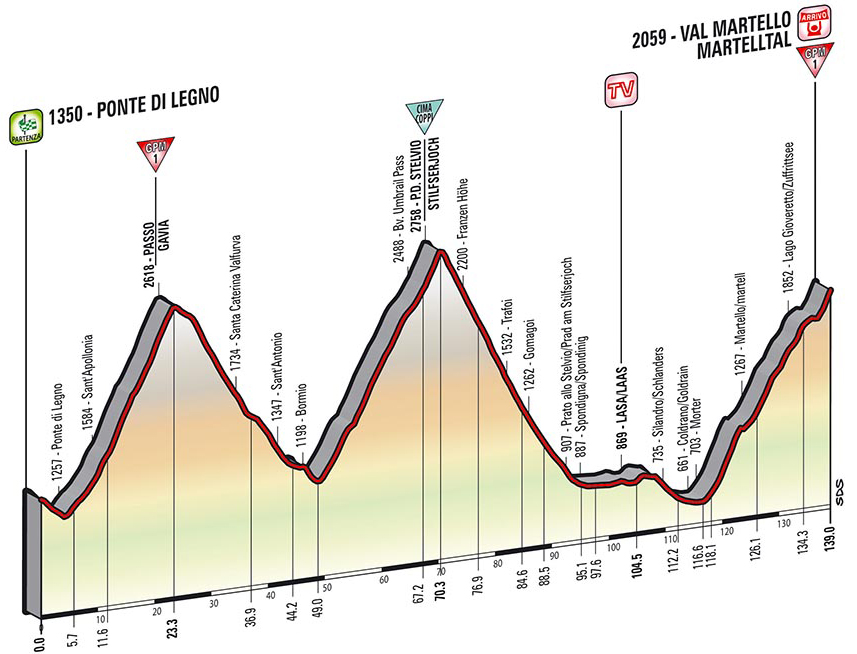
    Stage 16: Ponte di Legno > Val Martello/Martelltal – 139 km

    The peloton will be glad to have enjoyed a rest day before the brutal climbing challenge that awaits on Stage 16. Stage 15, which saw Fabio Aru take a victory and Nairo Quintana take some valuable time on GC, provided a great look at the uphill form of the big names in this race, but trips up the Passo Gavia, the Stelvio, and the Val Martello climbs could rewrite the script.

    Unfortunately, snow in the high mountains has opened the door for the possibility of an alternate route that would skip the first two climbs and replace them with a different pair of ascents before the finale. Race organizers will assess the weather situation on the morning of the stage. At the moment, however, RCS Sport is planning to go ahead with the original route, so this preview is going ahead with it as well.

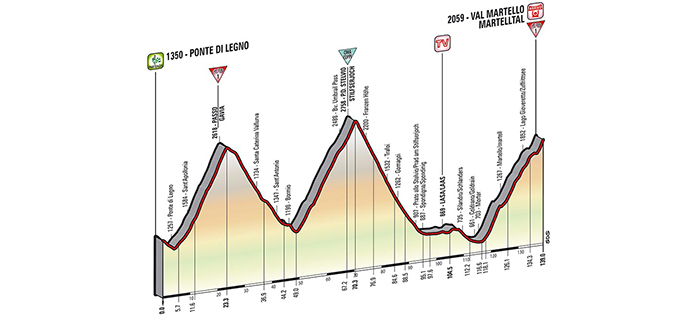
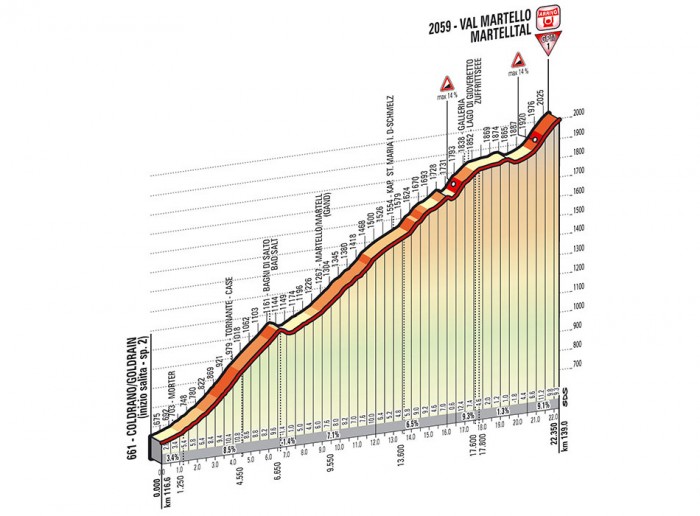
    139 kilometers make this the second shortest non-TT stage in the Giro d’Italia, but that won’t be much consolation for the riders. Very few of those kilometers don’t involve grueling ascending or nervous descending. The peloton will enjoy about 5 downhill kilometers to start the day before they take on the Passo Gavia climb, 16.5 km at 8%. From Cat. 1 summit, it’s a technical and rough descent that runs to the foot of the Stelvio ascent, 21.7 kilometers at an average of 7.1%. The roads are narrow and it’s quite cold towards the top. Another tricky descent follows, before the road flattens out a bit with around 35 kilometers remaining. The final climb is an irregular 22.4 kilometer journey that averages 6.4%, but it includes various sections of 10% or more, including one just before the finish line.

    Val Martello

    This stage is a prime target for anyone hunting the King of the Mountains jersey. The top of the Stelvio, as the highest point in the Giro (the “Cima Coppi”), offers more KOM points than any other climb in the race. The Gavia and Val Martello climbs are both Category 1s. The competition to get up the road early will be fierce, as it will be difficult for any rider who misses out to take home the blue jersey. As leg-breaking as the first two climbs are, the final ascent will be an excellent opportunity for the GC men to attack each other, enough so that most of the big pink jersey contenders are probably planning to hold off on making moves until the road goes up for a final time. This means that the breakaway, already likely to be made up of some very talented climbers, will have a great shot of staying away.

    As with most breakaway-friendly stages, naming favorites it’s quite difficult, but Julian Arredondo stands out as one of the likely protagonists to make things interesting. He went far too early on the Montecampione climb on Stage 15 and cracked, but he’s had a day off to recover some strength and he knows how important this one is. Given the likelihood of breakaway success, Arredondo is a great bet to take the stage from an early move, assuming he doesn’t go too deep trying to pick up points in the first two climbs. If he is there in the final, he’ll have a number of opportunities on the irregular slopes to launch an attack.

    Colombia’s Fabio Duarte nabbed 2nd on Stage 15 among the very best climbers in this race. Unlike Arredondo, Duarte does not seem focused on the blue jersey, meaning that he won’t need to expend too much energy trying to be the first to the top of the Gavia or Stelvio climbs. He’s far enough down on GC to be allowed off the front and he’s on elite form at the moment, making him a great candidate for success here. If Duarte is on the front towards the end of the day, he’ll be a really difficult guy to catch on the final climb. Another option for Colombia is Duarte’s teammate Jarlinson Pantano, who came pretty close to victory from the breakaway on Stage 14 and could look to try again after recharging his batteries.

    Katusha’s Daniel Moreno stuck with the GC contenders on Stage 15 and finished 8th on the day. No longer a threat for the maglia rosa, Moreno could try to go for a long one, and he’s obviously in top shape. Katusha came into this race with such high hopes, and Moreno is their best bet to make something happen.

    Other strong options to go long include Sky’s Dario Cataldo and Sebastian Henao, Bardiani-CSF’s Stefano Pirazzi, Lampre’s Przemyslaw Niemiec and Diego Ulissi, Neri Sottoli’s Yonathan Monsalve, Astana’s Mikel Landa, and Tinkoff-Saxo’s Nicolas Roche.

    If the peloton decides to keep the gaps manageable over the first two ascents, it will be tough for a breakaway to survive all the way up the brutal final climb. Should the GC contenders end up fighting it out for stage honors, Nairo Quintana has to be the favorite. He has shown in the last two stages that he’s recovered from the health issues that plagued the beginning of his bid for Giro glory, and he’s had another rest day since then just in case he wasn’t all the way back to full strength. With two long mountain slogs to wear out the legs in the first half of the stage and a third with plenty of excellent launching pads for attacks to close things out, Stage 16 suits Quintana’s skillset perfectly. He needs to claw back time on his GC rivals, and this is an excellent opportunity that he won’t likely pass up. I wouldn’t necessarily bet on him over the field, given the likelihood of breakaway success, but he’s certainly the single favorite rider to take the day.

    Astana’s Fabio Aru delivered a beautiful victory on the Plan di Montecampione on Sunday. He made a decisive move to get away from the pack of GC contenders and stayed full throttle all the way up, putting his raw talent and his top-shelf form on full display. We’re into the third week of the race now and he has yet to show signs of slowing down. With teammates like Michele Scarponi and Mikel Landa, he has a great shot at continuing his successful Giro, though the seemingly endless climbing of Stage 16 will really put him to the test.

    Europcar’s Pierre Rolland is climbing quite impressively in this race. Far enough back on GC that the big names are giving him breathing room to attack, he has gone on the move at nearly every opportunity so far, and clawed back some of the time that he lost early on the Giro. With the form he has displayed constantly jumping out ahead of his GC rivals, Pierre Rolland should have another strong performance in the cards. Garmin’s Ryder Hesjedal has not been as successful, but he’s looked decent so far and could also see success if allowed to get out front.

    Gaining time on almost all of his rivals (other than Quintana and Aru) on Stage 15, Rigoberto Uran made a strong statement that his Stage 14 may have been more the result of a bad day than a loss of climbing form. OPQS (with Wout Poels leading the way) has supported him well on the tough mountain days. He’s more focused on marking his GC rivals than jumping ahead for stage honors, but with his explosive uphill ability he could have a shot if things hold together until the end of the last climb.

    Tinkoff-Saxo’s Rafal Majka has a great resume on the very hard days in the mountains and could look to make something happen here. He was one of the strongest GC riders on Stage 15 and Stage 16 could be even better for the climbing star. AG2R’s Domenico Pozzovivo has not quite lived up to expectations in the past few stages but a true climber’s test with plenty of opportunities to attack should suit him. BMC’s Cadel Evans won’t love the constant changes of pace that his rivals are likely to force on these irregular slopes, but he could respond to moves more effectively after a rest day. Belkin’s Wilco Kelderman has hung with the best so far, but he has another brutal test waiting for him here.

    VeloHuman Stage Favorites

    1. Nairo Quintana | 2. Fabio Duarte | 3. Julian Arredondo

    Keep an eye out for news of a possible route change in Stage 16, but even in the event of alterations, it’s still likely to be a day with big GC implications. The Stage 17 preview will be up a few hours after the Stage 16 finish. In case you missed it, the overall Giro d’Italia preview can be found here. Also, be sure to follow @VeloHuman on Twitter for more analysis during the race.

    -Dane Cash