The Tour de Pologne is the first stage race that follows the Tour de France on the WorldTour calendar. Now in its seventy-first year, it tends to be an exciting and often unpredictable contest, as many riders are coming into the race following La Grande Boucle, hoping to maintain their form for one more week, while others are returning to competition after long midseason breaks, and are therefore in unknown condition. Pieter Weening was the surprise winner of the 2013 edition. Daniel Martin and Moreno Moster both picked up their first WorldTour victories here. Expect more of the unexpected in this year’s journey through Poland.
The Route
The Tour de Pologne opens with several days that aren’t likely to impact the General Classification: the fast men should reign supreme at the beginning of this week of racing. Stage 1 has a few small hills, but it’s not likely to see any significant separation and will probably end in a sprint. Stages 2 and 3 are almost guaranteed to come down to a bunch gallop, while Stage 4 at least closes out with a succession of small rollers to open the door for some moves (though a sprint is again a likelihood).
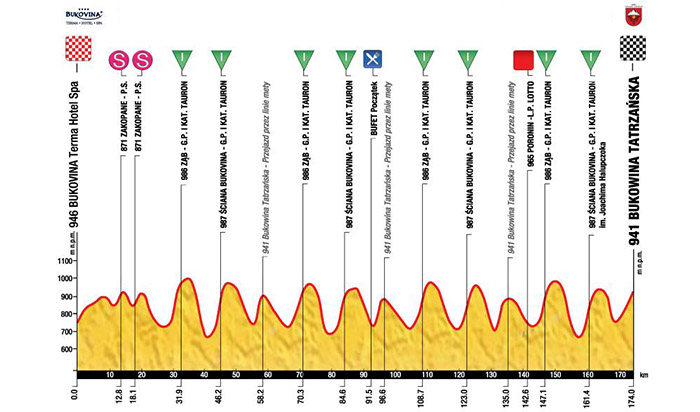
Stage 5 will be a jarring transition, with some early uphill challenges and then an arduous skyward trip to the Štrbské Pleso resort that is repeated not once, but twice, with the third and final ascent climbing higher than the first two to a summit finish line. Stage 6 is an even harder day of climbing, with almost no flat sections across 174 kilometers of racing.
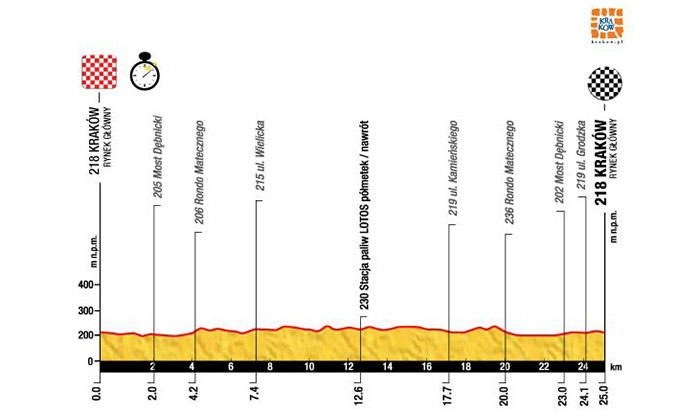
The seventh and final stage of the Tour of Poland is a 25 kilometer race against the clock that starts and finishes in Kraków. It’s a mostly flat affair that will really favor the powerful time trialing experts, and it’s likely to play an integral role in deciding the overall winner.
The General Classification Contenders
A few early hills, a pair of tough mountain stages, and a high-speed chrono make this a profile for the well-rounded riders. The the time trial, in particular, will have a big impact on the overall leaderboard: a 25 km ITT may not seem like much, but with only two real climbing stages to open up any serious gaps on GC, it will be a pivotal test for the contenders.
As unpredictable as the Tour de Pologne tends to be, Rafal Majka will enter the race as a top favorite. He’s a star climber who just won two stages and the King of the Mountains classification in the Tour de France, showcasing stellar form right now, but he has also developed considerably as a soloist this year, putting in a ride good for 4th in the Giro’s first (and less climber-friendly) ITT. With the motivation of performing in front of his home crowd, Majka has the tools to better the 4th overall he notched in the 2013 edition of this race.
The winner of that 2013 running of the Tour de Pologne, Pieter Weening, will be another likely protagonist in the GC battle. He’s had an up-and-down year, anonymous in some races but also winning a stage at the Giro d’Italia and the recent Giro della Toscana. When he is locked in, he’s a major talent, and this is a race in which he’s had a lot of success; in addition to his recent overall victory, he also has been 2nd overall and a stage winner in the past. Versatile Cameron Meyer will be a great teammate.
Movistar’s Ion Izagirre was runner-up in 2013 and looks to be on good form right now, having put in a strong ride in support of Alejandro Valverde in the Tour de France. The 25-year-old can deliver a nice time trial and while the high-gradient climbs can be a bit of a challenge for him, the uphill tests in this Tour de Pologne should be within his capabilities. Movistar also has Beñat Intxausti, who has shown immense talent in various races throughout his career (he was 8th in the Giro and outclimbed Rui Costa and Dan Martin to win the Tour of Beijing last year), but who has also been a nonfactor in plenty of races where he might have been expected to thrive. Eros Capecchi (6th in the 2013 Tour of Poland) and Andrey Amador are other options.
Sky’s Dario Cataldo will like the look of the profile. A strong time trialist who is also capable of powering up the less steep climbs quite nicely, he has the skillset to succeed here. Sky is desperate to find a shred of success right now and Cataldo is a tough competitor who came close to delivering results on a number of occasions in this year’s Giro. This could be his opportunity. Kanstantsin Siutsou, great in the ITT, and up-and-comer Sebastian Henao, great on the climbs, are other options.
Trek has a very strong squad for this race, with several potential GC contenders. It will be interesting to see how they play this: Bob Jungels should land a nice result on the final time trial, though the climbs will be a big challenge for him. Giro d’Italia King of the Mountains Julian Arredondo, on the other hand, shouldn’t have much trouble with those climbs, but he doesn’t have much ability against the clock. The same is true for Robert Kiserlovski, 10th overall in this year’s Giro. In other words, depending on how they decide to take on this race, Trek will have the firepower to light up the mountain stages, or to help support their more capable time trialist through them. Given all of the talent in the roster, it seems likely that they’ll have at least one rider in the mix for the Tour of Poland GC.
Wouter Poels of OPQS has an excellent skillset to contend. Known for punchy climbing ablility, he has developed into a good time trialist as well. He was 4th here in 2011 and has had a great year so far. Teammate Thomas De Gendt is another potential protagonist, with a top-notch time trial. He’s been an inconsistent rider on the climbs recently, sometimes showing great uphill form, sometimes struggling mightily, but if he can put together a pair of good days during the mountain stages, he could be in the mix.
Garmin-Sharp’s Ryder Hesjedal isn’t the rider he was in 2012 when he won the Giro, but he did land a decent 9th in that race this year, and followed that up with some strong riding in support of Andrew Talansky during the Dauphine. He hasn’t raced since, but this will be an important step in his Vuelta preparation. 23-year-old Nathan Brown, good against the clock and capable on climbs that aren’t too steep, could be a nice dark horse candidate.
Belkin’s Robert Gesink enters the race with unknown form, without many racing days in 2014 as a result of a heart condition that required surgery in the spring. A great all-round talent when at his best, he will be a rider to watch in this race. It’s hard to say how he’ll do: if the intense training he’s been doing out of competition has pulled him back into form, he’ll could contend here; on the other hand, it wouldn’t be a surprise to see him fall off the pace early.
AG2R’s Christophe Riblon was on the podium of last year’s race, but he’s done very little so far in 2014. He did spend a lot of time putting in work for his teammates in the Tour de France, however, so it wouldn’t be a complete surprise to see him in the mix despite a lack of results this year: he’s obviously a great climber but he’s not bad in the ITT either. Astana’s Fabio Aru established himself as an elite uphill specialist in this year’s Giro d’Italia, but it will be a big ask for him to separate himself enough from the pack on the steep stuff to counteract the inevitable losses in a mostly flat ITT. Janez Brajkovic could be a nice alternative for the team. The chrono will be a major obstacle for Giant-Shimano’s Warren Barguil, but he’s a great climber who should be starting to round into form for the Vuelta. BMC has a very strong nice three-pronged attack in Steve Cummings, Samuel Sanchez, and Peter Velits. Lotto Belisol’s Maxime Monfort, Cannondale’s Davide Formolo, Damiano Caruso, and Moreno Moser, FDJ’s Alexandre Geniez, Lampre-Merida’s Przemyslaw Niemiec (who will try to get something out of this season in his home race after a crash doomed his Giro hopes), RusVelo’s Ilnur Zakarin, and CCC Polsat Polkowice’s Davide Rebellin are other outsiders who could be looking to land a GC result.
The Stagehunters
With several stages likely to end in sprints, the fast men will feature prominently in this race. Lampre’s Sacha Modolo looks to be the class of the bunch (with teammate Roberto Ferrari as a nice alternative), while Belkin’s Theo Bos, Giant-Shimano’s Luka Mezgec, OGE’s Michael Matthews, Movistar’s Juan Jose Lobato, Sky’s Ben Swift (and Edvald Boasson Hagen), and Garmin-Sharp’s Tyler Farrar will be other top contenders in the sprints. AG2R’s Yauheni Hutarovich and Davide Appollonio, BMC’s Thor Hushovd, OPQS’s Nikolas Maes, and Astana’s Francesco Gavazzi will also hope to be in the mix for the bunch finishes.
In addition to the many strong time trialists already mentioned as potential GC contenders, there will be several other chrono specialists in attendance, with Movistar’s Adriano Malori the top name on the list. OGE’s Brett Lancaster, Belkin’s Jack Bobridge, and Giant-Shimano’s Tobias Ludviggson are others with the potential to deliver against the clock.
VeloHuman Top 10 GC Favorites
Winner: Rafal Majka
Podium: Pieter Weening, Dario Cataldo
Other Top Contenders: Ion Izagirre, Wout Poels, Bob Jungels, Christophe Riblon, Ryder Hesjedal, Robert Gesink, Fabio Aru
As usual, VH will be tweeting plenty of live analysis during the race, so follow @VeloHuman on Twitter for more. Also, be sure to check back in a few days for the preview of the Eneco Tour!
-Dane Cash
Photo by Piotr Drabik.