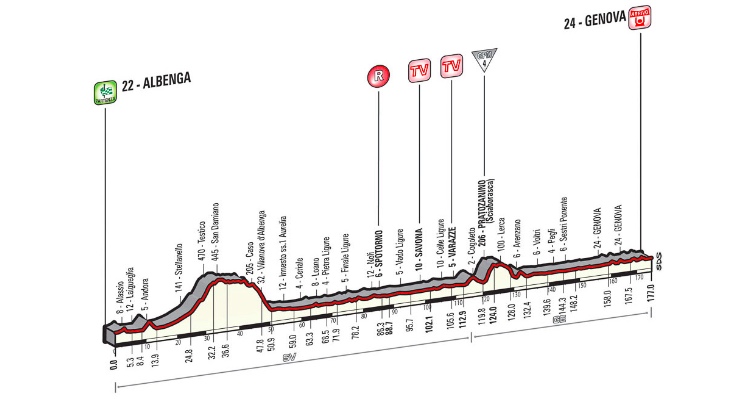
Road racing gets underway at the Giro d’Italia with a mostly flat Stage 2. A single Cat. 4 climb inside the final 60 kilometers is the only official categorized acent of the day. The finish has a few bumps, though, and the road to the line angles ever so slightly uphill.
With the general classification still completely unsettled and a profile without many big challenges, this looks like a sprinters’ stage all the way. There are several candidates for victory—although there are plenty of big-name fast finishers in the race, none comes in as the clear favorite for one reason or another.
André Greipel has the strongest track record and, at his best, probably the fastest kick. He’s probably the best bet to win Stage 2, though he’s here without much of a leadout and he’s not the most consistent rider in the world, often disappearing on days that would seem to suit him.
Giacomo Nizzolo can handle a slightly uphill finish and he’s highly motivated in this Giro d’Italia, with a dedicated leadout train to position him well among the favorites. Few can match him for top speed. Sacha Modolo is also extremely quick, and coming off a nice stage win in the Tour of Turkey. He can run hot and cold, but if he’s feeling good, he will be hard to beat.
Elia Viviani is a strong sprinter who won’t have as much support as he’d like, given the fact that Sky is here for Richie Porte; still, I think he’s capable of coming away with a victory in a straight-up bunch kick. Nacer Bouhanni showed last year that you don’t need an elite leadout to win big sprints in the Giro. Luka Mezgec does have a strong leadout squad but little in the way of recent results. Still, he’s a danger.
Michael Matthews of Orica-GreenEdge can’t be underestimated even if a big bunch gallop. He’s been successful in that scenario before. With the slight uphill drag at the line, he’ll be an even stronger candidate for victory. The same is true for JJ Lobato, who has had a nice year so far.
Other candidates for victory in the likely sprint are Matteo Pelucchi, Alessandro Petacchi, Moreno Hofland, and the EQS duo of Gianni Meersman and Tom Boonen.
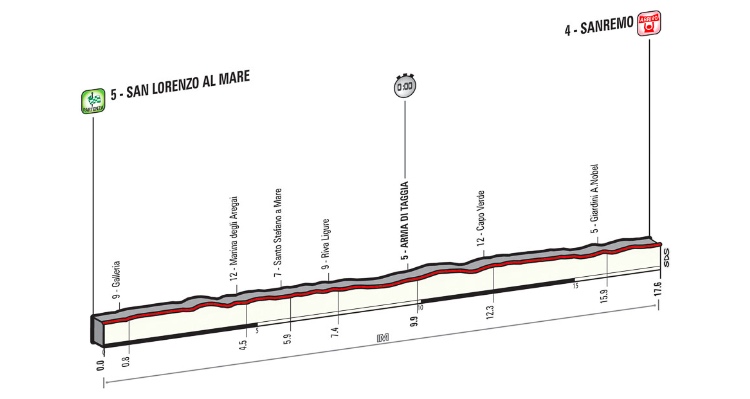
Stage 1 (TTT): San Lorenzo Mare › Sanremo – 17.6km
The 98th Giro d’Italia gets underway with a 17.6-kilometer team time trial. It’s a short, flat affair from Point A to Point B, but there are some tight corners along the way. Huge gaps are unlikely but the good TTT squads should be able to pick up a bit of time on the weaker teams here.
Most of the powerhouse names in time trialing are skipping the Giro this year, but the always strong Orica-GreenEdge TTT squad was never built off of one big name anyway. They get it done with consistent strength from top to bottom, good teamwork, and grade-A preparation. With most of the same riders that very nearly won the Tour de Romandie TTT, they will be the favorites to take Stage 1.
Team Sky beat them in Romandie but that team consisted of different riders; the black and blue squad will still have plenty of chrono firepower here, but will it be enough without Froome, Thomas, and Rowe? Motivated as they’ll be to put Porte into a good position for this race, expect a strong ride.
The GC aspirations of Joaquim Rodríguez have often been put at a serious disadvantage by Katusha’s poor team time trialing performances, but the Russian squad has found new life in this discipline thanks to chrono talents like Anton Vorobyev. They’ll be in the mix here. Etixx-QuickStep, on the other hand, has a reputation for TTT dominance, but the majority of their specialists aren’t making the trip to Italy.
Tinkoff-Saxo isn’t bringing too many big TT stars either, but a strong ride in support of Alberto Contador should be in the cards given the amount of general talent on the roster.
VeloHuman Stage 1 Favorites
1. Orica-GreenEdge | 2. Team Sky | 3. Katusha
Be sure to check back after the conclusion of Stage 1 for the preview of the next stage…
The Giro d’Italia kicks of the first three weeks of Grand Tour season this weekend. Last year’s winner Nairo Quintana won’t be at the startline, but the hottest rider of the spring, the best GC rider in recent history and last year’s runner-up will be, along with a host of other big talents. Every one of the major jerseys in the race (pink, red, blue, and white) will face fierce competition from a number of candidates—as Grand Tours go, things are pretty open for the taking in the 2015 Giro d’Italia, and that should make it even more worth watching. And more worth checking out pre-race content too, like the most recent Recon Ride pre-race podcast…
The Route
This year’s Giro route is a balanced one, with six or seven days that favor the sprinters (depending on how optimistic you are about the versatility of some of the quick men), about as many days for the GC types, several intermediate stages, a team time trial, and an individual time trial. It’s the sort of parcours that will require a complete set of skills to make it through with success.
The TTT kicks things off—at 17.6 kilometers it won’t open up massive gaps but it will give a few teams a not-insignificant advantage in the fight for the pink jersey. The sprinters and puncheurs, and the craftier aggressors will have their opportunities in the opening week of flat or rolling stages, though a small summit finish on Stage 5 will probably see at least a few GC hopefuls caught unprepared. Stage 8 is another potential GC day, with a breakaway friendly Stage 9 and then a rest day to follow. Stages 10 through 13 will be prime targets for the stagehunters as the GC types prepare for a critical week starting with a very long (59.4km) individual time trial on Stage 14. By the end of the day, there will be sizeable differences between the riders on the GC leaderboard.
But they won’t get to rest in the aftermath. Challenging mountains await on Stages 15 and 16 (the latter offers the viciously steep Mortirolo as the penultimate ascent on the day). The pink jersey hunters will catch their breath on a relatively easy Stage 17 before a difficult trio of mountain stages, culminating with a Stage 20 that will force the peloton to go up and over the incredible Colle delle Finistere.
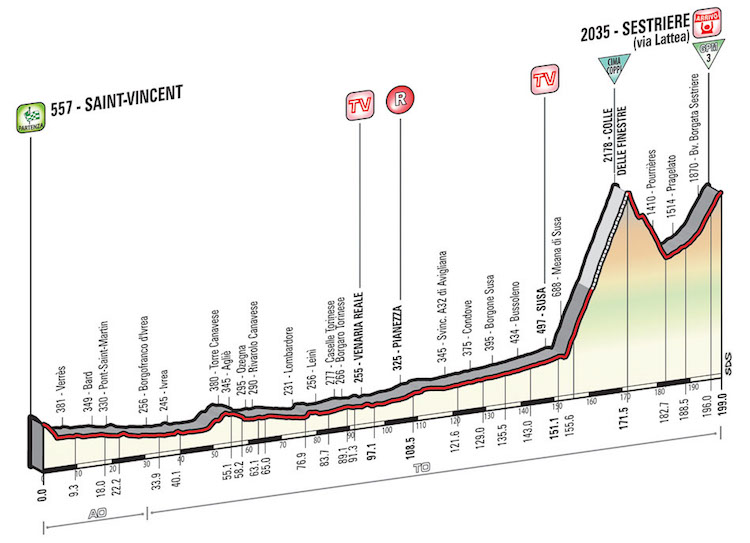
Stage 20: Sint Vincent › Sestriere (196km) – The penultimate climb of the day will be among the hardest uphill challenges the professional peloton will face all season.
It may not have the name recognition of some other famous Giro mountains, but that won’t be much comfort to the riders climbing it’s 18.5 brutal km at a 9.2% average gradient. Stage 20 closes thing out with a sprinter-friendly day in Milan.
The GC Contenders
The trio rightfully receiving the most attention prior to the start of the race is that of Alberto Contador, Richie Porte, and Rigoberto Urán. Each is a complete rider backed by a strong team.
Contador, who has won this race in the past, looks like the top favorite. His skills are widely known. At his best, he’s almost unbeatable, and one might expect him to easily best Porte and Urán—but he’s aiming for the Giro-Tour double this season, and that may explain in part why his early-season racing has not been up to Contador standards.
Still, he’s put in okay showings all year long, hanging with the top favorites on the mountain stages of the one-weekers he’s raced, letting others be the main protagonists as he has rolled into Top 10 placings. In this race, which matters much more than Tirreno-Adriatico, expect Contador to fight harder. His form may be a bit of a question mark but his ceiling is so high it’s hard to look past him even if he’s a bit below 100%. Roman Kreuziger, Michael Rogers, and Ivan Basso (Kreuziger in particular) make for excellent lieutenants.
Richie Porte, on the other hand, has been terrific so far this year. He’s checked all the boxes in the run-up to this race, winning both on the hills and against the clock. Now all that remains is the big goal of his season. Thanks to his strong TT, Porte is best-suited to races with lots of chrono mileage, and the 59.4km ITT should be good for him. The big concern for Porte is his propensity to crack in a three-week race. As amazing has some of his one-week performances have been, he is a 30-year-old GC rider with just one Grand Tour Top 10 to his name, so often putting in a bad day in the mountains to ruin his campaigns. If he can avoid that this year (which is something that’s been said in the past) he should contend for the victory, with help from Leopold König, Mikel Nieve, and the rest of a strong Sky team.
Urán will hope to better his two straight runner-up performances. With Contador and Porte around, it won’t be easy, but if Contador is indeed lacking for form compared to Urán, for whom the Giro is the season’s main target, and if Porte does have a bad day in the high mountains, then Urán can slide into the driver’s seat with his powerful engine. And really, neither of those conditions is that unlikely, making Urán a viable contender.
Fabio Aru would probably be right up in there in the favorites conversation but he’s been sick this year and it’s hampered his prep. He’s a brilliant climber when in form, making him dangerous regardless, but the health is a question mark. The long ITT doesn’t suit him either. He’ll need all the help he can get in this race, though Astana brings a strong squad of supporters/potential alternatives with the likes of Mikel Landa, Dario Cataldo, and Diego Rosa.
Domenico Pozzovivo doesn’t have a flashy resume but he’s put in several strong performances here over the years and could be one to take advantage of the situation if the top favorites start looking at each other. He’s got an impressive uphill burst.
Former winner Ryder Hesjedal will hope to leave his mark on the 2015 edition of the race but Cannondale-Garmin teammates Davide Formolo and Tom Danielson may be even better bets. Jurgen Van Den Broeck of Lotto Soudal looked great in the Tour de Romandie. Movistar’s Beñat Intxausti and possibly Ion Izagirre will hope to carry the flag in place of Nairo Quintana. Expect at least one of them to do very well. Katusha’s Ilnur Zakarin will look to continue his great run; it’s pretty hard to know what to expect from the surprise Romandie winner here. Damiano Caruso and Darwin Atapuma, Przemyslaw Niemiec and Diego Ulissi, Damiano Cunego, and Esteban Chaves are other outside candidates for GC contention.
The Stagehunters
The sprinters’ stages should be a bit more unpredictable than they were last year, when Marcel Kittel and Nacer Bouhanni dominated the conversation in succession. André Greipel is probably the fastest “on paper,” but he’s lacked consistently of late and isn’t the type to win every sprint stage in a race. Giacomo Nizzolo could finally get that Giro stage win after years of trying: his top speed is impressive. Elia Viviani transferred to Sky during the offseason and will hope to get at least a little bit of support from his team on the sprinters’ days. Luka Mezgec will benefit from Giant-Alpecin’s always strong leadout but his early season has not mirrored his impressive early 2014 campaign. Sacha Modolo is extremely fast but can run hot and cold.
Michael Matthews, who wore pink and took an amazing hilltop victory last year, will return to fight for the bumpier sprint stages with JJ Lobato, who has been great so far this year. Matteo Pelucchi and Heinrich Haussler, Tom Boonen and Gianni Meersman, Moreno Hofland, and Nicola Ruffoni are other speedsters who could be in the mix on the days that end in fast finishes.
Watch out for the always aggressive Adam Hansen, Sylvain Chavanel, Maciej Paterski (who has been great so far in 2015), the entire Bardiani-CSF team (especially Stefano Pirazzi), which will be firing off breakaway attempts at every opportunity, and punchy types like Simon Gerrans, Tom-Jelte Slagter and Philippe Gilbert on the intermediate days.
VeloHuman Top 10 Overall Race Favorites
GC Winner: Alberto Contador Podium: Richie Porte, Rigoberto Urán Other Top Contenders: Domenico Pozzovivo, Jurgen Van Den Broeck, Beñat Intxausti, Fabio Aru, Przemyslaw Niemiec, Roman Kreuziger, Ilnur Zakarin
Be sure to follow @VeloHuman on Twitter for more analysis during the race, and keep an eye out for daily stage previews (the Stage 1 Preview is already up)!
The Classics are in the rearview mirror but the WorldTour drives on, with the Tour of Romandie the next race on the docket. A six-stage event in the French-speaking part of Switzerland, Romandie has drawn an excellent startlist of big GC names to race its scenic parcours (said scenery one of the many topic’s discussed in the latest Recon Ride, which is worth checking out).
The Route
The Tour de Romandie opens with a team time trial. It’s got a small hill near the end but otherwise it’s relatively flat; at 19.2 kilometers, it’s not long, but it’s not short either, and there will likely be gaps large enough to give a few contenders a sizable advantage.
Stage 2 is a bumpy 166.1km day that will likely see some attempts to get clear on the Cat. 2 climb crested with less than 10km to go, though a major GC shakeup seems unlikely. Stages 3 and 4 have up-and-down profiles but don’t have any major ascents: the sprinters will try to hold on and their teams will try to keep breakaways from going the distance.
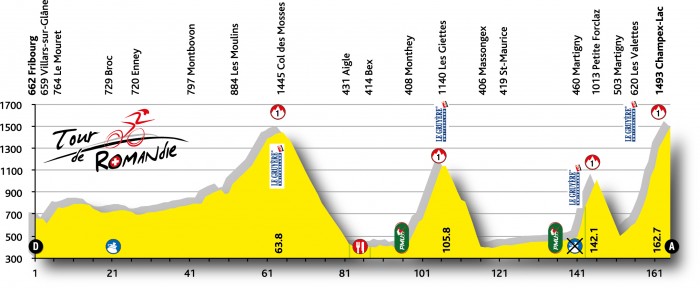
Stage 5 is likely to be the most decisive stage of the race, with four Category 1 climbs on the menu, including one to close out the stage.
Stage 5: Fribourg › Champex-Lac (166.1km) – The clear “queen” stage of the Tour de Romandie is the mountainous Stage 5.
The ascent to the summit finish is particularly challenging, 14.2km at 7%, and after a day of tough climbing, plenty of would-be GC contenders will likely run out of gas on the incline.
The Tour de Romandie finishes with a 17.3km individual time trial. There is two-part climb in the middle of the course but not one so steep as to make this a climber-friendly ITT: the big engines should thrive here.
The GC Contenders
Chris Froome will be looking to take his third Tour de Romandie in a row this year, but his run-up to this race has not been ideal. Illness forced him to withdraw from Tirreno-Adriatico in March, he was unable to put up much of a showing in his Catalunya return, and then he suffered a bad fall in La Flèche Wallonne. Apparently he’s healthy enough to race, but form is an unknown. He did appear to be going well enough on the road to the Mur de Huy before his crash, and he did ultimately finish the race. His record here and elite combination of climbing and chrono talent (and his team’s) make him hard to pick against as the top favorite again this year, but there is always the possibility that he is just nowhere near racing shape, and competition will be fierce. Geraint Thomas and Nicolas Roche will be around to play support roles or act as alternatives if necessary, which is quite a luxury for Sky.
Vincenzo Nibali did not land any big results in the Ardennes, but he did show himself to be fit. The chrono mileage doesn’t particularly suit him compared to some of the more ITT-savvy riders here, but he’s demonstrated form more recently than most of the other big names on the startlist. Jakob Fuglsang will make the start as well and figures to play a role for the team coming off of back-to-back Ardennes Top 10s. Fuglsang and Nibali were both in the Top 10 last year and it would be a surprise not to see them both in the mix again this year.
Nairo Quintana’s presence on the startlist means that three of cycling’s so-called Big Four will take on the Tour de Romandie, with Alberto Contador being the only missing rider of the quartet. Quintana, like Nibali, would prefer more climbing and less time trialing. What’s more, although Movistar often field a very strong TTT squad, most of their big chrono guns are sitting this race out. That means that Quintana will have a lot of work to do on Stage 5. Still, he has looked great on the slopes this year and will relish the opportunity to face off against his Tour de France rivals.
Rigoberto Urán is one of the top favorites for next month’s Giro d’Italia, and that means he’ll likely be close to top form in this race. He’s also an elite time trialist riding for EQS, who field an elite TTT squad (which includes Tony Martin) here as well. The Tour de Romandie suits him very well, and he should be in the mix for the overall victory.
Simon Spilak has been runner-up in this race to Chris Froome for two years running. He tends to perform very well in Switzerland, and he’s got a strong all-round skillset that should keep him in contention on both the climbs in the time trials.
Rui Costa also performs at an extremely high-level in Switzerland, with a statistically anomalistic three straight 3rd-place finishes in this race and three straight wins in the Tour de Suisse. He was only so-so in País Vasco but he looked good in the Ardennes Classics and his tendency to ride aggressively on bumpy profiles will be beneficial with this route. I expect Costa to be fighting with the top favorites for the win.
AG2R’s JC Peraud is well suited to the parcours and heading up a powerful team, though one that is likely to lose ground in the opening TTT. Romain Bardet is another option here, though he’ll need to be very aggressive on the climbs to overcome lacking ITT skills in addition to the team’s weak chrono. Mathias Frank of IAM Cycling tends to do quite well in his home country of Switzerland, though the TTT will likely make this a difficult race for him as well. FDJ’s Thibaut Pinot should be in the mix, with Swiss all-rounder Steve Morabito making the start as a nice second. BMC’s Rohan Dennis is an elite time trialist who will hope to handle the difficult climbs. Orica-GreenEdge’s Simon Yates, Lotto Soudal’s Jurgen Van Den Broeck, Tinkoff-Saxo’s Rafal Majka, Cannondale-Garmin’s Dan Martin and Ryder Hesjedal, LottoNL’s Robert Gesink, and Europcar’s Pierre Rolland are other GC types with a chance in this race.
The Stagehunters
Not many pure sprinters are making the trip to the Tour de Romandie, probably because there aren’t many stages that are surefire sprint days. Stages 3 and 4 seem like the most likely opportunities for the quick men, and Giant-Alpecin’s Luka Mezgec, Trek’s Giacomo Nizzolo, Sky’s Elia Viviani, and Europcar’s Bryan Coquard look to be the class of the bunch gallopers. The likes of OGE’s Michael Albasini (who won a whopping three stages last year), FDJ’s Arthur Vichot, EQS’s Gianni Meersman and Julian Alaphilippe, and AG2R’s Jan Bakelants are among the riders to watch on the hillier days that could see the heavier pure sprinter-types left behind.
And time trial wonder Tony Martin deserves a mention of his own, given the fact that this race closes out with an ITT. He should be the favorite to win that stage, with only some of the aforementioned chrono-oriented GC men to challenge him.
VeloHuman Top 10 Overall Favorites
GC Winner: Chris Froome Podium: Rigoberto Urán, Vincenzo Nibali Other Top Contenders: Rui Costa, Simon Spilak, Nairo Quintana, Jakob Fuglsang, Thibaut Pinot, Jean-Christophe Peraud, Geraint Thomas
What better way to close out the Classics season than with the legendary Liège-Bastogne-Liège? The oldest Classic, Liège lives up to its status as a historic (said history covered in more detail in the most recent Recon Ride Podcast) springtime cycling icon with a challenging route that caters to aggressive types with strong climbing legs, and recent editions have offered no shortage of thrills. With most of the familiar veteran contenders and a host of young guns making start, the 2015 edition should not disappoint.
The Route
Liège-Bastogne-Liège is a long one at 253 kilometers, and the road from Liége to the finishing town of Ans is lined with difficult climbs (officially, there are ten). This is especially true in the final 90 kilometers of the race, where eight of the ten ascents big enough to warrant an icon on the official race profile await the peloton.
The last three in particular really put the hurt on, typically whittling down the peloton and launching attacks as well: the Côte de La Redoute (2 km at an average grade of 8.9%), the Côte de la Roche-aux-Faucons (1.5 km at an average grade of 9.4%), and the Côte de Saint-Nicolas (1.2 km at 8.6%). Saint-Nicolas, crested just 5 kilometers from the line, is a popular place to strike out for glory. The race finishes on a gradient as well, with a climb into Ans of more than a kilometer.
With the abundance of challenging climbs and a lot of kilometers between the start and the finish, Liège wears down the peloton, but also offers opportunities for those strong enough to get clear. Sometimes the race ends in a small sprint, but there are always attacks to be marshaled, and endurance and great climbing legs are critical here.
The Contenders
Last year’s winner Simon Gerrans looks to still be recovering from a crash, meaning that Orica-GreenEdge is probably riding for the likes of Michael Albasini. That might open up the contenders conversation a bit, but fresh off his third career Flèche Wallonne victory, two-time Liège winner Alejandro Valverde comes into the race as the hot favorite. His elite climbing legs and deadly finishing kick make him an obvious choice for this race, and the form he has shown recently confirm has status as the rider to beat this year.
Michal Kwiatkowski was 3rd last year and comes into this year’s edition with Amstel Gold Race-winning confidence. His already impressive sprint has clearly improved this year, and he’s a great solo artist. It won’t be easy to match the climbing legs of some of the star uphill chargers in this race, but if Kwiatkowski can survive some of the steeper sections of the road, he’ll be able to outsprint most of the contenders in the race or outpower them in a late break to the finish.
After his incredible Basque Country performance, Joaquim Rodríguez was a bit of a disappointment only coming in 4th at La Flèche Wallonne, but this is the grand prize and the one he’s been hunting for so long. The rare soloing form he showed in the País Vasco time trial could come in handy here, matched with his elite climbing ability. This is also a race where a strong team can make a big difference, and Katusha is among the strongest. Daniel Moreno and Giampaolo Caruso, both Top 10 finishers last year, are excellent cards to play for the Russian outfit.
Dan Martin won this race in 2013 and came close to winning in 2014 before a late crash ruined his shot at victory. He’s obviously a rider to watch, but he’ll be in unknown shape following a crash at La Fléche Wallonne. If he’s healthy, he’ll be in the mix to win. Tom-Jelte Slagter is a nice backup option in case he isn’t.
Philippe Gilbert is another former winner of the race in unknown health following a crash, though unlike Dan Martin, he’s not been as successful in recent years. He looked okay at the Amstel Gold Race but he was unable to stay clear at the top of the Cauberg. Health, form, and top-level ability at this point in his career are all question marks now.
Vincenzo Nibali and Jakob Fuglsang make a great 1-2 punch for Astana. Neither can win in a sprint, but both have great uphill ability and an aggressive streak. Watch for attacks from the light blue jerseys on a late climb like the Côte de la Roche-aux-Faucons. Also watch out for action from Lotto Soudal. Tim Wellens is hunting for glory in the Ardennes and his best shot at a top result is a long-range move. He’s not the best climber or the most powerful soloist on the startlist, but he seems to find an extra gear when he gets up the road on a Belgian climb. Jelle Vanendert and Tony Gallopin are excellent alternatives for the team. AG2R is another squad with multiple excellent options, among them, Romain Bardet and Domenico Pozzovivo, both Top 10 finishers last year.
Rui Costa, Sergio Henao, Roman Kreuziger, Bauke Mollema, Julián Arredondo, and Tom Dumoulin also have a chance at being in the mix in this race.
VeloHuman Top 10 Favorites
Winner: Alejandro Valverde Podium: Michal Kwiatkowski, Joaquim Rodríguez Other Top Contenders: Vincenzo Nibali, Tim Wellens, Dan Martin, Rui Costa, Domenico Pozzovivo, Tony Gallopin, Bauke Mollema
After the opening act of the Amstel Gold Race, the hilly Classics specialists head to Belgium for La Flèche Wallonne. A rare midweek WorldTour one-day event, it’s more than just a warmup for Liège-Bastogne-Liège: the “Walloon Arrow” is a major prize for the explosive climbers, and they’re here in droves for the 2015 edition.
The Route
The shortest of the Ardennes week trio, La Flèche Wallonne is only 205.5 km in total. Its 11 classified climbs range from 1 kilometer to 2.9 kilometers in length and 4.8% to 9.6% in average gradients—these are all short climbs, but most are at least somewhat steep, and some are downright brutal. The final two climbs in particular are quite demanding from a vertical standpoint.
The organizers added the Côte de Cherave to the route this year as the penultimate uphill challenge. 1.3 kilometers at 8.1%, it could be a nice launching pad with only about 5 km to go. But the real test will be the final climb, the Mur de Huy. The peloton will actually crest the iconic Wall of Huy three times in this race, but the last will be the most important, because the finish line is at the top of the climb. 1.3 km at 9.6%, it’s a vicious ascent that has no mercy for those without pure climbing ability. The winding slopes of the Mur deaden any momentum the riders bring with them into the ascent, forcing would-be winners to rely on raw uphill strength for almost the entirety of the way up (though things flatten out a bit at the very top). Coming at the end of a day full of climbs, it’s even more of a challenge.
Knowing that the Mur is coming, riders tend to try to keep a lot of energy in reserve in this race. That being the case, even with a new and difficult climb added so close to the line, it seems likely that many of the favorites will still plan to wait until the slopes of the Mur de Huy to launch their bids for glory. It’s possible that someone slips away before the pack reaches the the final climb, but it seems more probable that, as in years past, the Mur will remain the battleground on which La Flèche Wallonne is decided.
The Contenders
Neither Amstel nor Liège end on an uphill, and they are therefore open to victory bids from those with strong sprints or powerful soloing engines. But a race that ends on the Mur de Huy is almost guaranteed to go a rider with an elite uphill kick. Alejandro Valverde certainly fits the bill, which is probably why he’s won the race twice, including last year. He’s among the two or three most explosive uphill chargers in cycling, and his three-win Catalunya performance and runner-up ride at Amstel prove his great form right now. He’s got a great chance of doubling up here this year. He may be able to rely on Nairo Quintana to try something late in the day to put the pressure on Movistar’s rivals as well.
Right up there in the discussion of most explosive climber in cycling is Katusha’s Joaquim Rodríguez, also a past winner here. Purito isn’t quite as strong as Valverde in a flat finish, but I rate his upward kick (when he’s at his best) ever so slightly above Valverde’s—and I think he’s currently quite close to his best. Rodríguez did not factor much in Amstel, but that parcours isn’t really his style; La Flèche Wallonne, on the other hand, suits him perfectly. Purito showed incredible form in the Basque Country and one would imagine he’s carried it into the Ardennes. Katusha must be excited to make the start here, having what is clearly the best team in the race. Daniel Moreno won here in 2013, and Giampaolo Caruo, who seems to get better every year despite being well over 30, has consistently been a factor in the hilly one-day events these past few seasons. Tiago Machado is no slouch either. With so many options, Katusha is likely to launch one uphill assault after another, and that will make them very difficult to counter.
Dan Martin has come close to victory here in the past, and seems destined to win at some point in his career given his excellent skillset for the Mur de Huy. Runner-up in 2014, he’s got a great uphill kick and an aggressive streak to match. He has improved tactically since his 4th place in 2013 that might have been a win if he hadn’t started the Mur so out of position. It seems likely that he’ll again be among those fighting for the win this year. Cannondale can send Tom-Jelte Slagter on the offensive as well.
Chris Froome will likely get plenty of media attention coming into this race, but it’s his teammate Sergio Henao that Sky’s rivals will really be watching. He sat out the 2014 edition but was 2nd to Daniel Moreno in 2013, and a recent 2nd-place in Pais Vasco shows his excellent form. With Froome and Nicolas Roche and Wout Poels as alternatives or support options, Sky can be aggressive in this race.
Amstel Gold Race winner Michal Kwiatkowski was 3rd here in 2014. He launched his attack relatively early in that edition and looked good into the final few hundred meters before being passed by Dan Martin and Alejandro Valverde. This pure climber’s finale doesn’t suit him as well as Amstel or Liège, simply because he just doesn’t quite have the uphill ability that Purito and some of the other top contenders here have, but he’s a better soloist and a better sprinter than practically anyone else with a chance in this race. That means that he could try something a bit long distance, or alternatively, try to hold the right wheel all the way to top of the Mur where things flatten out, and in either scenario, he’ll have a chance.
Rui Costa looked good at Amstel and is constantly underrated as a climber (and as a time trialist, and as a sprinter for that matter). With Diego Ulissi as a fine second, Lampre can probably make something happen here. Trek has the excellent 1-2 punch of Bauke Mollema and Julián Arredondo—Arredondo has the perfect skillset for La Flèche Wallonne but hasn’t shown much lately. If he’s got some form hidden away he’ll be in the mix. AG2R’s Carlos Betancur also has an excellent skillset for La Flèche Wallonne; at his best, few would be able to match him in this race. He has done almost nothing from a results standpoint in over a year, but he didn’t look too bad at Amstel and will be worth watching here. Lotto Soudals’s Jelle Vanendert and Tim Wellens could get involved. Astana’s Vincenzo Nibali and Jakob Fuglsang, both clearly hungry for one-day success, will almost certainly try to be aggressive as the day nears its conclusion. Philippe Gilbert has won here in the past and will probably be up there again, but a podium performance at this stage in his career seems highly unlikely—he is not climbing like he used to. Samuel Sanchez could be a nice alternative option for BMC. OGE’s Simon Yates and Michael Albasini, LottoNL’s Wilco Kelderman, and Tinkoff-Saxo’s Rafal Majka and Roman Kreuziger are others who could get involved.
VeloHuman Top 10 Favorites
Winner: Joaquim Rodriguez Podium: Alejandro Valverde, Daniel Martin Other Top Contenders: Michal Kwiatkowski, Sergio Henao, Rui Costa, Daniel Moreno, Philippe Gilbert, Simon Yates, Vincenzo Nibali
Be sure to follow @VeloHuman on Twitter for plenty more live analysis during the race.