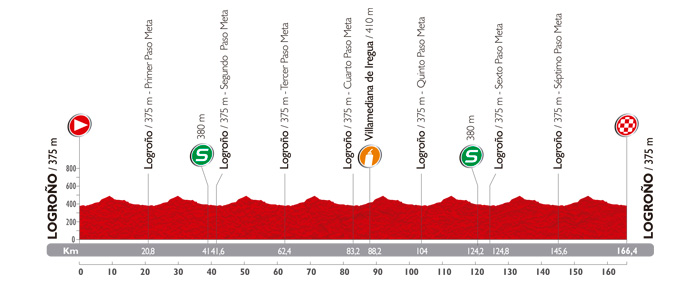
The Vuelta’s eleventh stage followed up an eventful time trial with even more drama: Fabio Aru took the stage win in a hard-fought battle among the GC contenders, but the biggest story of the day was the abandonment of Nairo Quintana following another crash. Stage 12, which consists of eight laps of a 20.8 kilometer circuit in and around the town of Logroño, should allow the red jersey hunters to settle down a bit.
Each lap includes the climb of a small, uncategorized hill and then a descent onto a flat stretch where the finish line awaits. Things get a bit technical in the final 5 kilometers of the circuit, with several roundabouts and sweeping turns in store as the road heads toward the center of town, but the final kilometer of each go-round is a flat, straight run to the line. The weather forecast for Stage 12 includes some chance of rain, which could make things a bit hectic on the urban circuit.
A profile like this will make it almost impossible for an early break to go the distance. After several days of GC battles, the sprinters’ teams won’t want to miss this chance for a bunch gallop, and they’ll likely keep a sharp eye on the gap to ensure that their quick men get the finish they want. The sprinters will still have to be on their toes as the day draws near its close, however; it won’t be an easy task to steal one from the fast finishers, but on an urban circuit like this, it’s almost certain that a few enterprising riders will attempt late attacks from the bunch.
With a high likelihood of a bunch sprint for stage honors, Stage 12 should offer another showdown between Giant-Shimano’s John Degenkolb and FDJ’s Nacer Bouhanni. Bouhanni will love the circuit, and the fact that there aren’t any categorized climbs on the menu. Potential bad weather would favor him as well. On this stage likely to go to the pure sprinters, he probably has a slight edge over Degenkolb, but don’t count the German out: their last head-to-head matchup came one day after Degenkolb had crashed, and he’s had some time to recover since then. His powerful leadout boosts his chances. It should be a close battle.
OGE’s Michael Matthews showed his impressive top speed on Stage 8, crossing the line in 2nd behind Bouhanni. He’s highly motivated to show anyone watching that he has what it takes to be in the mix even against the sprinting heavyweights on a flat day.
Lampre’s Roberto Ferrari was 3rd in Stage 2 of this race, and he’ll have another good opportunity to land a good result on the flat Stage 12. Astana’s Andrea Guardini has not yet featured in the group sprints of this Vuelta, but he should be able to get involved here. He has the speed to challenge even Bouhanni and Degenkolb in a bunch kick if he can make it to the final few kilometers in a good position. Cannondale’s Peter Sagan finally showed an interest in contesting a stage victory on Stage 8, where he took 3rd. If he decides to put in the effort here on Stage 12, he’ll be among the favorites in a sprint, especially with some corners to navigate in the run-up to the final straightaway and the potential for bad weather. Matteo Pelucchi, Tom Boonen, Jens Debusschere, Yauheni Hutarovich, Gerald Ciolek, Francesco Lasca, Robert Wagner and Jasper Stuyven are on the long list of outside contenders for the probable sprint finish.
Though it will be very hard to stave off a hungry pack of sprinters, a few of the stronger solo artists in this race will probably try to attack on the last lap and use the twists and turns of the final few kilometers to hold an advantage over the chasers. Watch out for the likes of Tony Martin, Philippe Gilbert, Adam Hansen, and Fabian Cancellara as the peloton re-enters Logroño for the last time on the final lap.
VeloHuman Stage Favorites
1. Nacer Bouhanni | 2. John Degenkolb | 3. Peter Sagan
Be sure follow @VeloHuman on Twitter for live commentary of this and every stage of the 2014 Vuelta a España! The next preview will be up after the conclusion of Stage 12, so stay tuned.
Stage 11: Pamplona › Santuario de San Miguel de Aralar – 153.4 km
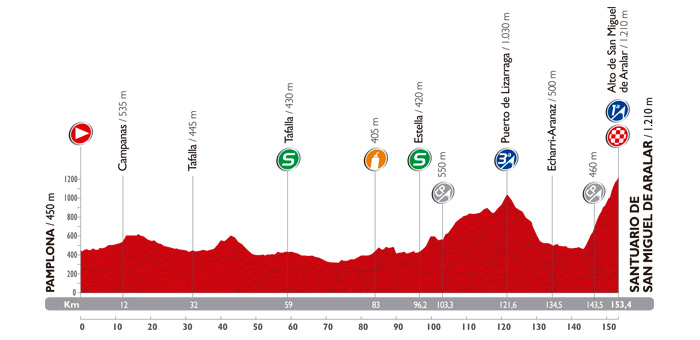
Even after a tough time trial (won by Tony Martin) that saw Alberto Contador take the red jersey and Nairo Quintana and Chris Froome lose a lot of time, dramatically shaking up the General Classification of this race, the peloton won’t have a chance to rest on Stage 11. Another summit finish is on tap. The first two thirds of the stage are relatively tame, without any categorized climbs, but things get a bit more difficult with around 50 kilometers to go, when the road rises at the Puerto de Lizarraga, a Cat. 3 of 18.3 long kilometers with an average grade of 2.6%. It’s an uneven climb with a steep stretch at the top, so it is harder than the low gradient indicates. From the top it’s a tricky descent of about 9 kilometers, and then a stretch of flat before the final climb, a 9.9 kilometer Category 1 with an average gradient of 7.5%. It’s a fairly steady climb, except for a short 14% section at around 2.5 km from the top. The summit finish marks 153.4 kilometers in the saddle, making Stage 10 the second shortest non-TT day in the race: this is likely going to be a fast-paced affair.
The breakaway will have its chance of taking this stage, but if the GC contenders decide to keep the early aggressors on a tight leash, it will be hard for anyone up the road to stay away with a late flat section (likely to see an injection of pace as the GC men jostle for position) and then a tough final climb. Katusha is among the teams who will hope that the battle for stage honors will come down to the GC contenders. Joaquim Rodriguez put in a respectable time trial on Stage 10 to stay within striking distance of the GC title, and he has already shown that he’s on the offensive in this race. The steep section near the finish should be a perfect place for him to strike out for a gap and for bonus seconds. Daniel Moreno makes for a dangerous ally. Katusha’s elite uphill talents will be very hard to keep under control in the last few kilometers of the race.
Alberto Contador no longer has to gain ground on anyone, as the race leader, but without a strong team helping him, sitting tight and waiting for the attacks may not be the best idea. He’s obviously on excellent form, far more so than he was willing to admit publicly at the start of the race, and he’s not the type to rest on his laurels with a great opportunity for more success right in front of him.
Nairo Quintana may have gone down hard on Stage 10 but Movistar isn’t out of this race yet. If the young Colombian wants to get back into this Vuelta a España, he’ll need to attack early and often. Alternatively, if he shifts his attention to helping Alejandro Valverde, attacking early and often (and forcing the other GC riders to chase) would still be a good strategy. Quintana’s form is an unknown after his fall, but if he’s feeling strong enough to attack, he probably will. That would give Valverde the opportunity to latch onto any wheels that go chasing after, and should this come down a sprint (things are a bit easier at the very top), Valverde would of course be the heavy favorite among the top GC contenders. Even if Quintana isn’t at his best, Valverde will still likely be in the mix on Stage 11 on his own. He has looked sharp in this Vuelta and he’s running out of opportunities to add another Grand Tour to his palmares.
Chris Froome, on the other hand, showed in the Stage 10 ITT that he’s just not at his best in this race, giving up nearly a minute to Alberto Contador on a parcours that looked to suit him quite well. He’s still one of the top climbers in the Vuelta, though, with Mikel Nieve as a valuable second, so it would be unwise to overlook Team Sky on this final climb.
Rigoberto Uran put in a great chrono and is now sitting in 3rd overall. He struggled to hold the pace on the first climbing stage of the Vuelta, but since then he’s looked stronger every day. He’s got a nice sprint and if he can hold onto the lead group to the line he’ll have a shot. Fabio Aru has been flying a bit under the radar in this Vuelta but he has looked to be in excellent shape thus far. More than two minutes behind on GC, he might be allowed some room if he puts in an attack, and this final climb suits him very well. Daniel Martin is another rider who could get aggressive. He tried an attack on Stage 9 but was reeled in; he’ll be on the lookout for another opportunity here. Esteban Chaves, who had a very rough day in the ITT, will at least now be less of a marked man should he try to put in a dig on his favored terrain. If he can pick himself up after his disappointing chrono, he could be in the mix (he might even try to his luck in the break). Winner Anacona, unlike compatriot Chaves, had a very impressive ride against the clock on Stage 10 after a very impressive breakaway victory on Stage 9, and those performances have put him into the GC conversation. That will make it harder to successfully attack the pack on the climb, but with the form he’s shown, he still has a shot at a good result on Stage 11 even from the pack and with the top GC contenders watching him more closely.
Should the GC riders allow an early move to stay up the road all day, the long list of potential protagonists for stage honors from afar would include OGE’s Adam Yates, FDJ’s Thibaut Pinot and Kenny Elissonde, Garmin’s Ryder Hesjedal and Andrew Talansky, Lampre’s Jose Serpa and Przemyslaw Niemiec, Trek’s Julian Arredondo, BMC’s Cadel Evans, Astana’s Mikel Landa, Cannondale’s Alessandro De Marchi, Caja Rural’s David Arroyo and Amets Txurruka, Belkin’s Laurens Ten Dam, Europcar’s Romain Sicard, and Sky’s Dario Cataldo, among others.
Be sure follow @VeloHuman on Twitter for live commentary of this and every stage of the 2014 Vuelta a España! The next preview will be up after the conclusion of Stage 11, so stay tuned.
Stage 10 (ITT): Real Monasterio de Santa María de Veruela › Borja – 36.7 km
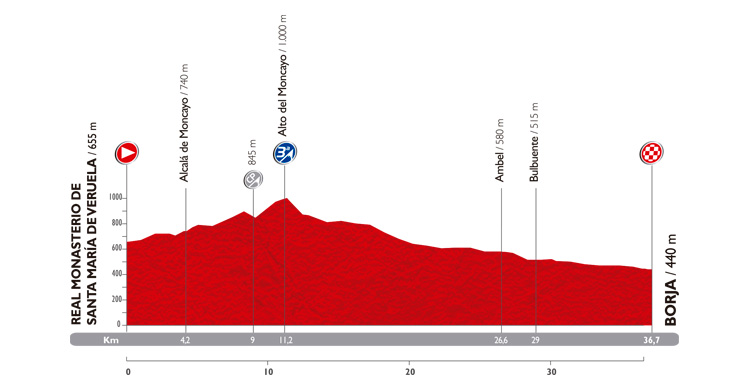
Winner Anacona led the peloton into the Vuelta’s first rest day with a win from the breakaway on Stage 9. Now it’s on to the critical Stage 10, a 36.7 km individual time trial. The parcours should open up some significant time gaps among the top GC contenders. The course starts out with a gentle uphill that leads into a short but steep Cat. 3 climb crested 11.2 kilometers into the stage. Then it’s all downhill to the finish. It’s not a straight-out run to the line, with some twists and turns along the way, but it’s not extremely technical. This is likely to be a very high speed chrono.
Tony Martin is the big favorite for stage honors. This is route that will favor chrono specialists, and he is the world’s premier time trialist. He’s also a great descender. It’s hard to see anyone outmatching his engine over 36.7 kilometers.
Behind Martin are several time trialing specialists and GC riders with top-notch chrono ability who should make the battle for Top 3 on the stage a tight one. Fabian Cancellara is obviously a prolific time trialist, and he’ll be one of the few riders with a shot of beating Martin in the World Champs later this month, but form is a bit in question at the moment. He has fallen off the pace even on a few of the flatter stages in this race, and though he’s likely give this time trial far more effort than he has on any stage so far, it may not be enough to match up with the likes of Martin. Cancellara is a strong descender and this is a nice parcours for him, but victory on Stage 10 would be a lot to ask.
This ITT is central to the GC hopes of Chris Froome, and he is one of the few red jersey hunters who excels even on a flatter chrono profile. His time trial performances in this year’s Tour de Romandie and the Criterium du Dauphine were stellar, and if he can recapture that strength here, with motivation running high, he’s likely to be among the top finishers on the day.
Alberto Contador is another GC rider with serious time trialing talent, and he’s a great descender to boot. If his time trialing engine is in as good shape as his climbing legs, he should be able to deliver a top-notch performance on Stage 10. Rigoberto Uran has developed into an elite talent against the clock as well, and he looks to be rounding into form in this race after a disappointing first mountain stage.
Movistar’s Adriano Malori had a hot start to the year, winning a Tirreno-Adriatico time trial ahead of Martin and Cancellara. He hasn’t had as much success in the latter half of the season, but after post-crash injuries robbed him of a chance to take a Grand Tour ITT win in the Giro d’Italia, he’ll be motivated to go for this. Trek’s Kristof Vandewalle beat Malori by 3 seconds to take his first WorldTour win the Tour de Pologne chrono last month, and he’ll be another outsider for stage honors. BMC’s Rohan Dennis put in an underwhelming ride in the Eneco Tour’s time trial stage, but he’ll be eager to show his new team what he’s made of here. Bob Jungels (who is targeting this stage especially), Jesse Sergent, Tobias Ludvigsson, Vasil Kiryienka, Stef Clement, Jonathan Castroviejo, and GC riders Wilco Kelderman and Nairo Quintana (who has improved against the clock this year) are others who could be in the mix on Stage 10.
VeloHuman Stage Favorites
1. Tony Martin | 2. Chris Froome | 3. Fabian Cancellara
Be sure follow @VeloHuman on Twitter for live commentary of this and every stage of the 2014 Vuelta a España! The next preview will be up after the conclusion of Stage 10, so stay tuned.
Stage 9: Carboneras de Guadazaón › Aramón Valdelinares – 185 km
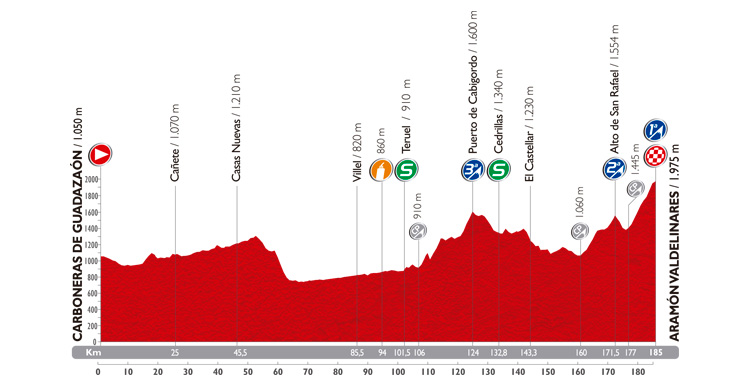
After Nacer Bouhanni’s bunch sprint victory in Stage 8, the Vuelta heads North and the road gets mountainous. Stage 9 opens with a short downhill and then a long stretch on a slight incline. Roughly 50 kilometers into the day the incline abates for a fast downhill, and then the peloton will take on another long false flat before they reach the foot of the first categorized ascent. The Puerto de Cabigordo is quite a long Cat. 3, 18 kilometers in total, at an average gradient of 3.8%. From the top it’s 36 kilometers of mostly downhill roads to the two-part stage finale: the 11.5 kilometer, 4.2% average grade Alto de San Rafael, and the 8 kilometer, 6.6% average grade Aramón Valdelinares climb that follows almost immediately after. There are only 5.5 kilometers of descent between the two, so it will feel much more like one harsh climb with a quick respite in the middle than two separate tests. Near the very top of the final climb, at the end of a steeper stretch, things do flatten out a bit, opening the stage up for a possible sprint between survivors if a group reaches the line.
A breakaway will have a decent shot at this stage, with plenty of ups and downs after the midway point of the route to make controlling the race hard. However, it’s the day before a rest day, the GC is very tight, and there are bonus seconds on the line, meaning that there is a strong chance that a lot of riders in the pack will want to go full gas. For a long-range attacker to maintain any advantage over the final climb, a wealth of climbing talent will be necessary.
Stage 6 offered the first indications of who is on form and who isn’t in this race, and most of the riders who delivered on that final climb should be in the mix again here. Chris Froome will be a top favorite if this contest comes down to a battle among the GC contenders. He has been sharp in this Vuelta a España, and moreso than the very steep 4.6 km test that decided Stage 6, the final uphill drag that awaits on Stage 9 is much more Froome’s style. With Mikel Nieve as a top-notch lieutenant, Froome will look to take an advantage over his rivals here.
Movistar’s Alejandro Valverde put in a brilliant performance on Stage 6, but this will be a different sort of challenge. Climbs that require an explosive kick suit him perfectly, but over a longer, more drawn-out uphill ride, his post-Tour form will face a new test. He did do a lot of pulling at the front on the lower slopes of the final climb on Stage 6, suggesting that the engine is running well. If he is with the lead group at the finish, his sprint will make him hard to beat. Teammate Nairo Quintana will find this profile suits his skillset quite well, but he did fade a bit on Stage 6 and it’s a bit of a question mark whether the form is where it needs to be just yet. If he has gotten that little bit stronger over the past few days, this will be a nice opportunity for him to get ahead on GC.
Alberto Contador looked quite recovered from his leg injury on Stage 6, and this is an excellent profile for him if he is indeed returning to full strength. This is a longer test, which will offer a better opportunity to gauge his fitness. If it’s all there, he should be right in the mix for stage victory.
Joaquim Rodriguez has looked strong in this race but his performance on a sixth stage that seemed to suit him perfectly left a bit to be desired. He’ll have another shot at landing a good result here, with Daniel Moreno as a strong second.
Astana’s Fabio Aru and OGE’s Johan Esteban Chaves were 6th and 7th, respectively, on Stage 6, and this final uphill test will be a good opportunity for both uphill specialists to get involved in the battle for stage glory.
Daniel Martin definitely underwhelmed on Stage 6, but with that one exception he has looked strong recently, and this will be another chance to get it right. His sprint has been particularly on point, and if he can manage to stick with the lead group until the final kilometer he’ll have a shot in the flatter finish. Rigoberto Uran also struggled on the Cumbres Verdes climb, but typically, this long climb would suit him, and he’s not a bad post-climb sprinter either.
Cofidis’s Dani Navarro outperformed expectations on the Alto Cumbres Verdes and will be an outsider for victory here on Stage 9 if the GC men are indeed fighting for the day’s victory. Belkin has a powerful trio in Laurens Ten Dam, Robert Gesink, and Wilco Kelderman. Gesink and Kelderman in particular have strong finishing kicks if they can manage to stick with the leaders here. Having such strong team support will help. Sergio Pardilla, Warren Barguil, Samuel Sanchez, and Damiano Caruso are others who could be in the mix on Stage 9 if the General Classification riders make up the lead group on the road when the day nears its conclusion.
Thibaut Pinot and Julian Arredondo are both in the Vuelta a España targeting mountain stage victories, both are well-suited to this profile, and both would be allowed off the front if they decided to go for a long one here, but as of yet form is still a question mark for both as well. Ryder Hesjedal looked strong on Stage 7 before his crash, and could be a candidate for stage honors if he can get into the breakaway again here on Stage 9. Hesjedal’s teammate Andrew Talansky, Alessandro De Marchi, Damiano Caruso, George Bennett, Kenny Elissonde, Cadel Evans, Przemyslaw Niemiec, Winner Anacona, Louis Meintjes, Adam Yates, David Arroyo, and Amets Txurruka are others who could have a shot in a long-range strike.
VeloHuman Stage Favorites
1. Chris Froome | 2. Alejandro Valverde | 3. Alberto Contador
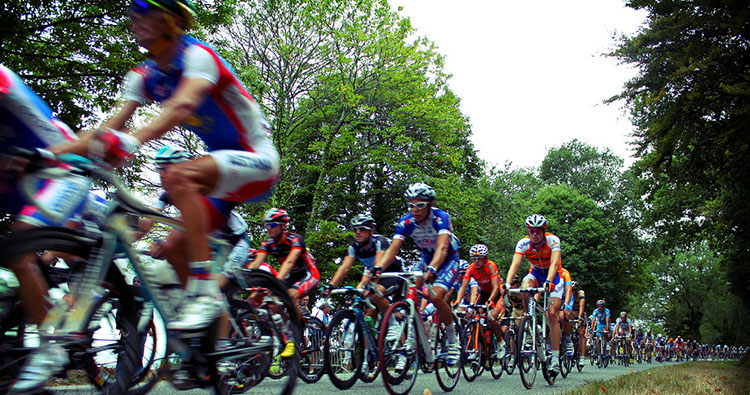
Also commonly known by its older name, the Grand Prix de Plouay (Plouay being the Breton town in which it starts and finishes), the GP Ouest-France is a long and hilly circuit race. 229.1 kilometers from start to finish, the 2014 edition involves eight laps around a 26.9 kilometer circuit, followed by a single, final lap of a reduced section (13.9 km) of the larger circuit to close things out.
The Route
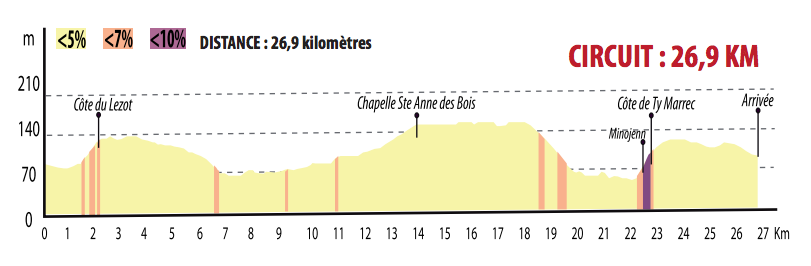
The route will take the peloton on several repeated trips up and over some short but challenging climbs; almost immediately after the beginning of each full lap, the pack will hit the Côte du Lezot, a little over a kilometer in length and with much of that distance at a gradient in the realm of 6%. From the top, it’s a descent followed by a long gentle ascent up to the Chapelle Sainte-Anne des Bois and, roughly, the midpoint of the circuit. After a flat section and then a quick downhill run, the pack will take on the Côte de Ty Marrec, only about a kilometer in length but with a long stretch in the middle nearing 10%.
The main lap, 26.9 kilometers in length with a few uphill challenges along the way.
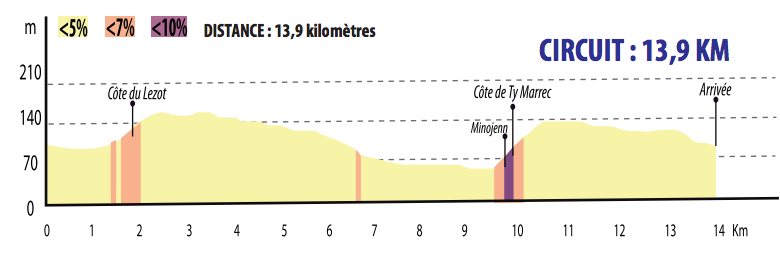
The final lap will still look quite familiar, but with a twist: the less challenging trip to the the Chapelle Sainte-Anne des Bois will not be a part of the last lap, which cuts out almost half the distance of the full lap, thereby squeezing the ascents of the Côte du Lezot and the Côte de Ty Marrec closer together on the course for the final go-round.
The final lap, with both of the day’s tough climbs and less time for recovery in between.
The profile makes this a very open race, where a sprint finish is possible, but also where the aggressive, punchy types could conceivably escape from the bunch, most likely on the final climb of the Ty Marrec, and grab the victory for themselves. The 2013 edition ended in a sprint that was not dramatically reduced in number of contenders, though the long day did take its toll, helping Filippo Pozzato to nab a victory over other riders who would typically be faster in a sprint. A group finish may very well happen again in 2014, but the slightly amended final lap could make things interesting, reducing the amount of time that those who struggle on the Côte du Lezot will have before the next ascent begins and putting even more pressure on the heavier purer sprinter-types. Winning this race will require either the ability to charge up the steep stuff to escape the pack, the speed to outsprint them in a sprint, or some combination of both, to survive any selection and then outmatch any other survivors at the line. Ardennes-style specialists and strong-climbing sprinters are all over the startlist, with some teams bringing multiple riders for the variety of possible scenarios.
The Contenders
Simon Gerrans of Orica-GreenEdge is one of the most capable riders in a post-climb sprint in the entire peloton, and he showed in the Vattenfall Cyclassics, where he outsprinted Mark Cavendish and Marcel Kittel on his way to 3rd place, that he is on blazing form. He’s fast enough, especially when his opponents have begun to tire, that he’s even got a chance against the purer sprinters should a large group reach the line together, and he’s also capable of going on a solo strike if it looks to be the best move. As a true specialist for this exact sort of race, capable of winning in a number of ways, Simon Gerrans will be a top favorite. Teammate Jens Keukeleire is another excellent card to play on this rolling profile, having shown nice form with his first GC Top 10 in a WorldTour race at the recent Eneco Tour.
As an excellent escape artist, a strong climber, and a capable sprinter, BMC’s Greg Van Avermaet also has all the tools necessary to contend in this race, and his skillset was on full display in last year’s edition when he put in a late solo move and survived until he was well inside the final kilometer. A tougher finale this year may be all he needs to turn that near miss into a victory. Of all the riders in this race capable of sticking an attack, Van Avermaet, who showed his good form with an Eneco Tour victory this month, seems among the likeliest to succeed, but he can’t be counted out in a reduced bunch sprint either. Young Silvan Dillier, 9th in the Vattenfall Cyclassics, is having a great year and could be another card for BMC to play in Plouay.
Katusha’s Alexander Kristoff comes into the race riding high, having the best season of his career and fresh off his recent win at the Vattenfall Cyclassics. Always a strong sprinter with a knack for the bunch gallops coming after longer days in the saddle, Kristoff has taken his game to a new level this year, climbing particularly well and holding up over some extremely lengthy one-day races to put in top results. He doesn’t have the same uphill ability as Simon Gerrans, but if the punchier types aren’t able to make this race selective enough to drop him, they’ll have a hard time outsprinting him at the end of the day (and so will any other sprinting specialist who manages to survive). Given the difficulty of the parcours, it’s not a given the Kristoff will stick with the lead group to the end to contest victory, but if he is there for a bunch kick, it will be hard to look past anyone else. Luca Paolini will be with him, and the Italian veteran has proven a valuable second throughout the year.
Giacomo Nizzolo of Trek Factory racing is another top sprinter in attendance who could contend for victory if he can stay in good position over the last few ascents. Nizzolo came agonizingly close to winning the GP Ouest-France in 2013; he was well ahead of every other sprinter in the race with the finish line only a hundred meters away before Pippo Pozzato, who had waited much longer to start his sprint, passed him in the final few meters. As Nizzolo told VeloHuman this week, he’s extremely motivated to take the win in Plouay this year, and coming off of a runner-up performance in the Vattenfall Cyclassics, he is on sharp form. He’s one of the few riders in this race who has the top-end speed to challenge Kristoff should it come down to bunch sprint. Trek is fully committed to his chances, and Stijn Devolder and Danilo Hondo make up a strong support squad.
Giant-Shimano has the talented Luka Mezgec for a potential group finish. It won’t be easy to keep the young fast man at the front of affairs, but if he’s there, he’ll be a strong contender as one of the top-tier sprinters in the race, with some strong leadout riders for support.
Lotto Belisol has quite hand of cards to play, and it would be a big surprise if they didn’t have at least one rider in the Top 10 at the end of the day. Jurgen Roelandts is strong in a fast finish after a long day in the saddle; he was 4th here last year. Tony Gallopin has been away from competition for a few weeks, but he is a speedy finisher with a particular talent for getting into late moves. Tim Wellens showed immense strength in winning the Eneco Tour this year and he could get aggressive in the last lap. Jelle Vanendert is a specialist on the classics-style climbs who could try to get into a move over the Ty Marrec. It’s very hard to pick any one rider out of this group as the likeliest to succeed, but whatever happens, Lotto has several elite options for this GP Ouest-France.
OPQS is another well-staffed squad with plenty of options. Gianni Meersman is probably their best, on good form and particularly dangerous in a reduced sprint, with Matteo Trentin as a great alternative in that scenario should Meersman miss out, but Jan Bakelants is in good shape as well, and he’ll be among the top candidates to break clear of the pack in the last lap. Michal Kwiatkowski is on unknown form after a long break from racing, but he deserves a mention in any hilly one-day race, given a skillset perfectly tailored to the Plouay parcours.
Sky brings a strong one-two punch in Ben Swift and 2012 winner Edvald Boasson Hagen. Swift has the ability to hang on over some tough climbs to fight it out in the sprint. After a strong RideLondon, he didn’t perform up to his expectations in last week’s Vattenfall Cyclassics, but he told VH on Friday that he is feeling good at the moment, and that his rough day on the bike in Hamburg may have simply been a bit of training fatigue after a hard midweek block. This parcours certainly suits him. Edvald Boasson Hagen hasn’t shown the sprinting ability this year that he once displayed, but he’s still dangerous on a hilly parcours that could very well split up the pack.
AG2R has last year’s 3rd place finisher Samuel Dumoulin for a potential sprint, and they also have Blel Kadri, Romain Bardet and Christophe Riblon if they want to take an aggressive approach. Europcar has a very strong long-distance specialist in Cyril Gautier, and a top-notch sprinter in Bryan Coquard. Garmin-Sharp also has one strong rider for a sprint in Tyler Farrar and a few others who could look to get aggressive in classics specialist Sebastian Langeveld and in the versatile Tom Jelte-Slagter, a late addition to the startlist who is on uncertain form, but who does have the skillset to put in an excellent result on a profile like this if he’s in good shape. Astana could back Borut Bozic or Francesco Gavazzi in a bunch kick, or they could try to send Enrico Gasparotto, Andriy Grivko, or Maxim Iglinskiy up the road.
Sylvain Chavanel is a rider who could be very dangerous if he can escape from the pack, and he is most definitely on good form after winning the Tour du Poitou-Charentes this week. IAM Cycling also has Heinrich Haussler if this ends in a bunch gallop. Lampre-Merida’s young sprinting talent Davide Cimolai was an impressive 7th in Hamburg last week, and could be looking to get involved in a potential sprint here. Rui Costa is also on the startlist and obviously a dangerous rider on this profile, but he hasn’t raced since withdrawing from the Tour. Cannondale’s Elia Viviani landed a Top 10 in this race last year and if he can make it to the line, he’s shown nice form recently; versatile Marco Marcato will be a nice alternative. Movistar could try to set up a strong JJ Lobato for the sprint, with Fran Ventoso as a nice alternative. Romain Feillu of Bretagne – Séché Environnement has finished in the Top 10 in this race twice and could be another outside contender in a sprint. Matti Breschel of Tinkoff-Saxo is another who could be in the mix in a fast finish. Bardiani-CSF has options with the very speedy Nicola Ruffoni, the speedy and also strong-climbing Enrico Battaglin and Sonny Colbrelli, and the always-dangerous-from-afar Stefano Pirazzi. Fellow Pro Continental Italian outfit Neri Sottoli has Simone Ponzi, who excels in the hilly circuit races, and Mauro Finetto, a good sprinter who can handle a few bumps. FDJ’s Arthur Vichot will like this rolling profile. Belkin has a strong squad with Lars Petter Nordhaug, Barry Markus, and Lars Boom all making the start. Julien Simon of Cofidis specializes in profiles like this and could be an outsider in a reduced sprint. Wanty – Groupe Gobert has talented veteran Bjorn Leukemans and in-form Jean-Pierre Drucker as cards to play.
VeloHuman Top 10 Favorites
Winner: Simon Gerrans Podium: Greg Van Avermaet, Alexander Kristoff Other Top Contenders: Giacomo Nizzolo, Gianni Meersman, Ben Swift, Luka Mezgec, Sylvain Chavanel, Tim Wellens, Tony Gallopin
Be sure to follow @VeloHuman on Twitter for live commentary and analysis of the race.
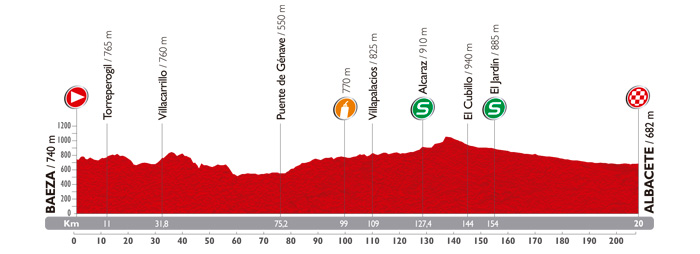
After a bumpy Stage 7 won by Alessandro Di Marchi, and with Sunday’s mountain stage looming, the peloton will get to enjoy a day of flat roads on Stage 8. There isn’t a single categorized climb on the road from Baeza to Albacete, and the final 60 kilometers are more or less downhill, though there is a short uphill section of less than a kilometer right around the 3-km-to-go mark. There are a few roundabouts and some hard corners, but then the final 900 meters run straight to the line. Overall, Stage 8 is the longest stage in this Vuelta at 207 kilometers, but without many uphill challenges, the length of the route shouldn’t alter the outcome too drastically.
A sprint finish seems more than likely on the profile, setting up another probable showdown between FDJ’s Nacer Bouhanni and Giant-Shimano’s John Degenkolb. There are reasons to like both for stage honors. Degenkolb took the most recent head-to-head battle on Stage 5, and even had Bouhanni made better positioning choices in the finale (he ended up boxed out on the barriers behind and to the outside of Degenkolb), it’s not totally a given that he would have passed the German anyway. Degenkolb is very fast right now, and a longer day than usual will further favor the Paris-Roubaix runner-up as well. Still, Bouhanni’s typically top-notch ability to fight for position will help as the peloton passes through a few late roundabouts. Moreover, Degenkolb hit the deck on Stage 7, and it’s unclear how he’ll feel the day after. If both riders are at their best, this should be very close, (and the duo is significantly faster than any of their other rivals), but Bouhanni has a slight edge as the favorite for Stage 8 with uncertainty around Degenkolb’s condition.
Familiar names make the list of other potential contenders. Roberto Ferrari, who has not made it to many sprint finishes yet in this race, should jump at this opportunity to contest a bunch gallop on a very flat stage. He is still quite fast. Belkin’s Moreno Hofland was 3rd behind Degenkolb and Bouhanni on Stage 5, showing his potential. Another good result could be in the cards here. The versatile Michael Matthews wants to do well on the pure sprint stages as well as the hilly ones, and although he hasn’t landed the kinds of results he’s hoped for on the flat days in this Vuelta a España just yet, he does have an impressive turn of speed. If he can nail down the timing and the positioning, he could be in the mix on Stage 8. Astana’s Andrea Guardini, IAM Cycling’s Matteo Pelucchi, and Lotto Belisol’s Jens Debusschere have not featured in the sprint finishes in this race as often as they would have hoped so far, but this parcours should put them in position to challenge for stage honors. Tom Boonen, Jasper Stuyven, Vicente Reynes, Yauheni Hutarovich, Oscar Gatto (or Peter Sagan, should he decide to go for it), Gerald Ciolek, and Francesco Lasca are others who could get involved in the probable bunch gallop to the line.
VeloHuman Stage Favorites
1. Nacer Bouhanni | 2. John Degenkolb | 3. Roberto Ferrari
Be sure follow @VeloHuman on Twitter for live commentary of this and every stage of the 2014 Vuelta a España! The next preview will be up after the conclusion of Stage 8, so stay tuned for more. Also, be sure to come back soon for the preview of the upcoming GP Ouest-France in Plouay, and in the meantime, check out VeloHuman’s recent interviews with two likely protagonists of that race, Giacomo Nizzolo of Trek Factory Racing and Ben Swift of Team Sky.