Tag: Tony Gallopin

  • Grand Prix Cycliste de Montréal 2015 Preview

    Grand Prix Cycliste de Montréal 2015 Preview

    eCS26gb

    After Rigoberto Urán delivered a surprise win in Québec, the racing moves on the Montréal. A slightly hillier course could favor the attackers even more, which will make predicting an already unpredictable race quite a challenge!

    The Route

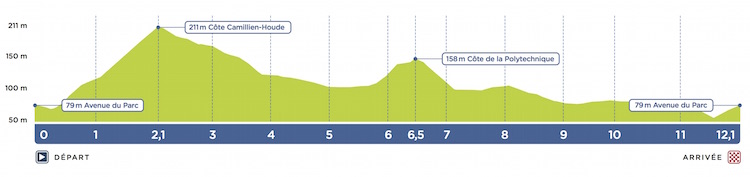
    The Grand Prix Cycliste de Montréal takes on 17 laps of a 12.1km circuit for a total distance of 205.7 kilometers. The race starts along the Avenue du Parc, makes a loop along the slopes of Mount Royal, and then finishes back where it started.
    GPC_MTL_PARCOURS_FR

    There are three uphill sections in each lap. After a short downhill from the starting line, the first and most difficult climb comes almost immediately: the Côte Camillien-Houde, 1.8 kilometers at an 8% average gradient. From the top, there is a fast descent, a brief flat section, and the next uphill test, the short but difficult Côte de la Polytechnique, 780 meters at a 6% average. There is a particularly steep 200m section of about 11% along the way. After another descent, things even out for a bit until the final 1100 meters: the riders will make a right turn heading south and shoot downhill on the Avenue du Parc, and then they will make a 180 degree turn to head right back up the Avenue in the other direction towards the finish. That final run-in is a 560m, 4% climb.

    The Contenders

    While the startlists are the same and many of the top contenders are the same, the Montréal circuit is, on the whole, harder than that of the GP Québec. “The two are different,” Rui Costa told VeloHuman from Québec. “Montreal is a race that I think is harder, and more open.”

    The Côte Camillien-Houde, crested 17 times, will put the heavier riders into serious difficulty and will likely see a smaller group coming into the final few laps than the peloton in Montréal. An attack on the 8% gradients has a decent chance of holding out over the final few up and down kilometers. The finish in Montreal, however, is a fair bit easier, which means that a select group of escapees could find themselves battling it out in a sprint. Orica-GreenEdge kept the race on lockdown last year, allowing a sizable bunch to finish together, but that was rather unusual for this race, and I’d expect a more select group to battle for the win this time around. Whatever the scenario, explosiveness and excellent climbing legs are important.

    It was not a real shocker to see an Etix-QuickStep rider take the win in Québec, given all the firepower they have, though Rigoberto Urán seemed like maybe the fourth best option on his team! In any case, EQS will have another excellent opportunity to nab the win in Montréal. Julian Alaphilippe looked strong in an escape attempt that was ultimately reeled in in Québec, and Michal Kwiatkowski looked particularly impressive chasing down Greg Van Avermaet. Despite Urán’s victory, I still see Alaphilippe and Kwiatkowski as the top EQS riders for Montréal, as Urán won’t be taking anyone by surprise this time; in fact, I’d be just as surprised if he won Montréal now that he’s no longer under the radar. Still, watch out for the Colombian: he’s got all the right skills for these races, and although he’s basically taken a two-year hiatus from contending in the Classics, there was a time when he was a top rider for the Ardennes and in Lombardy—and apparently still has those skills hiding under the hood.

    Rui Costa has won in Montréal in the past and was runner-up in 2014. Without Simon Gerrans around, I like his chances this year. He looks to be in good form. The biggest question is team leadership. Costa made it into the select group that appeared to have their shot at fighting for the Québec win before hesitation allowed the larger pack to catch back up, but then Lampre-Merida backed Diego Ulissi in the final sprint. The Italian could be a strong contender in Montréal as well. Both riders are great climbers with explosive side, and my first instinct is to see Costa as the man for Montréal given his past performances, but Lampre might not see it that way, which makes it harder to view Costa as an out-and-out favorite.

    For most of the day in Québec, BMC looked to be the strongest team in the race, contributing to the chase of the early break and then involving themselves in one attack after another. It didn’t work out in the end, but it showed the team’s strength and that bodes well for Greg Van Avermaet and Philippe Gilbert in Montréal. The selective profile will weed out some of the purer sprinters, but the less difficult finish will provide an excellent opportunity for both riders, who can rely on their impressive uphill speed, with a shot in a reduced sprint. I’m not sure either one is at full strength just yet with Worlds as such a major goal, but they’ll be close to their best. I like Van Avermaet a bit more than Gilbert, as he’s been coming to the GP Montréal for so many years running now, but both are contenders.

    Tony Gallopin, 3rd last year, showed good form with an 8th place in Québec. The way I see it, Montréal suits him better. He’s a excellent tactician who knows how to make an attack, and he has the fast finish to win out of a small group. He appears to be in terrific form as well. He was in the small group that made it up the Côte de la Montagne at the head of the race in Québec, and still managed to come in 8th in the final sprint after that group was swept up (Van Avermaet, also in that small group initially, could only manage 10th despite being near the front in the finale). In a wide-open race, I like Gallopin’s chances to turn last year’s third-place result into a win. If he doesn’t, Tim Wellens, Jurgen Roelandts, and Tiesj Benoot are other options for a loaded Lotto-Soudal.

    Michael Matthews was the runner-up in Québec and he’ll have a shot in Montréal, but I see the parcours as being just a bit too difficult to view him near the top of the favorites (oddsmakers disagree with me on this one). In any case, if Matthews is not able to handle the climbs, it shouldn’t be too much of a problem for OGE, who have Adam Yates (on blazing form at the moment), Simon Yates, and Michael Albasini too.

    Tom-Jelte Slagter is in the best form he’s been in all season. He was 4th in Québec, and although he’s had better results there in the past, I think Montréal suits him well too. He can handle tough climbs without too much trouble. Slagter isn’t going to Worlds, having suddenly found his form after the Dutch team selection, and I therefore expect he’ll be giving it everything he has to pull something off in Montréal. Ramunas Navardauskas and Ryder Hesjedal are other options for Cannondale-Garmin.

    Lars Petter Nordhaug won here in 2012 and count be counted out. Trek’s Bauke Mollema and Fabio Felline make for a great 1-2 punch. The same is true for Giant-Alpecin’s Simon Geschke and Warren Barguil. Europcar has Tommy Voeckler, while FDJ can rely on Arthur Vichot. AG2R is the French squad with the widest array of options: Romain Bardet, Alexis Vuillermoz, and Jan Bakelants are all potential contenders. I was very impressed with LottoNL-Jumbo in Québec, and see Robert Gesink and Wilco Kelderman liking this parcours even more—Sep Vanmarcke is another option for the men in yellow.

    Alexander Kristoff was surprisingly in the mix in Québec but it’s hard to see him holding on over the more challenging GP Montréal parcours. Hesitation at the head of the race late on in Québec helped his chances but I doubt he’ll get that kind of gift again, though obviously he’ll be a favorite if he’s there for a sprint.

    VeloHuman Top 10 Race Favorites

    Winner: Tony Gallopin
    Podium: Rui Costa, Tom-Jelte Slagter
    Other Top Contenders: Greg Van Avermaet, Michal Kwiatkowski, Philippe Gilbert, Julian Alaphilippe, Michael Matthews, Diego Ulissi, Bauke Mollema

    VeloHuman will be at the race so be sure to follow @VeloHuman on Twitter for more analysis!

  • Tour de France 2015: Stage 13 Preview

    Tour de France 2015: Stage 13 Preview

    PROFIL13

    Stage 13: Muret › Rodez – 198.5km

    Joaquim Rodríguez’s Stage 12 win closed out three straight days with late HC-rated climbs, and now the Tour de France transitions to a stretch of slightly less mountainous stages—but that doesn’t mean things will get all that much easier. Stage 13 is a relatively long, hilly day with three categorized climbs (a Cat. 3, a Cat. 4, and a Cat. 4) in the last 70 kilometers. The final official climb comes 30km from the line, but it’s followed by a short uncategorized bump and then a longer one to La Primaube, just 10km from the finish. From there it’s downhill until the final 2.5km, where the road flattens out until 570 meters from the line. Then things kick sharply upward at a 9.6% gradient to the finish. The final drag to the line is not categorized, but it’s the sort of challenge that will serve to dramatically reduce the speed of heavier sprinter-types in the final moments of the stage.

    A bumpy parcours late on in the stage and a finale that isn’t all that sprinter-friendly both favor the chances of the early breakaway. A tired peloton, limping along after three brutal days in the Pyrenees, could bid good riddance to the riders up the road. Then again, there aren’t a whole lot of stages for the fast finishers in this race, and that could inspire those teams with more versatile quick men to try to keep this one under control for the uphill sprint at the end of the day. Stage 13 looks to be yet another day where the outcome of the breakaway vs. peloton battle will be extremely tough to predict. In any case, the favorites for success will be punchy finishers with the endurance to still have something in the tank after a long day of racing, with those capable of winning from afar holding an extra advantage over those who will need to stay in the pack to have a shot.

    Peter Sagan seems as likely as anyone to win Stage 13, though the nature of the profile makes it hard to call him a “favorite.” The finale is steeper than he’d prefer but the high-gradient stretch is short enough that his impressive finishing kick should outweigh (figuratively) the fact that he’s heavier than the more specialized puncheurs in the race. Sagan is on terrific form at the moment and this stage presents a fine opportunity for him to pick up a victory. He also can’t be ruled out as a possible long-range contender.

    This should be an excellent day for Tony Gallopin: hilly with a sting in the tail, but not so mountainous as to bring the GC favorites sailing past on the high gradients. Ignoring other race circumstances, punchy, aggressive Gallopin would look the perfect candidate for a stage win. However, Lotto Soudal may decide that André Greipel has a chance in a potential sprint, even with this gradient (which I think is too steep for him), which could leave Gallopin riding a support role. Moreover, Gallopin’s decent GC position could keep him from getting involved in a potentially stage-winning breakaway. He will still be among the most dangerous riders to watch on Stage 13, but there are factors that may be a bit beyond his control that could hold him back.

    Greg Van Avermaet has been in the mix on several stages so far in the 2015 Tour, and has climbed admirably to high placings on days with short steep finishes. This certainly qualifies. With the number of hilly days on tap, Van Avermaet has a great chance of coming away with a victory soon—if he sees this as a good opportunity, he could try to get into an early break, and that makes him especially dangerous.

    Edvald Boasson Hagen has also put in several good rides so far, and this bumpy parcours suits him very well. He doesn’t quite have the finishing kick he used to, but he’s got a sharp eye for opportunities to escape the pack, and this is a good profile for such a talent.

    Dan Martin will be a top favorite either from a breakaway (and he showed on Stage 11 that he’s not afraid to get up the road) or from the bunch in an uphill sprint. This finale is tailormade to his talents. He’s come close to success several times so far in this race—if he can manage to position himself better on Stage 13 than he has on previous stages, Martin has the explosiveness to take a win. Teammate Ryder Hesjedal could have a shot as well. He’s got more punch than many realize, and has a knack for getting into breakaways at this point in his career.

    EQS has several very strong options for the stage. It’s probably too steep for Mark Cavendish, but Zdenek Stybar should thrive on the final climb. Matteo Trentin and even Rigoberto Urán could be in the mix as well. Michal Kwiatkowski, at his best, would love this stage, but after a brutal day in the breakaway, and not on top form, it seems unlikely that Kwiatkowski will be able to mount that much of a challenge for stage honors.

    Katusha’s, Joaquim Rodríguez might also be a bit too tired after his Stage 12 win to try another day in the breakaway, but the steep kick to the line does suit the punchy Spaniard.

    The Tommy Voeckler of 2015 is a far cry from the Tommy Voeckler of 2012, but the Stage 13 profile suits him nevertheless. Compatriot Sylvain Chavanel has been actively battling to get into the breakaway so far in the 2015 Tour, and could look to get aggressive on here. This intermediate stage looks good for his skillset. Another Frenchman, the explosive Alexis Vuillermoz, is deadly on the high gradients and capable of getting into a move if he sees the opportunity. He’d probably prefer a longer drag to the line, but will still be one to watch on Stage 13.

    John Degenkolb has flashed impressive ability even on the very steep stuff during his career, but this will be a bigger challenge than he’d prefer, and for him to have any chance at winning, the stage will have to come down to a sprint, which isn’t even close to a given. He’s still got to be among the favorites in that scenario, but it’s going to be a tough ask for the versatile German. Bryan Coquard, Michael Matthews, Davide Cimolai, and Alexander Kristoff are other versatile fast finishers whose chances will rely on this stage coming down to a sprint from the peloton, though should that happen, they’ll also have to fight with a number of aforementioned puncheurs and the more explosive GC types, with Alejandro Valverde far and away the biggest name in that department. In an uphill bunch kick, expect the Flèche Wallonne winner to shine. Few riders on this startlist are as well-suited to a finish like this.

    VeloHuman Stage 13 Favorites

    1. Peter Sagan | 2. Greg Van Avermaet | 3. Tony Gallopin

    Don’t forget: you can find plenty more Tour de France analysis in the most recent Recon Ride podcast episode. Be sure to follow @VeloHuman on Twitter for more commentary during the race, and check back for the preview of the next stage after the conclusion of Stage 13.

    -Dane Cash

  • Tour de France 2015: Stage 8 Preview

    Tour de France 2015: Stage 8 Preview

    PROFIL8

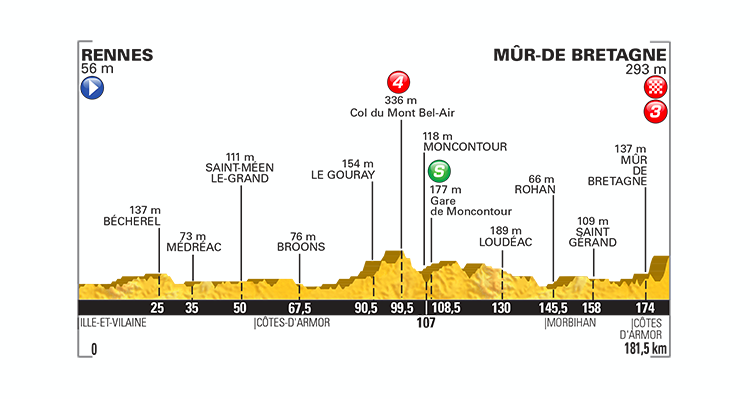
    On the heels of Mark Cavendish’s big sprint victory on Stage 7, the Tour de France heads into a stretch of more GC-oriented days, starting with the 181.5-kilometer Stage 8. It is another day that could come down to a showdown near the finish, but a steep climb to the line will bring a different set of riders to the fore.

    The action kicks off in Rennes, Brittany. The first half of the stage is mostly flat, with the first of two categorized climbs finally appearing around the midway point of the action. It’s only a Cat. 4, and not likely to see much of a shakeup. That climb is followed by a descent and then a few gentle ups and downs, which roll all the way to the finish, where things will get interesting.

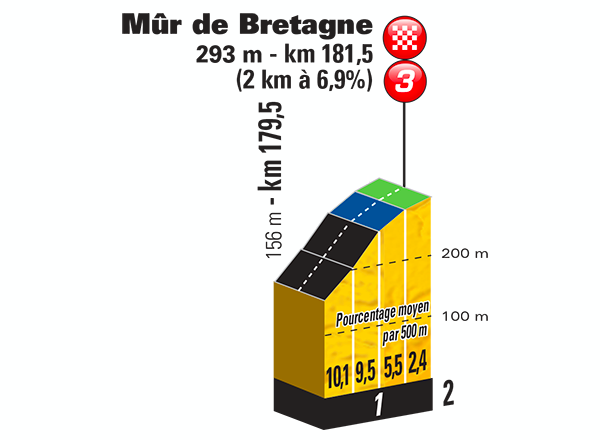
    Stage 8 finishes atop the Mûr-de-Bretagne climb, 2 kilometers in length with a challenging average gradient of 6.9%—but the average gradient doesn’t tell the full story. The first kilometer of the ascent has sections in the double digits, and averages just under 10%. After this steep opener, things ease off in the second half of the climb, with the gradient gradually decreasing into the final 500 meters, which angle upward at only 2.4%.

    Steep at first, but easing off halfway through, the Mûr-de-Bretagne will make for a thrilling, though hard to predict, Stage 8 finale.
    The steep incline of the Mûr-de-Bretagne will make for a thrilling, through hard to predict, Stage 8 finale.

    The vicious gradients that open the Mûr-de-Bretagne will keep the traditional sprinters from contending for the stage victory. That will, in turn, likely lead to a less organized chase in the bunch, which could help out any breakaway riders who manage to get up the road. What’s more, the upcoming team time trial will probably have the GC teams inclined  to take this stage easy, rather than putting the pressure on all day. There are bonus seconds on offer at the line, and there are plenty of strong puncheurs in this race who will have a great chance at this finish if their teams keep the stage under control, but the early break does have a very real chance at going the distance on this stage—it seems to be about a 50/50 proposition to me. As such, no rider should be seen as “the favorite” for the stage, though there are plenty of riders who will be favored if they are in the lead group inside the final 10 kilometers: the battle for stage honors, whether that battle is being fought within a small group of breakers or the larger bunch, will likely come down to the final climb, which will suit riders that have some combination of strong climbing legs and a fast finish.

    If the pack is able to reel in the early move, Joaquim Rodríguez, who won on the Mur de Huy a few days ago, will like the look of this one. He has flashed strong form in this Tour, and he has both the climbing prowess to launch a move early on this climb, and the finishing kick to outsprint a small group around him if he nears the finish line with company. Having the also explosive Giampaolo Caruso gives Katusha options.

    At his best, Alejandro Valverde would love this profile, but form has been a question mark for Valverde so far in this Tour de France. On the Mur de Huy, where he won earlier this season in La Flèche Wallonne, he was unable to muster even a Top 10. This is another opportunity for him to use a skillset tailormade for this sort of finale, but his inability to make much an impact on this Tour so far can’t be ignored on a stage where he’d otherwise probably rank as my top favorite. Valverde’s teammate Nairo Quintana will be a rider to watch as well with this gradient—the diminutive Colombian doesn’t have Valverde’s top speed but few riders are as dangerous on gradients in the double digits. With a likelihood of gaps in this finale, Quintana will be locked in and should be in the mix at the front of the pack.

    Dan Martin showed great form on Stage 3 on his way to 4th place, a result that would have been better if he hadn’t been way behind the head of the race before starting his charge through the ranks of riders struggling to make it to the top of the Mur. The extreme gradients on the lower slopes of that climb may have hindered Martin, who is very explosive but has never favored the double-digit slopes. The Mûr-de-Bretagne will be another great opportunity for him if this does come down to a group finish, especially with more space between the 10% gradient and the finish line in which Martin can make up ground he loses to the more effective climbers.

    Chris Froome doesn’t have the Ardennes track record of Purito, Valverde, or Martin, but he’s an elite climber with an elite team around him that is fully dedicated to putting him into the perfect position for the uphill finishes. He was very strong on the Mur de Huy, and if this comes down to the GC men, I’d bet he’ll be right up there again here on Stage 8, with bonus seconds on the line. GC rival Vincenzo Nibali was not all that far behind, rolling across the line in 7th on Stage 3. Already down more than a minute on Froome, Nibali could try to get clear on the climb to earn a few seconds back on GC.

    Peter Sagan won’t be able to match the GC favorites on the high gradients, but could hang on for the easier final kilometer if no one is too aggressive early on. The main factor playing against Sagan is the fact that the team may have him on domestique duty to help Alberto Contador, who is also a danger with this sort of gradient so close to the line.

    A kilometer at over 9% might just be too much to ask of John Degenkolb, but he will have a shot at stage honors here if the pack can reel in the early breakaway. Rui Costa has been quiet so far in this Tour but should like this finish, as should another fast-finishing fringe GC contender, Bauke Mollema. Warren Barguil, a more-explosive-than-many-realize Tejay van Garderen, Robert Gesink, AG2R’s Romain Bardet and a surprising Alexis Vuillermoz, and Rigoberto Urán are others who could thrive in this finale if things come together before the line.

    Tony Gallopin has the versatility to challenge for victory here in a variety of scenarios. He’s deadly in a long-range move, and capable in a reduced sprint as well. With the ability to weigh his options and determine his strategy out on the road, Gallopin has a great chance here. Teammate Tim Wellens is another rider to watch—he’s a smart attacker who can be very dangerous in a breakaway. Edvald Boasson Hagen, Michal Kwiatkowski, Zdenek Stybar, Julian Arredondo, and Simon Yates are just a few of the other riders who can threaten for stage success either from the breakaway or from the bunch.

    VeloHuman Stage 8 Favorites

    1. Joaquim Rodríguez | 2. Alejandro Valverde | 3. Tony Gallopin

    Be sure to follow @VeloHuman on Twitter for more analysis and commentary during the race, and check back for the preview of the next stage after the conclusion of Stage 8. The VeloHuman overall Tour de France race preview is available here.

    -Dane Cash

  • Tour de France 2015: Stage 6 Preview

    Tour de France 2015: Stage 6 Preview

    PROFIL

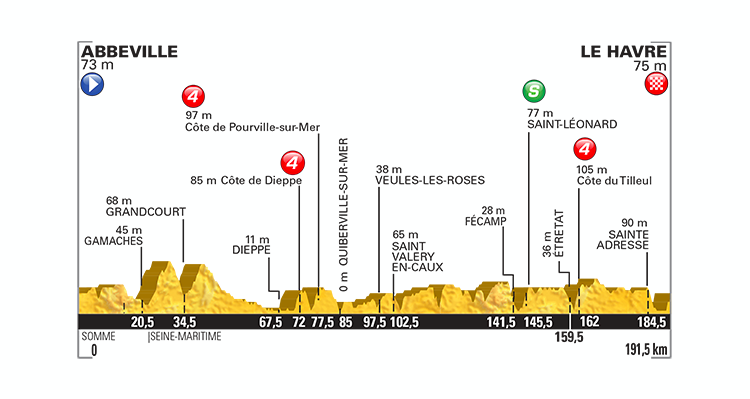
    Stage 6: Abbeville › Le Havre – 191.5km

    With André Greipel’s second 2015 Tour win now in the books, the peloton is set to take on a 191.5-kilometer journey along the coast from Abbeville to Le Havre on Stage 6. The profile should set up an interesting contest.

    There are only three categorized climbs on the road from start to finish, all of them Cat. 4s, and none of them inside the final 25km—but this is a rolling parcours throughout that could make things difficult to control. The finish is the most intriguing part of the stage. Inside the final two kilometers the road kicks upward on the Côte d’Ingouville, 850 meters at 7%, before mostly flattening out for the final half-kilometer or so. It’s not a categorized challenge, but it’s steep enough to put the heavier sprinters at a big positioning disadvantage before the last few hundred meters, and that’s assuming a large group comes to the finish in the first place.

    A strong breakaway could have a chance on this profile, especially given the fact that some of the punchier favorites who could thrive in the finale ride for teams with GC interests, teams that might be less interested in wasting energy giving chase to a group up the road. However, with bonus seconds on offer at the line and a relative dearth of stages with opportunities for the less Alpine-inclined in this Tour de France, there should be decent motivation within the pack to keep this together at least into the final few kilometers, from which point it will be anyone’s game.

    If he’s well-positioned coming into the final few kilometers, Peter Sagan should be able to handle the late climb and thrive in a somewhat reduced kick. He’s nearly won two sprint stages against the very fastest riders in this Tour de France already; with a bit of help from gravity on the uphill drag near the line on Stage 6, he’ll be very hard to beat. His biggest challenge, as it often is, will probably be other aggressive types trying to steal a march from the peloton a bit further out than the finishing straight—with Contador’s GC aspirations as Tinkoff-Saxo’s primary focus in the race, the team may not be inclined to put in the effort to control the race in the finale. Sagan will need to be alert here.

    Lotto Soudal has had a great Tour so far and will have another opportunity for success on Stage 6. André Greipel is obviously on blazing form, having already nabbed two victories in this race. But with the late climb, Tony Gallopin may be the team’s best option here. Having landed an impressive 5th place on the Stage 3 Mur de Huy finish, ahead of some very strong climbers, he has the right mix of uphill ability and explosiveness to be in the mix, especially if there is action in the last few kilometers. This finale suits him very well.

    Greg Van Avermaet should appreciate this opportunity to pick up an elusive Tour stage victory. The climb should be just hard enough to jettison some of the heavier types while still allowing Van Avermaet to survive and potentially jump clear. The Belgian is on excellent form right now.

    John Degenkolb tends to put in good performances on stages with slightly uphill finishes, but I’m not sure how well he will handle the 7% gradient. That’s a bit steeper than he might like, and with so many strong puncheurs on the startlist, he will have his work cut out for him holding on if some of the better climbers put the pressure on. If he can hold a strong position in the finale, he’ll be deadly, but it won’t be easy.

    Alejandro Valverde, on the other hand, would probably prefer a slightly more difficult finale, but he’s a danger regardless. He’s been particularly effective this season in reduced sprints this season, and the bonus seconds on offer on this stage should be great motivation to put in some effort here, though his form is a bit of a question mark after an underwhelming visit to the Mur de Huy on Stage 3. A stronger performance there might have me more confident in his chances here.

    An in-form Edvald Boasson Hagen should like the look of this stage. It’s been a long time since he took a big victory but a good result should be well within his reach—he outgunned the likes of Degenkolb and several other strong sprinting favorites on Stage 5 and Stage 6 suits him even better. Michal Kwiatkowski has been a bit underwhelming so far in this Tour de France, but the Amstel Gold Race winner is always a danger on this sort of profile and will be a rider to keep an eye on—he knows how to get clear of a bunch when the opportunity presents itself, and he’s also got a great turn of speed if things stay relatively compact over the final climb. His EQS teammates Matteo Trentin and the surprisingly fast Rigoberto Urán may be dangerous in the finale as well. Mark Cavendish may find the late climb too steep, but if the peloton plays it conservatively, he might have a shot of holding on. Trek teammates Julian Arredondo and Bauke Mollema both rate as strong outsiders for me—they’re known for their climbing prowess but both pack a punch in a finishing kick like this. Sep Vanmarcke, Zdenek Stybar, Bryan Coquard, Joaquim Rodríguez, the Cannondale duo of Dan Martin and Ramunas Navardauskas, and the Lampre-Merida duo of Davide Cimolai and Rui Costa are others to watch.

    VeloHuman Stage 6 Favorites

    1. Peter Sagan | 2. Tony Gallopin | 3. Greg Van Avermaet

    Be sure to follow @VeloHuman on Twitter for more analysis and commentary during the race. Check back for the preview of the next stage after the conclusion of Stage 6. The VeloHuman overall Tour de France race preview is available here.

    -Dane Cash

  • Grand Prix Cycliste de Montreal 2014 Post-race Impressions: Gerrans Dominates, Making Strong Statement for Upcoming World Championships

    Grand Prix Cycliste de Montreal 2014 Post-race Impressions: Gerrans Dominates, Making Strong Statement for Upcoming World Championships

    GPMPodium

    With the conclusion of the GP Montreal, the WorldTour’s yearly visit to Canada is now complete. With the World Championships around the corner, today’s race offered plenty of takeaways. Starting with the obvious, Simon Gerrans dominated the Canadian WorldTour double. Before 2014, no rider had ever won both races in the same season. Gerrans did it this week, and he made it look easy. It helped that his team rode a perfect race. They did some pace-setting early, but they let other teams do the lion’s share of the work to bring back the breakaway. Then, in the final few kilometers, Orica-GreenEdge hit the front and took control. They had plenty of riders left in the finale to put Gerrans into perfect position for the sprint, and he was so far ahead of anyone else on the finishing straight that he had both hands in the air well before the line.

    Mathew Hayman spent a lot of time early in the day at the front of the peloton, driving the pace the keep the break in check.

    At age 34, Gerrans seems to have just hit his prime, taking his third one-day WorldTour win this year (he also won a stage and the overall at the Tour Down Under in January). He’ll be among the top favorites for the upcoming World Champs, where a hilly circuit with a flat finish could very likely come down to a reduced sprint; current World Champion Rui Costa voiced this very sentiment in the post-race press conference.

    Speaking of Costa, he said after the race that he was happy with the result. He was unable to get clear of the pack in the last few kilometers, but still had enough energy to take 2nd place in the sprint. On the one hand, the number of 2nd place finishes Costa has racked up in the rainbow jersey has to be frustrating. On the other hand, his ability to pick up so many top results is still very impressive, and after having a quiet few weeks after his Tour de France exit, he showed in Montreal that he’s returning to his best ahead of what will be a very difficult Worlds defense.

    Tony Gallopin was a decent 9th place in Quebec, and a much stronger 3rd (he was inches away from 2nd, with Costa just barely ahead of him at the line) in Montreal. With Gallopin and Tim Wellens performing so well recently, Lotto Belisol has to be pleased that they’ve gone from a team essentially built to drag Andre Greipel to the line in the pure sprints to a team that can mix it up with the very best on the hilly profiles.

    I wasn’t sure how to gauge the chances of Ramunas Navardauskas coming into Montreal, where the circuit is harder than that in Quebec. He proved to be quite capable on the climbs, and sprinted to 4th place. It’s been a career year for Navardauskas. He’s proved amazingly versatile, landing big results on all sorts of profiles. I said after Quebec that he’ll be a rider to watch at Worlds in two weeks, and today in Montreal he made another loud statement.

    Romain Bardet, in 5th, notched his second Top 10 in a WorldTour one-day race this year, the other coming in Liege-Bastogne-Liege. He’s still just 23, and he outgunned Greg Van Avermaet, Enrico Gasparotto, and Bauke Mollema, among others, in the finishing sprint here. He may be known for his stage-racing skills, but it will be hard to overlook him in the Ardennes Classics in 2015 with results like this.

    Tom Dumoulin only managed to follow up his runner-up performance in Quebec with a 6th place in Montreal, but that’s still a big ride for the Dutchman, who will continue to develop. Greg Van Avermaet probably won’t feel particularly satisfied with 7th, but he did outperform every other Belgian in Montreal, just as he did in Quebec. With Worlds team selection around the corner, that’s huge. Tom-Jelte Slagter put in another decent ride ahead of the World Championships, landing 12th, not bad with Narvardauskas getting the backing in the sprint. In 13th place and among some very impressive company, 22-year-old Petr Vakoc was the best-placed rider for OPQS. They had a strong team here in Montreal, so they probably won’t be satisfied with that, but Vakoc should take confidence from the result. He won a stage in and, very impressively, rode well enough for the remainder of the Tour de Pologne to take 10th overall, and this is another showing of ability from the up-and-coming Czech rider.

    Among those who underwhelmed today was Alexander Kristoff, though I don’t find his inability to land a result here particularly surprising. Once the pace picked up in the final few laps, he struggled mightily to hold on. He was dropped with plenty of time left to go in the race, and rolled in over 8 minutes down. I don’t think it means all that much (Montreal’s climbs are tough), but it is at the very least a missed opportunity for Kristoff to prove that he can handle the tougher vertical challenges with Worlds around the corner.

    Said World Championship Road Race is now just two weeks away. The ITT is only ten days away! VH will be previewing the team time trial, the individual time trial, and the road race, so stay tuned.

    -Dane Cash