It’s time for the big show! The most important race on the cycling calendar kicks off this weekend, and the Recon Ride is here to get you ready for the action.
[powerpress]
Froome, Quintana, Contador, and more—this year’s Tour de France start list is as impressive as ever. Dane Cash and Cosmo Catalano analyze the route and the favorites ahead of the season’s biggest race.
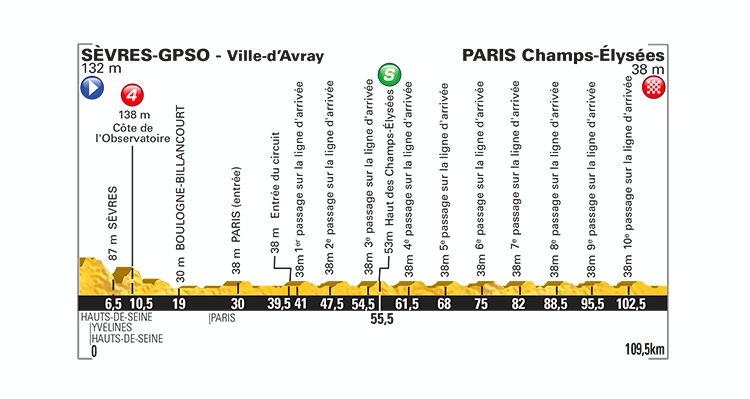
Chris Froome may have effectively sealed his 2015 Tour de France win, but the race reaches its official conclusion in Paris on Stage 21. Only 109.5km in total, the pack starts in Sèvres and then rides about 40km into Paris, where they begin ten laps of an urban circuit, finishing on the Champs-Élysées. The first third or so of the stage is essentially a procession to celebrate the race and Froome’s all-but-sewn-up overall victory. Once the peloton enters the Paris, riders will start to attempt to break clear of the pack for one last shot at glory in the world’s biggest bike race, and then the sprint teams will gradually wind up the pace. Things get very fast in the final few laps.
The final kilometer of the circuit has a large s-curve that veers left and then right again with around 500 meters to go, but after that it’s a straight run to the line where we can expect a high-speed sprint finale.
With a bit of rain in the forecast for the afternoon, there is a slight chance of wet roads at the finish.
Though the Tour’s final stage always starts out with relative calm, the stage victory in Paris is the most valuable stage win in the sport for the sprinters. There will be plenty of attempts to get clear on the urban roads, but don’t expect any attackers to get too much room. The Champs-Élysées is all about the quick men and a big bunch kick.
On results, one sprinter has been head and shoulders above crowd in this Tour: André Greipel. In a mass sprint, Mark Cavendish, the only rider who has beaten Greipel in a previous bunch kick in the 2015 Tour, looks to be the only one with a real chance of taking him on again on Stage 21.
Greipel definitely has the edge on win record so far in the 2015 Tour—Greipel has a three-to-one win advantage in that department. He’s been on terrific form so far in this race. However, both of Greipel’s first two stage wins came against a poorly-led-out Mark Cavendish, and Greipel’s third win was against a field that did not include Cavendish, who had been dropped from the pack much earlier in the day. Prior to this Tour, the younger Cav has typically had the better of Greipel. In short, there are reasons to like Cavendish’s chances despite his relative lack of success so far.
Both riders are without their main leadout men going into Stage 21, with Lotto-Soudal’s Greg Henderson and Etixx-QuickStep’s Mark Renshaw both having abandoned the race. I see this as almost a dead heat, but based on peak ability and past performances on the Champs-Élysées, I give a very, very slight edge to Mark Cavendish, who has won on this stage plenty of times before.
Behind the two top-tier sprinters in this Tour are plenty of hopeful quick men hoping to steal the day—but it’s hard to like anyone’s chances in this high-speed finale other than the two fastest riders in the race. Peter Sagan has come close in the bunch sprints, in the Top 4 of each of the race’s four bunch kicks so far with two close runner-up rides among those results. For all the talk you’ll hear from observers about him “not being a pure sprinter,” Sagan has an impressive turn of speed and can never be counted out, especially after a few days in the mountains that might have softened the legs of his rivals.
The same is true of John Degeknolb, who ran 2nd behind Greipel on Stage 15. He’s gotten better as the race has gone on, and, as he’s among the toughest sprinters in the peloton, he will probably be less depleted from the Tour’s visit to the Alps than most. Alexander Kristoff has not been as strong in this Tour as he was last year, but he came close to a Champs-Élysées win behind Marcel Kittel in last year’s Tour and also has endurance in spades.
Arnaud Démare, Bryan Coquard, Tyler Farrar, Michael Matthews, and Edvald Boasson Hagen are others who will have a chance at success in the bunch gallop that will likely close out the 2015 Tour de France.
VeloHuman Stage 21 Favorites
1. Mark Cavendish | 2. André Greipel | 3. Peter Sagan
As Stage 21 is the final stage of the race, this is the last VeloHuman preview of the 2015 Tour de France. I’ve had a blast previewing every day of the Tour, and I have particularly enjoyed hearing from those of you who have reached out to talk racing, to ask for an opinion on your favorite long shot, or just to say hello! I hope you’ll continue to stay connected by following @VeloHuman on Twitter and by checking out the VeloHuman Facebook page.
While the Tour may be reaching its conclusion, VeloHuman is nowhere near done for the year! There are still previews and podcasts to come and plenty of favorites and outsiders to be named for big races like the Vuelta a España, Il Lombardia, and the World Championship Road Race, so even after the last rider crosses the finish line on the Champs-Élysées, stay tuned for a whole lot more in 2015. The race preview and the pre-race podcast for the always exciting Clásica de San Sebastián are only a few days away!
Stage 20 is the Tour’s final mountain stage, and the only stage in the race to feature two HC-rated climbs. Those two uphill tests are the only categorized climbs on the day, but they’re plenty challenging by themselves.
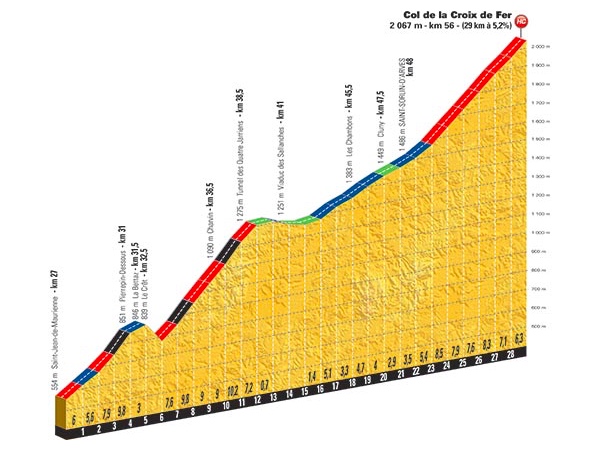
It’s a very short stage at just 110.5 kilometers, so expect a high pace all day. After a downhill run of 25km from the start the road angles upward in the form of the now-familiar Col de la Croix de Fer, though this time they approach the summit a different way.
The peloton may have gained some familiarity with the Col de la Croix de Fer after Stage 19, but that won’t offer much comfort during the 29km ride to the top.
The trip upward will span 29km at 5.2%, with a few steeper sections early on and then near the top.
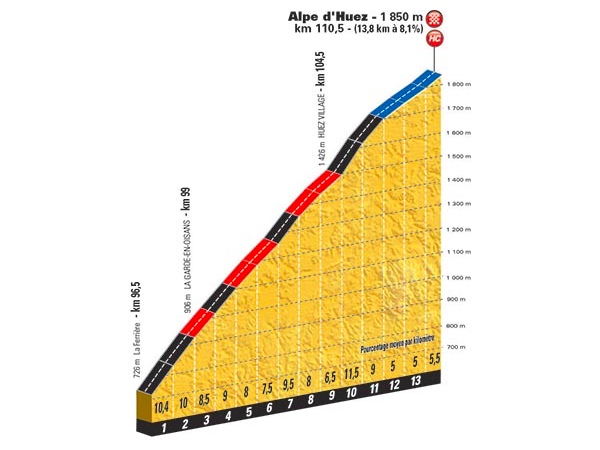
After the riders crest the climb, they’ll head downhill for about 30 kilometers into a short stretch of flat road, which leads into the foot of the final mountain climb of the 2015 Tour de France: Alpe d’Huez.
The legendary Alpine test is 13.8km in length with an 8.1% average gradient. It is at its steepest at the beginning of the climb and then with around 3 kilometers to go. Things even out a bit near the top for a final kilometer at just over 5%.
The Alpe d’Huez is the final opportunity for the climbers to leave their mark on the 2015 Tour de France.
The profile isn’t a terrible one for the early breakaway, and if a strong group gets up the road they will have a chance, but most of the big favorites from afar have spent a lot of time in the breakaways in the past two stages, and that could leave them low on fuel. The GC men, especially if they wind it up early to put pressure on each other, have a good chance of fighting it out for the final mountain stage in the Tour.
Nairo Quintana put some time into Chris Froome on Stage 19 and will look to do so again on Stage 20. For Froome, the goal is simply to not lose 2 and a half minutes on the stage. Froome didn’t look totally cooked on Stage 19 and was probably playing things conservatively, limiting the damage reasonably well—but the young Colombian is nevertheless closer to yellow than he was before. That could have Froome planning to take Stage 20 as safely as possible.
If he decides to attack Quintana, Froome’s an obvious danger for stage win, but with the Tour de France on the line, that seems like a risky proposition. What’s more, Quintana, benefiting a great deal from having Alejandro Valverde as a foil, might just be stronger now anyway. If this does come down to the GC favorites, it’s hard to see anyone challenging Quintana for Stage 20.
Alberto Contador will likely give it a shot. He’s way too far down on Froome to be a threat, but the podium is not completely out of reach, and a stage win would be something of a consolation prize for Contador, whose Tour has fallen very short of his expectations. He’s not strong enough to beat Froome and Quintana head-to-head but there’s a chance he’s given enough of space that that won’t matter too much.
Stage 19 winner Vincenzo Nibali could obviously have aspirations of breaking clear of the GC group once again, and he’s certainly looked stronger in the past few days than he did at the start of the race. But he’s not likely to get nearly as much breathing room as before now that he’s in contention for the podium, and he’s bound to pay somewhat for his efforts on Stage 19.
Robert Gesink sits nearly 9 minutes behind Froome on GC, and he has nearly 4 minutes of cushion to the next rider on the leaderboard. If he feels strong on the final climb, don’t be surprised if he tries to leave the GC men behind to go in pursuit of a stage win. Even if his bid fails spectacularly, he’s got plenty of time to lose to drop even one spot inside the Top 10.
Romain Bardet has enjoyed two great stages in a row, with a win on Stage 18 and a top 5 placing (and plenty of KOM points racked up) on Stage 19. He’s certainly strong right now, and he’s far enough behind on GC that he’ll be given some space if he wants to go for a long one. It’s hard to predict how he’ll play the stage—in his quest for the KOM title, the points on the Croix de Fer won’t actually be all that important if Froome ends up placing highly on the final climb. Bardet can’t afford to wear himself down too much and not be in contention for a decent placing at the finish. As such, his strategic decisions should be more focused simply on whether he thinks he has a better chance at a high stage placing (and the accompanying KOM points) from the pack, or in the break. Sticking with the peloton until the final ascent and then launching a move could be the best tactic. In any case, after two days of exhausting himself, Bardet is likely to be bringing a bit of fatigue into Stage 20, so it will be a big challenge for him to take a victory, especially with stronger GC favorites and fresher potential breakaway candidates having their eyes on the same prize.
Joaquim Rodríguez is in a similar boat, but he has not looked the best in the past two stages. The veteran racer could still recover, however, and unlike Bardet he conserved energy after the breakaway was reeled in on Stage 19, so don’t be surprised if he gives a long-range attack another go on Stage 20.
Pierre Rolland has plenty of form in this Tour de France but two days in a row of exhausting solo efforts won’t have left him with much energy to try for another on Stage 20. Then again, everyone will likely be tired and Rolland isn’t a threat to the overall, so he may find success if he saves energy by riding in the pack until the final climb, and then goes for a long one on the early slopes.
Thibaut Pinot stayed with the GC men for the entirety of Stage 20, which, first, suggests that he is feeling strong right now, and second, will likely leave him a bit fresher than Bardet, Rodríguez, and a number of other likely breakaway contenders. That could serve him well for a long-range move, though he hasn’t quite had the strength to turn in a victory so far.
Jakob Fuglsang was one of the few big-name potential breakaway favorites to completely save his energy on Stage 19, dropping out of the GC group early, and he’s looked strong enough in this Tour that he may have a chance with a long one on Stage 20. The question for Fuglsang will be whether he gives it a shot at all. Now that Nibali is fighting for the podium, Astana may call for all hands on deck in support of the Italian GC contender, which could leave Fuglsang playing domestique. If he goes on the attack, he’s a dangerous rider.
Rigoberto Urán, Rafal Majka, Ryder Hesjedal, Andrew Talansky, Cyril Gautier, Adam Yates, Serge Pauwels, Samuel Sánchez, Warren Barguil, Mathias Frank, and Rafael Valls are other names to watch for a long-range strike on Stage 20.
VeloHuman Stage 20 Favorites
1. Nairo Quintana | 2. Chris Froome | 3. Alberto Contador
Don’t forget: you can find plenty more Tour de France analysis in the most recent Recon Ride podcast episode. Be sure to follow @VeloHuman on Twitter for more commentary during the race, and check back for the preview of the final stage of the 2015 Tour after the conclusion of Stage 20.
Stage 19: Saint-Jean-de-Maurienne › La Toussuire – 138km
The Tour de France is now halfway through its Alpine stretch and the climbs aren’t getting any easier on Stage 19.
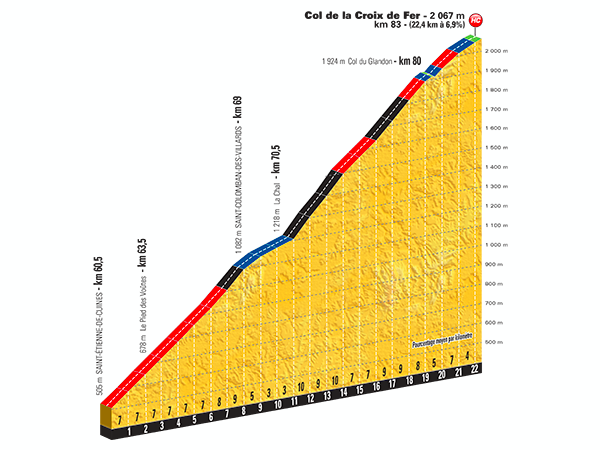
Just like Stage 18, Stage 19 kicks off with climbing right from the gun. The Cat. 1 Col de Chaussy is 15.4km long at 6.3%, quite a challenge to take on in the first hour of the day. From the top it’s a long descent into a long flat section of a little over 25km, which ends at the foot of the massive Col de la Croix de Fer.
Anyone who struggles to make it up the brutally long Col de la Croix de Fer will be in for a tough day—it’s still over 50km from the top to the finish line, with two hard climbs along the way.
22.4km at 6.9%, the Croix de Fer is a huge challenge to overcome, with a particularly steep midsection that jumps into double digits for a little while.
After the summit comes a descent into the short, Cat. 2 Col du Mollard (5.7km at 6.8%). From there it’s a a long downhill that runs right into the foot of the La Toussuire climb, the final ascent of the day. 18km at 6.1%, it’s pretty challenging as Cat. 1 climbs go. The steepest part as at the very beginning, with things easing off slightly near the finish line.
Despite the hard climbs on the profile, Stage 19 is actually quite short, so expect a day of high-speed racing.
Breakaways have enjoyed their own opportunities to fight for stage victories two days in a row now, and the Stage 19 profile is another that will look appealing to the aggressive types, with the hardest climb of the day so far from the finish and plenty of testy descending in between its summit and the finish. On the other hand, the long final climb will require the breakaway riders to have a hefty advantage to stay clear, and this is the penultimate opportunity for the GC men to try to make something happen on the overall leaderboard, which could spur some into action. Even if Movistar isn’t going to be all that aggressive, we’ve seen the fringe GC contenders getting active in the mountains, which has the domino effect of spurring the outside GC contenders to go on the chase, with the top GC contenders then getting into gear to follow.
What’s more, the Stage 18 breakaway included almost all of the top potential Alpine breakaway contenders, which might leave many of them a bit tired. This will be another big day for the KOM contenders, which could inspire some of those who were on the move on Stage 18 to take up the march again on Stage 19, but it’s hard to say who will be that interested in putting themselves through the hell of a real stage victory bid in the breakaway once again.
If a strong group of top-notch climbers gets clear, they’ll have a chance at winning this from afar, but otherwise, the GC men could have their day on Stage 19.
Nairo Quintana has not been able to drop Chris Froome so far in this Tour de France, but with the dangerous 1-2 punch of Alejandro Valverde, he has the chance to put some serious pressure on the race leader in the Alps. It likely won’t make a difference on the GC unless Froome crashes or gets sick (which could happen), but a nabbing a stage while he’s hunting for seconds on the overall leaderboard seems like a real possibility. In 2013, Froome allowed Quintana to get up the road in the final week to take back a little bit of time, and if that formula holds here, Quintana could skip clear on the last climb of the day to take a stage victory. Alejandro Valverde, sitting in 3rd, seems a bit less likely to launch a suicide attack since he’s never actually landed a podium performance in the Tour in his long career, but his powerful finishing kick makes him a threat if things are still together at the top of the final climb.
If Froome decides that he wants a stage victory, he will be very difficult to stop, as he’s been unbeatable on the climbs so far in this Tour de France; as such, he can never be counted out. However, with just two more mountain stages left in the race, Froome could decide to play this rather conservatively.
Alberto Contador has tried to go on the move in the Alps already, but he can’t quite get any separation. The legs just haven’t been there. Still, if Froome focuses all his attention on Movistar, the Giro-winner could steal a march on the other GC favorites. The same is true for Vincenzo Nibali, though the Italian isn’t at his best.
Robert Gesink’s strong form, fast finish, and non-threatening position a bit further down the leaderboard make him a nice candidate to try to make something happen out of the GC group on the final climb. The same is true for Bauke Mollema, though the form hasn’t quite been as strong for Mollema in this Tour de France.
If the early breakaway stays clear, it will likely include plenty of familiar long-range attackers. Jakob Fuglsang has now missed out on two stage wins from the breakaway, and the most recent one will likely have him fired up for another shot. A collision with a race moto took Fuglsang down on the hardest climb of Stage 18, and chasing back onto the breakaway group left him burnt out for the final battle for the stage victory. It also kept him from collecting as many points in the KOM competition, leaving him sitting 3rd in that classification. Fuglsang will likely try very hard to get into the break on one or both of the next two stages in the hunt for KOM points and a stage victory, and the long, challenging climbs of Stage 19 suit him very well.
Joaquim Rodríguez is currently tied with Romain Bardet (just ahead of Fuglsang) on KOM points and will have to get up the road again if he wants to win the competition. He won the early battles for points on Stage 18 but then faded on the Col du Glandon. However, Rodríguez has said that he missed a feed before taking on the climb and then suffered a hunger knock, which shouldn’t hold him back on Stage 19. Plus, he won’t have nearly the effort in his legs that many of his breakaway rivals continued to put in all the way to line. He’s definitely a candidate for success.
So is Bardet, though the young Frenchman may be a bit more conservative in his racing (and he may be more of a marked man) now that he’s holding on to a Top 10 on GC. A monumental effort to win Stage 19 with a solo attack from over 40km out won’t help either. He’s definitely a threat and will be a favorite if he can get into the break, but back-to-back stage wins from the break in the Alps is an extremely challenging feat.
Unlike the aforementioned trio, Pierre Rolland probably won’t expend energy trying to pick up KOM points if he gets into the Stage 19 breakaway. He’s got to be a bit tired after a tough Stage 19, but like Fuglsang he’ll be motivated by the missed opportunity and will likely be very interested in getting on the move in the penultimate mountain stage of the 2015 Tour.
Thibaut Pinot, Tanel Kangert, Serge Pauwels, Ryder Hesjedal, Andrew Talansky, Samuel Sánchez, Rafal Majka, Winner Anacona, Adam Yates, and Rafael Valls and Rigoberto Urán (two of the few likely breakaway hopefuls who didn’t spend much energy on Stage 18) are other potential candidates for long-range success on Stage 19.
VeloHuman Stage 19 Favorites
1. Nairo Quintana | 2. Jakob Fuglsang | 3. Pierre Rolland
Don’t forget: you can find plenty more Tour de France analysis in the most recent Recon Ride podcast episode. Be sure to follow @VeloHuman on Twitter for more commentary during the race, and check back for the preview of the next stage after the conclusion of Stage 19.
Simon Geschke’s Stage 17 breakaway win concluded just the first of four tough Alpine stages. With another day at the Tour de France comes another day in the mountains. Stage 18 features more categorized climbs (seven in total) than any stage in the Tour de France, and a few of them are quite challenging.
The climbing starts right away with the 6.3km, 7%-gradient Col Bayard, which will certainly see some action as riders try to get into an early move. After the top of the climb and a descent thats eases into a stretch of more gentle downhill, the profile is up and down for the rest of the day. Three Cat. 3 climbs lead into the Cat. 2 Col de la Morte, only 3.1km in length but with a harsh 8.4% average gradient.
From the top it’s a very steep descent of about 15 kilometers, after which the road angles upward again, climbing for a not-insignificant stretch to the official start of the Col du Glandon.
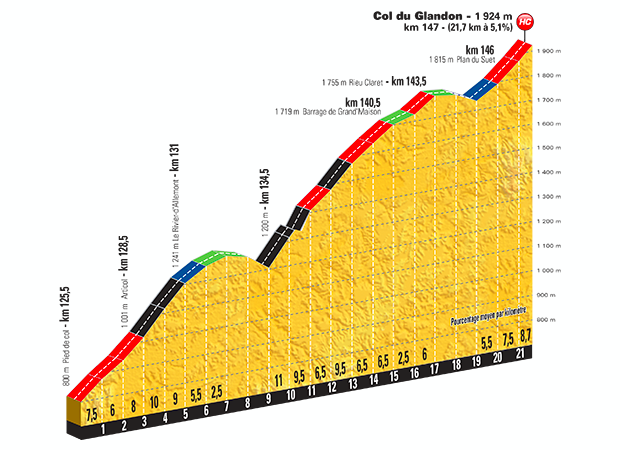
21.7km a 5.1%, and coming after a bit of uncategorized climbing at that, the Cat. 1 Col du Glandon is an irregular ascent with numerous stretches that get up near and over 10%. There are plenty of places to attack on the very long way up, and the sheer magnitude of the climb will make it an unpleasant trip for everyone involved.
The riders will have already been going uphill for a while by the time they hit the official start of the very long Col du Glandon, which has a number of very steep stretches to inject some serious hurt into the legs.
But the day doesn’t end at the top of the climb—a 20km descent follows into the final climb of the day, the Cat. 2 Lacets de Montvernier. 3.4km at 8.2%, it’s one last jumping off point for the punchy, enterprising riders in this Tour, with the top of the ascent coming 10km from the finish.
So many categorized climbs, and so many short steep stretches, will make Stage 18 an attackers’ playground. Expect to see plenty of action on the earlier climbs. If the morning aggressors are reeled in, expect to see plenty more attackers on the Col de la Morte and then the Col du Glandon. It could be some time before a solid break is formed. And even if the early break is reeled in sometime before the final 20km, the Lacets de Montvernier will be a great launching pad for one last strike for glory.
The Tour has already seen plenty of big, successful breakaway moves, with Sky and Movistar content to fight it out in the GC battle well behind the breaks. The fact that the hardest climb of the day comes so far from the line might help temper the pace in the peloton. Controlling this stage will be a big challenge anyway, given the profile. With so many strong climbers well out of the overall race leadership competition, it seems likely that plenty of talented riders will find themselves up the road on battling for Stage 18 from a long-range move. Only a serious injection of pace from the pack on the Col du Glandon can keep this together.
In any case, the Stage 18 winner will almost certainly be a top-notch climber with good descending skills as well. Joaquim Rodríguez tried and tried again to get up the road on Stage 17 but the peloton kept reeling in the early moves. I’m betting he’ll resume that effort on Stage 18. Of the strong climbers in the Tour de France who aren’t any GC threat whatsoever, Rodríguez is one of the very strongest. He should thrive on this brutal day, and he doesn’t even need to attack on the Col du Glandon if he doesn’t want to, since the short but very steep test near the end of the stage suits him perfectly. The finishing straight even kicks up slightly to favor him in a late uphill sprint if he finds himself in that situation. As always, the question mark will be whether Purito gets up the road. If he’s there, he’s a major threat.
Romain Bardet kept the powder dry on Stage 17, but he could try to go on the move on Stage 18. This profile doesn’t suit him quite as much, but he’s still among the top climbers in the race, and he has plenty of motivation to get something out of the Tour before it leaves the Alps. Alternatively, AG2R could send Alexis Vuillermoz up the road here instead. Vuillermoz has shown in the past that he’s capable on the long, hard climbs, and the steep final climb suits him very well.
Ryder Hesjedal has been active in the breakaways in 2015 Tour but he hasn’t been particularly successful. He’ll have another chance here on a stage that suits his characteristics. Teammate Dan Martin is another solid candidate for long-range success—the profile, especially the late climb, is a good one for him. Unfortunately, Martin suffered from illness in the second week of the Tour, and his current form is a question mark. Andrew Talansky will probably be a bit exhausted after Stage 17 but he is, at his best, a Grand Tour GC rider who should have the endurance for back-to-back hard days if he has it in his mind to get involved here.
BMC’s Samuel Sánchez has been quietly riding an excellent Tour de France, currently sitting 13th overall despite riding in support of Tejay van Garderen for most of the race. Now that his team leader has abandoned the Tour, Sánchez could look to go on the move. It’s hard to imagine a better profile for the elite descender and punchy climber. If Sánchez can get up the road, he’ll be a top favorite for stage honors. Damiano Caruso is worth keeping an eye on as well.
Europcar, a team looking for a 2016 sponsor, has yet to come away with a stage victory in this Tour, but this is a golden opportunity. Pierre Rolland tried to get into the break on Stage 17 and could look to get on the move again on Stage 18. Cyril Gautier doesn’t have a Tour de France white jersey in his palmarès, but he may be an even better bet. The up and down suits him very well. Tommy Voeckler isn’t what he once was as a racer but this is a great profile for him as well.
Jakob Fuglsang is among the top climbers in the Tour and way down on GC; if he were clear in his motivations of taking every opportunity available to go stagehunting from the break, he’d be a strong pick—but he’s been very quiet since his 2nd-place finish on Stage 12. If he’s up there, he’s a strong contender but he might be waiting a little bit longer to go for it . . . or he might even have resigned himself back to being a domestique again that Vincenzo Nibali seems set on fighting for the Top 5.
Jarlinson Pantano (who is surprisingly fast at the line), Rigoberto Urán, Jan Bakelants, Wilco Kelderman, Michael Rogers, Rafal Majka, Thibaut Pinot, and, if he’s not too exhausted, Stage 17 winner Simon Geschke are other riders worth watching as potential candidates to take a Stage 18 victory from afar.
Tony Gallopin would be one of my top contenders from the breakaway for this stage but he has shown very little interest in getting up the road in this race, and he’s looked exhausted in the past few days. The profile suits him but I’m not sure he’s got the strength at this point. On the flipside, don’t rule out Peter Sagan—the HC-rated climb of the Col du Glandon is very difficult and not really Sagan’s style, but he’s looked to be incredibly strong this month and if he can hold on over the top of the climb he’s got a great shot at the stage win if he’s in the lead group.
Should the main breakaway be reeled in by the peloton on Stage 18, Alejandro Valverde will be an obvious favorite with the late short climb and then the flat finish. He excels in both scenarios. If Robert Gesink can hold on over the day’s challenging climbs, he’s another rider to keep an eye on late in the day. The Top 5 is a real possibility and Gesink has some punch.
Vincenzo Nibali will also like the look of the profile, given the very long descent on tap late in the day, followed by the short ramp that could provide an opportunity to go on the attack if he hasn’t distanced the GC men yet, though Chris Froome and Nairo Quintana are always potential stage winners themselves when there are mountains involved.
Don’t forget: you can find plenty more Tour de France analysis in the most recent Recon Ride podcast episode. Be sure to follow @VeloHuman on Twitter for more commentary during the race, and check back for the preview of the next stage after the conclusion of Stage 18.
The first of four challenging days in the Alps, Stage 17 comes on the heels of a rest day (which gave VH and Cyclocosm time to team up for one last Tour de France Recon Ride episode). Hopefully, the riders will have gotten in every bit of recovery they need, because the next few stages will put everyone to the test.
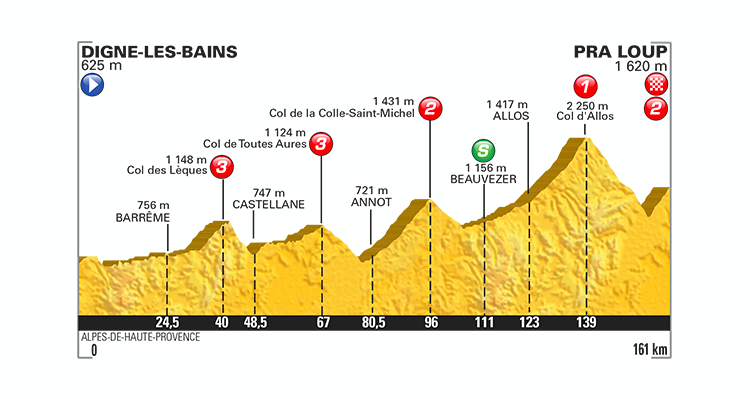
Relatively short at 161km, Stage 17 follows the same route of Stage 5 of the 2015 Critérium du Dauphiné, won by Romain Bardet. The stage opens on a short climb, with about 30km of flat to follow, and then it’s up and down all the way to the line. A pair of Cat. 3s and then an 11km (at 5.2%) Cat. 2 are the appetizers of the day before a 1-2 punch of climbs (that happen to be Category 1 and Category 2 climbs, respectively) to close things out.
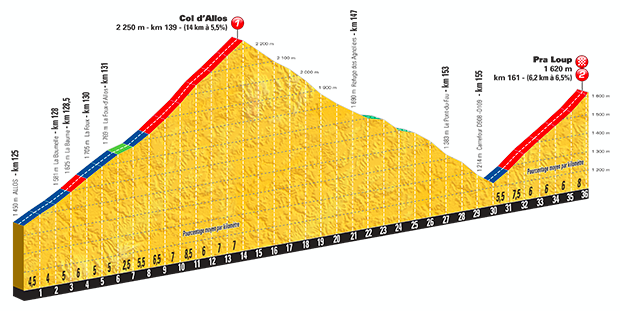
The Cat. 1 Col d’Allos is really just the second half of a long uphill stretch that starts much earlier. The peloton will be going upward for over 30 kilometers, with an average grade of about 3% over the long haul. The official climb of the Col d’Allos is 14km in length at 5.5%. It starts out at relatively low gradients, but it stays at 6% or more for the final 6 kilometers.
Neither of the final two climbs of Stage 17 is comparatively all that difficult, but together, with plenty of vertical meters already in the legs, they’ll make for a hard day of racing.
After a long, tricky descent from the Col d’Allos comes the final climb of the day, the 6.2km, 6.5% ascent to Pra Loup. It’s a pretty steady uphill drag, with the final kilometer getting a bit steeper at 8%.
The rolling profile, and the lack of any HC-rated climbs, makes this a great day for the breakaway, but it’s never easy getting a great read of the motivations of the teams in the pack. Several of the fringe GC contenders have shown interest in trying to get up the road, but others have been cagey about that prospect and had their teams policing potential escapes. We saw this on Stage 14 when IAM Cycling chased the break because the squad wasn’t pleased with the presence of GC outsiders in the move who might have threatened Mathias Frank’s Top 10 bid. The makeup of the Stage 17 break will help determine whether the pack chases it down, as will the plans of Movistar and Tinkoff-Saxo, who could be hoping to test the waters, knowing some riders struggle after a rest day. To me, it’s another toss-up day between the pack and the break.
For a possible breakaway win, look to the strong climbers whose GC aspirations have faded. Romain Bardet will be an obvious pick after taking the win here in the Dauphiné. He’s already spent plenty of time up the road in this Tour de France, and he’s come close to stage victories so far twice. He’s not at his very best form-wise, but he’ll still be able to beat most anyone else on this profile if he’s in the breakaway. Teammates Alexis Vuillermoz and Jan Bakelants will be worth watching as well—these climbs aren’t so hard as to put them out of contention from a long-range move.
Jakob Fuglsang beat Bardet to the top of the Plateau de Beille on Stage 12, and the long, steady climbs of the day suit him. He’s in good form and Astana is hoping to salvage something from this Tour despite Vincenzo Nibali’s GC failings. The biggest question for Fuglsang is whether he’ll go on the attack here, or wait until the following stages to try a breakaway move.
That’s also a question for Joaquim Rodríguez, who has kept his powder dry over the last few stages for a big mountain push. The Stage 17 finish is excellent for Rodríguez, a short steep wall after a not-that-hard climb, but he may have the KOM points of the next few stages in mind. If he’s in the lead group at the end of the day he’ll be a top favorite.
Pierre Rolland should shine on this profile, if he can manage to get up the road either early on, or with a late attack—Cyril Gautier and Romain Sicard could try to get in the mix as well. Compatriot Thibaut Pinot looked very strong coming into the Tour de France but his form has been nowhere near expectations so far. This isn’t a perfect profile for him (he’s never been the world’s best descender) but he’ll likely be very active in the hunt for a stage win in the mountains.
Rafal Majka could threaten if he decides to try to get in the break. Dan Martin was sick during the last few stages but says he’s recovering now, and this is an excellent stage profile for him. Teammate Ryder Hesjedal will be worth watching as well. Michal Kwiatkowski, Rigoberto Urán, Louis Meintjes, Serge Pauwels, Adam and Simon Yates, Wilco Kelderman, and Rafael Valls are other potential dangers in a long-range move.
If the peloton does reel in the break, Alejandro Valverde will be the hot favorite for stage victory with this final climb, which is not hard enough to open up huge gaps and will instead favor Valverde’s excellent finishing kick. A potentially aggressive Nairo Quintana will give Movistar a great 1-2 punch for Stage 17.
Tony Gallopin has the speed at the line to challenge Valverde if this comes down to a reduced sprint among the GC types. He’d be a stronger contender if he hadn’t looked exhausted during the stage to Gap, but perhaps after a rest day he will have recovered some strength.
Vincenzo Nibali’s ability to descend and his aggressive streak will serve him well if he decides to go on the hunt for a stage win here.
Chris Froome may decide to play this safe and stay in the wheels, but if he is interested, he’s looked strong enough so far in this Tour de France that he can distance his GC rivals, with the exception of maybe Nairo Quintana, at a moment’s notice if he is so motivated. Sky’s Geraint Thomas will be one to watch with this finish as well.
Robert Gesink and Bauke Mollema could both surprise people if this comes down to a group finish—both are speedier at the line than many realize.
Don’t forget: you can find plenty more Tour de France analysis in the most recent Recon Ride podcast episode. Be sure to follow @VeloHuman on Twitter for more analysis and commentary during the race, and check back for the preview of the next stage after the conclusion of Stage 17.