Tag: Tour de France

  • Tour de France 2015 Preview

    Tour de France 2015 Preview

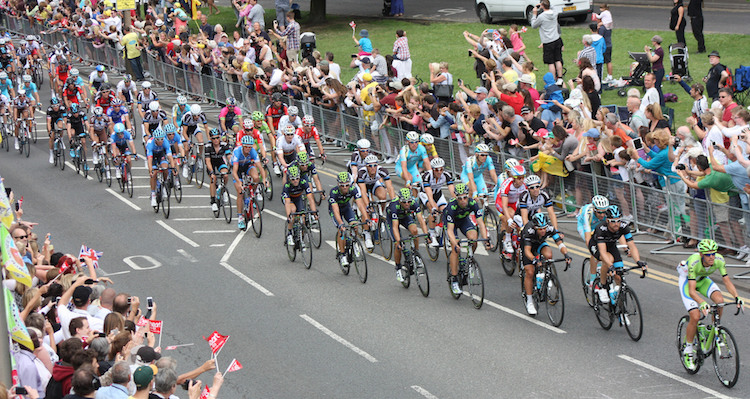
    14639059893_e4b1d1a34b_k

    The 2015 Tour de France is about to get underway, with the peloton set for a Dutch Grand Départ in the Netherlands this weekend. A quick time trial and then a few days of Classics-style racing will give way to several days for the sprinters and more versatile stagehunters before a team time trial and then some very challenging mountain stages to really spark competition among the overall favorites. With a route built to encourage uphill battles and multiple riders looking to have legitimate chances of coming away with the overall win, this year’s edition of the sport’s biggest event is set to be an excellent showdown, and with all the action just around the corner, it’s time for VeloHuman’s overall Tour de France preview.

    The Route

    The Tour kicks off with a short, flat ITT in the Netherlands (in the university town of Utrecht, to be exact). Then comes another day on Dutch soil, a flat road stage, followed by a trip to Belgium’s challenging Mur de Huy on Stage 3. Stage 4 will stick with the Classics theme, challenging the peloton with several stretches of cobbles in between start and finish.
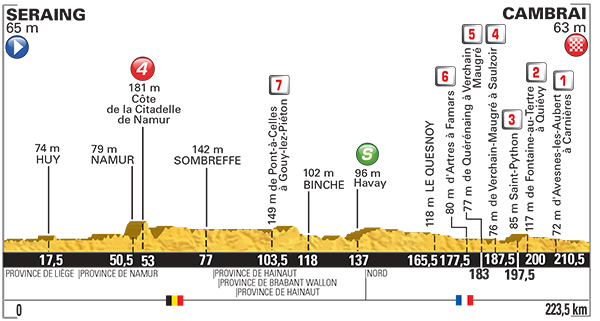
    Stage 4: Seraing › Cambrai (223.5km) – Several stretches of cobbles could inject some nervousness into the Tour de France peloton early on in the race.

    Things get a bit more traditional after that. Stages 5 through 8 look friendly for the fast finishers or those riders fortunate and skilled enough to stick long breakaways. Stage 9 is a medium-length team time trial that will open up a few time gaps on the General Classification, and it’s followed by three high mountain stages certain to see plenty more GC action.
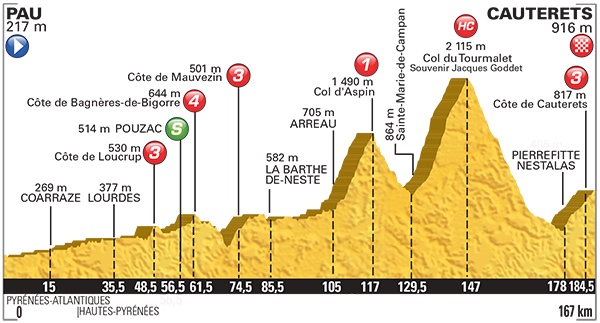
    Stage 11: Pau › Cauterets (188km) – A visit to the Tourmalet, during a day with five other categorized climbs on the menu as well, will make Stage 11 a tough Week 2 test.

    The bumpy profiles of Stages 13 through 16 will keep the GC riders on their toes and, at least in terms of stage honors, will likely favor the more well-rounded fast finishers and aggressive types. Then come the serious mountain tests likely to decide the Tour de France: a very difficult Stage 17, a tough Stage 18, and an extremely challenging one-two punch of mountaintop finishes on Stages 19 and 20.
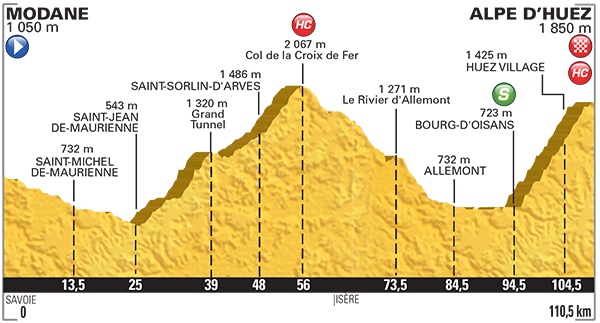
    Stage 20: Modane Valfréjus › Alpe d’Huez (110.5km) – The Tour’s short but vicious penultimate stage should provide a thrilling conclusion to the GC battle on the slopes of the Alpe d’Huez.

    The Alpe d’Huez finale of Stage 20 will make for a great final GC battleground in the 2015 Tour de France, especially at the end of a day packed with climbing. The race will conclude in its usual style with a sprinter-friendly Stage 21 in Paris.

    All told, it’s a climber-friendly route, with far fewer total kilometers of individual time trialing than recent years have seen. Versatility will still be important, however, as cobblestones, Low Country weather, plenty of short steep climbs, and technical descents will challenge the yellow jersey hopefuls to survive and thrive on more than just the long Alpine uphill slogs.

    The General Classification Contenders

    This year’s GC battle is all about cycling’s “Big Four” GC riders: Chris Froome, Alberto Contador, Vincenzo Nibali, and Nairo Quintana. Only Quintana is without at least one Tour de France victory on his record, but his runner-up performance in 2013 and his Giro win in 2014 shine brightly all the same. With all four seemingly on form and healthy, it should be quite a showdown. Each rider has factors weighing for and against favorite status.

    At least in VeloHuman’s perspective, Chris Froome, recently victorious in the Critérium du Dauphiné, looks to be the slight favorite. The last time he stayed healthy throughout the Tour de France, he dominated the field. His 2015 campaign has not been as steady as that incredible 2013, but he looked very strong last month in the Dauphiné, and he has an unbelievable supporting cast with the likes of Richie Porte, Leopold König, Wout Poels, and Nicolas Roche, among others. Sky can put the pressure on early with so many weapons, and Froome’s machine-like endurance should keep his legs powering along late in the race. For Froome, a parcours light on time trials might seem like a less ideal scenario, but the 30-year-old stage racer has actually been underwhelming against the clock lately, meanwhile putting in some very strong climbing rides so far this year. To win, however, he’ll need to overcome the fierce competition of his rivals, whom he has not been able to put away as easily in recent months as he did back when he last won the Tour.

    Alberto Contador certainly has the talent at peak ability to take on Froome in this race, as his terrific 2014 Vuelta victory suggested. But his Giro participation, excellent though his winning performance was, will almost certainly have taken something out of him. The Giro-Tour double is an extremely hard feat to accomplish. Contador may have a better chance of pulling it off than anyone in the sport, but that still might not be enough. A TT-light route won’t help him—he’s certainly better against the clock than Quintana and Nibali, but that won’t be of use here. Instead, he’ll need to rely on his ability to get up the vicious climbs in the final week to win this race, and that might be a lot to ask after a prior GT win already on the season. In any case, strong supporters like Rafal Majka and Roman Kreuziger will be valuable to Contador’s attempt to beat the odds and the other favorites.

    Nairo Quintana should be coming in fresh, and this is the perfect route for him. He’s not a great time trialist, but that won’t hold him back with less than 15km against the clock solo—what’s more, Movistar typically fields a strong TTT squad, making the TTT a place where the young Colombian might actually be able to pick up time on his rivals. After that he’ll have plenty of opportunities to put his terrific climbing skills on display. The last time Quintana and Froome went up against each other in a full Grand Tour, Froome emerged victorious, but Quintana has gotten older and stronger since then, and should be a very strong contender for the overall. Alejandro Valverde offers Movistar a powerful card to play as well—and don’t be surprised if he has his own GC ambitions in this race too.

    Despite winning last year’s Tour de France, Vincenzo Nibali will face an uphill battle for a repeat victory. His Tour win was impressive, for sure, but with neither Froome nor Contador surviving into the final week (and Quintana opting to race elsewhere that year), it’s hard to judge Nibali against the gold standard of his top rivals. He was far stronger than everyone else still in the race by the final mountain stages of the 2014 Tour, but that wasn’t really all that unexpected. Still, this is a good route for him, and he has a very complete team around him (which includes stalwart lieutenant Jakob Fuglsang) to help him pursue his second Tour win.

    Outside of that quartet of top favorites, it’s hard to see anyone else really challenging for the overall win, but there are a few strong outsiders. Fresh off his Dauphiné win, Tejay van Garderen looks better than ever on the climbs, and he’ll have BMC’s worlds-winning TTT squad to put him into a good position early on in the race. Thibaut Pinot won high mountain stages in both the Tour de Romandie and the Tour de Suisse, and the lack of ITT mileage favors his skillset. Rui Costa has had a strong year, and has been an elite one-week racer for some time, despite never really putting it together across three weeks to land a big Grand Tour result—this could be his year to finally string together several good days. Joaquim Rodríguez has run a bit hot and cold in 2015, but he was untouchable in País Vasco; this parcours suits his abilities quite well and that could help him battle it out for a big result. Bauke Mollema should also like the overall route (and the Dutch start), and he has shown flashes of impressive form this year.

    AG2R’s one-two punch of Jean-Christophe Peraud and Romain Bardet, and Cannondale-Garmin’s one-two-three punch of Andrew Talansky, Ryder Hesjedal, and Dan Martin could make things interesting. The EQS duo of Michal Kwiatkowski and Rigoberto Urán, IAM’s Mathias Frank, Europcar’s Pierre Rolland, LottoNL’s Wilco Kelderman, and Giant-Alpecin’s Warren Barguil are among those who will hope to battle for big results from the fringes of the GC conversation.

    The Stagehunters

    With Marcel Kittel out of the Tour de France this year, Mark Cavendish looks to be the class of the field in the pure speed department in this race, but there are plenty of strong riders behind him who will hope to nab stage wins as well, especially on some of the bumpier stages where Cav might struggle. André Greipel, at his best, should be able to mix it up with Cavendish on the pure flats. The likes of Alexander Kristoff, John Degenkolb, Nacer Bouhanni, Arnaud Demaré, Michael Matthews, and, of course, Peter Sagan, will also try to be in the conversation, with the tougher days potentially providing opportunities for some of them to battle it out without Cavendish in the conversation. John Degenkolb, in particular, could surprise—as versatile as he is, he’s also just plain fast in a sprint. With Giant-Alpecin’s full support thanks to the absence of Marcel Kittel, Degenkolb could rack up the results and maybe even a strong green jersey bid. Sam Bennett, Bryan Coquard, and MTN-Qhubeka’s speedy pair of Tyler Farrar and an in-form Edvald Boasson Hagen are others to watch in the sprints.

    A generous helping of intermediate stages will likely see the peloton’s punchy climbers and long-range specialists hunting for multiple stage victories. Watch out for the likes of OGE’s Simon Gerrans and Michael Albasini, BMC’s Philippe Gilbert and Greg Van Avermaet, Trek’s Julian Arredondo, and Lotto-Soudal’s Tony Gallopin (among many others) to keep things interesting on the bumpier days. Lastly, a note about the very strong field of TT specialists in attendance: there may be only one (short) ITT in the Tour, but a chance to wear yellow is on the line and the impressive time trialing quartet of Tony Martin, Fabian Cancellara, Tom Dumoulin, and Adriano Malori should be in the mix with a few of the aforementioned GC contenders for the honor of a stint in the yellow jersey early on in the year.

    VeloHuman Top 10 Overall Race Favorites

    GC Winner: Chris Froome
    Podium: Nairo Quintana, Alberto Contador
    Other Top Contenders: Vincenzo Nibali, Tejay van Garderen, Thibaut Pinot, Joaquim Rodríguez, Rui Costa, Romain Bardet, Alejandro Valverde

    Be sure to follow @VeloHuman on Twitter for plenty more analysis, and check back soon for the preview of the first stage of the race—VeloHuman will be previewing every individual stage of the 2015 Tour. The preview of Stage 1 is already online! Also, don’t miss the Recon Ride’s three Tour de France podcasts. The first episode is available here!

    -Dane Cash

    Photo by Epping Forest District Council (CC).

  • The Recon Ride Podcast: Tour de France 2015 Show, Part I

    The Recon Ride Podcast: Tour de France 2015 Show, Part I

    tdf2015vh

    Episode 17: Tour de France 2015 Show, Part I
    Cycling’s main event is almost here. The Recon Ride takes a look at the route, the favorites, and the big storylines of the 2015 Tour de France.

    [powerpress]


    With the biggest race of the year around the corner, Cosmo Catalano of Cyclocosm and Dane Cash of VeloHuman join forces to present the first of three Recon Ride Tour de France episodes.

    Photo by Greenwich Photography (CC).

  • Mathias Frank Almost Back to Full Strength, Preparing for Another Run at a Tour de France Top 10 and the (Potential) “Big Challenge” of a WorldTour Promotion

    Mathias Frank Almost Back to Full Strength, Preparing for Another Run at a Tour de France Top 10 and the (Potential) “Big Challenge” of a WorldTour Promotion

    Mathias Frank

    After a busy season that left him with a much-improved résumé but also a broken femur and second career Tour de France DNF, Mathias Frank is enjoying some time off. Earlier this year, his first with IAM Cycling, Frank landed in the GC Top 10 of five straight stage races, claiming runner-up honors in the Critérium International, Bayern Rundfahrt, and Tour de Suisse, and also racking up a few stage wins as well during the excellent run of performances from March to late June. The 27-year-old seemed primed for a successful return to the Tour de France, a race he’d abandoned in his 2010 debut due to a broken thumb and torn thigh muscle sustained in a crash in the prologue. However, Frank’s 2014 Tour campaign went awry on Stage 7, when he was one of a hapless bunch of riders who hit the deck hard inside the final kilometer. The crash left him with a broken left femur, an appointment with a surgeon, and another DNF in the world’s biggest race. Frank spent two months away from competition recovering before returning for a few one-day races to close out his 2014 racing program while getting a bit of strength back in his legs. Now one month removed from the season, he is (finally) nearly back to full health.

    “From the femur, I don’t feel anything anymore. I don’t have any pain or anything. There was a little imbalance at the last test I did, so I’m still working with the physio on it, but I’m sure I will be at 100% pretty soon again,” he told VeloHuman in a phone interview this week.

    As he takes those last few steps towards full recovery, Frank is able to look back on his season in a positive light. As frustrating as his Tour de France journey was, he still managed to put together an excellent first half of the year, which Frank acknowledges was “definitely” the best spring in his career. “Normally it always took me a bit longer to get into good shape. This year I was really happy to open the account early in the Critérium [International] and from then on, I did some pretty good racing the whole spring. So it was the best first part of the season for me,” he said.

    Frank joined IAM Cycling this season after several years in the red and black of BMC. Coming off a fine 2013, the Swiss rider was a promising addition to the Swiss team that was making several big improvements at the time, also bringing in star all-rounder Sylvain Chavanel. One might expect the season’s high hopes to have come with high pressure, but Frank says that he did not feel pressured to perform, at least not by anyone other than himself. “It’s something you always put on yourself, the pressure. I don’t feel any pressure from the team, it’s more my expectations that I have. . . . I think the expectations that I have are more than what the team has! The team really doesn’t put any pressure on me,” he said.

    Frank’s own motivation and the low-pressure team atmosphere contributed to a major step forward in results. Frank attributed his early season success to a “combination of different things,” among them, a new role in a new team: “The environment, the role that I have, that I can go for myself. I think I already felt in BMC the last couple of years, 2012 and 2011, I could see that I was always a competitor. I couldn’t really turn that into results but from the numbers from training I knew that I was quite close to being where I was this year. So it wasn’t really a surprise—I think that there were a lot of things coming into place.”

    The multiple podium performances in the spring raised Frank’s expectations even higher for the Tour, but when his run at the main goal of his season came to a sudden end in a heap of riders and mangled bikes near the finish line in Nancy, it was a psychological blow. Still, Frank seems to have already put the frustrating Tour behind him. “For sure, I was super disappointed,” he said. “I had a big chance going for the Tour in the really good shape that I had after the Tour of Switzerland, but at the end . . . that’s how it is. Crashes, they happen. You can’t do anything but get up and try it again next year. What also helped me this year was that I became a father in June, during the Tour de Suisse, so when I was home, there was something else, there was some distraction, with my daughter. I didn’t really think too much about it. I think I just took it as destiny, as a ‘try it next year’ again.”

    After crash-marred races that resulted in DNFs in both of his two career Tour appearances, Frank is hoping (in fact, he seems confident) that the third time will be the charm. “After two bad experiences, the third time it’s really going to work out. I really believe in this and that’s how I see it. That’s two bad crashes in my whole career, and they were at the Tour de France. So for sure, I’d say it’s sad, but it could happen anywhere. I’ll just have to try it again and at one point it will work,” he explained.

    Frank and his squad are currently awaiting word from the UCI License Commission regarding their application to join the WorldTour in 2015, but various sources have reported that the team will likely make the cut. Thanks to strong seasons by Frank and Sylvain Chavanel, IAM Cycling was among the best of the Pro Continental squads in the peloton in terms of results this season, but joining the WorldTour ranks is no small step up. A commitment to a full calendar of top-level races, including all three Grand Tours and all five grueling Monuments, is quite an effort for any squad, and many teams have struggled in their first year at the highest level. Frank acknowledges that if IAM Cycling is, in fact, given a WorldTour bid for the 2015 season, it will not be easy. At the moment, he is realistic about what the promotion might mean, but also hopeful that rider development will pay off. “I think it will be a big challenge for sure. It’s a tough schedule now with all these race days, with three Grand Tours. But I think it was good last year to do two Grand Tours, for the team. We still have a lot of young guys and I think for them, they’re developing and next year if we go WorldTour, the team should be ready for it,” he said. “It’s a big challenge, and maybe it takes another one or two years for some guys to adapt but in general I think we have a good squad with all the new guys that are coming at the end here, and we should be ready, if we move up to the WorldTour, to perform well there.”

    IAM Cycling added a few more “young guys” this transfer season, with up-and-comers Clément Chevrier and Sondre Holst Enger among a list of new arrivals that also includes climber Jarlinson Pantano and time trialing talent Stef Clement. On the other hand, the team lost experienced riders Thomas Löfkvist, Johann Tschopp, and Gustav Larsson. Frank knows that the veteran presence will not be easy to replace, but he likes what he sees in the team’s signings. “We lost some experienced guys . . . some pretty good pros. But I’m positive that the young guys will step up, the guys that we’re going to get. We’ll have to see, but I think in general we’ll be at least as good as this year,” he said.

    Mathias Frank’s own plans for 2015 are not yet set in stone, but he has his sights on the one-week stage races (like the Tours de Romandie and Suisse in which he’s had recent success) and especially the Tour de France, with a third run at cycling’s main event as his central target this upcoming season. “Next year, it will be all about the Tour. I really want to go to France in good shape again and try to get a Top 10, so I think we’re going to build the program around the Tour and start from there, but it’s not really decided yet so I can’t really give details. I think it will be less racing than this year for sure, but focusing on the Tour de France,” Frank said. “The Tour is going to be the biggest goal. . . . At the end it’s the Tour de France that really counts.”

    Frank has plenty of reasons to be optimistic about his major goal for next season, given the way he performed at several WorldTour and 2.HC races in 2014. On the other hand, he wouldn’t have to look very hard to find reasons to be cautious about targeting a race that has given him a broken femur and broken thumb in his two career appearances—but Frank seems to have put those unpleasant experiences behind him. That’s good news for IAM Cycling. With a WorldTour promotion (and its requirement to ride all three Grand Tours) a very real possibility, the Swiss team will be counting on their Swiss GC leader to deliver in 2015.

    -Dane Cash

    Photo by Georges Ménager.

  • Leopold König on Overcoming Injury, Tour de France Success, and What’s Next in 2014

    Leopold König on Overcoming Injury, Tour de France Success, and What’s Next in 2014

    Konig Climbing

    Given his 7th overall finish in this year’s Tour de France, you might think it’s been smooth-sailing all year for NetApp-Endura’s Leopold König, but almost from day one this season, things have not exactly gone according to plan for the rising Czech star. Having battled through a knee injury early in the year and a tough bout with illness more recently, 26-year-old König is now stateside to participate in the USA Pro Challenge, and he battled spotty reception in the Colorado mountains (much to the gratitude of VeloHuman) to answer a few questions about his fight to overcome one obstacle after another on his way to some fantastic results on the sport’s biggest stage, and what lies ahead for the rest of the year.

    König closed out his 2013 season on a high note, notching a stage win and 9th overall at the Vuelta a España, delivering the kind of performance for Pro Continental squad NetApp-Endura that announced to everyone just how deserving they were of a wildcard invitation. With an invite to ride in the Tour de France in 2014, it was fairly obvious what NetApp-Endura’s plan would be: build a team around this fast-rising talent to support his GC ambitions and again prove themselves worthy of their wildcard invite.

    With the sport’s main event on the horizon, König set out to build his form over the early months to be at his best for the big race in July, but just as the season began, his plans were derailed by a nagging knee injury.

    “Ligament issues,” he told VeloHuman. “It wasn’t too serious but the problem was the healing process lasted so long, and the only way to fix it was to relax the knee and not put any pressure on it. So that was very frustrating because we didn’t know how long it would last and finally it was more than one month, it was actually a long time.”

    Any plans to target a particular aspect of his skillset for improvement in training went out the window.

    “To be honest, there wasn’t much time to get specific training in, and we had to adjust a lot of training because I was one month off the bike and it was just a race with time to get to the Tour in time and to get prepared,” he said. “I actually just did one real training block in the Sierra Nevada that was more focused on climbing, and then I went to Bayern and the Dauphiné. So there wasn’t really much time to get specific training in for the Tour.”

    As might be expected, not being able to prepare for the biggest goal of his career was not easy for König.

    “I tried to stay relaxed and not really think about it but it was pretty hard to manage mentally because, as I mentioned, we didn’t know when I would be able to train properly, or when I would be able to race,” he explained. “I tried to stay relaxed but there were moments when it wasn’t really easy. But finally it worked out.”

    At last on his way back to recovery (he finished 4th at the Bayern Rundfahrt and 11th at the Critérium du Dauphiné), König took on his very first Tour de France with the added expectations that come with being a team leader.

    “Everything was much bigger, all the pressure, the media attention, and the things around are just bigger than the Giro and Vuelta, but we went into the Tour with a strong team and we wanted to prove to the organizers that the wildcard we got was worth it,” he said.

    König’s Tour campaign itself got off to a rocky start. He lost more time than many of his GC rivals on the cobbles and then crashed hard on Stage 8, losing several minutes. At the end of Stage 9 he was already more than nine minutes off the lead and sitting in 28th place. However, from then on he put in one great ride after another (including a 3rd place performance on Stage 13), climbing higher and higher up the GC leaderboard as the Tour became more mountainous. König attributes his strong second half to his endurance and his ability to get into a groove.

    “I think that’s just the way my body is built,” he said. “I’ve done just 2 Grand Tours but I can feel that every week I’m improving and feeling better. The first ten days of the Tour were especially hard and unlucky for me but then I just started to feel day by day more relaxed and powerful.”

    KonigITT2

    By the penultimate stage of the race, König had soared all the way to 9th place, but a stellar time trial catapulted him even higher. He jumped to 7th overall in the Stage 20 ITT, to the surprise of many, though König himself had been anticipating success in the chrono all along.

    “To be honest I expected that. I looked forward to this TT as it was supposed to suit me well. And finally you know that’s the last real stage of the Tour and the race is almost done so I really wanted to enjoy it,” he said.

    In spite of an inability to train as planned in the run-up to the race, and further difficulty in the first few stages of the Tour de France, König finished 7th overall, among some very impressive company. Now with two Grand Tour Top 10s under his belt, he has cemented his status as one of the sport’s brightest young GC talents. After a short rest period following the Tour, König is now focused on a few late-season goals. He is currently racing in the USA Pro Challenge, and, perhaps unsurprisingly, this part of the season has not been without difficulties of its own, difficulties that saw him lose time on the opening day of the Pro Challenge, though he still has ambitions for the racing that remains.

    “On the way to Colorado I got some virus and spent two days in bed with fever so my GC ambitions are gone but I want to try to win at least one stage,” König said. “After Colorado I’m supposed to race the Tour of Britain, which I really like.”

    Somewhere in between all the racing, König has also had to find time to think about his future. He’s in the final year of his contract with NetApp-Endura, and having notched so much success (and shown some serious mental toughness battling difficulties along the way) over the past two years, he has plenty of suitors hoping to win his services in 2015 and beyond. While several big-name riders have signed in the past few weeks, König has taken his time weighing offers, but that may be about to change.

    “Things are moving ahead now so it’s going to be sorted out very soon,” he said.

    After delivering Top 10 performances in his first two Grand Tours, König’s impending decision will be closely watched around the sport. Having established himself as a capable GC contender not easily deterred from his goals, Leopold König is certain to make waves in whatever team kit he is wearing in 2015.

    -Dane Cash

    Photos by TNE/BrakeThrough Media.

  • Tour de France 2014 Post-race Impressions: Nibali Dominant, Others Ascendant

    Tour de France 2014 Post-race Impressions: Nibali Dominant, Others Ascendant

    Tour de France Wide

    Now that the 2014 Tour de France is officially in the books, there’s time to draw a few conclusions about what we’ve seen. Three weeks of racing offer enough storylines and takeaways for weeks of analysis, but I’ve distilled my impressions down to a select few major observations.

    A Worthy Winner

    Vincenzo Nibali did not want this race to be remembered as the Tour de France without Chris Froome and Alberto Contador, and the results he delivered in pursuit of a truly dominant performance were quite impressive. With four stage wins and several other Top 5s, a strong challenge for the polka dot jersey, and a gap of nearly eight minutes to his closest challenger, Nibali was in another universe compared to the competition in the race. It would have been nice to have seen him battling Froome and Contador, and as things stand right now, Froome is still the oddsmakers’ favorite for the 2015 Tour, but Nibali did all the right things to ensure his place in the history books as a worthy maillot jaune.

    Astana in Front

    We always knew that Nibali was a strong climber (one does not win the Vuelta and Giro without elite climbing ability) but he was up for it on every type of uphill challenge on the menu in this Tour, and avoided even one bad day. What’s more, he has developed into a top-notch time trialist, landing 4th in the Stage 20 chrono. And perhaps most importantly for this race, he displayed the sort of bike handling skills and racing savvy necessary to survive three weeks of riding on often rain-soaked and occasionally cobbled roads. There is a lot to be said for his ability to emerge unscathed from a Tour that dashed the hopes of so many other riders.

    A Lengthy Injury Report

    Speaking of those other riders: as much as Nibali did everything in his power to make this race his own, any rational analysis of this Tour has to include mention of the health issues that plagued so many riders and generated so many headlines. Alberto Contador was on fire this year and now he may not race again in 2014, and Chris Froome looked to be rounding back into shape before his multiple fractures took him out of the Tour. It would have undoubtedly been a very different Tour de France had they been in the mix in the mountains. They weren’t the only riders who suffered race-ending health problems. Mark Cavendish left the Tour on its very first day. Rui Costa was running well in the beginning of the race, but pneumonia hampered him as the Tour went on and ultimately he abandoned his campaign for a Top 10 overall. Andrew Talansky crashed and crashed again early on in the race and was just too banged up to continue riding at the level necessary to hang with the peloton. Andy Schleck suffered a serious knee injury which has put his next several months in doubt.

    Others made it to the Champs-Élysées but were noticeably lessened by ailments along the way. Among the big names in this camp were John Degenkolb, whose first several days were hampered by injury, Arnaud Demare, who battled sickness, and Richie Porte, whose tumble out of the GC Top 10 may have been partially due to a chest infection. In short, a number of big names struggled with health issues in this Tour de France. Those riders who did survive and thrive in the race are worth noting, but it’s important to view all of their successes in perspective.

    New Generation of Sprinters Here to Stay

    With four victories, Marcel Kittel was clearly the best “pure sprinter” in the race. We’ll never know how Mark Cavendish might have fared against the younger Kittel through three weeks of racing, but Kittel continues to assert himself as a dominant force in the top tier of fast men. This is his second straight year of four wins, but remember, he’s only 26! Alexander Kristoff, with a pair of stage wins, is planting his flag as a sprinting force as well, especially in the bunch gallops that follow long and/or rainy days. Peter Sagan is known as the rider to beat on the hilly days that end in reduced sprints, but Kristoff has carved out a niche of his own: he’s not as strong a climber as Sagan, but even flatter stages, if lengthy enough (and especially when wet) can wear out the other fast men, and it is in those scenarios that Alexander Kristoff shines brightest. Andre Greipel and Marcel Kittel were both in the mix on Stage 15, but Kristoff won anyway, much as he won the sprint finale of this year’s Milano-Sanremo despite the presence of Mark Cavendish.

    Peter Sagan may not have won a stage in this year’s Tour, but the nine Top 5 stage finishes that put him into the green jersey are undeniably impressive. It seems likely that with a stronger team, he’ll be able to focus more on winning and less on chasing down late moves; the question of “Where will Sagan land?” will be the biggest story of transfer season.

    Several other young non-winners were, nonetheless, strong performers on a number of stages as well. 22-year-old Bryan Coquard was always in the mix in the sprints, and 22-year-old Arnaud Demare and 25-year-old John Degenkolb delivered some nice results despite nagging ailments.

    A French Resurgence

    The 2014 Tour de France was a wonderful return to prominence for French cycling. Jean-Christophe Peraud, who has landed several impressive results in stage races in his career, put in a next-level performance to reach 2nd overall in cycling’s biggest event. He got stronger as the Tour went on, and benefitted from a top-notch team that also included 6th place finisher Romain Bardet, just 23 years old. A climbing specialist with serious talent and a high ceiling, Bardet now has a Top 10 in the Tour and in Liege-Bastogne-Liege on his 2014 resume (to go with several other nice results), and he should continue to develop as an uphill force.

    AG2R Jenkin Road

    Thibaut Pinot finally took that step up that many expected after his 10th overall and stage victory in the 2012 Tour; a podium position in the Tour de France (ahead of Grand Tour winner Alejandro Valverde) will do wonders for his confidence. He seems to have gotten over his fear of descending, which was a major drawback to his game, but he developed into a much more well-rounded rider in other ways too, now seemingly capable of putting in a strong time trial and several straight good days in the mountains. He should only get stronger over the next few years.

    The GC riders weren’t the whole story for the French revival either. Consummate breakaway specialist Blel Kadri took a very long stage win in Gerardmer, and versatile Tony Gallopin spent time in the yellow jersey and later escaped Peter Sagan and a chasing pack to win Stage 11. He took an impressive victory in San Sebastian last year and continues to prove his wide array of talents that include climbing, soloing, and sprinting.

    Deserving Team Leaders

    BMC’s Tejay van Garderen recovered from a prior injury to race in this Tour, and then recovered from an early crash and a single bad day in the Pyrenees to land 5th on GC when all was said and done. 2013 was a rough year for the young American, who, despite winning both the Tour of California and the USA Pro Challenge, looked to have taken a step back as a Grand Tour rider in that year’s edition of La Grand Boucle. With Cadel Evans showing signs of slowing down, however, BMC backed van Garderen completely in this year’s Tour, and by consistently hanging with with the GC Top 10 types and then delivering a very strong time trial performance in the penultimate stage, van Garderen proved that he is back on track as a GC contender. He’s still just 25.

    Not far behind van Garderen on the GC leaderboard was Leopold Konig. Konig took a stage and 9th overall in the 2013 Vuelta, but 2014 hadn’t been going smoothly for the young Czech climber, who was slated for his first run at being a team leader in the Tour de France. A knee injury hampered his early season campaign and left him unable to prepare as well as he would have liked for this race. He overcame those obstacles and looked strong in the second and third week of the Tour, climbing to 9th on GC before the time trial on Stage 20. He proceeded to deliver the chrono of his life and jumped two more placings to finish 7th overall. It shouldn’t come as a complete surprise, as he has been delivering impressive time trial results somewhat under the radar over the last two years, but few expected him to land 5th in the ITT. If he can continue to show that sort of abiltiy against the clock, he will be a rider to watch in Grand Tours for years to come.

    Looking Ahead

    The last day of the Tour de France is not the last day of the cycling season! The Clasica de San Sebastian, a one-day race with a hilly profile designed to thrill, is less than a week away, with the Tour de Pologne and Eneco Tour soon after. Stay tuned for more previews, analysis, and rider interviews!

    -Dane Cash

    Photos by Adam Bowie, Sum_of_Marc, and Photigule.

  • Tour de France 2014: Stage 21 Preview

    Tour de France 2014: Stage 21 Preview

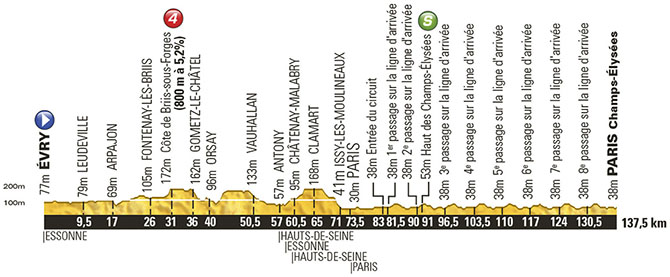
    Stage 21 Profile

    Stage 21: Évry › Paris – 137.5 km

    With the time trial done and dusted (and won, unsurprisingly, by Tony Martin), only the Champs-Élysées finale remains in the 2014 Tour de France. Just 137.5 kilometers in length and quite flat, Stage 21 starts out in parade-like fashion, with champagne toasts and photo opportunities, and the pace remains pleasant until the peloton reaches Paris, when things start to speed up as the riders enter a 7 kilometer finishing circuit and begin an eight-lap journey to the end of the Tour de France. A few aggressive riders will attempt to break away from the pack on the circuit, but as the eighth lap and the final crossing of the line on the Champs-Élysées get closer and closer, the sprint teams will ramp up the pace, making it virtually impossible to stay away. Victory in the final stage of the Tour de France is one of the most prestigious prizes in the sport, and it’s rare that anything stands in the way of a sprinters’ battle royale on the Champs-Élysées.

    Marcel Kittel of Giant-Shimano won the Champs-Élysées finale of last year’s race, and he is in the hunt for his fourth stage win at this year’s Tour de France. All three of his victories so far came very early in the race, as he did struggle a bit on some of the tougher stages after the first week, but Stage 21 doesn’t have the sort of profile that is likely to take much out of the massive German sprinter. Kittel has established himself as a dominant force in tests of pure speed, and he will be the rider to beat on the Champs-Élysées.

    Lotto Belisol’s Andre Greipel does have a stage win under his belt in this year’s Tour, but he will be hungry for another here. In a drag race, few can match Marcel Kittel, but Greipel is probably the rider with the best chance of doing so. He has not done the best job of positioning himself in the many sprint stages of this race so far, but he has a strong support train and this is not a stage with too many obstacles for the powerhouse fast men to overcome on their way to the final few hundred meters. If he can nail the run-in, Greipel can challenge for victory on Stage 21.

    Katusha’s Alexander Kristoff typically prefers fast finishes that follow hard days in the saddle, but he’s also got plenty of pure sprinting ability. He’s looked particularly strong in this race, benefitting from a team that is more focused on his success than they usually are. 6th on the final stage of the 2013 edition of the Tour, he could contend for the win on the Champs-Élysées this year.

    Cannondale’s Peter Sagan will have one last chance at a stage victory in the 2014 Tour de France here in Paris. He doesn’t have the top speed of Marcel Kittel, but he was runner-up to Mark Cavendish in the final stage of the 2012 Tour, and given his talent and tendency to position himself well for the charge to the line, he can never be counted out.

    OPQS’s Mark Renshaw knows how to deliver a result on the Champs-Élysées, even though in the past his biggest successes have been all about providing an excellent leadout to someone else. This year, he’ll have a rare chance to be the featured rider on the final stage of the Tour, and he’s shown impressive speed in this race so far. FDJ’s Arnaud Demare has struggled to make it to the finish with the lead group in many of the sprint days in this race, but the journey to the line is quite short on this stage. If he’s there in the final few hundred meters, he could be in the mix. Europcar’s Bryan Coquard has racked up quite a few Top 10s so far in the Tour, and as a star of the track, he’ll enjoy the chance for a drag race to the line.

    Tinkoff-Saxo’s Daniele Bennati, Garmin-Sharp’s Ramunas Navardauskas, OGE’s Michael Albasini, and AG2R’s Samuel Dumoulin are outsiders who could land strong results on Stage 21, while Giant-Shimano’s John Degenkolb will be ready to step up for his team as a quality alternative should anything happen to Marcel Kittel.

    VeloHuman Stage Favorites

    1. Marcel Kittel | 2. Andre Greipel | 3. Alexander Kristoff

    As Stage 21 is the final stage of the race, this is the last VeloHuman preview of the 2014 Tour de France. I’ve had a blast previewing every day of racing, and I have particularly enjoyed hearing from those of you who have reached out to talk racing, to ask for an opinion on your favorite long shot, or just to say hello! I hope you’ll continue to stay connected by following @VeloHuman on Twitter and by checking out the brand new VeloHuman Facebook page.

    Lastly, an important note: while the Tour may be reaching its conclusion, VeloHuman is nowhere near done for the year! There are still rider interviews to come and plenty of favorites and outsiders to be named for races like the Vuelta a España, Il Lombardia, and the World Championship Road Race, so even after the last rider crosses the finish line on the Champs-Élysées, stay tuned for a whole lot more in 2014.

    -Dane Cash