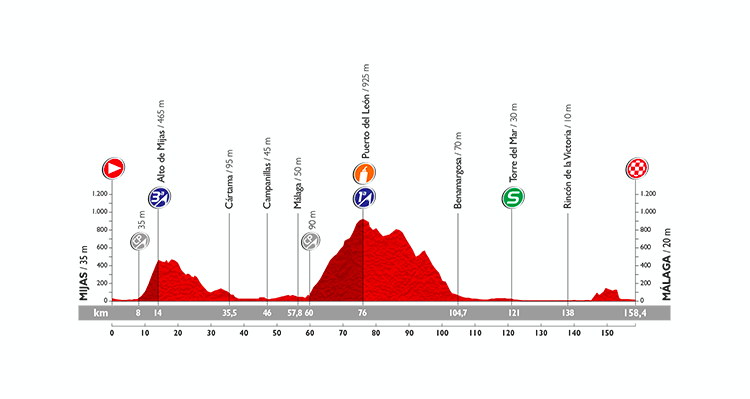
The third stage of the 2015 Vuelta should give the quick men a chance at glory, if they can make it over a tough climb midway through the day. 158.4km from start to finish, Monday’s Stage 3 is a short one, but the Cat. 1 Puerto del León will challenge the sprinters. 16km at 5.2%, it’s a long way to the top. Fortunately, the fast finishers will have about 80 kilometers after the summit to get back into the bunch if they lose contact.
There is also an uncategorized bump about 10km from the finish, though it is neither particularly long, nor all that steep. The final 4km are pan flat, though somewhat technical with a full about-face turn inside the last 2km.
This early in the race, a sprint finish is almost a certainty, and most of the sprint specialists should make it to the line despite the Cat. 1 halfway along the route.
Nacer Bouhanni and John Degenkolb went head to head several times in last year’s Vuelta, with Degenkolb taking four wins and Bouhanni nabbing two. The two speedsters are set to resume the confrontation in this year’s race starting Monday. I rate Degenkolb’s top-end speed a bit higher than most observers probably do, about on par with Bouhanni’s, though Bouhanni has the edge in a technical finish. However, Bouhanni went down hard on Stage 2 and he may be feeling the effects in the Stage 3 sprint. Without much indication of form this early in the race, I’d give Degenkolb a tiny advantage for this likely showdown due to Bouhanni’s fall, though it wouldn’t be a surprise at all if the Frenchman took the stage win. If something should happen to Degenkolb, his teammate Luka Mezgec will be a handy alternative for Giant-Alpecin, fast enough even to challenge Bouhanni.
Peter Sagan is certainly among the top names to watch on Stage 3 as well, though his form is a big question mark. Sagan showed last year that he’s quite comfortable taking the Vuelta as a pure training ride and giving up opportunities for stage victories as works his way towards Worlds. If he’s up for it, he’ll be in the mix, but that seems less than likely.
Caleb Ewan, on the other hand, should be fully motivated to go for glory in his first Grand Tour sprint stage. The 21-year-old has all the speed in the world, and should be right up there in the finale with the more experienced favorites if he can position himself properly.
Danny Van Poppel doesn’t have many opportunities to sprint for himself, but he’s looked sharp this year, especially in the past few weeks. He has a shot on Stage 3. The same is true for Kris Boeckmans—the climb could challenge the hefty Belgian, but he has the speed to fight for a sprint win.
Jean-Pierre Drucker, Kristian Sbaragli, Tom Van Asbroeck, Carlos Barbero, JJ Rojas, Max Richeze, and Jasper Stuyven are among the others who will have a shot at the stage win in the likely bunch kick.
Be sure to follow @VeloHuman on Twitter for more analysis and commentary during the race, and check back for the preview of the next stage after the conclusion of Stage 3. The VeloHuman overall Vuelta a España race preview is available here.
Stage 2: Alhaurín de la Torre › Caminito del Rey – 158.7km
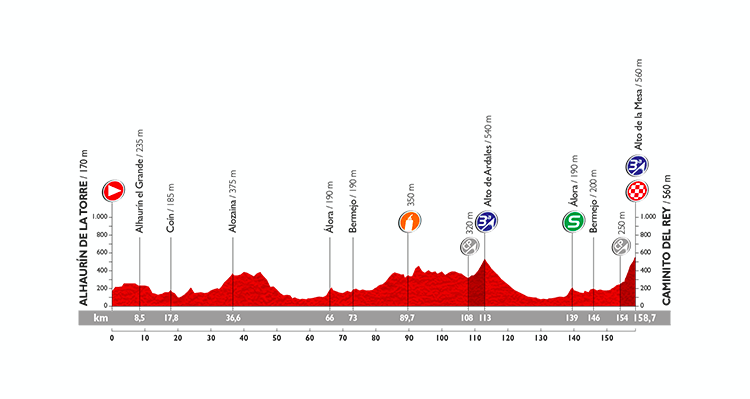
After a strange opening TTT without GC implications, the Vuelta a España kicks off in earnest on Sunday’s Stage 2.
At 158.7 kilometers, Stage 2 is a short one, but a sting in the tail will bring the GC riders to the fore, which is rather unusual for such an early stage in a three-week race. The day finishes with a 4.7km climb at an average gradient over 6%, with a few steeper sections near the finish. It’s not L’Angliru, but it won’t be a cake walk either, especially this early in the race before many riders have gotten acclimated to the pace of a Grand Tour.
Without any separation on the GC leaderboard as of yet, the peloton will probably drive a hard pace to keep the break on a short leash, though it remains to be seen just which teams will do the work. The shortness of the stage should only increase the speed in the peloton. It’s likely that the pack will hit the final climb at a dogged pace, which could blunt any long-range moves. However, on the slopes of the ascent to the finish, things could change dramatically. Any hesitation could see an attack go clear on the steep stuff. In the event that that doesn’t happen, a strong finishing kick will come in handy, as the final few hundred meters do even out a bit.
Dan Martin is a specialist in this sort of finish, and delivered multiple near misses on similar late climbs in last month’s Tour de France. It’s been a disappointing year for Martin, but he’s shown strong form at times, and should be in the mix here in the Vuelta’s Stage 2. The fact that the top GC favorites probably won’t see him as too much of an overall threat could give him an edge should he try for an attack from a little ways out, and he also happens to have great finishing speed for a sprint should that be necessary. He has lived in Spain for some time now, and tends to do pretty well in his adopted home country, having taken his first Grand Tour stage win at the Vuelta back in 2011. In-form teammate Joe Dombrowski is another strong option for Cannondale-Garmin.
Alejandro Valverde was brilliant in the first half of the season, and if he still has anything left in the tank after a tough Tour de France, he’ll be in the mix for this finish, which suits him very well. Of the top GC riders in the race, he is far and away the fastest in a reduced sprint. He probably won’t be given any breathing room to go on the move, but if Movistar can keep a lid on any late attacks (and they have a team capable of taking control of the race), Valverde will be hard to beat. This finish isn’t hard enough to really favor Nairo Quintana, but don’t count him out either—Quintana is a danger any time the road goes up.
Katusha’s one-two punch has a great chance at success on this stage. Joaquim Rodríguez should come into the stage ready for a showdown, and the finish suits him very well. Expect to see him teaming up with Daniel Moreno to try to set the tone for Katusha early on in this race. Both should be a bit fresher than many of the top climbers in this Vuelta; Moreno didn’t race the Tour at all, and Rodríguez played a stagehunting role there instead of fighting for a GC result.
Astana’s Fabio Aru should also bring plenty of freshness into this finish. He was already showing strong form in the Tour of Poland. If he pours all his energy into an attack on the final climb, he could get some separation. Teammates Vincenzo Nibali and Mikel Landa are obvious options as well.
This short climb isn’t the sort of test typically seen as preferred terrain for Chris Froome, but when he’s motivated, he’s almost impossible to keep down; don’t underestimate his chances. Still, Sergio Henao could be the best option for Sky. The Colombian is on great form, and he’s got some pop for a late move or a finishing sprint.
This finish is probably a bit hard for a Peter Sagan who is in Spain to build up form for Worlds, but he deserves a mention ahead of a stage that he might have a chance at on peak form. The same is true for Simon Gerrans, coming back from a collarbone injury.
Domenico Pozzovivo may find the climb a bit too short for his liking, but he’ll be among the freshest riders in the entire race, and he could get some breathing room for an attack if the top favorites start looking at each other. Esteban Chaves, Samuel Sánchez, Carlos Barbero, Pello Bilbao, Rafal Majka, Jelle Vanendert, Daniel Navarro, and Pierre Rolland are others who will have a shot at success on Stage 2.
VeloHuman Stage 2 Favorites
1. Dan Martin | 2. Alejandro Valverde | 3. Joaquim Rodríguez
Be sure to follow @VeloHuman on Twitter for more analysis and commentary during the race, and check back for the preview of the next stage after the conclusion of Stage 2. The VeloHuman overall Vuelta a España race preview is available here.
The 2015 Vuelta a España will get underway with one of the whackiest stages in race history thanks to an absurd course design and a last-minute UCI decision.
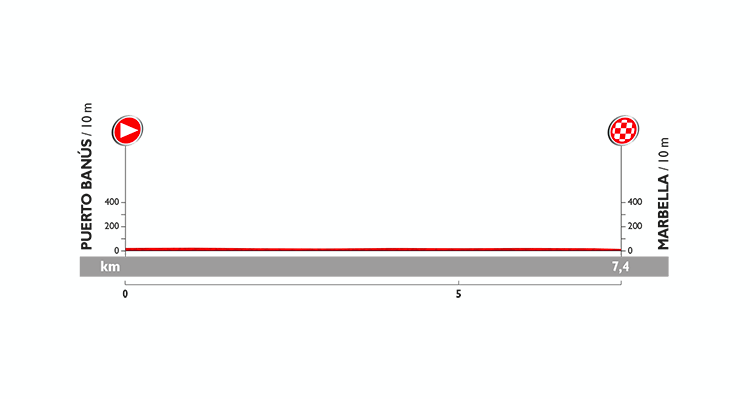
An opening team time trial of just 7.4 pancake-flat kilometers is odd enough, too short to really have any GC impact whatsoever, but the route includes a few unique challenges. Running along the vacationer-friendly Mediterranean coast from Puerto Banús to Marbella, the course involves stretches of packed dirt and sand and a narrow wooden bridge. Those peculiar obstacles caused plenty of consternation to riders putting in some course recon this week, spurring the UCI to call a meeting that ultimately deemed the TTT parcours too dangerous to count towards the General Classifiation. And so, just one day before the start of the Vuelta, the decision has been made to neutralize the opening stage in terms of the GC, leaving only a stage win and position in the team classification up for grabs.
Obviously, that dramatically changes the prediction picture, as any teams with GC aspirations now have little motivation to take any risks on the absurd course. A few of the top overall contenders lead strong TTT squads, but it’s hard to see them putting in the effort to contend for a stage win on the sand.
Instead, this should come down to the teams without GC candidates on the roster. Trek Factory Racing is among the front-runners. Fabian Cancellara leads a squad packed with fast finishers, and over a course of just 7.4km, sprinter speed will come in handy. Without a top GC favorite to shepherd over the whacky parcours, Trek will be hard to beat.
Giant-Alpecin should thrive for the same reasons as Trek—time trialing star Tom Dumoulin will lead the squad, with high-octane John Degenkolb and Luka Mezgec providing firepower over the very short course.
Orica-GreenEdge may have a shot, with a few time trialing specialists and a few fast finishers making the start. OGE always outperforms the sum of its parts in team time trials, and the team has nothing to lose in this race.
Etixx-QuickStep doesn’t have many of its top talents against the clock making the start, but Niki Terpstra leads a team that does include a few decent TT men and no reason to take the course gingerly.
Tinkoff-Saxo has a collection of speedsters and big engines to put up a good ride if Rafal Majka’s GC aspirations don’t hold them back. Sky has the firepower to put in a challenge for the TTT victory, but it seems almost guaranteed that the British squad will ride this one without much urgency as Chris Froome is a contender for the overall Vuelta a España victory. The same goes for BMC and Movistar, who might otherwise have contended for the stage, but who will now likely keep the powder dry for a day with real GC implications.
VeloHuman Stage 1 Favorites
1. Trek Factory Racing | 2. Giant-Alpecin | 3. Orica-GreenEdge
Be sure to follow @VeloHuman on Twitter for 2015 Vuelta analysis. The next preview will be up after the conclusion of Stage 1. And if you haven’t already checked out the Recon Ride’s first of three Vuelta episodes, there’s no time like the present to start listening!
The youngest of the trio of legendary three-week races, the Vuelta a España tends to garner less attention than the Giro d’Italia or the Tour de France, but the past few editions of Spain’s biggest race have been must-watch cycling entertainment. The challenging route, the top-notch startlist, and the desperation for results always present at this part of the season should make for an epic final grand tour of 2015 (the perfect storm of factors likely contributing a thrilling Vuelta is just one of many topics covered in the Recon Ride’s Vuelta pre-race show by the way—you should definitely check it out).
The Route
This year’s Vuelta offers the variety of profiles to favor a well-rounded winner. After things open with a very short team time trial (short enough that it’s unlikely to make a difference for the GC battle), the race takes on an uphill finish (albeit only a Cat. 3) right away in Stage 2, which is a great way to set the tone for a challenging race.
Then come several days that look likely to favor the sprinters or puncheurs, until a likely GC showdown on Stage 7, which sees the first Cat. 1 finishing climb of the race. After a medium-difficulty day on Stage 8, the Vuelta will throw another Cat. 1 uphill finish at the pack on Stage 9. Then, it’s a stagehunter friendly Stage 10 and a long-awaited rest day after a whopping ten straight days of racing.
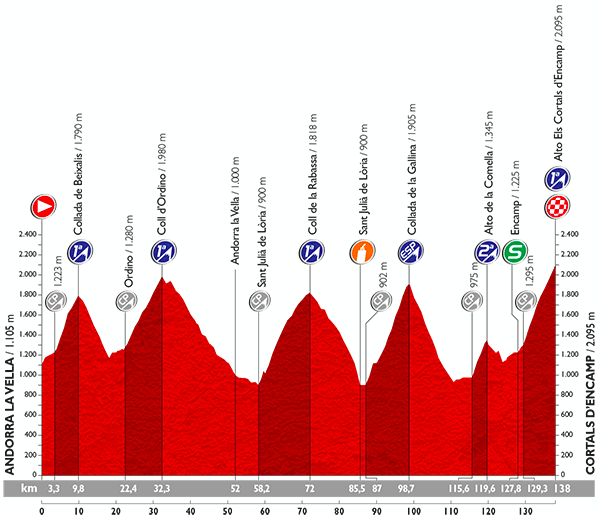
Any dreams of a stress-free return to racing after the day off will be squashed by the brutal Stage 11, which will throw one steep climb after another at the riders
Stage 11: Andorra la Vella › Cortals d´Encamp (138km) – The peloton will come back from the first rest day of the Vuelta to face a tough day in Andorra.
After such a difficult Stage 11, pair of more fast-finisher-friendly stages will give the GC men a chance to relax a bit, but climb-heavy Stages 14, 15, and especially 16 will bring them to the fore again.
The Stage 17 time trial will also be a critical day for the GC hopefuls.
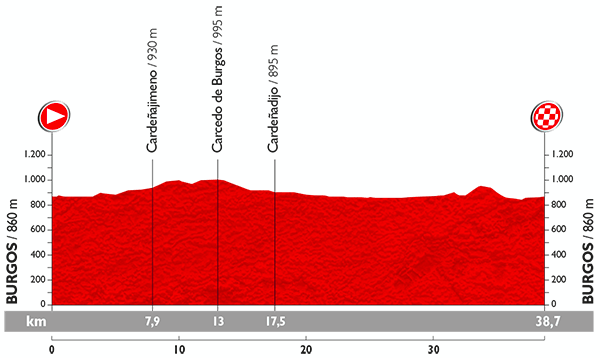
Stage 17: Burgos › Burgos (38.7km) – A time trial favoring the big engines in the Vuelta’s final week will put the pure climbers under pressure.
A little under 40km and mostly flat, the ITT could deal a serious blow the GC campaign of anyone without strong time trialing ability.
Stages 18 and 19 look good for those with an aggressive streak who are not afraid to be active on the late climbs, before a Stage 20 that consists of four Cat. 1 ascents.
To close out the race, the sprinters will get one last chance on the final stage in and around Madrid.
The General Classification Contenders
Most of cycling’s top Grand Tour GC stars are making the Vuelta start this year, which should set up a thriller of an overall battle. Chris Froome, the 2015 yellow jersey winner himself, headlines the startlist. It’s pretty rare for a Tour winner to start the Vuelta, but Froome has come close here in the past and has some unfinished business to take care of.
It’s hard to say just how well the route suits him because the Chris Froome of 2015 is a different rider from the Chris Froome that won the 2013 Tour de France. That previous incarnation of Froome was an excellent time trialist who could take advantage of a long flat ITT against less chrono-savvy rivals. The Froome of the past two years, however, has been far less impressive against the clock. If Froome can get his time trial back on track, he could run away with this race. If he doesn’t, this will be a close fight, though Froome is still among the world’s very best climbers (something that often gets overlooked or underplayed by many observers) and can still win this race on pure climbing ability and a powerful team. Geraint Thomas and Nicolas Roche are back at Froome’s side. Sergio Henao could be the real star—he’s been prepping for this all season and he’s been sharp recently. He makes a fine alternative if Froome decides a few days into the Vuelta that he’s content with his Tour de France win and doesn’t need to fight for a second Grand Tour in 2015.
Nairo Quintana and Alejandro Valverde were unable to wrest control of the Tour de France from Sky but they’ll have another opportunity here. The time trial won’t help the Movistar pair, but motivation to beat Froome will be pretty high, and a route filled with steep climbs will offer plenty of chances to launch a flurry of attacks to keep the pressure on. Quintana is the better overall rider at this point and if his motivation is there he could challenge for the win with help from Valverde. If Quintana isn’t coming in at 100%, Valverde will likely be in the mix on his own, though winning the Vuelta against this caliber of rivals would be a tall order. Andrey Amador is another card to play on a strong Movistar squad.
In terms of depth, Astana’s trio of Fabio Aru, Mikel Landa, and VincenzoNibali headline the strongest GC squad in recent memory. Aru is probably the team’s best hope, having been preparing for this race since his runner-up performance in the Giro. He’ll love all the opportunities to break clear of his rivals on the tough climbs of the race, and he’ll probably be a bit fresher with more of a time cushion since his last Grand Tour appearance than those who raced the Tour. Meanwhile, Nibali will be motivated to prove something in this race after a disappointing Tour de France. He’s not afraid to get aggressive and if he is in better shape for this race, he’ll be up there. Landa is the wildcard—he has said he is targeting stages, and a long flat time trial does not suit him in the slightest, but he showed flashes of incredible climbing ability in the Giro and Astana’s multifaceted approach could see him steal a huge chunk of time if he can launch an unanswered move somewhere along the way. It would be pretty surprising if Astana didn’t land at least one rider on the Vuelta podium.
Joaquim Rodríguez will have his work cut out for him taking on such a list of stars in this Vuelta, but he did not have to expend nearly as much energy in the Tour as his other Vuelta GC rivals—his stagehunting focus allowed him to take days off in the mountains. Daniel Moreno will serve as a valuable second.
Rafal Majka leads the Tinkoff-Saxo charge. He should put in a good Vuelta campaign—he has developed into a well-rounded rider who isn’t afraid of a time trial, and like Rodríguez he should be a bit fresher than Froome or Quintana.
Speaking of freshness, Domenico Pozzovivo probably stands the best chance of being the rider to keep one recent Vuelta streak alive: since 2011, the winner of the Vuelta a España has been a rider who did not complete either the Tour of the Giro earlier in the season. Freshness has been critical in recent years at the Vuelta, and Pozzovivo, who crashed out of the Giro early, has not put the same sort of wear and tear into his legs this season as many other ridres in this race. He’s also a specialist on the steep stuff, which the Vuelta has in spades. Expect a strong ride from Pozzovivo here.
BMC’s Tejay van Garderen will find himself in the same boat, hoping to benefit from the freshness of not having finished a Grand Tour yet this season, but it’s hard to say how he’ll fair. On the one hand, the Vuelta suits him more than the Tour did thanks to its long and flat time trial, where he is stronger than most of the top GC riders in this race. On the other hand, van Garderen’s Vuelta was a last minute decision to salvage something from the season after his disappointing Tour. If van Garderen is in shape and motivated, I’d expect to see him in the thick of the GC battle. If not, he’ll probably be out of it very quickly. Samuel Sánchez is a fine alternative for BMC, having put up plenty of strong Vuelta rides in the past.
Lotto-Soudal’s Jurgen Van Den Broeck has managed to put up several excellent time trial performances so far this season, and if he can bring that balanced approach into the Vuelta, he could prove to be a big surprise. Cannondale-Garmin’s duo of Andrew Talansky and Dan Martin should be capable of producing at least one contender for the Top 10 among them. Cofidis’s Daniel Navarro hasn’t done much this season but he tends to come alive in the Vuelta. Pierre Rolland rode a respectable Tour de France, nearly coming away with a stage win, and should be capable of another decent result here.
The Stagehunters
Without many pan-flat stages but plenty of days to suit the more versatile fast finishers, it’s no surprise that the Vuelta has drawn several riders who thrive in bunch kicks after harder days. Peter Sagan is an obvious member of that club, though his Vuelta form is a big question mark—last year he rode the Vuelta purely to prep for Worlds, and mostly stayed under the radar. John Degenkolb also makes the start, hopefully with the same interest he showed last year (when he won four stages and the Points Classification) and not an approach entirely centered on his own Worlds campaign. Nacer Bouhanni can handle a climb or two and should be able to nab multiple wins if the form is there for this race—the motivation should certainly be there near the end of a disappointing season. Caleb Ewan, JJ Rojas, Matteo Pelucchi, and Danny Van Poppel are other speedsters to keep an eye on at the Vuelta.
Tom Dumoulin and Fabian Cancellara are obvious favorites for the long, flat time trial in the third week. Simon Gerrans, Alessandro De Marchi, Sylvain Chavanel, Carlos Barbero and Pello Bilbao will be among the riders hoping to do some damage on the intermediate stages, while the likes of Fabio Duarte, Amets Txurruka, and Joe Dombrowski could be on the hunt for breakaway wins in the high mountains.
VeloHuman Top 10 Overall Favorites
GC Winner: Chris Froome Podium: Fabio Aru, Nairo Quintana Other Top Contenders: Alejandro Valverde, Joaquim Rodríguez, Vincenzo Nibali, Domenico Pozzovivo, Mikel Landa, Tejay van Garderen, Rafal Majka
VeloHuman will be previewing every individual stage of the race, so stay tuned for more analysis. Meanwhile, if you haven’t already checked out the Recon Ride’s first of three Vuelta episodes, there’s no time like the present to start listening! And, of course, be sure to follow @VeloHuman on Twitter for more commentary.
Episode 23: Vuelta a España 2015 Show, Part I The Recon Ride dives into the challenging parcours and the excellent startlist of the 2015 Vuelta a España.
[powerpress]
The final Grand Tour of 2015 is about to get underway, and the collection of talents preparing to make the start in Spain is impressive. Cosmo Catalano of Cyclocosm and Dane Cash of VeloHuman team up to present the first of three Recon Ride Vuelta episodes.
The Vuelta is always an important opportunity for riders who have missed out on results in the early part of the season to take one final shot at Grand Tour success, but a particularly crash-heavy 2014 made this year’s Vuelta startlist one of the strongest in years. The late-season showdown, with many of the sport’s top talents in the mix, was a nice platform for several riders to make strong statements to close out the Grand Tour calendar.
Big Names Deliver in GC Battle
Alberto Contador has now ridden in the Vuelta three times in his career, and he’s won the overall victory each time. That is a stunning achievement in and of itself; this year’s victory is an especially impressive feat given the powerhouse startlist. Contador was untouchable in the mountains, and he was very good in the time trial as well. He also rode a tactically brilliant race; he had the weakest team of any of the top GC contenders, and it didn’t seem to matter at all. He followed the attacks he needed to follow, and didn’t waste energy with others. He was robbed of a chance to prove his strength at the 2014 Tour de France, but this ride at the 2014 Vuelta will be a warning to his rivals that he’ll be very hard to beat in the 2015 Tour.
Had Chris Froome continued throughout the race in the same shape that saw him lose a chunk of time to even Alejandro Valverde in a long, mostly flat time trial, it might have been cause for concern, but he ended the race very, very strong. It’s a shame it took him some time to get back to his best (it would have made for a better, more competitive race if he were able to put in the sort of time trial we know he’s capable of) but his main goal in starting this race was to ride well in a Grand Tour before the season’s end, and he absolutely did that. He may not have been able to touch Contador after falling behind early, but he should still come out of the race with confidence for 2015.
Nairo Quintana‘s abandonment following a bad crash took some excitement out of the race. Hopefully he will recover quickly for 2015; the strength he showed early this season will make him a top favorite in the Tour next year. Teammate Alejandro Valverde wasn’t able to threaten for the Vuelta overall once Contador took control, but that can’t take away from the amazing year he’s had. Among his many huge successes so far are victories in La Fleche Wallonne and San Sebastian, a Vuelta stage win, and Top 5s in the Amstel Gold Race, Liege-Bastogne-Liege, the Tour de France, and the Vuelta overall. His big ride in Spain came after a difficult Tour, to boot; it’s not easy to land a podium in the Vuelta on the heels of a three-week race finished less than a month before the start.
Joaquim Rodriguez, in 4th, never managed to contend, and he didn’t win a stage despite the presence of a very strong team. It was a disappointing ride given the expectations going in. His inability to match rival Valverde will be most frustrating for him. After dropping out of the Giro, Purito rode the Tour as a means of preparing for this race; it was an odd choice, and I’m not sure it was the right one.
Fabio Aru, on the other hand, should be thrilled with a 5th place result. He’s only 24, and he has now landed two Grand Tour Top 5s and three Grand Tour stage wins in the same year! It’s not easy to perform so well across two three-week races in one season, especially not as his young age. He made his “arrival” at the Giro, but I find his Vuelta a España, against so much top-tier talent and coming with plenty of race mileage in his legs already this year, just as impressive.
I’m not sure what Dan Martin‘s Grand Tour racing future holds because he clearly prefers the shorter events, but I’ve been saying for a while now that the has the talent to put in a Top 10 in a three-week event, if he could only avoid crashing or getting sick. It was good to see him finally deliver (7th overall), and against an elite startlist too. Warren Barguil, in 8th, also took a big career step. We knew he could climb, but could he perform at a high level across three weeks? It seems the answer is yes. He’s only 22.
Damiano Caruso was one of the biggest surprises of the race. He had never had a Top 10 in the General Classification of a WorldTour stage race coming into the Vuelta a España, and he picked up his first in a Grand Tour. BMC got a good one for next year.
Belkin will wish they’d gotten a bigger GC result out of this Vuelta, but they should be pleased with the performance of Robert Gesink, who was on track to land well inside the GC Top 10 before leaving the race for personal reasons. After a very tough start to the year and a long break spent recovering from a heart problem, that’s a very encouraging sign for Gesink.
A Few Thoughts on the Stagehunters
John Degenkolb dominated the sprints of the 2012 Vuelta, and his 2014 return to the race was a triumphant one. His four stage wins were impressive, especially the victory on Stage 5 over the very speedy Nacer Bouhanni. Degenkolb’s Points Classification victory may be even more impressive: it’s not easy for a sprinter to win the points jersey in the Vuelta, especially when versatile Alejandro Valverde is on the startlist, but Degenkolb was not to be denied once it became clear that green was within his reach. He missed out on a few opportunities at this year’s Tour due to an early injury in that race, but with the sort of speed he showed in Spain, he should be on track for plenty more success in the very near future, with the upcoming World Championships as a major target and the 2015 classics season and Tour beyond.
Alessandro De Marchi was another stagehunter who found success, picking up his first Grand Tour stage win after coming close several times in the past. He is emerging as one of the top breakaway talents in the peloton, showing a lot of strength when riding uphill on his own. He was King of the Mountains at the Dauphine in June, and riding off the front like he has been this year, a Grand Tour KOM jersey could be in his future.
Jasper Stuyven, who finished with six stage Top 10s, may not have come particularly close to any victories, but his consistent presence near the front on a variety of profiles bodes well for the future: he’s only 22. Yet another rising young talent for Belgium, who just announced a Worlds squad loaded with firepower.
Speaking of Worlds, it’s right around the corner! Stay tuned for VeloHuman previews of the team time trial, the individual time trial, and the road race, and be sure to follow @VeloHuman on Twitter for more analysis.