Quite a collection talented riders is headed to Tirreno-Adriatico this week to hunt for results – and the race’s famed golden trident trophy – along the road from one side of Italy to the other. A balanced parcours offers something for everyone in the country’s first big stage race of the year.
The Route
Tirreno-Adriatico opens with a 22.7-kilometer team time trial. It’s long enough to make a difference, giving an advantage to the GC hopefuls with high-octane backing squads, but it’s not so long that it’s going to flat-out win someone the race on day one.
Stage 2 throws a few challenges at the riders at the end of a 207km day. There is a small categorized climb just before the finish that may open up a few gaps.
Stage 3 is a day for the sprinters. Stage 4 concludes with a flat stretch but a string of late climbs could inspire attacks, either from stagehunters or from aggressive GC types.
Stage 5 is the definitive queen stage, with five categorized climbs including a tough uphill finish of 13km at 6.6%.
Stage 6, the longest stage in the race, has some uncategorized ascents late on in the profile that could favor the more versatile riders in the peloton, but it’s hard to see it having any GC impact.
The race closes out with a 10km individual time trial in San Benedetto del Tronto. It’s a completely flat out-and-back run that should see some pretty high speeds.
The General Classification Contenders
Nairo Quintana won the 2015 edition of the race, but he won’t be defending his crown in 2016. However, with Alejandro Valverde leading the way, Movistar still has a great chance of coming away with a win. The Spaniard can do it all, and that’s a big plus on this varied parcours. Movistar’s great TTT will help.
Vincenzo Nibali makes the start in pursuit of a third career Tirreno title, and he too should appreciate the parcours. The queen stage involves plenty of descendning, which should allow the Italian to put his downhill abilities on display. Jakob Fuglsang gives Astana a strong Plan B.
Tejay van Garderen would probably have a hard time drawing up a more favorable parcours. BMC’s world-class TTT squad should set him up well from the get go, and the long queen stage finishing climb and stage 7 time trial will both give him a chance to put his own big engine on display. He looked strong in Andalucía last month and should be among the top favorites in Italy.
Rigoberto Urán will also like the style of climbs in this race and the closing TT, though the opening team time trial may hurt him given Cannondale’s struggle in the discipline. If he can limit his losses there, he’ll have a shot at the overall.
Joaquím Rodríguez should appreciate the plethora of opportunities to punch clear of the pack even if the chrono mileage doesn’t suit him. He has yet to deliver much this season but it’s not unusual for him to show up stronger than expected after a few quiet weeks riding tune-up races. Jurgen Van Den Broeck could be a nice alternative.
Bauke Mollema was runner-up in Tirreno in 2015 and looks to be in good form at the moment. He could be among the GC favorites trying to snipe a few seconds here and there on the intermediate stages.
Thibaut Pinot won’t be a fan of the opening TTT but he’s improved dramatically as a descender and so should be able to hold his own on the queen stag. He’s also capable of putting in a decent ITT, making him a real contender for the overall title.
Ag2r’s one-two punch of Domenico Pozzovivo and Jean-Christophe Peraud should be in the mix, as should Orica-GreenEdge’s duo of Adam Yates and Esteban Chaves. Sky brings a powerhouse trio of Michal Kwiatkowski, Vasil Kiryienka, and Wout Poels.
Diego Ulissi, Roman Kreuziger, Rafael Valls, and Rodolfo Torres are other potential protagonists in the General Classification.
The Stagehunters
Mark Cavendish looks like the fastest of the pure sprinters in attendance, although there are several big names that could challenge him in the bunch kicks. Caleb Ewan,Fernando Gaviria, Elia Viviani, Giacomo Nizzolo, and Sacha Modolo are the headliners there.
Peter Sagan should have a few opportunities of his own as well, as there are some lumpier days. Greg Van Avermaet could be in the mix as well—he actually beat Sagan in a sprint to take a stage here in 2015. Edvald Boasson Hagen, Ramunas Navardauskas, and Jens Debusschere are others worth keeping an eye on in the stagehunting game.
VeloHuman Top 10 Overall Favorites
Winner: Vincenzo Nibali Podium: Alejandro Valverde, Tejay van Garderen Other Top Contenders: Rigoberto Urán, Joaquím Rodríguez, Domenico Pozzovivo, Thibaut Pinot, Bauke Mollema, Michal Kwiatkowski, Wout Poels
The podcast takes a closer look at the third WorldTour race of the season, Italy’s Tirreno-Adriatico.
[powerpress]
Though some big names are in France for Paris-Nice, plenty of other stars are headed to Italy to kick off their European WorldTour campaigns at Tirreno-Adriatico. The Recon Ride previews the race route and the favorites, and chats with Sam Bennett, who will make the start hoping to nab a stage win in the sprints.
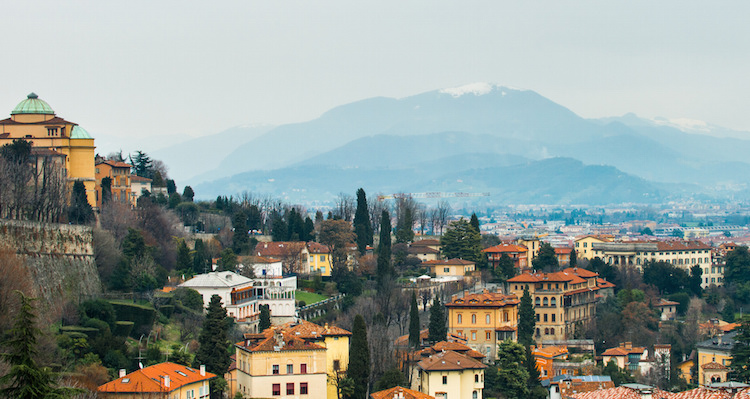
Il Lombardia, the final race of the 2015 WorldTour, kicks of Sunday in Bergamo, Italy. 245 kilometers of up and down in Italy’s Lombardy region, Il Lombardia (formerly known as the Giro di Lombardia) is the last of the five Monument Classics on the cycling calendar. The organizers have tinkered with the profile over the course of the last few years, but a unique Northern Italian character, incredible lakeside scenery, and thrilling finishes are constant features in Il Lombardia, making it a great event to close out the season in style.
Be sure to check out the latest Recon Ride powered by VeloNews, with special insight from cycling expert and Lombardy local Gregor Brown, for more on what makes Il Lombardia stand out as a legendary bike race.
The Route
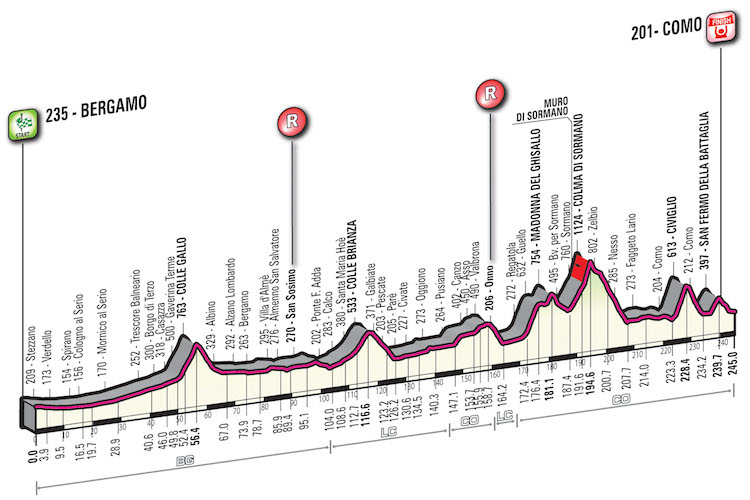
Il Lombardia gets progressively harder as the day goes on. After leaving Bergamo, the peloton will enjoy nearly 50km of flat before the road angles upward for the Colle Gallo, 7.4km at 6%. After a descent it’s another mostly flat stretch for nearly 50km once again before the long, low-gradient Colle Brianza. Another downhill leads to another flat stretch before things get a bit lumpier in the run-up to a very difficult pairing of climbs: the Madonna del Ghisallo and the Colma di Sormano.
The challenging profile of Il Lombardia makes it an excellent opportunity for the climbing specialists to take a big one-day win.
Ghisallo is an irregular climb whose average gradient doesn’t really tell the whole story. All told it’s 8.6km at an average grade of 6.2%, but it’s really a three-part climb, starting out with about 3.5km at around 9%, flattening out (even running downhill for a bit) for 4km or so, and then kicking up again at nearly 10% for the rest of the way to the top. Unfortunately for the riders, there won’t be much of a chance to rest after the climb is crested—a fast descent leads into the foot of the brutal Colma di Sormano (with a particularly challenging stretch known as the Muro di Sormano).
The climb opens with a little over 5km at 6.6%. Then things suddenly get extremely difficult. The final 1.9km have an average gradient of 15.8%, with one stretch at over 25%, which will undoubtedly see many riders dropped off the back. At least the view is nice.
As hard as the Ghisallo-Sormano combo is, the race is far from over after the pack crests the latter, as there are still about 50 kilometers left to race. From the top of the Sormano it’s a tricky descent into a flat section of about 15km, where we can expect things to get very cagey as riders jockey for position for the finale.
With a little over 21km to go the riders will hit the foot of the Civiglio, 4.2km at a vicious 9.7%. It’s consistently steep the whole way up. Then comes a very steep descent that runs into the foot of the final climb of the race, the San Fermo della Battaglia, 2.7km at 7.2%. Expect plenty of action here if the race isn’t blown to pieces already. Once the riders go over the summit, it’s a little over 3km downhill and then just 1.5km of flat to the finish line in Como.
The Contenders
This year’s route strongly favors the explosive climbing stars. A fast finish will be useful in case a small group comes to the line together, but the finale will make it very hard for riders to sit in and hold out for a big sprint. The pack will be thinned out after so much climbing, and a pair of steep launching pads in the last 20km will provide the aggressive riders with plenty of space to go on the move. Some technical descents will further favor the attackers. Those descents could get even more technical with a chance of some rain on Sunday—rain is as much a classic feature of Il Lombardia as the scenery along Lake Como, and it figures to at least play a part this year.
Alejandro Valverde’s combination of elite climbing legs, strong descending skills, Classics grit, and an excellent sprint make him an obvious entrant in the favorites conversation. Although he’s never won the race, he has been the runner-up for two years in a row now. 5th in the World Championship Road Race, he’s still in-shape even at the end of a very long season, and this is a race he’s been trying to win for a little while now. Giovanni Visconti makes for an strong second. For me, the big question mark next to Valverde’s name is whether he will be aggressive enough to take the victory—I don’t think he can take his usual approach (staying in the wheels for a reduced sprint) into this race and expect to win, with a finale so well-tailored to a do-or-die attack.
One rider who probably won’t hesitate to launch an all-or-nothing strike is Vincenzo Nibali. It’s been a down year for Nibali, and he’s never managed to take the big one-day victory he has long sought (other than Plouay back in 2006), but he’s in great form right now and this course suits him perfectly. Nibali is not a good sprinter, meaning that he’ll need to drop everyone and win this thing solo, but the gradients on the final climbs and the tricky descents that follow should give him plenty of chances to do that. Fabio Aru, Diego Rosa, and Mikel Landa are other strong options for a stacked Astana squad.
Dan Martin won Il Lombardia in 2014, but he’s only just returned to racing after a shoulder injury knocked him out of the Vuelta, which could hurt his chances of repeating. Still, this course suits him as well as ever (of his six career participations, he’s finished in the Top 10 four times in this race) and an encouraging showing in Milano-Torino (he was 14th) suggests that he’s already back in shape to contend. Tom-Jelte Slagter is a great alternative for Cannondale-Garmin if Dan Martin isn’t at 100%.
Speaking of past winners, Joaquím Rodríguez won Il Lombardia in 2012 and 2013, but he’s a late scratch this year after hurting his knee in training. Daniel Moreno will attempt to take up the flag for Katusha, and he’s not a rider to be underestimated.
Philippe Gilbert is certainly not the rider he was back when he took the win here in 2010, but he’s looked pretty strong this year and appears to be in decent late-season form. The finale suits him well, if he can make it all the way over the tough climbs. Samuel Sánchez will be a fine second. Greg Van Avermaet was originally going to ride this race as well, but he withdrew from the startlist upon returning from Richmond a bit jet-lagged.
Rui Costa was 3rd in 2014 and I expect him to contend for the win this year. He tends to attract less attention than he maybe should given his excellent array of abilities, and I think that could come in particularly handy on this profile. I wouldn’t be surprised if the peloton let him jump clear on one of the final two climbs only to see him hold out all the way to the line. Diego Ulissi is a nice backup option for Lampre-Merida.
Tim Wellens has had his sights set on improving last season’s 4th place all year long. This profile will really put him to the test, but like Costa and Nibali, he’s not afraid to go all-in on an attack, and he often gets a bit more breathing room than maybe he should (as was the case when his two-man move in the GP Montréal managed to go the distance). Tony Gallopin will also be on the limit on this course but will be a huge threat if he holds out to the finish.
AG2R sends a powerhouse team to Il Lombardia, with Domenico Pozzovivo, Romain Bardet, and Alexis Vuillermoz all capable of being in the mix. The French outfit isn’t well-known for its one-day prowess but Pozzovivo and Bardet in particular have had a few nice showings in Liège-Bastogne-Liège and this route should be even better for them. On the other side of the French team coin is FDJ, a squad sending only one strong contender this race in Thibaut Pinot, a rider who doesn’t have anything to speak of in the realm one-day results—but who is in good shape right now.
Rafal Majka was 3rd here back in 2013 and looks to be strong right now. Michal Kwiatkowski is also showing great end-of-year form for Etixx-QuickStep, and he hasn’t done much historically in this race, the profile should suit him. Orica-GreenEdge sends a team full of options: Adam and Simon Yates, Esteban Chaves, Simon Gerrans, and Michael Albasini will all have a chance here. Expect OGE to try to stick a rider in every legitimate move. Trek has Bauke Mollema, Julián Arredondo, and Fränk Schleck. LottoNL-Jumbo’s Robert Gesink and Wilco Kelderman are worth watching. Former three-time winner Damiano Cunego, Sergio Henao, Wout Poels, Davide Rebellin, Rodolfo Torres, Warren Barguil, and Tom Dumoulin are other riders who could be in the mix.
VeloHuman Top 10 Race Favorites
Winner: Vincenzo Nibali Podium: Alejandro Valverde, Rui Costa Other Top Contenders: Dan Martin, Tim Wellens, Rafal Majka, Philippe Gilbert, Domenico Pozzovivo, Thibaut Pinot, Daniel Moreno
As the last WorldTour race of the season, Il Lombardia is also the last event that VeloHuman will preview in 2015. I hope you’ve enjoyed the year as much as I have! Follow @VeloHuman on Twitter to stay up-to-date with the cycling world through the cold, dark offseason. The Tour Down Under will be here before you know it!
The 2015 Tour de France is about to get underway, with the peloton set for a Dutch Grand Départ in the Netherlands this weekend. A quick time trial and then a few days of Classics-style racing will give way to several days for the sprinters and more versatile stagehunters before a team time trial and then some very challenging mountain stages to really spark competition among the overall favorites. With a route built to encourage uphill battles and multiple riders looking to have legitimate chances of coming away with the overall win, this year’s edition of the sport’s biggest event is set to be an excellent showdown, and with all the action just around the corner, it’s time for VeloHuman’s overall Tour de France preview.
The Route
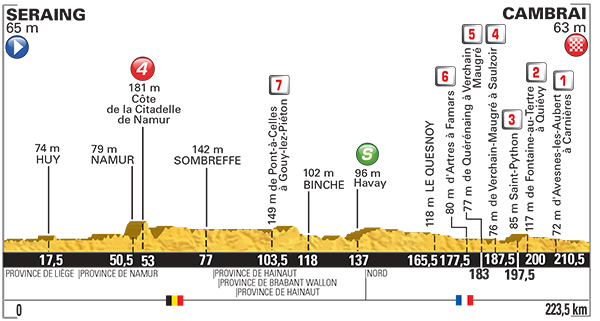
The Tour kicks off with a short, flat ITT in the Netherlands (in the university town of Utrecht, to be exact). Then comes another day on Dutch soil, a flat road stage, followed by a trip to Belgium’s challenging Mur de Huy on Stage 3. Stage 4 will stick with the Classics theme, challenging the peloton with several stretches of cobbles in between start and finish.
Stage 4: Seraing › Cambrai (223.5km) – Several stretches of cobbles could inject some nervousness into the Tour de France peloton early on in the race.
Things get a bit more traditional after that. Stages 5 through 8 look friendly for the fast finishers or those riders fortunate and skilled enough to stick long breakaways. Stage 9 is a medium-length team time trial that will open up a few time gaps on the General Classification, and it’s followed by three high mountain stages certain to see plenty more GC action.
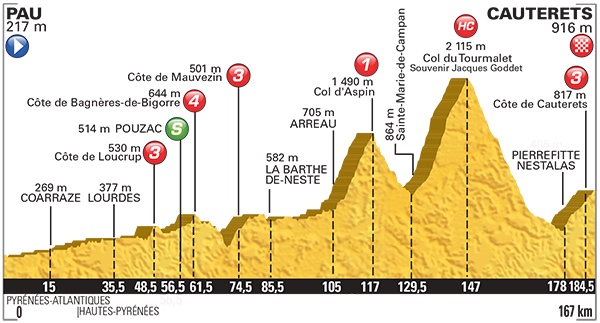
Stage 11: Pau › Cauterets (188km) – A visit to the Tourmalet, during a day with five other categorized climbs on the menu as well, will make Stage 11 a tough Week 2 test.
The bumpy profiles of Stages 13 through 16 will keep the GC riders on their toes and, at least in terms of stage honors, will likely favor the more well-rounded fast finishers and aggressive types. Then come the serious mountain tests likely to decide the Tour de France: a very difficult Stage 17, a tough Stage 18, and an extremely challenging one-two punch of mountaintop finishes on Stages 19 and 20.
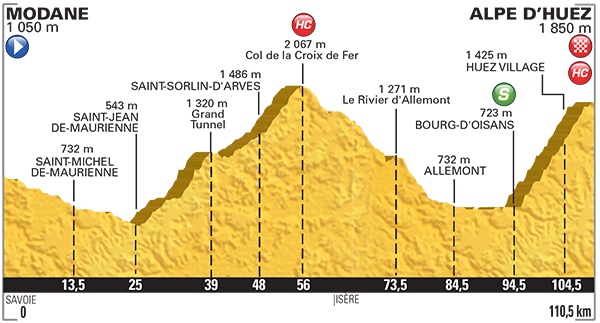
Stage 20: Modane Valfréjus › Alpe d’Huez (110.5km) – The Tour’s short but vicious penultimate stage should provide a thrilling conclusion to the GC battle on the slopes of the Alpe d’Huez.
The Alpe d’Huez finale of Stage 20 will make for a great final GC battleground in the 2015 Tour de France, especially at the end of a day packed with climbing. The race will conclude in its usual style with a sprinter-friendly Stage 21 in Paris.
All told, it’s a climber-friendly route, with far fewer total kilometers of individual time trialing than recent years have seen. Versatility will still be important, however, as cobblestones, Low Country weather, plenty of short steep climbs, and technical descents will challenge the yellow jersey hopefuls to survive and thrive on more than just the long Alpine uphill slogs.
The General Classification Contenders
This year’s GC battle is all about cycling’s “Big Four” GC riders: Chris Froome, Alberto Contador, Vincenzo Nibali, and Nairo Quintana. Only Quintana is without at least one Tour de France victory on his record, but his runner-up performance in 2013 and his Giro win in 2014 shine brightly all the same. With all four seemingly on form and healthy, it should be quite a showdown. Each rider has factors weighing for and against favorite status.
At least in VeloHuman’s perspective, Chris Froome, recently victorious in the Critérium du Dauphiné, looks to be the slight favorite. The last time he stayed healthy throughout the Tour de France, he dominated the field. His 2015 campaign has not been as steady as that incredible 2013, but he looked very strong last month in the Dauphiné, and he has an unbelievable supporting cast with the likes of Richie Porte, Leopold König, Wout Poels, and Nicolas Roche, among others. Sky can put the pressure on early with so many weapons, and Froome’s machine-like endurance should keep his legs powering along late in the race. For Froome, a parcours light on time trials might seem like a less ideal scenario, but the 30-year-old stage racer has actually been underwhelming against the clock lately, meanwhile putting in some very strong climbing rides so far this year. To win, however, he’ll need to overcome the fierce competition of his rivals, whom he has not been able to put away as easily in recent months as he did back when he last won the Tour.
Alberto Contador certainly has the talent at peak ability to take on Froome in this race, as his terrific 2014 Vuelta victory suggested. But his Giro participation, excellent though his winning performance was, will almost certainly have taken something out of him. The Giro-Tour double is an extremely hard feat to accomplish. Contador may have a better chance of pulling it off than anyone in the sport, but that still might not be enough. A TT-light route won’t help him—he’s certainly better against the clock than Quintana and Nibali, but that won’t be of use here. Instead, he’ll need to rely on his ability to get up the vicious climbs in the final week to win this race, and that might be a lot to ask after a prior GT win already on the season. In any case, strong supporters like Rafal Majka and Roman Kreuziger will be valuable to Contador’s attempt to beat the odds and the other favorites.
Nairo Quintana should be coming in fresh, and this is the perfect route for him. He’s not a great time trialist, but that won’t hold him back with less than 15km against the clock solo—what’s more, Movistar typically fields a strong TTT squad, making the TTT a place where the young Colombian might actually be able to pick up time on his rivals. After that he’ll have plenty of opportunities to put his terrific climbing skills on display. The last time Quintana and Froome went up against each other in a full Grand Tour, Froome emerged victorious, but Quintana has gotten older and stronger since then, and should be a very strong contender for the overall. Alejandro Valverde offers Movistar a powerful card to play as well—and don’t be surprised if he has his own GC ambitions in this race too.
Despite winning last year’s Tour de France, Vincenzo Nibali will face an uphill battle for a repeat victory. His Tour win was impressive, for sure, but with neither Froome nor Contador surviving into the final week (and Quintana opting to race elsewhere that year), it’s hard to judge Nibali against the gold standard of his top rivals. He was far stronger than everyone else still in the race by the final mountain stages of the 2014 Tour, but that wasn’t really all that unexpected. Still, this is a good route for him, and he has a very complete team around him (which includes stalwart lieutenant Jakob Fuglsang) to help him pursue his second Tour win.
Outside of that quartet of top favorites, it’s hard to see anyone else really challenging for the overall win, but there are a few strong outsiders. Fresh off his Dauphiné win, Tejay van Garderen looks better than ever on the climbs, and he’ll have BMC’s worlds-winning TTT squad to put him into a good position early on in the race. Thibaut Pinot won high mountain stages in both the Tour de Romandie and the Tour de Suisse, and the lack of ITT mileage favors his skillset. Rui Costa has had a strong year, and has been an elite one-week racer for some time, despite never really putting it together across three weeks to land a big Grand Tour result—this could be his year to finally string together several good days. Joaquim Rodríguez has run a bit hot and cold in 2015, but he was untouchable in País Vasco; this parcours suits his abilities quite well and that could help him battle it out for a big result. Bauke Mollema should also like the overall route (and the Dutch start), and he has shown flashes of impressive form this year.
AG2R’s one-two punch of Jean-Christophe Peraud and Romain Bardet, and Cannondale-Garmin’s one-two-three punch of Andrew Talansky, Ryder Hesjedal, and Dan Martin could make things interesting. The EQS duo of Michal Kwiatkowski and Rigoberto Urán, IAM’s Mathias Frank, Europcar’s Pierre Rolland, LottoNL’s Wilco Kelderman, and Giant-Alpecin’s Warren Barguil are among those who will hope to battle for big results from the fringes of the GC conversation.
The Stagehunters
With Marcel Kittel out of the Tour de France this year, Mark Cavendish looks to be the class of the field in the pure speed department in this race, but there are plenty of strong riders behind him who will hope to nab stage wins as well, especially on some of the bumpier stages where Cav might struggle. André Greipel, at his best, should be able to mix it up with Cavendish on the pure flats. The likes of Alexander Kristoff, John Degenkolb, Nacer Bouhanni, Arnaud Demaré, Michael Matthews, and, of course, Peter Sagan, will also try to be in the conversation, with the tougher days potentially providing opportunities for some of them to battle it out without Cavendish in the conversation. John Degenkolb, in particular, could surprise—as versatile as he is, he’s also just plain fast in a sprint. With Giant-Alpecin’s full support thanks to the absence of Marcel Kittel, Degenkolb could rack up the results and maybe even a strong green jersey bid. Sam Bennett, Bryan Coquard, and MTN-Qhubeka’s speedy pair of Tyler Farrar and an in-form Edvald Boasson Hagen are others to watch in the sprints.
A generous helping of intermediate stages will likely see the peloton’s punchy climbers and long-range specialists hunting for multiple stage victories. Watch out for the likes of OGE’s Simon Gerrans and Michael Albasini, BMC’s Philippe Gilbert and Greg Van Avermaet, Trek’s Julian Arredondo, and Lotto-Soudal’s Tony Gallopin (among many others) to keep things interesting on the bumpier days. Lastly, a note about the very strong field of TT specialists in attendance: there may be only one (short) ITT in the Tour, but a chance to wear yellow is on the line and the impressive time trialing quartet of Tony Martin, Fabian Cancellara, Tom Dumoulin, and Adriano Malori should be in the mix with a few of the aforementioned GC contenders for the honor of a stint in the yellow jersey early on in the year.
VeloHuman Top 10 Overall Race Favorites
GC Winner: Chris Froome Podium: Nairo Quintana, Alberto Contador Other Top Contenders: Vincenzo Nibali, Tejay van Garderen, Thibaut Pinot, Joaquim Rodríguez, Rui Costa, Romain Bardet, Alejandro Valverde
Be sure to follow @VeloHuman on Twitter for plenty more analysis, and check back soon for the preview of the first stage of the race—VeloHuman will be previewing every individual stage of the 2015 Tour. The preview of Stage 1 is already online! Also, don’t miss the Recon Ride’s three Tour de France podcasts. The first episode is available here!
The Dauphiné marks the arrival of “Tour de France season,” drawing an always impressive startlist of top Tour talent hoping for a final tuneup before La Grande Boucle. The big names and mountainous parcours should make this year’s edition of the race a worthwhile attraction.
The Route
The 2015 Dauphiné route offers a healthy dose of difficult climbs. The only stage without a categorized climb is the TTT, and even that has some challenges.
The race kicks off with a bumpy stage 1 likely to favor a punchier rider, with eight categorized climbs, small though they may be, on the day. Stage 2 does have a Cat. 1 challenge on the menu, but a long flat finale could favor the sprinters. The Stage 3 TTT will likely have serious GC implications. 24.5 kilometers is long enough to open the sort of gaps that will have an impact in a one-week race, especially given a long, slightly uphill stretch in the second half of the stage.
Stage 4 will be a day for the sprinters or more versatile fast-finishers before the GC riders come to the fore again on Stage 5, which closes out with a one-two punch of categorized climbs. Stage 6 is another day that may have a GC impact, closing out with a Category 3 climb.
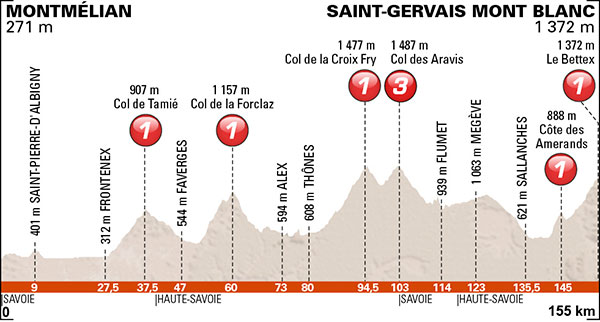
Stage 7 will probably be the most decisive stage of the 2015 Critérium du Dauphiné. After 30 flat kilometers, it’s up and down the rest of the way, with a total of five Cat. 1s along the route, including the summit finish.
Stage 7: Montmélian › Saint-Gervais Mont Blanc (155km) – A succession of difficult climbs will likely make Stage 7 the Dauphiné’s most hotly contested GC battleground.
None of the climbs are all that brutal by themselves but altogether they will provide plenty of launching pads for the uphill specialists. Stage 8 closes out the race with another Category 1 summit finish at Modane Valfréujs.
The General Classification Contenders
Two of cycling’s so-called “Big Four” will garner the most attention coming into the race: Chris Froome and Vincenzo Nibali. Froome has won the race before, the year he won the Tour de France, and he may be hoping to replicate his performance from 2013, where he came into the Tour riding high on the back of strong performances in the one-weekers. He’s had a decent, though not great, year so far, and this is an opportunity to get on track with a big success for his Tour bid this year. At his best, Froome is almost unstoppable, and he should be motivated to be close to his best here. The team trial suits Sky well. Nicolas Roche and Wout Poels are among Froome’s many strong teammates in attendance who will be valuable supporters or even potential alternatives should the need arise.
Vincenzo Nibali’s path to Tour de France victory was a bit different from Froome’s—the Italian all-rounder did not look nearly as strong in the run-up to the 2014 Tour, but peaked at the right time in July. If he’s looking to replicate that approach, he might not be quite at 100% here. If he’s gunning for victory though, he should love the climber-friendly profile, and Astana’s TTT squad looks strong too. This is a great parcours for Nibali, without any individual time trial to potentially set him back against his more chrono-adept rivals—motivation may be the key factor in determining how well he performs.
Last year’s winner Andrew Talansky was one of the most surprising winners of a WorldTour race all year, grabbing the Critérium du Dauphiné yellow jersey with a brilliant breakaway move on the final stage. The lack of a time trial in this year’s edition does not suit Talansky, the USA’s new national time trial champion, but with all of these climbs, the opportunities are there for plenty of action should he be hoping to get aggressive again this year. Teammate Daniel Martin is another option—individual time trials often tank his chances in stage races, and the absence of one here will make this an attractive event for him.
Alejandro Valverde will love the Dauphiné parcours. He’s been cycling’s most successful rider so far this season, landing on podiums almost at will, and he should be motivated to prove himself ready for the Tour with Nairo Quintana elsewhere. Movistar brings a strong team that includes Beñat Intxausti, who was great in the Giro.
Tejay van Garderen has looked great at times this season, and mediocre at other times. With the Tour on the horizon, though, he should be in strong form in this race, and with the strength of BMC’s world champion TTT squad, he should be set up for success. Van Garderen has focused on improving as a pure climber recently and that will come in handy here.
Despite a disappointing Ardennes campaign, Joaquim Rodríguez has shown flashes of brilliance in 2015. If he rides here like he did in País Vasco, he’ll be difficult to beat, especially with these sorts of climbs—the uphill challenges in the Dauphiné are many, but none of them are of the brutal, interminable sort that could put Rodríguez into trouble against the likes of Froome. Katusha Teammate Giampaolo Caruso should be a great second. Lampre’s Rui Costa is riding in the Dauphiné instead of the Tour de Suisse this year, eschewing a chance to win a fourth Suisse title in a row. He is hoping to make his mark on the Tour de France this season, which means that the form should be there. The profile, with its constant ups and downs but without any Ventoux-esque climbs, should suit him very well too.
Wilco Kelderman rode well here last year and should be primed for success with the Tour around the corner. Julian Alaphilippe will be eager to show that his success on the climbs in California was no fluke. Trek’s Bauke Mollema rode very well in Tirreno-Adriatico, and should be in the mix with the favorites in this race if he can show that sort of form here. AG2R’s two-pronged attack of Romain Bardet and Jean-Christophe Peraud won’t be easy to counter, assuming the French squad can hang tough in the TTT. Mathias Frank, Pierre Rolland, and Daniel Navarro, and Simon Yates are others with an outside chance at success in the General Classification.
The Stagehunters
The list of sprinters in this mountains race is rather thin, but not without talents. Nacer Bouhanni, Sacha Modolo, and Luka Mezgec look like the fastest finishers here, with Tyler Farrar, Edvald Boasson Hagen, Samuel Dumoulin, Kris Boeckmans, and Kevin Reza are others who could be in the mix in the bunch kicks.
Versatile quick men like Simon Gerrans, Ramunas Navardauskas, and Tony Gallopin will hope to challenge the more explosive GC types on the intermediate days, like Stage 1. And of course, watch out for any strong climbers who fall out of contention early with poor TTT performances to get involved in the breakaway conversation later on in the race.
VeloHuman Top 10 Overall Favorites
GC Winner: Chris Froome Podium: Alejandro Valverde, Vincenzo Nibali Other Top Contenders: Tejay van Garderen, Joaquim Rodríguez, Andrew Talansky, Rui Costa, Romain Bardet, Bauke Mollema, Wilco Kelderman
Be sure to follow @VeloHuman on Twitter for more analysis and commentary during the race!
The Classics are in the rearview mirror but the WorldTour drives on, with the Tour of Romandie the next race on the docket. A six-stage event in the French-speaking part of Switzerland, Romandie has drawn an excellent startlist of big GC names to race its scenic parcours (said scenery one of the many topic’s discussed in the latest Recon Ride, which is worth checking out).
The Route
The Tour de Romandie opens with a team time trial. It’s got a small hill near the end but otherwise it’s relatively flat; at 19.2 kilometers, it’s not long, but it’s not short either, and there will likely be gaps large enough to give a few contenders a sizable advantage.
Stage 2 is a bumpy 166.1km day that will likely see some attempts to get clear on the Cat. 2 climb crested with less than 10km to go, though a major GC shakeup seems unlikely. Stages 3 and 4 have up-and-down profiles but don’t have any major ascents: the sprinters will try to hold on and their teams will try to keep breakaways from going the distance.
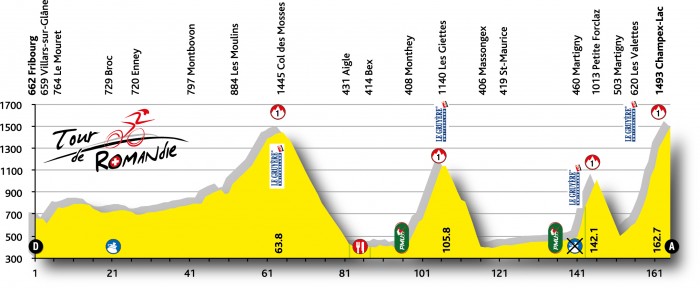
Stage 5 is likely to be the most decisive stage of the race, with four Category 1 climbs on the menu, including one to close out the stage.
Stage 5: Fribourg › Champex-Lac (166.1km) – The clear “queen” stage of the Tour de Romandie is the mountainous Stage 5.
The ascent to the summit finish is particularly challenging, 14.2km at 7%, and after a day of tough climbing, plenty of would-be GC contenders will likely run out of gas on the incline.
The Tour de Romandie finishes with a 17.3km individual time trial. There is two-part climb in the middle of the course but not one so steep as to make this a climber-friendly ITT: the big engines should thrive here.
The GC Contenders
Chris Froome will be looking to take his third Tour de Romandie in a row this year, but his run-up to this race has not been ideal. Illness forced him to withdraw from Tirreno-Adriatico in March, he was unable to put up much of a showing in his Catalunya return, and then he suffered a bad fall in La Flèche Wallonne. Apparently he’s healthy enough to race, but form is an unknown. He did appear to be going well enough on the road to the Mur de Huy before his crash, and he did ultimately finish the race. His record here and elite combination of climbing and chrono talent (and his team’s) make him hard to pick against as the top favorite again this year, but there is always the possibility that he is just nowhere near racing shape, and competition will be fierce. Geraint Thomas and Nicolas Roche will be around to play support roles or act as alternatives if necessary, which is quite a luxury for Sky.
Vincenzo Nibali did not land any big results in the Ardennes, but he did show himself to be fit. The chrono mileage doesn’t particularly suit him compared to some of the more ITT-savvy riders here, but he’s demonstrated form more recently than most of the other big names on the startlist. Jakob Fuglsang will make the start as well and figures to play a role for the team coming off of back-to-back Ardennes Top 10s. Fuglsang and Nibali were both in the Top 10 last year and it would be a surprise not to see them both in the mix again this year.
Nairo Quintana’s presence on the startlist means that three of cycling’s so-called Big Four will take on the Tour de Romandie, with Alberto Contador being the only missing rider of the quartet. Quintana, like Nibali, would prefer more climbing and less time trialing. What’s more, although Movistar often field a very strong TTT squad, most of their big chrono guns are sitting this race out. That means that Quintana will have a lot of work to do on Stage 5. Still, he has looked great on the slopes this year and will relish the opportunity to face off against his Tour de France rivals.
Rigoberto Urán is one of the top favorites for next month’s Giro d’Italia, and that means he’ll likely be close to top form in this race. He’s also an elite time trialist riding for EQS, who field an elite TTT squad (which includes Tony Martin) here as well. The Tour de Romandie suits him very well, and he should be in the mix for the overall victory.
Simon Spilak has been runner-up in this race to Chris Froome for two years running. He tends to perform very well in Switzerland, and he’s got a strong all-round skillset that should keep him in contention on both the climbs in the time trials.
Rui Costa also performs at an extremely high-level in Switzerland, with a statistically anomalistic three straight 3rd-place finishes in this race and three straight wins in the Tour de Suisse. He was only so-so in País Vasco but he looked good in the Ardennes Classics and his tendency to ride aggressively on bumpy profiles will be beneficial with this route. I expect Costa to be fighting with the top favorites for the win.
AG2R’s JC Peraud is well suited to the parcours and heading up a powerful team, though one that is likely to lose ground in the opening TTT. Romain Bardet is another option here, though he’ll need to be very aggressive on the climbs to overcome lacking ITT skills in addition to the team’s weak chrono. Mathias Frank of IAM Cycling tends to do quite well in his home country of Switzerland, though the TTT will likely make this a difficult race for him as well. FDJ’s Thibaut Pinot should be in the mix, with Swiss all-rounder Steve Morabito making the start as a nice second. BMC’s Rohan Dennis is an elite time trialist who will hope to handle the difficult climbs. Orica-GreenEdge’s Simon Yates, Lotto Soudal’s Jurgen Van Den Broeck, Tinkoff-Saxo’s Rafal Majka, Cannondale-Garmin’s Dan Martin and Ryder Hesjedal, LottoNL’s Robert Gesink, and Europcar’s Pierre Rolland are other GC types with a chance in this race.
The Stagehunters
Not many pure sprinters are making the trip to the Tour de Romandie, probably because there aren’t many stages that are surefire sprint days. Stages 3 and 4 seem like the most likely opportunities for the quick men, and Giant-Alpecin’s Luka Mezgec, Trek’s Giacomo Nizzolo, Sky’s Elia Viviani, and Europcar’s Bryan Coquard look to be the class of the bunch gallopers. The likes of OGE’s Michael Albasini (who won a whopping three stages last year), FDJ’s Arthur Vichot, EQS’s Gianni Meersman and Julian Alaphilippe, and AG2R’s Jan Bakelants are among the riders to watch on the hillier days that could see the heavier pure sprinter-types left behind.
And time trial wonder Tony Martin deserves a mention of his own, given the fact that this race closes out with an ITT. He should be the favorite to win that stage, with only some of the aforementioned chrono-oriented GC men to challenge him.
VeloHuman Top 10 Overall Favorites
GC Winner: Chris Froome Podium: Rigoberto Urán, Vincenzo Nibali Other Top Contenders: Rui Costa, Simon Spilak, Nairo Quintana, Jakob Fuglsang, Thibaut Pinot, Jean-Christophe Peraud, Geraint Thomas