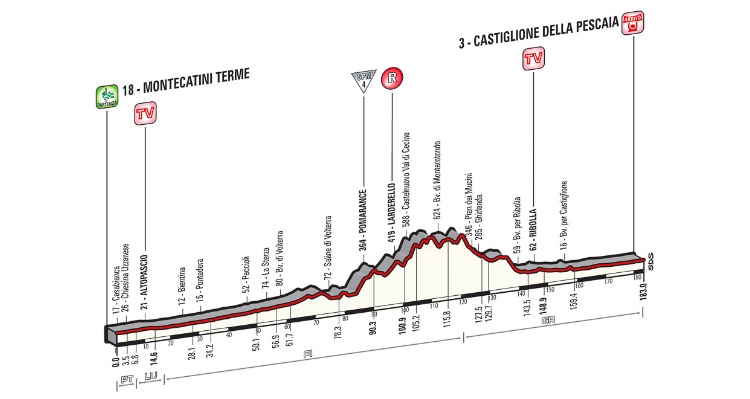
Stage 6: Montecatini Terme › Castiglione della Pescaia – 183km
Following two days of GC action and breakaway success (Jan Polanc won Stage 5 with a long-range move), the peloton will return to mostly flat roads for what should be a day for the sprinters.
Stage 6 opens and closes with long flat sections, with a bit of climbing (a single Cat. 4 and several uncategorized bumps) in between. It’s hard to see anything other than a bunch sprint for victory here. The finale involves a few corners and roundabouts but the last kilometer is basically a straightaway perfectly tailored for a drag race.
Unlike last year’s Giro, the 2015 edition of the Tour of Italy is lacking a dominant sprinter, but there are several very strong quick men who should battle it out for the win.
André Greipel, at his best, should be faster than the field. But he’s looked a bit below his best so far. He’s also somewhat inconsistent, and not prone to take control of all of a race’s sprint stages, even though he can beat the world’s best on a good day. On Stage 2, he opened up his sprint too early and couldn’t sustain his power on the slight incline to the line. Here, he’ll try to time things better, and prove that he’s still got what it takes to be the top favorite for this sort of profile.
Elia Viviani timed things just right on Stage 2, taking a victory on the day, and he’s worn the red jersey ever since. He lacks the level of leadout support that some of his rivals enjoy, but as I already pointed out in the Stage 2 preview when talking up his chances, I tend to think the necessity of a strong leadout is overstated by many observers. A fast rider with positioning savvy can win a sprint without much help, and Viviani has a great chance to do that again on Stage 6. Like Greipel, though he tends to have good and bad days, so it will be interesting to see if he’s still at the same level in this sprint that he was showing off on the second day of the race.
Giacomo Nizzolo has great top-end speed and will love the long, straight finale. He sometimes struggles when timing a jump coming out of a corner is required (even though he is a good bike handler), so he’ll be happy to focus more on the matter of getting up to blazing speed here in this probable sprint finish.
Sacha Modolo has beaten Mark Cavendish more than once in a bunch kick. It’s a bit hard to predict how he’ll do because he can go from hot to cold very quickly, but he seems to be pretty fast right now (he took a nice stage win in Turkey) and like Greipel and Viviani, if he’s on a good day he can be pretty hard to beat.
Moreno Hofland took 2nd on Stage 2 of this race somewhat surprisingly. He’s had big results in the past but against this company and in this big of a race, I didn’t expect him to come so close to the win. He tends to appreciate the slight gradients at the line (which this stage lacks) but he’ll still be dangerous.
Luka Mezgec was 4th on Stage 2 and has the always impressive Giant-Alpecin to set him up nicely coming into the final straightaway. The winner of last year’s final Giro d’Italia stage should be in the mix with the other favorites again.
Michael Matthews may have lost the pink jersey on the road to Abetone, but he’ll have plenty more opportunities for wins in this race, including here in this Stage 6. People often say that Matthews is “not a sprinter” because of his versatility, but in the same way that they’ll say that about Peter Sagan (who just beat Mark Cavendish in a Tour of California sprint) as well, that undermines the amazing finishing kick he does have. He’s capable of winning a bunch sprint if everything goes his way.
Juan José Lobato, Matteo Pelucchi, Tom Boonen, Nicola Ruffoni, and Alessandro Petacchi are others to watch in the field sprint likely to close out Stage 6.
Be sure to follow @VeloHuman on Twitter for more race analysis, and remember to check back after the conclusion of Stage 6 for the preview of the next stage.
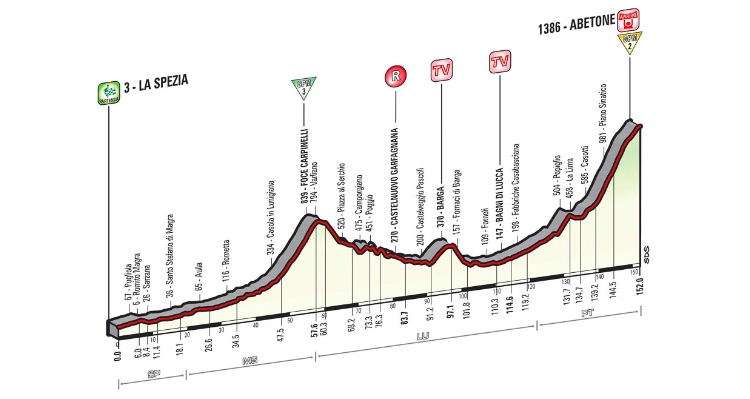
An unpredictable Stage 4 (won by Davide Formolo) shook up the fight for the pink jersey in the Giro d’Italia perhaps earlier than expected. The GC riders will have to be alert for the Giro’s fifth day as well, however, because it concludes with a very long climb to a summit finish.
The day opens with a long, low-gradient ascent into a Cat. 3 climb, followed by along descent, a short uncategorized climb, and then another long, low-gradient ascent into the finish climb to Abetone, 17.3 kilometers at a 5.4% average gradient.
As with any climber-friendly stage, this day could go to a breakaway. This is especially true in the aftermath of a Stage 4 that saw so many would-be GC riders lose a lot of time—there are now many strong climbers who will not pose much of a GC threat. On the other hand, there are bonus seconds on offer and an opportunity for the pink jersey favorites to test each other here, and if a chase is organized properly, it should be possible for the peloton to reel in riders up the road on this parcours. It’s hard to predict how things will play out, though whether the race is won from the pack or a break, the favorites will be those riders with strong climbing skills and the punchiness to win a finishing sprint or launch a late attack on the long but not terribly steep final ascent.
Fabio Aru is certainly a strong climber, and his Astana team proved to be in incredible shape on Stage 4, driving the pace in the peloton for the better part of the stage and closing down what had been a 10 minute gap to all of the breakaway riders up the road except for Formolo. That will be a big factor in Aru’s favor on this long slog of a climb, where Astana can put the pressure on Aru’s rivals, chase down other attacks, and prime the young Italian to launch an attack of his own at just the right moment. He’s quite adept at getting clear on a long climb like this one, as he showed in last year’s Giro and Vuelta alike, and he has to know that he’ll need every bit of time he can get before a long time trial that will suit his more time trial-oriented rivals.
Speaking of which, Alberto Contador and Richie Porte will both be obvious candidates for success on this stage, though the extent to which they’re planning on being active this early in the race is unclear. Neither sports a particularly deadly finishing kick, so to win they’d both have to be aggressive—the low gradients could see a group arrive at the finish unless someone can get clear with a powerful attack. Rigoberto Urándoes have a strong finishing kick. Before stage 4, Urán was my favorite for this stage—but the Colombian GC rider lost ground to his top GC rivals on that day, and that leaves his condition a bit uncertain. He’s also down two teammates. I still think he’s got a great chance here, but he comes into the stage with a few question marks. Damiano Caruso is another rider within a minute and a half of the GC lead who can finish fast. Esteban Chaves, sitting 2nd overall, is riding well right now and could be a danger too, as could Alberto Contador’s teammate Roman Kreuziger.
Diego Ulissi is among the many punchy candidates for stage success who will have the luxury of being given a bit more room to get aggressive, given his non-threatening GC position. Even if he were a GC candidate, he’d be a terrific bet here, given his strong climbing legs and explosive power. From a long-range move or with the pack, he’s an excellent option on Stage 5. Carlos Betancur lost a lot of ground on Stage 4 but he doesn’t look totally out of shape either—at his best he’d be among the top favorites here, and perhaps with the freedom that will come with his nearly-14-minute GC deficit, he could challenge for the stage.
Mikel Landa, Beñat Intxausti, Dario Cataldo, Stefano Pirazzi, Damiano Cunego, Giovanni Visconti, Ilnur Zakarin, Philippe Gilbert, and Tom-Jelte Slagter are on the long list of strong climbers who could be allowed up the road to go for the stage victory here. And don’t completely count out Trek’s Fabio Felline, who has put in some very strong uphill performances in the past, despite being quickly dropped on a difficult Stage 4.
VeloHuman Stage 5 Favorites
1. Fabio Aru | 2. Diego Ulissi | 3. Rigoberto Urán
Be sure to follow @VeloHuman on Twitter for more race analysis, and remember to check back after the conclusion of Stage 5 for the preview of the next stage.
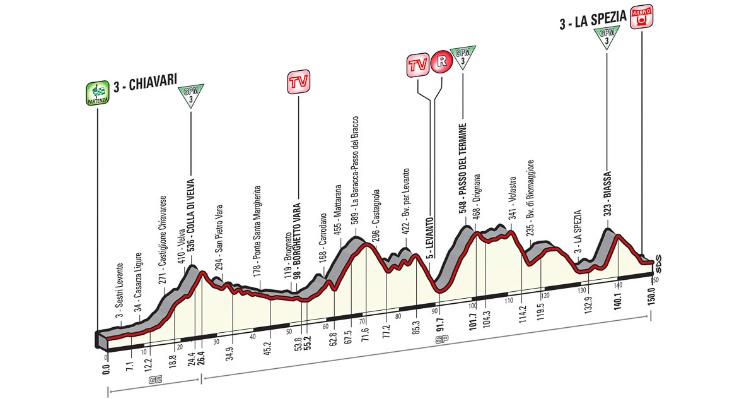
Michael Matthews took Stage 3 of the Giro d’Italia, and he should like the looks of Stage 4 as well. The route contains only three officially categorized climbs, but a fair bit of up and down, and the final climb is crested 10 kilometers from the finish, with steep sections of over 10% near the top and with 7km of descent to follow before a flat run-in to the line.
It’s another day that will likely have the breakaway specialists hoping to make something happen, but this early in the race, and with so many versatile fast finishers on the startlist, the peloton should keep them within striking distance. A reduced sprint between the survivors of the sting in the tail of this route, the Biassa climb, seems the most likely outcome (and even if a break does make it, expect to see at least a few of the upcoming names trying their luck from afar too).
Orica-GreenEdge has more than option on this sort of parcours, with two of the best riders for a reduced sprint on the roster. Michael Matthews, wearing the pink jersey, is an obvious candidate after his victory on Stage 3. He shines in selective sprints. If some of the purer climbers inject the pace on the final ascent, he may have trouble maintaining his position, but the way he’s been riding this year, especially the way he was glued onto Philippe Gilbert’s wheel on the Cauberg in the Amstel Gold Race, would suggest that he’s capable of a challenge like this. If he can’t, Simon Gerrans might be able to take up the slack. This is a perfect parcours for Gerrans and on any other day he might be the very top favorite, but having the pink jersey wearer on his own team means he might defer to his compatriot here. Either way, both are dangerous, as is Simon Clarke.
Philippe Gilbert came close to the win in Stage 3, and this is another great profile for him, perhaps even better, with a late climb that could see him putting pressure onto his rivals. It’s a flat finish but he’s a strong sprinter who can outmatch most climbers.
Fabio Felline is also a great candidate, one who defeated Matthews and Gilbert both at a similar finish in País Vasco. He’s in great shape right now, and an excellent climber who should have no problem with the parcours. If this comes down to a reduced sprint, expect to see him up there again, probably fighting it out with the same names that battled for the win in Sestri Levante.
Diego Ulissi spent a lot of time in the breakaway on Stage 3, and in the end, did not contend for a finish that suited him quite well. He’s got a great sprint and he’s a terrific climber; for Ulissi, this stage will be all about whittling down the pack to the right combination of opponents that he can outlast in a bunch kick.
Juan José Lobato lost contact on the difficult profile of Stage 3 but he’ll have another chance here. Southeast’s Francesco Gavazzi, Bardiani-CSF’s Enrico Battaglin, EQS’s Gianni Meersman, and CCC’s Greg Bole are others on the list of in-between types with the versatility to handle some climbing and the finishing kicks to win a reduced sprint. A more selective day could see the likes of Tom-Jelte Slagter, Sergey Lagutin, Damiano Caruso, Paolo Tiralongo, Damiano Cunego, and speedy GC contender Rigoberto Urán in the mix. Of course, there’s always the possibility that the day isn’t so hard as to drop all of the purer sprinters, leaving a small window open for riders like André Greipel, Giacomo Nizzolo, Moreno Hofland, and Elia Viviani.
VeloHuman Stage 4 Favorites
1. Michael Matthews | 2. Fabio Felline | 3. Philippe Gilbert
Don’t forget to follow @VeloHuman on Twitter for more analysis during the race, and be sure to check back after the conclusion of Stage 4 for the preview of the next stage.
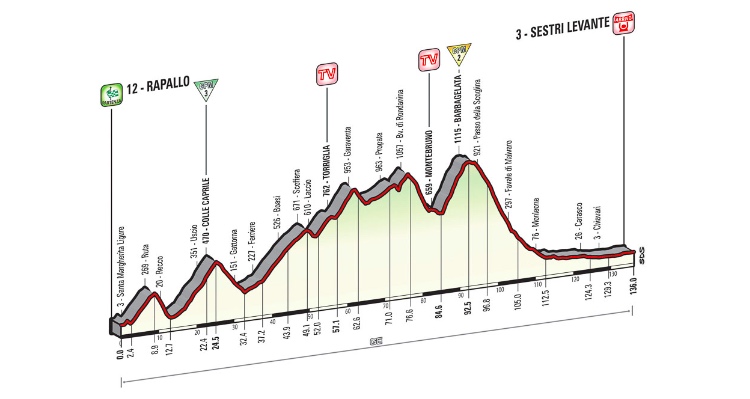
With Elia Viviani’s Stage 2 victory kicking off the road racing proper in this Giro d’Italia, the peloton will take on a short but intriguing third stage. Officially, the route only contains two categorized climbs (an early Cat 3. and a later Cat. 2), but for the first 112 kilometers of racing, there is barely a km of flat road. The road goes up and down and up again (with a general skyward trend for the first 92km) for quite a while. Most of the climbing is at a low gradient, but the riders will ascend from seaside Rapallo into the hills and reach an altitude of 1115 meters, the top of the Cat. 2 Barbagelata climb before a long descent to Monleone, after which they’ll only have 23km remaining to the finish. It’s a flat run-in to Sestri Levante and the line, but it won’t be easy getting there.
There aren’t all that many vicious gradients to face here but the Barbagelata climb is no cake-walk, 5.7km at 8%, and it comes after the pack will have already done a great deal of climbing. It is almost a certainty that some of the heavier riders in the peloton will lose contact before all is said and done, and with a long descent to follow, there won’t be all that much time to rejoin the main group.
A breakaway will likely get clear early and hold out an advantage over the bumpier parts of the stage, but with a flat run-in to the line and a likelihood of a few fast finishers still hanging around, it’s hard to see a breakaway surviving. The most probable scenario on Stage 3 would seem to be a reduced sprint.
Pink jersey wearer Michael Matthews is one of cycling’s best in the aforementioned scenario. He’s fast enough to beat the pure sprinters when he’s on a very good day; against a tired out pack, likely whittled down by the day’s climbing, he’ll be tough to beat, especially with the strong Orica-GreenEdge team helping him out. Simon Gerrans could be a deadly alternative.
JJ Lobato is one of the few riders who deserves to be considered as strong a favorite as Matthews, because he, too, can handle some climbing, and he’s already beaten Matthews in a sprint this year more than once. Movistar is mostly in this Giro for stage wins, and this is a great opportunity for Lobato. He has cooled off a bit after a very hot start to the season but that’s no reason to overlook him here.
Trek’s Giacomo Nizzolo will try to hold on and will obviously be among the favorites if he can, but Fabio Felline, who won a stage in País Vasco last month, could be the better bet for Trek. He’s a terrific climber who placed in the Top 10 on GC at the Criterium International. Etixx-QuickStep’s Gianni Meersman is another very versatile fast finisher who will probably appreciate the profile.
The obvious sprinter candidates, including Elia Viviani, André Greipel, Sacha Modolo, and Luka Mezgec, will all do their best here too, but the gradients will be a real challenge.
BMC’s Philippe Gilbert can be speedy in a reduced sprint, and could look to get involved, with Tom-Jelte Slagter, Enrico Battaglin and Sonny Colbrelli, Francesco Gavazzi, Heinrich Haussler, and Grega Bole potentially in the mix as well if some of the purer speed guys are missing. If the pack is seriously whittled in the mountains, the likes of Diego Ulissi and even Rigoberto Urán could thrive here.
Don’t forget to follow @VeloHuman on Twitter for more analysis of the Giro d’Italia. Be sure to check back after the conclusion of Stage 3 for the preview of the next stage. And, of course, there is still plenty of insight to be gleaned from the Recon Ride pre-race podcast, which you should definitely give a listen if you have already…
Road racing gets underway at the Giro d’Italia with a mostly flat Stage 2. A single Cat. 4 climb inside the final 60 kilometers is the only official categorized acent of the day. The finish has a few bumps, though, and the road to the line angles ever so slightly uphill.
With the general classification still completely unsettled and a profile without many big challenges, this looks like a sprinters’ stage all the way. There are several candidates for victory—although there are plenty of big-name fast finishers in the race, none comes in as the clear favorite for one reason or another.
André Greipel has the strongest track record and, at his best, probably the fastest kick. He’s probably the best bet to win Stage 2, though he’s here without much of a leadout and he’s not the most consistent rider in the world, often disappearing on days that would seem to suit him.
Giacomo Nizzolo can handle a slightly uphill finish and he’s highly motivated in this Giro d’Italia, with a dedicated leadout train to position him well among the favorites. Few can match him for top speed. Sacha Modolo is also extremely quick, and coming off a nice stage win in the Tour of Turkey. He can run hot and cold, but if he’s feeling good, he will be hard to beat.
Elia Viviani is a strong sprinter who won’t have as much support as he’d like, given the fact that Sky is here for Richie Porte; still, I think he’s capable of coming away with a victory in a straight-up bunch kick. Nacer Bouhanni showed last year that you don’t need an elite leadout to win big sprints in the Giro. Luka Mezgec does have a strong leadout squad but little in the way of recent results. Still, he’s a danger.
Michael Matthews of Orica-GreenEdge can’t be underestimated even if a big bunch gallop. He’s been successful in that scenario before. With the slight uphill drag at the line, he’ll be an even stronger candidate for victory. The same is true for JJ Lobato, who has had a nice year so far.
Other candidates for victory in the likely sprint are Matteo Pelucchi, Alessandro Petacchi, Moreno Hofland, and the EQS duo of Gianni Meersman and Tom Boonen.
The Giro d’Italia kicks of the first three weeks of Grand Tour season this weekend. Last year’s winner Nairo Quintana won’t be at the startline, but the hottest rider of the spring, the best GC rider in recent history and last year’s runner-up will be, along with a host of other big talents. Every one of the major jerseys in the race (pink, red, blue, and white) will face fierce competition from a number of candidates—as Grand Tours go, things are pretty open for the taking in the 2015 Giro d’Italia, and that should make it even more worth watching. And more worth checking out pre-race content too, like the most recent Recon Ride pre-race podcast…
The Route
This year’s Giro route is a balanced one, with six or seven days that favor the sprinters (depending on how optimistic you are about the versatility of some of the quick men), about as many days for the GC types, several intermediate stages, a team time trial, and an individual time trial. It’s the sort of parcours that will require a complete set of skills to make it through with success.
The TTT kicks things off—at 17.6 kilometers it won’t open up massive gaps but it will give a few teams a not-insignificant advantage in the fight for the pink jersey. The sprinters and puncheurs, and the craftier aggressors will have their opportunities in the opening week of flat or rolling stages, though a small summit finish on Stage 5 will probably see at least a few GC hopefuls caught unprepared. Stage 8 is another potential GC day, with a breakaway friendly Stage 9 and then a rest day to follow. Stages 10 through 13 will be prime targets for the stagehunters as the GC types prepare for a critical week starting with a very long (59.4km) individual time trial on Stage 14. By the end of the day, there will be sizeable differences between the riders on the GC leaderboard.
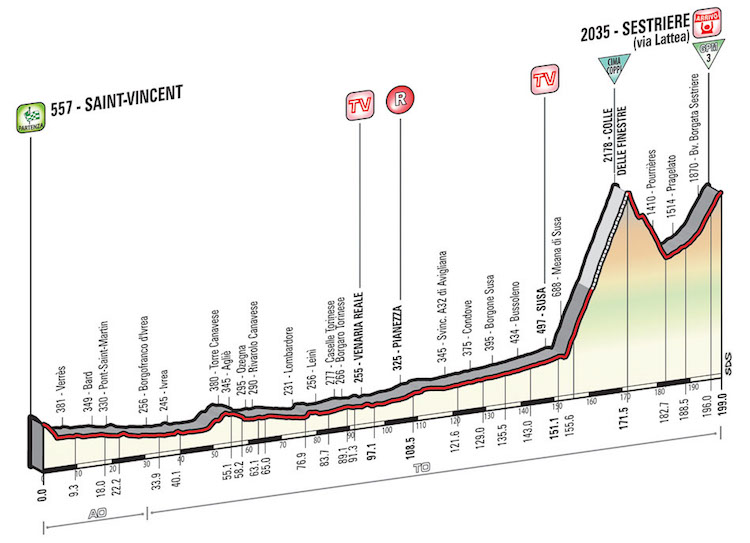
But they won’t get to rest in the aftermath. Challenging mountains await on Stages 15 and 16 (the latter offers the viciously steep Mortirolo as the penultimate ascent on the day). The pink jersey hunters will catch their breath on a relatively easy Stage 17 before a difficult trio of mountain stages, culminating with a Stage 20 that will force the peloton to go up and over the incredible Colle delle Finistere.
Stage 20: Sint Vincent › Sestriere (196km) – The penultimate climb of the day will be among the hardest uphill challenges the professional peloton will face all season.
It may not have the name recognition of some other famous Giro mountains, but that won’t be much comfort to the riders climbing it’s 18.5 brutal km at a 9.2% average gradient. Stage 20 closes thing out with a sprinter-friendly day in Milan.
The GC Contenders
The trio rightfully receiving the most attention prior to the start of the race is that of Alberto Contador, Richie Porte, and Rigoberto Urán. Each is a complete rider backed by a strong team.
Contador, who has won this race in the past, looks like the top favorite. His skills are widely known. At his best, he’s almost unbeatable, and one might expect him to easily best Porte and Urán—but he’s aiming for the Giro-Tour double this season, and that may explain in part why his early-season racing has not been up to Contador standards.
Still, he’s put in okay showings all year long, hanging with the top favorites on the mountain stages of the one-weekers he’s raced, letting others be the main protagonists as he has rolled into Top 10 placings. In this race, which matters much more than Tirreno-Adriatico, expect Contador to fight harder. His form may be a bit of a question mark but his ceiling is so high it’s hard to look past him even if he’s a bit below 100%. Roman Kreuziger, Michael Rogers, and Ivan Basso (Kreuziger in particular) make for excellent lieutenants.
Richie Porte, on the other hand, has been terrific so far this year. He’s checked all the boxes in the run-up to this race, winning both on the hills and against the clock. Now all that remains is the big goal of his season. Thanks to his strong TT, Porte is best-suited to races with lots of chrono mileage, and the 59.4km ITT should be good for him. The big concern for Porte is his propensity to crack in a three-week race. As amazing has some of his one-week performances have been, he is a 30-year-old GC rider with just one Grand Tour Top 10 to his name, so often putting in a bad day in the mountains to ruin his campaigns. If he can avoid that this year (which is something that’s been said in the past) he should contend for the victory, with help from Leopold König, Mikel Nieve, and the rest of a strong Sky team.
Urán will hope to better his two straight runner-up performances. With Contador and Porte around, it won’t be easy, but if Contador is indeed lacking for form compared to Urán, for whom the Giro is the season’s main target, and if Porte does have a bad day in the high mountains, then Urán can slide into the driver’s seat with his powerful engine. And really, neither of those conditions is that unlikely, making Urán a viable contender.
Fabio Aru would probably be right up in there in the favorites conversation but he’s been sick this year and it’s hampered his prep. He’s a brilliant climber when in form, making him dangerous regardless, but the health is a question mark. The long ITT doesn’t suit him either. He’ll need all the help he can get in this race, though Astana brings a strong squad of supporters/potential alternatives with the likes of Mikel Landa, Dario Cataldo, and Diego Rosa.
Domenico Pozzovivo doesn’t have a flashy resume but he’s put in several strong performances here over the years and could be one to take advantage of the situation if the top favorites start looking at each other. He’s got an impressive uphill burst.
Former winner Ryder Hesjedal will hope to leave his mark on the 2015 edition of the race but Cannondale-Garmin teammates Davide Formolo and Tom Danielson may be even better bets. Jurgen Van Den Broeck of Lotto Soudal looked great in the Tour de Romandie. Movistar’s Beñat Intxausti and possibly Ion Izagirre will hope to carry the flag in place of Nairo Quintana. Expect at least one of them to do very well. Katusha’s Ilnur Zakarin will look to continue his great run; it’s pretty hard to know what to expect from the surprise Romandie winner here. Damiano Caruso and Darwin Atapuma, Przemyslaw Niemiec and Diego Ulissi, Damiano Cunego, and Esteban Chaves are other outside candidates for GC contention.
The Stagehunters
The sprinters’ stages should be a bit more unpredictable than they were last year, when Marcel Kittel and Nacer Bouhanni dominated the conversation in succession. André Greipel is probably the fastest “on paper,” but he’s lacked consistently of late and isn’t the type to win every sprint stage in a race. Giacomo Nizzolo could finally get that Giro stage win after years of trying: his top speed is impressive. Elia Viviani transferred to Sky during the offseason and will hope to get at least a little bit of support from his team on the sprinters’ days. Luka Mezgec will benefit from Giant-Alpecin’s always strong leadout but his early season has not mirrored his impressive early 2014 campaign. Sacha Modolo is extremely fast but can run hot and cold.
Michael Matthews, who wore pink and took an amazing hilltop victory last year, will return to fight for the bumpier sprint stages with JJ Lobato, who has been great so far this year. Matteo Pelucchi and Heinrich Haussler, Tom Boonen and Gianni Meersman, Moreno Hofland, and Nicola Ruffoni are other speedsters who could be in the mix on the days that end in fast finishes.
Watch out for the always aggressive Adam Hansen, Sylvain Chavanel, Maciej Paterski (who has been great so far in 2015), the entire Bardiani-CSF team (especially Stefano Pirazzi), which will be firing off breakaway attempts at every opportunity, and punchy types like Simon Gerrans, Tom-Jelte Slagter and Philippe Gilbert on the intermediate days.
VeloHuman Top 10 Overall Race Favorites
GC Winner: Alberto Contador Podium: Richie Porte, Rigoberto Urán Other Top Contenders: Domenico Pozzovivo, Jurgen Van Den Broeck, Beñat Intxausti, Fabio Aru, Przemyslaw Niemiec, Roman Kreuziger, Ilnur Zakarin
Be sure to follow @VeloHuman on Twitter for more analysis during the race, and keep an eye out for daily stage previews (the Stage 1 Preview is already up)!