Tag: WorldTour

  • Grand Prix Cycliste de Quebec 2014 Preview

    Grand Prix Cycliste de Quebec 2014 Preview

    Veilleux

    While the Vuelta nears its conclusion in Spain, the WorldTour is also making its yearly visit to North America, where a pair of one-day races await. First up is the Grand Prix Cycliste de Quebec! 199.1 kilometers in total, the GP Quebec is a circuit race consisting of 11 laps that weave through the center of the city. As a top-level race and an important part of the Worlds buildup for many riders, it usually draws a very impressive group of participants (with those who focus on the hilly classics making up much of the roster) even with a Grand Tour taking place at the same time. This year is no exception!

    VH will be at the event in-person, so stay tuned here and on Twitter (@VeloHuman) for plenty of exciting coverage (previews, interviews, and post-race analysis) of the GP Quebec and the GP Montreal.

    The Route

    The profile of the GP Quebec always makes for a very interesting race. None of the uphill challenges on the menu seem particularly difficult at first glance, but their location on the route guarantees that they will play a major role in determining the day’s winner, either providing a launching pad for late attacks or at least whittling down the pack on the way to a reduced uphill sprint.

    GP Quebec Profile Crop

    The race starts (and finishes) in Old Quebec. The first 6.5 kilometers of the circuit are mostly flat as the road heads away from the city center, but then things change direction and there is a very fast descent down towards the water. As the road evens out, the pack will start heading back towards Old Quebec on the relatively flat Boulevard Champlain. Just after kilometer 14 of the circuit, things suddenly become difficult. The Côte de la Montaigne is only 375 meters in length, but at a 10% average grade, with almost half the climb at a whopping 13%, it will put plenty of pressure on the less uphill-oriented riders in the peloton. A fast descent follows, and then, as the route snakes through Quebec’s urban center, ultimately winding back towards the finish, the road kicks up in a series of climbs. The Côte de la Potasse is only 420 meters long, but the average gradient comes in at 9%. It is followed by a brief dip in the road and then another short, steep test, the Montée de la Fabrique, less than 200 meters in length but at 7%. Almost immediately after comes the long uphill drag to the line, the Montée du Fort climb, 1 kilometer at an average of 4%.

    By themselves, the late climbs may not look like much, but in rapid succession and coming at the end of the race, they will bring the uphill chargers to the fore. A technical urban circuit, with a few steep downhills to boot, will provide even more inspiration for the aggressive riders to attempt to escape from the pack as the day nears its conclusion.

    The Contenders

    The parcours makes for a very open race, where a wide spectrum of riders, including climbing powerhouses and even sprinters, will have an opportunity to pick up a WorldTour-level victory at the end of a hilly (but not too hilly) day. The 2013 edition was a perfect illustration of this: Robert Gesink, not partcularly known for his one-day race performances, outgunned would-be World Champion Rui Costa and even Peter Sagan in an uphill sprint.

    Gesink himself isn’t here, but the 2014 startlist, packed with hilly classics specialists, GC-style climbers, and a few of the peloton’s more versatile quick men, should set up another unpredictable race, as everyone will fight to survive the repeated uphill tests and then either launch a late move or hold out for a group finish on the Grande-Allée. A fair bit of punch and capable climbing legs will be necessities for anyone hoping to succeed in this race.

    Orica-GreenEdge, loaded with talented riders for the hilly profiles, probably couldn’t draw up a race much more suited to them than the GP Quebec or its sister race in Montreal. They bring a powerful squad to Canada to contest both. Simon Gerrans won this race in 2012, and with his skillset, he’ll be among the most dangerous riders on this parcours. The two-time Monument winner is strong enough to escape from the pack on a tough profile if he sees an opportunity, and he is deadly in an uphill sprint. With a World Championship course that suits him just around the corner, he showed excellent form in the recent Vattenfall Cyclassics, sprinting to 3rd ahead of some very impressive names, and this race fits him even more perfectly. OGE will also have Michael Albasini, Daryl Impey (fresh off a Tour of Alberta win), Pieter Weening, and Jens Keukeleire as powerful cards to play. At least one member of this impressive team should feature prominently in the finale.

    BMC’s Greg Van Avermaet was 2nd in the 2012 edition of the GP Quebec, and 3rd in last year’s race. The Canadian GPs are a major target of his, and an urban circuit with the ups and downs and twists and turns to inspire late attacks is perfect for the aggressive Belgian. He showed great form in an uphill burst to a stage victory in the recent Eneco Tour, and no matter how this race plays out, it’s hard to imagine that he won’t be involved at the finish once again. Tejay van Garderen may not have much of a resume in the one-day races, but the climbing specialist (who has looked more explosive than ever this year) will make for a powerful teammate.

    FDJ’s Arthur Vichot was runner-up to Robert Gesink in 2013, and just put in a top-notch display of form when he took 3rd overall in the GP Ouest France in Plouay. Vichot was very impressive in the hilly Paris-Nice in March, and he looks to be returning to a high level as the season nears its conclusion. He’s an explosive uphill charger who isn’t afraid to go solo, and he should be among the top contenders in the GP Quebec.

    World Champion Rui Costa has landed back-to-back top 5s in Quebec, and with his World Champs defense approaching, he’s highly motivated to put his mark on this race again. He’ll need a challenging race to put some of the faster finishers under pressure, but there are a number of true climbing talents on this startlist (including teammate Chris Horner) that could help. Costa has a knack for success here and the ability to strike out for glory alone or outgun a small group at the line.

    Katusha’s Alexander Kristoff is in attendance and probably has claim to the title of best sprinter on the startlist. Surviving the late uphill tests will not be easy for Kristoff, and the final drag doesn’t suit him that well, but he has continually delivered on very difficult profiles in 2014 and so he can’t be counted out with his elite finishing kick. Simon Spilak is a strong alternative.

    Gianni Meersman is one of the most versatile sprinters here, and he’s on strong form at the moment. He might have a chance at staying with the pack all the way to the line. If not, OPQS is loaded with other options. Zdenek Stybar has the power to make a late break for victory or to hold the wheel of anyone who does and the finishing kick to outmatch a group at the finish. Julian Alaphilippe is very strong right now and just delivered a very impressive ride in the GP Ouest France, and Jan Bakelants (who loves the hilly days) and Matteo Trentin (deadly in a reduced sprint) are even more potential protagonists for the team.

    Garmin-Sharp’s Tom-Jelte Slagter has finished in the Top 10 here on back-to-back occassions, and he’s had a career year. Form is a bit of a question mark, but he has the skills to thrive here if he’s in shape. Ramunas Navardauskas, Fabian Wegmann (an impressive 4th here in 2013), and sprinter Steele Von Hoff are other great options for the team. Europcar also has riders for multiple scenarios, with Bryan Coquard a potential contender in a sprint and Cyril Gautier and Yukiya Arashiro as options if the race is too selective for Coquard. Sky has their dangerous one-two punch of Geraint Thomas and Edvald Boasson Hagen, both of them capable of striking out for solo success or holding on for an uphill sprint. Giant-Shimano has an in-form Tom Dumoulin (who packs some underrated punch) and hilly classics specialist Simon Geschke (9th last year), and between them, a good result for the Dutch team seems likely. Lotto Belisol is stacked with talented riders for the parcours, with top-notch solo artist and very fast finisher Tony Gallopin in attendance and motivated, along with Jelle Vanendert and Tim Wellens, who could make things very interesting on the late climb, and strong one-day racer Jurgen Roelandts. Belkin’s Bauke Mollema is obviously an elite climber, but his great finishing kick might surprise some people; don’t rule him out even in a reduced sprint (he has a great chance to follow up Gesink’s unexpected victory with one of his own). Teammate Sep Vanmarcke may be known more for his cobbled classic prowess, but his punchy style and his ability to get over the small hills should translate well here.

    It’s hard to pick out one Astana rider as the most likely to land a good result in Quebec, but the team bring a serious array of talent to the race in Jakob Fuglsang, Enrico Gasparotto, Borut Bozic, Francesco Gavazzi, and Liewue Westra, and that impressive cast has among them the variety of skillsets to cover any scenario. Tinkoff-Saxo, with Michael Rogers and Matti Breschel, also has options for multiple outcomes. AG2R’s climber trio of Jean-Christophe Peraud, Christophe Riblon, and Romain Bardet should make this interesting, and don’t count out Hugo Houle either in his home country. Movistar’s Beñat Intxausti, JJ Rojas, and JJ Lobato, Cannondale’s Moreno Moreso, Marco Marcato, and Davide Formolo, and Trek’s Robert Kiserlovski and Frank Schleck are other talented riders who could be in the mix.

    VeloHuman Top 10 Favorites

    Winner: Simon Gerrans
    Podium: Greg Van Avermaet, Arthur Vichot
    Other Top Contenders: Rui Costa, Alexander Kristoff, Gianni Meersman, Tom-Jelte Slagter, Simon Geschke, Michael Albasini, Tony Gallopin

    Stay tuned for plenty more coverage of the GP Quebec and the GP Montreal, and be sure to follow @VeloHuman on Twitter for live commentary of both races.

    -Dane Cash

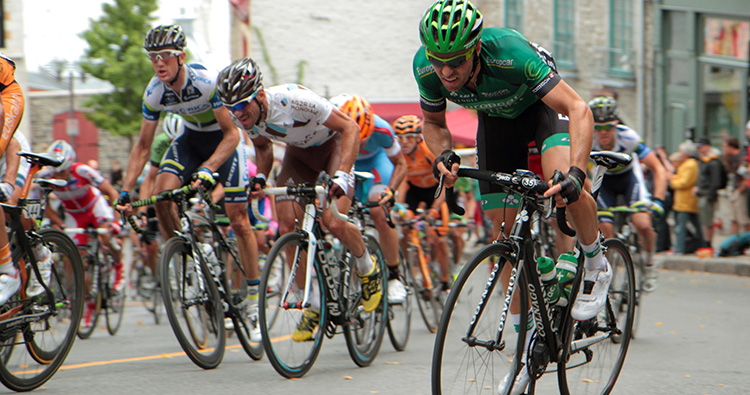
    Photo by Cephas.
  • Vuelta a España 2014: Stage 18 Preview

    Vuelta a España 2014: Stage 18 Preview

    Stage 18 Profile

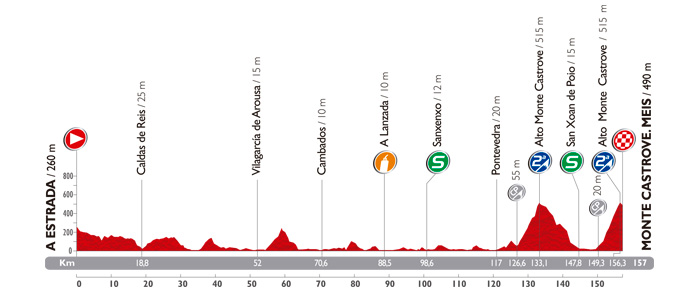
    Stage 18: A Estrada › Monte Castrove. Meis – 157 km

    Following John Degenkolb’s strong win on the Vuelta’s final real sprinters’ day, Stage 18 will bring to the fore those who prefer charging up a gradient. Very short at only 157 kilometers, Stage 18 nevertheless packs a punch in the finale. After they’ve spent most of the day riding on relatively flat roads, the peloton will have to climb the Alto Monte Castrove twice to close out the day. It’s short, but its 7% average grade will do plenty of damage, and with the finish line coming just over a half a kilometer after the riders crest the climb for the second time, only those with punchy climbing legs will have a chance at being positioned to contest the stage victory.

    Since this finish is too difficult for the pure sprinters’ teams to drive the pace, the breakaway will have a chance at staying away on Stage 18, but if Movistar or Katusha decide to keep things on a short leash so that their GC men might have a shot at the bonus seconds on offer, it will be hard for anyone to succeed for afar here. Katusha and Movistar should be keen on controlling this one, because Joaquim Rodriguez and Alejandro Valverde have to be among the top favorites for stage honors. The narrow uphill road of the final climb suits Purito quite well, and it’s hard to imagine him not delivering an all-out attack in the waning moments of the race. Daniel Moreno has just the right skillset for the Alto Monte Castrove as well. Meanwhile, Alejandro Valverde packs quite the uphill kick himself, and he also has the strongest sprint among the riders in the GC Top 5. If he can hold the wheels of the attackers in the last ascent, he’ll have an excellent opportunity to nab a victory and valuable bonus seconds on Stage 18.

    Dan Martin has already come close to a stage victory in this race using his top-notch punchy climbing legs, and he has maintained a high level of form even into the third week. He has a great chance here to finally pick up the stage win he’s been hunting. Fabio Aru may not have the Ardennes resume that Purito, Valverde, Moreno, and Martin have, but he is an elite climber who has a knack for exploding out of the pack on the very steep stuff.

    Chris Froome is getting stronger every day in this race, and if he can drop his rivals with an attack from far enough out, he’ll have a shot at victory on Stage 18 even on a short climb like this. Race leader Alberto Contador, on the other hand, doesn’t need to attack, and therefore will have the luxury of being able to follow the wheels he wants to follow. That puts him into a good position to pick up another win in much the same way he won Stage 16, when he allowed Chris Froome to drive the pace until an opportunity to fly past presented itself.

    Wilco Kelderman hasn’t had quite the level of form in this Vuelta a España that he displayed in the Giro, but he has a very fast finish and is a dangerous rider in a post-climb sprint. Samuel Sanchez, Warren Barguil, and Daniel Navarro are others on the fringes of the GC leaderboard who could hope to get involved in this sort of finish, while Philippe Gilbert and Michael Matthews will hope that they can hang with the GC-oriented climbers on the incline and outgun them in the final few moments for stage honors.

    Should a long-distance move take the day, Ryder Hesjedal, Alessandro De Marchi, Luis Leon Sanchez, Adam Yates, Wout Poels, Alexey Lutsenko, Louis Meintjes, and Alexandr Kolobnov are among those who should be considered good candidates for success on a profile that turns hilly quite suddenly in the last 30 kilometers.

    VeloHuman Stage Favorites

    1. Alejandro Valverde | 2. Joaquim Rodriguez | 3. Dan Martin

    Be sure follow @VeloHuman on Twitter for live commentary of this and every stage of the 2014 Vuelta a España! The next preview will be up after the conclusion of Stage 18, and there is plenty of GP Quebec and GP Montreal coverage coming very soon as well, so stay tuned!

    -Dane Cash

  • Vuelta a España 2014: Stage 16 Preview

    Vuelta a España 2014: Stage 16 Preview

    Stage 16 Profile

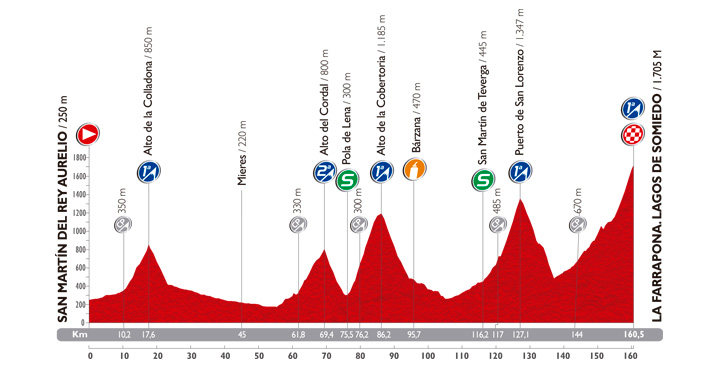
    Stage 16: San Martín del Rey Aurelio › La Farrapona. Lagos de Somiedo – 160.5 km

    After another tough day won by Przemyslaw Niemiec, Stage 16 closes out a trio of critical mountain stages in style, with no fewer than four Category 1 climbs (and a Cat. 2 thrown in for good measure), and the challenging profile won’t wait until the end of the day to test the peloton. The stage starts with 10 kilometers of slight incline before the first Cat. 1 is reached, the Alto de Colladona. After a tricky descent off the climb the riders will continue to go slightly downhill for another thirty kilometers or so, during which they will try to save as much energy as possible: after kilometer 60, it’s steep climbs or white-knuckle descents pretty much all the way to the finish line. First comes the Cat. 2 Alto del Cordal, followed by a descent right to the foot of the vicious Alto de la Cobertoria climb, a Cat. 1 of 10 kilometers at 8.8% (and it comes only halfway through the stage). From the top, the riders will take on a very technical downhill journey to Barzana, where the negative gradient will become gentler, but it won’t even out completely. When it does, after another 10 kilometers or so, the road kicks up again almost immediately, heading uphill in an uncategorized trip to the bottom of the categorized Puerto de San Lorenzo, another steep slope of 10.1 km at 8.5%. From the top it’s one more tricky descent the leads to one more uncategorized uphill trip to the foot of one more Cat. 1 climb: La Farrapona. It’s a long journey to the summit finish, 16.5 kilometers in total, and though the average gradient may seem manageable at 6.2%, the final 4 kilometers ratchet up the difficulty, with several stretches pushing over 10%.

    While the Vuelta’s sixteenth stage is followed by a rest day and is one of the last opportunities the GC contenders will have to put each other under pressure in the mountains (two factors that could spur the red jersey hunters to a fast pace and a more likely catch of the morning break), the profile itself looks perfect for any aggressive riders who manage to get up the road. Early climbs will give the uphill specialists a good chance of getting into the day’s move, and the constant up-and-down will make it very difficult for anyone to control the race. This breakaway vs. GC bunch battle looks to be another tossup, which will again make it difficult to name anyone the clear favorite to take stage honors.

    This very steep final climb should be yet another opportunity for Joaquim Rodriguez to get some separation from his rivals on the General Classification. He was unable to get clear of the rest of the red jersey hunters early on the last climb of Stage 15, and then spent most of the rest of the ascent letting Alberto Contador drive the pace, only sailing past in the final few hundred meters to steal a few seconds at the line. However, he won’t have many chances to get ahead after Stage 16, and the slope suits his style nicely. With time running out in this Vuelta, it’s hard to imagine that Katusha won’t look for stage honors and bonus seconds here. Daniel Moreno, as usual, will be a dependable second on these gradients.

    Alberto Contador may have lost a bit of time to Rodriguez and Valverde on Stage 15, but only after pulling both of them up the mountain for quite some time. He continues to show impressive strength in this race, and a stage like this, with so many vertical meters on the day, will allow him to put his otherworldly uphill endurance on display.

    Chris Froome again landed a good result after riding his own pace up a tough final climb on Stage 15. On peak form, he has the endurance to thrive on a hard stage like this; it will be interesting to see how he does despite not necesarilly being at his best. Alejandro Valverde took 2nd on Stage 15, but his nice result there didn’t necessarily show a whole lot more strength than we’ve seen just yet, as it came with a late jump around Alberto Contador (whom he’d been following for the last several kilometers) in the final few hundred meters. Stage 16 is one of the last chances for the climbers to create some space on the leaderboard, which should lead to more attacks on the final climb, and that will require more from Valverde. If he’s in a lead group in the last hundred meters, his sprint obviously makes him a top favorite, but that scenario will only occur if a lot of things go right for the 2008 winner of this race.

    Dan Martin showed immense ability on Stage 15, finishing 11 seconds behind Chris Froome despite spending several kilometers just before the final climb chasing the pack after crashing. He’s far enough behind on GC that he should have a bit of freedom to put in a late dig. Fabio Aru, in a similar position, remains a nice candidate for stage honors with this steep finish if it is, in fact, the GC men who are vying for the day. Robert Gesink, Daniel Navarro, and Samuel Sanchez are others on the fringes of the GC battle who have shown strength in the past few mountain days and who are also good candidates to get clear of the rest of the GC types on the final ascent.

    Several potential long-distance protagonists kept their powder dry and stayed in the pack on Stage 15. Ryder Hesjedal was one of them, but he did expend a lot of energy dragging Dan Martin back to the GC group after Martin’s crash. He’ll still be among the favorites if he gets into the day’s move, but it would be an impressive ride indeed if he were to succeed here after two tough days on the bike. David Arroyo was 8th on the stage that Hesjedal won from the break, and this will be another great opportunity for the pure climber to try for a long-range strike. Teammate Amets Txurruka is a good candidate to give it a go as well. Esteban Chaves has fallen out of GC contention in this Vuelta, and he could be hoping to get into the break on Stage 16, which has a steep finale that suits him; teammate Adam Yates is another likely long-distance hopeful. Astana’s Mikel Landa, Stage 15 winner Przemyslaw Niemiec of Lampre-Merida (if he still has anything left in the tank after two days in the break), his teammate Damiano Cunego, Belkin’s Laurens Ten Dam, OPQS’s Gianluca Brambilla and Wouter Poels, MTN-Qhubeka’s Sergio Pardilla and Louis Meintjes, Lotto Belisol’s Bart de Clercq, and Cannondale’s Alessandro De Marchi are other good candidates for breakaway success.

    VeloHuman Stage Favorites

    1. Joaquim Rodriguez | 2. Alberto Contador | 3. Daniel Martin

    Be sure follow @VeloHuman on Twitter for live commentary of this and every stage of the 2014 Vuelta a España! With a rest day on tap after Stage 16, the next preview will be up on Tuesday, so stay tuned for more.

    -Dane Cash

  • Vuelta a España 2014: Stage 15 Preview

    Vuelta a España 2014: Stage 15 Preview

    Stage 15 Profile

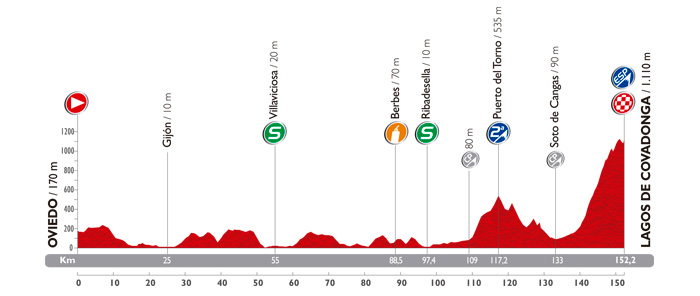
    Stage 15: Oviedo › Lagos de Covadonga – 152.2 km

    The Vuelta’s fifteenth stage is the second in a trio of intense mountain days (the first went to Ryder Hesjedal from the breakaway). Stage 15 is the shortest non-TT stage in the race at 152.2 kilometers, but the uphill challenges will make this a long day for everyone involved. Small, uncategorized hills are interspersed throughout the first 100 kilometers. Then comes the first categorized test of the day, the Puerto del Torno, a Cat. 2 of 7.2 kilometers at an 8.2% average gradient. The slopes are irregular, with several very steep sections on the way up; in other words, it’s harder than it looks. A tricky descent comes next, followed by a brief respite before the final climb: the iconic Lagos de Covadonga. 12.2 kilometers in length at an average grade of 7.2%, it’s another irregular ascent with several stretches (in the first half of the journey and then again at the very end) that push over 10%. It may rain, which would make this an even more difficult trip skyward.

    It’s tough to say one way or the other whether the pack will let the break stay clear here. Coming after one hard day and with yet another to follow, the GC riders could take the first half of the day at a less than furious pace, hoping to save a little energy for all the climbing yet to come. That would give the break a good chance on a profile that is already breakaway-friendly. However, both Chris Froome and Joaquim Rodriguez took a bit of time from Alberto Contador on Stage 14, suggesting that maybe he’s not as invincible as he has seemed so far in the race, and that may give Katusha and Sky the confidence and the motivation to put up more of a fight then they have so far and hunt down the valuable bonus seconds that await at the finish line.

    That uncertainty means that no single rider stands out as the indisputable favorite, but there are a few likely top protagonists for each scenario. Should this all come back together for a GC showdown for stage honors, I see Alberto Contador as the day’s most likely winner. He may have lost a bit of time on Stage 14, but he did spend more energy than he probably should have trying to chase down Alejandro Valverde. Ultimately, Valverde lost time, and Contador has to know that Rodriguez and Froome are the most dangerous rivals now. The Lagos de Covadonga climb suits Contador quite well, and he’ll want to do what he can here to close the door of opportunity that may have cracked open just a bit on Stage 14.

    Chris Froome‘s Vuelta a España has been enigmatic, to say the least. Who would have expected him to lose time to Alejandro Valverde in the time trial, only to outshine even Purito just days later on a climb with stretches of 20% gradients in the finale? This climb, less explosive except in the last hundred meters or so at the very top, should suit him a bit better, and if he can get away before the final two kilometers he’ll be hard to track down.

    Joaquim Rodriguez couldn’t escape from Chris Froome on Stage 14, but he did show strength in putting some daylight between himself and Contador. He’ll have another shot at stage honors on Stage 15, if the GC men are battling for the day and if he can hold on until the very steep final run to the line that will give him a chance to put his elite uphill kick on display.

    This is another good opportunity for Astana’s Fabio Aru to take a stage win. He crossed the line on Stage 14 just after Alberto Contador, and, still over two minutes down on GC, he will probably be given some breathing room if he tries to go on the move on Stage 15. Robert Gesink, Daniel Martin, Daniel Navarro, Daniel Moreno, and Mikel Nieve (if Team Sky is inclined to send him up the road) could face the same reaction if attempt to get clear of the GC bunch on the final slopes. Alejandro Valverde, on the other hand, still 2nd overall though losing ground to Froome and Rodriguez, will have plenty of eyes on him and a lot of pressure to bounce back here. That’s not out of the question, and this stage, which eases in the final few kilometers and then hits a steep wall at the very end, does suit him, but he’ll need to find an extra gear fast if he wants to keep his place on GC secure.

    No one potential breakaway protagonist could be called a top favorite for Stage 15, but there are several riders who will be well-positioned for glory if they can get out front of the peloton in a long-distance move. More than ten minutes behind on GC, Esteban Chaves is far enough off the radar of the top GC contenders that he should have some freedom to go up the road, and while he hasn’t yet put in a spectacular performance on one of the mountain stages in this Vuelta, he’s still been reasonably strong even when battling among the fringe GC contenders. Teammate Adam Yates might to try give this a go as well. Astana’s Mikel Landa, Trek’s Julian Arredondo, Lampre-Merida’s Damiano Cunego, OPQS’s Gianluca Brambilla, Belkin’s Laurens Ten Dam, MTN-Qhubeka’s Sergio Pardilla, and Cannondale’s Alessandro De Marchi are other top-notch climbers who could shine in a long-range attack. Ryder Hesjedal, Davide Arroyo, Romain Sicard, and Louis Meintjes will likely be feeling the effects of spending Stage 14 out front when they set out on Stage 15, but depending on each rider’s ability to recover quickly, any one of them could feature again soon

    VeloHuman Stage Favorites

    1. Alberto Contador | 2. Chris Froome | 3. Fabio Aru

    Be sure follow @VeloHuman on Twitter for live commentary of this and every stage of the 2014 Vuelta a España! The next preview will be up after the conclusion of Stage 15, so stay tuned.

    -Dane Cash

  • Vuelta a España 2014: Stage 14 Preview

    Vuelta a España 2014: Stage 14 Preview

    Stage 14 Profile

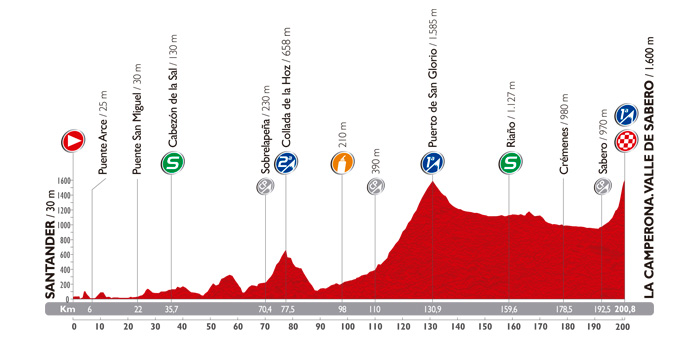
    Santander › La Camperona. Valle de Sabero – 200.8 km

    Stage 13, won by Dani Navarro, saw a skirmish among the GC riders in its final few kilometers, but the impending fourteenth stage of the Vuelta will likely be an intense battle among the top overall contenders of this race. The uphill challenges on Stage 14 are daunting. Things get started with 70 kilometers of mostly gentle roads before the Cat. 2 Collada de la Hoz kicks off the day’s categorized climbing. After cresting that ascent and then riding a tricky downhill, the peloton will take on approximately twenty kilometers of false flat at a slight incline before reaching the bottom of the Puerto de San Glorio, 20.9 kilometers long at a 5.8% average grade. There are sure to be some tired legs in the pack once they reach the top after over forty kilometers going uphill, but there will still be challenges yet to come on the day. Following a fast descent comes a long stretch of mostly flat roads before the final test. After 192.5 kilometers in the saddle, the peloton will reach the foot of La Camperona, a vicious 8.3 kilometer climb whose average gradient of 7.5% doesn’t really tell the whole story. Things start out relatively easy, but with around 2 kilometers to go, the road kicks up sharply, and it stays in the 15% range, touching well over 20% at points, until the final hundred meters or so, where things ease off to be only a little under 9% in the run to the line.

    A profile like this will be absolutely brutal for all but the most lightweight climbing specialists. The GC contenders will be locked in on the final ascent, knowing that a bad day could lead to serious losses on such a steep climb (especially after some hard uphill riding earlier in the day). Stage 14 is likely to end in a major showdown for the red jersey hunters. Whether or not they are riding for stage honors will depend on how they play the run-in to La Camperona; if the pace is kept high over the flat section that precedes the final climb, with riders jostling for position as the slopes approach, the morning break will be doomed. However, there are some tough mountain days to come in the days ahead, which could lead to enough hesitation in the pack that if a truly top-notch climber is up the road, he might have a chance.

    The top favorite to shine on this profile is Katusha’s Joaquim Rodriguez, the peloton’s premier uphill charger. He has put in attacks here and there in this race, but nothing has really stuck so far. This time, the parcours is perfect, and he needs to land a blow soon or he’ll have run out of opportunities to claw back time from those ahead of him on the leaderboard. He has the also explosive Daniel Moreno as an elite second.

    Race leader Alberto Contador has been up to every challenge thrown his way in this race so far, and he should continue to shine here. His biggest weakness is his lack of team support, but he may be strong enough for that not to matter. He’s not the type to rest on his laurels (or his current race lead), and if he sees an opportunity to pick up more time on his rivals, he will.

    Movistar’s Alejandro Valverde is very dangerous on the extreme gradients, and he’s within striking distance of the overall lead. A strong ride seems likely on Stage 14, but he needs to get more aggressive in this race if he wants to move up to that coveted first spot in the General Classification.

    Astana’s Fabio Aru took the eleventh stage of the race with a perfectly timed attack as the finish line approached, and he is still far enough back on GC that the riders at the very top of the leaderboard might give him some leeway if he tries to go on the move again. He has the skillset to achieve more success here. Garmin-Sharp’s Daniel Martin is in a similar boat, and he’s shown with repeated attempts to get away on the steep stuff that he’s highly motivated to get results on these climbs.

    Robert Gesink, who looked strong in an ultimately unsuccessful attempt to get clear of the GC bunch on Stage 11, Samuel Sanchez, Stage 13 winner Daniel Navarro, and Warren Barguil are other riders in the GC conversation who could enjoy a bit of freedom and potentially success if they attempt to get clear on the last climb. Chris Froome, who has at times looked very strong, and at times looked to be lacking something in this race, will be put to the test on this gradient; at his best he’d be a top candidate for success, but there won’t be anywhere to hide if he’s not feeling in peak condition when the road shoots skyward on Stage 14. Teammate Mikel Nieve could look to get something of his own if Sky decides to set him loose.

    If the pack does put in the effort to keep the breakaway on a tight leash early in the day, it will be very hard for anyone up the road to stay clear all the way to the top of the final climb, but should the GC contenders spend the stage looking at each other instead of worrying about the break, it’s possible that a strong uphill talent could hold out for victory here. Trek’s Julian Arredondo, Garmin-Sharp’s Ryder Hesjedal, Astana’s Mikel Landa, OGE’s Esteban Chaves and Adam Yates, Lampre’s Przemyslaw Niemiec, Cannondale’s Alessandro De Marchi, and Belkin’s Laurens Ten Dam are on the list of strong-climbing riders who might be able to succeed from the morning breakaway; alternatively, some of the aforementioned group could look to put in a dig a bit closer to the finish line, still benefitting from being far enough out of GC contention that they might be given some breathing room.

    VeloHuman Stage Favorites

    1. Joaquim Rodriguez | 2. Fabio Aru | 3. Alberto Contador

    Be sure follow @VeloHuman on Twitter for live commentary of this and every stage of the 2014 Vuelta a España! The next preview will be up after the conclusion of Stage 14, so stay tuned.

    -Dane Cash

  • VeloHuman Up-and-comer Q&A Series: AG2R La Mondiale’s Hugo Houle

    VeloHuman Up-and-comer Q&A Series: AG2R La Mondiale’s Hugo Houle

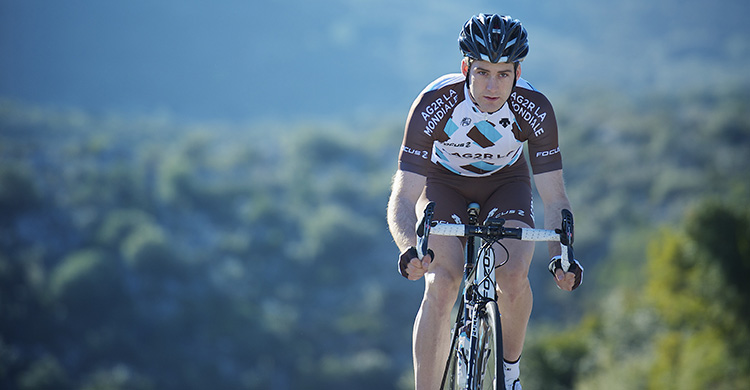
    Hugo Houle - Photo: Kramon

    In a new entry in the Up-and-comer Q&A Series, VeloHuman talked with 23-year-old Hugo Houle, a native of Sainte-Perpétue, Quebec. With the Tour of Alberta underway and the Grand Prix Cycliste de Québec and Grand Prix Cycliste de Montréal around the corner, now is the perfect time to catch up with one of Canada’s fastest-rising young stars.

    In his second year with French team AG2R La Mondiale, Hugo Houle is an all-round talent who made a name for himself at a young age, winning Canada’s Under-23 road race and time trial championships and finishing 4th overall in the U23 World Championship road race. His big results garnered the attention of WorldTour team AG2R La Mondiale, where he signed at the end of 2012 and has been riding since, with a largely classics-oriented race calendar. He recently spoke to VeloHuman about his year so far and his expectations for the rest of the season.

    VH: Hugo, you joined AG2R La Mondiale last year after spending a few years with Pro Continental Squad Spidertech. What was it like at first making that jump from Pro Continental Team up to the WorldTour? How did that transition go compared to your expectations?

    HH: In the end, it was the folding of Spidertech that gave me shot to join AG2R La Mondiale, because at first I had two more years with Spidertech. They folded at the end of 2012, so I found a place at AG2R La Mondiale, and I’m going to ride for them until 2015; I still have one more year on my contract with them. It’s a big step, because when you join a WorldTour Team, the races are longer and they make you ride more races. Sometimes you do two or three stage races in one month, so it takes time to build up to the volume of races. Also, the culture of a French team was new so I had to make some adjustments with that. So those are the big differences. With the volume of racing and the races being longer, you need to train longer, so I had to step up my training.

    VH: You rode plenty of races in your first season, with particular focus on the classics. What would you say were the biggest things that you learned in your first year?

    HH: I learned a lot! The first thing: to get to know a course, like, say, in Belgium . . . it’s hard, so it takes a couple of years to get to know the cobbled sectors and how to approach them and place yourself. So that’s the main thing. Even if you are strong, if you’re not well-placed, you don’t finish in the front, so last year I was more trying to understand the cobbled sectors. Now I’m good and I know them, so it’s easier to be well-placed, with good timing, and know when I have to move up. So that’s one thing. And also learning how to race with the team, the teamwork, and all that stuff. To know a teammate, what they like and what they want me to do, because I’m still pretty young so I have to do a lot of work and understand the races and do the best I can to help them save energy to be there at the end.

    VH: You look to be getting more comfortable in your second season, both in longer races and on the cobbles: last year you started Milano-Sanremo and Paris-Roubaix, but this year you started and finished them. Do you feel that you have continued to develop this year?

    HH: Yeah, for sure. Like I said, in those big races I now have more endurance so I can hold on for longer. So it’s easier to finish a race because I’ve become used to that distance and I know how to be well-placed. . . . So for sure it’s easier in the second year. . . . It’s not easy but I’ve learned a lot and I progress every year so that’s a good thing and the team is happy with the work I do.

    VH: Does AG2R La Mondiale have a specific role that they’re hoping you’ll grow into, maybe for the classics, or as a time trialist, etc.? You have a pretty versatile skillset.

    HH: For now they want me to do the work more than do my own stuff, but I have a good time trial and when I have an opportunity to do good on that, I always go all out. But they always put me in the big races, so to get the wins it’s hard because I’m still young. I do most of the classics, that’s where they want me to do well and support other riders, but they’re not talking about a leadership role, it’s more a support role for now. But I’m more of a punchy rider, so when it’s hills, circuit races like Quebec and Montreal, that’s where I could be good.

    VH: Are there any particular aspects of your skillset that you’ve worked to improve this season?

    HH: Yeah, they want me to lose some weight and be better in the hills. But it also depends on the time of year, because I’m doing classics the beginning of the year, and there we need more power for flat sections . . . and then for the second half of the year you need to be climbing, because I do more stage races, like Wallonie, Pologne, and now Limousin. It’s more hills, so I work more on those and am careful for weight because it makes a huge difference, the ratio of power to weight. . . . And before nationals I was doing more time trials. So I just try to see which races I’m going to do and try to train to be ready for that kind of effort. Let’s say if I do Montreal/Quebec, I try to do three to five minute hills to get ready for that kind of effort when I arrive at the race, so that I’m ready to do that. So all year, it changes.

    VH: Speaking of nationals: you’ve won both the Canadian U23 time trial and road race championships in the past, and you put in good performances this year at the top level with a 2nd place in the ITT and 7th in the road race. Is representing Canada on the international stage important to you?

    HH: Yeah, for sure. It’s important to try to build up the sport more in Canada. The sport is doing well, a lot of people are cycling and getting more interested in it. In Quebec they show more races now, all the classics and the three Grand Tours. Before it was only the Tour de France, so that’s a good development. For me, to be an ambassador for that is important, and to work with national teams and do well at nationals, that’s important for me. Racing in Europe, you bring a lot of experience that you can share with other riders. . . . I was pretty lucky to have Spidertech to make me race in Europe, and I was able to have a good result at the World Championship. That’s what helped me make the jump to a WorldTour team. The hardest thing is to get to a team. After, if you do well, your job and everything else, they keep you on board and you make friends with people. But the hardest part is to make a team in Europe and that’s why it’s hard for Canadians. So if I can help with that, it’s always good, and it’s nice to have more Canadians in the pro field. It’s important to do well and represent the country and get other riders to come to our level and come race with us.

    VH: Do you think a Canadian champs jersey, either for the time trial or the road race, might be a possibility in your future?

    HH: Yeah, that would be a goal. Right now it’s hard in the time trial with Svein Tuft, he’s pretty good at it! But I’m still young and have a couple of years ahead of me, so one day it could happen if I work hard and it’s something I would love to do. To wear the jersey in Europe for a whole year is something special and it gives you good visibility so it’s really important. I hope to do the double, like I did in U23, in the coming years. It would be great, but it’s always hard; Nationals, it’s always a special race because everyone knows the WorldTour guys are stronger and they all look at us to make the race and chase, so it’s always strange, but for time trial, I’ll keep training hard on that and one day maybe I’ll be as strong as Svein Tuft.

    VH: Well he is 37, so you have to think that at some point, maybe . . .

    HH: Yeah. I’m still 23 so I’ve still got a couple of years ahead of me!

    VH: What are your goals for the rest of the season?

    HH: I’d like to put in a result at the Tour of Alberta. It’s a good opportunity for me to race for the national team and I’m going to be a team leader and can do what I want to do, so I hope I can make a result there, and then a great performance in Montréal and Québec would be great for the people there and in front of my family, so I hope for a good result.

    VH: Last question, looking into the future a bit. Is there one particular race that maybe you grew up watching or maybe that you’ve ridden now and enjoyed that stands out as one you’re hoping to target for success in your career?

    HH: I think a lot of the races that I wanted to do, one-day races, I’ve done almost all of them, but now I will try to go for a Grand Tour for next year. Maybe the Giro or the Vuelta, though the Tour de France will be hard. The goal would be to ride the Tour de France before I stop cycling. I was not thinking about it when I started cycling, because it was just for fun, but now in the past few years I’ve seen that become more realistic. So to finish the Tour de France would be a big accomplishment, and racing the Olympics would be good also, so that’s the next step for me and that’s where I want to go.

    Still a few weeks shy of 24, Hugo’s role as a developing rider gaining experience particularly in the one-day races puts him in an interesting position on a team hoping to expand its results beyond the steep mountains, where they have had so much success this year. At the moment, Hugo is focused on landing results in Canada’s collection of major late-summer events, where profiles heavy on the short climbs suit his skillset nicely.

    -Dane Cash

    Photo by Kramon.