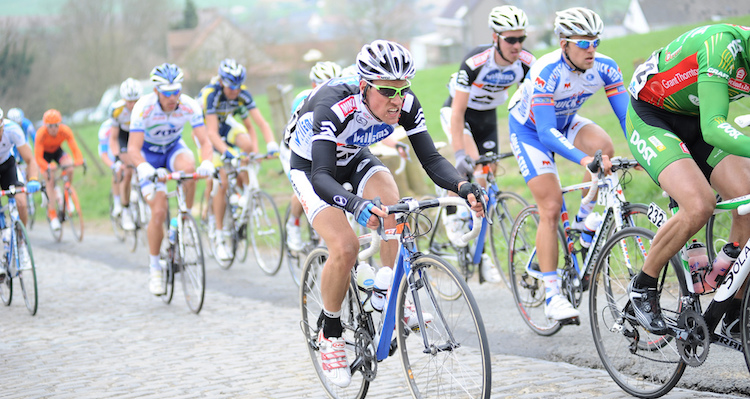
Friday’s E3 Harelbeke is the first of three WorldTour-level cobbled classics in Belgium. Featuring many of the climbs used in the Tour of Flanders, it’s an excellent prep race for De Ronde hopefuls, and it’s also a big prize in its own right. Recent editions have offered plenty of excitement, with late attacks keeping things interesting until the end.
The Route
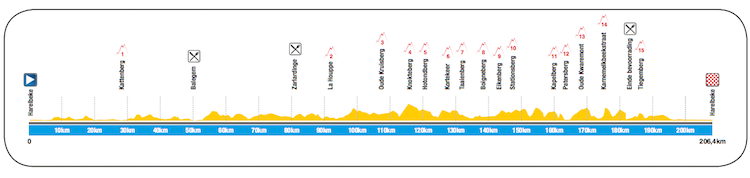
206.4km in total, the race starts and finishes in Harelbeke, Belgium, traversing 15 climbs along the way. The Oude Kwaremont, among the most important climbs in the Tour of Flanders these days, offers a decisive launching pad late on in the stage, followed by the Karnemelkbeekstraat and the Tiegemberg.
From there, however, it’s roughly 20 flattish kilometers to the finish—as such, anyone hoping to get clear on the hellingen will need a big engine to stay away in the finale.
The Contenders
This race has typically come down to a small group of escapees late on in the day, but a strong finishing kick can be very helpful given the less challenging final kilometers.
Greg Van Avermaet has made a living with his late attacks, and he is sprinting at a very high level right now as well. He’s never won a one-day race on the WorldTour, but this seems like the perfect time to start.
2014 winner Peter Sagan also has the right combination of skills to take the win. Motivation may be a question, but if he’s up for it, the world champ should be in the mix.
Fabian Cancellara counts three E3 titles on his palmares. It’s hard to say whether he’s all that interested in this year’s edition of the event (his eyes may be firmly fixed on the upcoming Tour of Flanders), but he’s one of the best solo artists in the sport on this sort of parcours.
Etixx-Quick-Step is loaded with options. Zdenek Stybar and Niki Terpstra are probably the best bets, though Tom Boonen has won this race a whopping five times. Stijn Vandenbergh is yet another card to play.
Alexander Kristoff is one of the few sprinter types who might have a shot at holding on given the profile. This will be a nice test of form ahead of his Tour of Flanders defense.
Sep Vanmarcke should love this parcours, and like Van Avermaet, he’s sprinting better than ever before these days should this come down to a small group. Vanmarcke was garnering plenty of pre-race attention this time last year, but things have quieted down in 2016 after his disappointing 2015 campaign. That could give him a chance to focus more on his goals and less on media appearances.
Outsiders include Lotto-Soudal’s Tiesj Benoot and Jurgen Roelandts, Sky’s Luke Rowe and Ian Stannard, Lars Boom, Bryan Coquard, and Arnaud Démare, fresh off a Milano-Sanremo victory.
VeloHuman Top 10 Race Favorites
Winner: Greg Van Avermaet Podium: Zdenek Stybar, Peter Sagan Other Top Contenders: Fabian Cancellara, Sep Vanmarcke, Niki Terpstra, Alexander Kristoff, Tiesj Benoot, Jurgen Roelandts, Ian Stannard
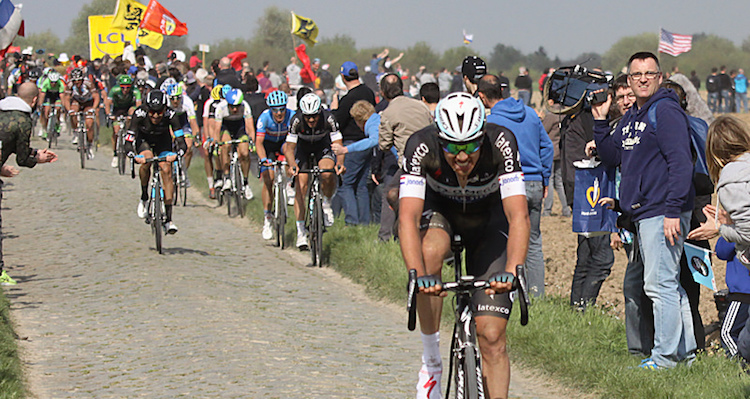
After weeks of exciting racing in Northern Europe, the grand finale of the Cobbled Classics has arrived. Paris-Roubaix gets underway Sunday morning in the small town of Compiegne, about an hour North of Paris by car, and after roughly six hours of racing, 2015 will crown its third Monument winner.
The Route
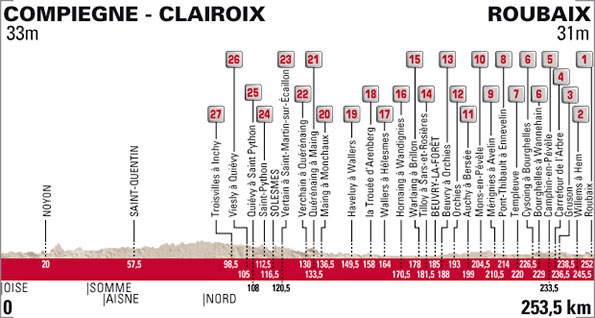
The route of Paris-Roubaix 2015 is much like the route of Paris-Roubaix 2014, with the same few sectors of especially vicious cobbles likely to force selection. Its name notwithstanding, Paris-Roubaix starts in the town of Compiègne, about an hour north of Paris. The first 98 km are, comparatively, quite easy, but then the peloton will hit the first of twenty-seven classified cobbled sections.
The Troisvilles sector that kicks things off is not among the hardest but after nearly 100 km of growing tension there will be a mad dash for position and things are likely to get a bit chippy. Other sectors of only moderate difficulty follow, until the first five-star sector, the Arenberg trench, reached at kilometer 158. 2.4 km of very challenging cobbles, plenty of riders see their Roubaix hopes meet an early demise on the rough terrain. The run-up to the Arenberg is typically where the action starts in earnest in Paris-Roubaix, and after that, it doesn’t stop, with several difficult sectors to follow before another particularly challenging sector, Mons-en-Pévèle. 204.5 km into the race, it is a very long stretch of cobblestones at 3 kilometers, and a place likely to see a few long-range attackers attempting to get clear.
After a few more cobbled sectors comes the final five-star challenge, the Carrefour de l’Arbre, 2.1 km of particularly nasty cobbles. As the pack, or what’s left of it, will hit this section with only 17 kilometers remaining in the race, it’s the perfect spot to launch an attack. Those who survive the Carrefour de l’Arbre will only face three more comparatively easy cobbled sections before the race finishes with 800 meters in the Roubaix velodrome.
“Anything can happen” is a mantra often used and reused to describe bike races, but nowhere else does it ring true quite like it does here. Positioning is critical, with the peloton stretching out and tightening up again constantly, and with attacks flying at all times. On this difficult terrain, mechanical problems are always a major concern, and in so many of the difficult sections along the road to Roubaix, help can be a long time coming if a rider needs a new wheel. Talking to VeloHuman at the team presentation, Heinrich Haussler noted: “The whole race, you get a flat tire in the wrong spot, you might as well just jump in the car.”
The Contenders
Few races reward pure strength the way Paris-Roubaix does, with its practically pancake-flat parcours and its bruising cobbled sectors that favor those riders with a bit of weight to keep them from bouncing around on the difficult road surface. Simply put, it’s a race that strongly favors the powerful cobbled specialists, especially those with good bike handling skills.
Etixx-QuickStep is bursting at the seams with Classics specialists, and yet they still have not come away with a top-level win on the cobbles this year. This is their last chance, but they will have a great opportunity to make things right here. Niki Terpstra is the defending champion, and the Dutch 30-year-old has shown strong form throughout the spring races in 2015. His 2nd in the Tour of Flanders proved his excellent fitness right now, and given his elite soloing talent, he makes for a great card to play for EQS here. Zdenek Stybar, though, might be the prime pick for the Belgian superteam. His combination of bike handling skills, endurance, and a nice finishing kick are perfect for this race, and he’s come close here in the past. The tooth problems that plagued him in Flanders have been fixed, and he’s shown great form this season. Stijn Vandenbergh is another very strong option for the team. QuickStep can send one rider after another off the front here and that puts them in prime position to finally come away with a win in the top Classics.
Alexander Kristoff comes in as the big name on everyone’s minds after his stunning Flanders win. Roubaix has not been a great race for him in the past but with the form he has shown lately and his incredible skillset, there’s no reason why this shouldn’t be another opportunity for him to win a big event. However, it won’t be easy for Katusha to corral what are likely to be constant attacks from Kristoff’s rivals (even with a very strong Luca Paolini on the team), and favorite status won’t help Kristoff either. Knowing how fast he will be in the velodrome, every other rival in this race will look to leave Kristoff behind at any opportunity, and that will make things pretty difficult for the Norwegian. He’s obviously a very dangerous rider, but pulling off a Flanders-Roubaix double would be an enormous feat.
John Degenkolb is the other “sprinter” near the top of the favorites discussion right now. Runner-up in 2014, he’s one of the few who might be able to beat Kristoff in a sprint, and he mentioned his and his team’s very high levels of confidence multiple times at the team presentation in Compiégne, saying that he has no fear if the race comes down to a sprint battle with Kristoff in the velodrome. He’s obviously strong this year after winning Milano-Sanremo, but his results in the other Cobbled Classics haven’t quite been as expected. Still, he’s already shown how well he can ride in this race, and even though he just won a Monument Classic last month, Kristoff’s recent success has taken all of the spotlight perhaps allowing him to enjoy a bit of under-the-radar status.
Bradley Wiggins rode to 9th here last year with practically no cobbled racing prep, and this year he’s got his sights set completely on a Roubaix win to close out his Team Sky career. In a race where time trialists often thrive, Wiggins has the requisite power for a big result. The question is whether he has the handling skills and the Classics savvy—many ridres spend years gaining experience here, gradually chipping away at results. Wiggins has been incredibly successful in his career when he has put his mind to even a very difficult goal, but this is asking a lot. He also doesn’t have much of a finishing kick, meaning that he’ll basically need to drop all of his rivals. He has a shot, but it won’t be easy. Geraint Thomas, on blazing form this Classics season, has done well here in the past and should do well again. Ian Stannard and Luke Rowe are nice alternatives for Sky.
Sep Vanmarcke was the runner-up in 2013, missing out on the victory because he couldn’t outsprint Fabian Cancellara in the velodrome. To me, he seems much quicker at the line these days, but he’s been lacking something in the Cobbled Classics this year. He can handle the cobbles more adeptly than almost anyone in the sport and that makes him deadly here but, simply put, he’ll need to better here than he was in Flanders.
Greg Van Avermaet has not had the success here that he’s had in other cobbled races but his speedy finishing kick and excellent team (with strong Daniel Oss as a second) makes him dangerous. Peter Sagan only notched his first Top 10 here last year, but his Classics prep this season has left him looking more powerful and perhaps better suited to this race than he was in the past. More under-the-radar than usual after weeks of missing out on big results, he could benefit from a rare lack of eyes pointed in his direction.
Lotto Soudal has a three-pronged attack with Jürgen Roelandts, Tiesj Benoot, and the surprising André Greipel. Similarly, IAM Cycling has the trio of Sylvain Chavanel, Heinrich Haussler, and the surprising Martin Elmiger—Haussler told VH that Elmiger said prior to Flanders that he is in the form of his life, and he proved it at the Ronde. That could come in handy in this race where having multiple strong teammates in crucial. Astana’s Lars Boom has looked strong this year and this race suits his cyclocross background and time trialing prowess. Cannondale’s Sebastian Langeveld, Lampre’s Filippo Pozzato, FDJ’s Arnaud Démare, Trek’s Stijn Devolder, and OGE’s Jens Keukeleire are on the list of outsiders with a shot in Paris-Roubaix.
VeloHuman Top 10 Favorites
Winner: Zdenek Stybar Podium: Bradley Wiggins, Alexander Kristoff Other Top Contenders: Niki Terpstra, Sep Vanmarcke, Peter Sagan, John Degenkolb, Geraint Thomas, Greg Van Avermaet, Stijn Vandenbergh
Be sure to follow @VeloHuman on Twitter for more analysis (from the roadside) of Paris-Roubaix 2015.
Episode 8: Paris-Roubaix 2015 Pre-race Show The Recon Ride gears up for Paris-Roubaix, the “Hell of the North,” taking a look at the history of the race, this year’s parcours, and the many riders who could make things interesting on Sunday.
[powerpress]
Dane Cash of VeloHuman and Cosmo Catalano of Cyclocosm cover the many storylines of Paris-Roubaix in the latest episode of the Recon Ride, which also features interview audio from Bradley Wiggins, Geraint Thomas, and Tyler Farrar.
With E3 and Gent-Wevelgem in the books, the Tour of Flanders is almost here. Sans Fabian Cancellara (and Tom Boonen, though he would not have enjoyed the same level of favorite status as Cancellara even if he were here) the 2015 Ronde looks especially open, which should make for quite a race.
The Route
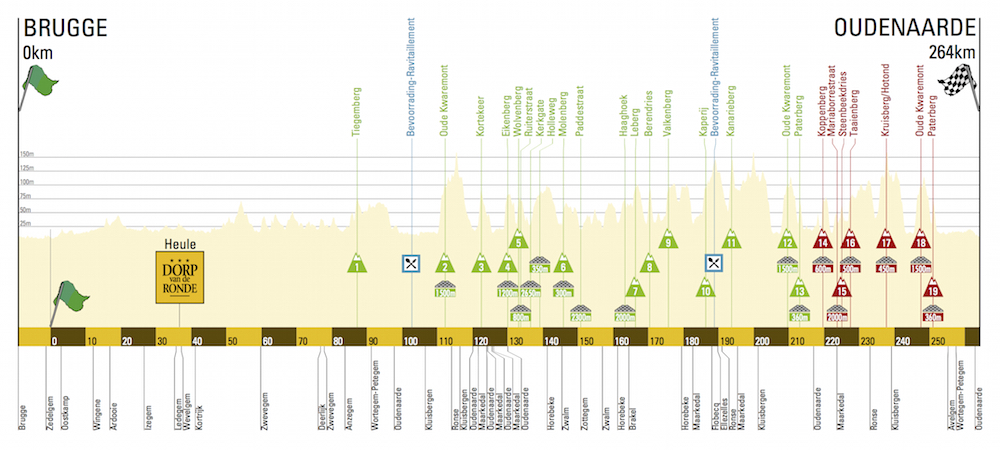
At 264 kilometers, the Tour of Flanders is a long one, and the arduous journey gets more and more difficult as the day wears on. The peloton will set out from scenic Bruges and head south towards the cobbled climbs that this race has made so famous. The route contains seventeen officially classified climbs this year, many of them repeat trips up the same ascents, as the course starts looping into itself and covering the same ground again for multiple visits to these famous hellingen.
The final string of climbs that runs from roughly kilometer 219 to kilometer 251 are the likely battleground where this race will play out. Over the top of brutal challenges like the Koppenberg, after already having been up and over so many of these cobbles all day, the peloton is likely to break apart. And if things aren’t already shattered to pieces by the time the peloton hits the final climbs of the Oude Kwaremont and the Paterberg, the attacks are certain to fly on the long drag of the former and the vicious steepness of the latter.
After the descent from the Paterberg, it’s a mostly straight run to the line, meaning that anyone hoping to whittle down the lead group is going to look to act before the final few kilometers.
The Contenders
It’s a wide open field for the Tour of Flanders this season, with four or five riders enjoying roughly equivalent favorite status and a host of others nipping at their heels. LottoNL’s Sep Vanmarcke is certainly among the top contenders. The Belgian cobbled specialist was 3rd here in 2014 and despite never quite coming away with that big win he’s been searching for in his career, he’s displayed the grit, the bike handling, the climbing chops, and the explosive required to make a bid for glory here. The results in the run-up races of E3 and Gent-Wevelgem haven’t quite been where he would have hoped, with others appearing stronger out on the road in both events, but this is the real prize for Vanmarcke and he seems like an excellent rider to watch as the final Kwaremont-Paterberg double approaches.
Similarly versatile is Zdenek Stybar of Etixx-QuickStep, who happens to also have a true powerhouse of talent supporting him team-wise. Stybar looks to be the best of the EQS riders for this race because, among the Classics stars on this QuickStep roster, he best combines climbing legs and a powerful finishing kick. But Niki Terpstra and especially Stijn Vandenbergh, 4th here last year and extremely savvy racing these roads, give the team options. Expect to see attacks flying from all sides late in this race.
Team Sky also brings firepower with their many talented stars on the roster, with Geraint Thomas leading the way. Among the strongest climbers in this Ronde, Thomas is on terrific form right now as evidenced by his win at E3 and his follow-up 3rd place at Gent-Wevelgem. Being able to rely on Ian Stannard and Bradley Wiggins will help. With a pair of Top 10s here already on his resume and a recent win in a race that incorporated many of the same climbs, Thomas has the experience necessary to take on this race as a top favorite and it would be a big surprise not to see him try something on one of the final climbs. The question is whether he’ll be able to shed his top rivals who might give him a run for his money in a small sprint.
One rider certain to be hoping that this race ends with a small group sprinting for the win is Tinkoff-Saxo’s Peter Sagan. Flying more under the radar right now than maybe he was expecting to be due to a general lack of results this year, Sagan might have a bit of an advantage that he doesn’t usually enjoy; so often, his plans are foiled immediately because all of his rivals are eying him at all times. This year, with the focus on other riders, Sagan may have a chance to make something happen the way he wants to. The form hasn’t been too bad, and this is a major objective, so he can’t be ignored even though he hasn’t been lighting it up coming into the Ronde this year.
After a crash at E3, where his skillset would have made him one of the likely top contenders at the business end of the race, Greg Van Avermaet might be flying under the radar a bit as well. But he seems to have recovered from his fall and he has been in excellent shape so far this year. 2nd here last year and a more capable sprinter than most, he may be able to look for the right wheels to follow this year rather than launching one of his trademark “almost-good-enough” attacks. Daniel Oss makes for a terrific teammate.
Speaking of terrific teammates, Alexander Kristoff will be in good hands with Luca Paolini at his side as well. In Katusha’s pre-race press conference, Paolini was very clear in his support of Kristoff, and that solidarity will be a great boon for the Norwegian. It won’t be easy to keep this together for a sprint (which is what Kristoff will need to win here) but Kristoff is tougher than most and with Paolini to help close down attacks if necessary, he has a fighting chance. So too does John Degenkolb, who may not have much of a history in this race but who has shown that he can climb well (winning plenty of hilly, intermediate-stage type races in the past) and ride cobbles well (winning Gent-Wevelgem in 2014 and taking 2nd in Paris-Roubaix that year) which are the necessary requirements to hanging on here. Given the difficult nature of this race and the wide open field likely to see constant attacks, I think the sprinters will have a very hard time here, but Kristoff and Degenkolb are the two obvious riders to watch in that potential scenario.
Jürgen Roelandts, who proved his great form with a bold solo move in Gent-Wevelgem, also packs a quick finish and that makes him dangerous here, with the surprising Jens Debusschere as an alternative. Stijn Devolder will head up Trek’s Flanders campaign in the absence of Fabian Cancellara. Cannondale-Garmin’s Sebastian Langeveld was a late addition to the startlist, recovering from a recent crash; he’s a great talent in unknown shape right now. Astana’s Lars Boom, OGE’s Jens Keukeleire, MTN-Qhubeka’s Gerald Ciolek, and a stable of young Topsport Vlaanderen talents that includes Jelle Wallays and Edward Theuns are among the outsiders who will hope to contend.
VeloHuman Top 10 Favorites
Winner: Sep Vanmarcke Podium: Zdenek Stybar, Geraint Thomas Other Top Contenders: Greg Van Avermaet, Peter Sagan, Stijn Vandenbergh, Jürgen Roelandts, Alexander Kristoff, John Degenkolb, Niki Terpstra
Be sure to follow @VeloHuman on Twitter for more roadside analysis during the race. Also, don’t miss the Recon Ride podcast, with pre-race insight from Sep Vanmarcke, Geraint Thomas, and Patrick Lefevere.
When the gap between a dwindling E3 Harelbeke peloton and Peter Sagan, Geraint Thomas, and Zdenek Stybar had gone out to around one minute as the riders approached the finish line, it became clear that a victory in first Belgian Classic of the 2015 WorldTour would soon grace the palmares of one of the three riders up the road. One of them, Peter Sagan, had already won the race the year prior by outsprinting a small group of companions at the line, a group that included another member of the trio now fighting for this year’s honors, Geraint Thomas.
Given Sagan’s impressive array of abilities, it was only natural for the third member of the trio to be focusing on the Slovakian defending champion in the waning moments of this year’s race over a rider he’d beaten here last year. But Zdenek Stybar’s decision to mark Sagan at the 2015 E3 Harelbeke did not pay off. Geraint Thomas launched a powerful attack in the last few kilometers of the race, and Stybar immediately got on Sagan’s wheel thinking the younger rider would give chase—but Sagan was cooked, and he faded immediately, leaving Stybar to launch an unsuccessful attempt to bridge a gap that had now grown too far.
“I expected that Sagan would be a bit stronger, but he wasn’t,” Zdenek Stybar said after the race.
Few would fault Stybar for such an expectation. Unfortunately for the former world cyclocross champion, the tremendous strength of Thomas left no room for error in the E3 finale.
“He was really, really impressive the last four kilometers. I knew that if he went, I’d have to jump in his wheel but I thought that Sagan would do the same, and he didn’t have the legs anymore.”
Sagan was not able to offer much of an explanation as to his sudden loss of power; in a post-race interview outside the Tinkoff-Saxo bus, he seemed at a loss for words when asked what had transpired, saying that something had “turned off.”
“I felt good on Kwaremont but after, it was still a far way to go to the finish,” he said. Somewhere in between that difficult climb and the final 4 kilometers, Sagan ran out of gas. However it happened, and whenever he realized that he was scraping the bottom of the barrel, his surprise power failure was a pivotal moment in the race.
After narrowly missing out on E3, Stybar and Sagan are already looking to next week’s Ronde van Vlaanderen, where the absence of one of two would-be top contenders (Fabian Cancellara and Tom Boonen) will certainly alter the narrative of the race. But when asked about what the upcoming Tour of Flanders might be like with its now somewhat reduced cast of star protagonists, both Stybar and Sagan were quick to point out there was plenty of competition still out there.
“There are still enough guys who want to win the race,” said Stybar.
“There’s also a lot of other riders who are really strong and we’ll have to see in the race,” said Sagan.
In a day full of surprises, that agreement in the opinions of the two riders should not be much of a surprise: they both had front row seats to the show put on by one of strongest of those other riders today, one who will be hungry for more success in next week’s Ronde.
The WorldTour returns to the land of the Spring Classics for one week in August, and that week is upon us: the 2014 Eneco Tour is here. A seven-day ride through Belgium and the Netherlands, the Eneco Tour was for many years a race decided almost exclusively by one day of time trialing, but recent years have seen more and more challenges added to the parcours to guarantee that the battle for General Classification rages across the whole week. With classics specialists having a chance to show their strength one last time on the WorldTour calendar and several riders nearing peak form for the upcoming Vuelta, competition tends to be fierce, and the 2014 edition should continue the trend.
The Route
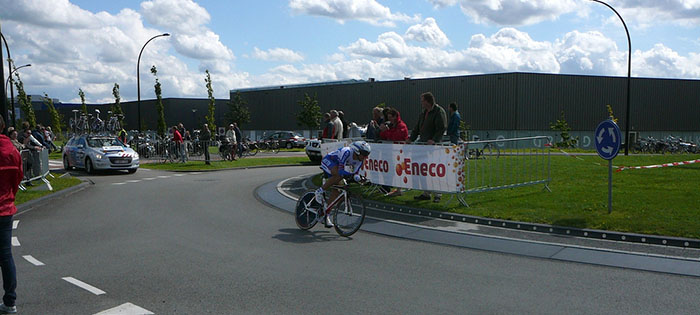
The first two stages take place on mostly flat profiles that aren’t likely to shake up the General Classification. Stage 3 is a short (9.6 km) time trial that certainly will; however, this is not the Eneco Tour of old. Strength against the clock will always be important in a weeklong race with a chrono stage and no real mountains, but there are enough challenges in this year’s Eneco Tour to make the fight for overall victory a much more drawn-out affair.
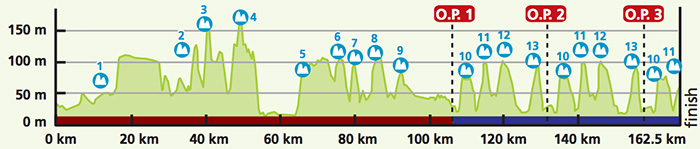
Stage 5: Geraardsbergen › Geraardsbergen (162.5 km) – It isn’t as long as De Ronde, but the Eneco Tour’s fifth stage visits many of the same challenging landmarks.
Stage 4 takes place in the same region as the spring’s Gent-Wevelgmen, traversing some of the same roads. Fittingly, the next stage will put the peloton through a number of difficult tests made famous by the Tour of Flanders. With two full climbs up the legendary Muur van Geraardsbergen before finishing there after 160 kilometers (with visits to other familiar Ronde climbs, like the Kruisberg and Bosberg, along the way), Stage 5 is a very difficult day that is certain to play a major role in the General Classification of the Eneco Tour.
Stage 6 offers no respite: with nonstop steep climbs all the way from start to finish, including multiple trips up and over La Redoute, one of the toughest challenges of April’s Liege-Bastogne-Liege, it will bring the punchy climbers to the fore. The seventh and final stage of the race is yet another day of nonstop climbing, as the Eneco Tour culminates with a visit to Amstel Gold Race country and many of the same short, steep climbs (though not the Cauberg) that feature in that event. While the weekend of familiar challenges won’t present the riders with any single stages nearing the length of the grueling spring classics, several consecutive very difficult days will guarantee some serious selection on the GC leaderboard.
The General Classification Contenders
Zdenek Stybar returns to the race as the defending champion, with the always impressive Omega Pharma-Quick Step squad backing his campaign for a repeat victory. Strong in the time trial, capable on the shorter climbs, and even handy in a sprint for bonus seconds, Stybar has the versatile toolset to compete, though this edition of the race is even harder than last year’s and uphill ability is at an even higher premium. However, the Czech star showed his climbing mettle in the 2013 Eneco Tour, putting in his best work on the very hilly stages, and he put his climbing form on display as recently as last weekend when he landed 10th the Clasica de San Sebastian. Still, while he put in Top 10 performances in both Milano-Sanremo and Paris-Roubaix in the spring, Stybar has not landed as many big results so far this season as might have been expected, and these climbs will really put him to the test. In short, it will be a challenge holding on to his title against some very dangerous rivals. OPQS does have plenty of strong, versatile lieutenants to put the pressure on from all angles, with the likes of Niki Terpstra and Matteo Trentin (among others) in attendance and capable of getting in to the mix on all kinds of different terrain.
2013 runner-up Tom Dumoulin is an elite time trialist who may lament the fact that the chrono stage is 3.6 kilometers shorter in this year’s race, but he’s also a strong climber who should appreciate the climbing challenges that await. 2nd to Tony Martin in Stage 20 ITT in the 2014 Tour de France, he’s on sharp form this summer. He’s also shown a bit more explosiveness this season, which will be a major asset here. His skillset puts him in an excellent position to better his result from last year. Hilly parcours specialist Simon Geschke will be an excellent second.
Sky’s Geraint Thomas has all the skills necessary to fight for the top step on the podium. He has not had much of a break from racing since winning the Bayern Rundfahrt at the beginning of June, but it’s hard to draw up a better parcours for a rider who combines cobblestone prowess with good climbing legs and a particular affinity for short time trials. If he can hold on to top form all the way through the race, he will be very hard to beat. Teammate Edvald Boasson Hagen is actually a two-time winner of the Eneco Tour, but the recent increased focus on uphill tests do not favor his toolset as much as past editions did, and he may be hunting stages and playing lieutenant in this year’s race. Ian Stannard has finally returned from his long break following a serious injury suffered in the spring, and Sky will be glad to see him back on the bike in the WorldTour’s return to the Low Countries.
BMC’s Philippe Gilbert was running well in the 2013 edition before a crash forced him to abandon the race. He’s been dealing with illness recently but his top-notch performance in the RideLondon Classic suggests that he’s back to full strength and ready to contest the 2014 edition of this race. He excels in the shorter time trials, and with the Ardennes-style final two stages, I like his chances to stand on the overall podium. As is standard operating procedure for such a powerhouse team, BMC has plenty of other options: Greg Van Avermaet showed excellent form with an 8th place finish in a very difficult Clasica de San Sebastian, and the sort of climbing chops required to land a good result in that race will be crucial for the last few stages of the Eneco Tour. New acquisition Rohan Dennis, a good climber with an elite time trial, could also try to get into the mix, and Steve Cummings, great in the short chronos, is yet another option, having a strong season so far.
Trek’s Fabian Cancellara is on the startlist after cutting his Tour de France campaign short to prepare for later season goals. Despite its classics-season feel, this has never been a race he’s targeted, and it’s hard to say where it ranks on his list of 2014 goals. As the sport’s most dominant classics rider right now, Cancellara will obviously be among the top favorites if he has the form and drive to hunt for the overall victory. It’s hard to see past him whenever the Muur van Geraardsbergen is involved. His classics prowess hasn’t extended into Ardennes results in his career, but he can usually handle some short climbs, and he’s obviously a top candidate in the time trial stage. Stijn Devolder is always a dangerous teammate.
Belkin’s Lars Boom has had a great deal of success in the Eneco Tour in the past, winning in 2012, but the parcours is no longer one that suits his style quite as well, and the last two stages will be a major challenge. Bauke Mollema may be the GC rider of choice here, given the back-to-back Ardennes-like stages that close out the race. 2nd in San Sebastian, he’s clearly carried some strong form out of the disappointing Tour de France, and his underrated sprinting ability will be a major asset in a race where bonus seconds often play a significant role in the GC results. Sep Vanmarcke is also on the startlist; the parcours is probably a bit bumpy for him, but he proved in the Tour de France that he doesn’t mind a few climbs. Garmin-Sharp has Ramunas Navardauskas and Sebastian Langeveld, the former very strong in a short time trial and on up-and-down profiles, the latter a proven classics talent who was 3rd in this race back in 2009. Lotto Belisol’s two-pronged attack of Jelle Vanendert and Tim Wellens will love the look of the final two stages and could surprise some people. Bjorn Leukemans of Wanty-Groupe Gobert has a knack for landing good results on this sort of terrain. OGE’s Jens Keukeleire is a rising classics talent who could be in the mix, while teammate Michael Hepburn will likely spend at least a little time near the top of the GC leaderboard given the early position of the time trial in the race. Peter Sagan initially seemed set to participate (and contend) in this race, but he is no longer on Cannondale’s roster to make the start; Moreno Moser looks to be the team’s main hope on this parcours.
The Stagehunters
In a race without any real mountains, so many riders who spend most of their stage-racing days hunting stage victories have a rare real shot at the General Classification (and are therefore among the many aforementioned potential overall protagonists), but there are still a few sprinting heavyweights and time trialing specialists yet to be mentioned who will be searching for individual wins in the Eneco Tour.
The list of strong sprinters includes Lotto Belisol’s Andre Greipel, FDJ’s Nacer Bouhanni, Giant-Shimano’s Luka Mezgec, Lampre-Merida’s Sacha Modolo, and Trek’s Giacomo Nizzolo as likely contenders for a bunch gallop. Tyler Farrar, who did not look great in the Tour of Poland but who tends perform well in the Low Countries, Matti Breschel, OGE’s Leigh Howard and Matt Goss, Movistar’s JJ Rojas and JJ Lobato, Barry Markus, Andrea Guardini, Bryan Coquard, and Tom Boonen could also feature in the sprints.
Plenty of strong chrono riders were already named as possible GC contenders, but watch out for Alex Dowsett, Patrick Gretsch, Jesse Sergeant, and David Millar in the ITT as well.
VeloHuman Top 10 GC Favorites
Winner: Tom Dumoulin Podium: Zdenek Stybar, Philippe Gilbert Other Top Contenders: Geraint Thomas, Greg Van Avermaet, Fabian Cancellara, Bauke Mollema, Ramunas Navardauskas, Rohan Dennis, Jelle Vandendert
As usual, I’ll be tweeting plenty of live analysis during the race, so follow @VeloHuman on Twitter to stay connected. Also, be sure to come back soon for more previews, interviews, and analysis: the Vuelta a España is right around the corner!